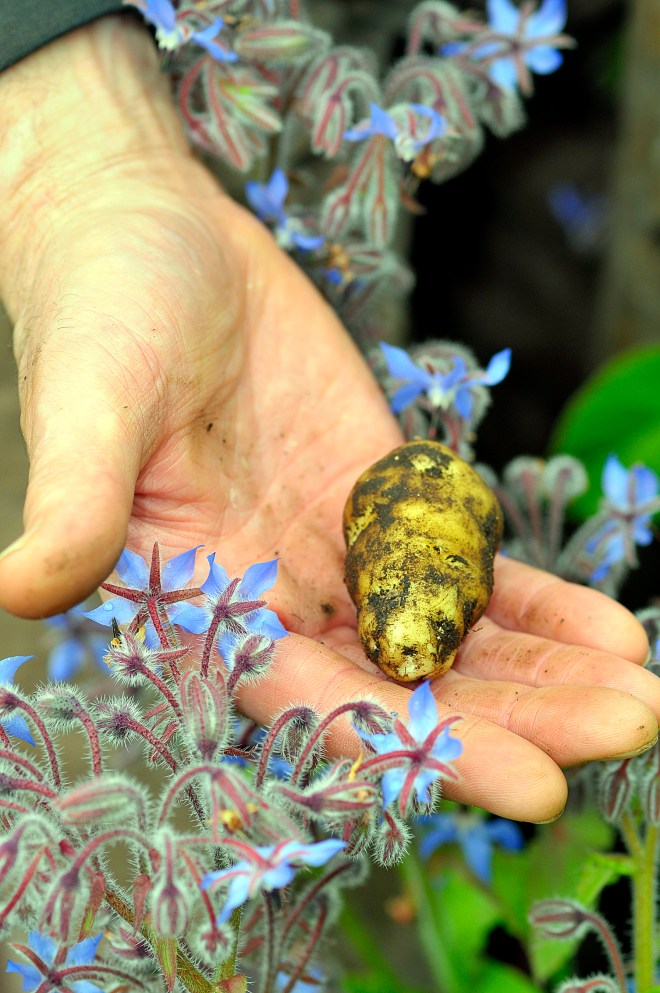
Tlingít potato garden being readied for community of Sitka

(Photo courtesy of Klas Stolpe/Juneau Empire) Bill Ehlers, assistant gardener at the Jensen-Olson Arboretum in Juneau, holds a Tlingít potato next to some of the potato plant’s flowers.

The U.S. Forest Service-Sitka Ranger District and Sitka Tribe of Alaska have joined forces to help create an educational opportunity and traditional food source for community members.

The two groups will show how to grow Tlingít potatoes, and tell about their biology, history and cultural aspects.

The Sitka Ranger District is providing a plot of land to serve as the shared potato garden. The Sitka Tribe’s Traditional Foods Program and the gardening class from Pacific High School will assist on the project, but community involvement also is needed.

Attendees should bring boots, gardening gloves and shovels, and (if possible) five-gallon buckets of kelp to incorporate into the soil. The first work day and educational opportunity is scheduled for 12:30 p.m. on Friday, April 14, at the Sitka Ranger District office, 2108 Halibut Point Road.

Organizers said that members of the community who help tend the shared garden may receive more than gratitude as their reward.

“We hope to share the harvest among those helping out, and possibly share potatoes through the Sitka Tribe’s Traditional Foods Program and Social Services,” Sitka District Ranger Perry Edwards said. “This project will teach people how to grow and sustain a traditional food, while supporting the growing need for food security among Sitka families.”

K’únts’ — sometimes called Maria’s Potatoes — have been present in Tlingít gardens for more than 200 years. The potatoes originate from Mexico or Chile and were a trade item in Southeast Alaska in the early 1800s.

For more information, contact Michelle Putz at 747-2708 or mputz@fs.fed.us.

• Natural History Seminar Series to feature presentation on Mushrooms of Alaska’s Southern Coasts

mohatth

The next topic of the Natural History Seminar Series will feature Kate Mohatt presenting “Mushrooms of Alaska’s Southern Coasts.” The presentation is at 7:30 p.m. on Friday Sept. 19, in Room 229 at the University of Alaska Southeast Sitka Campus.

Kate Mohatt is an ecologist for the Chugach National Forest who has been studying fungi in Montana and Alaska for several years. She has been a key organizer in the Girdwood Fungus Fair and a frequent speaker at the Tongass Rainforest Festival in Petersburg. Mohatt is the lead author of the 2013 publication, Mushrooms of the National Forests in Alaska (available at the USDA Forest Service, Sitka Ranger District office in Sitka, 204 Siginaka Way).

Mohatt will talk about the importance of fungi in forests, and about some common and interesting fungi found in Alaska. She also will lead a walk focused on forest fungi on Saturday, Sept. 20, in Sitka, with details shared at the Friday night seminar.

The seminar series is supported by a grant from the Sitka Permanent Charitable Trust to the Sitka Sound Science Center, and by the University of Alaska Southeast Sitka Campus with support from the USDA Forest Service. If you have questions, please contact Kitty LaBounty at 747-9432.

• Tongass National Forest, Sitka Ranger District, clarifies rules for berry-picking and gathering on forest lands

Salmonberries await picking near the entrance to Sitka National Historical Park

Salmonberries await picking near the entrance to Sitka National Historical Park

The Tongass National Forest, Sitka Ranger District, is reminding people that any berry-picking or other gathering for commercial use on national forest lands requires a special-use permit. The rules clarification comes after a sign recently was posted outside a grocery store offering payment for salmonberries. Personal-use berry-picking and other gathering is allowed, so long as no money changes hands.

Please note, these are not new regulations and they have been on the books for many years. But the USDA Forest Service wants to remind people about them because many Sitka residents don’t know them.

“Here is an interim policy for special forest products attached (see link below), but it is long and cumbersome for most to read,” District Ranger Perry Edwards wrote. “The short version is you can collect berries, mushrooms, etc., for personal use in a national forest. But once you sell them it becomes a commercial use and a person needs to have a special forest product permit. So far, no one has officially gone through the process to get one from the Sitka Ranger District, as it does take some time for the USDA Forest Service to do the analysis and the public process.”

The interim rules and regulations run several pages, but the two paragraphs below help clarify Special Forest Products and commercial uses.

  • Special Forest Products – Special forest products (SFPs) are defined as products derived from non-timber biological resources that are used for subsistence, personal, spiritual, educational, commercial, and scientific use. SFP resources include, but are not limited to: mushrooms, boughs, Christmas trees, bark, ferns, moss, burls, berries, cones, conks, herbs, roots, and wildflowers. Also included are cuttings (such as of willow used for restoration) and transplants (as for landscaping purposes). SFP resources exclude saw-timber, pulpwood, cull logs, small round-wood, house logs, utility poles, minerals, animals, animal parts, rocks, water and soil.
  • Commercial Uses — SFP resources that are sold, processed for sale, or used in business operations are considered commercial use. Research collections for bioprospecting or other purposes by entities that do not have a cooperative agreement with the Forest Service or other federal government agency or department are considered commercial use and are subject to the same permitting procedures and requirements as other commercial uses. Commercial use on the Tongass National Forest is subject to the standards and guidelines in the Tongass Forest Plan, national and regional SFP policies, and the following management guidelines. In all cases, commercial use should not displace subsistence, personal or other non-commercial uses.

The Alaska Division of Parks and Outdoor Recreation has similar rules for harvesting from Alaska State Parks, and earlier this summer began requiring a special permit for gathering seaweed at the Halibut Point Recreation Area in Sitka.

• Interim Special Forest Products Policy for Tongass National Forest, Sitka Ranger District