• Local food news from Juneau: Virus infects Tlingít potato crop; Glory Hole to get community garden

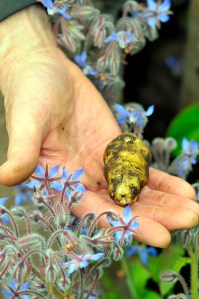
(Photo courtesy of Klas Stolpe/Juneau Empire) Bill Ehlers, assistant gardener at the Jensen-Olson Arboretum in Juneau, holds a Tlingít potato next to some borage plant flowers.

(Photo courtesy of Klas Stolpe/Juneau Empire) Bill Ehlers, assistant gardener at the Jensen-Olson Arboretum in Juneau, holds a Tlingít potato next to some borage plant flowers.

Click here to read an article in Tuesday’s Juneau Empire about a virus that has infected the crop of Tlingít potatoes at Juneau’s Jensen-Olson Arboretum. According to the article, the potatoes still are safe to eat, despite the virus. But the virus means they won’t be used as seed potatoes for other community gardens in Southeast Alaska, as previously planned. Officials from the University of Fairbanks Cooperative Extension Service office in Juneau are doing what they can to remove the virus so they can guarantee clean seed, but it might take a few years.

Click here to read an article from Monday’s Juneau Empire about plans to build a community garden at the Glory Hole homeless shelter and soup kitchen in downtown Juneau. The community garden is expected to provide fresh vegetables and fruit for the soup kitchen, as well as giving Glory Hole patrons a project they can work on at the shelter. Plans are to put garden beds on the roof and terraced garden beds on the hill behind the Glory Hole’s back door.

• Juneau Empire spotlights harvest of Tlingít potatoes

(Photo courtesy of Klas Stolpe/Juneau Empire) Bill Ehlers, assistant gardener at the Jensen-Olson Arboretum in Juneau, holds a Tlingít potato next to some borage plant flowers.

(Photo courtesy of Klas Stolpe/Juneau Empire) Bill Ehlers, assistant gardener at the Jensen-Olson Arboretum in Juneau, holds a Tlingít potato next to some borage plant flowers.

The Juneau Empire on Monday (click here) ran a nice photo package of a sustainable harvest camp at the Jensen-Olson Arboretum in Juneau that was hosted by the 4-H program run by UAF Cooperative Extension Service and the Alaska Department of Fish & Game. The photos feature several children harvesting “Maria’s Potatoes,” a type of Tlingít potato grown from seed potatoes that originally came from deceased Tlingít elder Maria Miller’s garden in Klukwan. These fingerling potatoes do well in Southeast Alaska’s rainy climate and have been around for hundreds of years. The story link above has a link to an audio slideshow by Juneau Empire photographer Michael Penn. The slideshow is worth watching.

By the way, click here to read more about the Tlingít potato posted on the Sitka Local Foods Network site about three weeks ago. Elizabeth Kunibe did want to clarify that in the link to the Chilkat Valley News story she is misquoted so it appears that she “discovered” the Ozette potato (another Native American variety). She said she is not the discoverer.

Kunibe also said the Tlingít potatoes can be sold, but for food only and not for seed. Some of them contain potato viruses, transmitted by vectors, that can affect the soil and other varieties of potatoes. She said when people buy seed potatoes, they need to make sure they have “clean seed” or “virus-free seed” before they plant. She said potato viruses do not affect humans who eat the potatoes, but we need to use clean seed to keep the viruses from destroying crops (like what happened in the Irish potato famine). She said the UAF Cooperative Extension Service, which has offices in Sitka and Juneau, may have more information on how to find virus-free seed potatoes.

Kunibe, who made a presentation on Tlingít potatoes and traditional gardening in Sitka last year, is hoping to schedule another trip to Sitka for a future presentation. Kunibe also wanted share this link from the USDA Agricultural Research Service about newly discovered nutritional benefits of potatoes, especially in regards to phytochemicals and cancer prevention.

• Tlingít potato makes a comeback in Juneau

(Photo courtesy of Klas Stolpe/Juneau Empire) Bill Ehlers, assistant gardener at the Jensen-Olson Arboretum in Juneau, holds a Tlingít potato next to some borage plant flowers.

There was an interesting article in Wednesday’s edition of the Juneau Empire about the revival of a Tlingít potato that was a staple in Tlingít gardens for hundreds of years (Click here to read the Juneau Empire article by Kimberly Marquis).

Tlingít and Haida gardeners grew their own vegetables more than 200 years ago, and potatoes were one of their most important crops. In an article in the Winter 2008/2009 newsletter for Alaska EPSCoR (Experimental Program to Stimulate Competitive Research), University of Alaska Southeast social science/anthropology student Elizabeth Kunibe said residents of many Southeast Alaska villages planted gardens of root vegetables — such as potatoes, rutabagas and parsnips — on neighboring islands in the spring while they headed to their fish camps. They harvested them when they returned home in the fall (Click here to read the article on Pages 4-5).

Kunibe said many of these gardens disappeared over the past century, especially as the U.S. Forest Service parceled out some islands for homesteads or fox farms. She said Tlingíts in Sitka lost their island gardens in World War II when the government forbade private water travel. The increasing availability of imported food and other disruptions, such as tuberculosis outbreaks, also sped up the demise of the individual and community gardens found in many Native villages. Kunibe said in 1952 they grew 4,000 pounds of potatoes in Angoon, but the gardens disappeared and Angoon was without a garden until the last year or two when there was a movement to start a community garden.

The Tlingít potato is a fingerling potato with a yellowish skin and somewhat lumpy shape. They do not do well mashed or fried, but taste great in soups or roasted, said Merrill Jensen, manager of the Jensen-Olson Arboretum in Juneau where they expect to harvest about 1,500 pounds of the potatoes next month. The Tlingít potato also is known as “Maria’s Potato” in honor of the late Maria (Ackerman) Miller, the Haines woman who in 1994 gave Juneau’s Richard and Nora Dauenhauer their first seed potatoes. Miller, who died in 1995, told the Dauenhauers the potatoes had been in her family for more than 100 years.

According to Kunibe, who sent samples to a plant geneticist for DNA testing, the Tlingít potato is a distinct variety among potatoes, but they are very similar to two other varieties of Native American potatoes — the Ozette or Makah potato from Washington State’s Olympic Peninsula and the Haida potato from Kasaan on Alaska’s Prince of Wales Island. In a June 7, 2007, article in the Chilkat Valley News (click here to read it), Kunibe said potatoes arrived in Southeast Alaska aboard Spanish ships as early as 1765. She said the three Native American varieties are closely related to potatoes grown in Mexico and the Chilean coastal areas. (Most modern domestic potatoes are descended from species native to the Peruvian Andes.) The Tlingít potato grows well in our rainy climate and keeps a long time in a root cellar. Kunibe said the potatoes became a prime Southeast Alaska commerce item in the early 1800s and the Russian fleets contracted with the Tlingít and Haida tribes to grow them.

Bob Gorman, a master gardener who works with the Sitka office of the University of Alaska Fairbanks Cooperative Extension Service, said off the top of his head he didn’t know of anybody growing the potato in Sitka right now, though he did suggest several longtime gardeners who might know if people grew them in the past. Maybelle Filler, a master gardener who works with the SEARHC Diabetes Program, said they are looking to bring some seed potatoes to give to Sitka gardeners, but she had been told the potatoes can’t be sold at local markets (though they can be given away).
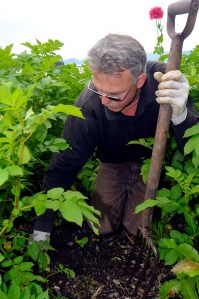
(Photo courtesy of Klas Stolpe/Juneau Empire) Bill Ehlers, assistant gardener of the Jensen-Olson Arboretum in Juneau, tends to a Tlingít potato plant on July 27, 2009. The potatoes will be used as seed stock to be distrbuted to people interested in growing the variety.