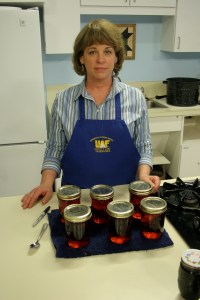
Dr. Sonja Koukel of the UAF Cooperative Extension Service's Juneau office displays some wild berry preserves
Preserving Alaska’s Wild Berries
By Dr. Sonja Koukel, PhD
Health, Home & Family Development Program
UAF Cooperative Extension Service, Juneau Office
_____
Is your freezer teeming with berries harvested last season? If so, now is the time to preserve them in jams, jellies, or syrups. As the winter days grow darker and shorter, preserving berries provides an emotional uplift as the activity brings with it memories of sunshine and relaxing hours spent in the beauty that is Alaska.
While freezing is an acceptable preservation method for berries, it is not the most economical and there is the risk of power outages that could compromise the storage time. Freezing is the least time consuming method of food storage than canning. However, when foods are home canned, they enjoy a longer shelf life, can be stored at room temperature, and are not affected by power outages.
Berries are a high acid food; therefore jams and jellies can be processed quickly and easily using the boiling water canning method. In this method, filled jars are covered with boiling water and heated to an internal temperature of 212 degrees (F). At this temperature, bacteria, yeasts and molds that could be a health hazard or cause the food to spoil are destroyed. Additionally, the hot water inactivates enzymes that cause foods to spoil. The canning process removes air from the jar and a vacuum seal is formed when the product cools. The seal prevents air from getting back into the product, bringing with it microorganisms that could recontaminate the food.
As mentioned, removing the air from the jar is important as microorganisms will not thrive in an anaerobic environment. Presented with these facts, some individuals question the “inversion” method that is often included along with the directions found in purchased packages of pectin. According to this method, the filled, hot jars are turned upside-down after the rings have been screwed onto the tops. After five minutes, the jar is turned upright to cool, after which it is stored on pantry shelves. The problem with this method is that the air has not been exhausted from the jar, which can encourage mold growth. To ensure food quality and safety, all jellied products are processed in a boiling water canner.
Recipes for jams and jellies are available in packages of pectin, cook books, magazines, and food preservation guides. For Alaska berries, check out the UAF Cooperative Extension Service publication, “Collecting and Using Alaska’s Wild Berries and Other Wild Products.” A best-seller, this publication provides berry facts, storage and preservation methods, and recipes. Blueberries, currants, highbush cranberries, and red huckleberries can be found along with fireweed and wild roses. Over the holiday season, the “Berry Book” is offered at the reduced rate of $7. Contact your district office or place an order online at http://www.uaf.edu/ces/pubs
If you have never preserved jams or jellies, or would like to review the process, visit the UAF Cooperative Extension Service website for fact sheets that can be downloaded free to your home computer: http://www.uaf.edu/ces/pubs/catalog/. Newly released educational modules can be viewed online: http://www.uaf.edu/ces/preservingalaskasbounty/index.html.
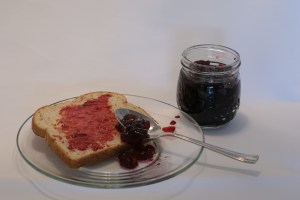
Alaska wild berry preserves are a great treat



 Sitka Local Foods Network
You must be logged in to post a comment.