Does your neighbor have an incredible garden? Do you think your own garden looks pretty impressive? Then help the Sitka Local Foods Network find out who grows the best gardens in Sitka.
If you know of someone with an impressive garden, take a picture or two and e-mail the photos by Sept. 11 to charleswbingham3@gmail.com. Tell us why you think the nominated garden is one of Sitka’s best, and don’t forget to tell us the owner of the garden and address (NOTE: if you’re nominating a neighbor, please double-check with them to make sure they want their garden nominated). The Sitka Local Foods Network focuses on food production, but there is a category for flower gardens.
Hopefully we’ll get enough nominations so we can create an informal garden tour of Sitka to show how people are growing their own food. The better gardens will be featured here in a photo slideshow toward the end of September.
Here are some categories to consider:
Best of show (top overall gardens in Sitka)
Biggest variety of food (most different kinds of food)
Most productive garden (which garden produces the most food)
Best looking food garden (for productive gardens that really look nice)
Most unique plants (who grows stuff in Sitka nobody else grows)
Best use of limited space (for apartment dwellers and container gardens)
Best greenhouse
Best flower garden
Again, e-mail a photo or two to charleswbingham3@gmail.com to nominate your favorite Sitka gardens, then I’ll post them on the site. Please help the Sitka Local Foods Network recognize the best gardens in Sitka.
An artist's concept of one version of a proposed Sitka Community Greenhouse and Education Center
About a dozen people joined Sitka Local Foods Network president Kerry MacLane for a PowerPoint presentation about the proposed Sitka Community Greenhouse and Education Center on Wednesday, May 12, at the SEARHC At Kaník Hít Community Health Services Building first-floor conference room. Kerry showed his presentation (attached) and provided a status update for the project. He also took feedback from the participants, seeking ideas for the next steps needed to complete the project.
The Sitka Community Greenhouse and Education Center is a project of the Sitka Local Foods Network to address one of the top local health priorities identified at the 2008 Sitka Health Summit. Sitka residents said they wanted a community greenhouse in order to make more locally grown fruits and vegetables available in town, and a community greenhouse is seen as a way to grow fruits and veggies all year. In addition to local food being healthier for you, local food also provides food security in case of a disaster or other event that keeps the barges or airplanes from delivering (it’s estimated that 95 percent of the food eaten in Alaska is shipped in from the Lower 48 or overseas).
Currently, the Sitka Local Foods Network is in negotiations with the State of Alaska to lease an unused piece of Mt. Edgecumbe High School-owned land on Japonski Island near Mt. Edgecumbe Hospital. If the lease goes through, the community greenhouse will help Sitka grow more fruits and vegetables locally while extending our short growing season. The greenhouse can provide educational opportunities for Mt. Edgecumbe High School and University of Alaska Southeast-Sitka Campus students, as well as for other school, church and community groups who want to learn more about growing their own food. The community greenhouse also can provide horticultural therapy for medical and behavioral health patients.
Kerry said the model for the Sitka Community Garden and Education Center is the Cheyenne Botanic Gardens in Cheyenne, Wyo. Kerry used to work at the Cheyenne Botanic Gardens several years ago, and he has been given pointers by Cheyenne Botanic Gardens director/founder Shane Smith. The Cheyenne Botanic Gardens started out as a small-scale community greenhouse in 1977 that now features more than nine acres of extensive gardens, a solarium, arboretum and other features. It combines educational opportunities with production gardening and horticultural therapy (see fact sheet linked below).
Kerry said he is seeking letters of support from individuals and groups in Sitka who support the Sitka Community Greenhouse and Education Center, and a sample letter is attached below. For more information, contact Kerry at 966-8839 or 752-0654.
An artist's concept of one version of a proposed Sitka Community Greenhouse and Education Center
Have you heard about the proposed Sitka Community Greenhouse and Education Center? Join us for a short lunchtime presentation at noon on Wednesday, May 12, at the SEARHC At Kanik Hít Community Health Services Building first-floor conference room (1212 Seward Ave., down the hill from Mt. Edgecumbe Hospital, the building with the big totem pole in front).
The Sitka Community Greenhouse and Education Center is a project of the Sitka Local Foods Network to address one of the top local health priorities identified at the 2008 Sitka Health Summit. Currently, the Sitka Local Foods Network is in negotiations with the State of Alaska to lease an unused piece of Mt. Edgecumbe High School-owned land on Japonski Island near Mt. Edgecumbe Hospital.
If the lease goes through, the community greenhouse will help Sitka grow more fruits and vegetables locally while extending our short growing season. The greenhouse can provide educational opportunities for Mt. Edgecumbe High School and University of Alaska Southeast-Sitka Campus students, as well as for other school, church and community groups who want to learn more about growing their own food. The community greenhouse also can provide horticultural therapy for medical and behavioral health patients.
This short lunchtime PowerPoint presentation will be made by SEARHC Grant Writer Kerry MacLane, who also serves as president of the Sitka Local Foods Network, http://www.sitkalocalfoodsnetwork.org/. For more information, contact Kerry at 966-8839.
As you start to plan your garden for this spring and summer, don’t forget to Plant A Row For The Hungry. The Plant A Row For The Hungry program (also known as Plant A Row or PAR) is a national campaign by the Garden Writers Association of America that got its start in Alaska.
In the cold winter of 1994, Anchorage Daily News garden columnist and former Garden Writers Association of America President Jeff Lowenfels was returning to his hotel after a Washington, D.C., event when he was approached by a homeless person who asked for some money to buy food. Lowenfels said Washington, D.C., had signs saying, “Don’t give money to panhandlers,” so he shook his head and kept on walking. But the man’s reply, “I really am homeless and I really am hungry. You can come with me and watch me eat,” stayed with Lowenfels for the rest of his trip.
Jeff Lowenfels
The encounter continued to bother Lowenfels, even as he was flying back to Anchorage. During the flight, Lowenfels came up with an idea when he started writing his weekly garden column (the longest continuously running garden column in the country, with no missed weeks since it started on Nov. 13, 1976). He asked his readers to plant one extra row in their gardens to grow food to donate to Bean’s Café, an Anchorage soup kitchen. The idea took off.
When Anchorage hosted the Garden Writers Association of America convention in 1995, Lowenfels took the GWAA members to Bean’s Café to learn about the Plant A Row For Bean’s Café program. The Garden Writers Association of America liked the idea, and it became the national Plant A Row For The Hungry campaign. In 2002, the Garden Writers Association Foundation was created as a national 501(c)(3) nonprofit to manage the Plant A Row For The Hungry program.
“I am not surprised by the growth of PAR,” Lowenfels wrote in an e-mail to the Sitka Local Foods Network. “It is now in all 50 states and across Canada and there are thousands of variations of the original program — from prison gardens for the hungry to botanical gardens donating their produce from public display gardens. This is because gardeners always share information and extra food, so the idea was a natural.”
It took five years for the program to reach its first million pounds of donated food, but the second million only took two years and the next eight years saw a million pounds of donated food (or more) each year. Since 1995, more than 14 million pounds of food have been donated. Not only that, the program is getting ready to expand overseas to Australia, England and other countries with avid gardeners.
“We have supplied something in the vicinity of enough food for 50 million meals,” Lowenfels wrote in his e-mail. “Gardeners can solve this hunger problem without the government. And we don’t need a tea party to do it! Or chemicals, I might add, as author of a book on organic gardening (Teaming With Microbes, written with Wayne Lewis)!”
According to the U.S. Department of Agriculture, one out of every eight U.S. households experiences hunger or the risk of hunger. Many people skip meals or eat too little, sometimes going an entire day or more without food. About 33 million Americans, including 13 million children, have substandard diets or must resort to seeking emergency food because they can’t always afford to buy the food they need. In recent years the demand for hunger assistance has increased 70 percent, and research shows that hundreds of children and adults are turned away from food banks each year because of lack of resources.
While many people credit Lowenfels for creating the Plant A Row For The Hungry program, Lowenfels says the real heroes are the gardeners growing the extra food and donating it to local soup kitchens, senior programs, schools, homeless shelters and neighbors. You can hear him pass along the credit to all gardeners at the end of this interview last year with an Oklahoma television station (video also embedded below).
“One row. That’s all it takes. No rules other than the food goes to the hungry. You pick the drop-off spot or just give it to a needy friend or neighbor. Nothing slips between the lip and the cup, I say,” Lowenfels wrote in his e-mail.
For people wanting to Plant A Row For The Hungry in Sitka, there are several places that would love to help distribute some fresh locally grown veggies or berries to those who are less fortunate, such as the Salvation Army (note, the current officers are Capts. Kevin and Tina Bottjen), Sitkans Against Family Violence (SAFV), local churches, Sitka Tribe of Alaska and other organizations. The food the Sitka Local Foods Network grows at St. Peter’s Fellowship Farm communal garden goes to the Sitka Farmers Market, where people who are in the WIC (Women, Infants, Children)supplemental food program can use special farmers market vouchers to buy fresh vegetables.
The Sitka Local Foods Network also takes donations of local produce to sell at the Sitka Farmers Markets, and all proceeds from the Sitka Farmers Markets are used to help pay for Sitka Local Foods Network projects geared toward helping more people in Sitka grow and harvest local food. For more information, contact Sitka Farmers Market coordinators Linda Wilson (lawilson87@hotmail.com) or Kerry MacLane (maclanekerry@yahoo.com).
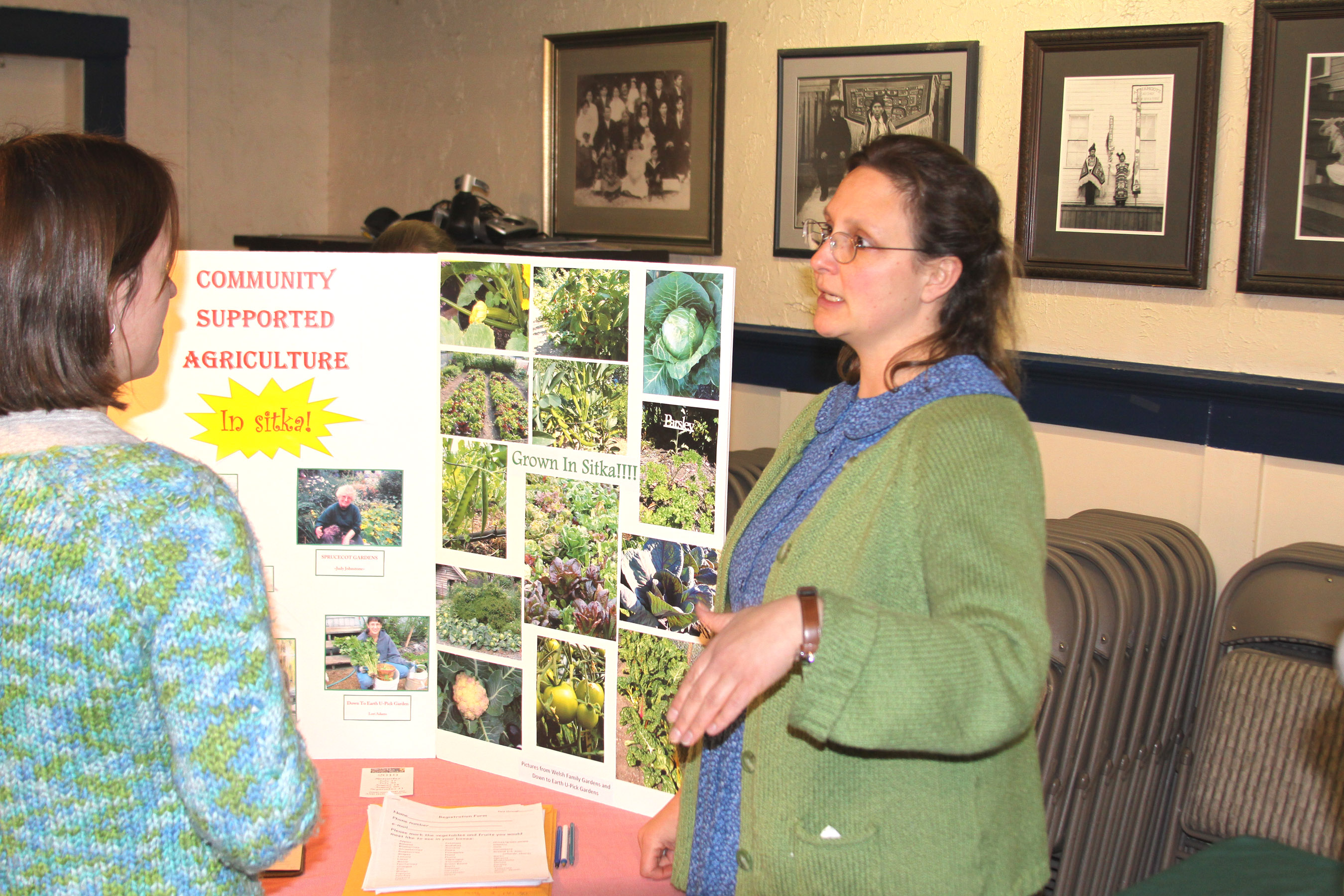
Renee Pierce, right, explains the first Sitka CSA venture to Sitka Local Foods Network board member Natalie Sattler during the Let's Grow Sitka! event on March 14
One of the latest trends in farming is Community Supported Agriculture (CSA), which enables people to buy local, seasonal food directly from the farmer. Renee and Brian Pierce, who own the locally made kelp products and wild berry jelly shop Simple Pleasures of Alaska, are working with Sitka growers to start a small CSA venture with local produce during the summer growing season.
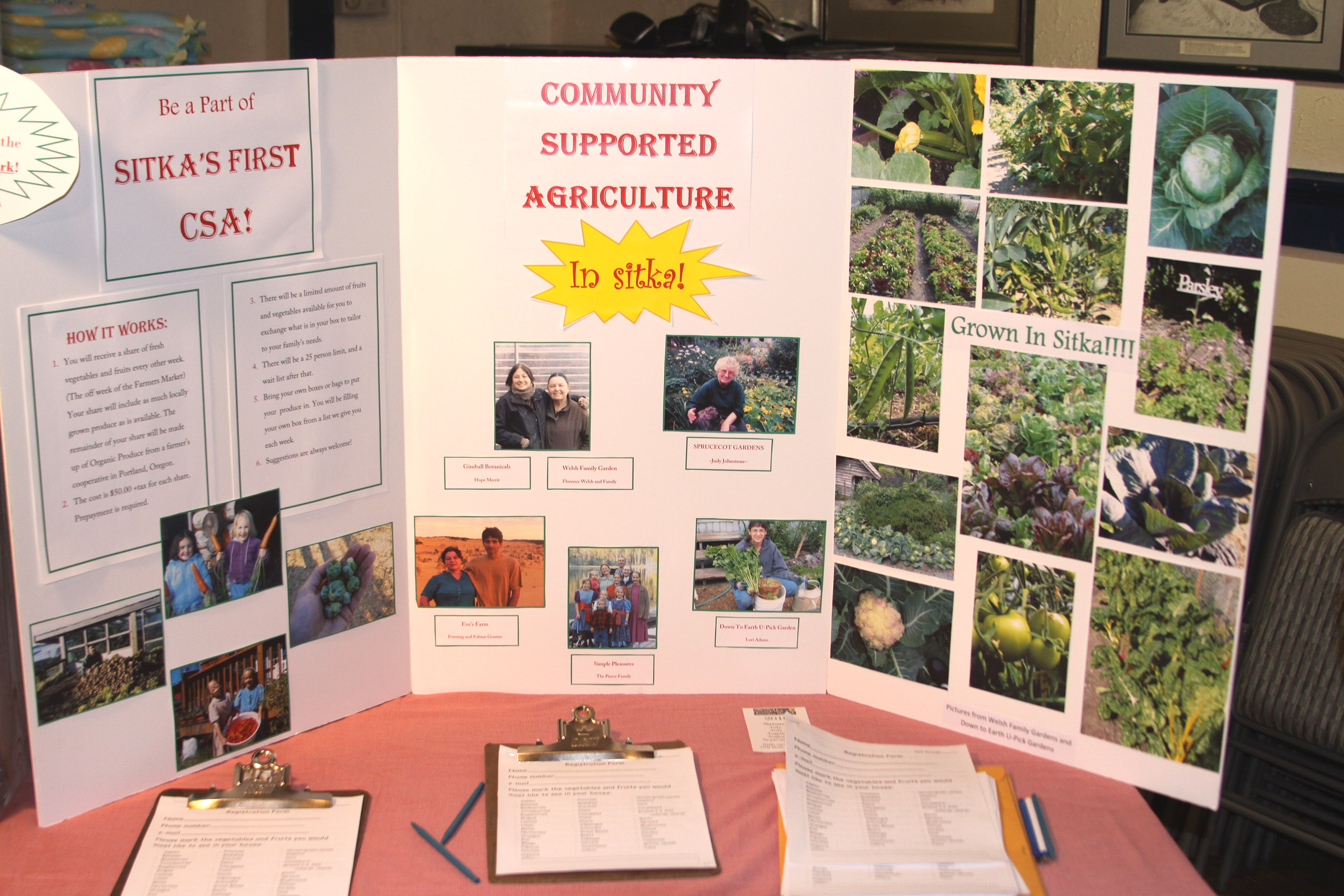
Renee Pierce said that instead of the CSA being a true farmers’ cooperative, she will buy produce from several local growers — including Florence Welsh of the Welsh Family Forget-Me-Not Gardens, Hope Merritt of Gimbal Botanicals, Judy Johnstone of Sprucecot Gardens, Evening Star and Fabian Grutter of Eve’s Farm, and Lori Adams of Down To Earth U-Pick Gardens. The CSA also will include produce from the Pierce Family’s Simple Pleasures garden.
The Sitka CSA will start small, with membership slots for just 25 families the first year. Renee Pierce said of those 25 slots, only about 10 memberships are left. CSA members will commit to paying $50 plus tax every other week, which will give the member families a selection of produce that includes some organic produce purchased from Organically Grown Company of Portland, Ore. During the months when Sitka growers aren’t producing many vegetables, there will be more produce purchased from Organically Grown Company. There also will be an option to buy bread at $6 a loaf beyond the price of the produce box.
The produce selection includes many crops that can be grown in Sitka — such as blueberries, strawberries, raspberries, potatoes, radishes, zucchini, green beans, beets, cabbage, carrots, cauliflower, broccoli, greens, tomatoes, etc. But with the Organically Grown Company providing some of the produce, CSA members also can choose items that aren’t regular Sitka crops — such as bananas, lemons, limes, pineapples, oranges, etc.
Information about Sitka's first CSA from the Let's Grow Sitka! event on March 14
Renee Pierce said she has worked with Organically Grown Company for about four years, purchasing organic produce for the Pierce family and several friends and other Sitka residents who heard about the venture (at one point she had about 60-70 families buying from her). She said she orders produce by the case, and it is available for pick-up from 3-6 p.m. every other Monday afternoon at the Simple Pleasures store next to Kettleson Memorial Library. The first pick-up day for the Sitka CSA is March 29 (which will be for the 15 or so families that already have reserved a spot in the CSA), and the next pick-up day is April 12. CSA members are encouraged to bring their own bags and/or boxes on pick-up days.
The pick-up days are slated to be during the weeks between the every-other-week Sitka Farmers Markets this summer, which will give local growers and buyers the opportunity to buy and sell local produce for both. Renee said there will be some produce extras for families that want to adjust their allotments, but everybody’s allotted produce value will be $50. If you add from the extras you will need to pay the difference, and if you give up some produce you don’t want so your value dips below $50 there are no refunds. She said the CSA is being done as a community service and it’s meant to just break even so the bills get paid.
To learn more about the Sitka CSA, contact Renee Pierce at 738-0044 (cell) or 747-3814 (home). You also can e-mail her at mpierce@ptialaska.net.
Information about a March 28 open house at the Garden Ventures booth during the 2010 Let's Grow Sitka! garden show
Penny Brown of Garden Ventures is inviting Sitka gardeners to her plant nursery for a spring open house from 3-9 p.m. on Sunday, March 28. Garden Ventures is located at 4103 Halibut Point Road and it also will be open its regular Sunday hours of 10 a.m. to 3 p.m. on March 28.
The open house will feature a presentation at 3 p.m. on new annuals and perennials for the 2010 season. There also will be a presentation at 5 p.m. about growing vegetables in Sitka. Class sizes are limited for both free presentations. To register for one or both classes, call Penny at 747-5329.
In addition to the two presentations, local artist Julie Stroemer will be on hand to display her watercolors of flowers grown locally here in Sitka. All who attend the open house are invited to explore Penny’s gardens filled with spring bulbs, perennials and flowering trees. Garden Ventures sells seeds, plant starts, bushes, shrubs and trees. Bare root fruit trees will arrive by the first week of April, and you can contact Penny for more details and varieties.
The class also will involve two 9 a.m. to 3 p.m. Saturday sessions, on March 20 and May. All classes take place at the University of Alaska Southeast Sitka Campus. Local field trips and growing projects are part of the class.
The non-credit course costs $50 for materials and a student agreement to provide 40 hours of gardening-related service to the community within 12 months of completing the course. UAF Cooperative Extension Service Resource Development Agent Bob Gorman will be the course’s instructor. Guest presenters will assist during the classes.
The class includes topics such as plant propagation, soil management, pest identification and control, extending the growing season, vegetable and fruit gardening, greenhouse and indoor gardening, and ornamental gardening.
The purpose of the program is to train volunteers to assist the UAF Cooperative Extension Service by providing the public with gardening-related information. Volunteer service includes help with the Sitka native plants and demonstration garden, youth and in-school gardening, community gardening events, helping with plant pest identification, and assisting with the Sitka Local Foods Network.
Class size is limited and students are encouraged to register early. Those people interested in the class are encouraged to leave their names, contact information and a phone message on the Sitka office of the UAF Cooperative Extension Service at 747-9440. Registration packets are available at the UAS Sitka Campus front desk. The course is offered by the UAF Cooperative Extension Service and the UAS Sitka Campus.
Save the dates: The Alaska Greenhouse and Nursery Conference takes place on Feb. 25-26 in Juneau, with the Southeast Gardening Workshop on Feb. 27. These events should be worth a trip from Sitka to Juneau.
Alaska Greenhouse and Nursery Conference topics will include slugs and snails, low maintenance landscape design, propagating native plants, new varieties for 2010 and more.
As usual, the Polar Grower Trade Show will be available during the conference. All sessions will be at the Alaska Native Brotherhood Hall in Juneau (on Willoughby Ave.). Click here for a registration brochure with more details (link opens PDF file).
The Alaska Greenhouse and Nursery Conference is hosted by the Juneau office of the University of Alaska Fairbanks Cooperative Extension Service, and conference details are available at 796-6221.
In addition to the two-day conference and trade show, there also is the Southeast Gardening Workshop on Feb. 27. For information on the Southeast Gardening Workshop, contact Darren Snyder of the UAF Cooperative Extension Service office in Juneau at 796-6281.
One of the five focus areas for the Sitka Local Foods Network is to build a community greenhouse in Sitka. This will serve several functions, such as extending our growing season, allowing us to grow a wider variety of produce and expanding our capacity to grow fruits and vegetables in Sitka. The Sitka Local Foods Network has been looking at several locations around town and recently submitted a proposal for a possible site (more details as they become available).
Anyway, there is a model for a successful greenhouse here in Alaska, and it’s worth looking at so people from Sitka can see the possibilities.
Chena Hot Springs, located about 60 miles from Fairbanks, is working toward becoming a more sustainable community and an important element of this vision is being able to produce more of their own food locally. In 2004, Chena Hot Springs Resort installed a 1,000-square-foot test greenhouse that has become the only year-round producing greenhouse in Interior Alaska (click here to read more).
The hoop house greenhouse was able to maintain an interior temperature of 78 degrees Fahrenheit, even when outside temperatures dipped to minus-56 (the 134-degree difference is the largest ever recorded for a controlled environment facility in the U.S.). The greenhouse is heated by geothermal energy from the hot springs (165-degree water running through pipes embedded in concrete floor slabs). Click here for a downloadable report (as a PDF file) on the economic benefits of the project.
After the successful first year or two of production, Chena built a new 4,320-square-foot greenhouse to provide the resort’s restaurant with a greater variety of fresh produce on a year-round basis. Under optimal conditions the nearly 14,000 lettuce plants can grow nearly 150,000 heads of lettuce in a year. They also have 450 different tomatoes, including six Dutch varieties, a cherry tomato variety, a grape tomato variety, a beefsteak tomato variety and three intermediate cluster varieties. They also grow green beans, peppers, cucumbers and numerous greens and herbs (click here for a photo gallery). Chena Hot Springs Resort is working in partnership with the University of Alaska Fairbanks Agricultural and Forestry Experiment Station (click here for a link to the UAF AFES).
Chena Hot Springs Resort, which uses geothermal and other waste heat for power, will host the Fourth Annual Chena Renewable Energy Fair on Saturday, Aug. 22. Click here for more information.

 Does your neighbor have an incredible garden? Do you think your own garden looks pretty impressive? Then help the Sitka Local Foods Network find out who grows the best gardens in Sitka.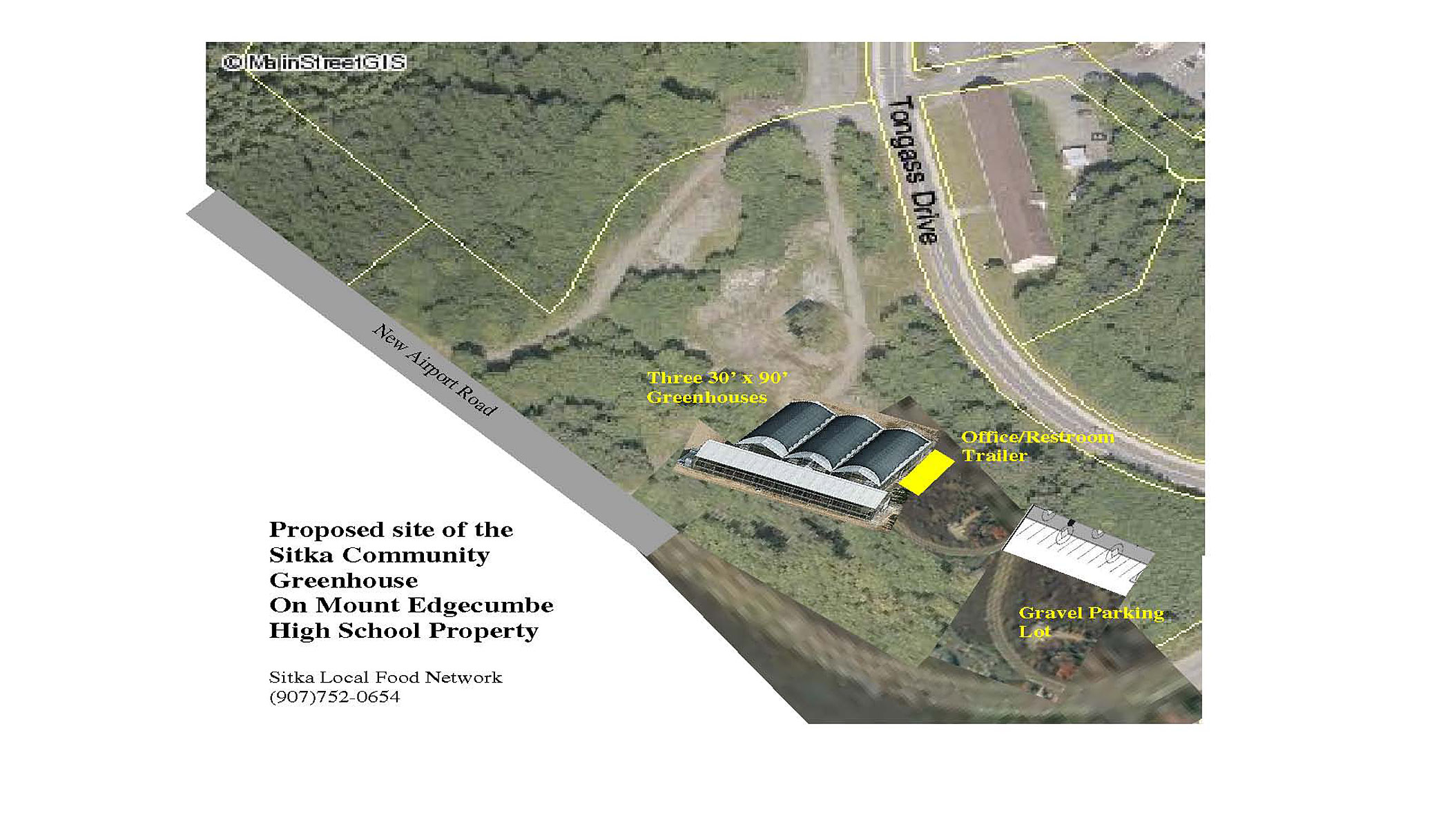




 Sitka Local Foods Network
You must be logged in to post a comment.