• Lori Adams discusses everything she’s learned about growing kale in her latest Daily Sitka Sentinel garden column

LoriAdamsDownToEarthUPickGarden(Lori Adams, who owns Down-To-Earth U-Pick Garden and is a frequent vendor at the Sitka Farmers Market, will be writing a regular garden column in the Daily Sitka Sentinel this summer. The Sentinel is allowing us to reprint the columns on this site after they first appear in the newspaper. This column appeared on Page 5 of the Wednesday, Nov. 7, 2012, edition of the Daily Sitka Sentinel.)

GARDENING IN SITKA

By Lori Adams

EVERYTHING I’VE LEARNED ABOUT GROWING KALE

Kale grows so well here in Sitka that it should be indigenous, but many gardeners don’t grow it because they have no experience eating it and don’t know how delicious and nutritious it is.

Kale is from the brassica family so it is a heavy feeder.  Prepare your bed for kale this Fall by amending with fertilizer rich in nitrogen (fish carcasses, spent grain, seaweed) and lime (sea shell sand), or amend your bed next spring using seaweed with herring eggs.

There are many different varieties of kale to choose from that have leaves of different shapes and colors.  You can sow seeds directly outdoors mid-April, but it’s best to start seeds indoors mid-March and then transplant the seedlings outdoors mid-April.  When transplanting make a dish-shaped depression in the soil and then dig a hole in the bottom of the depression for the seedling, being sure to bury it up to its first set of true leaves. Use 12-18 inch spacing because kale plants grow quite large and if they are planted too closely together they will just get tall and spindly and go to seed prematurely.

Cover the entire bed with row cover until July 15 or later and for best results use hoops to hold the cover up off the plants.

Kale leaves can be harvested at any time, but it is best for the plant if you wait until the plant matures a little bit before you start ripping leaves off of it.  When you do start to harvest leaves be sure to take only the biggest, oldest ones and leave the growing center of the plant alone so it can continue to produce new leaves. Never harvest more than one-third of the leaves at any one time off a plant or the plant will become stressed and take longer to recover.  To harvest just cut the leaves from the plant with a knife or snap them off with your fingers.

Kale can be eaten raw or cooked.  Many people use small tender leaves raw in salads and utilize the larger older leaves for cooking.  Just remove the “rib” with a knife (unless you like a little crunch), chop up the leaves, and then throw them into soups or stirfries, but don’t cook them too long- they wilt quickly.  I recently heard about a salad that’s made by “massaging” or “kneading” chopped kale in dressing that sounds really interesting.

Kale often acts like a biennial. A biennial grows during the first year and if it survives the winter it produces seed during the second year.  Sometimes my plants go to seed during the first year.  If they do I just pinch out the growing center flower bud which allows the plant to branch out with more leaves.

It’s a good idea to let some of your kale flower and leave it in the garden all winter and hope for some seedlings to sprout up the next spring that you can transplant into a new bed.  Kale is very, very hearty and will practically grow year round.  I have gone out the garden in the middle of the winter and broken ice off of my kale plants to harvest leaves and they were perfectly fine!  I am sure if you utilize row cover in the winter you can significantly extend your growing season.

Brought to you by Down-To-Earth U-Pick Garden

2103 Sawmill Creek Road

Open June-August / Monday to Saturday, 11 a.m. to 6 p.m.

747-6108 or 738-2241

http://downtoearthupick.blogspot.com/

• Lori Adams discusses everything she’s learned about growing beets in her latest Daily Sitka Sentinel garden column

LoriAdamsDownToEarthUPickGarden(Lori Adams, who owns Down-To-Earth U-Pick Garden and is a frequent vendor at the Sitka Farmers Market, will be writing a regular garden column in the Daily Sitka Sentinel this summer. The Sentinel is allowing us to reprint the columns on this site after they first appear in the newspaper. This column appeared on Page 9 of the Friday, Nov. 2, 2012, edition of the Daily Sitka Sentinel.)

GARDENING IN SITKA

By Lori Adams

EVERYTHING I’VE LEARNED ABOUT GROWING BEETS

I have had bad luck with beets, but they grow really well here for most people.  I am not sure what the problem is, but I suspect that it is because I don’t really care for the way they taste. Therefore, I procrastinate about planting them, don’t spend much time preparing the soil for them and then just toss the seeds out in some random spot that’s squeezed between other vegetables that I DO enjoy.

Beets are a root crop that bear edible leaves (greens). They will do best in a bed that is prepped with bonemeal (starfish, pulverized deer bones or fish skeletons), sandy organic material that is not too rich with nitrogen (beach mulch gathered in the fall), and plenty of lime (seashell sand). The seeds can be started indoors mid-March and then transplanted outdoors mid-April, but most people just plant them directly outdoors mid-April.

Each beet “seed” is actually a capsule that contains roughly 2-4 seeds. The seedlings will sprout together in a really tight clump but it is not necessary to thin them because each beet plant will grow “out” from the clump center. If the surrounding spacing is adequate there will be enough room for all of them. You can plant the seeds directly into your bed with about three-inch spacing if you are growing them for the greens, but if you are trying to grow large roots you should space the seeds at least six inches apart.

Another option is to plant them close together at first and then when the greens are large enough to eat you can thin the bed by pulling enough plants to achieve six-inch spacing which will produce large roots for later harvest. If beet seeds are planted too closely together the plants will just sprout up tall and spindly with tiny roots, so plant your seeds carefully.

Most of us are familiar with the typical round, red beet with dark green leaves, but beets come in many varieties with different colors, shapes and sizes.  I think they all do well here.

Be sure to cover the entire bed with floating row cover and leave it on as long as possible. Beets like it warm and can take a long time to mature in Sitka, so row cover can really speed up maturity.

Beets are edible at any stage. You can harvest baby greens or entire baby plants to eat raw or cooked, or you can wait and harvest plants that have roots 2 inches across for cooking. Roots that are larger than 2 inches across can become more fibrous.  Leaves that are harvested from mature plants tend to be tough and will need to be cooked. When harvesting roots, leave at least one inch of foliage on the root to avoid excess bleeding during the cooking process. I have heard that roasting beets in the oven is quite delicious too, but I wouldn’t know. I don’t really like beets.

Brought to you by Down-To-Earth U-Pick Garden

2103 Sawmill Creek Road

Open June-August / Monday to Saturday, 11 a.m. to 6 p.m.

747-6108 or 738-2241

http://downtoearthupick.blogspot.com/
• Lori Adams discusses everything she’s learned about growing zucchini in her latest Daily Sitka Sentinel garden column

LoriAdamsDownToEarthUPickGarden(Lori Adams, who owns Down-To-Earth U-Pick Garden and is a frequent vendor at the Sitka Farmers Market, will be writing a regular garden column in the Daily Sitka Sentinel this summer. The Sentinel is allowing us to reprint the columns on this site after they first appear in the newspaper. This column appeared on Page 4 of the Wednesday, Oct. 24, 2012, edition of the Daily Sitka Sentinel.)

GARDENING IN SITKA

By Lori Adams

EVERYTHING I’VE LEARNED ABOUT GROWING ZUCCHINI

Oh, zucchini …. the “hit or miss” crop.  Some years it does fantastic and you start to think that you’re an expert, and then the next year it totally fails and you realize that you know nothing.

I DO know that zucchini plants hate to get wet, that almost all varieties need insects to pollinate them to produce fruit, and that the plants do best in warm weather.  The best zucchini plants I’ve seen in town have been grown under some sort of clear roofing with open sides.  The roofing lets in the sun but protects the plants from rain.  The open sides allow the wind to blow through (reducing mildew and rot), and gives the insects access to the blossoms.

If you grow yours outside don’t expect the plants to get huge and sprawl across the garden like they do in a greenhouse or down south — they will probably only get big enough to take up about nine square feet.  I grow mine in black plastic longline tubs on a shelf that runs the length of my house.  They are under the eaves which gives them a little protection from bad weather.

Zucchini is a heavy feeder so prep your bed or pots with plenty of nitrogen rich fertilizer (fish carcasses or compost).  It also needs potassium to produce healthy fruit  (seaweed) and plenty of lime (sea shell sand).  Early April is the time to start seeds indoors.  This is where I often run into trouble.

This year I planted my seeds in seedling trays in the sunroom and none of them germinated.  TWICE. I figured there must be something wrong with the seeds and did a germination test (sandwiched seeds between damp paper towels in an open Ziplock bag in the warm kitchen) and ALL of the seeds germinated. Once they germinated I carefully planted them into the seedling trays and then they did really well!  (If the sprouts were stuck to the paper towel I just cut around them with a scissors and planted the whole thing.) I have decided that from now on this is how I am going to germinated zucchini seeds every year.  Once the seedlings have been planted into trays they can be placed in a cooler environment, but they still do not like to be really cold.

Zucchini seedlings can be transplanted outdoors in early May. Handle them very carefully because they hate to be transplanted.  If you are planting in tubs be sure to make a depression in the soil, dig a hole in the bottom of the depression and then plant the seedling in the hole up to its first set of true leaves.

Tubs have a tendency to dry out really quickly, so the depression can help channel the water to the roots rather than just running out between the soil and the sides of the tub.  It’s a good idea to add a 3-4 inch layer of seaweed as mulch on top of the soil to help retain moisture, but be sure it doesn’t touch the seedlings possibly causing them to rot.  If you are planting in the ground then catching water is not as critical.

It’s really important to protect the seedlings from the cold.  I cut the bottoms off of plastic milk jugs and place the tops over the seedlings (with the lids off) like little miniature greenhouses and then cover the entire bed with floating row cover that is held up by hoops.  When the plants grow big enough to “fill” the milk jugs I take them off but continue to use floating row cover.  Once the plants start to blossom I remove the row cover, but have it handy for cold nights or really bad weather.  If you keep your blossoming plants covered the insects will not be able to pollinate the blossoms and you will not get any zucchinis to mature.

Each zucchini plant produces both male and female flowers.  The male flowers grow on long skinny stems and the female flowers grow at the end of tiny baby zucchinis that are on short squatty stems. The blossoms are only open for about a day or two and if the female flower does not get pollinated during this time the baby zucchini will start to wither and then die.  If this keeps happening you could try to hand pollinate by breaking off a male flower, pulling back it’s petals and rubbing a little bit of it’s pollen inside a couple of female flowers.  Some people chose to grow “self-pollinating” varieties to eliminate this problem.

Once the blossoms have closed they are of no use to the plant and should be removed, but be sure they are “ready” to come off.  Gently break them off sideways with your fingers.  If they don’t want to come off easily then just wait a day or two otherwise you might break off the entire tip of the zucchini and ruin it.

Zucchini blossoms are edible and quite delicious when stuffed with cheese, dredged in flour and fried in butter.  But be sure to leave them on the plant until they have done their job!  Zucchinis are edible at any stage of maturity, but it seems like a waste to eat them when they are tiny.  On the other hand it is not good to leave them on the plant until they get huge because the plant will think it has done its job and will stop producing fruit.  For best results harvest all the zucchinis that are over nine inches long and then your plants will keep producing fruit until the first frost kills the plant.

Brought to you by Down-To-Earth U-Pick Garden

2103 Sawmill Creek Road

Open June-August / Monday to Saturday, 11 a.m. to 6 p.m.

747-6108 or 738-2241

http://downtoearthupick.blogspot.com/


• Pacific High School’s local food meal featured on KCAW-Raven Radio

Photo courtesy of KCAW-Raven Radio

Photo courtesy of KCAW-Raven Radio

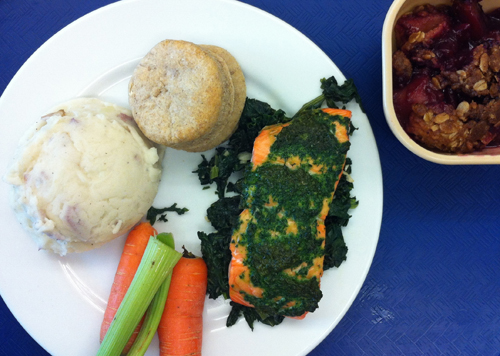
A special local food meal cooked and eaten by students at Pacific High School in Sitka was featured in a story by reporter Anne Brice on the Wednesday, Oct. 24, morning and evening newscasts on KCAW-Raven Radio.

October is National Farm To School Month, and Oct. 24 was Food Day, so the students cooked up a meal featuring coho salmon with a lemon swirl and dill pesto served on a bed of kale. The fish was provided as part of the Sitka Conservation Society’s Fish-to-Schools program (a 2010 Sitka Health Summit project), and the veggies and herbs came from Lori Adams’ Down-To-Earth U-Pick Garden.

• Lori Adams discusses everything she’s learned about growing broccoli in her latest Daily Sitka Sentinel garden column

(Lori Adams, who owns Down-To-Earth U-Pick Garden and is a frequent vendor at the Sitka Farmers Market, will be writing a regular garden column in the Daily Sitka Sentinel this summer. The Sentinel is allowing us to reprint the columns on this site after they first appear in the newspaper. This column appeared on Page 4 of the Friday, Oct. 19, 2012, edition of the Daily Sitka Sentinel.)

GARDENING IN SITKA

By Lori Adams

EVERYTHING I’VE LEARNED ABOUT GROWING BROCCOLI

Broccoli loves the climate here in Sitka and with a few tips you can have delicious broccoli to eat for months.

Broccoli is from the brassica family and is a fairly heavy feeder.  Preparation should begin in the fall by amending your bed with nitrogen rich fertilizer and lime (or salmon carcasses, seaweed and seashell sand).

Start your seeds indoors mid-March.  They sprout up fast and grow tall quickly, so for best results after germination reduce the temperature in the room to 40-50 degrees F and turn the trays 180 degrees at least once a day to keep the seedlings from getting leggy and falling over.  It is also a good idea to have an oscillating fan in the room blowing gently across the trays to make the seedlings as strong as possible.

Transplant seedlings outdoors mid-April in a bed that has not had brassica’s planted in it the year before. Make a dish-shaped depression in the soil, then dig a hole in the bottom of it for the seedling and bury it up to its first set of true leaves.  The depression acts as a catch basin for water and will keep the seedling from drying out.

If your seedlings are a bit spindly, just do your best to prop them up and as they grow they will get stronger and straighten up on their own.  Space the seedlings about 20 inches apart.  It’s tempting to crowd them together to get more plants in the garden, but broccoli plants that are too close together produce small heads.

Mulch the entire bed with a generous layer of seaweed but try to keep the seaweed from touching the seedlings to prevent rot.  Cover the entire bed with floating row cover to protect the plants from the dreaded root maggot fly using hoops to keep the cover up off the plants if possible.  Leave the cover on until at least July 15.

In a few months you will see tiny broccoli head starting to form.  Some varieties of broccoli produce small heads and some varieties of broccoli produce large heads.  Immature heads are very tightly formed, mature heads are loosely formed and overly mature heads open up into flowers.

The key is to harvest before the heads flower regardless of size.  Harvest heads with a knife cutting the stem at a sharp angle.  This prevents water from setting on the stump and causing the plant to rot.  Broccoli leaves are edible and can be used like kale and broccoli stems can be eaten raw or cooked.  If the skin is tough just peel it away and eat the center.

Unfortunately, slugs LOVE broccoli.  Damaged leaves aren’t so bad, but when a slug crawls across a head and leaves a slimy, rotten track behind it, it can be very aggravating.  It’s easy to become discouraged and think the entire plant is ruined, but don’t pull it out. Just harvest the damaged head, eat the good parts and leave the plant in the ground because most varieties of broccoli will produce more, smaller heads called “sprouts” for months to come.  I have harvested fresh broccoli from my garden for Thanksgiving.

Brought to you by Down-To-Earth U-Pick Garden

2103 Sawmill Creek Road

Open June-August / Monday to Saturday, 11 a.m. to 6 p.m.

747-6108 or 738-2241

http://downtoearthupick.blogspot.com/

• Lori Adams discusses everything she’s learned about growing sunflowers in her latest Daily Sitka Sentinel garden column

(Lori Adams, who owns Down-To-Earth U-Pick Garden and is a frequent vendor at the Sitka Farmers Market, will be writing a regular garden column in the Daily Sitka Sentinel this summer. The Sentinel is allowing us to reprint the columns on this site after they first appear in the newspaper. This column appeared on Page 7 of the Friday, Oct. 12, 2012, edition of the Daily Sitka Sentinel.)

GARDENING IN SITKA

By Lori Adams

EVERYTHING I’VE LEARNED ABOUT GROWING SUNFLOWERS

Many people think that it is impossible to grow nice sunflowers here in Sitka, but it is possible. It just takes careful planning.

Sunflowers grow in just about any type of soil, but will do much better in soil that is rich with organic material and fertilizer. I start my sunflowers by seed indoors in mid-March. Once they have germinated it is important to reduce the temperature in the room to about 40-50 degrees to prevent the starts from getting leggy and spindly.  If they have to lean to reach the sun, be sure to rotate them 180 degrees at least once a day to get them to grow as straight as possible. It is also a good idea to have an oscillating fan gently blowing across them to encourage them to grow strong.

I transplant my starts outdoors between mid-April and mid-May.  Transplanting time is the most important step for ensuring success.  The weather should not be too cold or too hot.  (This year I transplanted at the beginning of a long stretch of rainy weather and I had a horrible success rate.)  The starts should not be transplanted near a lot of brush or in a crowded perennial bed because these settings encourage rot and slug damage.

The larger the starts are the better chance they have of surviving, but be sure they don’t get too tall and spindly or they may fall over or break in the wind.  Prepare supports of some sort before transplant time. Supports can really help. After the starts have been outdoors for awhile and have recovered from transplant shock they will start growing again and become stronger, but in the meantime the supports will help them.

You can attach the stems of the sunflowers to the supports but be sure to check them once in a while during the season to be sure they have not gotten too tight as the stems grow thicker.  Even a large mature sunflower will benefit from support.  I have had beautiful, huge plants uprooted or broken off by the wind. It was very sad.  If my starts get leggy and spindly I still transplant them outdoors and prop them up the best I can.

I’ve been amazed at how hardy they can be.  The ones that recover from the shock of transplanting take root, get stronger, grow taller, straighten out and develop thick, healthy stalks.  The key is to transplant at the right time, in the right place, with the right supports. Take some time to do it right.

Although you shouldn’t plan on it, it is possible to harvest sunflower seeds to eat if the weather cooperates.  A mature head will often tip down, thereby preventing damage from rain and allowing the seeds to mature.  If you want to try to harvest seeds do not prune spent flowers — let them die on the plant.

Amazingly enough, some of the best sunflowers I have ever grown have volunteered from sunflower seeds that were thrown outside the year before.  Of course this is a hit or miss procedure, but you might try it.

Throw some seeds out right now, mark the spot and see what happens.  You might scratch them in a bit or cover them with a thin layer or dirt to prevent birds from eating them. I have noticed that volunteer sunflowers are stronger and healthier than ones I have started indoors as long as the slugs didn’t get them.

I have grown many different varieties and colors of sunflowers, but I highly recommend the basic yellow and brown branching varieties that produce more than one blossom on a plant. The other colors don’t do as well here and don’t stand out like the traditional ones. And nothing says, “There’s a garden here!” like the sunny face of a brown and yellow sunflower.

Brought to you by Down-To-Earth U-Pick Garden

2103 Sawmill Creek Road

Open June-August / Monday to Saturday, 11 a.m. to 6 p.m.

747-6108 or 738-2241

http://downtoearthupick.blogspot.com/

• Lori Adams discusses everything she’s learned about growing potatoes in her latest Daily Sitka Sentinel garden column

(Lori Adams, who owns Down-To-Earth U-Pick Garden and is a frequent vendor at the Sitka Farmers Market, will be writing a regular garden column in the Daily Sitka Sentinel this summer. The Sentinel is allowing us to reprint the columns on this site after they first appear in the newspaper. This column appeared on Page 3 of the Wednesday, Sept. 26, 2012, edition of the Daily Sitka Sentinel.)

GARDENING IN SITKA

By Lori Adams

EVERYTHING I’VE LEARNED ABOUT GROWING POTATOES

I am relatively new to growing potatoes, but they are so fun to grow and do so well here that I am absolutely hooked.

Potatoes can be planted in almost any kind of soil and grow just fine.  I have heard people say they grew them in nothing but a pile of seaweed and I have seen someone plant them in a cleared lot with no food at all and they did great.

They are not super heavy feeders and prefer acidic, loose sandy soil with a moderately steady supply of organic material and phosphorus (bonemeal, starfish or fish bones and heads).  They can be grown right in the ground, but I prefer to grow them in tubs because it makes harvesting so much easier — no lost potatoes in the garden to volunteer next year!

Potatoes are very susceptible to a disease called “scab.”  It looks just like it sounds — rough brown scabs on the surface of the skin.  Scab is in the soil and although there are ways to try to avoid it, it seems inevitable.  Fortunately, although scabby potatoes are undesirable for market they are perfectly edible for home use.

To prepare the ground or tubs for potatoes do not add high-nitrogen food or lime.  New dirt is the best, and never plant potatoes in the same spot for at least three years. Just add some beach mulch for some organic material.  Buy certified scab-free seed potatoes from a garden supplier to avoid introducing “blight” (another disease), to the garden, or get some from a friend (they will probably have scab), and plant them outdoors mid-April.

Seed potatoes do not need to be large, in fact, it is preferable to obtain small ones with at least two “eyes” – dimples on the skin where sprouts emerge.  If you have large seeds potatoes you should cut them in several pieces and let the cut edges dry before planting them.  Whole seed potatoes do better in Sitka gardens than ones that have been cut.  They get off to a better start and are more resistant to diseases.

It’s best if your seed potatoes have already started to sprout, if they haven’t then they will just sit in the ground for a month before sprouting.  If yours haven’t sprouted by late March, expose them to 60 degree heat and as much sunshine as possible for two weeks before planting them.  Be sure not to break any sprouts off.

To plant, dig a 12-inch deep hole in the ground or tub that will not be below standing water when it rains, lay a fish head or a couple of starfish in the bottom and cover with dirt.  Or, dig a nine-inch hole and mix a handful of bonemeal into the soil.  Make a nest of straw or dried grass in the hole and set the seed potato in it with the sprouts reaching up, cover with more straw and then toss in a shovel full of spruce or hemlock needles (to made the soil more acidic to try to avoid scab), bury with dirt and beach mulch and top it all off with a couple inches of seaweed.

Potato plants usually sprout up fast and get quite large.  It is important to “hill-up” the plants a couple times during the season by burying the foliage so that only a couple of inches stick up out of the dirt.  This will cause more potatoes to grow on the buried foliage and dramatically increase your yield.

Potatoes can be harvested at any time for eating, but it is best to wait until the foliage has pretty much died back to achieve maximum yield. Early September is about right. Potatoes that have been harvested early have fragile skins and have a tendency to “peel,” like a sunburn.  If you want to store them all winter it is very important to wait until late September or early October to ensure that the potato skins have cured and will store well.

Now comes the fun part. Dump out the tub or dig a large enough hole to harvest every potato.  Lay them out on a tarp to dry. Lightly rub off the excess dirt and store them at 33-38 degrees in total darkness where they won’t get too dried out.  Be sure to save a few small ones of your favorite varieties to plant next year.

Brought to you by Down-To-Earth U-Pick Garden

2103 Sawmill Creek Road

Open June-August / Monday to Saturday, 11 a.m. to 6 p.m.

747-6108 or 738-2241

http://downtoearthupick.blogspot.com/

• Lori Adams discusses everything she’s learned about growing cabbage in her latest Daily Sitka Sentinel garden column

(Lori Adams, who owns Down-To-Earth U-Pick Garden and is a frequent vendor at the Sitka Farmers Market, will be writing a regular garden column in the Daily Sitka Sentinel this summer. The Sentinel is allowing us to reprint the columns on this site after they first appear in the newspaper. This column appeared on Page 6 of the Wednesday, Sept. 19, 2012, edition of the Daily Sitka Sentinel.)

GARDENING IN SITKA

By Lori Adams

EVERYTHING I’VE LEARNED ABOUT GROWING CABBAGE

Cabbage does really well in Sitka.  It is a crop worth growing, if you have the space for it.  I find that the most important thing about growing cabbage is picking the right variety.  Loosely knit heads allow too many spaces for slugs, so choose varieties that produce tightly packed heads.  Purple varieties mature really late but the slugs don’t bother them as much as they do the green varieties. I always grow both colors.

Cabbage is a moderately heavy feeder, so prepare next year’s bed this fall by loading it up with fertilizer (or compost, seaweed and salmon carcasses) and lime (or seashell sand).  Plant seeds indoors mid-March and transplant outdoors mid-April. It’s important to transplant cabbage plants while they are still young.  If they get too old the plants will stunt and never reach their potential size.

Make a dish-shaped depression in the soil and then plant the seedling in the bottom of the depression burying it up to its first set of true leaves.  Cabbage that is planted too close together produces small heads so be sure to give them plenty of room.  I like to use about 2 foot spacing.  Mulch the entire row with seaweed (without herring eggs) to retain moisture, but be sure the seaweed touches the tender starts as little as possible to avoid rot.

Cabbage is from the brassica family and as with all brassicas it is very important to cover the entire bed with floating row cover to protect the crop from the dreaded root maggot fly.  For best results use hoops to support the row cover up off the little seedlings so they do not get flattened by the rain. Leave the cover on until at least July 15.

Slugs are the mortal enemy of cabbages.  They get in between the leaves, live in the cracks and crannies, and just riddle the heads with holes.  It is quite unpleasant to cut into a cabbage and find slugs, worms and slug poop.  GROSS!  My ducks do a good job of eliminating the slugs, but they also love to eat cabbage so during the summer I need to lock them out of the garden.  Consequently the slugs eventually move back in and take up residence in the cabbage.

The only thing that can help this situation is preventative measures:  Don’t plant cabbage next to slug habitat (brush, groundcover, piles of boards or stones), be vigilant with the slug bait/traps, try some cabbage collars or copper flashing when transplanting, when the plant is sturdy enough remove leaves that are touching the ground, and keep the bed weeded to reduce slug habitat.

Cabbage is ready to eat at any time but it is a waste to harvest a head that is the size of a softball. Try to be patient and start harvesting your first heads when they are about the size of a cantaloupe. Use a knife to cut the head at ground level leaving the root in the ground to avoid disturbing the plants nearby.  It can be removed later in the season or even next spring. The loose outer leaves are edible but not as tender and sweet as the head itself.

Do not feel that you have to harvest all the plants in the row before the weather turns cold.  Cabbage is very hearty. It can sit in the garden covered with snow and still be perfectly edible.  Of course it can’t withstand that type of weather forever, so by November if you haven’t eaten them all harvest the rest and store them in the fridge in plastic bags.  They have an amazing shelf life.

One more note, sometimes gardeners have trouble with their cabbages splitting.  General information says that this is caused by too much rain, but I have heard that too much nitrogen can also cause splitting. If you notice a head has split, harvest it right away.  Split heads start to deteriorate quickly if left in the garden.

Brought to you by Down-To-Earth U-Pick Garden

2103 Sawmill Creek Road

Open June-August / Monday to Saturday, 11 a.m. to 6 p.m.

747-6108 or 738-2241

http://downtoearthupick.blogspot.com/

• Lori Adams discusses herbs she has grown in her latest Daily Sitka Sentinel garden column

(Lori Adams, who owns Down-To-Earth U-Pick Garden and is a frequent vendor at the Sitka Farmers Market, will be writing a regular garden column in the Daily Sitka Sentinel this summer. The Sentinel is allowing us to reprint the columns on this site after they first appear in the newspaper. This column appeared on Page 4 of the Wednesday, Sept. 12, 2012, edition of the Daily Sitka Sentinel.)

GARDENING IN SITKA

By Lori Adams

HERBS I HAVE GROWN

Herbs are a fun addition to the garden and do not take up very much space. I do not have vast experience growing herbs, but each year I learn a little more and now have an area in the garden that is set aside exclusively for herbs. When I can’t start them from seeds I buy them as starts from Penny out at Garden Ventures.

CHIVES: Every Sitka garden should have a clump or two of chives, they are so easy to grow and seem to love our climate. They look beautiful, taste delicious and attract beneficial insects for pollination. Chives are perennial so don’t bother with seeds, just get a division from a friend or neighbor. Each year your clump will get bigger and bigger and soon you will be looking for someone to share your divisions.  They grow in any type of soil but grow much larger and healthier if mulched with compost spring and fall. Chives can be harvested at any time (they taste like mild sweet onion). Simply grab a handful and cut them off three inches above the ground. The flowers are edible but the stems they grow on are extremely tough and fibrous. If your clump starts to look ragged and  turns brown, just cut the entire thing down three inches above the ground and it will start to send out tender new blades.

FRENCH SORREL:  This is the first year I have grown sorrel and I am in LOVE with it. It is a hardy perennial that multiplies quickly with deep roots and has a decidedly lemon flavor.  It can be planted by seed, but I recommend you buy a start or get a division from someone that is growing it in their yard. Sorrel can be harvested at any time, simply cut the stems to harvest the leaves. Do not take more than a third of the leaves at any one time. I use sorrel to make a pesto that is delicious with fish. Do not let the plant flower, if it does just cut the stalk off and throw it away.

OREGANO:  I have had pretty good luck with oregano.  It is an annual here with only rare instances where it survives the winter.  I usually start mine from seed indoors and transplant out in April.  There are several different varieties which range from bitter to sweet.  To harvest just cut a stem close to the ground and harvest the whole sprig.  To cook with it snip the leaves off and throw the stem away.

DILL:  Dill does okay here, and on a good year can grow quite large.  I grow two types, one for flowers and one for foliage.  Start seeds indoors in March.  The seedlings can get tall and unmanageable but once transplanted in April seem to straighten up and grow strong.  To harvest foliage just cut the ferny sprigs free from the stalk, mince and use.  It’s great with fish and cooked carrots and cheese balls look beautiful covered with it.  The flowers are used for pickling and look beautiful in flower arrangements.  If the flowers are left on the plant to go to seed it is possible they’ll reseed themselves the following spring.

STEVIA:  Stevia is a curiously strong flavored sugar substitute that does well here most years (it didn’t do well this year for me).  Fresh out of the garden it is 15 times sweeter than sugar.  It can be started from seed indoors in March and transplanted outside in April with cover.  Harvest the leaves, mince and add to fruit salad or iced tea.  It tastes stronger by the end of the summer, almost bitter, and will not survive the winter.

MINT:  Mint is EASY to grow but is invasive so plant it in a pot that is lined with landscaping cloth.  You can start it from seed, but almost every garden in Sitka has a patch of mint so get a start from a friend or neighbor.  Although it will grow in any soil it will be more lush and healthy if you feed it with compost spring and fall.  To harvest just cut a sprig loose at ground level.  Use leaves fresh or dried and discard the stems.

PARSLEY:  Parsley does well in Sitka.  I grow both the flat and the curly varieties.  Start seeds indoors in March and transplant outdoors in April using 12-18 inch spacing.  The flat parsley is an excellent green to mix in salads that tastes a lot like strong celery.  The curly parsley is even stronger and is used mostly for garnish.  I have noticed that parsley does really well in partial to full shade, especially the curly variety.  In full sun the leaves are tightly curled and in partial shade they seem to loosen up and look more lush.  To harvest just snip the outside sprigs from the plant leaving the center to continue to grow.

BASIL:  My customers always ask for basil but I have had many challenges trying to grow it.  As a rule it does not do well outside, but I have had some survive in pots right next to the house.  The red variety seemed to be the hardiest.  It is just best to grow it indoors.  Start seeds in March and be sure to keep the seedlings warm.  Transplant to bigger pots as needed.  My biggest problem has been aphids.  The soap/water treatment did not take care of the problem but I found some very effective organic insecticidal soap that I am going to use from now on — really it is the difference between having basil or not, so I am using the spray.  Wait to harvest any basil until the plant has grown at least four sets of true leaves.  Then pinch out the tops just above the second set of leaves to encourage the plants to branch out.  There is just nothing like the aroma of fresh basil.  There is a big demand for it here in Sitka so if you have the room please consider growing it to sell at the Sitka Farmers Market.

SAGE:  Sage can survive for several years before it dies.  It is another one of the herbs that can run from bitter to sweet depending on variety.  A mature sage plant is sort of like a small shrub with woody branches.  I recommend buying a start rather than planting seeds.  In the spring when you see new growth, prune the plant to remove dead branches and encourage new tender growth for harvesting.

OTHER HERBS: I have grown rosemary and thyme and they have done okay. I know there are some creeping thymes that do well here for ground cover.  I hear people talking about the chervil they are growing but I have no experience with it at all. Cilantro grows great here for about a month and then all it wants to do is bolt, bolt, bolt.  You have to cut it down many times to keep it producing and then it has mosly small leaves. Comfrey does well but be sure you want it — it gets quite large, spreads easily and has deep, deep roots so it will probably be there forever.  Someone recently gave me a horseradish start so I guess it grows here too.  I hear it has a deep invasive root system and the roots are the part of the plant used during harvest so I think I will grow it in a pot.  If you have an herb that does well here that I did not mention please let me know.

Brought to you by Down-To-Earth U-Pick Garden

2103 Sawmill Creek Road

Open June-August / Monday to Saturday, 11 a.m. to 6 p.m.

747-6108 or 738-2241

http://downtoearthupick.blogspot.com/

• Lori Adams discusses everything she’s learned about growing Brussels sprouts in her latest Daily Sitka Sentinel garden column

(Lori Adams, who owns Down-To-Earth U-Pick Garden and is a frequent vendor at the Sitka Farmers Market, will be writing a regular garden column in the Daily Sitka Sentinel this summer. The Sentinel is allowing us to reprint the columns on this site after they first appear in the newspaper. This column appeared on Page 4 of the Wednesday, Sept. 5, 2012, edition of the Daily Sitka Sentinel.)

GARDENING IN SITKA

By Lori Adams

EVERYTHING I’VE LEARNED ABOUT GROWING BRUSSELS SPROUTS

Brussels sprouts grow really well in Sitka. They are a late crop that actually tastes best after the first frost. I have had good Brussels sprouts every year except this year … it just wasn’t warm enough.

Brussels sprouts are heavy feeders so amend your soil this fall with nitrogen (salmon carcasses a foot apart) and potassium (seaweed a foot deep) and lime (an inch of seashell sand). In mid-March start seeds indoors, till up the bed either with a rototiller or by hand, and then transplant the starts mid-April with 18-20 inch spacing. Make a dish-shaped depression in the soil and then dig a hole for the transplant right in the middle of the depression. Bury the starts up to their first set of true leaves.

It’s very helpful to mulch the entire bed with four inches of seaweed that has a small amount of herring eggs on it, but be sure the seaweed does not touch the starts or they could be burnt from the “hot” eggs. Cover the entire bed with floating row cover and for best results suspend the cover with hoops to keep the starts from getting beaten down from the rain. As with all brassicas, you should leave the row cover on until July 15 to protect the crop from the root maggot fly.

In the summer you will start to see little baby cabbages growing at the base of each leaf right on the stem.  These are the “sprouts.”  The sprouts closest to the ground are the biggest and the ones at the top of the plant are the smallest because they ripen from the bottom up. When the sprouts reach the size of a marble, start cutting or breaking off the leaves (by pulling down or sideways until they snap off). This allows the plant to put more energy into growing sprouts and less energy into growing leaves. The leaves are edible and can be used like kale.

Brussels sprouts are ready to eat at any stage, but it is best to wait until they are about the size the circle your fingers make when using the OK gesture. The sprouts can be harvested from the plants by pulling them sideways until they snap off.  If you see a sprout start to open up, it has gone past maturity. It is still good to eat but not as choice as a tight, tender sprout.

To prepare Brussels sprouts, just cut the stump off including the bottom sliver of the sprout.  This will allow you to peel off some of the outer leaves which are so hard they feel like you are eating plastic.  Some people like to boil or steam their sprouts and others like to roast them in the over drizzled with olive oil and salt and pepper. But I’ve never heard of anyone that likes to eat them raw.

In September, it is a good idea to prune the top of the plants off to encourage them to stop growing new sprouts and to plump up the sprouts already on the stalk.   The tops are edible and can be used like kale.

Brussels sprouts are extremely hearty and can be left outside in the snow for a month or two, but keep an eye on them because after prolonged cold weather they start to deteriorate.  If you have a good cool storage area it is a good idea to cut the plants off at the ground and stack them inside.  Whenever you want sprouts for dinner just go break off the ones you want and leave the rest on the stalk for later.

Brought to you by Down-To-Earth U-Pick Garden

2103 Sawmill Creek Road

Open June-August / Monday to Saturday, 11 a.m. to 6 p.m.

747-6108 or 738-2241

http://downtoearthupick.blogspot.com/