• UAF Cooperative Extension Service offers online resources for home canners

Salmon ready for canning in jars (Photo courtesy of University of Alaska Fairbanks Cooperative Extension Service)

Salmon ready for canning in jars (Photo courtesy of University of Alaska Fairbanks Cooperative Extension Service)

Did you catch a lot of fish this summer and now you want to can some of them to eat this winter? Do you want to make salmonberry preserves with all those lush, ripe salmonberries you picked this week?

The University of Alaska Fairbanks Cooperative Extension Service recently launched a series of interactive online demonstrations called “Preserving Alaska’s Bounty.” Want to learn how to can salmon using jars? Click on the link and you are taken to a page with photos and short descriptions mixed in with video clips to show you how to can your fish. There is an introduction and sections on equipment, preparation, packing, canning, cooling and storage. There also are links to additional resources.

If you want to learn about making jams and jellies, there’s an online demonstration on that topic. There also are demonstrations about canner basics, acidity, canning fish using cans, canning wild meats in jars and in cans, and more. Jeff Fay from the UAF Cooperative Extension Service said there also are DVDs that cover some of the same topics, and more titles are expected to be added to the site in the next year or two.

If you do a little bit of surfing around the UAF Cooperative Extension Service’s Web site, you’ll find all kinds of how-to materials. There are materials on gardening, recipes, home construction, food safety, winterizing your house and other topics.

If you can’t find what you need on the UAF Cooperative Extension Service site, other state land grant universities have their own version of the Cooperative Extension Service and most of their materials are available for download off the Internet. One of the attachments below is to a handout from the Iowa State University Cooperative Extension Service about how to freeze a variety of fruits and vegetables to maintain freshness and nutritional value.

Click here to go to the “Preserving Alaska’s Bounty” page on the University of Alaska Fairbanks Cooperative Extension Service Web site

Click here to go to a catalog of available DVDs from the University of Alaska Fairbanks Cooperative Extension Service

Click here to go to the main page for the University of Alaska Fairbanks Cooperative Extension Service

Click here to open an Adobe Acrobat PDF file of a handout on freezing fruits and vegetables from the Iowa State University Cooperative Extension Service

A batch of fruit is ready to be canned in jars (Photo courtesy of the University of Alaska Fairbanks Cooperative Extension Service)
A batch of fruit is ready to be canned in jars (Photo courtesy of the University of Alaska Fairbanks Cooperative Extension Service)

• How does your garden grow?

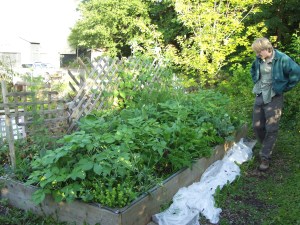
Doug Osborne checks out the WISEGUYS men's health group's plot at the Blatchley Community Gardens in August 2008

Doug Osborne checks out the WISEGUYS men's health group's plot at the Blatchley Community Gardens in August 2008

Now that we’re well into the garden season, it’s time to take an informal survey to find out who is growing the best gardens in Sitka.

Does your neighbor have an incredible garden? Do you think your own garden looks pretty impressive? Then look for the “Leave A Comment” link below this story and post a nomination. Tell us why you think the nominated garden is one of Sitka’s best, and don’t forget to tell us the address (NOTE: if you’re nominating a neighbor, please double-check with them to make sure they want their garden nominated). The Sitka Local Foods Network is focussed on food production, but there is a category for flower gardens.

Hopefully we’ll get enough nominations so we can create an informal garden tour of Sitka to show how people are growing their own food. At some point, a few of the better gardens might be featured here with photos.

Here are some categories to consider:
• Best of show (top overall gardens in Sitka)
• Widest variety of food (most different kinds of food)
• Most productive garden (which garden produces the most food)
• Best looking food garden (for productive gardens that really look nice)
• Most unique plants (who grows stuff in Sitka nobody else grows)
• Best use of limited space (for apartment dwellers and container gardens)
• Best greenhouse
• Best flower garden

Again, click on the “Leave a Comment” link below to nominate your favorite Sitka gardens (all comments are moderated so there may be a delay before comments appear on the page). Those of you who don’t want to deal with the comment function on this site can e-mail nominations to charles@sitkalocalfoodsnetwork.org, then I’ll post them on the site. Please help us recognize the best gardens in Sitka.

(NOTE: Please be respectful of others when leaving comments. Any comments that are excessively negative or those that are worse than a PG rating will be deleted. This is site a place to encourage others, and we want to keep things family friendly. Thanks)

• Healthy Wrangell Coalition hopes to build a community garden

Some of our neighbor communities also are looking for ways to get more local foods into their diets. Last week, KSTK-FM in Wrangell ran a story about the Healthy Wrangell Coalition’s goal of building a community garden in Wrangell. A couple of days later, there was a follow-up story about the project receiving a $5,000 start-up grant from the SEARHC Steps to a Healthier SE Alaska program.

Here’s wishing Wrangell well with the project. We can use more locally grown food in all Southeast Alaska communities.

By the way, Wrangell and Kake both recently launched new WISEFAMILIES Through Customary and Traditional Living health and wellness programs, which are modeled after a similar WISEFAMILIES program in Klukwan that’s been around for a couple of years. These programs feature culture camps where residents learn how to harvest and preserve traditional subsistence foods, learn Tlingít language, tell stories and learn other traditional activities such as carving and weaving. The more established program in Klukwan includes a community garden and a potato patch as part of its offerings, and Kake also is working on building a community garden. The three WISEFAMILIES programs are partnerships between the SEARHC WISEWOMAN Women’s Health Program and the local tribes in each community (Wrangell Cooperative Association, Organized Village of Kake and Chilkat Indian Village).

Click here to listen to the first KSTK-FM radio story about building a Wrangell community garden (note that link has streaming audio, so adjust your volume accordingly)

Click here to listen to the follow-up KSTK-FM radio story about the $5,000 start-up grant for the project (link also has streaming audio)

Click here to learn more about the Healthy Wrangell Coalition

• A broccoli pesto/dip recipe from Sitka’s Keith Nyitray

Broccoli pesto/dip made by Sitka resident Keith Nyitray

Broccoli pesto/dip made by Sitka resident Keith Nyitray

A broccoli pesto/dip recipe from Sitka resident Keith Nyitray

What a wonderful year for gardening! If your garden is anything like mine this year, you probably ended up with an overabundance of broccoli. You’ve sold or given your broccoli away, gorged on steamed broccoli, made broccoli quiche, broccoli rarebit, cream of broccoli soup, and maybe even blanched and frozen some for the winter. And STILL the plants keep producing, especially those side florets!

Well, here’s a variation of pesto that stores well and can easily be transformed into a great dip for other fresh vegetables from your garden. The best thing about this “recipe” is that amounts aren’t written in stone. Feel free to play around with it. Personally I like to toast my pine nuts and double the amount of garlic!

Broccoli Pesto/Dip

3 cups broccoli florets
1/3 cup olive oil (or more as needed)
1/3 cup grated Parmesan cheese
1/2 cup pine nuts (walnuts also work)
1/4 cup fresh parsley (optional)
2 or 3 large cloves of garlic
1 teaspoon salt (sea salt if you have it)
1/4 teaspoon pepper
splash of lemon juice

Steam the broccoli in a medium saucepan until bright green and just slightly tender, drain and immediately rinse in cold water. (You can also cook the florets in a skillet with a pinch of salt, olive oil, and a little bit of water to retain the maximum amount of nutrients. Do not rinse.)

Place the broccoli, half the olive oil, and the rest of the ingredients in a blender or food processor and purée. While blending, drizzle in as much olive oil as is needed to reach a smooth, almost creamy, consistency. (Note: if you’ve got a small blender like mine, this can be done in two batches and mixed together by hand in a separate bowl.)

Once blended, toss it with cooked fettuccine noodles as you would a regular basil pesto. It will store in a refrigerator for weeks and almost indefinitely in a freezer.

To convert this into a hearty vegetable dip, just blend in a little sour cream, cream cheese, mayonnaise or yogurt to taste.

Broccoli growing in the garden

Broccoli growing in the garden

• Welcome to the Sitka Local Foods Network blog

SitkaLocalFoodsNetwork5Logo

Hello and welcome to the Sitka Local Foods Network blog. The Sitka Local Foods Network is a 501(c)3 non-profit group dedicated to promoting the growing, harvesting and eating of local foods in Sitka, Alaska. This blog will be used to keep people updated on what we’re doing and let people know how they can participate in this community effort.

The 2008 Sitka Health Summit planted the seeds for the Sitka Local Foods Network when Sitka community members got together and chose two local-foods-oriented projects as community health priorities. The Sitka Health Summit participants wanted to start a public market so Sitka residents had easier access to local fish and produce, and the participants wanted to build a community greenhouse and expand the community garden programs so more local produce could be grown in Sitka. Since there were a lot of tie-ins between the two projects, the Sitka Local Foods Network was created to streamline the work efforts.

The Sitka Local Foods Network now has five major focus areas:

* Creating and operating the Sitka Farmers Market, where people can sell locally grown produce, locally harvested fish and locally produced arts and crafts.

* Expanding local community gardens, so people who don’t have their own plots of land can grow their own fruits and vegetables. Sitka currently has the Blatchley Community Garden where families and other groups can get their own plot, and the new St. Peter’s Fellowship Farm which is a cooperative community garden with most of the food being sold at the farmers markets or used by non-profit groups.

* Planning and building a Sitka Community Greenhouse, which can help extend the growing season and allow us to grow additional crops.

* Promoting the use of traditional foods (subsistence foods), such as local salmon, halibut, cod, deer, berries, seaweeds and other foods that were in the Tlingít diet before non-Natives arrived in Sitka.

* Providing educational opportunities, technical expertise and encouragement so Sitka residents who want to build their own gardens have the knowledge and support they need.