• Alaska Center for the Environment launches local food campaign

AlaskaCenterForTheEnvironmentLogo

The Alaska Center for the Environment is launching a new campaign to teach Alaskans about the importance of local food. This campaign is just getting going, and there’s a lot of work needed to flesh out all of the elements. But it’s good to see someone looking a local food security issues on a statewide level.

Click here to read the main information page about the campaign, which includes facts such as Alaskans spent $2.6 billion on food each year and in 2007 only 0.13 percent of that money went to agricultural products grown in Alaska. Click here to read the campaign’s Frequently Asked Questions page. Click here to read about a proposed “Alaska Food, Farms and Jobs Act” that is based on legislation out of Illinois that ACE hopes to find an Alaska legislator willing to introduce.

Finally, click here to read about the Alaska Local Food Film Festival that takes place Oct. 2-8 at the Bear Tooth Theatrepub and Grill in Anchorage. Each day during the festival the Bear Tooth will show a local food-related movie at 5:30 p.m. The films include “Food, Inc.,” “The Garden,” “Eating Alaska,” “Fresh” and “The End of the Line.” Sitka filmmaker Ellen Frankenstein will lead a discussion after her film, “Eating Alaska,” is shown on Sunday, Oct. 4.

AlaskaLocalFoodFilmFestivalPoster

• Alaska Grown hosts the “Eat Local Challenge 2009” on Aug. 23-29

Flier for the Alaska Grown "Eat Local Challenge"

The Alaska Grown program will launch its “Eat Local Challenge 2009” this week, Sunday through Saturday, Aug. 23-29 (click here to read more).

During the next week, Alaska residents are encouraged to:

• Try eating at least one home-cooked meal this week, made of mostly local ingredients.
• Try to incorporate at least one never-before-used local ingredient into a meal.
• Try “brown-bagging” at least one meal this week made primarily of local ingredients.
• Try talking to at least one local food retailer and one food producer about local food options.
• Try to choose local food products whenever possible.

By the way, a good time to buy local food this week is the fourth Sitka Farmers Market of the summer, which takes place from 10 a.m. to 2 p.m. on Saturday, Aug. 29, at Alaska Native Brotherhood Hall (235 Katlian St.). We’ll see you there.

• Herbal medicine workshop to be taught Sept. 4-6 at UAS-Sitka Campus

“Native American Herbal Medicines: Going Into The Woods,” a workshop teaching about the harvest, preparation and use of medicinal plants in Southeast Alaska, will take place Friday through Sunday, Sept. 4-6, at the University of Alaska Southeast-Sitka Campus.

The emphasis will be on treatment based on Native American and other approaches to acute disorders, with some discussion of chrinic illnesses. The focus will be on external remedies, including wild herbal oils, salves, ointments, foot baths and more.

The class fee is $149. For more information or to register, call the UAS-Sitka Campus Continuing Education and Professional Development office at 747-7762.

• Alaska Division of Forestry hosts tree planting, pruning class Aug. 24

Sitka residents are invited to learn how to select the right tree for the right place — and how to plant, maintain and prune it — at an all-day class on Monday, Aug. 24, at Harrigan Centennial Hall.

The class is taught by urban forester and arborist Jim Flott. He has 25 years of experience in urban forestry and the nursery and landscape industry to offer to participants. He teaches tree workshops nationwide.

Chief among the topics the class will cover is how trees function as complex systems and how to use this information when selecting, siting, planting, pruning and maintaining landscape trees. A classroom presentation will be followed by a demonstration in the field and hands-on experience in pruning and planting.

The class is sponsored by the Alaska Division of Forestry Community Forestry Program and the Alaska Community Forest Council, with financial support from the U.S. Forest Service.

For more information, go to the Alaska Division of Forestry Web site at http://www.forestry.alaska.gov/community/, or the Kettleson Memorial Library, or contact Lisa Moore in Sitka at 747-5534 or moorelisa@aol.com. The registration fee is $35.

• Community Gardens Act of 2009 introduced in Congress

According to the Vancouver, British Columbia, blog CityFarmer.info, U.S. Rep. Jay Inslee (D-Wash.) and Rep. Eleanor Holmes Norton (D-D.C.) on July 15 introduced HR 3225 into the U.S. House of Representatives, a bill known as the Community Gardens Act of 2009 (click here to read the text of the bill).

In a nutshell, this bill creates a grant program that compensates community groups up to 80 percent of the costs of starting and maintaining a community garden (click here to read the CityFarmer.info article about the bill).

Activities eligible to receive grant assistance include acquisition of interest in real property, construction, community outreach, operations, and any other appropriate activity. When making grants, the U.S. Department of Agriculture will consider the geographic diversity among grantees and the number of individuals in a local community that are likely to participate in a community garden.

“I’ve introduced this bill to help local groups create new community gardens in neighborhoods around the country,” Inslee said in a press release posted on his Congressional Web site (click here to read it). “Community gardens provide local food sources, strengthen and beautify neighborhoods and let people in urban settings enjoy the benefits of local agriculture. As a parent, I’m also happy to note that community gardens engage families and children in growing their own vegetables, which studies have shown has increased the willingness of children to eat their veggies.”

According to a national study, 1 million households participated in community gardens in 2008, but an estimated 5 million households expressed an interest in starting a garden plot near their home. Groups eligible to apply for funds in Inslee’s new grant program include community-development organizations, schools, state and local governments, tribal organizations and other groups. By encouraging these groups to construct gardens in their communities, Inslee’s bill will promote nutrition, environmental awareness, and neighborhood development.

On the same day the Community Gardens Act of 2009 was introduced, Rep. Doris Matsui (D-Calif.) introduced a complementary resolution to designate August as “National Community Gardening Awareness Month.”

“I support the Community Gardens Act of 2009, as it will help Americans across the country establish new gardens and support those who want to take part in feeding their families and their communities,” Matsui said. “Community gardens are on the rise across the nation as Americans look to shrink their monthly grocery bills, introduce produce and more nutritious foods into their children’s diets, and as a way to create a connection between our communities and the food we feed our families.”

Encourage Rep. Don Young (R-Alaska) to support this bill, and ask him to sign on as a co-sponsor. Also, write and ask Sen. Lisa Murkowski (R-Alaska) and Sen. Mark Begich (D-Alaska) to sponsor a similar bill in the U.S. Senate. Feel free to take things a step further and notify your state representative and senator that Alaska needs a similar bill using this legislation as a model.

Click here to e-mail Rep. Don Young.

Click here to e-mail Sen. Lisa Murkowski.

Click here to e-mail Sen. Mark Begich.

• Down To Earth u-pick garden gives Sitkans a new option for fresh produce

LA-DownToEarthSign

Many people enjoy going to the Sitka Farmers Market to get fresh, locally grown produce, but for some of them two weeks between markets is too long to wait for fresh veggies.

Sitka resident Lori Adams opened the Down To Earth u-pick garden in July, so now folks don’t have to wait as long to get fresh, locally grown produce, especially if they don’t have their own gardens. Down To Earth u-pick garden is open from 11 a.m. to 6 p.m. Monday through Saturday on two-thirds of an acre at 2103 Sawmill Creek Rd. (across from the Mormon church). A small sign in front of her business lets people know what’s available for picking.

“People can show up for a tour and pick what is available,” Adams said when she opened in mid-July. “Right now we have strawberries, zucchini, kale, Egyptian walking onions and miscellaneous herbs. Coming soon will be carrots, peas, celery, Brussels sprouts, tomatoes and Kohlrabi.”

Adams grew up on a family farm in Albany, Ore., but it wasn’t until she moved to Sitka that she realized how much she loved gardening. She brought some of her produce to two of last year’s three Sitka Farmers Market events, but realized there was some produce that wouldn’t last the two weeks between markets this year and a u-pick garden was a way she could make it available to other residents. She worked with the Sitka Planning Commission and then the Sitka Assembly to get the zoning code changed to allow home horticulture in residential zones.

Adams said she will grow many Sitka staple crops that she knows do well in this climate, but she also will try a few experimental varieties. She’s hoping her business will inspire other Sitka residents to grow their own gardens.

“You have to embrace the plants that like to live here, instead of knocking yourself out trying to grow things that don’t like to grow here,” Adams told the Daily Sitka Sentinel when she opened. “Take it easy on yourselves. … I’m hoping people will get enthused and do it themselves — the more of us the better. More of us could do more than we realize. If you just know how and keep trying, people will be surprised with what they can grow.”

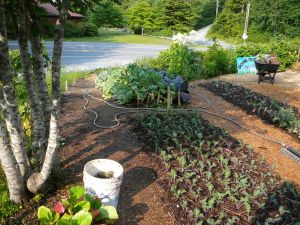
Some of the garden beds at Down To Earth u-pick garden in July

Some of the garden beds at Down To Earth u-pick garden in July

A woman checks out some broccoli she picked in July at Down To Earth u-pick garden in Sitka

A woman checks out some broccoli she picked in July at Down To Earth u-pick garden in Sitka

Down To Earth u-pick garden is a good place for families to pick fruits and veggies together

Down To Earth u-pick garden is a good place for families to pick fruits and veggies together

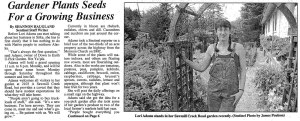
Sentinel-UPickFarm-June19,2009_Page_1

Sentinel-UPickFarm-June19,2009_Page_2

• Sitka Local Foods Network featured in Christian Science Monitor

A screenshot of the Christian Science Monitor site showing the Sitka Local Foods Network story

A screenshot of the Christian Science Monitor site showing the Sitka Local Foods Network story

A July 17 Daily Sitka Sentinel article about the Sitka Local Foods Network that was picked up by the Associated Press newswire still has legs. It showed up in the Christian Science Monitor on Thursday (Click here to read the story). It’s nice to see we’re still getting some national exposure.

The Alaska Dispatch blog saw the story in the Christian Science Monitor and posted this response (Click here to read it).

• Tlingít potato makes a comeback in Juneau

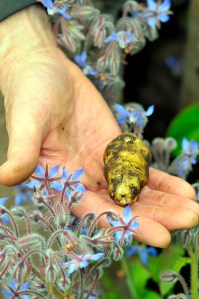
(Photo courtesy of Klas Stolpe/Juneau Empire) Bill Ehlers, assistant gardener at the Jensen-Olson Arboretum in Juneau, holds a Tlingít potato next to some borage plant flowers.

There was an interesting article in Wednesday’s edition of the Juneau Empire about the revival of a Tlingít potato that was a staple in Tlingít gardens for hundreds of years (Click here to read the Juneau Empire article by Kimberly Marquis).

Tlingít and Haida gardeners grew their own vegetables more than 200 years ago, and potatoes were one of their most important crops. In an article in the Winter 2008/2009 newsletter for Alaska EPSCoR (Experimental Program to Stimulate Competitive Research), University of Alaska Southeast social science/anthropology student Elizabeth Kunibe said residents of many Southeast Alaska villages planted gardens of root vegetables — such as potatoes, rutabagas and parsnips — on neighboring islands in the spring while they headed to their fish camps. They harvested them when they returned home in the fall (Click here to read the article on Pages 4-5).

Kunibe said many of these gardens disappeared over the past century, especially as the U.S. Forest Service parceled out some islands for homesteads or fox farms. She said Tlingíts in Sitka lost their island gardens in World War II when the government forbade private water travel. The increasing availability of imported food and other disruptions, such as tuberculosis outbreaks, also sped up the demise of the individual and community gardens found in many Native villages. Kunibe said in 1952 they grew 4,000 pounds of potatoes in Angoon, but the gardens disappeared and Angoon was without a garden until the last year or two when there was a movement to start a community garden.

The Tlingít potato is a fingerling potato with a yellowish skin and somewhat lumpy shape. They do not do well mashed or fried, but taste great in soups or roasted, said Merrill Jensen, manager of the Jensen-Olson Arboretum in Juneau where they expect to harvest about 1,500 pounds of the potatoes next month. The Tlingít potato also is known as “Maria’s Potato” in honor of the late Maria (Ackerman) Miller, the Haines woman who in 1994 gave Juneau’s Richard and Nora Dauenhauer their first seed potatoes. Miller, who died in 1995, told the Dauenhauers the potatoes had been in her family for more than 100 years.

According to Kunibe, who sent samples to a plant geneticist for DNA testing, the Tlingít potato is a distinct variety among potatoes, but they are very similar to two other varieties of Native American potatoes — the Ozette or Makah potato from Washington State’s Olympic Peninsula and the Haida potato from Kasaan on Alaska’s Prince of Wales Island. In a June 7, 2007, article in the Chilkat Valley News (click here to read it), Kunibe said potatoes arrived in Southeast Alaska aboard Spanish ships as early as 1765. She said the three Native American varieties are closely related to potatoes grown in Mexico and the Chilean coastal areas. (Most modern domestic potatoes are descended from species native to the Peruvian Andes.) The Tlingít potato grows well in our rainy climate and keeps a long time in a root cellar. Kunibe said the potatoes became a prime Southeast Alaska commerce item in the early 1800s and the Russian fleets contracted with the Tlingít and Haida tribes to grow them.

Bob Gorman, a master gardener who works with the Sitka office of the University of Alaska Fairbanks Cooperative Extension Service, said off the top of his head he didn’t know of anybody growing the potato in Sitka right now, though he did suggest several longtime gardeners who might know if people grew them in the past. Maybelle Filler, a master gardener who works with the SEARHC Diabetes Program, said they are looking to bring some seed potatoes to give to Sitka gardeners, but she had been told the potatoes can’t be sold at local markets (though they can be given away).

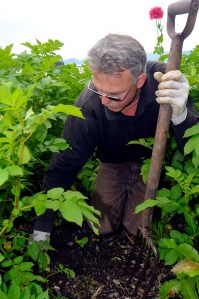
(Photo courtesy of Klas Stolpe/Juneau Empire) Bill Ehlers, assistant gardener of the Jensen-Olson Arboretum in Juneau, tends to a Tlingít potato plant on July 27, 2009. The potatoes will be used as seed stock to be distrbuted to people interested in growing the variety.

• Local foods articles in Capital City Weekly and Fairbanks Daily News-Miner

This week’s issue of Capital City Weekly, a free weekly newspaper distributed throughout Southeast Alaska, included four local food-related stories. The Fairbanks Daily News-Miner, a daily paper in Fairbanks, also has had a couple of local food-oriented stories the past couple of days. Here are some links to the articles.

Click here to read a Capital City Weekly article on a new community garden being built behind the Glory Hole homeless shelter in downtown Juneau.

Click here to read a Capital City Weekly article on the Montessori Borealis Adolescent Program’s vegetable garden project in Juneau’s Mendenhall Valley.

Click here to read a story about a couple of upcoming University of Alaska Fairbanks Cooperative Extension Service classes this weekend in Juneau about how to market specialty food products (geared toward people selling at farmers markets).

Click here to read a Capital City Weekly article on home canning of crab and geoducks by Sonja Koukel of the Juneau office of the UAF Cooperative Extension Service.

Click here to read a Fairbanks Daily News-Miner story from Wednesday’s paper from Roxie Rodgers Dinstel of the Fairbanks office of the UAF Cooperative Extension Service about how fireweed (which grows wild in Sitka) can add a subtle flavor to different meals.

Click here to read a Fairbanks Daily News-Miner story from Tuesday’s paper about how Fairbanks students are turning their schoolyards into blooming gardens as part of the EATING (Engaging Alaska Teens IN Gardening) program run by the Calypso Farm and Ecology Center. Click here to read more about the EATING program on the Calypso Farm site.

• Gardening column reminds us time to harvest food is now

Anchorage Daily News garden columnist Jeff Lowenfels, a member of the Garden Writers Association Hall of Fame, in his column on Wednesday reminded us that the time to begin harvesting our vegetable gardens starts now. We don’t want to let any food go to waste on the ground. If we don’t want the food, there are others who do.

In his column, Lowenfels tells us which plants to harvest and how to do it, with special tips for broccoli, Kohlrabi, cauliflower, carrots and others. While geared toward the Anchorage audience, the column is worth a read for Sitka gardeners.

On a side note, Lowenfels is the garden columnist who first suggested the “Plant a Row for the Hungry” campaign, which encourages gardeners to plant an extra row or two of food that will be donated to local homeless shelters or food banks. He raised the idea in his column as a way to help out Bean’s Cafe, an Anchorage soup kitchen, and the Garden Writers Association liked the idea so well that they made it a national effort.

Click here to read the Anchorage Daily News gardening column by Jeff Lowenfels about the time to harvest is now

Click here to learn about the Garden Writers Association’s “Plant a Row for the Hungry” campaign