• Vote for the Sitka Local Foods Network and help us win $15,000 for St. Peter’s Fellowship Farm

GardensForGood

StPetersSignWithToDoListSignHelp us grow the St. Peter’s Fellowship Farm communal garden program by voting for the Sitka Local Foods Network in the Nature’s Path Organic Foods Gardens For Good contest.

People can vote once per day from Monday, June 22, through 10:59 a.m. (Alaska time) on Monday, July 6. The top three vote-getters (two from the United States, one from Canada) will win $15,000 each to support their urban gardening efforts. We are the only project from Alaska among the 120 entrants.

“The Gardens for Good program is a way to fund the terrific things we are doing in Sitka through the Sitka Local Foods Network to get healthy, fresh and local produce into the mouths of Sitkans,” Sitka Local Foods Network Board President Lisa Sadleir-Hart said. “Take time to vote once a day so we can make it into the final nine. We could really do a lot with $15,000!”

The St. Peter’s Fellowship Farm communal garden was built in 2008, shortly after that year’s Sitka Health Summit, when a majority of Sitkans said they wanted to see more community gardens/greenhouses in Sitka and they wanted a local foods market. The Sitka Farmers Market was launched a couple of months later, with produce grown at St. Peter’s Fellowship Farm for sale to Sitka residents.

A group of kids harvests garlic during an Aug. 12, 2011, work party at St. Peter's Fellowship Farm.

A group of kids harvests garlic during an Aug. 12, 2011, work party at St. Peter’s Fellowship Farm.

Since then St. Peter’s Fellowship Farm (located behind St. Peter’s By The Sea Episcopal Church, 611 Lincoln St.) has grown and it now produces several times the amount of local produce as what was for sale that first year. We also have added a few satellite gardens to help us grow even more produce in Sitka, and we still sell it at the Sitka Farmers Markets. People with Alaska Quest (SNAP) and WIC benefits can purchase the local produce using matching funds, so they can double the value of their vouchers. St. Peter’s Fellowship Farm produce is sold to school lunch programs, and we host a table during non-market weekends at the Chelan Produce stand.

In addition to growing local produce to sell to Sitka residents, St. Peter’s Fellowship Farm has been used to teach locals about gardening. It’s also a fun place for kids to become more connected to their food. We also will use the $15,000 to continue our garden mentor program for another year or two and to help support the development of the Sitka Kitch community commercial kitchen project.

Don’t forget to vote for us once per day now through the morning of July 6. Your support is greatly appreciated. Please use this link, http://wshe.es/fZ1TjYIj, to share on your social media sites, letting people know where they need to go to vote for us.

• Take the $5 Per Week Alaska Grown Challenge and help improve Alaska’s food security

AlaskaGrown2_Graphic

AlaskaGrown3_GraphicThe Alaska Farm Bureau announces the $5 Per Week Alaska Grown Challenge – a statewide campaign to increase consumer spending on Alaska Grown products with the goal of strengthening local economies and increasing Alaska’s food security.

The Kenai Peninsula Chapter of the Alaska Farm Bureau, in partnership with the Kenai Soil and Water Conservation District and several other local organizations (including the Sitka Local Foods Network), launched the $5 Per Week Alaska Grown Challenge on May 5, in honor of Alaska Agriculture Day. Now the Challenge is going statewide with the help of social media, Alaska Farm Bureau chapters, and local food advocates across the state.

“We’d like to see the state investing in agriculture the way it invests in the resource extraction industries,” said Heidi Chay, district manager of the Kenai Soil and Water Conservation District. “After all, everyone needs to eat, and Alaska is at the end of a very long and vulnerable food chain. The signs of agriculture’s growth potential are all around us. … However, if the state can’t or won’t invest in agriculture the way it should, it’s on Alaskan consumers to take the lead. That’s why the District joined with local partners last month to launch the $5 Per Week Alaska Grown Challenge. We’re calling on Alaskans to invest a small part of their food dollars in the future of Alaskan agriculture, by spending $5 per week per person year-round. Farmers market season is a great time to start.”

Sitka residents will be able to participate in the Challenge by purchasing local veggies at the Sitka Farmers Markets this summer. The markets take place from 10 a.m. to 1 p.m. on alternate Saturdays, July 4, July 18, Aug. 1, Aug. 15, Aug. 29, and Sept. 12, at the Alaska Native Brotherhood Founders Hall, 235 Katlian St.

“I’m excited by the prospect of growing local producers pocketbooks with the $5 Per Week Alaska Grown Challenge in Sitka,” said Lisa Sadleir-Hart, Sitka Local Foods Network Board President. “It’s about supporting local foods and your neighbors as well as giving your body the benefit of fresh food. I plan on spending at least $5 a week on local food and doing it at the Sitka Farmers Market makes absolute sense.”

The Challenge calls on Alaskans to spend $5 per week per person on Alaska Grown products year-round. With farmers market season just around the corner, this is the perfect time for Alaskans to commit to investing a portion of their consumer dollars in the future of Alaskan agriculture.

graphic1Agriculture has played an important role in Alaska’s history. Today it is a growing industry with increasing numbers of farms producing food, forage and fiber for local consumers, as well as peonies and rhodiola for sale around the world.

Although farm production is rising, the economic potential of Alaskan farms is far from realized.  More than 95 percent of Alaska’s food is imported, which means that most of our food dollars are leaving the state.

Are Alaska farmers prepared to scale up to meet increasing demand? Yes. According to the Alaska Division of Agriculture, 67 percent of Alaska farmers surveyed indicate that they would increase production if they had more market options. Meanwhile, a warming climate and the rapid adoption of season-extension technologies such as high tunnels are creating more favorable conditions for agriculture.

The Alaska Farm Bureau is calling on every resident in Alaska to join the $5 Per Week Alaska Grown Challenge. If every Alaskan spent $5 per week on Alaska Grown products, year-round, it would have a $188 million dollar impact.

Why buy Alaska grown? Not only are you supporting Alaskans and boosting our economy, you’re also getting a fresher, tastier, more nutritious product. In a blind taste test, 82 percent of Alaskans surveyed could taste the difference between products grown here and those shipped up. Adults and kids say Alaska grown is sweeter, fresher-tasting and crispier.

The $5 Per Week Alaska Grown Challenge isn’t hard. The key, simply enough, is to eat what grows here. You can find a wide variety of produce and value-added products like bread, jam and pickles at farmers markets throughout the summer. Alaska Grown carrots, potatoes, cabbage, milk and barley products (flour, couscous and even pancake mix!) are available year-round in local grocery stores, joined by lettuce, tomatoes, cucumbers and broccoli during the growing season. Local farms produce meat, poultry, eggs and honey, which are available direct from the farm and at locally-owned retailers. Farmers grow more than just food; Alaska also has cut flower and natural fiber industries with products available. Local restaurants, breweries, distilleries and wineries purchase local products to use in their recipes. And don’t forget our local seafood products.

Not sure where to find Alaska Grown? Check out the $5 Per Week Alaska Grown Challenge website (http://www.alaskafb.org/challenge/) where you will find links to local and statewide resources including the Alaska Grown Source Book, a list of local producers and farmers markets. Be sure to ask for Alaska Grown when you are eating out as well.

Take the challenge: $5 per person per week. You’ll help local farmers, boost the local economy, increase Alaska’s food security, and eat better too. Sign up for the challenge here, http://www.alaskafb.org/challenge.

• Taste of Alaska white paper

• KCAW-Raven Radio features Sitka Local Foods Network’s garden mentoring program in story

KubackiCoupleWithGarden

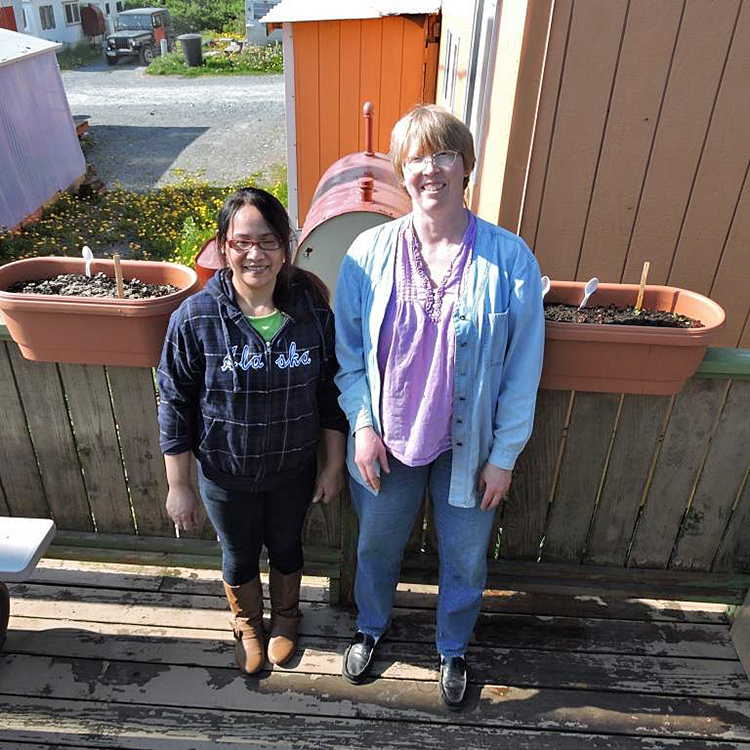
Vegetable gardening used to be a necessity for Sitka residents back in the day, but regular barges and daily flights made it easy for people to stop growing their own food and buy it at the store. If you didn’t have your own garden, you didn’t have fresh veggies. In recent years grocery prices and shipping costs have gone up significantly, so more Sitka residents are going back to gardening. But there are some Sitkans who haven’t gardened before.

That’s where the Sitka Local Foods Network garden mentoring program comes in. This program started in 2014 when the network mentored two first-time gardeners and their families through a year of growing four basic crops that do well in Sitka — lettuce, kale, potatoes and rhubarb. This year, our two original families are back for a second year with slightly trickier crops (carrots, chard, peas and green onions), and we have four new first-year families in the program.

Recently, KCAW-Raven Radio reporter Vanessa Walker attended a class at the home of Rebecca Kubacki to learn more about the program and how it’s helping Rebecca reconnect with her food (click here to listen to the story). All of our free garden mentoring program classes are open to the public and we try to announce the classes enough in advance so people can attend.

Michelle Putz has been contracted to coordinate the program and design lesson plans, after the Sitka Local Foods Network received a community development grant from First Bank. We also have about a half-dozen experienced Sitka gardeners who serve as mentors for the program.

For more information about the garden mentor program, please contact Michelle Putz at 747-2708.

• USDA offers cost-share assistance program to help farms get certified as organic

Carrots2

2000px-USDA_organic_seal.svgWith the growth of the local foods movement in recent years, many consumers are more aware of the health benefits of eating organically grown food. But in Alaska, getting certified as organic is a challenge due to high costs and no accredited certifying agents being in the state.

In an effort to meet the growing demand for organic food, the U.S. Department of Agriculture (USDA) introduced two cost-share assistance programs to increase the number of farmers and manufacturers working with organic products. The programs cover three-quarters of the certification costs, up to $750 per category (up to $3,000 total), for each of the four categories of organic food — crops, livestock, processed products, and wild crops.

“The organic industry saw record growth in 2014, accounting for over $39 billion in retail sales in the United States,” said Agriculture Secretary Tom Vilsack. “The organic certification cost-share programs help more organic businesses succeed and take advantage of economic opportunities in this growing market.”

The USDA Agriculture Marketing Service National Organic Program (NOP) has allocated approximately $11.9 million to participating state departments of agriculture to help defray the costs of organic certification incurred by organic producers and processors. Reimbursements to organic operations will be made under the Agricultural Management Assistance (AMA) Certification Cost Share Program or the National Organic Certification Cost Share Program (NOCCSP).

The cost-share programs were included in the 2014 Farm Bill. NOCCSP has approximately $11 million available for producers and processors in participating states, U.S. territories and the District of Columbia. AMA has $900,000 for producers in 16 participating states (Alaska is not in the AMA program).

Each state has its own application process, and Barbara Hanson from the Alaska Division of Agriculture in Palmer is Alaska’s contact for the NOCCSP program. She can be contacted at (907) 761-3854 or barbara.hanson@alaska.gov. The program this year is for organic certification costs incurred between Oct. 1, 2014, and Sept. 30, 2015.

Organic certification is important because no food can claim to be organic without the certification, even if it’s grown or processed following organic standards. In Alaska, this has been a challenge because it’s difficult to get a USDA-accredited certifying agent out to our farms and there are none based in our state. So many Alaska farms go without the label. Click this link to learn more about the process for becoming certified as an organic farm.

• 2014 Alaska USDA organic certification cost-share program letter

• 2014 Alaska USDA organic certification cost-share program application

• What Is Organic Certification Fact Sheet

• USDA Organic Cost-Share Programs Information Sheet

• More classes set in 2015 Sitka Local Foods Network garden mentor program

KubackiCoupleWithGarden

DasallaAndPutzThe fourth classes for the 2015 Sitka Local Foods Network garden mentor program have been set for our four participating first-year families, and the classes will be open to the public. The classes will be similar at each location, except one where we will be planting a container garden instead of our usual raised garden beds.

The fourth class of the six-class series is about early harvesting and learning about which crops are ready to be picked and which should be left in the garden to grow some more. For our first-year gardener families, we teach them how to grow four hardy crops for Sitka — kale, lettuce, potatoes and rhubarb. These classes are essentially the same, so feel free to attend the class that best fits your schedule.

The class schedule and location for these first-year families is:

  • Josephine Dasalla, 1709 Halibut Point Rd., No. 31 (green trailer) — 4:30 p.m., Monday, June 8.
  • A.J. Bastian, 207 Brady St. — 4 p.m., Thursday, June 11.
  • Rebecca Kubacki, 1202 Halibut Point Rd. — 7 p.m., Tuesday, June 16.
  • Breezy, 616 Sawmill Creek Rd. — 6:30 p.m., Wednesday, July 1 (Note: this class was postponed from its original date of June 24).

Please note the classes at the Dasalla residence involve container gardens instead of building raised garden beds like we’ve done for our other families.

In addition, the third class for one of our other first-year students (Breezy) and second classes for our second-year students also have been set. These will be garden maintenance classes (slug and pest control, thinning, watering, garden care, etc.).

The two second-year families (Anna Bradley and Tami O’Neill) participated in the inaugural year of the program last summer, and now they’re back for more. Our two returning families will be planting carrots, chard, green onions and peas this year, which are slightly more difficult to grow than our chosen crops for first-year students. Even though this year’s crops are more difficult to grow, many gardeners in Sitka still have good results with these vegetables.
Again, the classes at each location will be similar, and they are free and open to the public. The schedule is:
  • Breezy, 616 Sawmill Creek Rd. — 6:30 p.m. on Thursday, June 4.
  • Anna Bradley, 4764 Halibut Point Road, 4 p.m. on Saturday, June 6.
  • Tami O’Neill, 2309 Merganser Drive, 5:30 p.m. on Wednesday, June 17.

BastianPutzAndSpiveyWithBigCheckMichelle Putz has been contracted to coordinate the program and design lesson plans, after the Sitka Local Foods Network received a community development grant from First Bank. We also have about a half-dozen experienced Sitka gardeners who serve as mentors for the program.

For more information about the garden mentor program, please contact Michelle Putz at 747-2708.

• USDA Natural Resources Conservation Service offers funding support program for high tunnels

picture8

The deadline is coming up for the next round of applications for the U.S. Department of Agriculture’s Natural Resources Conservation Service (NRCA) cost-sharing program. This program enables qualifying landowners who produce food to build high tunnels with financial assistance from the USDA.

The next NRCA Alaska program deadline is June 15. However, the program usually sets two applications deadlines a year so applications can be batched and ranked. Applications that miss the June 15 deadline will be held for the next deadline (usually Sept. 15, but it hasn’t yet been posted online).

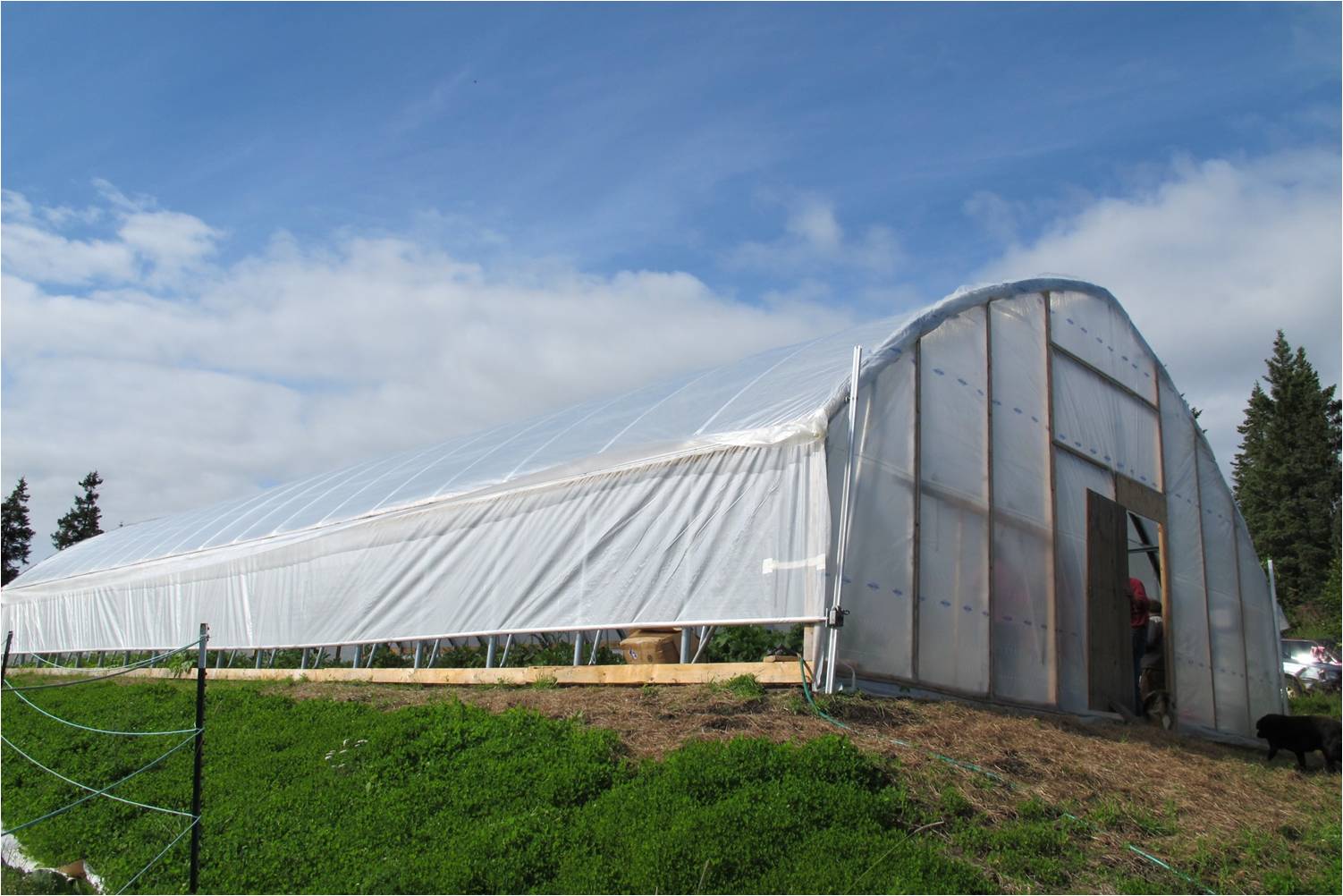
High tunnels, also known as hoop houses or temporary greenhouses, extend the growing season so more food is produced before and after the traditional weather dates for growing stuff outdoors. They also can help with irrigation and drainage, and with pest control.

High tunnels are different than greenhouses in that they are passively heated by the sun, so they have lower energy costs than greenhouses. High tunnels are at least six-feet tall, so people can walk upright in them. Low tunnels, which usually involve some PVC pipe bent over a garden bed and covered with row cover, aren’t eligible in this program. Food in high tunnels is planted either directly into the ground or in raised beds. To learn more about the USDA’s high tunnel program, click here, and click here to get information about the application procedure. This link has frequently asked questions and answers about seasonal high tunnel systems for crops.

Picture10This program started a couple of years ago as a pilot program, but now is a permanent part of of the NRCS EQIP (Environmental Quality Incentive Programs). The program recently was revamped, and one major change is there now is no size restriction on the structures NRCS provides cost-sharing funds (previously it was limited to up to 2,178 square feet, or 5 percent of one acre). Also, geodesic domes are now eligible. Both the land owner and land must meet certain eligibility requirements.

Funding is provided on a reimbursable status once the high tunnel is installed and certified to meet NRCS standards. In 2012 there was just one high tunnel in Sitka, but in 2013 there were six. Other areas of the state, such as Homer, have built dozens of high tunnels through the program.

For information regarding the NRCS technical service or program participation in Southeast Alaska, please contact Samia Savell or Will Murray at the Juneau field office at (907) 586-7220 or 586-7208, or send email to samia.savell@ak.usda.gov or william.murray@ak.usda.gov. The June 15 deadline is the first deadline for the Fiscal Year 2016 funding cycle. Click here for a link to the Alaska NRCS page. Click here for an interview with Samia Savell on KRBD-FM (Ketchikan) about the program.

• High Tunnel In Alaska Fact Sheet (March 2014)

• Flier about Southeast Alaska cost-sharing program for FY2016 (March 2015)

• Check out the June 2015 edition of the Sitka Local Foods Network newsletter

SLFNJune2015NewsletterScreenshot

The Sitka Local Foods Network just sent out the June 2015 edition of its newly launched monthly newsletter. Feel free to click this link to get a copy.

This edition of the newsletter has brief stories about several new street food options in Sitka that are highlighting local seafood, a Blessing of the Garden ceremony at St. Peter’s Fellowship Farm, an update on a June 2 meeting for prospective and past vendors of the Sitka Farmers Market, and a reminder about the Plant a Row for the Hungry program. Each story has links to our website for more information.

You can sign up for future editions of our newsletter by clicking on the registration form image in the right column of our website and filling in the information. If you received a copy but didn’t want one, there is a link at the bottom of the newsletter so you can unsubscribe. Our intention is to get the word out about upcoming events and not to spam people. We will not share our email list with others to protect your privacy.

• Scenes from the May 13 Blessing of the Garden service at St. Peter’s Fellowship Farm

RevJuliePlatsonBlessesRhubarb

Parishioners from St. Peter’s By The Sea Episcopal Church held a Blessing of the Garden service on Wednesday, May 13, at St. Peter’s Fellowship Farm communal garden, where they prayed for a bountiful harvest from the garden used by the Sitka Local Foods Network to grow veggies for the Sitka Farmers Market, school lunch and food assistance programs, etc. The service was led by Kit Mellema, and as part of the rogation service tradition in the church the parishioners walked to all corners of the property as Rev. Julie Platson, the new priest in charge at St. Peter’s, sprinkled holy water on the various vegetable garden beds, trees and flowers. A photo slideshow from the service is linked below.

This slideshow requires JavaScript.

• Kindergartners learn about planting a garden at Russian Bishop’s House

Sitka National Historical Park volunteer gardener Pam Vanderweele helps Baranof Elementary School kindergartner Arianna Moctezuma-Hernandez, 6, plant peas in the Russian Bishop’s House garden on a recent sunny morning. The kindergartners will return to the historical garden in the fall when they are in the first grade to harvest the crops and cook them in a soup. (Daily Sitka Sentinel Photo by James Poulson)

PLANTING A GARDEN: Sitka National Historical Park volunteer gardener Pam Vanderweele helps Baranof Elementary School kindergartner Arianna Moctezuma-Hernandez, 6, plant peas in the Russian Bishop’s House garden on a recent sunny morning. The kindergartners will return to the historical garden in the fall when they are in the first grade to harvest the crops and cook them in a soup. (Daily Sitka Sentinel Photo by James Poulson)

• Rev. Julie Platson to host a blessing of the garden service at St. Peter’s Fellowship Farm

StPetersSignWithToDoListSign

Rev. Julie Platson, the new priest in charge at St. Peter’s By The Sea Episcopal Church, will host a short “blessing of the garden” service at 5:30 p.m. on Wednesday, May 13, at St. Peter’s Fellowship Farm.

St. Peter’s Fellowship Farm is a communal garden located behind St. Peter’s By The Sea Episcopal Church (611 Lincoln Street). This communal garden is where the Sitka Local Foods Network grows most of the fresh veggies it sells at the Sitka Farmers Market, to local school lunch programs, on Chelan Produce weekends, and for food assistance programs.

“It will be a short service of prayers and blessings of the gardens and the work you do,” Rev. Platson wrote in an email to the Sitka Local Foods Network board of directors.

The church decided to host the blessing of the garden service as part of its usual Wednesday services, since this Wednesday is known as “a ‘rogation day’ in our tradition — a day to ask God’s blessings on gardens, farms, the labor and the work,” Rev. Platson wrote.