• Lori Adams discusses slugs in her latest Daily Sitka Sentinel garden column

(Lori Adams, who owns Down-To-Earth U-Pick Garden and is a frequent vendor at the Sitka Farmers Market, will be writing a regular garden column in the Daily Sitka Sentinel this summer. The Sentinel is allowing us to reprint the columns on this site after they first appear in the newspaper. This column appeared on Page 4 of the Wednesday, April 4, 2012, edition of the Daily Sitka Sentinel.)

GARDENING IN SITKA

By Lori Adams

SLUGS!

Sitka gardeners do not struggle with a lot of pests, but the few that we do have give us plenty of trouble. The worst pests I have encountered in my garden are slugs, root maggots and aphids — and the slugs are by far the biggest problem.

I have had slugs wipe out an entire bed of young lettuce plants in one night! Large slugs eat entire plants, leaving their silvery trails behind them; and tiny slugs hide in the cracks and voids of  bushy plants, riddling them with holes. The only real solution I have found for slugs is ducks.

Ducks love to eat slugs!  They love the rain, they provide delicious eggs and meat and they are endlessly entertaining. My “herd” of ducks spends every waking moment foraging for slugs and other creepy crawlers in my garden!  I could go on and on about the benefits of raising ducks, but I will try to focus on other solutions in this column.

Slugs thrive in damp, cool, dark areas — a perfect description of a Sitka garden!  They are migratory by nature, coming out mostly at night to do their damage and slinking away before daylight. You need to think of the battle against slugs as a war that never ends.  There is no permanent fix because no matter how many you kill they will continue to migrate in.

The best strategy in this war is to make your entire property a hostile environment for slugs. Cut down all brush, salmonberries and grass — TO THE GROUND.  You would be surprised how many slugs live in these areas, just close enough to your garden to provide shelter during the day. Remove all piles of brush, stacks of lumber and other junk. (Compost heaps do not pose a problem if they are kept active and hot).  Potted plants in the garden should be up on blocks to prevent slugs from living underneath them.

Slugs can crawl over virtually any surface but they do not prefer shells, wood chips, sand or gravel so use one of these materials to create a clear perimeter around your garden. Remove ornamental ground cover. My ducks can spend an hour in a patch of ground cover — what does that tell you?  It’s the perfect environment for slugs! Finally, think about getting rid of your lawn. I loved my lawn and still miss it very much, but slugs love lawns.

One other strategy is bait, but rethink how you use it. If the theory is that slugs just happen to fall into it or eat it on their way by, then you should have hundreds of bait traps scattered around your garden. If on the other hand bait actually lures slugs in then DON’T put bait in the middle of your garden! Put it far away to draw slugs away from your vegetables.

Next week’s column — Feeding Your Plants.

Brought to you by Down-To-Earth U-Pick Garden

2103 Sawmill Creek Road

Open June-August / Mon-Sat 11:00-6:00

747-6108 or 738-2241
http://downtoearthupick.blogspot.com/

• Lori Adams provides advice in her latest Daily Sitka Sentinel garden column

(Lori Adams, who owns Down-To-Earth U-Pick Garden and is a frequent vendor at the Sitka Farmers Market, will be writing a regular garden column in the Daily Sitka Sentinel this summer. The Sentinel is allowing us to reprint the columns on this site after they first appear in the newspaper. This column appeared on Page 4 of the Wednesday, March 28, 2012, edition of the Daily Sitka Sentinel.)

GARDENING IN SITKA

By Lori Adams

TAKE MY ADVICE

Your best resource for gardening advice is from experienced, successful Sitka gardeners. Ask them a lot of questions, but be ready for an interesting anomaly … they will give you different answers.

Don’t be confused and get discouraged, and DON’T think that one or both of them is wrong.  Most likely they are both right! They have each been successful and truly believe that their method is the reason why. What you need to do is gather all the information you can and then decide what is the best method for you to try. If that method doesn’t work then you can try one of the other suggested methods.

The one thing you don’t want to do is say something like, “Well, Lori Adams says that you have to raise your beds.”  This is a sure way to irritate them and they may stop offering you advise!  It would be better to form your statement into a question, “Do you think it is important  to raise your beds?” Ask lots of questions and be sure to take notes.

It is also a good idea to have some gardening resource books in your library.  The problem is finding ones that are actually helpful. Sitka has such a unique climate that we just don’t fit into any of the zones addressed in their charts and graphs.

Why are we so different?  For one thing we have a maritime climate. The ocean keeps us warm in the winter and cool in the summer. Our rainfall is 100 inches a year, and the winter is usually just a series of freezes and thaws. We get plenty of daylight hours, but since it is often cloudy we don’t get much sunlight. These are all unique characteristics, and when you put them together it makes gardening difficult. I recommend the following books:

  1. Gardening in Southeast Alaska by the Juneau Garden Club. This is the absolute Bible for gardening in Sitka. Although Juneau is warmer in the summer and colder in the winter than Sitka, this book is full of fabulous information! I try to read through it once a year.
  2. 3-Step Vegetable Gardening by Steve Mercer. This book tells you in simple terms just what you need to know about planting, growing and harvesting most types of vegetables and herbs.
  3. The Welsh Family Forget-Me-Not Gardens by Florence Welsh.  Florence has gardened on their property here since 1984.  In this booklet she generously shares information and seed varieties for successful Sitka gardening.

These books are available in Sitka stores and you can contact Florence for her booklet at florence.welsh@acsalaska.net

It’s also helpful to get a few magazines for information and inspiration.  I recommend Organic Gardening and Mother Earth News.

Next week’s column will address SLUGS!

Brought to you by Down-To-Earth U-Pick Garden

2103 Sawmill Creek Road

Open June-August / Mon-Sat 11:00-6:00

747-6108 or 738-2241

http://downtoearthupick.blogspot.com/

• Lori Adams plants some seeds in her Daily Sitka Sentinel garden column

(Lori Adams, who owns Down-To-Earth U-Pick Garden and is a frequent vendor at the Sitka Farmers Market, will be writing a regular garden column in the Daily Sitka Sentinel this summer. The Sentinel is allowing us to reprint the columns on this site after they first appear in the newspaper. This column appeared on Page 3 of the Wednesday, March 21, 2012, edition of the Daily Sitka Sentinel.)

GARDENING IN SITKA

By Lori Adams

PLANTING SEEDS

Most vegetable seeds can be planted directly outdoors after May 10, but if you have a sunny window you can get a tremendous head start by planting seeds indoors and then transplanting them outside later.

In February, I start celery, tomatoes and leeks. In March, I start broccoli, cauliflower, cabbage, kohlrabi, kale, fennel, herbs, lettuce, spinach, chard, brussel’s sprouts. In April, I start squash and cucumbers. The only things I don’t start indoors are carrots, radishes, peas, beans, beets, turnips, potatoes which I plant in April and garlic which I plant in October. Anyone can have some luck starting seeds, but you can really improve your success rate by paying attention to details.

The killers for indoor seedlings are poor germination and “damping off”(a disease caused by fungi that results in wilting and death). To prevent these things from happening to you, buy high quality seeds packaged for 2012 and sterile potting soil. I have tried to use soil from my garden to save money and it has NEVER worked. You do not want to scrimp on these two things.

Fill the containers of your choice with dampened potting soil and then set them in a shallow tray that will hold water. Be sure the pots are all the same height and the soil is level with the tops of the containers. The soil should just be damp, not waterlogged. Place the trays in any warm spot (60-80 degrees F), cover them with plastic to reduce evaporation and check on them every day.

Once you see some seedlings emerging you can uncover the trays and place the trays in the sun. Reduce the temperature to 40-60 degrees F to prevent them from getting tall and scraggly. From this point on you should only water from the bottom by pouring water in the tray using a watering can rather than a hose with a spray nozzle.

Place an oscillating fan so that it blows gently over the level surface of the soil causing the seedlings to wiggle in the breeze.  Good airflow reduces disease problems and wiggling makes the stems stronger. If you don’t have a fan, brush your hand across the tops of the seedlings twice a day.

When the seedlings start to lean toward the sun you can flip the trays around once in awhile to encourage them to grow as straight as possible. You can plan on transplanting these seedlings outside mid April-mid May. Once outside they will need to be protected with a floating row cover to survive any late freezes.

If you think it might be June before your new beds are ready, just put everything off a month.  Better late than not at all.  Just be sure that your seedlings don’t get too old, they are best when young and fresh!

Next week’s column will focus on how to find good gardening advice.

Brought to you by Down to Earth U-pick Garden

Located at 2103 Sawmill Creed Road

Open June-August / Mon-Sat 11:00-6:00

747-6108 or 738-2241

• Easing concerns about possible radiation in gathered seaweed this year

One of the prime springtime activities around Sitka is for people to gather seaweed, either for subsistence/traditional food purposes or to use it to fertilize local gardens. Seaweed is loaded with lots of healthy vitamins and minerals so it’s eaten by many in Sitka, and it also makes great fertilizer for the garden.

But this spring members of the Sitka Local Foods Network board have been hearing concerns from local gardeners and farmers about the seaweed this year possibly being contaminated by radiation (or iodine 131) from the March 2011 earthquake, tsunami and nuclear accident in Japan. Some of these concerns came after several local residents in recent weeks found Japanese fishing buoys and other debris on beaches around Sitka, and they were fueled by other stories about Japanese debris washing up on Alaska beaches.

Many people have had reservations about harvesting seaweed, either to eat or use in their gardens, and some people were skeptical about official reports that said there was no or limited radiation exposure to debris headed toward Alaska. For those people who want to test their seaweed or soil, the Plant Science Library in Anchorage is not equipped to test seaweed. But there are facilities in Washington State that are willing to test for a fee of between $50 to $200.

For those people who want to track the effects of the Fukushima Dai-ichi on U.S. marine environments, you can track the effects on Alaska coastlines at this congressional site. Other reliable websites for current information include  http://www.fda.gov/newsevents/publichealthfocus/ucm247403.htm  and http://www.srrb.noaa.gov/.

Greg Wilkinson, a public information officer with the Alaska Department of Health and Social Services, provided this link to a three-page handout about the effects of radiation on wild foods in Alaska. The State of Alaska has teamed up with the states of Hawai’i, California, Oregon and Washington, the province of British Columbia, the National Oceanographic and Atmospheric Association (NOAA) and the Environmental Protection Agency (EPA) to provide the Japan Tsunami Marine Debris Joint Information Center.

“Hopefully, disseminating this information to you all will alleviate some concerns about seaweed harvesting this year,” Sitka Local Foods Network board member Johanna Willingham said.

• Lori Adams gets the scoop on dirt in her Daily Sitka Sentinel garden column

(Lori Adams, who owns Down-To-Earth U-Pick Garden and is a frequent vendor at the Sitka Farmers Market, will be writing a regular garden column in the Daily Sitka Sentinel this summer. The Sentinel is allowing us to reprint the columns on this site after they first appear in the newspaper. This column appeared on Page 5 of the Wednesday, March 14, 2012, edition of the Daily Sitka Sentinel.)

GARDENING IN SITKA

Issue No. 3

By Lori Adams

THE SCOOP ON DIRT

If you have any dirt in your yard at all it is most likely ash.  This dirt has very little nutritional value and must be amended. Our local experts recommend the following recipe for building new beds:

  • One-third (1/3) sand (purchased or gathered);
  • One-third (1/3) seaweed (from the high tide line); and
  • One-third (1/3) dirt that you already have.

They also add that if you have to do without one of these three things, you can give up the dirt!  Be very cautious about bringing in someone else’s dirt to supplement what you already have because it may contain invasive weed roots that could plague you for years to come.  I use this recipe faithfully with excellent results.

These items should be gathered and mixed together in your bed as soon as the ground thaws out. Do not pile layers on top of a frozen bed or it will act like insulation and keep the ground frozen longer.  This mixture provides a good basic start.  Different types of crops require specific additional amendments to do their best, but you can add those as the years go by.

One additional thing I’d like to address about dirt is the pH level. Because of the amount of rain we get here in Sitka our soil is acidic.  From what I have read, only a few crops can tolerate this condition — potatoes, carrots, radishes, parsley, and parsnips. It would be a good idea to plant some of these crops your first year.

Rhubarb, mint and most berries thrive in acidic soil but you need to take into consideration that they come back year after year requiring a permanent spot in the garden.  Also, mint must be grown in a container as it can be quite invasive. If you have your heart set on growing something other than these crops you will need to add some fast-acting lime and read up on pH levels. The Internet or any good gardening encyclopedia will cover the subject in depth so I will not go into the details here.

Here are my recommendations for your new bed in order of importance:

  1. potatoes
  2. radishes
  3. rhubarb

This is a realistic plan that will reward you with produce spring, summer and fall.

If you want a little more variety and have time to put in some additional work consider:

  1. Amending a section with extra nitrogen and lime for lettuce;
  2. Putting up a trellis and amending a section with lime and inoculant for peas; and
  3. Sifting a section and amending it with bonemeal for carrots.

Brought to you by Down to Earth U-pick Garden

Located at 2103 Sawmill Creed Road

Open June-August / Mon-Sat 11:00-6:00

747-6108 or 738-2241
• Maximizing Space in Small Gardens handout

• Food advocate Andrianna Natsoulas to discuss the food sovereignty movement on Sunday, March 18

Food advocate Andrianna Natsoulas will give a free presentation about the food sovereignty movement at 5 p.m. on Sunday, March 18, at the Kettleson Memorial Library in Sitka.

Andrianna is a longtime advocate for food and environmental issues. She operates the Food Voices website, which features people from around the world (including Sitka) discussing the importance of developing a sustainable and sovereign food system. She also is writing the book, “Food Voices: Stories of the Food Sovereignty Movement.”

The food sovereignty movement is based on community-based agriculture and fishing, rather than industrial food production. More people are becoming concerned about where their food comes from and how it was produced. They are starting to recognize how local food is fresher, tastes better, puts more money back into the local economy, uses less fuel for transportation, and has fewer chemicals and pesticides.

To learn more about the food sovereignty movement, go to Andrianna’s Food Voices website or e-mail her at andrianna@foodvoices.org.

• Lori Adams discusses building raised garden beds in her Daily Sitka Sentinel gardening column

(Lori Adams, who owns Down-To-Earth U-Pick Garden and is a frequent vendor at the Sitka Farmers Market, will be writing a regular garden column in the Daily Sitka Sentinel this summer. The Sentinel is allowing us to reprint the columns on this site after they first appear in the newspaper. This column appeared on Page 3 of the Wednesday, March 7, 2012, edition of the Daily Sitka Sentinel.)

                                             GARDENING IN SITKA

By Lori Adams

BUILDING BEDS

The following is an overview of my method for building beds:

  1. Cut down any existing brush and use a pickax to break up the soil in the entire area to a depth of at least 6 inches. I prefer this method over simply laying down landscaping cloth and covering it up with soil. If you don’t remove the salmonberry and horsetail roots they will crawl around under the cloth trying to find light, and when they find it they will sprout up through the weak spot and become IMPOSSIBLE to eradicate.
  2. Remove any roots or large stones. Vegetable crops only require the removal of stones that are larger than an egg, unless you are going to grow carrots or parsnips. For these crops you should sift out the gravel because it can cause crooked, twisted or split roots.
  3. Mark out a space no wider than 4 feet for your bed and shovel the surrounding dirt into it. Raised beds are a MUST in rainy, cloudy Sitka. They will drain faster than they would if left the same level as the rest of your yard. Wet soil is cold soil!
  4. Bring in a “clean” material such as wood chips, sand or sea shells for the pathways. This will reduce the amount of mud that is tracked into the house and gives you a nicer surface to kneel on while working.

It is not necessary to build a traditional bottomless box to keep dirt in place. My best bed is just dirt that is mounded up about a foot high and it withstood the entire season of weeding and u-pick traffic. When we built it we simply leaned a long piece of plywood against its side and kneeled against it, then compacted the damp soil along the edge by pounding it with our fists. The plywood was removed and the dirt stayed in place.

Traditional boxes or rock edges provide ideal conditions for weeds, slugs and mold. This being said, I do need something to keep the soil in when I till and keep the ducks out when crops are growing, so I keep experimenting with different types of fencing. My latest prototype utilizes chicken wire, rebar and 2×4’s.

The next step is to amend the dirt which I will address in the next issue.

Brought to you by Down to Earth U-pick Garden

Located at 2103 Sawmill Creek Road

Open June-August / Mon-Sat 11:00-6:00

747-6108 or 738-2241


• Kettleson Library to screen Cooking Channel’s “Hook, Line and Dinner” show featuring Sitka

"Hook, Line and Dinner" TV show host Ben Sargent, of the Cooking Channel, showed up in costume to participate in the Sitka Local Foods Network's Running of the Boots fundraiser on Sept. 24, 2011.

"Hook, Line and Dinner" TV show host Ben Sargent, of the Cooking Channel, showed up in costume to participate in the Sitka Local Foods Network's Running of the Boots fundraiser on Sept. 24, 2011.

Sitka residents who missed the “Hook, Line and Dinner” show’s episode about Sitka are invited to watch the Cooking Channel show in a free public screening at 5:30 p.m. on Tuesday, March 6, at Kettleson Memorial Library.

The show, which originally aired nationally Feb. 23 and 26 on the Cooking Channel, recounted a September trip to Sitka by host Ben Sargent. Unfortunately, the Cooking Channel is not available on any of the GCI Cable TV packages, so many Sitka residents missed seeing the episode.

The show features a fishing trip with Alaska Longline Fishermen’s Association Executive Director Linda Behnken and her family, cooking with Chef Colette Nelson of Ludvig’s Bistro, a visit to the Alaska Raptor Center, and then Ben participates in the Running of the Boots fundraiser for the Sitka Local Foods Network and eats some black cod tips cooked by Sitka Local Foods Network President Kerry MacLane.


• Lori Adams debuts new ‘Gardening in Sitka’ column in the Daily Sitka Sentinel

(Lori Adams, who owns Down-To-Earth U-Pick Garden and is a frequent vendor at the Sitka Farmers Market, will be writing a regular garden column in the Daily Sitka Sentinel this summer. The Sentinel is allowing us to reprint the columns on this site after they first appear in the newspaper. Her first column appeared on Page 6 of the Friday, March 2, 2012, edition of the Daily Sitka Sentinel.)

GARDENING IN SITKA

By Lori Adams

In an effort to encourage more people in Sitka to start growing their own vegetables, I thought I would share some things that I have learned out at the u-pick garden. This column will address basics for people who are new to gardening.

1. THE SITE

The ideal site in your yard for a garden is the area that gets the most sun. If you own your property it helps a great deal to cut down any trees or brush that block sunlight. Even trees on the east and west sides of your property can block a surprising amount. Trees also rob nutrients and moisture that should be going to your vegetables.

The best orientation for rows is running north to south rather than east to west so that the sun heats up both sides of the bed during the course of the day. It is even better if those rows are on a south sloping hill which causes the sun to hit the soil at a more direct angle so more heat is absorbed.

I have rows that run in both directions. The north to south rows warm up faster and have evenly distributed sunlight allowing each plant grow to its full potential. The rows that run east to west tend to have a sunny side and a shady side and the plants in the front shade the plants in the back. If east to west is your only option then it is best to raise the dirt on the back side of the row and grow shorter plants in the front.

Walk around your yard and notice the paths of your sunlight and shade, but remember that in the summer the sun will be higher than it is now.

Good drainage is also very important. Most successful Sitka gardeners raise their beds higher than their existing yard and pathways by about 9 inches. If your yard is on muskeg or usually has puddles you might want to install some drainage tiles. Hillside gardens usually don’t have drainage problems. Many people think you must terrace a hillside to avoid erosion from rain but I have not had trouble with erosion on my hillside beds. The rain soaks through and seeps out the bottom. Walk around your yard and notice where puddles form.

Once you have selected your site don’t try to get the entire garden ready your first year. Building beds can be back-breaking work and you can quickly get discouraged. Set the realistic goal of completing one bed this spring. You will be rewarded with fresh vegetables this summer, and the knowledge that you gain will give you a better idea how to build the rest of the beds in the following years.

Brought to you by Down-To-Earth U-Pick Garden

Located at 2103 Sawmill Creek Road

Open June-August / Mon-Sat 11:00-6:00

747-6108 or 738-2241

• Alaska Food Policy Council releases its 2012-15 strategic plan

The Alaska Food Policy Council recently released its 2012-15 Alaska Food Policy Strategic Plan, which was about a year in development.

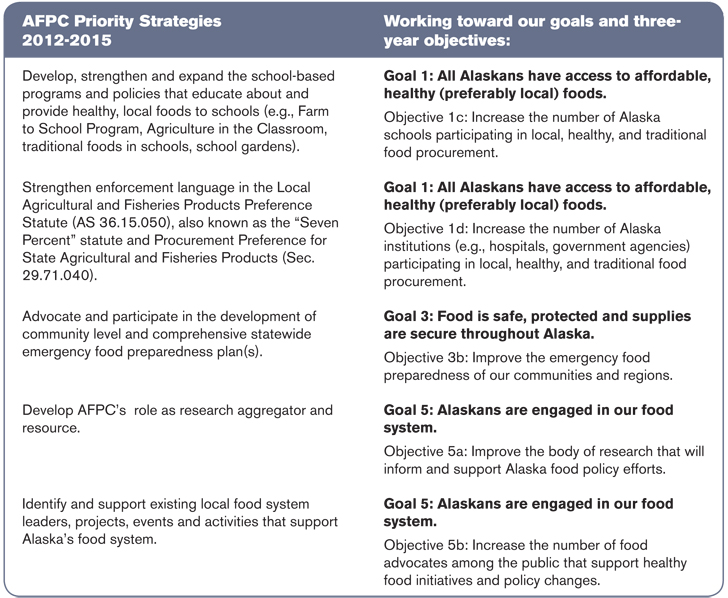
This spring, the council will work on action-planning on its top five priority strategies:

  1. Develop, strengthen and expand the school-based programs and policies that educate about and provide healthy, local foods to schools (e.g., Farm to School Program, Agriculture in the Classroom, traditional foods in schools, school gardens).
  2. Strengthen enforcement language in the Local Agricultural and Fisheries Products Preference Statute (AS 36.15.050), also known as the “Seven Percent” statute and Procurement Preference for State Agricultural and Fisheries Products (Sec. 29.71.040).
  3. Advocate and participate in the development of community level and comprehensive statewide emergency food preparedness plan(s).
  4. Develop AFPC’s role as research aggregator and resource.
  5. Identify and support existing local food system leaders, projects, events, and activities that support Alaska’s food system.

“The Alaska Food Policy Council has been working toward this strategic plan since May 2010,” said Diane Peck, MPH, RD, a community and evaluation specialist with the Alaska Obesity Prevention and Control Program who leads the council. “Initial committees worked to identify Alaska’s food system issues and concerns and then the strategic planning group worked to turn those into our goals and strategies. It’s exciting to see such a broad spectrum of food system stakeholders come together to develop a clear and concise plan that will help guide local, regional and statewide food systems planning in Alaska.”

“The Alaska Food Policy Council works to strengthen Alaska’s food systems to spur local economic development, increase food security, and improve nutrition and health,” according to the council’s website. “The council serves as a resource for information on local and state food systems, and works to identify and propose policy and environmental changes that can improve the production, processing, distribution, health, security and safety of our food.”

According to the council’s website, “the long-term goals of the Alaska Food Policy Council are to identify barriers to building a viable Alaska food system, create a strategic plan to address these barriers, and make the necessary recommendations to decision makers to implement this plan. Diverse stakeholders from around the state have been invited to participate, including representatives for commercial farmers, farmers’ markets and CSAs; fisheries and fish processors; distributors; institutional purchasers; private-sector businesses; legislators; consumers; Alaska Native tribal organizations; food security organizations; environmental organizations; and local, state, and federal government agencies.

”

The Sitka Local Foods Network is represented on the Alaska Food Policy Council by Lisa Sadleir-Hart, MPH, RD, CHES, ACE, community nutrition department manager for SEARHC Health Promotion and the treasurer of the Sitka Local Foods Network.

“Being involved in the Alaska Food Policy Council has deepened my commitment to making local food a reality in Sitka,” Lisa said. “It’s also made me realize that we are already a community ‘on the map’ when it comes to food issues and creative responses. Sitka is considered to be one of the leading communities in the state, on par with Fairbanks/Ester/Delta Junction and Homer.”

The Alaska Food Policy Council will meet April 4-5 in Anchorage for a face-to-face meeting to action-plan the five priority strategies. People interested in providing feedback on the plan should contact Diane Peck at diane.peck@alaska.gov.

• 2012-15 Alaska Food Policy Council Strategic Plan