
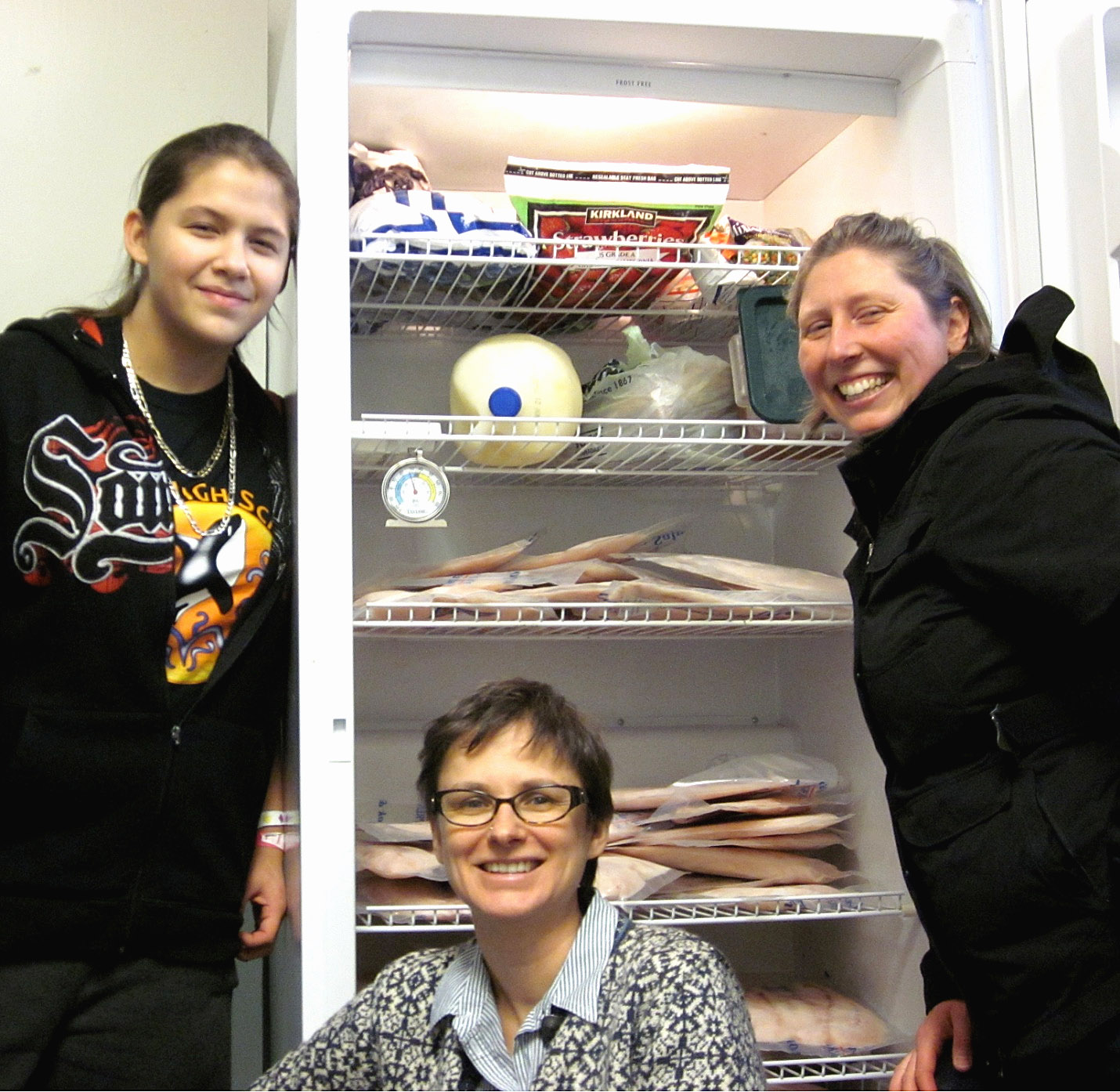
Pacific High School student Jessie Young, left, co-principal Sarah Ferrency, center, and lunch coordinator Johanna Willingham load rockfish into the freezer at Pacific High School. an alternative high school in Sitka, Alaska. (PHOTO COURTESY OF TRACY GAGNON / SITKA CONSERVATION SOCIETY)
Pacific High School now serves local seafood in the cafeteria and joins the growing ranks of schools connecting to local foods. Starting Wednesday, Feb. 1, Pacific High students will have a choice of local seafood dishes twice a month due to a partnership with the Sitka Conservation Society.
Sitka, Alaska, is the ninth largest fishing port in the country, but only recently did school children have access to the abundance of local seafood in school lunches. The project began in 2010 after getting more fish in school lunches was voted on as one of Sitka’s four health priorities at the Sitka Health Summit. The Sitka Conservation Society took the lead on the project and partnered with Blatchley Middle School in the winter of 2010-11 school year and then with Keet Gooshi Heen Elementary School in 2011-12 to launch a Fish to Schools program. Due to the success of that program, it has evolved and spread to another school in the community.
Tracy Gagnon, Fish to Schools coordinator at Sitka Conservation Society said, “To kick off the new partnership, SCS’s Fish to Schools program will cook with Pacific High students to rally support for local fish lunches. A favorite recipe will be chosen for an upcoming Fish to Schools benefit.”

LOCALLY MADE– Americorps Volunteer Lauren Hahn, left, and Pacific High School students in the culinary arts program, Brendan Didrickson and Jenny Jeter, prepare a lunch of Caribbean rockfish with sweet potato fries, baked apples and wild rice at the school on Wednesday, Feb. 1. This was the first Pacific High lunch in the Fish to Schools program. The program began in 2010 as a Sitka Health Summit project when Sitka Conservation Society joined Blatchley Middle School to serve locally caught fish in school lunches. Since then, Keet Gooshi Heen Elementary School and now Pacific High have joined the twice-monthly program. On Wednesday, Feb. 8, SCS is inviting commercial fishers to join students at Keet for lunch. (Daily Sitka Sentinel photo by James Poulson, printed in the Tuesday, Feb. 7, 2012, edition)
Unlike at the middle and elementary schools, Pacific High (the Sitka School District’s alternative high school) has more flexibility in the dishes it prepares with local fish. For example, the first Pacific High local seafood lunch will be Caribbean rockfish with sweet potato fries, baked apples and wild rice. Students help prepare the meals through the school’s culinary arts program. Every student earns their food handlers’ card and annually they cycle through a six-week cooking class. Students graduate high school with enough experience to enter into the cooking industry, bringing with them the knowledge to prepare scratch meals with healthy and local ingredients.
“We are striving to change the system by incorporating more local and traditional foods that the students want to eat,” said Johanna Willingham, Pacific High School lunch coordinator. “Through our innovative food-based meal program, the students are learning valuable life skills by developing recipes they enjoy and cooking with their local bounty.”
The Fish to Schools program creates new partnerships by uniting the local conservation organization and high school with community-based processors and fishermen. That partnership allows more students access to healthy lunches, as fish are packed with vitamins, proteins and omega-3 fatty acids that promote healthy hearts and healthy brains.
“Our community depends on the fish that comes out of the ocean, yet our school lunches were so disconnected from our local resources,” said Beth Short-Rhoads, Fish to Schools volunteer organizer, mother and fishing woman. “Thanks to Fish to Schools, our children now have access to local seafood. The fact that it is incredibly healthy is an even bigger bonus.”
There are more than 9,000 schools across the United States involved with local Farm to Schools programs. The majority of the programs serve land-based foods in the cafeterias, so Pacific High adds another layer by providing local seafood to students. “This is an exciting opportunity to be part of the growing farm — or fish — to school movement across the country,” Gagnon said.
 The Fish to Schools program also serves up local fish dishes at Blatchley Middle School and Keet Gooshi Heen Elementary School on the second and fourth Wednesdays during the school year. On Wednesday, Feb. 8, the program is honoring local commercial fishermen by inviting them to join the students at lunch so they can share the meal and answer questions the students may have about the fish. (Editor’s note: On Feb. 6, Tracy Gagnon, Beth Short-Rhoads and students Grace Gjertsen, Zofia Danielson and Sienna Reid were interviewed by Robert Woolsey about the We Love Our Fishermen! promotion on the Morning Edition show on KCAW-Raven Radio.)
The Sitka Conservation Society has been working to protect the temperate rain forest of Southeast Alaska and Sitka’s quality of life since 1967. SCS is based in the small coastal town of Sitka, in the heart of the Tongass National Forest, the nation’s largest national forest. For more information, go to http://www.sitkawild.org. To learn more about the Fish to Schools program, contact Tracy Gagnon at tracy@sitkawild.org or 747-7509.


 Sitka Local Foods Network
You must be logged in to post a comment.