• Meggan Turner and Kathy Branch win Table of the Day at fifth Sitka Farmers Market

Sitka Local Foods Network Quest Card coordinator Muriel Sadleir-Hart, far left, Sitka Farmers Market assistant market manager Jasmine Shaw, second from left, and Sitka Local Foods Network board member Robin Grewe, right, present the Table of the Day Award to Meggan Turner, center, and Kathy Branch for the fifth Sitka Farmers Market of the season, on Sept. 1, 2012, at ANB Hall. Meggan and Kathy sold organic bread, pasta in gift jars, jams, jellies, pie fillings, and dehydrated fruit. The Sitka Local Foods Network board selects a Table of the Day winner from the vendors at each Sitka Farmers Market of the season, and the winners receive prizes such as a fifth-anniversary market tote bag, produce and a check.

The final Sitka Farmers Market of the summer is scheduled for 10 a.m. to 2 p.m. on Saturday, Sept. 15, at ANB Hall (235 Katlian St.). The Sitka Local Foods Network is seeking volunteers to help set up tables and tents before the market starts, and to tear down and pack up the market after it ends. We need volunteers for this last market. If you have a strong back and helping hands, please contact Johanna Willingham at 738-8336 for more details. Also, if you are a vendor who wants to accept Quest and debit card tokens, please contact Johanna. For more information about the Sitka Local Foods Network and the Sitka Farmers Market, go to http://www.sitkalocalfoodsnetwork.org/

• Easter Group to auction off painted boots to raise money for the homeless during the Sept. 15 Sitka Farmers Market

The Easter Group will raise money for Sitka’s Project Homeless Connect event when it auctions off several pairs of painted rubber boots during the final Sitka Farmers Market of the season, from 10 a.m. to 2 p.m. on Saturday, Sept. 15, at Alaska Native Brotherhood Hall (235 Katlian St.).

The white rubber boots were a donation from Sitka Sound Seafoods, which found them inadequate for its slippery floors. According to Dorrie Ferrell, the unpainted boots were available to Sitka’s homeless residents during the Project Homeless Connect event in January, but only a couple of of pairs were taken. So the boots were given to local artists to paint, and now they will be auctioned off to help raise money for future Project Homeless Connect projects.

The boots will be on display at Kettleson Memorial Library from Sept. 1-14, when they will be moved to a booth at the Sept. 15 Sitka Farmers Market for the auction. The auctioneer will be Brock Bauder. In addition to Project Homeless Connect and other projects to combat homelessness in Sitka, Easter Group also supports the local Blessings in a Backpack program, which sends food home on the weekend with school children whose families need food assistance. For more information, contact Easter Group at info@eastergroup.org.

And don’t forget the Running of the Boots fundraiser for the Sitka Local Foods Network is on Saturday, Sept. 29, at Crescent Harbor shelter, which is a perfect time to wear your newly purchased painted rubber boots. Registration opens and the Sitka Blues Band starts playing at 10 a.m., costume judging is at 10:30 a.m., and the fun run is at 11 a.m.

• Sitka Food Co-op to host first annual membership meeting on Sept. 24

The Sitka Food Co-op will host its first annual membership meeting at 5:30 p.m. on Monday, Sept. 24, at the Rasmuson Center on the Sitka Fines Arts Camp/Sheldon Jackson Campus.

This membership meeting is an important part of the co-op’s development. The co-op incorporated one year ago and now it has to file official by-laws with the Alaska Department of Commerce and Economic Development. The Sitka Food Co-op is a community-based, member-owned buying service dedicated to making wholesome foods and products available to its members as inexpensively as possible.

During this meeting we will establish co-op membership, discuss and vote on the co-op bylaws and elect board members for the next year.

This will affect the bulk ordering aspect of the co-op, so please come and share your opinions and your vote.

“Thanks to you all for making this such a successful operation thus far,” co-op organizer Ann Jenny said. “I look forward to the next phase of our development and, as always, am open to all of your ideas.”

For more information, send an e-mail to Ann at sitkafoodcoop@gmail.com or contact Keith Nyitray at 752-2335. Any person, organization or business interested in becoming a member or just interested in learning about the benefits of becoming a member of the largest local cooperative buying service in Sitka is welcome to attend.

• Sitka Food Co-op annual meeting flier to print out and post around town (PDF file)

• Lori Adams discusses everything she’s learned about growing Brussels sprouts in her latest Daily Sitka Sentinel garden column

(Lori Adams, who owns Down-To-Earth U-Pick Garden and is a frequent vendor at the Sitka Farmers Market, will be writing a regular garden column in the Daily Sitka Sentinel this summer. The Sentinel is allowing us to reprint the columns on this site after they first appear in the newspaper. This column appeared on Page 4 of the Wednesday, Sept. 5, 2012, edition of the Daily Sitka Sentinel.)

GARDENING IN SITKA

By Lori Adams

EVERYTHING I’VE LEARNED ABOUT GROWING BRUSSELS SPROUTS

Brussels sprouts grow really well in Sitka. They are a late crop that actually tastes best after the first frost. I have had good Brussels sprouts every year except this year … it just wasn’t warm enough.

Brussels sprouts are heavy feeders so amend your soil this fall with nitrogen (salmon carcasses a foot apart) and potassium (seaweed a foot deep) and lime (an inch of seashell sand). In mid-March start seeds indoors, till up the bed either with a rototiller or by hand, and then transplant the starts mid-April with 18-20 inch spacing. Make a dish-shaped depression in the soil and then dig a hole for the transplant right in the middle of the depression. Bury the starts up to their first set of true leaves.

It’s very helpful to mulch the entire bed with four inches of seaweed that has a small amount of herring eggs on it, but be sure the seaweed does not touch the starts or they could be burnt from the “hot” eggs. Cover the entire bed with floating row cover and for best results suspend the cover with hoops to keep the starts from getting beaten down from the rain. As with all brassicas, you should leave the row cover on until July 15 to protect the crop from the root maggot fly.

In the summer you will start to see little baby cabbages growing at the base of each leaf right on the stem.  These are the “sprouts.”  The sprouts closest to the ground are the biggest and the ones at the top of the plant are the smallest because they ripen from the bottom up. When the sprouts reach the size of a marble, start cutting or breaking off the leaves (by pulling down or sideways until they snap off). This allows the plant to put more energy into growing sprouts and less energy into growing leaves. The leaves are edible and can be used like kale.

Brussels sprouts are ready to eat at any stage, but it is best to wait until they are about the size the circle your fingers make when using the OK gesture. The sprouts can be harvested from the plants by pulling them sideways until they snap off.  If you see a sprout start to open up, it has gone past maturity. It is still good to eat but not as choice as a tight, tender sprout.

To prepare Brussels sprouts, just cut the stump off including the bottom sliver of the sprout.  This will allow you to peel off some of the outer leaves which are so hard they feel like you are eating plastic.  Some people like to boil or steam their sprouts and others like to roast them in the over drizzled with olive oil and salt and pepper. But I’ve never heard of anyone that likes to eat them raw.

In September, it is a good idea to prune the top of the plants off to encourage them to stop growing new sprouts and to plump up the sprouts already on the stalk.   The tops are edible and can be used like kale.

Brussels sprouts are extremely hearty and can be left outside in the snow for a month or two, but keep an eye on them because after prolonged cold weather they start to deteriorate.  If you have a good cool storage area it is a good idea to cut the plants off at the ground and stack them inside.  Whenever you want sprouts for dinner just go break off the ones you want and leave the rest on the stalk for later.

Brought to you by Down-To-Earth U-Pick Garden

2103 Sawmill Creek Road

Open June-August / Monday to Saturday, 11 a.m. to 6 p.m.

747-6108 or 738-2241

http://downtoearthupick.blogspot.com/

• Slack Tide to be special musical guest at the final Sitka Farmers Market of the season

The last Sitka Farmers Market of the summer will be from 10 a.m. to 2 p.m. on Saturday, Sept. 15, at Alaska Native Brotherhood Hall, so the Sitka band Slack Tide will be the market’s special guest.

Slack Tide is rock and dance band that’s jamming Sitka style. The members of the group are Joe Montagna on guitar and vocals, Jen Reid on vocals, “Pignose Bob” Jacobs on guitar and vocals, Peter Apathy on bass and Colin Herforth on drums.

Also, don’t forget the Sitka Farmers Market now accepts Alaska Quest electronic benefit cards and debit cards. You can use these cards to purchase tokens, which you then can spend with participating vendors at the market. Look for the Sitka Local Foods Network booth inside ANB Hall for more details.

In addition, we always need volunteers to help us set up before the market and to take down the market after we’re done. Please contact Sitka Farmers Market coordinator Johanna Willingham at 738-8336 if you’re interested in helping out.

Finally, don’t forget to mark your calendars for the Running of the Boots fundraiser for the Sitka Local Foods Network on Saturday, Sept. 29, at Crescent Harbor Shelter. Race registration is at 10 a.m., costume judging is at 10:30 a.m., and the race starts at 11 a.m. Paint up your Xtratuf boots and get your costumes ready for this fun event that’s great for kids and families. We will have a booth or two selling late-season produce at this event. Watch for more details coming soon.

• Lori Adams discusses everything she’s learned about growing raspberries in her latest Daily Sitka Sentinel garden column

(Lori Adams, who owns Down-To-Earth U-Pick Garden and is a frequent vendor at the Sitka Farmers Market, will be writing a regular garden column in the Daily Sitka Sentinel this summer. The Sentinel is allowing us to reprint the columns on this site after they first appear in the newspaper. This column appeared on Page 4 of the Wednesday, Aug. 29, 2012, edition of the Daily Sitka Sentinel.)

GARDENING IN SITKA

By Lori Adams

EVERYTHING I’VE LEARNED ABOUT GROWING RASPBERRIES

Raspberries grow in Sitka without a lot of care or fuss. I’ve had a good crop every year in my garden — even this year.

Raspberries are perennials. With proper care they should come back year after year and never need to be replanted. So choose your planting site very carefully — someplace sunny where the wind doesn’t blow its hardest and where there won’t be shading or crowding other crops.

Raspberries send out many runners underground that pop up yards away, so if you plant them right next to another crop or flower bed the runners will cause problems. The best spot would be up against a building to minimize rain and maximize heat with a wide pathway in between the raspberries and the next crop.

All red raspberry varieties do well in Sitka, but it seems that most of us got our starts from Florence Welsh (tall with large berries and handles the weather fine) or the geodetic experimental agriculture site (shorter with smaller berries and less appreciative of wet weather).

To prep the soil for raspberries loosen up the soil, remove the largest stones to a depth of about six inches and remove all salmonberry roots. The two will complete for space and the salmonberries will always win.

I think planting in rows is much preferable to planting in a patch. Weeding, mulching, pruning and harvesting are all easier when every plant is easy to see and access. Fence posts and wire can be very handy to support the plants efficiently in a row. I have been growing raspberries in a patch for years and have had good success, but am planning to move the entire patch into rows next year. Down-To-Earth U-Pick Garden customers do not like to crawl through wet plants and many berries go to waste simply because they can’t be seen.

As with most berries, raspberries do not need any lime. But they do like rich soil, so I mulch with about 10 inches of seaweed every fall and aspire to add more in the spring but usually don’t get it done. Healthy raspberry leaves are green. If yours appear yellow they need more nutrition.

All of the berries will not be ready at once, so be faithful to pick them every three days — RAIN OR SHINE. You don’t want to waste a single berry, and they deteriorate when wet with rain for even a couple of days. Excessive rain will cause berries to become crumbly. This is annoying when you are picking, but they still taste delicious so don’t throw them away. I have noticed that the first picking is the worst and they seem to hold together better as the season progresses.

You must understand how raspberries grow to know how to prune them properly.   First-year canes do not produce berries. Prune the tops off if they grow taller then five feet to keep them from falling over (this does not hurt the plant and will encourage it to branch out more). When winter comes, the canes will look dead but they are very much alive and will sprout leaves the next spring.

Second-year canes will produce berries.  During that same year the plant also will send out more first-year canes. It is very important to protect these first-year canes from damage to ensure a harvest every year. The canes die during their second winter and need to be pruned off the plant that fall or the next spring when you can tell dead ones from live ones easily. Eventually the plant will die, but they are always sending out shoots underground and new plants replace the old ones.

Raspberry plants always send up more shoots than you want, so be vigilant about pulling them up or your whole yard will become a raspberry patch. Pulled shoots can be planted and will take root easily, so be generous and share the love with your friends and neighbors.

Brought to you by Down-To-Earth U-Pick Garden

2103 Sawmill Creek Road

Open June-August / Monday to Saturday, 11 a.m. to 6 p.m.

747-6108 or 738-2241

http://downtoearthupick.blogspot.com/

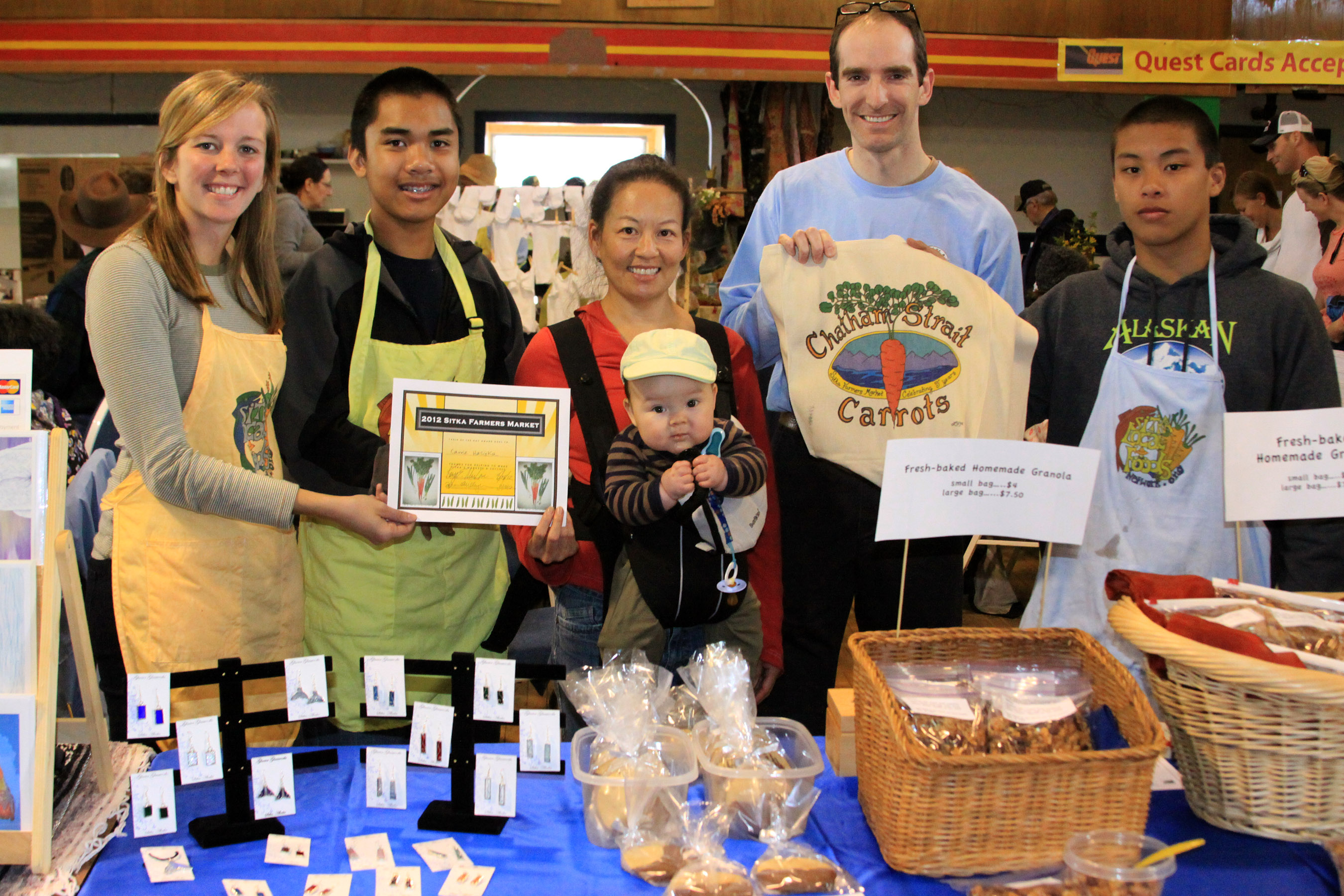
• Carrie Hisaoka and Ben Warren win Table of the Day at fourth Sitka Farmers Market of 2012

TABLE OF THE DAY: Sitka Local Foods Network intern Courtney Bobsin, far left, volunteer Mark Partido, second from right, and volunteer Marjo Vidad, right, present the Table of the Day Award to Carrie Hisaoka (with baby Joshua Warren) and Ben Warren for the fourth Sitka Farmers Market of the season, on Aug. 18, 2012, at the Alaska Native Brotherhood Hall. Carrie and Ben sold handmade jewelry, fireweed bread cookies and homemade granola. The Sitka Local Foods Network board selects a Table of the Day winner from the vendors at each Sitka Farmers Market of the season, and the winners receive prizes such as a fifth-anniversary market tote bag and check.

The next Sitka Farmers Market is scheduled for 10 a.m. to 2 p.m. on Saturday, Sept. 1, at ANB Hall (235 Katlian St.). The Sitka Local Foods Network is seeking volunteers to help set up tables and tents before the market starts, and to tear down and pack up the market after it ends. We need volunteers for the two remaining markets (Sept. 1 and 15). If you have a strong back and helping hands, please contact Johanna Willingham at 738-8336 for more details. Also, if you are a vendor who wants to accept Quest and debit card tokens, please contact Johanna. For more information about the Sitka Local Foods Network and the Sitka Farmers Market, go to http://www.sitkalocalfoodsnetwork.org/

• Lori Adams discusses everything she’s learned about growing radishes in her latest Daily Sitka Sentinel garden column

(Lori Adams, who owns Down-To-Earth U-Pick Garden and is a frequent vendor at the Sitka Farmers Market, will be writing a regular garden column in the Daily Sitka Sentinel this summer. The Sentinel is allowing us to reprint the columns on this site after they first appear in the newspaper. This column appeared on Page 4 of the Wednesday, Aug. 22, 2012, edition of the Daily Sitka Sentinel.)

GARDENING IN SITKA

By Lori Adams

EVERYTHING I’VE LEARNED ABOUT GROWING RADISHES

All of the gardening books I have read say that growing radishes is SO easy, but I really have a hard time growing a good decent radish.

Every year I try, and every year I get a few good ones and a whole lot of bad ones — skinny tough roots with nice tops that immediately bolt. This year I actually grew some pretty decent radishes so I think I’m starting to get it figured out a little. I refuse to give up.

First of all, radishes are a root crop, so they don’t like a lot of fertilizer. In fact, the books pretty much say to just throw the seeds in any old dirt and they will grow. Nitrogen produces large luscious tops, not large plump roots, so this fall don’t put any nitrogen-rich material in the bed where you plan to plant radishes next year. Instead, bulk up the bed with sand and loose organic material such as beach/forest mulch (not much seaweed) and leaves.

Next spring, either mix some bonemeal into the soil or gather some starfish to bury about four inches below the surface and then plant your seeds directly on top of the bed. I recommend buying seeds for varieties that are shaped like carrots rather than the typical round ones because they produce more poundage per square foot. If you are using a seeder the seeds will be buried, but if you broadcast the seeds by hand you will need to rake them in a little or sprinkle some dirt over the top.

Be sure not to get the seeds too close together. I am sure this is one of my biggest problems. Radishes that are too close together just shoot up and bolt. Proper spacing is VERY important. About three inches of spacing is about right. You can hand plant each seed, but that is very, very tedious. That’s why I purchased a seeder. I am still learning how to use it, but I think it will be helpful to achieve proper spacing.

Radishes need cool weather to germinate and grow and we have that, but even though our winters are mild it doesn’t work to plant outdoors in February (believe me, I’ve tried). Some years you can plant in March, but mid-April is probably the best time to plant.

Be sure to cover the bed with floating row cover to protect the seedlings from frost and the dreaded root maggot flies. Radishes are from the brassica family and root maggot flies love them. It can be helpful if you do not grow radishes (or any other brassicas) in the same spot each year.

It is important to keep the surface of the bed damp while you are waiting for the seeds to germinate, and on dry days it may be necessary to water the bed more than once. After germination it is very important to water evenly. Large fluctuations in watering can cause radishes to split, bolt or get pithy.

If you have tried everything and your radishes still bolt, pull them up and throw them in the compost, but leave a few of them in the ground. They will flower and then grow seed pods. The green, tender pods can be eaten whole and they taste just like radishes.

One variety called the “Rat Tail Radish” (raphanus sativus) is grown specifically for its pods. It grows about six feet tall and produces hundreds of pods. The advantage of growing this variety is that it matures in the summer and likes warm weather, but unlike other varieties it needs rich, fertilized soil. I like to plant both types for radish taste all season long.

Brought to you by Down-To-Earth U-Pick Garden

2103 Sawmill Creek Road

Open June-August / Monday to Saturday, 11 a.m. to 6 p.m.

747-6108 or 738-2241

http://downtoearthupick.blogspot.com/

• Join us for St. Peter’s Fellowship Farm work parties on Wednesday and Saturday

The Sitka Local Foods Network will host a pair of work parties this week at the St. Peter’s Fellowship Farm communal garden located behind St. Peter’s By The Sea Episcopal Church on Lincoln Street (the dark brown brick/wood church above Crescent Harbor).

The first work party will be from 4-6 p.m. on Wednesday, Aug. 22. The second work party is from 2-4 p.m. on Saturday, Aug. 25. Dress for the weather, and tools and gloves are provided for use. We will be weeding, picking slugs and other garden maintenance tasks that need to be done.

In addition to the work parties, we will have fresh produce available for either a donation or WIC produce warrants.

Food grown at St. Peter’s Fellowship Farm is sold at the Sitka Farmers Market to raise money for Sitka Local Foods Network projects during the year. For more information, contact St. Peter’s Fellowship Farm lead gardener Laura Schmidt at 738-7009 or 623-7003.

• Suzan Brawnlyn, the Chef at the Market, provides her recipes from the fourth Sitka Farmers Market of 2012

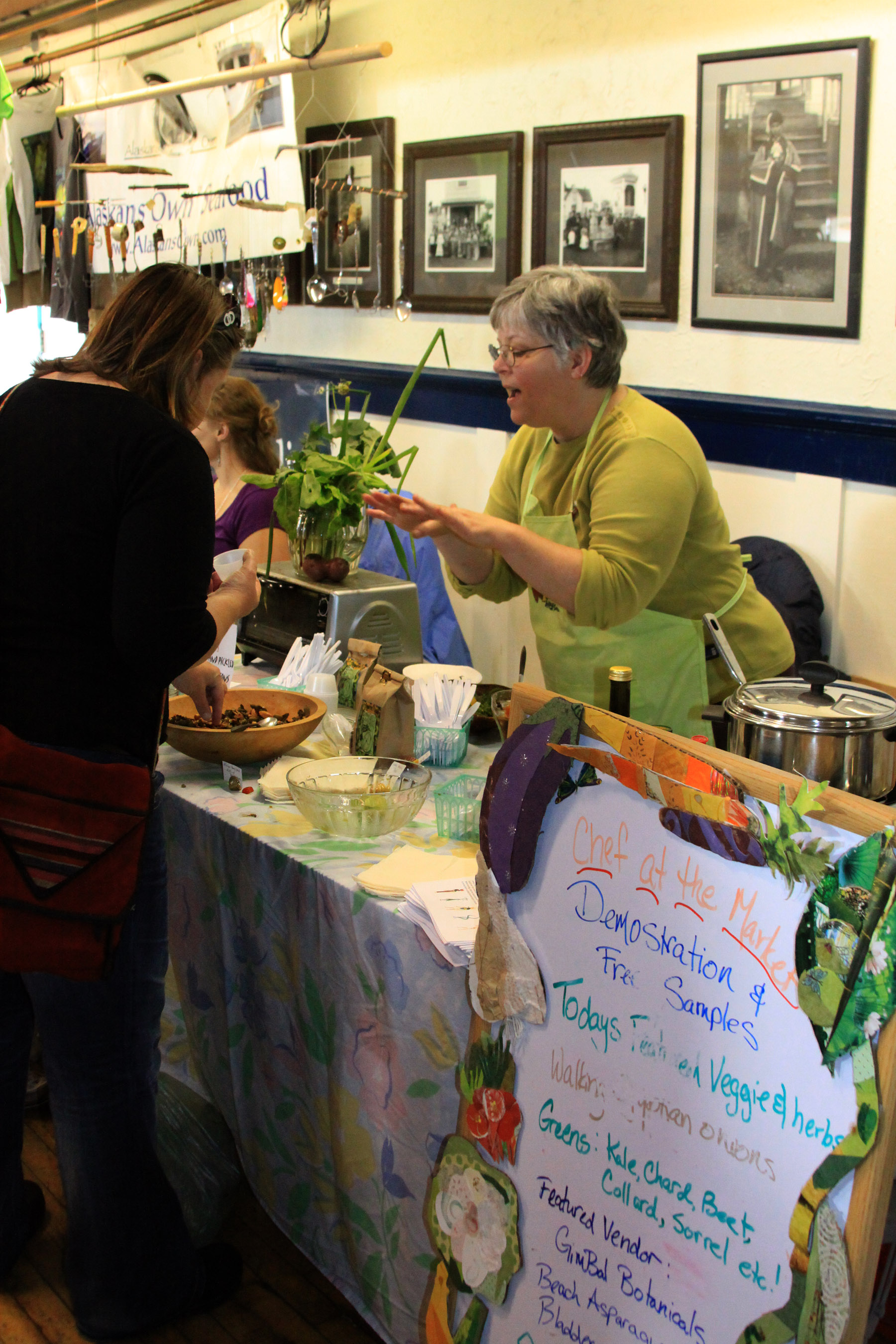
Suzan Brawnlyn, the Chef at the Market, discusses how to cook Egyptian walking onions during a cooking demonstration on Aug. 18, 2012, at the fourth Sitka Farmers Market of the season.

Suzan Brawnlyn, the Chef at the Market, discusses how to cook Egyptian walking onions during a cooking demonstration on Aug. 18, 2012, at the fourth Sitka Farmers Market of the season.

This year, the Sitka Local Foods Network is happy to feature local chef Suzan Brawnlyn as its “Chef at the Market.” Suzan received a grant to provide cooking demonstrations at at least four of our six markets this year.

Suzan also has been making her recipes available so people can try them at home. Her recipes from the fourth market on Aug. 18 are posted below. Her featured herb was the Egyptian walking onion, and her featured vegetables were “The Greens” (chard, kale, beet, spinach and collards).

The next Sitka Farmers Market is from 10 a.m. to 2 p.m. on Saturday, Sept. 1, at Alaska Native Brotherhood Hall (235 Katlian St.).The Sitka Local Foods Network is seeking volunteers to help set up tables and tents before the market starts, and to tear down and pack up the market after it ends. We need volunteers for  the two remaining markets (Sept. 1 and 15). If you have a strong back and helping hands, please contact Johanna Willingham at 738-8336 for more details.

• Chef at the Market recipes from the fourth Sitka Farmers Market of the season, Aug. 18, 2012