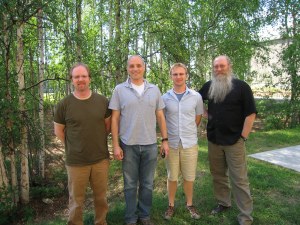
Fast Food Nation author Eric Schlosser, second from left, visits with University of Alaska Fairbanks School of Natural Resources and Agricultural Sciences associate professor Joshua Greenberg, left, student Charles Caster, third from left, and professor Milan Shipka, right, during a May 27 visit to speak at UAF. (Photo courtesy of the UAF School of Natural Resources and Agricultural Sciences blog)
Eric Schlosser, the author of “Fast Food Nation” and “Chew On This,” encouraged Alaskans to grow their own local foods during a May 27 lunch of Alaska-grown food with University of Alaska Fairbanks (UAF) School of Natural Resources and Agricultural Sciences (SNRAS) students, faculty and staff involved with food security and food production.
Schlosser, who also co-produced the films “Food, Inc.” and “There Will Be Blood,” was in Fairbanks to give a lecture that night as part of UAF’s Summer Sessions. Stories about his lecture can be found on the SNRAS blog and in the UAF Sun Star student newspaper, and a preview story was in the Fairbanks Daily News-Miner.
 During his free lecture, Schlosser discussed the recent changes to how our food is grown and prepared, and about how we are losing contact with how our food gets to our plates. He focused on many of the industrial agriculture themes highlighted in his more popular book, “Fast Food Nation,” and some of the resulting problems, such as the low wages and vulnerable workforce in fast food production and the use of hormones in feedlot cattle and issues with antibiotics given feedlot animals.
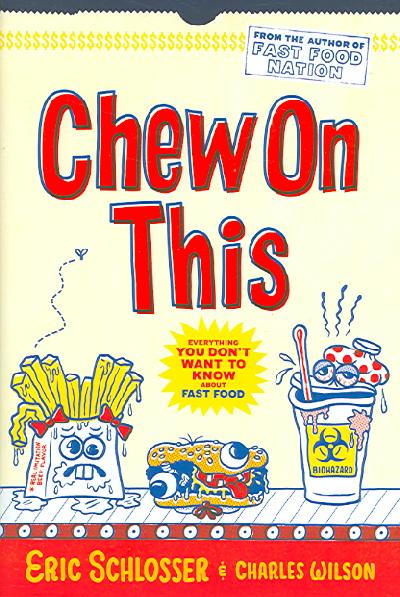
 He also delved into some of the resulting health issues from eating too much fast food, a topic he discussed in his book “Chew On This,” which was written for older children. (Editor’s note: “Chew On This” has a section about the Stop The Pop movement by schools in rural Alaska to eliminate soda pop from their school vending machines.) According to the SNRAS blog, Schlosser discussed the connections between our highly processed, industrial food and diseases such as diabetes.
The people most at risk are children and the elderly. Fast food, which is high in fat, sugar, starch, and salt, compromises the health of these vulnerable citizens. “These are ideal foods to make you unhealthy,” Schlosser said. “And they sell tons of soda because it is the most profitable thing they sell.”
While people in the US used to be some of the most fit people now they are terribly unfit. The obesity rate has nearly doubled for toddlers and tripled for children ages 6 to 11. “Alaska has one of the highest obesity rates in the US,” Schlosser said. “Alaska has more in common with Alabama and Mississippi than western states when it comes to obesity.”
Diabetes is another concern, with one in three children born in 2000 destined to develop diabetes. Among poor people the number is one in two.
“What is to be done?” Schlosser asked. “That all sounds really grim but an entirely different system is possible and necessary.” He stressed organic foods, buying local food, and reconnecting people with where food comes from. He said he is encouraged by the interest in sustainability found on college campuses.
“The fast food system exploits the weak and the poor and threatens our entire democratic system,” he said. “We need an agricultural system based on social policies and access to healthy, nutritional food for every member of society.”
Schlosser also noted how dependent Alaska has become on imported food, and how that impacts food security.
“Hey, you guys in Alaska gotta grow your own. You need to remember where food comes from. Alaska is the most food insecure state; that is not good.” He said Alaska has 15 million acres suitable for agriculture, yet only 30,000 acres are cultivated. (See addendum below.) “Rhode Island has twice as many farms as you and their value of agricultural products is twice as big. Now come on, you guys need to grow food in your back yards, have school gardens, and buy food grown in this state.”
(Addendum — From SNRAS Dean and AFES Director Carol Lewis, June 1, 2010: The 15 million acres is a wonderful quote, but if you look at Roeger (1958), you’ll see the rest of the story. Only 500,000 are accessible by road or rail. There are opportunities to use non-agricultural lands if we use controlled environments and composting, however. There are more than 30,000 acres actually cleared and in Delta alone there are about 100,000 acres.)

 The Juneau Farmers Market will start hosting weekly booths this Saturday as part of the Juneau Artists Market. The Juneau Farmers Market booths will be open from 10 a.m. to noon starting on Saturday, June 12, at the Juneau Arts and Culture Center, and running through the annual Juneau Farmers Market and Local Food Festival on Aug. 28.
 The season culminates in Juneau with the third annual Juneau Farmers Market and Local Food Festival from 9 a.m. to 2 p.m. on Saturday, Aug. 28, at the Juneau Arts and Culture Center. In past years, this was the only farmers market event in Juneau, so it’s nice to see weekly markets this year. Click the link above for more details on this larger annual event, which includes produce, fish, jams and jellies, baked breads and demonstrations about how to harvest and preserve local foods, or click this link for information from the Sustainable Juneau blog.



 Sitka Local Foods Network
You must be logged in to post a comment.