• It’s time to … learn how to build a simple raised garden bed

OLYMPUS DIGITAL CAMERA

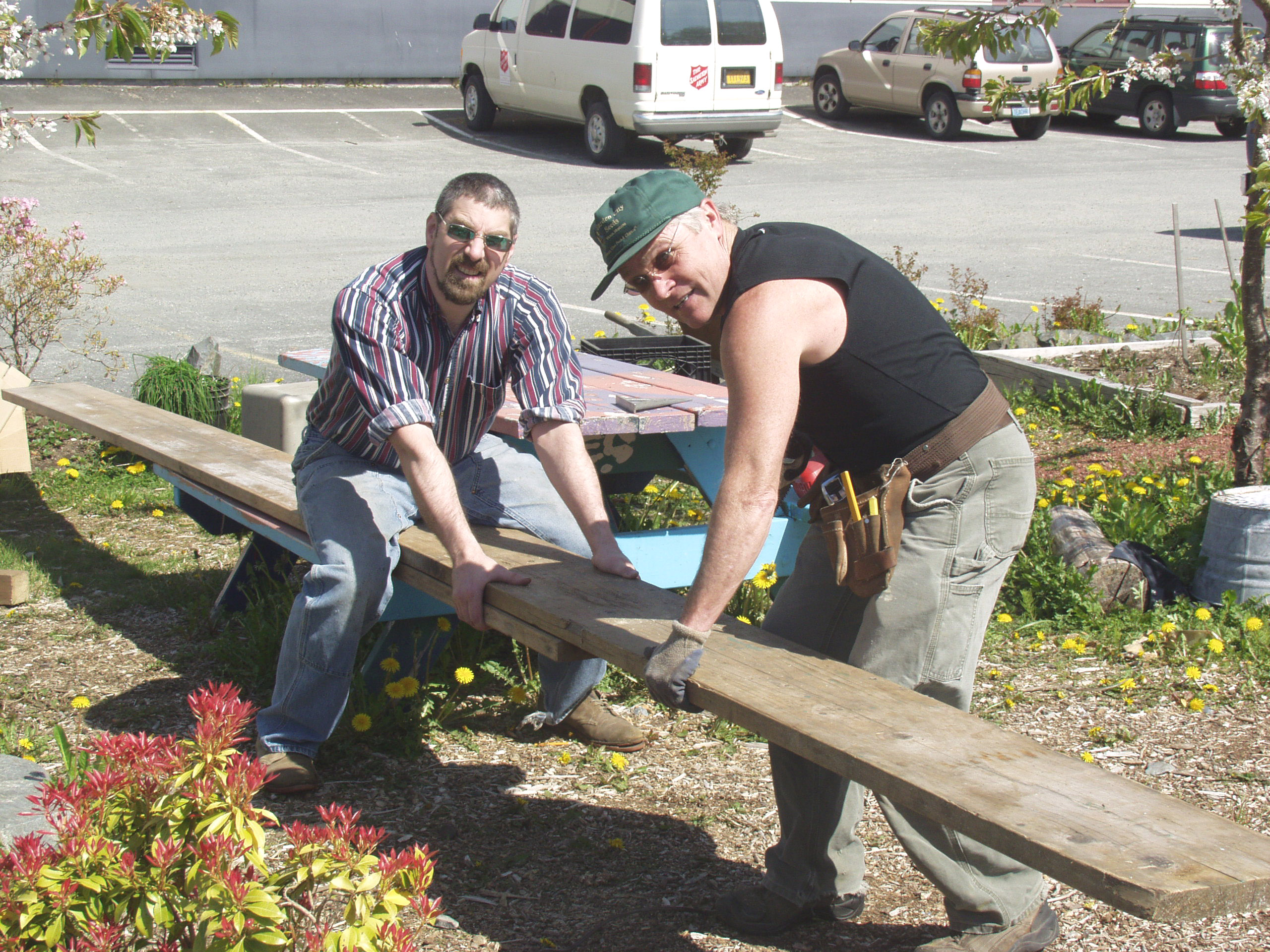
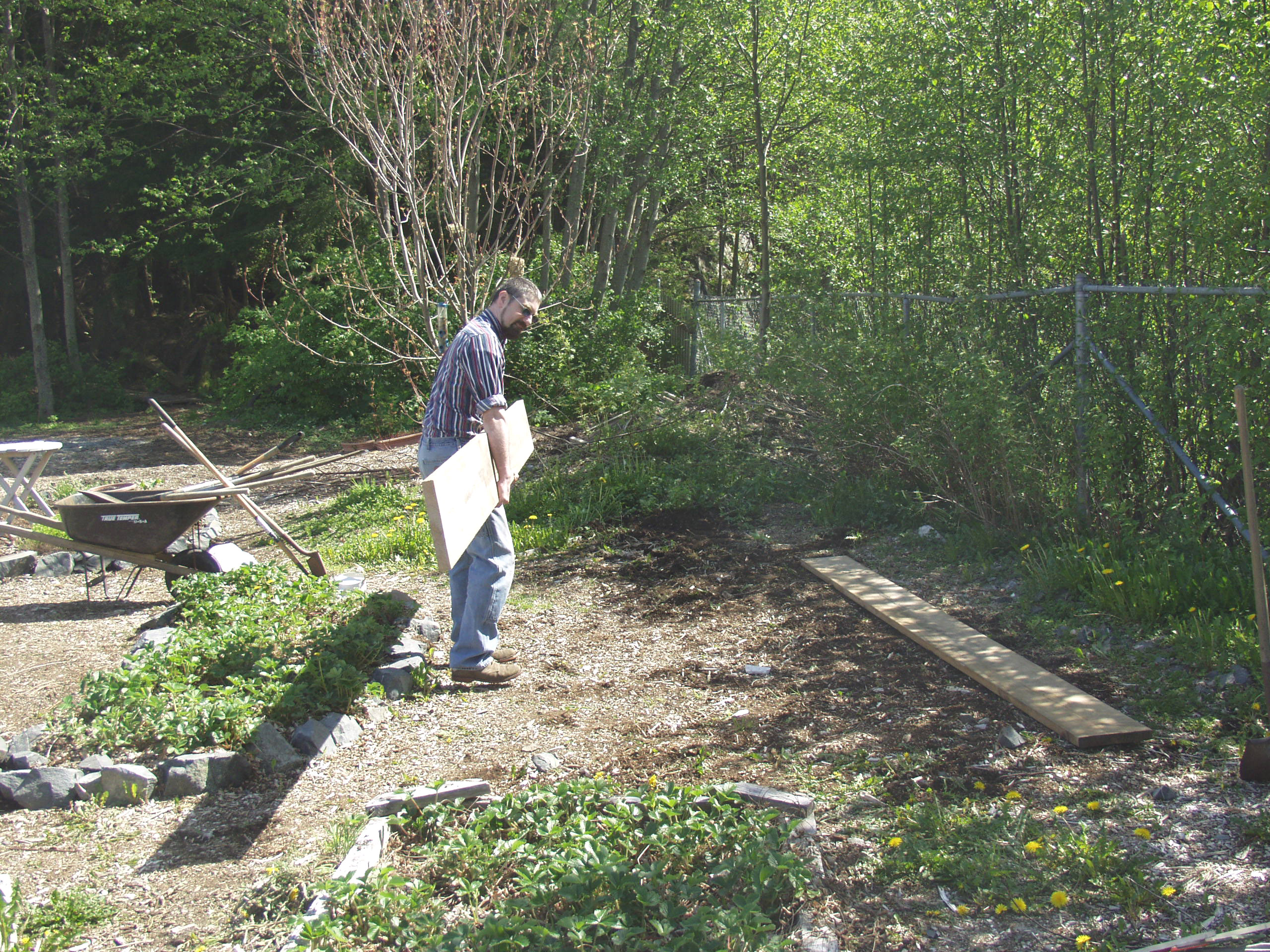
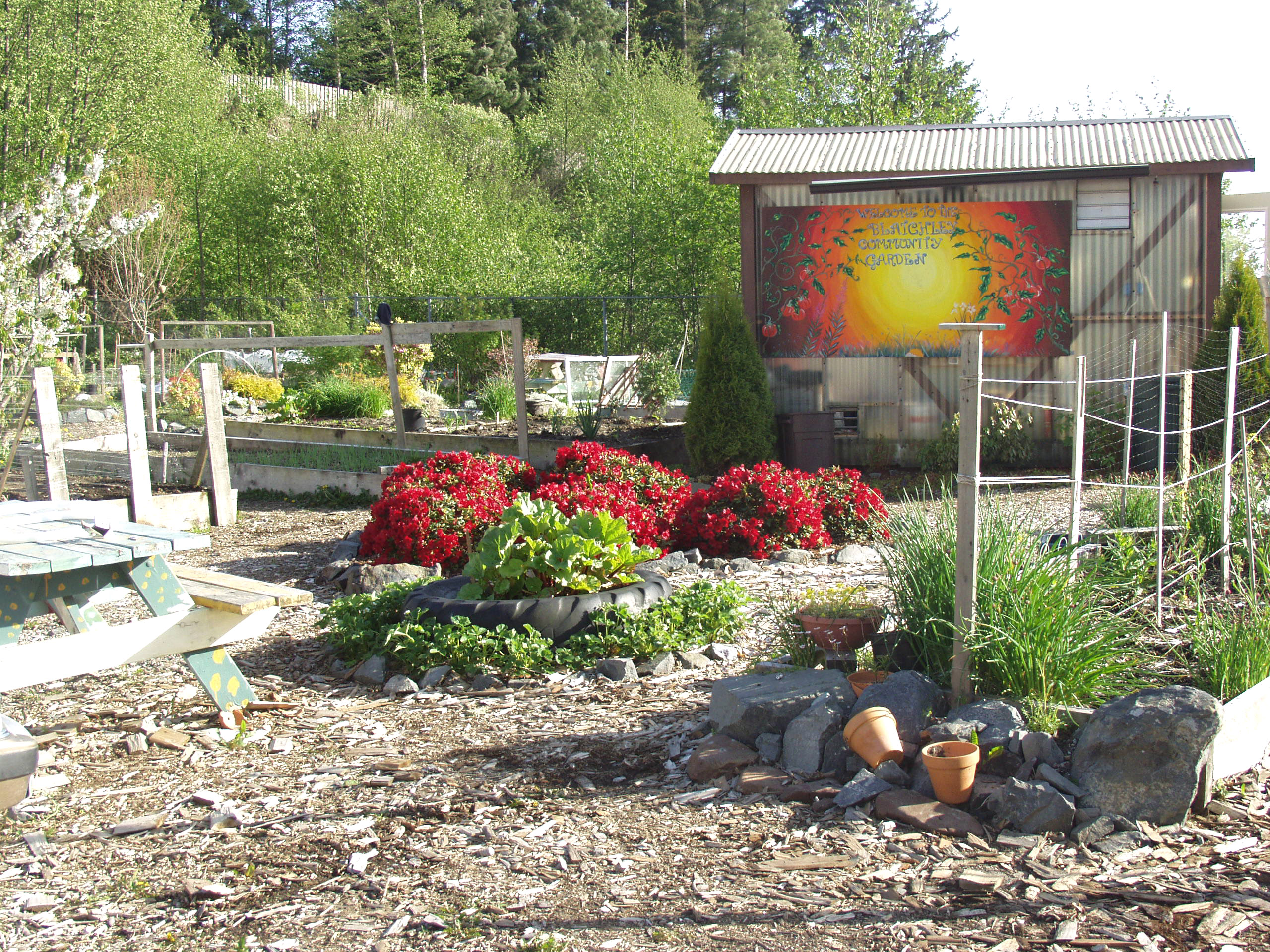
While we’re waiting for spring to finally show up in Sitka, one thing gardeners can do to prepare for planting is build a simple raised garden bed. The pictures with this post feature members of the WISEGUYS men’s health group (Rick DeGroot, Kerry MacLane, Doug Osborne and his daughter, Darby, then 4) building a garden bed in May 2008 at Blatchley Community Garden in Sitka.

OLYMPUS DIGITAL CAMERA

First, you will need some untreated lumber (treated lumber has chemicals that can get into your food), with 2x12s being good for the frame. Your garden bed will probably be between 3-4 feet wide and 6-8 feet long, depending on your garden space and your lumber. Don’t go much wider than four feet, because you will want to be able to easily reach across the garden so you can plant and weed without falling into the bed. You can go longer than eight feet, but you might need to use more than one board to get that length. So cut your boards to your desired length and width.

OLYMPUS DIGITAL CAMERA

Next, lay out your lumber and nail or screw your boards together to form a box. Some people prefer screws over nails, because they don’t pull loose as easily as nails. But use what you have. Some people will add corner posts that can be punched into the ground.

OLYMPUS DIGITAL CAMERA

After you’ve built the frame, cover the ground with a bunch of old cardboard or newspapers. This will act as a barrier to help keep weeds from getting into your veggies.

OLYMPUS DIGITAL CAMERA


Now you can start filling your frame with soil. About halfway through filling the frame, you can add a layer of seaweed, compost or other soil amendments to add nutrients to your soil. Finish by adding top soil that you mix with some of your soil amendments.


OLYMPUS DIGITAL CAMERA

Once you have your raised garden bed built and full of soil, you can start planting (if you’re past your last-frost date, which tends to be mid-May in Sitka). Once you have your seeds planted or starts transplanted, you can water your garden bed.

OLYMPUS DIGITAL CAMERA

In Sitka it’s always a good idea to use row-cover over your garden, especially early in the season. This not only helps keep birds and other pests out of your garden, but the white fabric creates a mini-greenhouse effect that helps warm your soil so your seeds sprout sooner.

• UAF Cooperative Extension Service publication on raised bed gardening

• UAF Cooperative Extension Service publication Gardening In Southeast Alaska

• UAF Cooperative Extension Service publication Southeast Alaska Garden Varieties

• 20th annual Running of the Boots costumed fun run raises funds for Sitka Local Foods Network

RunningOfTheBoots2014

It’s time to dig your XtraTufs out of the closet and gussy them up. The 20th annual Running of the Boots begins at 10 a.m. on Saturday, Sept. 27, at the big tent near St. Michael of the Archangel Russian Orthodox Cathedral on Lincoln Street.

This will be the second year featuring a new meeting point and course, allowing the race to be a bigger part of the End-of-Season Celebration festivities hosted downtown by the Greater Sitka Chamber of Commerce and the Alaska Cruise Line Association.

“I’m excited about the Running of the Boots joining the End-of-Season folks under one big tent … literally,” race organizer Kerry MacLane said. “We’ll have music, hot chocolate, and folks can enjoy a complimentary lunch after oodles of prizes have been awarded.”

So what is the Running of the Boots? It’s Southeast Alaska’s answer to Spain’s “Running of the Bulls.” Sitkans wear zany costumes and XtraTufs — Southeast Alaska’s distinctive rubber boots (aka, Sitka Sneakers). The Running of the Boots raises funds for the Sitka Local Foods Network, a nonprofit organization that hosts the Sitka Farmers Market and advocates for community gardens, a community greenhouse, sustainable uses of traditional subsistence foods and education for Sitka gardeners.

The Running of the Boots is a short race for fun and not for speed, even though one of the many prize categories is for the fastest boots. Other prize categories include best-dressed boots, zaniest costume, best couple, best kids group and more. The new course starts by St. Michael’s Cathedral, and heads down Lincoln Street toward City Hall, takes a left on Harbor Drive and loops up Maksoutov Street and back to the starting line.

The entry fee for the Running of the Boots is $5 per person and $20 per family, and people can register for the race starting at 10 a.m. Costume judging starts about 10:30 a.m., and runners hit the streets at 11 a.m. As usual, local merchants have donated bushels of prizes for the costume contest. The Sitka Local Foods Network will host a Sitka Farmers Market booth with fresh veggies for sale. The booth takes debit cards, WIC vouchers and Alaska Quest electronic benefit cards.

“This is a really fun way to advance the Sitka Farmers Market and our other Sitka Local Foods Network projects,” MacLane said. “This is a must-see annual change-of-the season tradition in Sitka.”

To learn more about the Running of the Boots, contact Kerry MacLane at 752-0654 or 747-7888, or by email at maclanekerry@yahoo.com.

Historical information about the race (through 2005) can be found online at http://www.runningoftheboots.org/. Info about the Sitka Local Foods Network and more recent Running of the Boots events (2008-13) is online at http://www.sitkalocalfoodsnetwork.org/ (type Running of the Boots into the search bar at the top of the page). Click here to see a slideshow of scenes from last year’s event.

Also, don’t forget to like our Facebook page at https://www.facebook.com/SitkaLocalFoodsNetwork to stay updated on Sitka Local Foods Network activities.

• Meet your vendors: Linda Wilson of Seaview Garden and Jewelry Arte

LindaWilson

SitkaFarmersMarketSign(This is part of a new series of “Meet your vendors” articles, where Sitka Local Foods Network Intern McLane Ritzel is writing features about our regular Sitka Farmers Market vendors.) 

Taking a stroll through this summer’s Sitka Farmers Markets, several perfectly baked rhubarb pies may have caught your eye. Outside in the tent next to the Sitka Local Foods Network produce tent, stood the talented gardener and craftswoman Linda Wilson, a Sitka local for the past three decades who owns Seaview Garden and Jewelry Arte.

Wilson’s father was in the USDA Forest Service. Wilson was raised in California until the age of 6, when her family moved to Ketchikan. A few years later, her father moved the family to Sitka and then to Juneau for his work. Wilson attended high school in Juneau, but yearned to be back in Sitka where they had bought a house in 1975 out on Halibut Point Road. The family returned to Sitka after Wilson’s father retired from the USDA Forest Service in 1982. Wilson lost both her mother and her brother to illnesses, and has been taking care of her father in Sitka since his retirement.

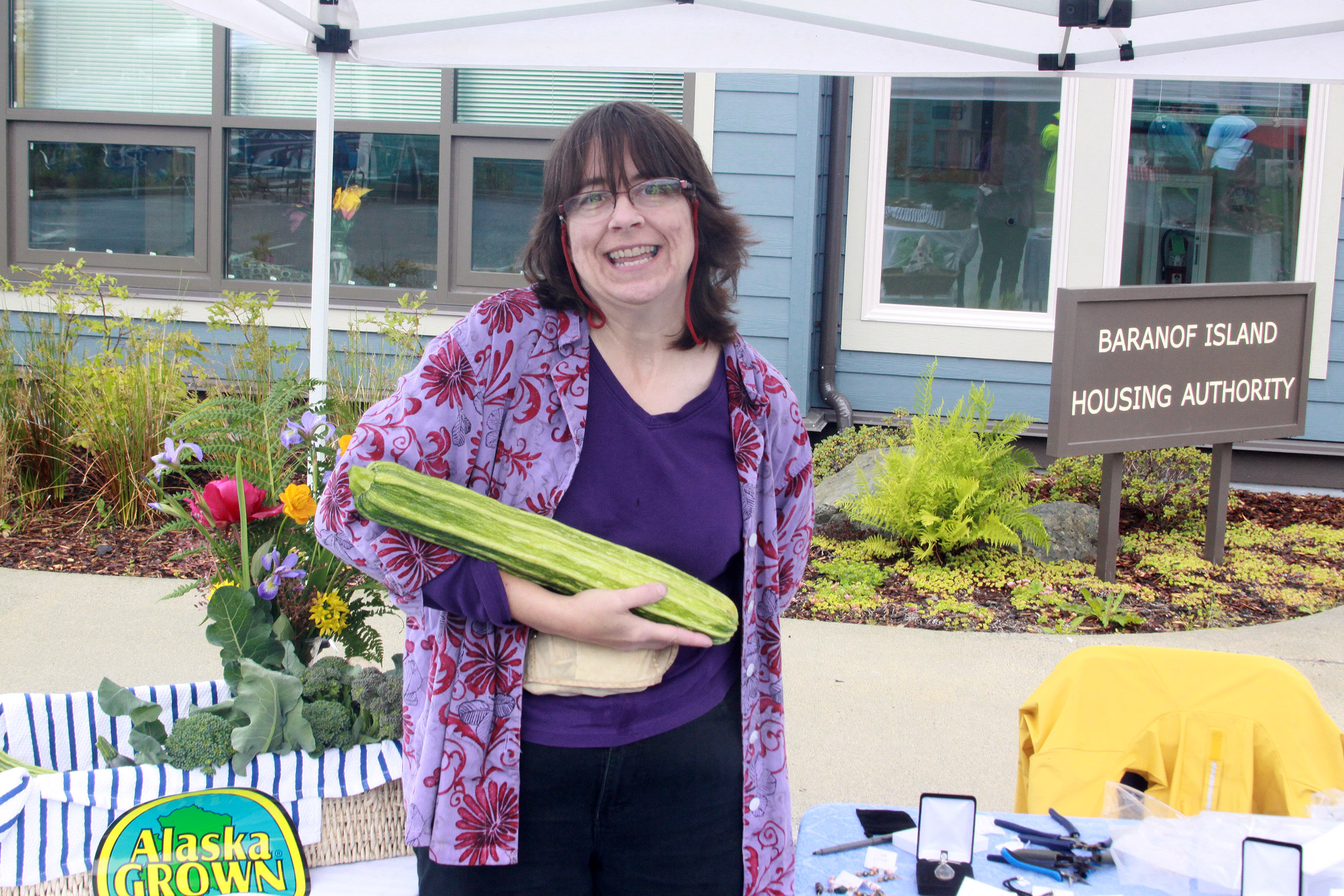
LindaWilsonWithZucchiniIn Sitka, Wilson fell into gardening, because outside of the house is where she felt she had the most control and freedom. Inside the house was dad’s territory. She ripped out her salmonberry bushes in 2004, and learned how to grow broccoli when she met Florence Welsh. Today, she grows carrots, snap peas, greens including kale, collard, and lettuce, and rhubarb. She loves composting and mostly uses coffee grounds and spent grains. At the Sitka Farmers Markets, she sold collard greens and delicious pies. Strawberry-rhubarb is her favorite.

This year, she has been growing zucchini and tomato plants inside her newly established high tunnel via a NRCS grant. She thanks those in the community who helped her put up the high tunnel, and particularly market vendor Kerry MacLane’s instrumental assistance. Even though she has retired from the Sitka Local Foods Network board of directors, Linda was one of the original board members. She also was one of the first managers of the Sitka Farmers Market, and she organized the first Let’s Grow, Sitka! education event.

LindaWilsonWithPieWilson loves making homemade pizza from scratch with homegrown tomatoes, onions, sliced zucchini, nasturtiums, broccoli, garlic, and basil. She says, “I grow tomatoes because it’s a challenge, and I’m gonna get it.” She also makes a mean pesto with carrot top greens. When she produces an overabundance of produce, she donates to the Salvation Army.

She loves to go mushroom foraging, and also picks berries to make a variety of jams. Her favorite is blueberry-huckleberry jam.

From 1985 until 2007, Wilson managed one of the local gift shops in town, where they sold authentic Russian imports. From 2003 to 2006, she also worked on a cruise ship in the Baltic Sea where she lectured on Russian arts and crafts, knowledge she had gained while managing the gift shop. Today, she works part-time with the Sitka Economic Development Association (SEDA), takes care of her father, and makes beautiful sculpted wire jewelry with gemstones.

Every February, Wilson makes a two-week trip down to one of the biggest jewelry shows in the world. She has attended the show 12 out of the past 13 years. Her favorite stones are fossils: coral, ammonites, and sand dollars, because, she says, “They used to be living.” She has a rock shop in her house where she houses her jewelry making studio with beautiful stones and lapidary equipment including a slab saw, trim saw, grinder, and rock tumbler, throughout. “Nature makes amazing things.”

LindaWilsonsJewelryWhen she is not out in the garden, tending to her father, or making jewelry, Wilson loves “petting kitty bellies.” They have two cats, Spike and Sandy, at home, though many more are buried out back. “Serving as compost,” Wilson jokes.

If you don’t see her at the Sitka Farmers Market, make sure to check out Linda Wilson’s beautiful jewelry at the Island Artists Gallery, an artists cooperative on Lincoln Street. Her jewelry makes great gifts for yourself, family members, and friends.

• 20th annual Running of the Boots costumed fun run raises funds for Sitka Local Foods Network

RunningOfTheBoots2014

It’s time to dig your XtraTufs out of the closet and gussy them up. The 20th annual Running of the Boots begins at 10 a.m. on Saturday, Sept. 27, at the big tent near St. Michael of the Archangel Russian Orthodox Cathedral on Lincoln Street.

This will be the second year featuring a new meeting point and course, allowing the race to be a bigger part of the End-of-Season Celebration festivities hosted downtown by the Greater Sitka Chamber of Commerce and the Alaska Cruise Line Association.

“I’m excited about the Running of the Boots joining the End-of-Season folks under one big tent … literally,” race organizer Kerry MacLane said. “We’ll have music, hot chocolate, and folks can enjoy a complimentary lunch after oodles of prizes have been awarded.”

So what is the Running of the Boots? It’s Southeast Alaska’s answer to Spain’s “Running of the Bulls.” Sitkans wear zany costumes and XtraTufs — Southeast Alaska’s distinctive rubber boots (aka, Sitka Sneakers). The Running of the Boots raises funds for the Sitka Local Foods Network, a nonprofit organization that hosts the Sitka Farmers Market and advocates for community gardens, a community greenhouse, sustainable uses of traditional subsistence foods and education for Sitka gardeners.

The Running of the Boots is a short race for fun and not for speed, even though one of the many prize categories is for the fastest boots. Other prize categories include best-dressed boots, zaniest costume, best couple, best kids group and more. The new course starts by St. Michael’s Cathedral, and heads down Lincoln Street toward City Hall, takes a left on Harbor Drive and loops up Maksoutov Street and back to the starting line.

The entry fee for the Running of the Boots is $5 per person and $20 per family, and people can register for the race starting at 10 a.m. Costume judging starts about 10:30 a.m., and runners hit the streets at 11 a.m. As usual, local merchants have donated bushels of prizes for the costume contest. The Sitka Local Foods Network will host a Sitka Farmers Market booth with fresh veggies for sale. The booth takes debit cards, WIC vouchers and Quest cards.

“This is a really fun way to advance the Sitka Farmers Market and our other Sitka Local Foods Network projects,” MacLane said. “This is a must-see annual change-of-the season tradition in Sitka.”

To learn more about the Running of the Boots, contact Kerry MacLane at 752-0654 or 747-7888, or by email at maclanekerry@yahoo.com.

Historical information about the race (through 2005) can be found online at http://www.runningoftheboots.org/. Info about the Sitka Local Foods Network and more recent Running of the Boots events (2008-13) is online at http://www.sitkalocalfoodsnetwork.org/ (type Running of the Boots into the search bar at the top of the page). Click here to see a slideshow of scenes from last year’s event.

Also, don’t forget to like our Facebook page at https://www.facebook.com/SitkaLocalFoodsNetwork to stay updated on Sitka Local Foods Network activities.

• Meet your vendors: Kerry MacLane and his barbecued blackcod tips

KerryMacLaneWithBlackcodCollars

SitkaFarmersMarketSign(This is part of a new series of “Meet your vendors” articles, where Sitka Local Foods Network Intern McLane Ritzel is writing features about our regular Sitka Farmers Market vendors.) 

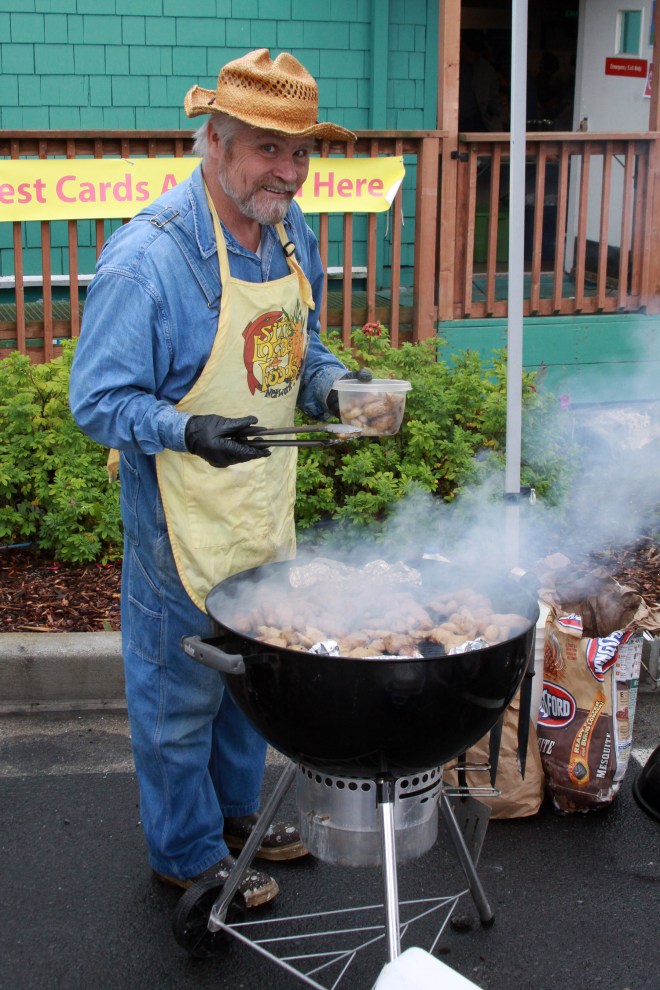
On Saturday mornings at the Sitka Farmers Market, the smell of slightly singed, brown-sugar, soy-sauce blackcod tips fills the air. Wandering Sitkans are lured to 235 Katlian St. in search of the origin of this barbecued aroma. Outside of the Alaska Native Brotherhood Founders Hall, visitors to the Sitka Farmers Market can find a bearded man in overalls and a straw hat cooking freshly caught and deliciously marinated black cod tips.

Kerry MacLane is a familiar face in the food community here in Sitka and we’re thrilled to see him cooking up his black cod tips at each farmers market. After blackening the tips, he takes them fresh off the grill and lays them on brown or white rice. He offers shredded kale and soy sauce as condiments for the steaming hot bowl of pure goodness. It’s not uncommon for a line to accumulate at MacLane’s booth, because his blackcod tips are wildly popular.

BlackcodCollarsRiceGreensMacLane is originally from Montana, where he worked as an organic farm inspector. Today his children (and now grandchildren!) still live in Missoula, but after going through a divorce, he decided to venture off to Alaska and fell in love with the state. He saw Alaska as Montana 30 years ago before large investors came in, such as Charles Schwab, who bought out his property there. In Tok, he first worked harvesting mushrooms. Throughout most of his life he has always been getting himself into trouble, being jailed time and again for civil disobedience. (Today on his property stands a sign that reads “WAR IS NOT THE ANSWER.”)

After Tok, he worked in Fairbanks as a teacher, and wrote a curriculum for a sustainable agriculture track. In 2007, he made his way down to Sitka, working as a deck hand. There, he was able to sample a lot of fish and gain knowledge of varying species and cleaning techniques.

“If you live long enough and are poor enough, you learn skills.” He decided to stay in Sitka and “reinvent himself,” as the “The Harbor Handyman” and was just that. Many people called for his help and he came to realize the need for reconstructive handy help on the island.

He lived on John Zarley’s Shamrock boat for the first years after his arrival in Sitka. Both Zarley and MacLane were born the same hour of the same day in the same year, though as MacLane says, “He’s a wealthy doctor and I have more hair.” The boat is a Monk design from 1940. Ed Monk was a famous shipwright and naval architect in the Pacific Northwest, who designed commercial and pleasure vessels, power or sail.

Within a year of his time in Sitka, MacLane became involved in the Sitka Health Summit during the program’s early years. He had worked in and helped build community gardens and grow local farmers markets in the past, but had never built his own community greenhouse. At the time, he was also working at SEARHC as a grant writer, and thanks to the Economic Stimulus Act of 2008, he was able to write $10 million in grants in his first year.

After the 2008 Sitka Health Summit, he helped form the Sitka Local Foods Network into a 501(c)(3) nonprofit organization, with the help of Linda Wilson (try her fabulous homemade rhubarb pie at the market) and other local food-interested individuals. MacLane served as the first president of the Sitka Local Foods Network.
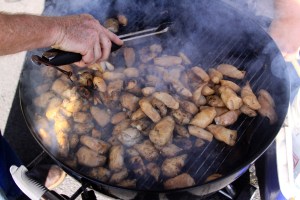
BlackcodCollarsOnGrillHe met his girlfriend, Sherie Mayo, a commercial fisherman working on her family’s boat called Coralee, here in Sitka and Kerry is able to operate his blackcod prepared food business with her help. He discovered the tasty benefits of blackcod tips nearly by chance. Mayo had always thrown out the tips under the blackcod gills until she met a few Russian women who taught her the importance of saving the decadent tips. As a result, MacLane’s blackcod recipe was featured on the Cooking Channel television show, “Hook, Line and Dinner,” where they contacted him to share his knowledge of cooking blackcod tips and other Sitkan delicacies. (Note, blackcod is not a true cod, and also is known as sablefish or butterfish for its high oil content.)

Together, Mayo and MacLane are buying a beautiful boat called the Blue Merlin, so named for its exterior blue tinge, and the infamous story of fisherman Ward Eldridge’s boat Merlin from 1999. On July 7 of that year, the Merlin sunk in Whale Bay after a whale poked its head through the hull. Before Mayo and MacLane started dating, MacLane hired Eldridge to take his son, daughter and himself to Goddard Hot Springs. MacLane remembers that trip as “magical,” and says that he himself is “turning into the little old man that Ward is now… [And] it is a pretty good place to age into.” According to MacLane, the Blue Merlin, Ward, Mayo and Kerry are like family now.

Someday, MacLane wants to learn to sail his boat to Hawai’i.

This coming Saturday, Aug. 9, come out to the Sitka Farmers Market and taste Kerry MacLane’s locally harvested and barbecued blackcod tips!

• Sitka Community Greenhouse and Education Center committee to present project update to Sitka Parks and Rec Committee

Community Greenhouse Turn Around_Page_1

Community Greenhouse Turn Around_Page_2Are you interested in seeing year-round produce and flower production in Sitka? The Sitka Community Greenhouse and Education Center ad-hoc committee will give a project update to the City and Borough of Sitka Parks and Recreation Committee at noon on Thursday, May 1, at the Harrigan Centennial Hall Exhibit Room.

The Sitka Community Greenhouse and Education Center idea started off as a project from the 2008 Sitka Health Summit, but problems acquiring land kept the center from advancing much beyond the concept stage. In recent months, the project gained some new momentum when city officials suggested using land at the city’s Turnaround Park (the old amphibious plane turnaround near the corner of Halibut Point Road and Katlian Street, where the Sitka Skatepark and Sitka Trail Works office are located).

The current proposal is to build a 25-foot-diameter geodesic dome in the middle of the site’s current parking lot. As the project grows, the plan is to build a 90-foot-diameter geodesic dome in the center (the smaller geodesic dome will be moved to another location), with two conventional greenhouses along the ridge by Katlian Street and by the guardrail by the Sitka Trail Works building. There also are plans for some garden landscaping around the site to help clean it up and make it a more attractive place to visit. The greenhouse project will not impede the use of the Sitka Skatepark.

The slideshow below includes several concept drawings by James Patterson. These plans are subject to change, but they help give people an idea of where the project stands right now. Another option is to start off with a high tunnel greenhouse and build around it.

Sitka residents are encouraged to attend the meeting Thursday to show their support for the project. “If we don’t make it through this committee meeting it be ‘back to the drawing board,'” project coordinator Kerry MacLane said. “Your appearance for even a few minutes from 12:10 12:30 p.m. would mean a lot.”

The project was presented to the Sitka Historic Preservation Commission in mid April (the Sitka Turnaround Park is a historic site). If the greenhouse concept is approved by the Parks and Rec Committee on Thursday, it then will be presented to the Sitka Planning Commission on May 6. After that, the proposal will go to the Sitka Assembly to approve a lease to use the property.

Linked below are some concept points and a response to some questions by Parks and Rec’s partner, the Alaska Department of Natural Resources. For more information, contact Kerry MacLane at 747-7888.

• Sitka Community Greenhouse and Education Center proposal bullet points

• Sitka Community Greenhouse and Education Center response to DNR questions

This slideshow requires JavaScript.

• As you build your garden this spring, don’t forget to Plant A Row For The Hungry

(EDITOR’S NOTE: The following article first appeared on this site in April 2010. It is repeated because much of the information remains current and newsworthy.)

As you start to plan your garden for this spring and summer, don’t forget to Plant A Row For The Hungry. The Plant A Row For The Hungry program (also known as Plant A Row or PAR) is a national campaign by the Garden Writers Association of America that got its start in Alaska.

In the cold winter of 1994, Anchorage Daily News garden columnist and former Garden Writers Association of America President Jeff Lowenfels was returning to his hotel after a Washington, D.C., event when he was approached by a homeless person who asked for some money to buy food. Lowenfels said Washington, D.C., had signs saying, “Don’t give money to panhandlers,” so he shook his head and kept on walking. But the man’s reply, “I really am homeless and I really am hungry. You can come with me and watch me eat,” stayed with Lowenfels for the rest of his trip.

Jeff Lowenfels

Jeff Lowenfels

The encounter continued to bother Lowenfels, even as he was flying back to Anchorage. During the flight, Lowenfels came up with an idea when he started writing his weekly garden column (the longest continuously running garden column in the country, with no missed weeks since it started on Nov. 13, 1976). He asked his readers to plant one extra row in their gardens to grow food to donate to Bean’s Café, an Anchorage soup kitchen. The idea took off.

When Anchorage hosted the Garden Writers Association of America convention in 1995, Lowenfels took the GWAA members to Bean’s Café to learn about the Plant A Row For Bean’s Café program. The Garden Writers Association of America liked the idea, and it became the national Plant A Row For The Hungry campaign (also known as Plant A Row or PAR). In 2002, the Garden Writers Association Foundation was created as a national 501(c)(3) nonprofit to manage the Plant A Row For The Hungry program.

“I am not surprised by the growth of PAR,” Lowenfels wrote in an e-mail to the Sitka Local Foods Network. “It is now in all 50 states and across Canada and there are thousands of variations of the original program — from prison gardens for the hungry to botanical gardens donating their produce from public display gardens. This is because gardeners always share information and extra food, so the idea was a natural.”

It took five years for the program to reach its first million pounds of donated food, but the second million only took two years and the next eight years saw a million pounds of donated food (or more) each year. Since 1995, more than 14 million pounds of food have been donated. Not only that, the program is getting ready to expand overseas to Australia, England and other countries with avid gardeners.

“We have supplied something in the vicinity of enough food for 50 million meals,” Lowenfels wrote in his e-mail. “Gardeners can solve this hunger problem without the government. And we don’t need a tea party to do it! Or chemicals, I might add, as author of a book on organic gardening (Teaming With Microbes, written with Wayne Lewis)!” (Lowenfels recently released a second book, Teaming With Nutrients, which is a follow-up to his first book).

According to the U.S. Department of Agriculture, one out of every eight U.S. households experiences hunger or the risk of hunger. Many people skip meals or eat too little, sometimes going an entire day or more without food. About 33 million Americans, including 13 million children, have substandard diets or must resort to seeking emergency food because they can’t always afford to buy the food they need. In recent years the demand for hunger assistance has increased 70 percent, and research shows that hundreds of children and adults are turned away from food banks each year because of lack of resources.

While many people credit Lowenfels for creating the Plant A Row For The Hungry program, Lowenfels says the real heroes are the gardeners growing the extra food and donating it to local soup kitchens, senior programs, schools, homeless shelters and neighbors. You can hear him pass along the credit to all gardeners at the end of this interview last year with an Oklahoma television station (video also embedded below).

“One row. That’s all it takes. No rules other than the food goes to the hungry. You pick the drop-off spot or just give it to a needy friend or neighbor. Nothing slips between the lip and the cup, I say,” Lowenfels wrote in his e-mail.

For people wanting to Plant A Row For The Hungry in Sitka, there are several places that would love to help distribute some fresh locally grown veggies or berries to those who are less fortunate, such as the Salvation Army, Sitkans Against Family Violence (SAFV), local churches, Sitka Tribe of Alaska and other organizations. The food the Sitka Local Foods Network grows at St. Peter’s Fellowship Farm communal garden goes to the Sitka Farmers Market.

People who participate in the Alaska Food Stamp program can use their Alaska Quest Cards to purchase produce and fish at the Sitka Farmers Market and other farmers markets around the state. People who participate in the  WIC (Women, Infants, Children) supplemental food program (operated in Southeast Alaska by the SouthEast Alaska Regional Health Consortium or SEARHC) also can use special farmers market vouchers to buy fresh vegetables at the Sitka Farmers Market and other farmers markets in Alaska (this is part of the national WIC Farmers Market Nutrition Program).

The Sitka Local Foods Network also takes donations of local produce to sell at the Sitka Farmers Markets, and all proceeds are used to help pay for SLFN projects geared toward helping more people in Sitka grow and harvest local food. For more information, contact SLFN President Lisa Sadleir-Hart or one of the other board members at sitkalocalfoodsnetwork@gmail.com.

• 2011 Plant A Row For The Hungry marketing brochure

• 2009 Start a Local Plant A Row For The Hungry campaign brochure

• Scenes from the 19th annual Running of the Boots

RaceStartsPilotBoyLooksAtGirlThe 19th annual Running of the Boots costumed fun run fundraiser for the Sitka Local Foods Network took place on Saturday, Sept. 28, as part of the End-Of-Season Celebration.

This year the race had a new course, starting in front of St. Michael the Archangel Russian Orthodox Cathedral and heading out Lincoln Street before looping onto Harbor Drive near City Hall and finishing on Maksoutov Street. There also were prizes for costumes, a table with late-season produce from the St. Peter’s Fellowship Farm communal garden, a band, and more.

A slideshow of scenes from the race follows below:

This slideshow requires JavaScript.


• 19th annual Running of the Boots costumed fun run raises funds for Sitka Local Foods Network

RunningOfTheBoots2013LowRez

It’s time to dig your XtraTufs out of the closet and gussy them up. The 19th annual Running of the Boots begins at 10 a.m. on Saturday, Sept. 28, at the big tents near St. Michael of the Archangel Russian Orthodox Cathedral on Lincoln Street. This year’s event features a new meeting point and course, allowing the race to be a bigger part of the End-of-Season Celebration festivities hosted downtown by the Greater Sitka Chamber of Commerce and the Alaska Cruise Line Association.

“I’m excited about the Running of the Boots joining the End-of-Season folks under one big tent … literally,” race organizer Kerry MacLane said. “We’ll have music, hot chocolate, and folks can enjoy a complimentary lunch after oodles of prizes have been awarded.”

So what is the Running of the Boots? It’s Southeast Alaska’s answer to Spain’s “Running of the Bulls.” Sitkans wear zany costumes and XtraTufs — Southeast Alaska’s distinctive rubber boots (aka, Sitka Sneakers). The Running of the Boots raises funds for the Sitka Local Foods Network, a nonprofit organization that hosts the Sitka Farmers Market and advocates for community gardens, a community greenhouse, sustainable uses of traditional subsistence foods and education for Sitka gardeners.

The Running of the Boots is a short race for fun and not for speed, even though one of the many prize categories is for the fastest boots. Other prize categories include best-dressed boots, zaniest costume, best couple, best kids group and more. The new course starts by St. Michael’s Cathedral, and heads down Lincoln Street toward City Hall, takes a left on Harbor Drive and loops up Maksoutov Street and back to the starting line.

The entry fee for the Running of the Boots is $5 per person and $20 per family, and people can register for the race starting at 10 a.m. Costume judging starts about 10:30 a.m., and runners hit the streets at 11 a.m. Local merchants have donated bushels of prizes for the costume contest, including a flightseeing trip for three, toys, gift certificates and pies. The Sitka Local Foods Network will host a Sitka Farmers Market booth with fresh veggies for sale. The booth takes debit cards, WIC vouchers and Quest cards.

“This is a really fun way to advance the Sitka Farmers Market and our other Sitka Local Foods Network projects,” MacLane said. “This is a must-see annual change-of-the season tradition in Sitka.”

To learn more about the Running of the Boots, contact Kerry MacLane at 752-0654 or 747-7888, or by email at maclanekerry@yahoo.com. Historical information about the race (through 2005) can be found online at http://www.runningoftheboots.org/, and info about the Sitka Local Foods Network and more recent Running of the Boots events (2008-12) is online at http://www.sitkalocalfoodsnetwork.org/.  Also, like our new Facebook page at https://www.facebook.com/SitkaLocalFoodsNetwork.

• KCAW-Raven Radio reports on how Sitka residents can double down on EBT benefits at the Sitka Farmers Market

Mira Vale staffs the EBT Quest Card table at the Aug. 3, 2013, Sitka Farmers Market

Mira Vale staffs the Alaska Quest Card/EBT benefits table at the Aug. 3, 2013, Sitka Farmers Market

The Friday, Aug. 9, 2013, newscast on KCAW-Raven Radio featured a story about how Sitka residents on food stamps can double their Alaska Quest Card/EBT benefits at the Sitka Farmers Market.

The Alaska Quest Card is an EBT, or Electronic Benefits Transfer, program that helps people on food stamps pay for food at local grocery stores. Their monthly EBT benefits are loaded onto their Alaska Quest Card, and an amount is deducted from the card each time they buy food.

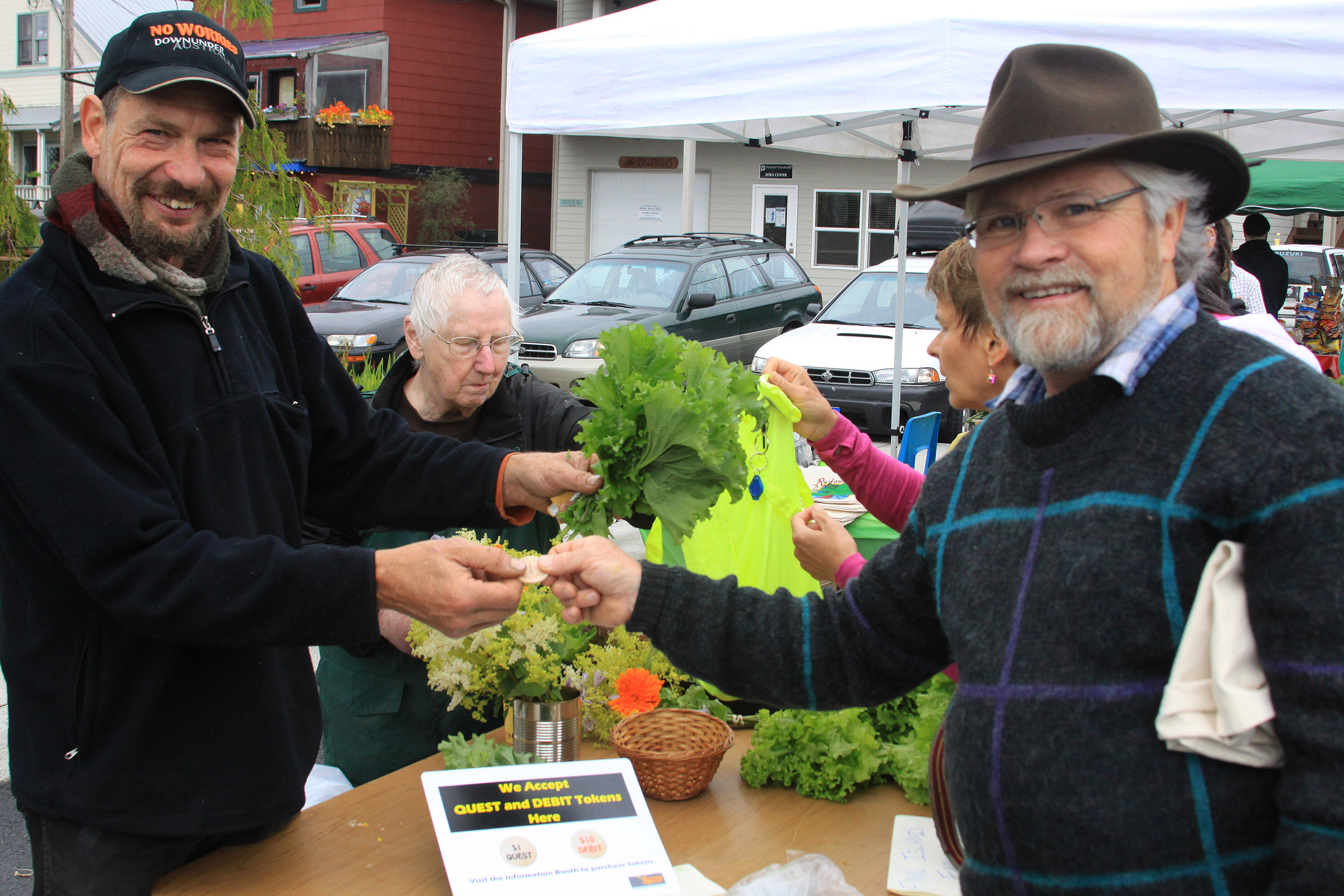
Starting last year, the Sitka Farmers Market joined several Alaska farmers markets in accepting Alaska Quest Cards/EBT benefits, and this year the number of markets accepting EBT has grown to 11 markets in Alaska. Since many farmers market vendors aren’t set up to accept charge cards, people on EBT benefits can use their cards to buy tokens (wooden nickels) at a booth at the Sitka Farmers Market, and they then can use the tokens to purchase fresh food from participating vendors.

The Alaska Quest Card/EBT booth also sells a second type of token that people not on EBT benefits can use to purchase food and other items (including arts and crafts) from participating vendors. This second token allows vendors who aren’t set up for credit/debit cards to still make sales.

Kerry MacLane uses a token to purchase produce from Sitka Farmers Market vendor Keith Nyitray during the Aug. 3, 2013, Sitka Farmers Market.

Kerry MacLane uses a token to purchase produce from Sitka Farmers Market vendor Keith Nyitray during the Aug. 3, 2013, Sitka Farmers Market.

The KCAW story focused on Sitka resident Stacie Joseph, who uses EBT benefits to help pay for her food for her four kids while she attends school. Because of a grant from the state, various Alaska farmers markets are able to provide double the benefits for people using EBT benefits. For example, if someone wants to use $20 of their EBT benefits, they’ll receive $40 worth of tokens. Joseph said the doubled benefits mean that in addition to providing healthy fresh produce for her family, she can have more money available to use on her health management classes at the University of Alaska Southeast-Sitka Campus, helping her improve her earning potential.

“This program improves access to fresh, local foods to community members who are struggling financially.  Additionally, the program helps increase understanding of food insecurity issues in our community and how produce and other food vendors can be part of the solution,” said Lisa Sadlier-Hart, president of the Sitka Local Foods Network board of directors, which hosts the Sitka Farmers Markets.