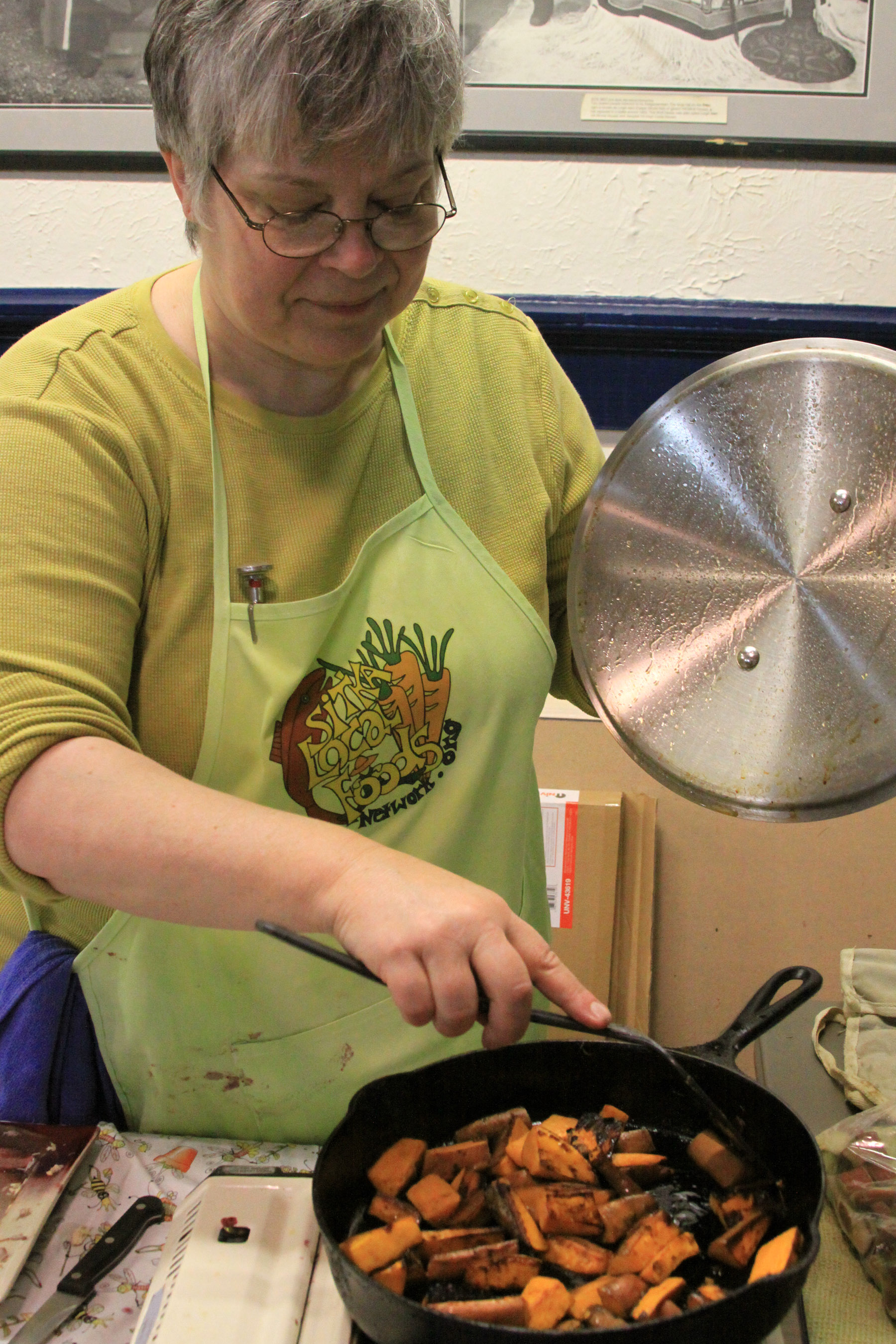
• Suzan Brawnlyn, the Chef at the Market, provides her recipes from the first Sitka Farmers Market

Suzan Brawnlyn, the Chef at the Market, cooks rhubarb and sweet potatoes during a cooking demonstration on July 7, 2012, at the first Sitka Farmers Market of the season.

Suzan Brawnlyn, the Chef at the Market, cooks rhubarb and sweet potatoes during a cooking demonstration on July 7, 2012, at the first Sitka Farmers Market of the season.

This year, several farmers markets from around the state received a share of a $15,000 grant from the Alaska Division of Agriculture to host a “Chef at the Market.” The Sitka Farmers Market is one of the lucky 11 markets, and local chef Suzan Brawnlyn will be doing cooking demonstrations at at least four of the six Sitka Farmers Markets this summer.

KCAW-Raven Radio hosted Suzan and Sitka Farmers Market manager Johanna Willingham for its Morning Interview on Monday, July 2, 2012. Suzan’s recipes from the first Sitka Farmers Market of the season on Saturday, July 7, are linked below. She plans to have a new cooking demonstration at the second market from 10 a.m. to 2 p.m. on Saturday, July 21, at Alaska Native Brotherhood Hall.

• Chef at the Market recipes from the first Sitka Farmers Market of the season, July 7, 2012

• Lori Adams discusses everything she’s learned about growing Kohlrabi in her latest Daily Sitka Sentinel garden column

(Lori Adams, who owns Down-To-Earth U-Pick Garden and is a frequent vendor at the Sitka Farmers Market, will be writing a regular garden column in the Daily Sitka Sentinel this summer. The Sentinel is allowing us to reprint the columns on this site after they first appear in the newspaper. This column appeared on Page 4 of the Tuesday, July 3, 2012, edition of the Daily Sitka Sentinel.)

GARDENING IN SITKA

By Lori Adams

EVERYTHING I’VE LEARNED ABOUT GROWING KOHLRABI

Many people have never even heard of Kohlrabi, but I think it is one of my favorite garden vegetables. Kohlrabi is from the brassica family. It is a round bulb like a turnip but it grows just above the soil level and has leaves that grow out from the bulb in many different places, not just the top.  There are two different colors, green and purple.

Although Kohlrabi is a bulb it is a heavy feeder. Preparation of the bed for Kohlrabi should begin in the fall with a heavy amendment of nitrogen. I like to use salmon and seaweed and seashell sand, and then cover the bed with black plastic for the winter to prevent the leeching of nutrients.

In the spring it wouldn’t hurt to also till in some herring roe on kelp. Just be sure that the roe has time to break down a little before it’s time to plant so you don’t burn your plants. Seeds can be planted directly out in prepared beds mid-April, but I recommend starting them indoors mid-March and then transplanting them outdoors mid-April.

In a raised bed make a dish-shaped depression and then dig a hole in the center of it for the transplant. Bury the transplant up to its first set of true leaves using 6-inch spacing between plants. The depression will function as a catch basin for water to prevent the plant from drying out.

Brassicas require steady moisture, so it’s not a bad idea to mulch around all the plants with seaweed. Just be sure the plants aren’t buried and have minimum contact with the seaweed. Mulching with seaweed really helps retain moisture, keeps the weeds down and also feeds the plants. If you have a wet, moldy garden without raised beds you may want to skip this step.

As with all brassicas, it is very important to cover Kohlrabi with floating row cover and to leave it on until July 15 or harvest time, whichever comes first. Row cover will protect the plants from frost and wind and rain damage, but more importantly it will keep out the root maggot fly – the mortal enemy of any plant in the brassica family.

To harvest Kohlrabi just pull up the bulb and use a sharp knife to cut off the tough root and peel away the skin and leaves. Around the root area you will find that the bulb is tough and the skin is thick, but as you work up to the top the bulb gets more tender and the skin gets thinner. At the very top you hardly have to peel away any skin at all.

I always eat my Kholrabi raw, but I read that it is also delicious cooked.  It tastes a lot like the center of a broccoli stem. It’s less watery and more dense and sweet than a turnip. The leaves are also edible and can be used like kale.

Brought to you by Down-To-Earth U-Pick Garden

2103 Sawmill Creek Road

Open June-August / Monday to Saturday, 11 a.m. to 6 p.m.

747-6108 or 738-2241

http://downtoearthupick.blogspot.com/

• Sitka Conservation Society presents another year of Sitka Salmon Tours

Sitka Salmon Tours, presented by the Sitka Conservation Society, returns this summer for its second year, guiding visitors through the journey salmon take from forest to plate. The two-hour tour begins at 1 p.m. on Mondays through Saturdays outside the Sitka Sound Science Center and progresses through Sitka National Historical Park, Sheldon Jackson Hatchery, and ends at Crescent Harbor. Tickets cost $20 per person.

The tours mainly draw from tourists visiting Sitka, but also found interest last summer from local residents with family in town, as something fun and unique to do for an afternoon. Personalized and private tours are available upon request.

“People really respond to how we bring the salmon in nature together with the science of the hatchery and the economic and cultural roles salmon play here,” Helen Schnoes, Salmon Tours staff says. “It helps them understand the significance of salmon — and the need to protect, restore, and enhance their habitat — in a new way.”

Tour guests this year and last immensely enjoy this unique perspective on salmon and life in Sitka, as demonstrated by these Trip Advisor reviews — “Great tour: got to see the real life Alaska … really informative and fun,” “Beautiful, Informative, and Entertaining,” and “The most delightful, interesting walking tour … a breath of fresh air.”

In addition to the daily walking tour, Sitka Salmon Tours also organizes events throughout the summer tailored to Sitkans, such as occasional tours of the Seafood Producers Cooperative, specialty community tours, and a salmon bake fundraiser.

We will be sending more details as the summer progresses, but here’s a heads up, too, about some future events:

  • July 15, “The Rise and Fall of Canned Salmon,” Talk by Nic Mink, 5-6 p.m. at Kettleson Memorial Library. Free and open to the public.
  • July 19, Community Salmon Bake Fundraiser, $20 per person ($15 for children age 12-younger), 6=8 p.m. at Harrigan Centennial Hall.
  • Aug. 5, “Fishing for Change,” Talk by Elizabeth Cockrell, 5-6 p.m. at Kettleson Memorial Library. Free and open to the public.
  • Aug. 7, Seafood Trivia at the Bayview Pub. Sitka Salmon Tours takes over this weekly trivia night with questions about seafood, salmon, and everything fishy. Teams must be entered by 8:45 p.m., trivia begins 9 p.m.
  • Aug. 9-13, Sitka Seafood Festival walks, including regular Salmon Tour, local seafood tour (includes tastings at some of Sitka’s best restaurants), and SPC processor tour; Events include a processor tour (11 a.m. on Aug. 9, $35 with light meal included, meet at location TBA), at least two Sitka Salmon Tours (one at 1 p.m. on Aug. 10, a second at 9 a.m. on Aug. 11, $20, meet at Sitka Sound Science Center), and a Seafood Walk (11 a.m. on Aug. 12, $45, includes processor tour and tastings at local restaurants)

Contact Helen Schnoes for questions, reservations, or for further information about events planned in Sitka this summer. Helen can be reached at the Sitka Conservation Society office at 747-7509, or by cell at (612) 741-1591 or e-mail at helen@sitkawild.org.


• Lori Adams discusses composting in her latest Daily Sitka Sentinel garden column

(Lori Adams, who owns Down-To-Earth U-Pick Garden and is a frequent vendor at the Sitka Farmers Market, will be writing a regular garden column in the Daily Sitka Sentinel this summer. The Sentinel is allowing us to reprint the columns on this site after they first appear in the newspaper. This column appeared on Page 4 of the Wednesday, June 27, 2012, edition of the Daily Sitka Sentinel.)

GARDENING IN SITKA

By Lori Adams

COMPOSTING

Sitka has poor soil. Any plant waste thrown into our garbage cans travels by barge and truck to Eastern Washington. Bagged soil is expensive and travels by truck and barge to get here. Garden waste can be turned into soil. COMPOSTING IS IMPORTANT!

Concentrated fertilizers provide plants with basic nutrients and are potent enough that they only need to be applied once or twice a year. Compost feeds plants with a gentler mixture of basic nutrients and a multitude of micronutrients, but must be applied about once a month to adequately feed your plants. Many people use a combination of the two.

“Compost” is defined as “a mixture of decaying organic material used to improve soil structure and provide nutrients.” Basically it’s the process of throwing excess plants and plant parts into a pile to rot down and turn into soil. This process can take about a year, but if you educate yourself and compost with a plan there are ways to speed up the process.

Plant parts fall into two main categories — Carbon/Brown and Nitrogen/Green. Composting experts suggest using 30 parts carbon to 1 part nitrogen.

  • EXAMPLES OF CARBON MATERIALS: untreated sawdust, straw, leaves, shredded newspaper, corn stalks and cobs, needles and cones, wood ashes (be sure the ashes are cold!)
  • EXAMPLES OF NITROGEN MATERIALS: manure, seaweed, chemical-free grass clippings, coffee grounds, food waste, spent brewer’s grain, fish waste
  • EXAMPLES OF MATERIALS NOT TO USE: cooking oil, soap, cat or dog poop, walnuts, maple leaves, colored paper, weed seed heads or roots, diseased plants
  • LOCATION: anywhere in the sun where it’s safe from rats, dogs and bears

There are many styles of composting bins you can purchased, but I think the ideal setup would be three bins side by side, no larger than 4 feet by 4 feet, made from pallets with see-through roofing to keep out the rain. The bottom would be just dirt to allow free movement of worms and bacteria and the fronts would be open.

In Bin No. 1 accumulate plant material. At some point, spend a day gathering bulk materials and layer them with your plant material in Bin No. 2. (Any new material that accumulates from now on is held in Bin No. 1.)  After a week use a pitch fork to “flip” the pile into Bin No. 3. Flipping gets oxygen throughout the whole pile better than stirring does which will really speed up the decomposition process. You should now notice quite a bit of heat coming from the pile and it should not stink.

Flip the pile once a week back and forth between Bins No. 2 and No. 3 for about two months.  By then it should resemble dirt. Sift it for use and throw all the chunks into Bin No. 1.

Remember that compost is not magical … whatever you put into your pile is what you will get out of it as far as nutrition is concerned. Be sure to adjust your pH level by adding some lime or seashell sand to it before you use it.

If you want to learn more about composting, I highly suggest you read these two books — “Let It Rot,” by Stu Campbell, and “The Complete Compost Gardening Guide,” by Barbara Pleasant and Deborah L. Martin.

Once your compost is ready you can spread it about 1 inch thick around your plants and watch them grow!!

Brought to you by Down-To-Earth U-Pick Garden

2103 Sawmill Creek Road

Open June-August / Monday to Saturday, 11 a.m. to 6 p.m.

747-6108 or 738-2241

http://downtoearthupick.blogspot.com/