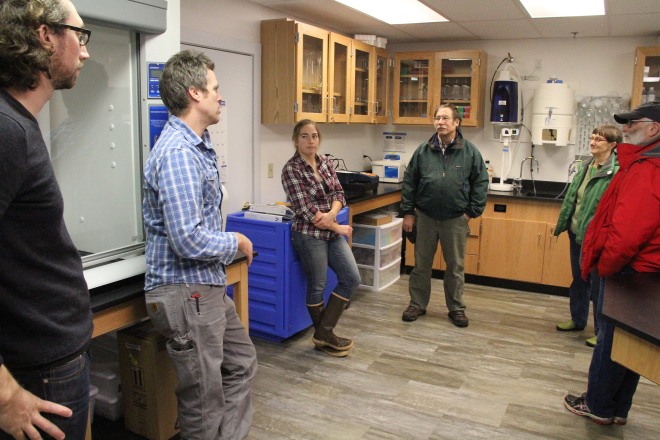
From left, Sitka Tribe of Alaska Environmental Lab Manager Michael Jamros, STA Environmental Program Manager Chris Whitehead, and STA Environmental Specialist Esther Kennedy discuss the new Sitka Biotoxin Lab with visitors to an open house on Monday, Nov. 30, 2015. The new lab will help Southeast subsistence and sport shellfish harvesters learn about harmful algal blooms in the region so they can avoid paralytic shellfish poisoning (PSP) or amnesic shellfish poisoning (ASP).
Most shellfish eaters are aware of the massive algal bloom that shut down many shellfish operations on the Pacific Coast this summer. The algal bloom even reached Sitka’s Starrigavan Beach with the June discovery of Pseudo-nitzchia, a species of plankton that sometimes produces domoic acid which can cause amnesic shellfish poisoning (ASP). ASP causes gastrointestinal issues in mild cases, such as nausea, vomiting, diarrhea, and abdominal cramps. In more severe cases there will be neurological problems, such as headaches, confusion, hallucinations, short-term memory loss, respiratory difficulty, seizures, coma, and in extreme cases, death.
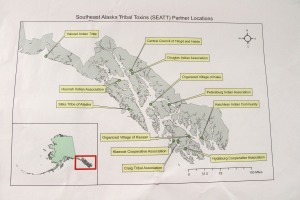 Until two years ago, Southeast Alaska beaches and subsistence- and sport-harvested shellfish weren’t tested for harmful biotoxins. That changed with the Southeast Alaska Tribal Testing (SEATT) program, a partnership of regional tribes coordinated by Sitka Tribe of Alaska, that began training technicians from six villages (now 12 villages) in the region on how to gather water samples so they could be tested. SEATT is part of a program called Southeast Alaska Tribal Ocean Research (SEATOR).
Now the project has moved to the next phase, the creation of a Sitka Biotoxin Lab, located at 429 Katlian Street, that can provide quicker and better testing results to people in the region who want to eat shellfish. Instead of sending samples to the Lower 48 for testing, which can take more than a week or two, samples from Southeast Alaska can be tested in Sitka and data can be available in less than 24 hours, Sitka Tribe of Alaska Environmental Program Manager Chris Whitehead said during an open house at the lab on Monday, Nov. 30. Before the lab opened, the program just took water samples. But now it will be able to actually test the shellfish for biotoxins.
Whitehead said one of the purposes of the lab is to give shellfish harvesters as much information as possible about possible harmful algal blooms so they can make informed decisions about if they still want to harvest and eat local shellfish. Harmful algal blooms spread a variety of biotoxins, such as domoic acid and saxitoxin, which can cause paralytic shellfish poisoning (PSP) and amnesic shellfish poisoning (ASP). PSP and ASP can be deadly, and in 2010 there were two people in Southeast Alaska who died from PSP.
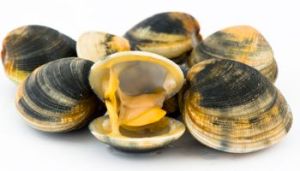
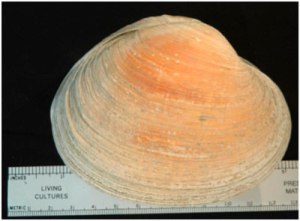
 “The toxins can stay in butter clams for 2 1/2 to three years,” Whitehead said, disproving the common local myth that shellfish is safe to eat in months with R in the name. “We’re still seeing blooms in December.”
Whitehead said he’s hoping to eventually be able to do baseline sampling of a variety of beaches in Southeast Alaska. He said they are sampling bays for cyst beds by digging cores in the beach soil, and they’ve found cysts 3-4 meters (9-13 feet) below the surface. While the beach might be safe for now, if people start building piers or docks it can stir up the cyst beds and launch a harmful algal bloom.
The lab and testing program is funded by the Environmental Protection Agency (EPA) Indian Environmental General Assistance Program, the Bureau of Indian Affairs (BIA) and Tribal Cooperative Landscape Conservation Program, and the Administration for Native Americans’Environmental Regulatory Enhancement program. The National Oceanic and Atmospheric Administration (NOAA) Marine Biotoxin Programs from Seattle, Wash., and Charleston, S.C., provided training through workshops to help develop the SEATT program.
 Michael Jamros, PhD, was hired in October as the STA Environmental Lab Manager, and he will be handling most of the actual testing and diagnosis of the seawater and shellfish. He said right now the lab is focused on subsistence and sports harvests, but down the road it’s hoping to become FDA-certified so it can test commercial harvests.
Esther Kennedy is the STA Environmental Specialist, and she said “every week I go plankton hunting.” This summer all of her tests were at Starrigavan State Recreation Area, but now that the lab is open she will be able to test in more areas, “wherever you think people might harvest shellfish.”
 “I think this will help our food security,” Kennedy said. “People will be able to see this abundant resource of shellfish, and now they’ll have better information about whether it’s safe to harvest.”
In addition to the Sitka staff, the program also trains monitors from 12 partner villages to test in their areas, which range from Ketchikan on the south to Yakutat on the north. These monitors come to Sitka twice a year for training, with their most recent training in early November. A slideshow of photos from the training is posted below.
This slideshow requires JavaScript.




 Sitka Local Foods Network
You must be logged in to post a comment.