• Harmful algal bloom warning issued for shellfish harvested in Starrigavan Beach

Clam diggers work the beach at Starrigavan in this file photo. The Sitka Tribe of Alaska is warning Sitkans against harvesting clams in the area due to a harmful algae detected Monday, June 8, 2015. (Daily Sitka Sentinel file photo by James Poulson)

Clam diggers work the beach at Starrigavan State Recreation Area in this file photo. The Sitka Tribe of Alaska is warning Sitkans against harvesting clams in the area due to a harmful algae detected Monday, June 8, 2015. (Daily Sitka Sentinel file photo by James Poulson)

Southeast Alaska Tribal Ocean Research (SEATOR) on Monday, June 8, issued a warning that people should not be eating shellfish harvested at Starrigavan Beach in Sitka.

Pseudo-nitzchia“Yes, we are seeing a bloom of Pseudo-nitszchia. This species of plankton can produce domoic acid which can cause amnesic shellfish poisoning (ASP),” Sitka Tribe of Alaska Environmental Program Manager Chris Whitehead said.

Whitehead is coordinating SEATOR and the Southeast Alaska Tribal Toxins (SEATT) partnership program where seven tribes in Southeast Alaska are partnering to test shellfish for harmful algal booms that can cause problems such as paralytic shellfish poisoning (PSP) or other health issues. The SEATT partnership program and SEATOR were launched a little bit over a year ago because there is no harmful algal bloom testing of Southeast beaches by the state, even though there had been many recent cases of PSP outbreaks that resulted in people being hospitalized or even dying.

According to the SEATOR website, Pseudo-nitzchia spp is a genus of diatoms found worldwide. In North America, it can be found on the Pacific Northwest Coast from Alaska to mid-California, the Northeast Atlantic Coast of Canada, in North Carolina, and in the Gulf of Mexico. Domoic acid is a neurotoxin that binds glutamate receptors, which are involved in memory processing.

Amnesic shellfish poisoning (ASP) causes gastrointestinal and neurologic issues. Mild cases usually occur within 24 hours after eating shellfish exposed to the ASP toxin. Symptoms include nausea, vomiting, diarrhea, and abdominal cramps. In more severe cases there also will be neurological problems, such as headaches, confusion, hallucinations, short-term memory loss, respiratory difficulty, seizures, coma, and in extreme cases, death.

According to a recent story from Oregon Public Broadcasting’s KUOW/EarthFix program, there currently is a massive harmful algal bloom extending from Homer, Alaska, on the north to Monterey Beach, Calif., in the south. In addition to impacting shellfish, the toxic harmful algal bloom has caused problems in fish and marine mammals that ate infected shellfish.

If you recently have eaten shellfish harvested in the Starrigavan State Recreation Area and have any of the above symptoms, you should seek medical help immediately.

• Sitka Tribe of Alaska, six other tribes partner to build lab to monitor shellfish biotoxins such as PSP

Cockles-Alaska-Department-of-Health-and-Social-Services

The Sitka Tribe of Alaska (STA) has formed the Southeast Alaska Tribal Toxins (SEATT) partnership with six other Southeast tribes to monitor harmful algal blooms (HABs) in Southeast Alaska. In addition, STA has been awarded a grant to build a lab to monitor biotoxins, which frequently impact clams, mussels, cockles, and other shellfish harvested in the region.

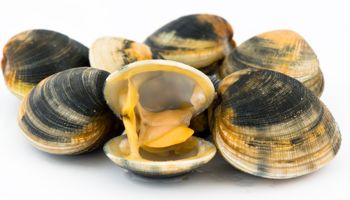
raw-clams-350SEATT will unify Southeast Alaska tribes in monitoring HAB events that pose a human health risk to the subsistence shellfish harvester, such as paralytic shellfish poisoning (PSP). This monitoring effort will provide weekly data on the timing and distribution of HABs, along with measurements of environmental conditions, indicators, and potential mechanisms that trigger HAB events.

In addition to STA, SEATT partners include the Klawock Cooperative Association, Craig Tribal Association, Yakutat Tlingít Tribe, Petersburg Indian Association, Organized Village of Kasaan, and the Central Council of Tlingít and Haida Indian Tribes of Alaska (CCTHITA).

The National Oceanic and Atmospheric Administration (NOAA) Marine Biotoxin Programs from Seattle, Wash., and Charleston, S.C., have committed to provide training through workshops to help develop the SEATT program. The Sitka Tribe of Alaska is hosting a workshop in November for SEATT to provide training on sample collection techniques and data entry. NOAA staff will help facilitate the trainings using previously established protocols used by other HAB monitoring groups throughout nation.

Each SEATT tribe received funding through the Environmental Protection Agency (EPA) Indian General Assistance Program (IGAP) totaling $210,000 for fiscal year 2015, with plans to continue through 2017. The Sitka Tribe of Alaska also received an additional $150,000 to support SEATT with the bi-annual technical workshops and conduct cellular toxin analysis.

Ipe-fig1n addition, the Sitka Tribe of Alaska received $527,000 for the development of a marine biotoxin lab in Sitka from the Administration for Native Americans’ Environmental Regulatory Enhancement program. The lab will provide the SEATT partners the ability to assess their communities’ vulnerability for human health risks following with the same regulatory standards used by other state and federal agencies.

The STA lab will conduct toxin analysis on shellfish using the new Receptor Binding Assay (RBA) technique developed at the NOAA Charleston laboratory. The RBA was just recently accepted as a regulatory method used to determine toxin levels in shellfish by the Interstate Shellfish Sanitation Conference (ISSC) and has been adopted into the National Shellfish Sanitation Program (NSSP).

• Alaska DEC, UAF Cooperative Extension to host food regulations training for farmers markets

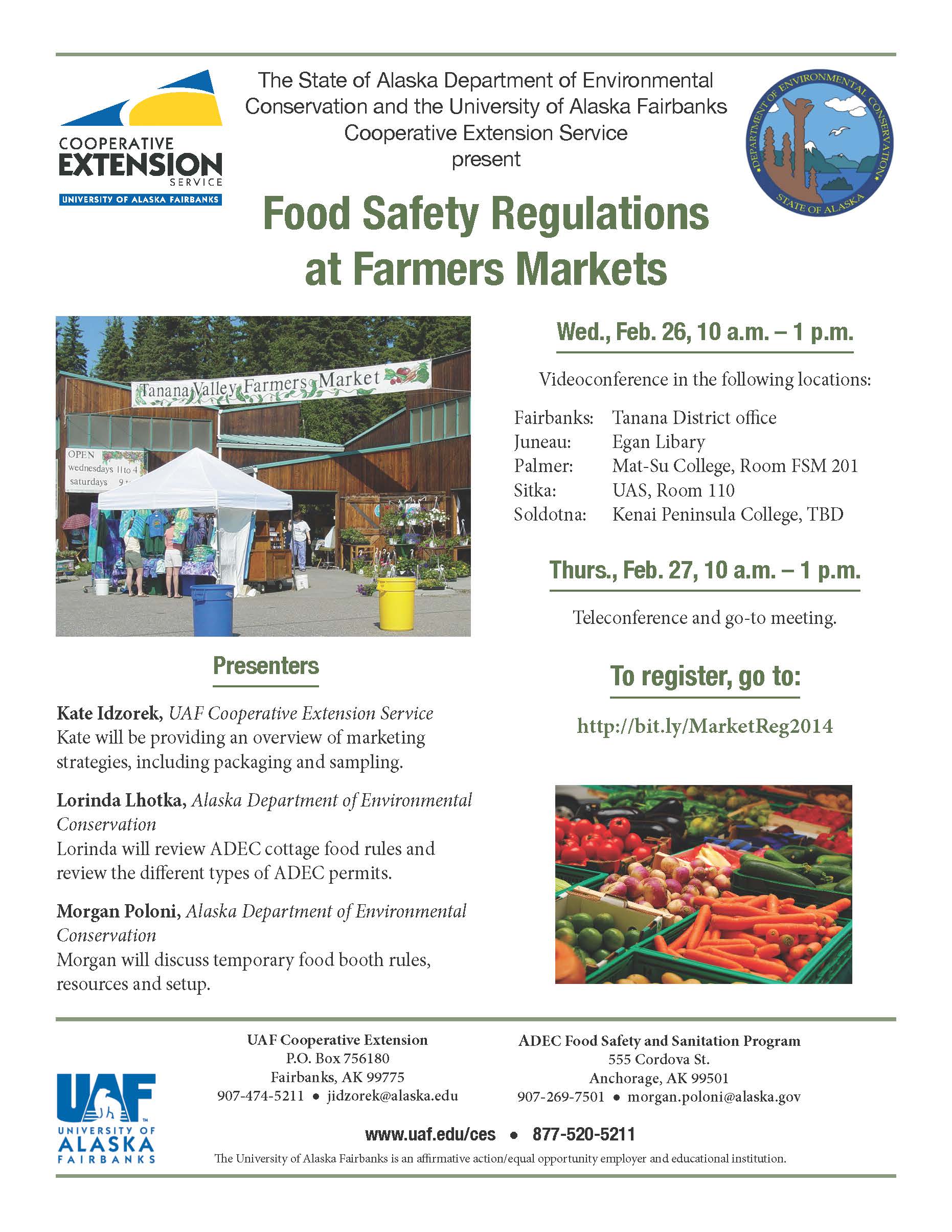
Farmers Market Regs

The Alaska Department of Environmental Conservation and the University of Alaska Fairbanks Cooperative Extension Service will team up to offer two training sessions about food regulations for farmers markets from 10 a.m. to 1 p.m. on both Wednesday, Feb. 26 (videoconference available in five locations, including Sitka) and on Thursday, Feb. 27 (by teleconference available statewide).

During these trainings you will learn how to market your products, how to set up your temporary food booth, and what foods do and do not require Alaska DEC permits. The course will be taught by Kate Idzorek with the UAF Cooperative Extension Service, and by Lorinda Lhotka and Morgan Poloni with the Alaska DEC Food Safety and Sanitation office. Kate will discuss marketing strategies including packaging and sampling, Lorinda will talk about Alaska DEC cottage food rules and the different types of permits, and Morgan review temporary food booth rules, resources and setup.

The first training will be offered by videoconference in five locations on Wednesday — Juneau, the Matanuska Valley, Soldotna, Fairbanks and Sitka. The Sitka videoconference site is University of Alaska Southeast Sitka Campus, Room 110 (see the flier for the other videoconference locations). The second training will be offered by teleconference or webinar (Go-To Meeting).

To register, go to http://bit.ly/MarketReg2014. For more information, contact Kate at 1-907-474-5211 or jizdorak@alaska.edu, or contact Morgan at 1-907-269-7501 or morgan.poloni@alaska.gov. The UAF Cooperative Extension Service can be reached (toll-free) at 1-877-520-5211. (Editor’s note: the three PowerPoint presentations from the Feb. 26 workshop are linked below as PDF files.)

• Cottage Foods at the market handout

• Food safety at farmers markets PowerPoint (opens as PDF file)

• Update on Alaska Farmers Markets Quest Card program PowerPoint (opens as PDF file)

• Registration deadline Wednesday, Sept. 18, for upcoming certified food protection manager workshop on Oct. 18

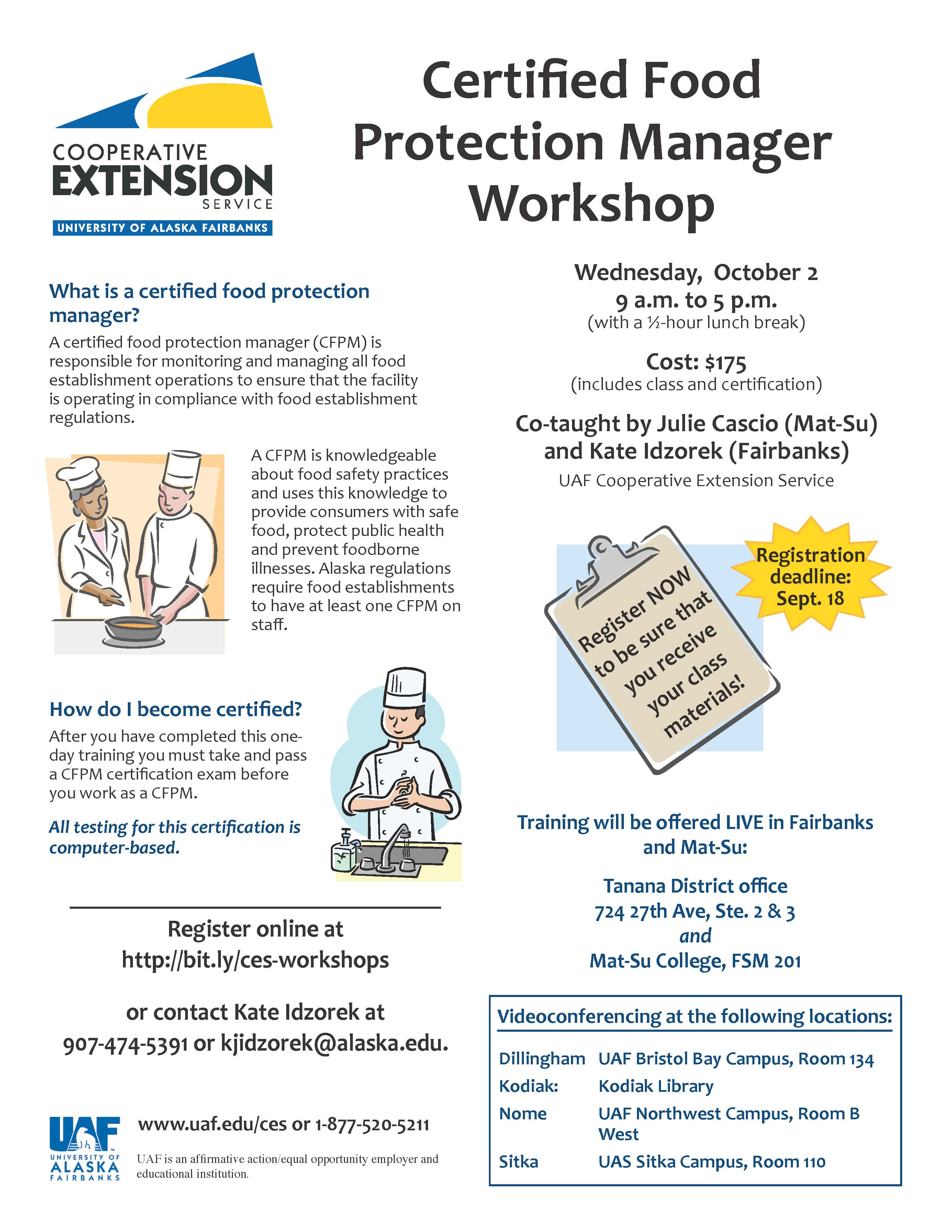
CFPM flyer 10-2-13

Wednesday, Sept. 18, is the registration deadline for a certified food protection manager workshop being taught on Wednesday, Oct. 2, by University of Alaska Fairbanks Cooperative Extension Service. This is an all-day statewide class that will be offered live in Fairbanks and Palmer, and by videoconferencing to Sitka, Nome, Kodiak and Dillingham.

A certified food protection manager (CFPM) is responsible for monitoring and managing all food establishment operations to ensure that the facility is operating in compliance with food establishment regulations.

A CFPM is knowledgeable about food safety practices and uses this knowledge to provide consumers with safe food, protect public health and prevent food-borne illnesses. Alaska regulations require food establishments to have at least one CFPM on staff.

This course takes place from 9 a.m. to 5 p.m. (with a half-hour lunch), and participants will take a computer-based exam at the end of the class. The reason the deadline is two weeks before the class is to guarantee course materials reach all the students in time for the class. The cost is $175, and the course will be taught by Kate Idzorek of Fairbanks and Julie Cascio of Palmer. Students can register here.

The Sitka videoconference for the class will take place in Room 110 at the University of Alaska Southeast Sitka Campus. To learn more, contact the Sitka District Office of the UAF Cooperative Extension Service at 747-9440, or contact Kate Idzorek at 907-474-5391 (toll-free, 1-877-520-5211) or kjidzorek@alaska.edu in Fairbanks.

• Alaska Division of Agriculture to host four On-Farm Food Safety Workshops in Southeast communities

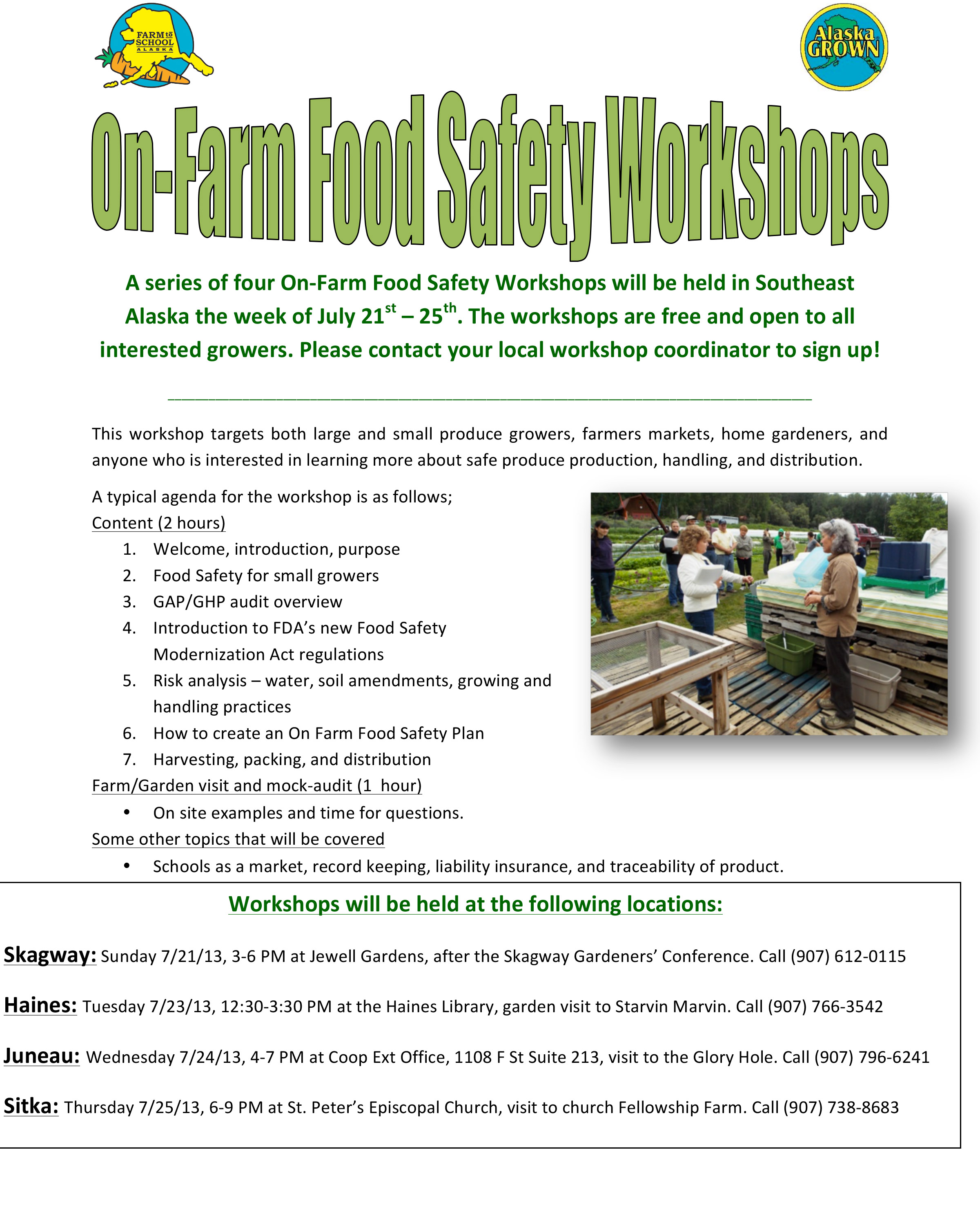
Southeast Workshops flyer2

The Alaska Division of Agriculture is planning a series of four On-Farm Food Safety Workshops in Southeast Alaska communities the week of July 21-25. The workshops will be in Skagway, Haines, Juneau and Sitka.

These workshops are geared toward farmers both large and small, farmers market vendors, gardeners, and anyone who is interested in learning more about food safety in the production of fruits and vegetables.

The Sitka workshop will be from 6-9 p.m. on Thursday, July 25, in the upstairs classroom of the See House at the St. Peter’s By The Sea Episcopal Church (on Lincoln Street, the brown church with the steeple above Crescent Harbor). This is a voluntary educational event for farmers and gardeners who want to learn more about agricultural practices that help reduce the risk of food-borne illness, especially if they plan to sell or donate produce to the Sitka Farmers Market or other programs. For more information about the Sitka workshop, contact Lisa Sadleir-Hart at 747-5985.

The workshops are free, informal, and run for about three hours. The workshops consist of two powerpoint presentations – one on food safety, and introduction to both USDA GAP/GHP food safety audits and the FDA’s new Food Safety Modernization Act, and a second presentation that assists growers who are interested in marketing their produce to schools and local institutions.

The workshops include a site visit to a local farm or garden where we will conduct a mock food-safety audit and answer growers’ questions. We will also provide a wealth of food safety reference materials, and an introduction to online tools that can assist growers in creating a food safety plan, which is the first step in providing food safety assurance to their buyers.  All attendees will receive a copy of FamilyFarmed.org’s “Wholesale Success” reference manual, and a certificate for 3 hours of continuing education in farm food safety.

To learn about the Skagway, Haines and Juneau workshops, check out the flier posted above.