The U.S. Department of Agriculture’s Natural Resources Conservation Service (NRCA) has revamped its cost-sharing program that enables qualifying landowners who produce food to build high tunnels.
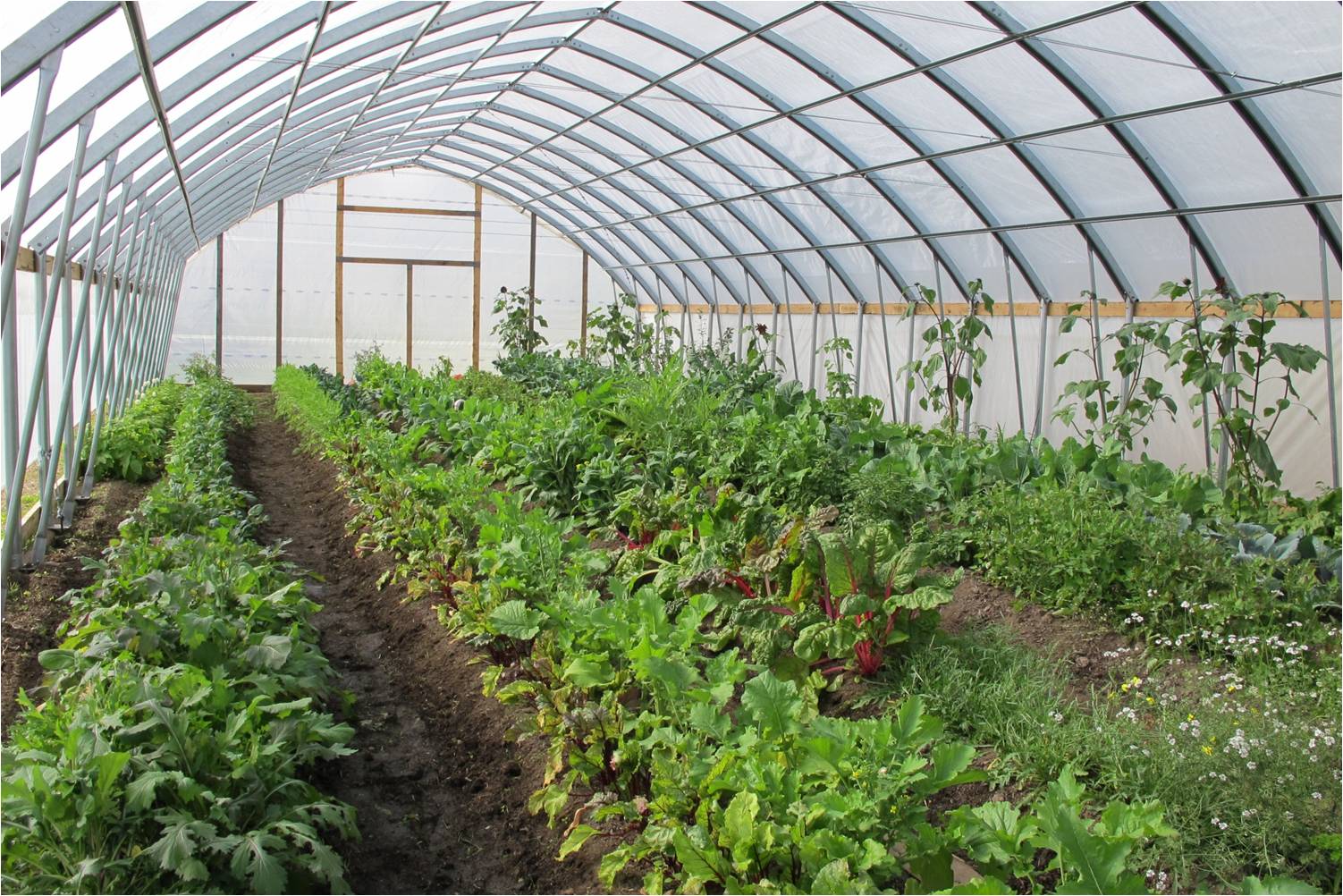
High tunnels, also known as hoop houses or temporary greenhouses, extend the growing season so more food is produced before and after the traditional dates for growing stuff outdoors.
High tunnels are different than greenhouses in that they are passively heated by the sun, so they have lower energy costs than greenhouses. High tunnels are at least six-feet tall, and low tunnels aren’t eligible in this program. Food in high tunnels is planted either directly into the ground or in raised beds. To learn more about the USDA’s high tunnel program, click here (note, link is to FY2013 program information, there have been updates for FY2015 but no link was available). This link has frequently asked questions and answers about seasonal high tunnel systems for crops.
This program started a couple of years ago as a pilot program, but now is a permanent part of of the NRCS EQIP (Environmental Quality Incentive Programs). One major change is there now is no size restriction on the size of structures NRCS will provide cost-sharing funds (previously it was limited to up to 2,178 square feet, or 5 percent of one acre). Also, geodesic domes are now eligible. Both the land owner and land must meet certain eligibility requirements. Funding is provided on a reimbursable status once the high tunnel is installed and certified to meet NRCS standards. In previous years only a couple of Sitka residents have taken advantage of the program, but other areas of the state, such as Homer, have built dozens of high tunnels through the program.
For information regarding the NRCS technical service or program participation in Southeast Alaska, please contact Samia Savella at the Juneau field office at (907) 586-7220 or samia.savell@ak.usda.gov. Applications currently are being accepted for the 2015 fiscal year (Oct. 1, 2014, to Sept. 30, 2015) and applications must be received at the Juneau field office on or before June 15, 2014. Click here for a link to the Alaska NRCS page.
The keynote speaker will be Garden Writers of America Hall of Fame member Jeff Lowenfels, longtime garden columnist with the Anchorage Daily News and the author of the books “Teaming With Microbes: The Organic Gardener’s Guide to the Soil Food Web” and “Teaming With Nutrients: The Organic Gardeners Guide to Optimizing Plant Nutrition.” Lowenfels also was the founder of the “Plant A Row for the Hungry” (aka PAR) program that has provided more than 14 million meals for the hungry, and he is former president of the Garden Writers of America.
Garden enthusiasts will be thrilled at the selection of topics ranging from gardening for Alaska’s pollinators to cooking with local edibles through the science behind the process of composting. The conference will have activities for kids and tours of Skagway’s finest gardens and historic garden sites, which includes the Klondike Gold Rush National Historical Park’s Herbarium.
The conference includes a Friday evening opening reception at the Red Onion’s Bombay Room; Keynote and Saturday program at the Arctic Brotherhood Hall; Saturday continental breakfast; garden tours; lunch at the Westmark Hotel featuring Laurie Constantino, author of “Tastes Like Home: Mediterranean Cooking in Alaska;” glassblowing demonstration and dinner at Jewell Gardens; and Sunday workshops. This year’s conference is hosted by the Skagway Garden Club and sponsored by the Skagway Convention and Visitors Bureau.
(EDITOR’S NOTE: The following article first appeared on this site in April 2010. It is repeated because much of the information remains current and newsworthy.)
As you start to plan your garden for this spring and summer, don’t forget to Plant A Row For The Hungry. The Plant A Row For The Hungry program (also known as Plant A Row or PAR) is a national campaign by the Garden Writers Association of America that got its start in Alaska.
In the cold winter of 1994, Anchorage Daily News garden columnist and former Garden Writers Association of America President Jeff Lowenfels was returning to his hotel after a Washington, D.C., event when he was approached by a homeless person who asked for some money to buy food. Lowenfels said Washington, D.C., had signs saying, “Don’t give money to panhandlers,” so he shook his head and kept on walking. But the man’s reply, “I really am homeless and I really am hungry. You can come with me and watch me eat,” stayed with Lowenfels for the rest of his trip.
Jeff Lowenfels
The encounter continued to bother Lowenfels, even as he was flying back to Anchorage. During the flight, Lowenfels came up with an idea when he started writing his weekly garden column (the longest continuously running garden column in the country, with no missed weeks since it started on Nov. 13, 1976). He asked his readers to plant one extra row in their gardens to grow food to donate to Bean’s Café, an Anchorage soup kitchen. The idea took off.
When Anchorage hosted the Garden Writers Association of America convention in 1995, Lowenfels took the GWAA members to Bean’s Café to learn about the Plant A Row For Bean’s Café program. The Garden Writers Association of America liked the idea, and it became the national Plant A Row For The Hungry campaign (also known as Plant A Row or PAR). In 2002, the Garden Writers Association Foundation was created as a national 501(c)(3) nonprofit to manage the Plant A Row For The Hungry program.
“I am not surprised by the growth of PAR,” Lowenfels wrote in an e-mail to the Sitka Local Foods Network. “It is now in all 50 states and across Canada and there are thousands of variations of the original program — from prison gardens for the hungry to botanical gardens donating their produce from public display gardens. This is because gardeners always share information and extra food, so the idea was a natural.”
It took five years for the program to reach its first million pounds of donated food, but the second million only took two years and the next eight years saw a million pounds of donated food (or more) each year. Since 1995, more than 14 million pounds of food have been donated. Not only that, the program is getting ready to expand overseas to Australia, England and other countries with avid gardeners.
“We have supplied something in the vicinity of enough food for 50 million meals,” Lowenfels wrote in his e-mail. “Gardeners can solve this hunger problem without the government. And we don’t need a tea party to do it! Or chemicals, I might add, as author of a book on organic gardening (Teaming With Microbes, written with Wayne Lewis)!” (Lowenfels recently released a second book, Teaming With Nutrients, which is a follow-up to his first book).
According to the U.S. Department of Agriculture, one out of every eight U.S. households experiences hunger or the risk of hunger. Many people skip meals or eat too little, sometimes going an entire day or more without food. About 33 million Americans, including 13 million children, have substandard diets or must resort to seeking emergency food because they can’t always afford to buy the food they need. In recent years the demand for hunger assistance has increased 70 percent, and research shows that hundreds of children and adults are turned away from food banks each year because of lack of resources.
While many people credit Lowenfels for creating the Plant A Row For The Hungry program, Lowenfels says the real heroes are the gardeners growing the extra food and donating it to local soup kitchens, senior programs, schools, homeless shelters and neighbors. You can hear him pass along the credit to all gardeners at the end of this interview last year with an Oklahoma television station (video also embedded below).
“One row. That’s all it takes. No rules other than the food goes to the hungry. You pick the drop-off spot or just give it to a needy friend or neighbor. Nothing slips between the lip and the cup, I say,” Lowenfels wrote in his e-mail.
For people wanting to Plant A Row For The Hungry in Sitka, there are several places that would love to help distribute some fresh locally grown veggies or berries to those who are less fortunate, such as the Salvation Army, Sitkans Against Family Violence (SAFV), local churches, Sitka Tribe of Alaska and other organizations. The food the Sitka Local Foods Network grows at St. Peter’s Fellowship Farm communal garden goes to the Sitka Farmers Market.
The Sitka Local Foods Network also takes donations of local produce to sell at the Sitka Farmers Markets, and all proceeds are used to help pay for SLFN projects geared toward helping more people in Sitka grow and harvest local food. For more information, contact SLFN President Lisa Sadleir-Hart or one of the other board members at sitkalocalfoodsnetwork@gmail.com.
This is the inside of a community greenhouse built above the Arctic Circle in Inuvik, Northwest Territories, Canada, that has been one of the models for the Sitka Community Greenhouse and Education Center (Photo from http://www.cityfarmer.org/inuvik.html).
Are you interested in helping Sitka increase its access to fresh, locally grown produce all year round? The Sitka Local Foods Network will host a gathering from 7-8:30 p.m. on Wednesday, April 24, at Harrigan Centennial Hall to discuss plans for the Sitka Community Greenhouse and Education Center.
Building a community greenhouse and education center was a community wellness goal from the 2008 Sitka Health Summit, but over the years there were a few problems bringing the project to fruition (usually with securing land). We are looking to build a 30-foot–by-52-foot greenhouse on a couple of possible sites, including on the Sheldon Jackson Campus or near the University of Alaska Southeast Sitka Campus, among other locations around town. This is the closest we’ve come to being able to start building a community greenhouse, which will help provide Sitka residents with more local produce, and it also will work with schools and local residents to teach gardening and horticulture.
In addition to the availability of land, we have been offered locally harvested wood to build the greenhouse frame, which will be modeled after another successful greenhouse built near Sitka in 2011.
For more information, contact Kerry MacLane at 752-0654 or Doug Osborne at 966-8734.
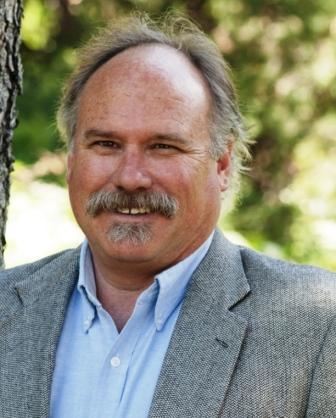
Sitka residents interested in building a Sitka Community Greenhouse and Education Center pose with Shane Smith of the Cheyenne, Wyo., Botanic Gardens (front row, second from right) after he spoke at a March 12, 2013, meeting about the greenhouse.
The Sitka Local Foods Network will host a meeting from 7-8:30 p.m. on Tuesday, March 26, at Harrigan Centennial Hall to continue discussions about creating a Sitka Community Greenhouse and Education Center.
The construction of a community greenhouse will help Sitka increase its access to fresh, locally grown produce all year round. The greenhouse also will serve as an education center, helping local residents learn about what it takes to grow fruits and veggies in Sitka, Alaska. This was a Sitka Health Summit project from 2008 that recently regained momentum.
The group currently is looking to build a 30-foot-by-52-foot greenhouse, possibly at the Sheldon Jackson Campus near the Hames Athletic and Wellness Center. Other locations are being considered, but this has been the best potential offer of a site since the start of the project. To learn more, contact Doug Osborne at 966-8734 or Kerry MacLane at 752-0654.
Are you interested in helping Sitka increase its access to fresh, locally grown produce all year round? The Sitka Local Foods Network will host a gathering from 7-8:30 p.m. on Tuesday, March 12, at Harrigan Centennial Hall to discuss plans for the Sitka Community Greenhouse and Education Center.
Building a community greenhouse and education center was a community wellness goal from the 2008 Sitka Health Summit, but over the years there were a few problems (usually with securing land) bringing the project to fruition. It now appears the Sitka Fine Arts Camp will allow us to build a 30-foot–by-52-foot greenhouse on the Sheldon Jackson Campus, next to the Hames Athletic and Wellness Center. This is the closest we’ve come to being able to start building a greenhouse.
In addition to the availability of land, we have been offered locally harvested wood to build the greenhouse frame, which will be modeled after another successful greenhouse built near Sitka in 2011.
Please join us on Tuesday to learn more about this exciting project. In addition, Shane Smith, the executive director and founder of the Cheyenne (Wyo.) Botanic Gardens and author of the Greenhouse Gardener’s Companion, will be at the meeting to provide advice based on his experiences building a similar project. Shane Smith also will give a presentation on greenhouses and high tunnels from 11 a.m. to 12:30 p.m. on Saturday, March 9, at the University of Alaska Southeast Sitka Campus Room 229, and he’ll have a booth at the Let’s Grow Sitka garden education event from noon to 3 p.m. on Sunday, March 10, at the Alaska Native Brotherhood Founders Hall, 235 Katlian St.
“The Sitka Community Greenhouse and Education Center would be a tremendous asset to our town and we’ve never been closer to making that dream become a reality,” Sitka Local Foods Network President Kerry MacLane said. “Having Shane’s expertise and guidance to draw from just puts us that much closer to making this happen this year.”
For more information, contact Kerry MacLane at 752-0654.
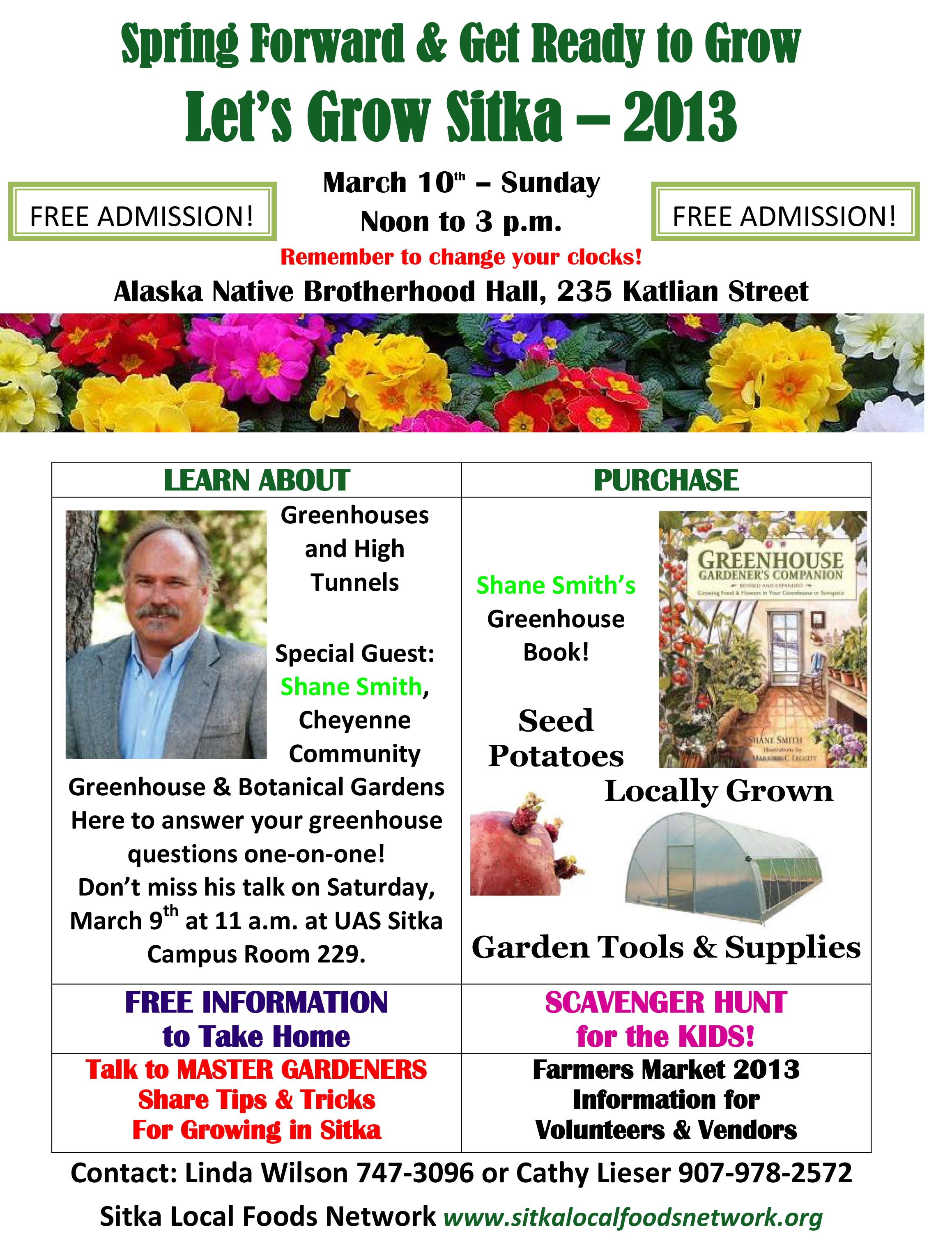
Mark your calendars as the Sitka Local Foods Network will host two big garden events Saturday and Sunday, March 9-10, in Sitka.
The first event is a presentation by Shane Smith of the Cheyenne (Wyo.) Botanic Gardens from 11 a.m. until 12:30 p.m. on Saturday, March 9, in Room 229 of the University of Alaska Southeast Sitka Campus. The second event is the fifth annual Let’s Grow Sitka garden education event from noon until 3 p.m. on Sunday, March 10, at the Alaska Native Brotherhood Founders Hall, 235 Katlian (don’t forget to set your clocks ahead an hour Saturday night).
The Sitka Local Foods Network is excited to bring Shane Smith to town to discuss gardens and greenhouses. Shane is the founder of the Cheyenne (Wyo.) Botanic Gardens and has been its director since 1977. Shane is the author of the Greenhouse Gardener’s Companion, and he will be signing copies of his book. Shane received the American Horticulture Society’s 2012 Great American Gardener Award.
Shane also will have a booth at Sunday’s Let’s Grow Sitka event, which is an annual event designed to get Sitka residents excited about the upcoming garden season. This annual event brings together local garden supply stores, local gardeners, landscapers and anybody who is interested in learning how to grow food and/or flowers.
There will be a wide variety of individuals and businesses with booths for the event, with some booths providing gardening information geared toward and others selling gardening supplies. Lunch will be available for purchase. There also will be a chance to learn from certified Master Gardeners, a chance to learn about greenhouses and high tunnels, an opportunity to buy seeds and seed potatoes, and there’s a scavenger hunt for the kids.
For more information, contact Linda Wilson at 747-3096 (evenings and weekends) or Cathy Lieser at 1-907-978-2572. Table space still may be available for people wanting to provide information about different types of gardening or gardening products/services available in Sitka.
The Sitka Local Foods Network thanks the City and Borough of Sitka, Shee Atika Corp., and the SouthEast Alaska Regional Health Consortium (SEARHC) Diabetes Programs for their help in making these events possible.
There will be a teleconference at 7 p.m. on Thursday, Sept. 27, to discuss whether there is interest from Southeast gardeners, greenhouse operators, farmers, ranchers and mariculture growers in forming a new Southeast Chapter of the Alaska Farm Bureau.
The Alaska Farm Bureau is the largest agricultural organization in the state and currently has six chapters: Fairbanks, Delta, Mat-Su, Kodiak, Kenai Peninsula and the Copper River Valley. Those who live in the Southeast are currently members of the Mat-Su Chapter.
Farm Bureau membership benefits include a subscription to the Alaska Farm and Ranch News, (Alaska’s only monthly agricultural newspaper), discounts at Grainger and Office Products, (both offering free shipping to Alaska for on-line orders); full service banking at Farm Bureau bank, farm policy insurance as well as all their other services from COUNTRY Financial, a prescription drug discount program for you and your employees and a $500 discount on GMC, Chevrolet and Buick new vehicle purchases.
To participate, call 1-800-528-2793. Enter the conference ID of 7807353 and press # at 7 p.m. on Sept. 27. There is no charge to participate.
If you are not able to participate that evening, please send an e-mail to Alaska Farm Bureau Executive Director Jane Hamilton at janehamilton99737@yahoo.com or mail a note expressing your interest to the Alaska Farm Bureau at PO Box 760, Delta Junction, AK 99737. Please include your name and contact information — mailing address, e-mail addresses and telephone number.
People who are not actively growing agricultural or mariculture products may join the Farm Bureau as Associate Members. Associate Members pay the same $40 annual membership fee and receive all of the same membership benefits. While they may join in discussions during chapter meetings, they do not have voting privileges. Their membership supports their local chapter as well as the state association. Any individual person or business is welcome to become an Associate Member.
If there is an interest, potential SE members will select a one person to represent them at the Alaska Farm Bureau Board of Director’s meeting that will be held at the Crowne Plaza Hotel in Anchorage on Nov. 8. The Friday Forum (conference day of agricultural speakers), Awards Banquet and Scholarship Auction will be held on Nov. 9 and the Annual Meeting will be held on Nov. 10.
The Board of Directors will pay travel expenses for your representative to attend the three-day event. The Board of Directors will decide whether there is enough interest to form a Southeast Chapter at their Nov. 8 business meeting.
The U.S. Department of Agriculture’s Natural Resources Conservation Service (NRCA) is offering a cost-sharing program that enables qualifying landowners who produce food to build high tunnels.
High tunnels, also known as hoop houses or temporary greenhouses, can help extend the growing season at both the start and end of the season so more food is produced.
High tunnels are different than greenhouses in that they are passively heated by the sun, so they have lower energy costs than greenhouses. Food in high tunnels is planted either directly into the ground or in raised beds. To learn more about the USDA’s high tunnel program, click here. This link has frequently asked questions and answers.
NRCS will provide cost-sharing funds on structures up to 2,178 square feet (5 percent of one acre). Both the land owner and land must meet certain eligibility requirements. Funding is provided on a reimbursable status once the high tunnel is installed and certified to meet NRCS standards.
For information regarding the NRCS technical service or program participation in Southeast Alaska, please contact the Juneau field office at (907) 586-7220 or samia.savell@ak.usda.gov. Applications currently are being accepted for the 2013 fiscal year (Oct. 1, 2012, to Sept. 30, 2013) and applications must be received at the Juneau field office on or before June 15, 2012. For contact info to other Alaska field offices, click this link.
(Lori Adams, who owns Down-To-Earth U-Pick Garden and is a frequent vendor at the Sitka Farmers Market, will be writing a regular garden column in the Daily Sitka Sentinel this summer. The Sentinel is allowing us to reprint the columns on this site after they first appear in the newspaper. This column appeared on Page 4 of the Wednesday, April 25, 2012, edition of the Daily Sitka Sentinel.)
GARDENING IN SITKA
By Lori Adams
TRANSPLANTING TIME
Most vegetable transplant starts can not handle any frost, so it is important to know the average frost-free date in your area. In Sitka we can get frost right up to about May 15, but you can transplant out a full month earlier if you utilize a product called a “floating row cover.”
Our local stores carry several brands of row cover in varying sizes. It is basically a light-spun polyester type of fabric through which water and light can penetrate. A floating row cover protects plants from frost and raises the temperature of the bed approximately 10 degrees. It can lie directly on the plants or be held aloft with hoops, but it needs to be weighted down around the edges to keep it from blowing away. Here at the Down To Earth U-Pick Garden, I use a seine net to hold it down. But you can use rocks or milk jugs full of water if you don’t have netting.
It would be best to leave this cover on your beds all season, but I take mine off about July 15 or when the vegetables are ready to pick, whichever comes first.
As a general rule I transplant the following vegetables outdoors in mid-April — broccoli, cauliflower, Brussels sprouts, Swiss chard, cabbage, lettuce, spinach, kohlrabi, kale and beets. And I sow these seeds directly into the soil — radishes, potatoes, turnips, carrots and peas. In May, I transplant — celery, leeks, fennel, sunflowers, herbs, zucchini, cucumbers and tomatoes; and I sow beans directly into the soil.
The first step in the transplanting process is to “harden off” your starts. This is a very tedious task which I hate, but it really is a must. Hardening off is a term used to describe the process of gradually getting the transplants used to the outside environment. During this process you carry your flats of transplants outdoors into a sunny sheltered area for several hours and then bring them back inside. Each day you extend the time they spend outdoors until they are ready to go out permanently. This reduces the shock to the baby vegetables.
When transplanting make a shallow dish-shaped depression in the bed and then dig a hole for the start right in the center. Carefully remove the start from its pot without handling the fragile stem (the plant can grow another leaf but it can’t grow another stem). Put it in the hole and lightly firm the soil around it. The shallow depression should remain to help catch water. You can bury most plants up to their first true leaves, but be sure not to cover the growing center of the plant with soil. Water lightly about three times that first day and at least once a day for the next two days if it doesn’t rain. Watering with a vitamin B solution is said to help starts deal with this stressful process. In a week or so your transplants should recover from the move and start showing signs of growth.
Next week’s column — Everything I know about carrots.
Brought to you by Down-To-Earth U-Pick Garden
2103 Sawmill Creek Road
Open June-August / Monday to Saturday, 11 a.m. to 6 p.m.


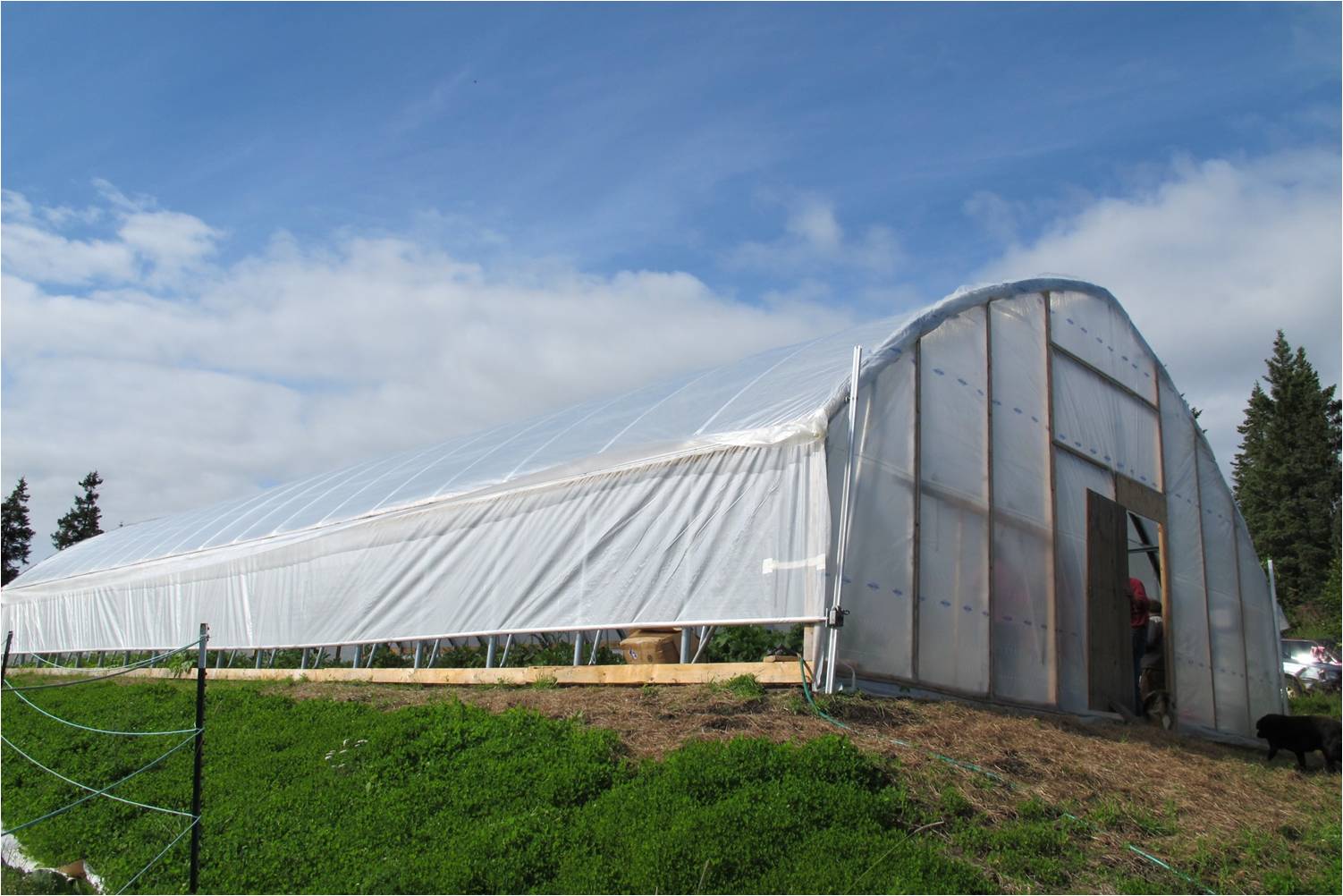 This program started a couple of years ago as a pilot program, but now is a permanent part of of the NRCS EQIP (Environmental Quality Incentive Programs). One major change is there now is no size restriction on the size of structures NRCS will provide cost-sharing funds (previously it was limited to up to 2,178 square feet, or 5 percent of one acre). Also, geodesic domes are now eligible. Both the land owner and land must meet certain eligibility requirements. Funding is provided on a reimbursable status once the high tunnel is installed and certified to meet NRCS standards. In previous years only a couple of Sitka residents have taken advantage of the program, but other areas of the state, such as Homer, have built dozens of high tunnels through the program.




 Sitka Local Foods Network
You must be logged in to post a comment.