• Alaska Center for the Environment launches local food campaign

AlaskaCenterForTheEnvironmentLogo

The Alaska Center for the Environment is launching a new campaign to teach Alaskans about the importance of local food. This campaign is just getting going, and there’s a lot of work needed to flesh out all of the elements. But it’s good to see someone looking a local food security issues on a statewide level.

Click here to read the main information page about the campaign, which includes facts such as Alaskans spent $2.6 billion on food each year and in 2007 only 0.13 percent of that money went to agricultural products grown in Alaska. Click here to read the campaign’s Frequently Asked Questions page. Click here to read about a proposed “Alaska Food, Farms and Jobs Act” that is based on legislation out of Illinois that ACE hopes to find an Alaska legislator willing to introduce.

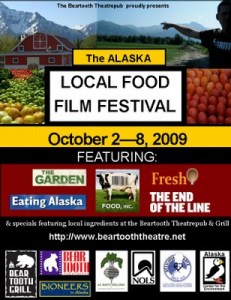
Finally, click here to read about the Alaska Local Food Film Festival that takes place Oct. 2-8 at the Bear Tooth Theatrepub and Grill in Anchorage. Each day during the festival the Bear Tooth will show a local food-related movie at 5:30 p.m. The films include “Food, Inc.,” “The Garden,” “Eating Alaska,” “Fresh” and “The End of the Line.” Sitka filmmaker Ellen Frankenstein will lead a discussion after her film, “Eating Alaska,” is shown on Sunday, Oct. 4.

AlaskaLocalFoodFilmFestivalPoster

• Local food news from Juneau: Virus infects Tlingít potato crop; Glory Hole to get community garden

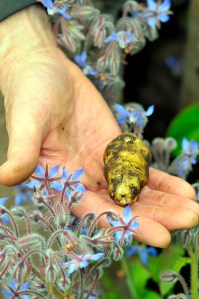
(Photo courtesy of Klas Stolpe/Juneau Empire) Bill Ehlers, assistant gardener at the Jensen-Olson Arboretum in Juneau, holds a Tlingít potato next to some borage plant flowers.

(Photo courtesy of Klas Stolpe/Juneau Empire) Bill Ehlers, assistant gardener at the Jensen-Olson Arboretum in Juneau, holds a Tlingít potato next to some borage plant flowers.

Click here to read an article in Tuesday’s Juneau Empire about a virus that has infected the crop of Tlingít potatoes at Juneau’s Jensen-Olson Arboretum. According to the article, the potatoes still are safe to eat, despite the virus. But the virus means they won’t be used as seed potatoes for other community gardens in Southeast Alaska, as previously planned. Officials from the University of Fairbanks Cooperative Extension Service office in Juneau are doing what they can to remove the virus so they can guarantee clean seed, but it might take a few years.

Click here to read an article from Monday’s Juneau Empire about plans to build a community garden at the Glory Hole homeless shelter and soup kitchen in downtown Juneau. The community garden is expected to provide fresh vegetables and fruit for the soup kitchen, as well as giving Glory Hole patrons a project they can work on at the shelter. Plans are to put garden beds on the roof and terraced garden beds on the hill behind the Glory Hole’s back door.

• Sitka Farmers Market on the Farm-To-Consumer Legal Defense Fund, Corvallis (Ore.) Gazette-Times sites

Screenshot from the Farm-To-Consumer Legal Defense Fund site with the Sitka Farmers Market story

Screenshot from the Farm-To-Consumer Legal Defense Fund site with the Sitka Farmers Market story

The Daily Sitka Sentinel article from mid-July previewing this year’s series of Sitka Farmers Market events continues to make the rounds of publications in the Lower 48. Click here to see the article posted on the Farm-To-Consumer Legal Defense Fund site.

The article also made its way to the Gazette-Times of Corvallis, Ore. (click here to see the article).

Screenshot of the Sitka Farmers Market article in the Gazette-Times of Corvallis, Ore.

Screenshot of the Sitka Farmers Market article in the Gazette-Times of Corvallis, Ore.

• Alaska Grown hosts the “Eat Local Challenge 2009” on Aug. 23-29

Flier for the Alaska Grown "Eat Local Challenge"

The Alaska Grown program will launch its “Eat Local Challenge 2009” this week, Sunday through Saturday, Aug. 23-29 (click here to read more).

During the next week, Alaska residents are encouraged to:

• Try eating at least one home-cooked meal this week, made of mostly local ingredients.
• Try to incorporate at least one never-before-used local ingredient into a meal.
• Try “brown-bagging” at least one meal this week made primarily of local ingredients.
• Try talking to at least one local food retailer and one food producer about local food options.
• Try to choose local food products whenever possible.

By the way, a good time to buy local food this week is the fourth Sitka Farmers Market of the summer, which takes place from 10 a.m. to 2 p.m. on Saturday, Aug. 29, at Alaska Native Brotherhood Hall (235 Katlian St.). We’ll see you there.

• Sitka Farmers Market debriefing and work party on Wednesday

The Sitka Local Foods Network will host a Sitka Farmers Market debriefing and St. Peter’s Fellowship Farm work party on from 4:30-6 p.m. on Wednesday, Aug. 19, at the communal garden located behind St. Peter’s By The Sea Episcopal Church, 611 Lincoln St.

Ideas on how to improve the Sitka Farmers Markets will be discussed, and we’ll do some weeding and slug hunting. The person that catches the most slugs gets a rare, tasty, healthy prize. Volunteers are discouraged from bringing slugs from their own yards in an attempt to increase their odds of winning. This event is open to the public.

For more information, contact Linda Wilson at 747-3096 (nights and weekends).

• City offers free topsoil for Sitka gardeners

A mound of topsoil at Blatchley Community Gardens

A mound of topsoil at Blatchley Community Gardens

According to Thursday’s issue of the Daily Sitka Sentinel, the city is offering limited amounts of free topsoil for use by community gardens.

A limit of one pick-up truck-sized load per household may be had at the north side of the community garden behind Blatchley Middle School.

Gardeners also are reminded that coffee grounds are still available. They’re located on the north end of the garden.

For more information, call Sitka Community School/RecycleSITKA at 747-8670.

Doug Osborne and his daughter, Darby, shovel topsoil into a wheelbarrow while building the WISEGUYS men's health group's garden plot in May 2008 at the Blatchley Community Gardens

Doug Osborne and his daughter, Darby, shovel topsoil into a wheelbarrow while building the WISEGUYS men's health group's garden plot in May 2008 at the Blatchley Community Gardens

• Community Gardens Act of 2009 introduced in Congress

According to the Vancouver, British Columbia, blog CityFarmer.info, U.S. Rep. Jay Inslee (D-Wash.) and Rep. Eleanor Holmes Norton (D-D.C.) on July 15 introduced HR 3225 into the U.S. House of Representatives, a bill known as the Community Gardens Act of 2009 (click here to read the text of the bill).

In a nutshell, this bill creates a grant program that compensates community groups up to 80 percent of the costs of starting and maintaining a community garden (click here to read the CityFarmer.info article about the bill).

Activities eligible to receive grant assistance include acquisition of interest in real property, construction, community outreach, operations, and any other appropriate activity. When making grants, the U.S. Department of Agriculture will consider the geographic diversity among grantees and the number of individuals in a local community that are likely to participate in a community garden.

“I’ve introduced this bill to help local groups create new community gardens in neighborhoods around the country,” Inslee said in a press release posted on his Congressional Web site (click here to read it). “Community gardens provide local food sources, strengthen and beautify neighborhoods and let people in urban settings enjoy the benefits of local agriculture. As a parent, I’m also happy to note that community gardens engage families and children in growing their own vegetables, which studies have shown has increased the willingness of children to eat their veggies.”

According to a national study, 1 million households participated in community gardens in 2008, but an estimated 5 million households expressed an interest in starting a garden plot near their home. Groups eligible to apply for funds in Inslee’s new grant program include community-development organizations, schools, state and local governments, tribal organizations and other groups. By encouraging these groups to construct gardens in their communities, Inslee’s bill will promote nutrition, environmental awareness, and neighborhood development.

On the same day the Community Gardens Act of 2009 was introduced, Rep. Doris Matsui (D-Calif.) introduced a complementary resolution to designate August as “National Community Gardening Awareness Month.”

“I support the Community Gardens Act of 2009, as it will help Americans across the country establish new gardens and support those who want to take part in feeding their families and their communities,” Matsui said. “Community gardens are on the rise across the nation as Americans look to shrink their monthly grocery bills, introduce produce and more nutritious foods into their children’s diets, and as a way to create a connection between our communities and the food we feed our families.”

Encourage Rep. Don Young (R-Alaska) to support this bill, and ask him to sign on as a co-sponsor. Also, write and ask Sen. Lisa Murkowski (R-Alaska) and Sen. Mark Begich (D-Alaska) to sponsor a similar bill in the U.S. Senate. Feel free to take things a step further and notify your state representative and senator that Alaska needs a similar bill using this legislation as a model.

Click here to e-mail Rep. Don Young.

Click here to e-mail Sen. Lisa Murkowski.

Click here to e-mail Sen. Mark Begich.

• Chena Hot Springs greenhouse a model for Sitka greenhouse project

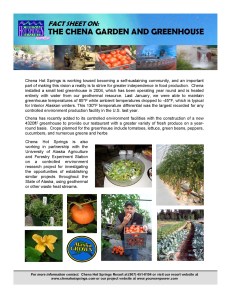
Greenhousefactsheet

One of the five focus areas for the Sitka Local Foods Network is to build a community greenhouse in Sitka. This will serve several functions, such as extending our growing season, allowing us to grow a wider variety of produce and expanding our capacity to grow fruits and vegetables in Sitka. The Sitka Local Foods Network has been looking at several locations around town and recently submitted a proposal for a possible site (more details as they become available).

Anyway, there is a model for a successful greenhouse here in Alaska, and it’s worth looking at so people from Sitka can see the possibilities.

Chena Hot Springs, located about 60 miles from Fairbanks, is working toward becoming a more sustainable community and an important element of this vision is being able to produce more of their own food locally. In 2004, Chena Hot Springs Resort installed a 1,000-square-foot test greenhouse that has become the only year-round producing greenhouse in Interior Alaska (click here to read more).

The hoop house greenhouse was able to maintain an interior temperature of 78 degrees Fahrenheit, even when outside temperatures dipped to minus-56 (the 134-degree difference is the largest ever recorded for a controlled environment facility in the U.S.). The greenhouse is heated by geothermal energy from the hot springs (165-degree water running through pipes embedded in concrete floor slabs). Click here for a downloadable report (as a PDF file) on the economic benefits of the project.

After the successful first year or two of production, Chena built a new 4,320-square-foot greenhouse to provide the resort’s restaurant with a greater variety of fresh produce on a year-round basis. Under optimal conditions the nearly 14,000 lettuce plants can grow nearly 150,000 heads of lettuce in a year. They also have 450 different tomatoes, including six Dutch varieties, a cherry tomato variety, a grape tomato variety, a beefsteak tomato variety and three intermediate cluster varieties. They also grow green beans, peppers, cucumbers and numerous greens and herbs (click here for a photo gallery). Chena Hot Springs Resort is working in partnership with the University of Alaska Fairbanks Agricultural and Forestry Experiment Station (click here for a link to the UAF AFES).

Chena Hot Springs Resort, which uses geothermal and other waste heat for power, will host the Fourth Annual Chena Renewable Energy Fair on Saturday, Aug. 22. Click here for more information.