• Sarah Lewis to provide free pressure canner gauge testing at Saturday’s Sitka Farmers Market

Canner

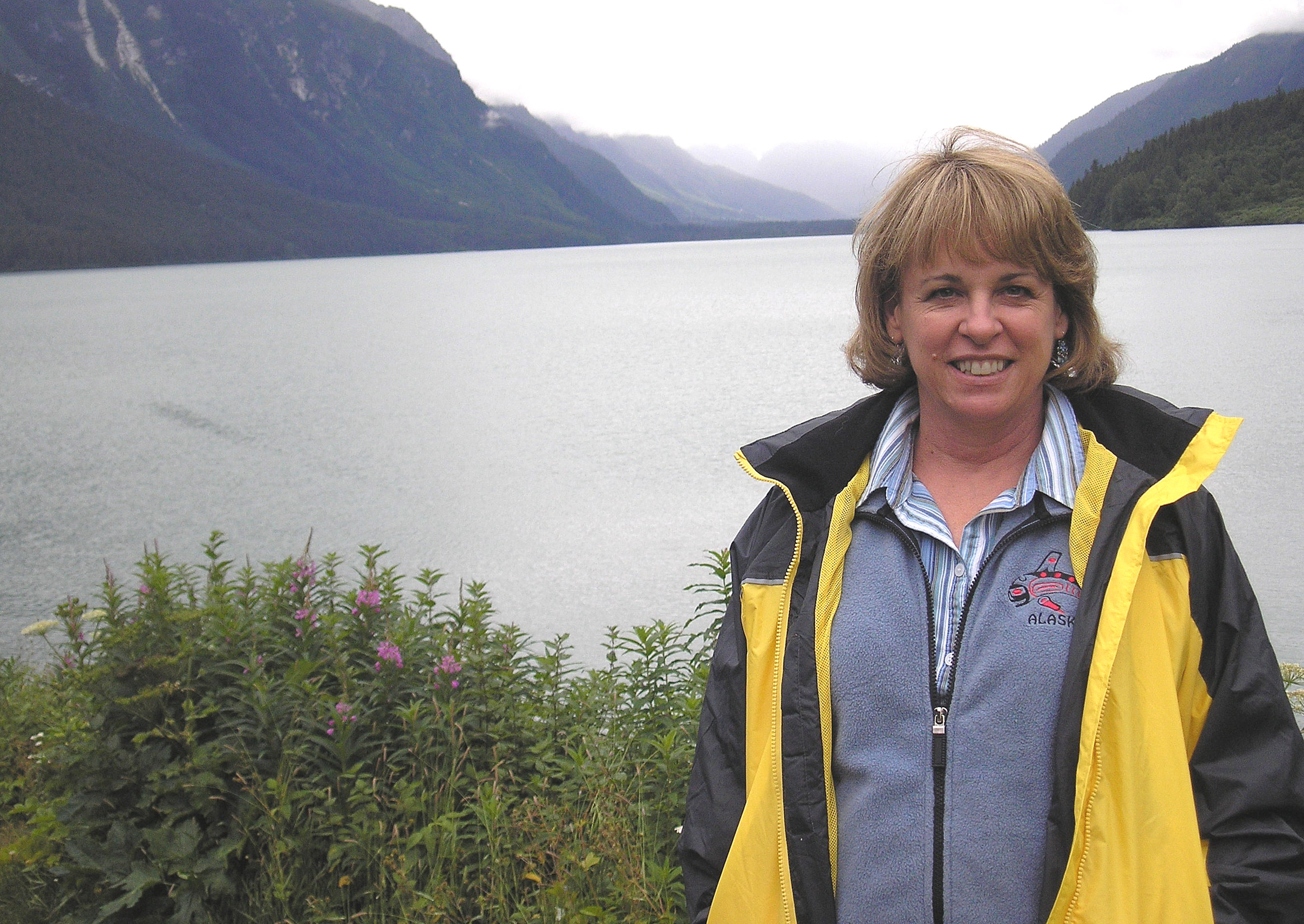
SarahLewisThis is a great time of the year to be in Sitka. The fish are running, gardens are starting to produce, and berries are ripe for the picking.

Many Sitka residents have pressure canners to preserve their harvest, and this weekend Sarah Lewis of the Juneau District Office of the University of Alaska Fairbanks Cooperative Extension Service will be in town to teach three classes about canning on Friday, Saturday and Sunday. She also provide free pressure canner gauge testing at the Sitka Farmers Market from 10 a.m. to 1 p.m. on Saturday, July 26, at the Alaska Native Brotherhood Founders Hall.

“People can bring the gauge or the lid with the gauge still attached,” Sarah said. “If they have any questions about the full canner (gaskets, damage, how to use, etc.) they can bring the whole thing.”

In addition to testing pressure canner gauges, Sarah plans to work with Jasmine Shaw of the Sitka District Office of the UAF Cooperative Extension Service to have a wide variety of publications available about home canning. In addition, the UAF Cooperative Extension Service has a series of online tutorials on its website called “Preserving Alaska’s Bounty.” Pressure canner gauges should be tested at least once a year to make sure they are hitting the right pressures for safe food preservation.

We posted earlier about Sarah’s canner classes this weekend, hosted by the Sitka Kitch project, and info can be found here. However, the location for the first two classes has been moved to the Sitka Presbyterian Church (from Sitka High School) and the topic and time have been changed for Sunday’s class (new topic is Canning Jams and Jellies, new time is noon to 3 p.m., location remains Sitka High School). The canning classes are $20 each, and preregistration is required (call Marjorie at the number below).

For more information about the Sitka Kitch project and to register for Sarah’s canning classes, contact Marjorie Hennessy of the Sitka Conservation Society at marjorie@sitkawild.org or 747-7509.

• Sitka Kitch hosts Sarah Lewis for cottage foods industry and home canning classes

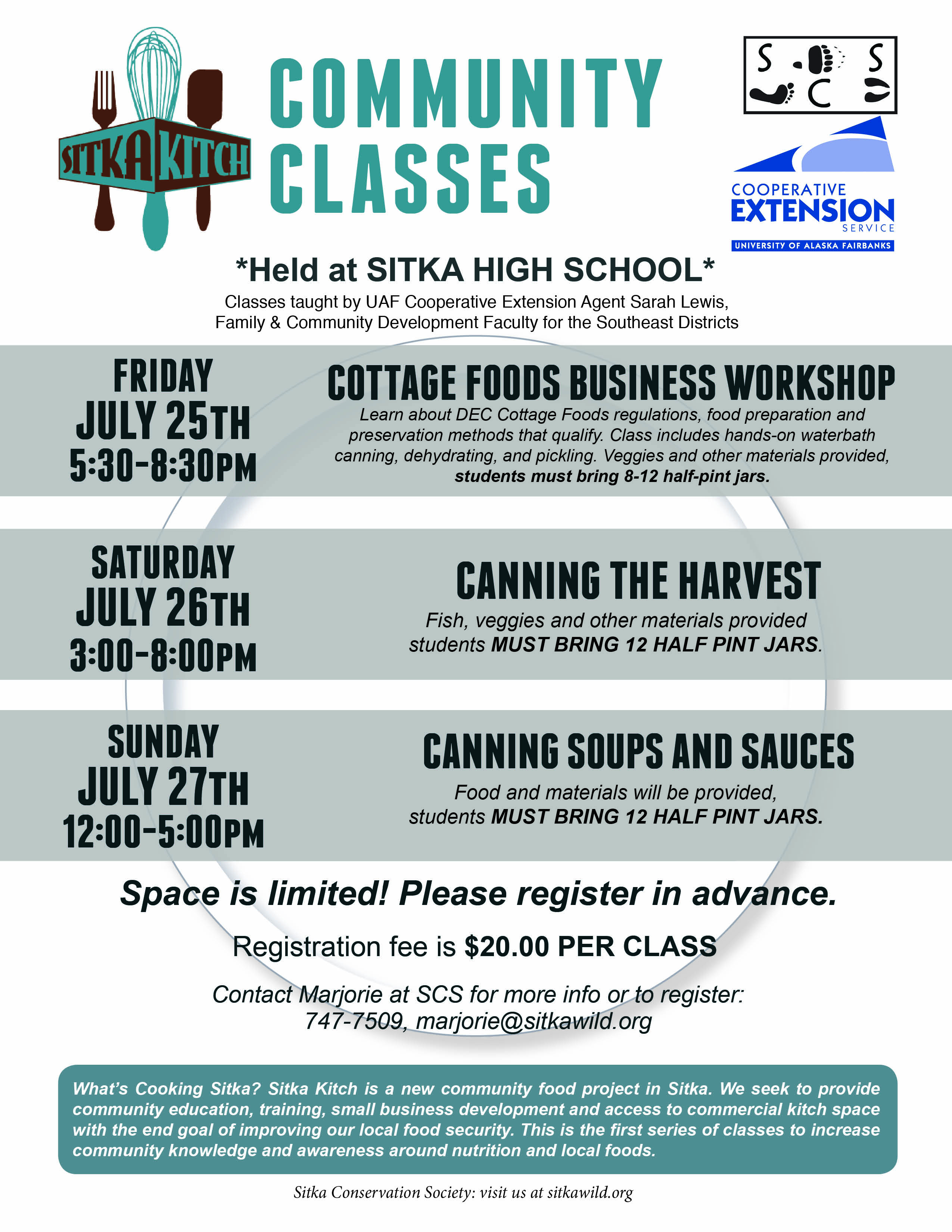
kitch_flyer_july25_26

SarahLewisSitka Kitch will host Sarah Lewis, Family and Community Development Faculty from the Juneau District Office of the University of Alaska Fairbanks Cooperative Extension Service, for three classes about the cottage food industry and home canning on July 25-27 at Sitka High School. (Editor’s note: The location of the first two classes has been moved to the Sitka Presbyterian Church on Sawmill Creek Road. Sunday’s class still will take place at Sitka High School, but the topic has been changed to Canning Jams and Jellies and the time will be from noon to 3 p.m.)

The three classes cost $20 each. Space is limited, so please register in advance by calling Marjorie Hennessy of the Sitka Conservation Society at 747-7509. Students will take home the products they make. The classes are:

  • Friday, June 25, 5:30-8:30 p.m., Cottage Foods Business Workshop — Students learn about Alaska Department of Environmental Conservation cottage foods industry regulations, as well as the food preparation and food preservation techniques that qualify. Class includes hands-on water-bath canning, dehydrating and pickling instruction. Veggies and other materials will be provided. Students must bring 8-12 half-pint canning jars with lids.
  • Saturday, June 26, 3-8 p.m., Canning the Harvest — Fish, veggies and other materials provided. Students must bring 12 half-pint canning jars with lids.
  • Sunday, June 27, noon to 5 p.m., Canning Soups and Sauces — Food and materials will be provided. Students must bring 12 half-pint canning jars with lids.

In addition, Sarah will be at the Sitka Farmers Market from 10 a.m. to 1 p.m. on Saturday, July 26, at the Alaska Native Brotherhood Founders Hall, where she will be available to test canner pressure gauges and provide other resources about home canning and food preservation.

Also, Sitka Kitch will partner with Sitka Tribe of Alaska to offer a pickled salmon course in August. This class is offered free of charge, but space is extremely limited. More details on date and location will be available soon.

Sitka Kitch is a community wellness project from the 2013 Sitka Health Summit designed to improve food security in Sitka. The different parts of the project include creating a community kitchen Sitka residents can rent to prepare food for their small businesses or to preserve their family harvest of fish, game, or garden veggies; expanding Sitka’s emergency food storage capacity; and providing education about preserving food and building family emergency food pantries.

For more information about the Sitka Kitch project, contact Marjorie Hennessy at marjorie@sitkawild.org or 747-7509.


• SEARHC, UAF Cooperative Extension Service to host ‘Basics of Food Preservation’ classes

University of Alaska Fairbanks Cooperative Extension Service Tanana District Agent Roxie Dinstel demonstrates proper home canning techniques (Photo courtesy of the UAF Cooperative Extension Service)

University of Alaska Fairbanks Cooperative Extension Service Tanana District Agent Roxie Dinstel demonstrates proper home canning techniques (Photo courtesy of the UAF Cooperative Extension Service)

Are you looking for ways to safely put up your grub? Do you have extra salmon or veggies you want to preserve for eating this winter? Two “Basics of Food Preservation” classes will be taught Wednesday, Aug. 31, in Sitka.

The first class takes place at noon on Aug. 31 at the SouthEast Alaska Regional Health Consortium (SEARHC) S’áxt’ Hít Mt. Edgecumbe Hospital Litehouse Cafeteria conference rooms. The second class is at 7 p.m. at Kettleson Memorial Library.

Both one-hour classes will be taught by University of Alaska Fairbanks Cooperative Extension Service Tanana District Agent Roxie Dinstel of Fairbanks, who will cover safe canning and preserving for various types of foods. Roxie helped create the UAF Cooperative Extension Service‘s new Preserving Alaska’s Bounty online tutorials for home canners, which can be found at http://www.uaf.edu/ces/preservingalaskasbounty/. (Note, Adobe Flash Player required to view tutorials, but it can be downloaded from the site.) She also helped write several of the UAF Cooperative Extension Service’s publications on canning, which are available from your local UAF Cooperative Extension Service office (at the University of Alaska Southeast-Sitka Campus in Sitka) or can be downloaded online at http://www.uaf.edu/ces/publications/.

In addition to the two classes on home canning, Roxie also will be available to test pressure gauges for home canning equipment owned by Sitka residents. These tests can tell you if your gauge is still accurate, or if it needs to be replaced for safe canning.

These classes are sponsored by the University of Alaska Fairbanks Cooperative Extension Service, Kettleson Memorial Library and SEARHC Health Promotion. All are welcome to attend, and the classes are free. For more information, please contact Martha Pearson at 966-8783 or martha.pearson@searhc.org.

• Sonja Koukel of the UAF Cooperative Extension Service writes about discovering treasures from the CES catalog

Dr. Sonja Koukel, PhD, of the UAF Cooperative Extension Service

Dr. Sonja Koukel, PhD, of the UAF Cooperative Extension Service

Discover Treasures from the UAF Cooperative Extension Service

By Dr. Sonja Koukel, PhD
Health, Home & Family Development Program
UAF Cooperative Extension Service, Juneau Office

_____

When was the last time you visited the University of Alaska Fairbanks Cooperative Extension Service (UAF CES) website? Perhaps it’s been awhile, or perhaps you’ve never taken the time to surf the site and take stock of all the treasures available in hard copy, electronic media, and on the Internet.

Every year the CES Communications Department provides a “Publications & Media” catalog listing research-based publications in the major program areas: Agriculture & Horticulture; Community Resource & Economic Development; Energy Education & Housing; and Health, Home & Family Development. Some publications are free and may be downloaded from the website. Those with a small fee can be ordered using the online form (http://www.uaf.edu/ces/pubs/), calling the toll-free number (1-877-520-5211), or contacting the local district office.

Let’s take a look at the treasure trove of information available through the Health, Home & Family Development (HHFD) program. For instance, there are a number of publications listed in the “Food, Nutrition and Health” category. Here, you will find information on storing vegetables and fruits, freezing vegetables, making fruit leather, making jerky, facts on botulism, and a variety of recipes including sourdough, rhubarb, zucchini, and wild berries. Several vegetable fact sheets provide nutrition and health guidelines (such as vitamin, mineral, and fiber content), harvesting, storage, and preparation with sample recipes included. Selected vegetables include beets, broccoli, cabbage, carrots, potatoes, squash, herbs, and chard. Bonus — all these fact sheets are free!

In my view, the most exciting new developments are the educational modules made possible through a USDA grant. Titled, “Preserving Alaska’s Bounty,” the web-based modules and DVDs were created and developed as a team effort involving HHFD faculty, program assistants, and the communications staff. The series focuses on home preservation of Alaska Native foods. Client feedback on the media, gathered from an online satisfaction survey, has been very positive.

The primary purpose for developing the modules was to provide research-based information for rural communities and areas that do not have extension faculty members on-site. The web modules are developed in a sequential manner so that each step is clearly defined and explained. There are hyperlinks within the modules that link the user to additional information. Topics are grouped into three main categories: Canning Basics, Canning Products & Methods (i.e., canning fish, meat, jams/jellies), and Meat Products & Methods (i.e., sausage, jerky). These modules are free. Locate them at (http://www.uaf.edu/ces/preservingalaskasbounty/index.html)

For those who learn best by watching demonstrations, the DVDs bring the extension experts into your home. Health, Home & Family Development program area faculty from all seven Alaska districts serve as the educators. To date, seven DVDs have been released on the following topics: Canning Basics, Canning Meat and Fish in Jars, Canning Meat and Fish in Cans, Pickling, Drying Foods, Sausage and Jerky, and the just-released, Jams and Jellies. More titles will be available in the very near future, these include: Root Cellars, Fireweed, Processing Reindeer (game meats), and Harvesting Alaska Seaweeds. The DVDs are available at a nominal fee of $5.

The Alaska Native foods preservation series is the culmination of a five-year process. It is a topic that figures into all the HHFD program areas: nutrition, food budgeting, eating locally, and energy conservation. Recently, the CES HHFD team received recognition for their work, “A Multimedia Approach to Preserving Alaska’s Bounty,” from the National Extension Honorary Society of Epsilon Sigma Phi.

In the new year, take a moment to visit the UAF Cooperative Extension Service website and discover all the treasures that await you. Contact: sdkoukel@alaska.edu or 907-796-6221.
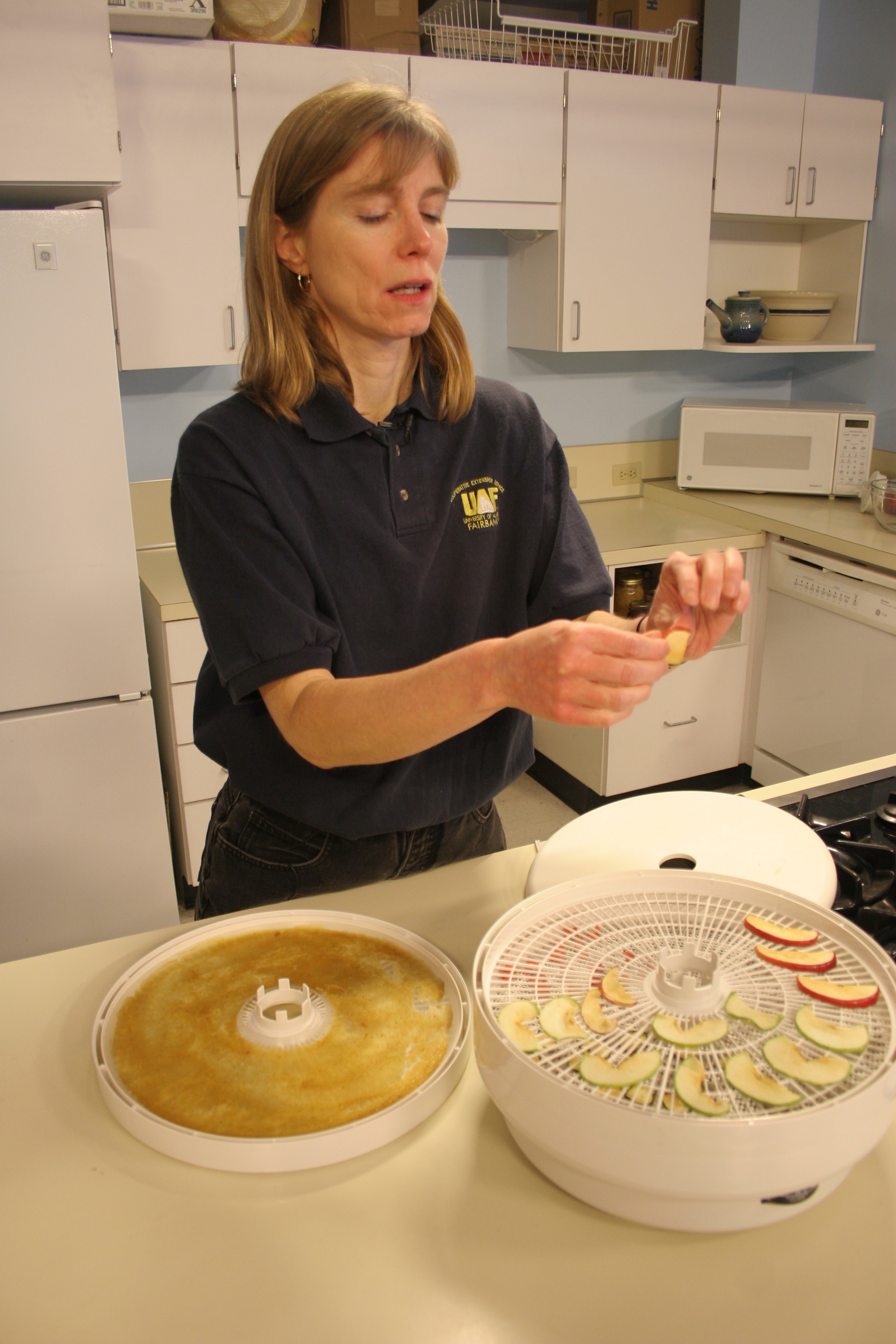
Julie Cascio of UAF Cooperative Extension Service's Health, Home and Family Development program in the Palmer/Mat-Su district demonstrates how to dry apples

Julie Cascio of UAF Cooperative Extension Service's Health, Home and Family Development program in the Palmer/Mat-Su district demonstrates how to dry apples