• ADF&G offers basic hunter education course this weekend in Sitka

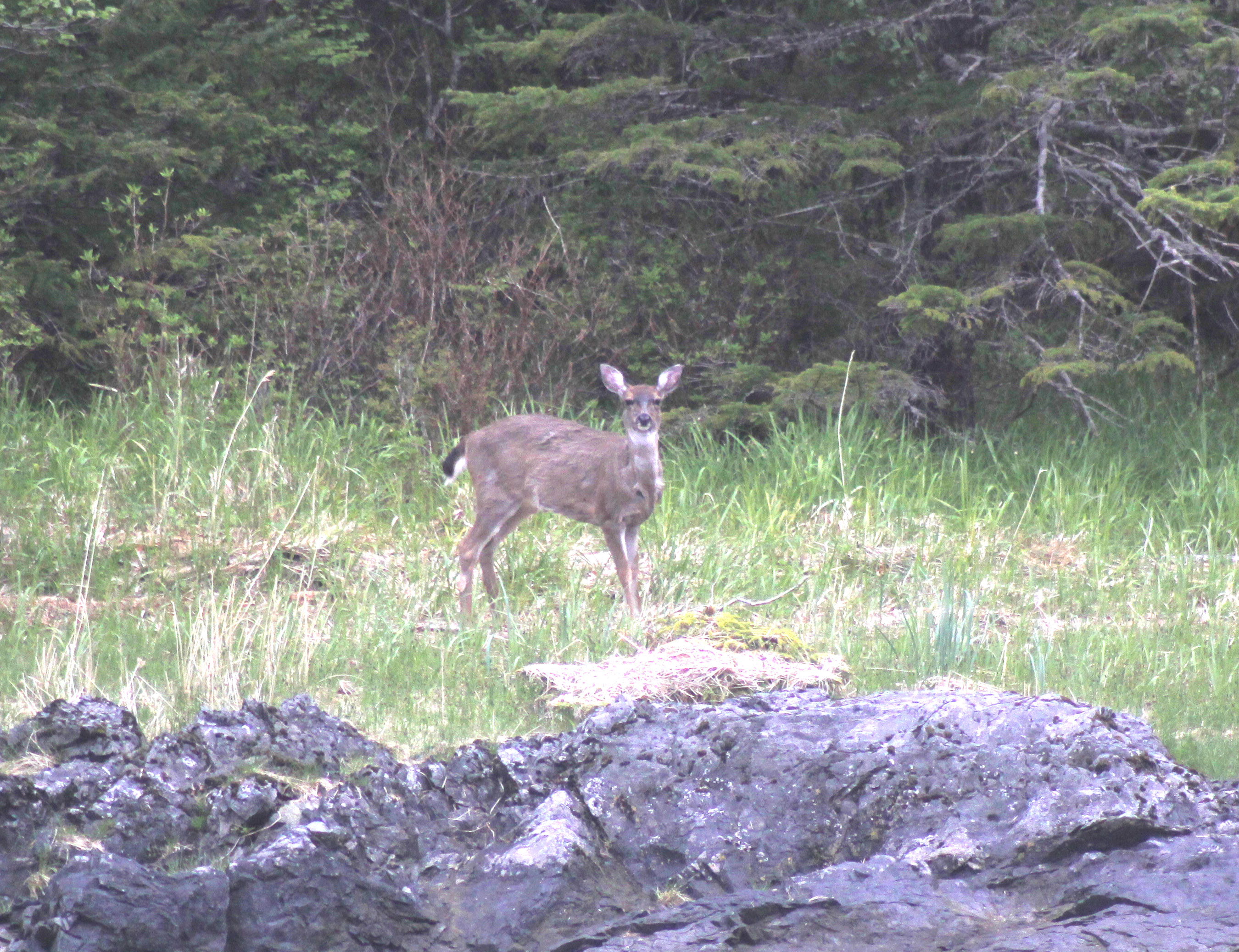
A Sitka black-tailed deer feeds on one of the barrier islands near Sitka

A Sitka black-tailed deer feeds on one of the barrier islands near Sitka

The Alaska Department of Fish and Game is offering a two-day basic hunter education class this weekend in Sitka. The class takes place from 6-9 p.m. on Friday, July 9, and from 9 a.m. to 4 p.m. on Saturday, July 10.

To register, students must purchase a $10 study packet that is available at the Sitka ADF&G office, 304 Lake St., Suite 103. The packet workbook must be completed before the start of the first class. The course is open to anyone, but it is designed for students ages 10 and older. A minimum of six students is needed for the class to take place.

For packet workbooks and additional information, contact the Sitka office of ADF&G at 747-5449. More information about the basic hunter education class also is available online at this link.

This class is required before hunters are allowed to get permits for some of Alaska’s game management areas. Successful completion of the class earns the hunter a certificate recognized by all other states, Canadian provinces and territories, and in Mexico.

• Sitka Seafood Festival to hold picnic with Monday’s steering committee meeting

The next meeting of the Sitka Seafood Festival steering committee will feature a picnic in addition to the business part of the meeting. The picnic should help spice up the planning process and boost attendance.

The next steering committee meeting takes place at 7 p.m. on Monday, June 28, at Halibut Point Recreation Area’s main shelter. Participants should bring their own drinks and side dishes. Hamburgers and sausage will be provided.

“We have a few important things to cover, but would just like to get everyone together and get excited about this event that is soon approaching again,” Sitka Seafood Festival steering committee chairperson Alicia Peavey said. “Thanks for everyone’s hard work, I really appreciate it and I do think the festival is going to be amazing thanks to all of you!”

The inaugural Sitka Seafood Festival takes place Friday and Saturday, Aug. 6-7, at Harrigan Centennial Hall and various other places around Sitka. The guest chef is Robert Kinneen of Orso Ristorante in Anchorage, with entertainment provided by the bluegrass band Trampled By Turtles and the four-man juggling, acrobatic, martial arts and comedy troupe “NANDA: Acrobaticalist Ninja Action Heroes.” The basic format of the event features a special dinner on Friday night with a variety of educational events, seafood booths and entertainment all day Saturday.

To learn more about the Sitka Seafood Festival or to volunteer to help on one of the committees, e-mail sitkaseafoodfestival@gmail.com. You also can contact Alicia Peavey at alaska_al33@hotmail.com or 1-928-607-4845. The minutes from the June 22 Sitka Seafood Festival steering committee meeting are posted below. The steering committee also will meet at 7 p.m. on Wednesday, July 7, at Harrigan Centennial Hall.

Sitka Seafood Festival minutes from the June 22, 2010, steering committee meeting

• Paralytic shellfish poisoning (PSP) warning issued for Southeast Alaska

The enclosed copy is courtesy of the SouthEast Alaska Regional Health Consortium (SEARHC) website.
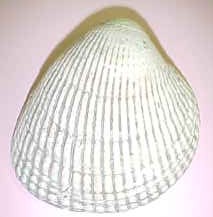
A cockle has deep ridges similar to a Ruffles potato chip (Photo courtesy of Alaska Department of Environmental Conservation)

A cockle has deep ridges similar to a Ruffles potato chip (Photo courtesy of Alaska Department of Environmental Conservation)

This past week has seen five cases of paralytic shellfish poisoning (PSP) in Alaska, including two cases in Southeast Alaska that resulted in the June 17 death of a Juneau woman who ate a cockle and the June 22 death of a Haines man who ate a Dungeness crab. The other three cases were in Kodiak and they resulted in illness from eating butter clams.

The two Southeast deaths, if confirmed by autopsy, will be the first paralytic shellfish poisoning deaths in Alaska since 1997. In 2009 there was just one reported case of PSP in Alaska, and there were no cases of PSP in 2008 and one in 2007. There have been periodic outbreaks of PSP over the years, with the most deadly instance coming when clams and mussels gathered from Peril Straits near Sitka killed more than 100 Russians and Aleuts in 1799.

According to the Alaska Department of Health and Social Services, the 57-year-old Juneau woman reportedly ate cockles she gathered on June 14 from the Point Louisa end of Auke Bay. She died June 17 after being hospitalized at Bartlett Regional Hospital in Juneau. The Alaska Department of Environmental Conservation tested cockles from Auke Bay after the woman was hospitalized and DEC found the Auke Bay cockles had much higher levels of PSP than acceptable (they should not have more than 80 parts per million, and the cockles had 2,044 parts per million).

The 57-year-old Haines man reportedly ate Dungeness crab on June 18 that he caught off Jenkins Rock near the Chilkat Inlet of Lynn Canal. He was hospitalized at Bartlett Regional Hospital on June 18 and released from the hospital on June 21. He died in his Haines home early on June 22. Dungeness crab meat does not contain PSP, but the viscera (guts) can have the toxin, health officials said. People should not eat crab viscera. The Department of Environmental Conservation plans to test crabs from Southeast for PSP.

What is paralytic shellfish poisoning (PSP)?

Paralytic shellfish poisoning, or PSP, is a potentially lethal toxin that can lead to fatal respiratory paralysis, according to the Alaska Department of Environmental Conservation. The toxin comes from algae, which is a food source for clams, mussels, crabs and other shellfish found across Alaska. This toxin can be found in shellfish every month of the year, and butter clams have been known to store the toxin for up to two years. The toxin cannot be seen with the naked eye, and there is no simple test a person can do before they harvest. One of the highest concentrations of PSP in the world was reported in shellfish from Southeast Alaska.
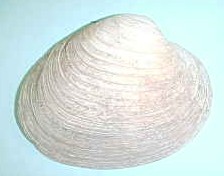
The butter clam has one set of rings that go one direction only, around the same center point (Photo courtesy of Alaska Department of Environmental Conservation)

The butter clam has one set of rings that go one direction only, around the same center point (Photo courtesy of Alaska Department of Environmental Conservation)

Symptoms of PSP can begin almost immediately, or they can take several hours after eating the affected shellfish before they appear. Symptoms include shortness of breath, tingling, dizziness and numbness. If you suspect someone has symptoms of PSP, get that person to a medical facility fast (an Alaska Sea Grant link below has first aid for PSP). Death is rare from PSP, but some people have died after eating just one clam or mussel with the PSP toxin, while in other cases it took eating many clams or mussels to get enough of the poison to cause death.

Are Southeast beaches safe for subsistence or recreational shellfish harvesting?

The Department of Environmental Conservation recommends harvesting of shellfish only from DEC-certified beaches, and the only certified beaches in the state are located in the Cook Inlet and Kachemak Bay areas of Southcentral Alaska. According to DEC, there are no certified beaches in populated areas of Southeast Alaska, Kodiak or the Aleutian Islands. The only beaches DEC can certify as safe for shellfish collecting are those where state-certified testing of clams and mussels is done regularly.

The littleneck clam has two sets of rings that cross each other at 90 degree angles (Photo courtesy of Alaska Department of Environmental Conservation)

The littleneck clam has two sets of rings that cross each other at 90 degree angles (Photo courtesy of Alaska Department of Environmental Conservation)

“Do not eat shellfish from uncertified beaches,” DEC Program Specialist George Scanlan said. “Anyone who eats PSP-contaminated shellfish is at risk for illness or death.”

The DEC warning does not apply to commercially grown and harvested shellfish available in grocery stores and restaurants. Commercially grown and harvested shellfish goes through a regular testing program before it goes to market.

Paralytic shellfish poisoning (PSP) resources

DEC page about paralytic shellfish poisoning (PSP) and how it works, http://www.dec.state.ak.us/eh/fss/seafood/psp/psp.htm

DEC links page with more info about PSP,
http://www.dec.state.ak.us/eh/fss/seafood/psphome.htm

DEC page about identifying butter clams, littleneck clams and cockles (has photos),
http://www.dec.state.ak.us/eh/fss/seafood/psp/shellfish.htm

Current DEC warning about PSP in Alaska (dated June 16, 2010),
http://dec.alaska.gov/press_releases/2010/2010_06_16_psp%20final.pdf

Joint DH&SS/DEC press release about Haines case of PSP (dated June 21, 2010),
http://www.hss.state.ak.us/press/2010/Additional_case_of_PSP_reported_062110.pdf

DH&SS  fact sheet about paralytic shellfish poisoning, http://www.hss.state.ak.us/pdf/201006_shellfish.pdf

Twitter feed for the Alaska Department of Health and Social Services,
http://twitter.com/alaska_DHSS

Alaska Sea Grant page with links about paralytic shellfish poisoning,
http://seagrant.uaf.edu/features/PSP/psp_page.html

Alaska Sea Grant page with first aid for PSP victims (get victim to medical facility fast),
http://seagrant.uaf.edu/features/PSP/PSP_aid.html

Centers of Disease Control and Prevention page on marine toxins (including PSP),
http://www.cdc.gov/nczved/divisions/dfbmd/diseases/marine_toxins/

• Sitka Seafood Festival steering committee to meet June 22

The Sitka Seafood Festival steering committee’s next meeting will be at 7 p.m. on Tuesday, June 22, at Harrigan Centennial Hall.

Each of the steering committee’s smaller committees should have held meetings since the large group met in May, and those updates will be discussed at this meeting. The Sitka Seafood Festival takes place on Aug. 6-7 at Harrigan Centennial Hall and other locations around Sitka.

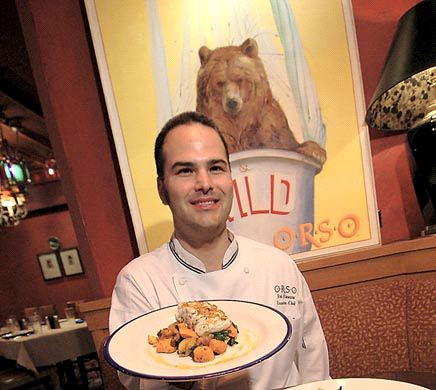
Chef Robert Kinneen of Orso Ristorante in Anchorage shows off an entrée featuring fresh Alaska yelloweye rockfish (Alaska Journal of Commerce photo by Rob Stapleton)

Chef Robert Kinneen of Orso Ristorante in Anchorage shows off an entrée featuring fresh Alaska yelloweye rockfish (Alaska Journal of Commerce photo by Rob Stapleton)

In other news, the Sitka Seafood Festival has chosen a guest chef — Robert Kinneen of Orso Ristorante in Anchorage, who has been featured in the Alaska Journal of Commerce for his extensive use of local foods at the restaurant. During the festival, Robert will be the featured chef for Friday night’s banquet and he will have a booth set up during Saturday’s festivities. Robert is currently filming a “Web-A-Thon” and has a professional camera crew that he would like to bring here to cover some of the festival. The Sitka Seafood Festival is in need of Alaska Airline miles to help bring the chef, his family and the filming crew to Sitka for the festival. While in Sitka, the camera crew may be available to film other projects related to fishing or tourism. If you can help the Sitka Seafood Festival out with air miles, send an e-mail to sitkaseafoodfestival@gmail.com or contact Alicia Peavey at 1-928-607-4845.

Sitka Seafood Festival steering committee minutes from May 20, 2010

• Wealth of resources available to learn about traditional foods

A selection of traditional plant books that are in popular use in Southeast Alaska

A selection of traditional plant books that are in popular use in Southeast Alaska

Living in Southeast Alaska, Sitka residents are exposed to a wealth of traditional foods that grow in our forests or can be found along our beaches. But many Sitka residents aren’t familiar with which plants are safe to eat, and which plants they should avoid. They also aren’t familiar with when are the prime times to gather certain plants.

In recent years, several books have been published to help teach people more about traditional plants and how they can be used. There also have been other groups, such as the Sitka Tribe of Alaska’s Kayaaní Commission, the Sealaska Heritage Institute and the Alaska Native Knowledge Network, that have posted traditional plant information online, including complete curriculum outlines for teachers to use in their classrooms.

Some of the more popular books used in Sitka (many of these can be found at Old Harbor Books) include:

  • Wild Edible & Medicinal Plants: Alaska, Canada & Pacific Northwest Rainforest: An Introductory Pocket Trail Guide (Volumes 1 and 2) by Carol R. Biggs
  • Wild Edible and Poisonous Plants of Alaska by the University of Alaska Fairbanks Cooperative Extension Service (FNH-00028)
  • Collecting and Using Alaska’s Wild Berries and Other Wild Products by the University of Alaska Fairbanks Cooperative Extension Service (FNH-00120)

In addition to these books, the Sealaska Heritage Institute has created curriculum resources using the Tlingít and Haida languages that are built around using traditional foods (links on language names go to Grades K-2 versions, but upper-lever courses available on main curriculum link). Examples of the Tlingít and Haida Grade K-2 courses for Plants are linked below as PDF documents, but there also are separate courses for beach greens, berries, cedar trees, hemlock trees, spruce trees, herring, hooligan, salmon, sea mammals, as well as for other cultural knowledge such as canoes, totem poles and Elizabeth Peratrovich.

The Alaska Native Knowledge Network also some curriculum resources posted online for Tlingít, Haida and Tsimshian culture, including some by Sitka teacher Pauline Duncan. The Alaska Native Plant Society has some information on traditional plant use, but the group is geared more toward the Anchorage area. The Alaska Natural History Program publishes an online Alaska Rare Plant Field Guide. The University of Alaska Fairbanks Cooperative Extension Service has online and printed guides available on plant identification, berries and berry use, and even has online tutorials about how to home can jams and jellies.

On a related note, the SouthEast Alaska Regional Health Consortium (SEARHC) Diabetes Program will be turning its focus to traditional living classes for 2011. The program will focus on traditional foods and activities to teach its Native patients and other community members how to prevent and manage their diabetes (the SEARHC Diabetes Program operates throughout Southeast Alaska, not just in Sitka). The SEARHC Diabetes Program is looking for resident experts in traditional living (fishing, hunting, gathering, preparation, storage, gardening, etc.) who can help teach these skills to others. The program also wants to learn what types of classes people want to see offered in their communities. For more information, contact SEARHC Health Educator Renae Mathson at 966-8797 or renae.mathson@searhc.org.

Sealaska Heritage Institute Tlingít plant curriculum (Grades K-2)

Sealaska Heritage Institute Haida plant curriculum (Grades K-2)

UAF Cooperative Extension Service Native Plants of Alaska page on devil’s club

Nellie’s Recipes: An ANTHC (Alaska Native Tribal Health Consortium) Traditional Food Cookbook for Assisted Living Homes

Alaska Traditional Food Resources (list from Eat Smart Alaska program run by Alaska Division of Public Health)

• Sitka Seafood Festival seeks local recipes for fundraising cookbook

Do you have a favorite seafood recipe? A recipe you are willing to share? One that you would like to see published in a cookbook?

We want it!

The inaugural Sitka Seafood Festival will be Friday and Saturday, Aug. 6-7, 2010. It will be a celebration focusing on Alaska’s wild seafood through entertainment, education and culinary delights.

As a fundraiser for the festival, we are putting together a local cookbook. The focus will be on seafood recipes, however, we want a well-rounded cookbook with recipes for appetizers, beverages, soups, salads, vegetables, main dishes, breads and rolls, desserts and miscellaneous dishes.

Please e-mail your recipes to sitkaseafoodfestival@gmail.com or mail them to Linda Olson at 230 Observatory Street, Sitka, Alaska, 99835 by Monday, May 24th. Please put your name on the recipe and include your contact information.

Thank you.

For more information about the festival, check out our website at http://sitkaseafoodfestival.org/ and our page on Facebook.

• Sitka Seafood Festival steering committee to meet on Saturday, April 17

The next meeting of the Sitka Seafood Festival steering committee is 10 a.m. on Saturday, April 17, at Harrigan Centennial Hall.

During the April 10 meeting, the committee voted Lily Herwald in as secretary and Phyllis Hackett as bookkeeper. The committee also decided to book “NANDA: Acrobaticalist Ninja Action Heroes,” a four-man juggling, acrobatic, martial arts and comedy troupe that is performing at the Southeast Alaska State Fair on July 29-Aug. 1 in Haines, the weekend before the Sitka Seafood Festival (Aug. 6-7). A headline music group also is being booked.

Committee members will be canvassing local businesses for donations to cover the costs of hosting the inaugural Sitka Seafood Festival, and the deadline for donations is May 9 (Mother’s Day). A donation/sponsorship letter has been approved and committee members soon will distribute it to local businesses. Donations will be accepted after May 9, but that’s the deadline to be included in the event promotional materials, which uses a tier system based on the amount of the donation. Donation/sponsorship checks need to be written to the “Sitka Conservation Society” with a memo of “Sitka Seafood Festival” or “SCS/SSF” (the Sitka Conservation Society is letting us share their 501(c)(3) permit until we can get our own next year).

Also, committee members are seeking prizes for a raffle and raffle prize commitments are needed by Wednesday, April 14, to either Alicia Peavey (alaska_al33@hotmail.com or 1-928-607-4845) or Linda Olson (747-6985 or Baranof Elementary School). The raffle will feature 800 tickets at $5 each, with the drawing to take place on May 9 (Mother’s Day). Donations of merchandise, including locally caught seafood or gourmet meals of Sitka seafood, are greatly appreciated.

During the April 5 meeting, the steering committee decided to hold the inaugural Sitka Seafood Festival on Friday and Saturday, Aug. 6-7. The tentative plan is to have an opening dinner on Friday night with a guest chef and the possibility of live music. The main events will be on Saturday, with vendors set up all day, contests, a parade, cooking demos, music and educational activities. The headliner music guest will play a concert/dance on Saturday night.

To learn more about the Sitka Seafood Festival or to volunteer to help on one of the committees, e-mail sitkaseafoodfestival@gmail.com. You also can contact Alicia Peavey at alaska_al33@hotmail.com or 1-928-607-4845.

Sitka Seafood Festival minutes from the April 10, 2010, meeting

Sitka Seafood Festival committee breakdown and job tasks (updated)

Sitka Seafood Festival business donation assignments (who asks) (updated)

• Sitka subsistence herring egg harvest in progress

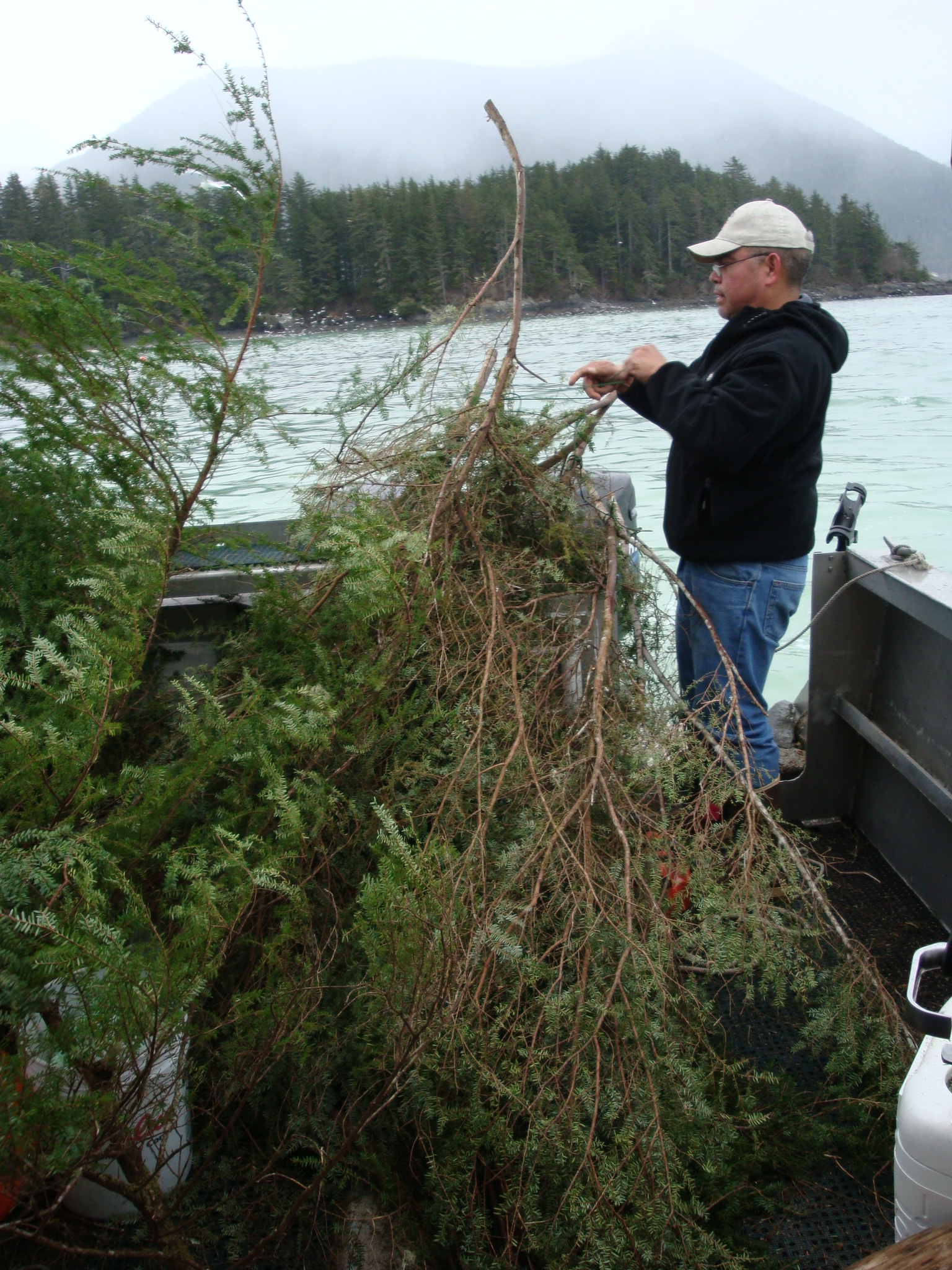
Michael Baines prepares hemlock trees and branches before they are placed in the water to catch herring spawn (Photo taken by Ed Ronco of KCAW-Raven Radio)

Michael Baines prepares hemlock trees and branches before they are placed in the water to catch herring spawn (Photo taken by Ed Ronco of KCAW-Raven Radio)

If it’s snowing in April, it probably means it’s time for the subsistence herring egg harvest in Sitka. This is one of the most important signs of spring in Sitka, especially for the Tlingít, Haida and Tsimshian people who lived in Southeast Alaska long before the first Europeans showed up.

On the KCAW-Raven Radio news Tuesday, KCAW reporter Ed Ronco reported on a trip he took with Sitka Tribe of Alaska Vice Chairman Michael Baines and his sister, Betty Baines, to place hemlock trees and branches into Sitka Sound, near Kasiana Island, to collect the herring spawn. The story link includes an audio postcard, where Michael Baines discusses the herring roe’s importance to the Native culture, and a few photos of the hemlock branches and trees being prepared. The herring eggs will collect on the branches, which will be pulled from the water a few days later, hopefully with a thick mass of roe. (Editor’s note: On Friday there was a follow-up story featuring the fishing vessel Julia Kae, skippered by Steve Demmert, which has been distributing herring eggs to local residents of Sitka and surrounding communities.)

The herring harvest is an amazing time in Sitka, because it seems like every species comes to town for the herring. There are more whales, eagles, sea gulls, sea lions, etc., around town, and even halibut and salmon are looking for meals of herring eggs. Pauline Duncan produced this Tlingít curriculum about herring geared toward younger students for the Alaska Native Knowledge Network. The blog Kiksadi News by Heen Kweix’ (Bob Gamble) tells how subsistence herring eggs are harvested and prepared (scroll down to the second item).

There also is a large commercial harvest of herring just before the subsistence herring roe harvest. The commercial harvest this year had a record guideline harvest of 18,293 tons, and finished just 550 tons short of that goal. The growing commercial harvest has put a lot of pressure on the relatively small subsistence harvest, in 2005 only 72,000 pounds (not tons) were taken out of a target range of 105,000 to 158,000 pounds. Sitka Tribe of Alaska regularly submits proposals to the Alaska Department of Fish and Game (which manages both the commercial and subsistence fisheries) to increase the subsistence harvest, but the proposals have not been passed. The subsistence herring eggs are used not just in Sitka, but all over the state and they are a popular trading subsistence food (for example, a Tlingít in Sitka might swap herring eggs with an Iñupiat for caribou meat from the Kotzebue area, since caribou is an item not found in Southeast Alaska).

• Sitka Seafood Festival steering committee to meet on Saturday, April 10

Sockeye salmon hang in a smoker in preparation for the 2009 ANSWER Camp program

Sockeye salmon hang in a smoker in preparation for the 2009 ANSWER Camp program

The next meeting of the Sitka Seafood Festival steering committee is 11 a.m. on Saturday, April 10, at the Bayview Wine Bar (on the second floor of the Bayview Building on Lincoln Street).

During the April 5 meeting, the steering committee decided to hold the inaugural Sitka Seafood Festival on Friday and Saturday, Aug. 6-7. The tentative plan is to have an opening dinner on Friday night with a guest chef and the possibility of live music. The main events will be on Saturday, with vendors set up all day, contests, a parade, cooking demos, music and educational activities. The headliner music guest will play a concert/dance on Saturday night.

To learn more about the Sitka Seafood Festival or to volunteer to help on one of the committees, e-mail sitkaseafoodfestival@gmail.com. You also can contact Alicia Peavey at alaska_al33@hotmail.com or 1-928-607-4845.

Sitka Seafood Festival committee breakdown and job tasks

Final draft of Sitka Seafood Festival donation letter

Sitka Seafood Festival business donation assignments (who asks)

• Sitka Seafood Festival steering committee meets tonight (April 5)

Grillmaster Rick DeGroot checks salmon fillets barbecuing for a 2007 prostate cancer awareness event in Sitka

Grillmaster Rick DeGroot checks salmon fillets barbecuing for a 2007 prostate cancer awareness event in Sitka

The Sitka Seafood Festival steering committee will meet at 7:30 p.m. tonight (Monday, April 5) at Harrigan Centennial Hall. The meeting times have been moving around in recent weeks as they try to find a time that can get local restaurant people involved.

Tonight’s meeting will finalize a sponsorship letter for fundraising, discuss a raffle fundraiser, discuss work committees and duties, discuss budget for music and possible guest chefs, etc.

At the last meeting on April 1, the group finalized the mission statement, “The Sitka Seafood Festival’s mission is to celebrate wild Alaska seafood.” The steering committee also decided that this year’s inaugural event will focus on culinary experience, entertainment (music) and education.

To learn more about the Sitka Seafood Festival or to volunteer to help on one of the committees, e-mail sitkaseafoodfestival@gmail.com. You also can contact Alicia Peavey at alaska_al33@hotmail.com or 1-928-607-4845.

Sitka Seafood Festival committee breakdown

Sitka Seafood Festival tasks

Rough draft of Sitka Seafood Festival donation letter

Sitka Seafood Festival business donation assignments (who asks)