• Another record cabbage at the Alaska State Fair

Screenshot of the Anchorage Daily News article on Steve Hubacek's giant cabbage

Screenshot of the Anchorage Daily News article on Steve Hubacek's giant cabbage

Click here to read about a record-breaking 127-pound cabbage, called “The Beast,” Wasilla’s Steve Hubacek weighed in on Friday at the Alaska State Fair in Palmer. Click here to read the Fairbanks Daily News-Miner’s version of the story, which includes some other big veggie records set at the fair.

This record-breaking cabbage, which qualifies for both the state record and a spot in the Guinness Book of World Records, was weighed in just two days after Hubacek broke a 20-year-old record with a 125.9-pound cabbage. I hope he enjoys cole slaw and sauerkraut. Click here to see a list of Guinness Book of World Record-setting veggies at the Alaska State Fair since 1993 (opens PDF file).

Screenshot of the giant cabbage story in the Fairbanks Daily News-Miner

Screenshot of the giant cabbage story in the Fairbanks Daily News-Miner

• Alaskans love their giant vegetables and other stories in the news

This is the time of year when Alaska has two state fairs in progress — in Palmer and in Fairbanks — and it’s also the time of year when people bring out the record-setting vegetables they’ve grown. This year is no exception, and there are several stories in the news about huge veggies grown in Alaska.

Click here to read an Anchorage Daily News story about the record-setting 125.9-pound cabbage grown by Steve Hubacek of Wasilla. This cabbage not only broke the Alaska state record, but also qualified for entry in the Guinness Book of World Records.

Click here to see an Anchorage Daily News video of the great pumpkin weigh-off between Dale Marshall of Anchorage and current state record-holder J.D. Megchelsen of Nikiski. Marshall’s winning pumpkin weighed 594 pounds.

Click here to read an article from the Fairbanks Daily News-Miner about monster vegetables entered in the Alaska Feed Co. vegetable contest at the Tanana Valley State Fair in Fairbanks.

Click here to read Anchorage Daily News photographer Fran Durner’s “Talk Dirt To Me” blog entry about colorful Alaska State Fair flowers.

Click here to read an article about invasive weeds by Anchorage Daily News garden columnist Jeff Lowenfels.

Click here to see a Capital City Weekly photo package from the second annual Juneau Farmers Market and Local Food Festival held last Saturday. Click here to see a larger photo gallery posted on the Capital City Weekly online site.

Click here to read a letter to the editor in the Fairbanks Daily News-Miner about Alaska’s bountiful harvest of berries this summer.

• Juneau hosts second annual Juneau Farmers Market and Local Food Festival and other news

The Juneau Commission on Sustainability hosted its second annual Juneau Farmers Market and Local Food Festival on Saturday, and the Juneau Empire had plenty of coverage of Juneau’s only farmers market of the summer. Click here to reach the main story about the farmers market in Sunday’s edition of the Juneau Empire. Click here to read an editorial praising the idea of a farmers market and sustainable food.

In addition to the farmers market stories, the Juneau Empire also ran a feature about a Juneau gardener who is using aeroponics to grow his food. Click here to read the story.

The Fairbanks Daily News-Miner on Sunday ran an article about the Fairbanks Community Cooperative Market, which is an effort to get 1,500 Fairbanks residents to buy $200 memberships in a new store that would emphasize local food and organic food choices (click here to read the story). So far the project has downpayments on about two-thirds of the memberships needed to launch the project.

Finally, this week’s Alaska Journal of Commerce has a feature story about alternative energy guru Bernie Karl, who uses geothermal energy to power 44 buildings over 450 acres at the Chena Hot Springs Resort, including the resort’s large greenhouses that can grow about 150,000 to 175,000 heads of lettuce a year and other crops. Click here to read more about the Chena Hot Springs Resort greenhouses and how they can be a good model for the Sitka Community Greenhouse project.

• Alaska Grown’s Eat Local Challenge is this week

Flier for the Alaska Grown "Eat Local Challenge"

The Alaska Public Radio Network had a story on the Alaska News Nightly show Thursday night about the “Eat Local Challenge,” which takes place Aug. 23-29. Click here to listen to the story, which discusses what’s available around the state and how residents can encourage their local stores and restaurants to carry more Alaska Grown produce. For more information on the Eat Local Challenge, click here to see our post introducing the event last week.

By the way, a good time to buy local food this week is the fourth Sitka Farmers Market of the summer, which takes place from 10 a.m. to 2 p.m. on Saturday, Aug. 29, at Alaska Native Brotherhood Hall (235 Katlian St.). We’ll see you there.

• Capital City Weekly features Sitka Farmers Market, and other local food stories in the news

Screenshot of Capital City Weekly site with the Table of the Day Winners from the third Sitka Farmers Market

Screenshot of Capital City Weekly site with the Table of the Day Winners from the third Sitka Farmers Market

Click here to see a photo in this week’s issue of Capital City Weekly that shows Table of the Day Award-winners Hope Merritt and Judy Johnstone of Gimbal Botanicals and Sprucecot Gardens receiving their award from Ellen Frankenstein at the third Sitka Farmers Market of the season on Aug. 15. We host the fourth Sitka Farmers Market of the summer from 10 a.m. to 20 p.m. this Saturday (Aug. 29) at Alaska Native Brotherhood Hall, 235 Katlian St.

In addition to the Sitka Farmers Market photo, there were several other local foods stories in statewide news the last few days.

Click here to read a Capital City Weekly story about the second annual Juneau Farmers Market and Local Foods Fair that takes place on Saturday, Aug. 29, at the Juneau Arts and Culture Center.

Click here to read a Capital City Weekly story about using and preserving healthy, delicious rose hips (by Dr. Sonja Koukel of the Juneau office of the University of Alaska Fairbanks Cooperative Extension Service, article includes a recipe).

Click here to read a story from Thursday’s Juneau Empire previewing this Saturday’s second annual Juneau Farmers Market and Local Foods Festival.

Click here to read a Fairbanks Daily News-Miner story about the history of sourdough bread in Alaska (article includes a couple of recipes).

Click here to read a roundup from the Anchorage Daily News about what’s available this week in local farmers markets.

Finally, click here to read an article from the Canadian magazine “Up Here” about a Yukon Territory resident’s attempt to eat a 100-mile diet (eg, a locavore diet).

• First Alaskans magazine highlights healthy berries

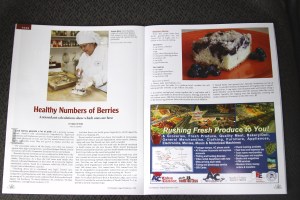
Screenshot of First Alaskans magazine article on healthy berries

Screenshot of First Alaskans magazine article on healthy berries

The August/September 2009 issue of First Alaskans magazine — a statewide magazine of Native business, culture and lifestyle — features an article called “Health Numbers of Berries: Antitoxidant calculations show which ones are best.” This article isn’t posted on the First Alaskans magazine Web site, so a scanned black-and-white PDF version is available by clicking here. The article also includes a recipe for Blueberry Buckle.

For more information about healthy berries, the Far North Science news service, written and edited by Doug O’Harra, about news, research and natural acts from Alaska, released a 2007 story called “Alaska Blueberries: Brain Food” (click here to see the article as published in The Alaska Report). The article includes a link to a 2006 report on extremely high antitoxidant rates in a variety of Alaska berries by University of Alaska Fairbanks researcher Patricia Holloway

• Juneau Empire spotlights harvest of Tlingít potatoes

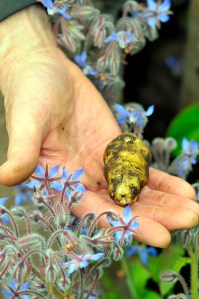
(Photo courtesy of Klas Stolpe/Juneau Empire) Bill Ehlers, assistant gardener at the Jensen-Olson Arboretum in Juneau, holds a Tlingít potato next to some borage plant flowers.

(Photo courtesy of Klas Stolpe/Juneau Empire) Bill Ehlers, assistant gardener at the Jensen-Olson Arboretum in Juneau, holds a Tlingít potato next to some borage plant flowers.

The Juneau Empire on Monday (click here) ran a nice photo package of a sustainable harvest camp at the Jensen-Olson Arboretum in Juneau that was hosted by the 4-H program run by UAF Cooperative Extension Service and the Alaska Department of Fish & Game. The photos feature several children harvesting “Maria’s Potatoes,” a type of Tlingít potato grown from seed potatoes that originally came from deceased Tlingít elder Maria Miller’s garden in Klukwan. These fingerling potatoes do well in Southeast Alaska’s rainy climate and have been around for hundreds of years. The story link above has a link to an audio slideshow by Juneau Empire photographer Michael Penn. The slideshow is worth watching.

By the way, click here to read more about the Tlingít potato posted on the Sitka Local Foods Network site about three weeks ago. Elizabeth Kunibe did want to clarify that in the link to the Chilkat Valley News story she is misquoted so it appears that she “discovered” the Ozette potato (another Native American variety). She said she is not the discoverer.

Kunibe also said the Tlingít potatoes can be sold, but for food only and not for seed. Some of them contain potato viruses, transmitted by vectors, that can affect the soil and other varieties of potatoes. She said when people buy seed potatoes, they need to make sure they have “clean seed” or “virus-free seed” before they plant. She said potato viruses do not affect humans who eat the potatoes, but we need to use clean seed to keep the viruses from destroying crops (like what happened in the Irish potato famine). She said the UAF Cooperative Extension Service, which has offices in Sitka and Juneau, may have more information on how to find virus-free seed potatoes.

Kunibe, who made a presentation on Tlingít potatoes and traditional gardening in Sitka last year, is hoping to schedule another trip to Sitka for a future presentation. Kunibe also wanted share this link from the USDA Agricultural Research Service about newly discovered nutritional benefits of potatoes, especially in regards to phytochemicals and cancer prevention.

• Alaska Grown hosts the “Eat Local Challenge 2009” on Aug. 23-29

Flier for the Alaska Grown "Eat Local Challenge"

The Alaska Grown program will launch its “Eat Local Challenge 2009” this week, Sunday through Saturday, Aug. 23-29 (click here to read more).

During the next week, Alaska residents are encouraged to:

• Try eating at least one home-cooked meal this week, made of mostly local ingredients.
• Try to incorporate at least one never-before-used local ingredient into a meal.
• Try “brown-bagging” at least one meal this week made primarily of local ingredients.
• Try talking to at least one local food retailer and one food producer about local food options.
• Try to choose local food products whenever possible.

By the way, a good time to buy local food this week is the fourth Sitka Farmers Market of the summer, which takes place from 10 a.m. to 2 p.m. on Saturday, Aug. 29, at Alaska Native Brotherhood Hall (235 Katlian St.). We’ll see you there.

• Local foods in the news this week

Many of Alaska’s newspapers had articles about local foods this week. Here is a sampling of some of the offerings.

Click here to read an article called “Beware of wild things in the blueberry patch” from the Capital City Weekly, about slugs, bugs and bears.

Click here to read an update on the Second Annual Juneau Farmers Market and Local Foods Festival from the Capital City Weekly. This event is from 9 a.m. to 2 p.m. on Saturday, Aug. 29, at the Juneau Arts and Culture Center.

Click here to read an item in Capital City Weekly about a tree planting and pruning workshop here in Sitka on Monday, Aug. 24, at Harrigan Centennial Hall.

Click here to read an article and photo package from Fran Durner’s “Talk Dirt To Me” gardening blog in the Anchorage Daily News about Dan Bilyeu of Nikiski, who grows and sells gourmet oyster mushrooms.

Click here to read a “Berries of the Kenai Peninsula” feature from the 2009 Peninsula Clarion Recreation and Tourist Guide.

It’s not from an Alaska publication, but the USDA’s Agricultural Research Service has a story (click here to read it) about new research into phytochemicals and other healthy plant compounds in potatoes.

• Capital City Weekly covers Sitka Farmers Market

Capital City Weekly screenshot showing the Table of the Day Award winners from the second Sitka Farmers Market of the summer (Aug. 1)

Capital City Weekly screenshot showing the Table of the Day Award winners from the second Sitka Farmers Market of the summer (Aug. 1)

This week’s edition of Capital City Weekly (a free Southeast Alaska regional weekly newspaper that comes out on Wednesdays) had some good coverage of the Sitka Farmers Market.

Click here to see a photo honoring Table of the Day Award winners Pete Karras and Mimi Goodwin from the second Sitka Farmers Market on Aug. 1. This photo ran in the Health section of the paper.

Click here to see a package of four photos taken by Capital City Weekly reporter Libby Sterling when she was in Sitka for the first Sitka Farmers Market on July 18. This package ran in the Outdoors section of the paper.

By the way, the third Sitka Farmers Market of the summer takes place from 10 a.m. to 2 p.m. on Saturday, Aug. 15, at the Alaska Native Brotherhood Hall, 235 Katlian St. Some booth space is available, so call Linda Wilson at 747-3096 (nights and weekends) for more information.

The Sitka Local Foods Network (the 501(c)(3) non-profit group that sponsors the Sitka Farmers Market) welcomes any volunteers who want to help set up the market before it opens and take it down once the market is over. Also, the Sitka Local Foods Network accepts donations of extra locally grown produce and berries people may have to sell at the network’s booth at the Sitka Farmers Market. The money raised at the network’s booth helps fund Sitka Local Foods Network projects (the market, community gardens, seed money for the community greenhouse project, educational speakers, etc.). Just drop your extra produce off at the network’s booth, usually outside right next to the building on Katlian St., at the start of the market.

And finally, there was one last story of interest in this week’s Capital City Weekly. Click here to read an article and photo package about the variety of plants being grown at the Jensen-Olson Arboretum in Juneau.

A screenshot from the Capital City Weekly photo package about Sitka's local foods from the first Sitka Farmers Market of the summer (July 18)

A screenshot from the Capital City Weekly photo package about Sitka's local foods from the first Sitka Farmers Market of the summer (July 18)