• Lori Adams discusses everything she’s learned about growing radishes in her latest Daily Sitka Sentinel garden column

(Lori Adams, who owns Down-To-Earth U-Pick Garden and is a frequent vendor at the Sitka Farmers Market, will be writing a regular garden column in the Daily Sitka Sentinel this summer. The Sentinel is allowing us to reprint the columns on this site after they first appear in the newspaper. This column appeared on Page 4 of the Wednesday, Aug. 22, 2012, edition of the Daily Sitka Sentinel.)

GARDENING IN SITKA

By Lori Adams

EVERYTHING I’VE LEARNED ABOUT GROWING RADISHES

All of the gardening books I have read say that growing radishes is SO easy, but I really have a hard time growing a good decent radish.

Every year I try, and every year I get a few good ones and a whole lot of bad ones — skinny tough roots with nice tops that immediately bolt. This year I actually grew some pretty decent radishes so I think I’m starting to get it figured out a little. I refuse to give up.

First of all, radishes are a root crop, so they don’t like a lot of fertilizer. In fact, the books pretty much say to just throw the seeds in any old dirt and they will grow. Nitrogen produces large luscious tops, not large plump roots, so this fall don’t put any nitrogen-rich material in the bed where you plan to plant radishes next year. Instead, bulk up the bed with sand and loose organic material such as beach/forest mulch (not much seaweed) and leaves.

Next spring, either mix some bonemeal into the soil or gather some starfish to bury about four inches below the surface and then plant your seeds directly on top of the bed. I recommend buying seeds for varieties that are shaped like carrots rather than the typical round ones because they produce more poundage per square foot. If you are using a seeder the seeds will be buried, but if you broadcast the seeds by hand you will need to rake them in a little or sprinkle some dirt over the top.

Be sure not to get the seeds too close together. I am sure this is one of my biggest problems. Radishes that are too close together just shoot up and bolt. Proper spacing is VERY important. About three inches of spacing is about right. You can hand plant each seed, but that is very, very tedious. That’s why I purchased a seeder. I am still learning how to use it, but I think it will be helpful to achieve proper spacing.

Radishes need cool weather to germinate and grow and we have that, but even though our winters are mild it doesn’t work to plant outdoors in February (believe me, I’ve tried). Some years you can plant in March, but mid-April is probably the best time to plant.

Be sure to cover the bed with floating row cover to protect the seedlings from frost and the dreaded root maggot flies. Radishes are from the brassica family and root maggot flies love them. It can be helpful if you do not grow radishes (or any other brassicas) in the same spot each year.

It is important to keep the surface of the bed damp while you are waiting for the seeds to germinate, and on dry days it may be necessary to water the bed more than once. After germination it is very important to water evenly. Large fluctuations in watering can cause radishes to split, bolt or get pithy.

If you have tried everything and your radishes still bolt, pull them up and throw them in the compost, but leave a few of them in the ground. They will flower and then grow seed pods. The green, tender pods can be eaten whole and they taste just like radishes.

One variety called the “Rat Tail Radish” (raphanus sativus) is grown specifically for its pods. It grows about six feet tall and produces hundreds of pods. The advantage of growing this variety is that it matures in the summer and likes warm weather, but unlike other varieties it needs rich, fertilized soil. I like to plant both types for radish taste all season long.

Brought to you by Down-To-Earth U-Pick Garden

2103 Sawmill Creek Road

Open June-August / Monday to Saturday, 11 a.m. to 6 p.m.

747-6108 or 738-2241

http://downtoearthupick.blogspot.com/

• Join us for St. Peter’s Fellowship Farm work parties on Wednesday and Saturday

The Sitka Local Foods Network will host a pair of work parties this week at the St. Peter’s Fellowship Farm communal garden located behind St. Peter’s By The Sea Episcopal Church on Lincoln Street (the dark brown brick/wood church above Crescent Harbor).

The first work party will be from 4-6 p.m. on Wednesday, Aug. 22. The second work party is from 2-4 p.m. on Saturday, Aug. 25. Dress for the weather, and tools and gloves are provided for use. We will be weeding, picking slugs and other garden maintenance tasks that need to be done.

In addition to the work parties, we will have fresh produce available for either a donation or WIC produce warrants.

Food grown at St. Peter’s Fellowship Farm is sold at the Sitka Farmers Market to raise money for Sitka Local Foods Network projects during the year. For more information, contact St. Peter’s Fellowship Farm lead gardener Laura Schmidt at 738-7009 or 623-7003.

• UAF Cooperative Extension Service hosts planning meeting for International Master Gardener Cruise in 2013

There will be a planning meeting at 7 p.m. on Tuesday, Aug. 21, at the University of Alaska Southeast-Sitka Campus for local activities related to the 2013 International Master Gardener Conference.

The International Master Gardener 2013 Conference will be aboard the Holland America cruise ship MS Westerdam, which will stop in Sitka from 7 a.m. to 3 p.m. on Wednesday, Sept. 11, 2013. Conference planners expect more than 900 passengers on the Westerdam will be registered for the IMG conference.

Local IMG conference activities will complement existing commercial cruise ship tours and activities. Examples of possible gardening activities for the IMG Sitka stop include a self-guided tour of the Sitka Pioneer Home, Russian Bishop’s House and downtown gardens, several repeating presentations on Sitka gardening past and present at Harrigan Centennial Hall, a bus tour of Sitka gardens, and a guided tour of the Forest and Muskegs Trail at Old Sitka Historic State Park near Starrigavan Bay. All groups and individuals interested in planning activities for the 2013 IMG Sitka stop are invited to the planning meeting on Aug. 21.

For more information, call the Sitka office of the University of Alaska Fairbanks Cooperative Extension Service at 747-9440.

• Lori Adams discusses everything she’s learned about growing turnips in her latest Daily Sitka Sentinel garden column

(Lori Adams, who owns Down-To-Earth U-Pick Garden and is a frequent vendor at the Sitka Farmers Market, will be writing a regular garden column in the Daily Sitka Sentinel this summer. The Sentinel is allowing us to reprint the columns on this site after they first appear in the newspaper. This column appeared on Page 4 of the Wednesday, Aug. 15, 2012, edition of the Daily Sitka Sentinel.)

GARDENING IN SITKA

By Lori Adams

EVERYTHING I’VE LEARNED ABOUT GROWING TURNIPS

I have been growing turnips the last couple of years for the greens, but have never had any luck growing them for the bulbs.

This year I was able to actually harvest some large bulbs and they were really delicious. They taste like a cross between a kohlrabi and a radish. It turns out that they are relatively easy to grow, so from now on I am going to make more room in my garden for turnips.

To prep the bed for growing turnips be sure not over-fertilize with nitrogen. Turnips are a root crop and root crops like loose soil amended with organic material, sand, bonemeal and plenty of lime (seashell sand) to keep them from being bitter. Plant the seeds directly outside in the soil with about 4-inch spacing.

If you want a lot of tops you can plant the seeds closer, and then when they are big enough to eat you can simply thin the crop by pulling every other plant completely out of the ground. After planting the seeds be sure to cover the entire area with row cover. All of the local pests seem to like turnips and it is not uncommon to pull one and find it riddled with holes and bite marks. Row cover and crop rotation can really help minimize pest damage.

At harvest time most of the turnips bulbs will be pushing their tops up out of the soil, so you will be able to see how big they are. Pull them when they still tender — about 3 inches in diameter. If they get too large they can become quite woody and fibrous. You can eat them raw or cooked and it is not necessary to peel them. The greens are ready to eat at any time and you can pull the entire plants or clip off the leaves leaving the roots to grow more leaves for a later harvest.

One of the reasons I am enthused about growing more turnips next year is because they are ready to harvest so early in the season, when there are mostly just greens to eat and no poundage crops. I had always considered them a fall crop, so I was surprised to have them mature so early. It might even be possible to sow multiple plantings each season.

Although it sounds so easy to grow turnips it took a lot of years for me to be successful at it. I think the biggest mistakes I made in the past were planting them too close together and adding too much nitrogen. If there is one thing I’ve learned about gardening in Sitka it’s to never give up. Keep trying and eventually you will probably succeed.

Brought to you by Down-To-Earth U-Pick Garden

2103 Sawmill Creek Road

Open June-August / Monday to Saturday, 11 a.m. to 6 p.m.

747-6108 or 738-2241

http://downtoearthupick.blogspot.com/

• Lori Adams discusses everything she’s learned about growing rhubarb in her latest Daily Sitka Sentinel garden column

(Lori Adams, who owns Down-To-Earth U-Pick Garden and is a frequent vendor at the Sitka Farmers Market, will be writing a regular garden column in the Daily Sitka Sentinel this summer. The Sentinel is allowing us to reprint the columns on this site after they first appear in the newspaper. This column appeared on Page 4 of the Wednesday, Aug. 1, 2012, edition of the Daily Sitka Sentinel.)

GARDENING IN SITKA

By Lori Adams

EVERYTHING I’VE LEARNED ABOUT GROWING RHUBARB

Rhubarb grows so well here that I’m surprised it’s not indigenous. I have always been amazed at how many customers come out to the Down-To-Earth U-Pick Garden just to pick it because I figured everyone had a clump growing behind their house.

Rhubarb is a vegetable but it is used most often like a fruit in pies and desserts. It grows out of a tuberous root system. The stalks are very tart, tasting a lot like lemon, and the leaves are poisonous but can be composted.

The best way to started growing it is to get a clump of roots from another Sitka gardener any time after May 15 but before Sept. 15. Penny Brown out at Garden Ventures has sold rhubarb seeds in the past and has had good reports from customers who have planted them, but I have no experience with rhubarb seeds.

The best growing conditions for a rhubarb patch in Sitka are partial shade, acidic soil, plenty of moisture, and a thick layer of mulch and nitrogen-rich food spring and fall. If at any point a flower stalk comes up out of the center of the plant it should be removed to ensure that the plant uses all of its energy to grow edible stalks. The flower is totally useless unless you are planning to save seeds. Just use a knife and cut it off close to the base of the plant.

It would be best not to harvest any stalks from your patch the first year and then in the following years harvest as much as you like as long as you don’t take more than two-thirds of the stalks from each clump each time you pick. It’s good to leave at least one or two stalks on the plant at the end of the season to die naturally to ensure that the plant is photosynthesizing up until the very end.

Rhubarb is “ripe” at any size. It does not change in flavor as it matures, but large, old stalks can get “pithy” or tough if they aren’t utilized and should be removed and thrown away. If most of your stalks are pithy you are not watering your patch enough. DO NOT cut your stalks from the plant when harvesting. It’s best to pull them loose by twisting them while pulling down and out with one hand and supporting the rest of the plant with the other. New plants could pull completely out of the ground and clumps of stalks can come out all together if you are not careful.

The entire stalk can be chopped up for use — even the very bottom tip that is white is good. Rhubarb holds up really well in the freezer. Just measure out  enough for a pie and put it in a labeled Zip-Lock bag and throw it in the freezer. No blanching is necessary. When it’s thawed out it will be kind of freezer burnt and soggy looking, but it cooks up just beautifully.

Rhubarb grows well in a pot but after a few years the root system will grow too large for the pot and the plant will become less and less productive. It’s also more susceptible during freezing weather so it’s best to grow it right in the ground.

About every five years or so it is beneficial to divide the plant. Shove a space right down through the middle of the clump and cut it into four pieces. The tubers can be very large and go very deep but you can be quite aggressive while dividing. Rhubarb is very hardy and even a portion of a tuber can survive just fine.

Replant some of the clumps for yourself but be sure to share the others with your neighbors  It’s good to spread the love!

Brought to you by Down-To-Earth U-Pick Garden

2103 Sawmill Creek Road

Open June-August / Monday to Saturday, 11 a.m. to 6 p.m.

747-6108 or 738-2241
http://downtoearthupick.blogspot.com/

• Celebrate National Farmers Market Week by going to the Sitka Farmers Market on Saturday, Aug. 18

Aug. 5-11 is National Farmers Market Week this year, as noted by the Farmers Market Coalition. The Sitka Farmers Market didn’t quite line up its dates with National Farmers Market Week this year, but if you didn’t attend our market on Saturday, Aug. 4 you still can celebrate the week by attending the Sitka Farmers Market from 10 a.m. to 2 p.m. on Saturday, Aug. 18, at the Alaska Native Brotherhood Hall (235 Katlian St.).

Farmers markets are a great way to connect with the community, while also purchasing local produce, wild fish, locally baked bread and arts and crafts. Besides providing access to fresh local produce, farmers markets create strong economic engines in communities, promote local health and bring a diverse group of people together. They also help consumers meet and get to know the people who produce their food.

“The Sitka Farmers Market serves as a family friendly place for people to meet and to visit with other members of the community,” Sitka Local Foods Network Vice-President Linda Wilson said. “Some people spend an hour or two just going around mingling with folks and chatting, catching up on the local news, telling jokes, and sharing ideas and information. There is a lot of good energy around during the market.”

Farmers markets have been growing nationally, from 2,863 in 2000 to 7,864 in 2012, a jump of more than 270 percent. While Alaska doesn’t have as many farmers markets as other states, it did have the highest percentage of new markets in the country last year, up 35 markets in 2011 or 46 percent. The national rate of new market growth was 17 percent in 2011 and 9.6 percent in 2012.

Aug. 18 will be the fourth of six full Sitka Farmers Markets this summer, with the schedule running on alternate Saturdays (July 7, 21, Aug. 4, 18, Sept. 1 and 15). The markets feature local seafood (fresh, frozen, and cooked, ready to eat), locally grown and harvested fruits and vegetables, baked bread, locally picked berries, jams and jellies, cooking demonstrations, live entertainment, locally brewed and roasted coffee, music, local arts and crafts, and a variety of other items gathered or made in Sitka. We emphasize local products and lots of fun. We are the first farmers market in Southeast Alaska to accept WIC coupons. You also can vote for the Sitka Farmers Market in the America’s Favorite Farmers Markets contest by following the links at https://sitkalocalfoodsnetwork.org/2012/06/22/%E2%80%A2-dont-forget-to-vote-for-the-sitka-farmers-market-in-this-years-americas-favorite-farmers-markets-contest/.

For more information about the market or hosting a booth, contact Sitka Farmers Market Manager Johanna Willingham at 738-8836 or johanna.willingham@gmail.com. By the way, we always need volunteers to help set up and take down the market before and after the event. Your help is greatly appreciated.

Also, there will be a couple of work parties from 4-6 p.m. on Wednesday, Aug. 8, and  from 2-4 p.m. on Saturday, Aug. 11, at St. Peter’s Fellowship Farm, which is located behind St. Peter’s By The Sea Episcopal Church (the dark brown brick-and-wood church on Lincoln Street above Crescent Harbor). Fresh veggies will be available for a donation to the Sitka Local Foods Network or a WIC Farmers Market Coupon. For more info on garden work parties, contact St. Peter’s Fellowship Farm Lead Gardener Laura Schmidt at 738-7009 or 623-7003.

• Community Wellness Award nominations needed for Sitka Health Summit

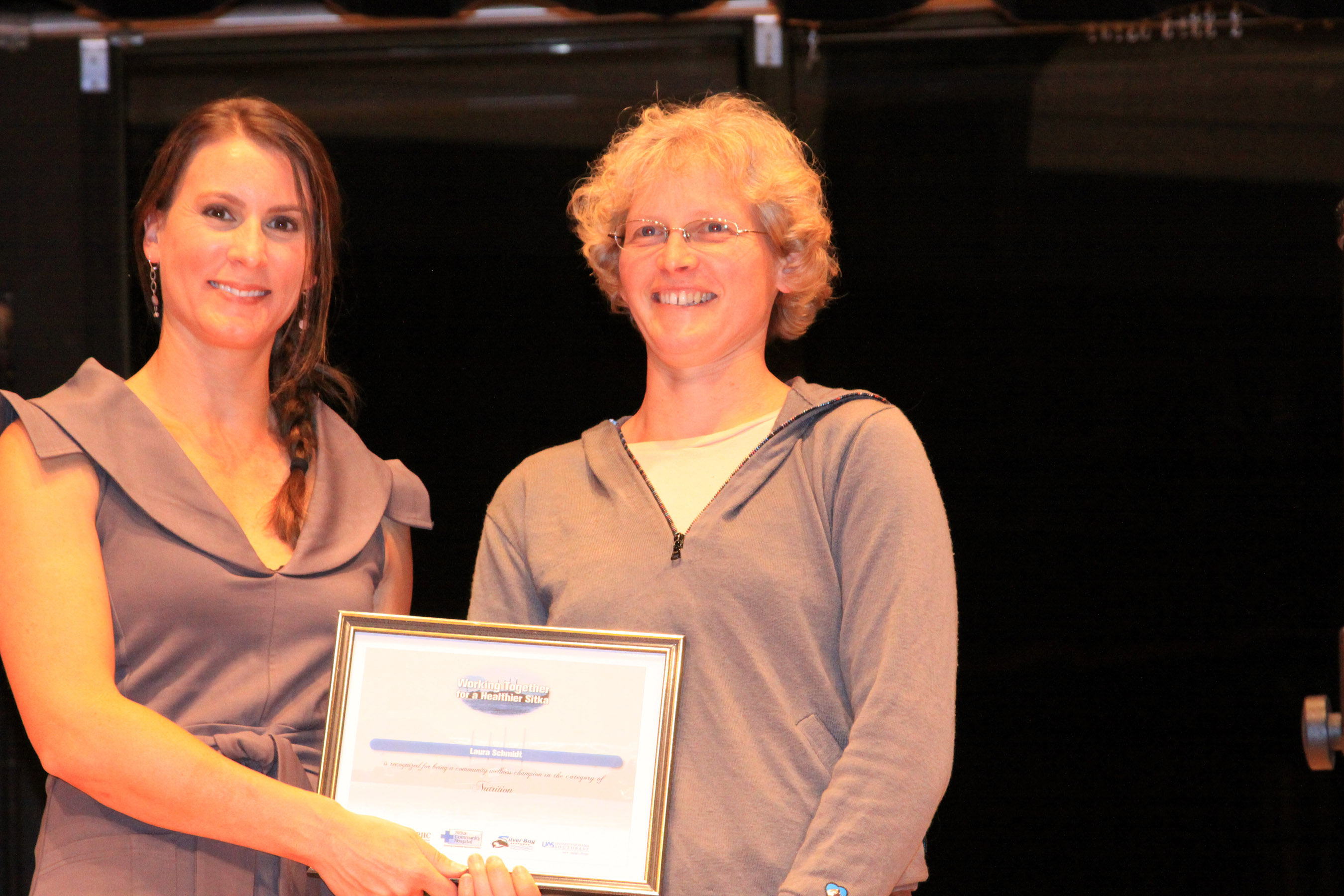
St. Peter's Fellowship Farm Lead Gardener Laura Schmidt, right, accepts the 2011 Nutrition community wellness champion award from Sitka Health Summit Steering Committee Member Alyssa Sexton.

St. Peter’s Fellowship Farm Lead Gardener Laura Schmidt, right, accepts the 2011 Nutrition community wellness champion award from Sitka Health Summit Steering Committee Member Alyssa Sexton.

The 2012 Sitka Health Summit is coming up, and nominations for the community wellness awards are being accepted now. These awards highlight people and groups in Sitka who are making our community a healthier place to live.

The Sitka Local Foods Network has its roots in the Sitka Health Summit. In 2008, two of the community health priorities dealt with local food security issues — starting a public market for local food and artisans, and building more community gardens and a community greenhouse. In 2010, two more community priorities dealt with local food — planting 200 fruit trees in Sitka and getting more local, wild fish into the menus at local schools.

The community health priorities from the 2011 Sitka Health Summit were to start a community composting project (Sick-A-Waste), develop plans for a new Sitka Community Playground that will be American Disabled Act-accessible, and get more Sitka people active through renewing our status as a Bicycle Friendly Community and launching a Parks Prescription program where local medical providers prescribe time outdoors in our parks.

Anyway, here is the announcement about the community wellness award nominations.

SITKA, Aug. 1, 2012 — Do you have a friend or neighbor you think is a fine example of a healthy role model or wellness champion? The steering committee for the sixth annual Sitka Health Summit, “Working Together for a Healthier Sitka,” is accepting nominations for awards that will be presented during this year’s summit, which takes place Oct. 3-6 at various locations around Sitka.

These awards are for Sitka residents who have made outstanding contributions or served as role models in one of six categories — physical activity, nutrition, safety/injury prevention, tobacco prevention/control, holistic health and general wellness. We will honor adults, youth, elders, policy makers, health care providers and Sitkans of all walks of life who make our community a healthier place to live. The awards will be presented during the Sitka Health Summit Awards celebration, which takes place on Wednesday night, Oct. 3, at the Sheet’ká Kwáan Naa Kahídi.

Each nomination should include a brief description of why this individual or group deserves an award, and it should provide us with contact information for both the nominator and the nominee. The awards are our way to recognize and thank Sitka’s unsung heroes of community wellness for their contributions to Sitka’s health.

Nominations should be received by Penny Lehmann no later than Tuesday, Aug. 28. Please e-mail nominations to sitkahealthsummit@yahoo.com, telephone them into Penny at 747-3255, or mail them to Penny Lehmann, Sitka Public Health Center, 210 Moller Dr., Sitka, AK 99835.

The Sitka Health Summit started in 2007 after officials from the SouthEast Alaska Regional Health Consortium (SEARHC) and Sitka Community Hospital met and decided they wanted to build a bridge of cooperation between their two organizations. SEARHC and Sitka Community Hospital continue to be major sponsors in this community event that involves other health care organizations, schools, businesses, non-profits and other groups concerned about the health and wellness of Sitka. The vision of the Sitka Health Summit is “to serve our great state as a model for community wellness by creating a healthy community where Sitkans strive for and enjoy a high quality of life.” You can learn more about the Sitka Health Summit and check out past Community Wellness Award winners by going to http://www.sitkahealthsummit.com/.

• SitNiks to provide musical entertainment during the third Sitka Farmers Market of the season, Aug. 4

The SitNiks will provide musical entertainment during the third Sitka Farmers Market of the season, from 10 a.m. to 2 p.m. on Saturday, Aug. 4, at the Alaska Native Brotherhood Hall (235 Katlian St.).

The SitNiks, who will play from 10 a.m. to noon, perform music from Russian and other Eastern European countries. Members of the group include, from left, Ritch Phillips on bass, John Fulton on concertina, Pattie Skannes on balalaika, Bree Hack on fiddle, Jeanne Stolberg on balalaika, Kris Fulton on fiddle and Mike Litman on accordion (not pictured is J Bradley on various stringed instruments).

The Sitka Farmers Market is happy to provide a showcase for local musicians. Musical acts for future Sitka Farmers Markets this year will be announced later. For more information about providing musical entertainment, contact market coordinator Johanna Willingham at 738-8336.

The Sitka Local Foods Network also is seeking volunteers to help set up tables and tents before the market starts, and to tear down and pack up the market after it ends. We need volunteers for all of the remaining markets (Aug. 4, 18, Sept. 1 and 15). If you have a strong back and helping hands, please contact Johanna at the number above.

In addition, the Sitka Local Foods Network needs people to help harvest veggies from St. Peter’s Fellowship Farm to sell at the Sitka Farmers Market. Work/harvest parties will take place from 4-5 p.m. on Friday, Aug. 3, and from 8-9 a.m. on Saturday, Aug. 4, at St. Peter’s Fellowship Farm (located behind St. Peter’s By The Sea Episcopal Church on Lincoln Street). We expect to have lots of veggies to harvest for Saturday’s market, so we hope to have several people help with the picking.

• Mama Lien Spring Rolls wins Table of the Day at second Sitka Farmers Market of 2012

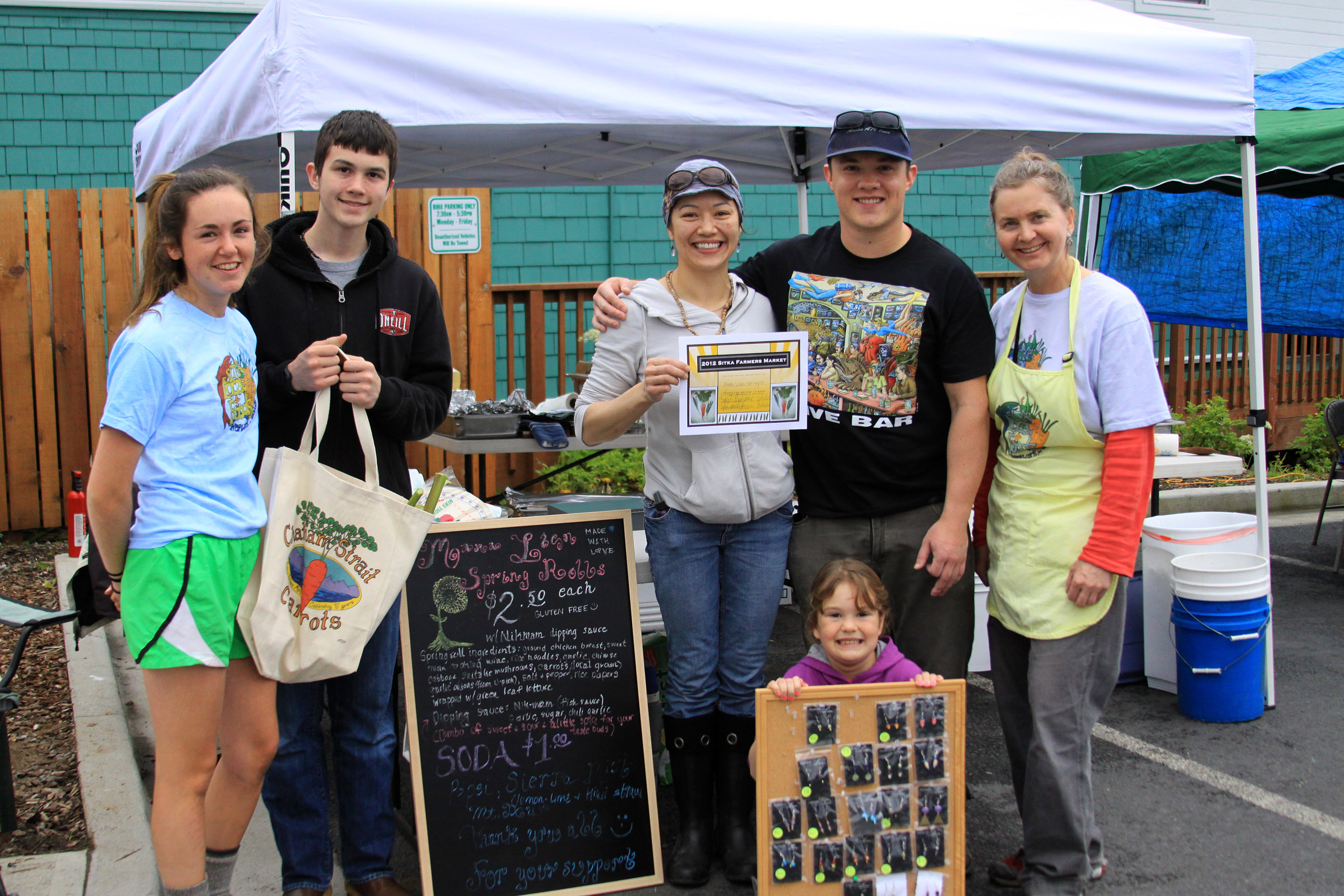
TABLE OF THE DAY: Sitka Local Foods Network intern Christine Devlin, far left, and Sitka Local Foods Network board member Cathy Lieser present the Table of the Day Award to Mama Lien Spring Rolls for the second Sitka Farmers Market of the season, on July 21, 2012, at ANB Hall. Representing Mama Lien Spring Rolls are, from second to left, Michael Ihde, Jessica Lew, Jack Lew and Taylor Ihde (in front). The Sitka Local Foods Network board selects a Table of the Day winner from the vendors at each Sitka Farmers Market of the season, and the winners receive prizes such as a fifth-anniversary market tote bag and check.

The next Sitka Farmers Market is scheduled for 10 a.m. to 2 p.m. on Saturday, Aug. 4, at ANB Hall. The Sitka Local Foods Network is seeking volunteers to help set up tables and tents before the market starts, and to tear down and pack up the market after it ends. We need volunteers for all of the remaining markets (Aug. 4, 18, Sept. 1 and 15). If you have a strong back and helping hands, please contact Johanna Willingham at 738-8336 for more details.

• Lori Adams says it’s time to start planning for garlic in her latest Daily Sitka Sentinel garden column

(Lori Adams, who owns Down-To-Earth U-Pick Garden and is a frequent vendor at the Sitka Farmers Market, will be writing a regular garden column in the Daily Sitka Sentinel this summer. The Sentinel is allowing us to reprint the columns on this site after they first appear in the newspaper. This column appeared on Page 3 of the Wednesday, July 25, 2012, edition of the Daily Sitka Sentinel.)

GARDENING IN SITKA

By Lori Adams

IT’S TIME TO START PLANNING FOR GARLIC

Garlic is the most rewarding thing I’ve grown yet in my garden.  It is amazingly delicious, easy to plant and does so well here in Sitka.

Even though it’s too early to plant garlic right now, the stores are starting to sell it and the catalogs are arriving in the mail. It’s good to buy now because garlic is a hot seller and everyone is usually sold out by October when you need it. Do not buy garlic from the grocery store to plant even though it is cheaper. It won’t do as well as stock bought from a nursery. In fact, many farmers spray the garlic with something to keep it from sprouting during storage.

Our local garden stores sell garlic and Penny Brown at Garden Ventures has been keeping track of the local gardener’s favorite varieties so be sure to talk to her. All garlic varieties fall under two basic categories — hard neck and soft neck.

Soft neck plants have soft stalks at harvest time that can be braided together. The cloves run on the smaller, milder side but have a long shelf life. Most of the garlic you see on the grocery store shelves is soft neck.

Hard neck plants have very rigid stalks.  The cloves run on the larger, more flavorful side but do not have a long shelf life. Hard neck garlic plants send a flower stalk out of the top of the plant in July that needs to be cut off so that all of the energy goes into producing large cloves. This flower stalk is called a “scape” and it’s not only edible, it’s delicious. Just eat it raw or chop it up and throw it into your stir fry.

All of the information I’ve gathered says that hard neck garlic is the best choice for Sitka.

The best time to plant garlic is in the fall. Some stores sell it in time for a spring planting and it works, but your garlic won’t reach its full potential. Preparation for the garlic bed should take place this September.

Remove all the existing plants in the bed, and till or loosen up the soil with a trowel.  Amend with fertilizer (or seaweed and compost), lime (or seashell sand) and bonemeal (or starfish). Be sure the bed has good drainage — if the garlic sits in a puddle all winter it will rot. Planting should take place mid-October.  Separate all the cloves of your garlic, being sure NOT to remove the individual papery covering over each clove. If the covering is accidentally removed plant the clove anyways.

Plant each clove about 2 inches deep and about 9 inches apart and then mulch the entire bed with a thick layer of seaweed to protect it from the winter weather. Mark your bed clearly so you remember where they are planted next year.

Next spring, green blades will start to appear that look like saw grass. Each blade indicates one clove. Fertilize or mulch with seaweed or compost when all the garlic has emerged. Harvest the scapes in July while they are tender before the flower develops.

During July the blades will start to turn brown from the bottom up.  Although garlic is edible at any stage, usually by early August half of the blades have turned brown and it is time to harvest. If you harvest too early it won’t store well and if you harvest too late the cloves will separate from the stalk and the flavor diminishes slightly.  Use a trowel to harvest instead of pulling the stalk to ensure that the garlic stays intact.  For storage just wash off the dirt, cut off the stalk to about an inch and let the garlic dry completely using a fan.

Save your largest cloves to plant for next season, eat the rest of the large cloves and save any tiny or misshapen cloves to plant an inch or two apart in a separate bed to use in the spring as “garlic greens.”  Garlic greens look like green onions but taste like garlic.  If you save and replant your own stock each year the garlic plants will get more adapted to our climate and will get better and better.

Garlic is so delicious, you just HAVE to try it.

Brought to you by Down-To-Earth U-Pick Garden

2103 Sawmill Creek Road

Open June-August / Monday to Saturday, 11 a.m. to 6 p.m.

747-6108 or 738-2241

http://downtoearthupick.blogspot.com/