UAF Cooperative Extension Service releases new food gardening app, Grow & Tell

Heidi Rader shows her new Grow & Tell app. (Photo by Jeff Fay, for the UAF Cooperative Extension Service)

Heidi Rader describes the new Grow & Tell app and website she developed as “essentially Yelp for gardeners.”

Rader teaches gardening and farming as the tribes Extension educator for the University of Alaska Fairbanks Cooperative Extension Service and the Tanana Chiefs Conference. She also reaches gardeners and farmers from around the state through distance-delivered courses.The free app, which was released Tuesday, allows gardeners in the United States to see what vegetable varieties grow best in their areas based on what other gardeners say. The app also invites gardeners to act as citizen scientists and rate the varieties that they have grown for taste, yield and reliability.

Vegetable variety trials conducted in Fairbanks show what grows well here, she said but not in other areas of the state.

“That works pretty well for me but not for people, say, in Arctic Village or Nome,” she said.

Rader hopes that lots of gardeners will rate crops, which will make the app more useful for others. “It’s citizen scientists conducting variety trials where they live,” she said.

The app is available on the App Store for iPhones, Google Play for android phones or as a website at www.growandtell.us. Development of the app was funded by a grant from the eXtension Foundation to promote innovation in the Cooperative Extension Service. To keep the app free, Rader said, Extension will seek sponsorships to pay for updates, fixes and regular maintenance. Additionally, event advertising can also be purchased and targeted to app users locally, by state or nationally.

Rader hopes to expand the app to capture ratings on other plants used in the landscape and garden, including trees, shrubs, flowers, fruits and berries.

The University of Alaska Fairbanks recognized Rader with a 2016 Invent Alaska Award for her work on the app. Cornell University contributed ratings that it had already collected as well as lessons learned from operating a similar citizen science project. A Boston-based company, Geisel Software, built the app. For more information, contact Heidi Rader at grow.andtell@alaska.edu.

St. Peter’s Fellowship Farm still producing veggies this month, and they’re for sale

zucchini

Do you have a need for locally grown zucchini? How about some other veggies grown here in Sitka? Even though the Sitka Farmers Market is over for the year, we still have some veggies for sale.

St. Peter’s Fellowship Farm lead gardener Laura Schmidt said we still have enough produce growing that she can sell 5-10 weekly boxes of produce through the next month. She said the boxes will run $30, and will likely contain about four pounds of carrots, two pounds of potatoes, two pounds of beets, one bundle of chard, one head of lettuce, with other possibilities such as cucumbers, basil, a half-dozen eggs, etc. She also has an excess of zucchini.

To learn more, contact Laura at ljschmidt835@hotmail.com.

Final classes set for 2016 Sitka Local Foods Network garden mentor program

img_1732

img_1993The final batch of classes (Class Six) for the 2016 Sitka Local Foods Network garden mentor program are being set for our two participating first-year families and our three returning second-year families. The classes will be similar at each location, and they are open to the public.

There were six classes in the series, with Class Six being about preparing the garden for the winter. Class One focused on site selection, garden preparation, building planter beds, simple vegetables and soil preparation, while Class Two was about simple vegetables and planting. Class Three was about garden maintenance, with Class Four about early harvest and Class Five about the final harvest.

Our first-year gardener families (Erin Mathes and Fran Baratki), learn how to grow four hardy crops for Sitka — kale, lettuce, potatoes and rhubarb. Our three returning families (A.J. Bastian, Rebecca Kubacki and Breezy) will be planting carrots, chard, green onions and peas this year. These four crops are slightly more difficult crops to grow that our first-year plantings of kale, lettuce, potatoes and rhubarb. Even though the crops for our second-year students are more difficult to grow, many gardeners in Sitka still have good results with these vegetables. These classes are essentially the same, so feel free to attend the class that best fits your schedule.

The class schedule and location for the one first-year and three second-year families is (some classes still need to be scheduled and will be announced later):

  • ERIN MATTHES (first-year family), 716 Etolin Street — CLASS 6: 9 a.m. on Sunday, Sept. 25.
  • FRAN BARATKI (first-year family), 180 Price Street, No. 6 (purple trailer) — CLASS 6: TBA.
  • A.J. BASTIAN (second-year family), 207 Brady St. — CLASS 6: 6 p.m. on Wednesday, Sept. 28.
  • REBECCA KUBACKI (second-year family), 1202 Halibut Point Rd. — CLASS 6: 4:30 p.m. on Monday, Oct. 3.
  • BREEZY (second-year family), 616 Sawmill Creek Rd. — CLASS 6: TBA.

img_1911This is the third year of the garden mentor program, which provides one-to-one mentoring to families who are trying to garden for the first time. In order to reach more people, our participating families allow the classes to be made public. By teaching families the basics of gardening, we are helping them improve their family nutrition, extend their family food budget, and increase food security in Sitka.

Michelle Putz has been contracted to coordinate the program and design lesson plans. We also have about a half-dozen experienced Sitka gardeners who serve as mentors for the program. For more information, please contact Michelle at 747-2708.

Scenes from the seventh and final Sitka Farmers Market of the 2016 summer

slfnboothjasmineshawmarytheresethompson

It rained heavily the day before and even the early morning of the market, but after we’d already set up inside we looked out and saw it was nice and sunny. So we decided outside was the best place to hold the seventh and final Sitka Farmers Markets of the 2016 summer, on Saturday, Sept. 10, at the Alaska Native Brotherhood Founders Hall.

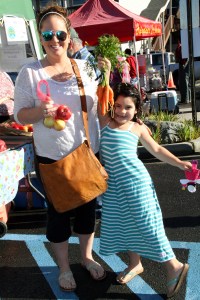
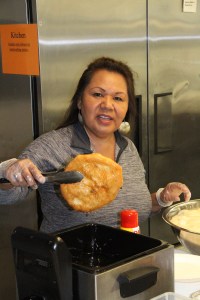
slfnboothyounggirlwithcarrotsOther than one booth using the Alaska Native Sisterhood Kitchen in ANB Hall to make Indian tacos, all of our booths were outdoors in the Baranof Island Housing Authority (BIHA) parking lot next to ANB Founders Hall. This week we also had three ladies who had antiques and other vintage items for sale.

Since it was the last market, it was nice to see some of the booths selling out. The Sitka Local Foods Network produce stand sold out of all its produce, and even its pork products from Mat-Valley Meats. The Salvation Army bread booth sold out, and Reindeer Redhots ran out of hot dog buns.

Now that the market season is over, we will be looking for new ways to try and revitalize the market. If you have ideas, please contact Matthew Jackson at (907) 821-1412 or jackson.mw08@gmail.com.

The Sitka Farmers Markets receive sponsorship funding from the SouthEast Alaska Regional Health Consortium (SEARHC). Don’t forget to vote for the Sitka Farmers Market in the American Farmland Trust’s eighth annual Farmers Market Celebration. The voting deadline is Sept. 21, and we were leading for Alaska in several of the categories.

Also, mark your calendars for Saturday, Sept. 17, which is the tentative date of the annual Running of the Boots costumed fun-run fundraiser for the Sitka Local Foods Network. Click this link for more details.

A slideshow of scenes from the seventh Sitka Farmers Market of the 2016 summer is below.

This slideshow requires JavaScript.

Scenes from the sixth Sitka Farmers Market of the 2016 summer

SLFNBoothLisaSadleirHartKathyHopeErickson

CharlieWithHisMushrooms

Charlie Bower brought a variety of mushrooms for sale this week.

It was nice and sunny, so we decided outside was the best place to hold the sixth of seven Sitka Farmers Markets of the 2016 summer, on Saturday, Sept. 3, at the Alaska Native Brotherhood Founders Hall.

Other than one booth using the Alaska Native Sisterhood Kitchen in ANB Hall to make Indian tacos, all of our booths were outdoors in the Baranof Island Housing Authority (BIHA) parking lot next to ANB Founders Hall.

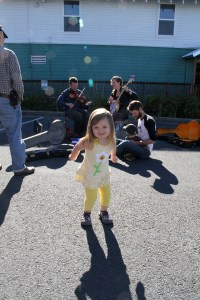
YoungGirlDancesToMusicians

Sometimes you just need to dance.

We always welcome new vendors who want to sell produce they’ve grown, fish they’ve caught, and local cottage food products they’ve made. To learn more about how to be a vendor, contact Matthew Jackson at (907) 821-1412 orjackson.mw08@gmail.com.

We only have one market left, which will be from 10 a.m. to 1 p.m. on Saturday, Sept. 10, at the ANB Founders Hall (235 Katlian St.). The Sitka Farmers Markets receive sponsorship funding from the SouthEast Alaska Regional Health Consortium (SEARHC). Don’t forget to vote for the Sitka Farmers Market in the American Farmland Trust’s eighth annual Farmers Market Celebration.

Also, mark your calendars for Saturday, Sept. 17, which is the tentative date of the annual Running of the Boots costumed fun-run fundraiser for the Sitka Local Foods Network. Click this link for more details.

A slideshow of scenes from the sixth Sitka Farmers Market of the 2016 summer is below.

This slideshow requires JavaScript.

Scenes from the fifth Sitka Farmers Market of the 2016 summer

SitkaFarmersMarketCrowdAtEntrance

For the first time in eight years, the Sitka Local Foods Network hosted Sitka Farmers Markets in back-to-back weeks, with our fifth of seven Sitka Farmers Markets of the 2016 summer taking place on Saturday, Aug. 20, at the Alaska Native Brotherhood Founders Hall. We also had a rainy market on Aug. 13, so it was nice to see a bit of sun for this week’s market.

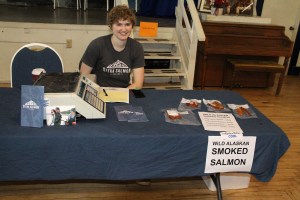
SitkaSalmonSharesBoothGenevieveCrowOne of our new vendors this week was Sitka Salmon Shares, a community-supported fishery program that sells a variety of fish caught in Sitka and other parts of Southeast Alaska to 2,500 subscribers in six Midwest states. Sitka Salmon Shares, which sells fish in 23 farmers markets in the Lower 48, brought out some of its new smoked salmon products to the Sitka Farmers Market.

We always welcome new vendors who want to sell produce they’ve grown, fish they’ve caught, and local cottage food products they’ve made. To learn more about how to be a vendor, contact Matthew Jackson at (907) 821-1412 or jackson.mw08@gmail.com.

AudreySaizAnnaSaizHomemadeFudgeThe two remaining markets this summer are from 10 a.m. to 1 p.m. on Saturdays, Sept. 3, and Sept. 10 at the ANB Founders Hall (235 Katlian St.). The Sitka Farmers Markets receive sponsorship funding from the SouthEast Alaska Regional Health Consortium (SEARHC). Don’t forget to vote for the Sitka Farmers Market in the American Farmland Trust’s eighth annual Farmers Market Celebration.

Also, mark your calendars for Saturday, Sept. 17, which is the tentative date of the annual Running of the Boots costumed fun-run fundraiser for the Sitka Local Foods Network. We’ll post more details later, once we get the event organized.

A slideshow of scenes from the fifth Sitka Farmers Market of the 2016 summer is below.

This slideshow requires JavaScript.

Scenes from the fourth Sitka Farmers Market of the 2016 summer

DownToEarthUPickGardenLoriAdamsKickedBack

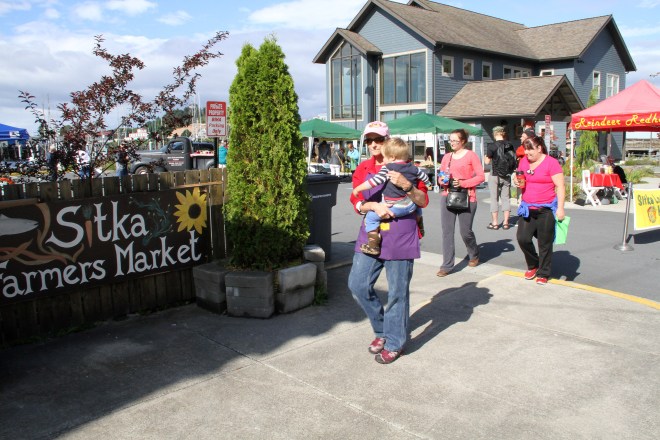
SitkaFarmersMarketSignLast week was National Farmers Market Week (Aug. 7-13), but someone forgot to tell the weatherman. So we had a bit of rain and inclement weather during our fourth of seven Sitka Farmers Markets of the 2016 summer on Saturday, Aug. 13, at the Alaska Native Brotherhood Founders Hall.

Things will be a bit different, as we host another Sitka Farmers Market from 10 a.m. to 1 p.m. on Saturday, Aug. 20, at the ANB Founders Hall (235 Katlian Street). That’s right, we’re having markets on back-to-back Saturdays for the first time in history.

SalvationArmyBreadDavidKitkaMajorTurnieWrightWe always welcome new vendors who want to sell produce they’ve grown, fish they’ve caught, and local cottage food products they’ve made. To learn more about how to be a vendor, contact Matthew Jackson at (907) 821-1412 or jackson.mw08@gmail.com.

The other markets this summer are on Saturdays, Sept. 3, and Sept. 10. The Sitka Farmers Markets receive sponsorship funding from the SouthEast Alaska Regional Health Consortium (SEARHC). Don’t forget to vote for the Sitka Farmers Market in the American Farmland Trust’s eighth annual Farmers Market Celebration.

A slideshow of scenes from the fourth Sitka Farmers Market of the 2016 summer is below.

This slideshow requires JavaScript.

Building a Local Food System: Andrea Fraga and Middle Island Organic Produce

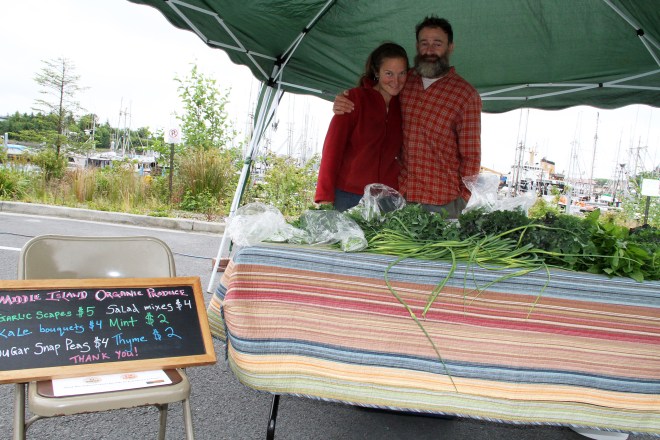
MiddleIslandOrganicProduceAndreaFragaKalebAldred

Andrea Fraga, left, and partner Kaleb Aldred, hosted their Middle Island Organic Produce booth at the July 16 Sitka Farmers Market.

(Editor’s Note: The Sitka Local Foods Network’s Bulldog on Baranof intern this summer, Claire Chang, is writing the Building a Local Food System series of articles about Sitkans working to improve food security. This is the fourth article of the series.)
WP_20160704_11_00_23_ProAndrea Fraga grew up in Hawaii and lived in Oregon for 10 years before she moved to Sitka. While in Oregon, she met a friend from Sitka who invited her to visit, and after her third trip she decided to embrace the rainy weather and move here. Sitka’s tremendous opportunities for subsistence appealed to her desire to become more self-sufficient. “I had been really interested in leading more of a subsistence lifestyle for a while” Fraga said.

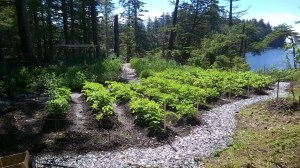
Fraga lives on Middle Island with her partner, Kaleb Aldred. They started with a small garden on the beach, and then established a garden with a greenhouse behind their home. They have since expanded to a lot due south of their house. “We had always lusted to have that space as an ideal garden spot,” she said.

Creating the “small farm or large garden” on Middle Island was not an easy task. They had to cut down trees and rent a machine to pull the stumps out. When they tried to dig the stumps out by hand, removing one stump took a whole week. The machine that removed the stumps compacted the soil, so they then had to dig a trench and fill it with gravel to provide the boggy field with adequate drainage. “I never thought I’d be someone to say, ‘Yeah, let’s cut down all the trees,’ but it’s necessary if you want to garden here,” Fraga said. Removing trees created a sunnier space and also has enabled Fraga to plant fruit trees along the perimeter of her garden.
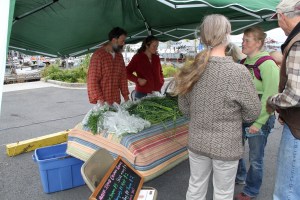
MiddleIslandOrganicProduceKalebAldredAndreaFragaWithCustomersOn occasion, Fraga sells vegetables at the Sitka Farmers Market through their Middle Island Organic Produce stand. She and Aldred hope to grow garlic commercially one day, although they are well aware that “weather and crop failure coalesce and can slow plans down.”

Currently, they have planted about a quarter of their garden in garlic so that they can harvest enough to plant a larger area in the future. Seed garlic costs about $25 dollars a pound from most sources, so generating seed on site will help save a significant amount of money. Fraga said growing garlic commercially makes sense because deer and slugs do not eat it and it is not highly perishable. Furthermore, unlike most garden vegetables she plants in the spring, garlic goes in the ground in the fall, so she can distribute her labor throughout the year.

At a commercial growers conference last spring, Fraga learned about using plastic mulch on garlic to control moisture levels and minimize weeds. The infrared- transmitting plastic transmits heat wavelengths of sunlight that warm the soil and absorbs the wavelengths that plants require for photosynthesis, so weeds cannot grow beneath it. Fraga has begun using the plastic mulch on her own garden this year.

Having farmed in Oregon where one can cultivate a wider variety of plants with greater ease than in Sitka, Fraga does find adapting to Sitka’s weather challenging. Living on an island also has its challenges. For example, in the fall and winter, storms and darkness can restrict travel to and from town. However, Fraga views these challenges as small tradeoffs that allow her to live and garden in a “beautiful, quiet place away from all the noises and distractions of town” and where she is “more in touch with the environment.”

WP_20160707_18_03_42_ProExperiencing beauty is, in large part, what Fraga finds so appealing about subsistence. She explained that gardens, berry thickets, and areas where she forages for mushrooms and seaweed are all beautiful places to spend time. For her, gardening “is just such a beautiful process.” She appreciates the exercise and fresh air involved in gardening, as well as the taste and nutritional value of fresh food. Fraga especially appreciates when she can refer to her dinner as a “Middle Island meal” because all of its components, apart from perhaps the fish,” came from the island that is her home. “It’s really satisfying to eat something that’s entirely grown or harvested yourself.”

Fraga is also a part of a gardening group that meets at one member’s garden every week to work there together. “It’s really great because garden projects that seem daunting end up being fun when you have people to work with,” Fraga said.

For those who find the prospect of starting a garden daunting, Fraga recommends “starting small and simple.” For example, one could begin by growing hearty plants like kale and potatoes that do not require extremely fertile soil. Learning about wild edibles also intimidates many people. Fraga took a class on mushroom identification through University of Alaska Southeast, but she also pointed out one can learn by reading field guides and talking with individuals who willing to share their knowledge on the subject. Gardening and foraging “are really rewarding,” she said. “They don’t have to be discouraging.”

For questions about her garden on Middle Island, contact Andrea Fraga at 738-5135.

Scenes from the third Sitka Farmers Market of the 2016 summer

SLFNBoothMatthewJacksonWithAlyssaRussellPeterWilliams

SitkaFarmersMarketSignAfter a week of rain, we lucked out with no rain when we held the third of the seven Sitka Farmers Markets of the 2016 summer on Saturday, July 30, at the Alaska Native Brotherhood Founders Hall.

PeoplCheckOut4HFairWe had several new vendors at this market, and the Sitka Spruce Tips 4H club sponsored by the UAF Cooperative Extension Service and Sitka Conservation Society hosted the first 4H Fair at this market, with lots of exhibits by the 4H kids.

We always welcome new vendors who want to sell produce they’ve grown, fish they’ve caught, and local cottage food products they’ve made. To learn more about how to be a vendor, contact Matthew Jackson at (907) 821-1412 or jackson.mw08@gmail.com.

RachelMorenoWithFrybreadThe next Sitka Farmers Market will be from 10 a.m. to 1 p.m. on Saturday, Aug. 13, at the ANB Founders Hall. National Farmers Market Week is Aug. 7-13, so celebrate by coming to the market on Aug. 13.

The other markets this summer are on Saturdays, Aug. 20, Sept. 3, and Sept. 10. The Sitka Farmers Markets receive sponsorship funding from the SouthEast Alaska Regional Health Consortium (SEARHC). Don’t forget to vote for the Sitka Farmers Market in the American Farmland Trust’s eighth annual Farmers Market Celebration.

A slideshow of scenes from the third Sitka Farmers Market of the 2016 summer is below.

This slideshow requires JavaScript.

Building a Local Food System: Dave Nuetzel and Blatchley Community Gardens

DaveNuetzelMemorialGardenKathySwanberg

Dave Nuetzel, right, helps build a memorial garden bed for longtime Blatchley Community Gardens supporter Kathy Swanberg.

(Editor’s Note: The Sitka Local Foods Network’s Bulldog on Baranof intern this summer, Claire Chang, is writing the Building a Local Food System series of articles about Sitkans working to improve food security. This is the third article of the series.)

BlatchleyCommunityGardenSignDave Nuetzel has held the role of lead gardener at Blatchley Community Gardens since 2007. Nuetzel grew up outside of Cleveland, and he toured around the country on a two-year road trip after he graduated from college. At the end of the trip, he wound up in Anchorage. In 2005, he followed his partner, who came to Sitka to work at the Sitka Fine Arts Camp, and he has lived here ever since. With a background in special education, he originally worked for the SouthEast Alaska Regional Health Consortium (SEARHC), and he now works for Southeast Alaska Independent Living (SAIL).

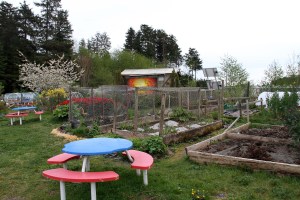
The Blatchley Community Gardens, located behind Sitka’s middle school on what used to be a gravel terrace, started in 2000 as a project of Sitka Community Schools. When Sitka Community Schools lacked the staff to run the garden, Nuetzel took on his role as lead gardener. This year the garden has transitioned from Sitka Community Schools to become a program of Blatchley Middle School. The community garden consists of about fifty garden plots, approximately 6-by-12-feet each. It is personal-use garden, although it does contain a few communal plots of plants such as mint, rhubarb, and flowers. Gardeners pay for the square footage of a plot, and Nuetzel explained that the community garden particularly appeals to people who live in apartments, on boats, or in houses with yards that receive little sunlight.

MiddleOfBlatchleyCommunityGardenAs someone who “has always liked to fix things and learn new skills,” Nuetzel had small gardens when he was growing up, as well as in college. In addition to his personal plots at the Blatchley Community Gardens, Neutzel says that he has “basically cultivated his whole yard.” Any areas around his house where he is not growing vegetables or flowers contain salmonberry, blueberry, or raspberry plants. Gardening appeals to Nuetzel’s desire to strive for self-sufficiency; he also fishes and forages for beach asparagus for subsistence.

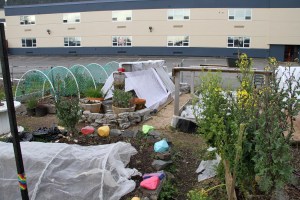
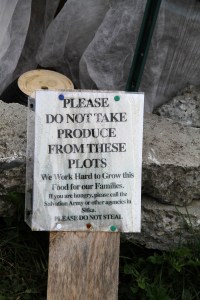
LeaveProduceAloneSignBlatchleyCommunityGardenNuetzel explained that, as lead gardener of Blatchley Community Gardens, maintaining a unified vision for the garden has posed a challenge. At the community garden, each plot represents the gardener’s individual approach to cultivation. Some gardeners devote themselves to experimentation, and they use their plots as a space for attempting to grow one type of vegetable that they have never succeeded in cultivating before. Others are committed to growing a wide variety of plants that they know will yield an ample harvest. Furthermore, gardeners choose to amend the soil in unique ways; while one might opt for buried salmon carcasses, kelp, and ground-up shells, another might rely more heavily on compost and coffee grounds.

An even larger challenge that Nuetzel has faced in his role is coordinating the management of common plots. Dividing up the responsibility of caring for a plot of chard, for example, becomes difficult when gardeners travel schedules and family obligations interfere. Furthermore, trying to ensure that everyone has equal to the resources of common plots, such as the apples from a communal apple tree, can be tricky.

BlatchleyCommunityGardenPicnicTableAndBedsNevertheless, Nuetzel appreciates Blatchley Community Gardens as a space where he and others can experience the tangible results of physical labor. Regular visits to the garden allow him to appreciate how well one can grow food for oneself when one puts in the effort. Nuetzel believes that gardening has grown more popular in Sitka in recent years. He has seen new gardens emerge in yard, and in the future, he would like to see new community gardens established in town. As gardening in the community becomes more popular, he wishes that more people would view gardening as a basic need, not just a hobby.

CherryBlossomsBlatchleyCommunityGarden“At one time, producing food was a requirement for life,” Nuetzel said. “Now, people think that gardening is only something you do if you have lots of ‘extra’ time. But if you provide people with a little bit of guidance and get them invested in the process of gardening, they will value it and treat it like something that is necessary.”

To learn more about Blatchley Community Gardens, go to the Facebook page or contact Dave Nuetzel at community.garden@hotmail.com.