• UAF Cooperative Extension Service offers Certified Food Protection Manager class by videoconference March 3 in Sitka

CFPM flyer 3-3-16-b

Wednesday, Feb. 17, is the registration deadline for a certified food protection manager workshop being taught on Thursday, March 3, by University of Alaska Fairbanks Cooperative Extension Service. This is an all-day statewide class that will be offered by videoconferencing to Fairbanks, Palmer, Juneau, Petersburg, Sitka, Craig, Angoon, Klukwan, and Tenakee.

A certified food protection manager (CFPM) is responsible for monitoring and managing all food establishment operations to ensure that the facility is operating in compliance with food establishment regulations.

A CFPM is knowledgeable about food safety practices and uses this knowledge to provide consumers with safe food, protect public health and prevent food-borne illnesses. Alaska regulations require food establishments to have at least one CFPM on staff.

This course takes place from 8:30 a.m. to 5 p.m. (with a half-hour lunch), and participants will take a computer-based exam at the end of the class. The reason the deadline is two weeks before the class is to guarantee course materials reach all the students in time for the class. The cost is $200, and the course will be taught by Julie Cascio of Palmer. Students can register here.

The Sitka videoconference for the class will take place in Room 110 at the University of Alaska Southeast Sitka Campus. To learn more, contact Jasmine Shaw at the Sitka District Office of the UAF Cooperative Extension Service at 747-9440, or contact Kathy McDougall at (907) 474-2420 (Fairbanks number) or kmmcdougall@alaska.edu. Note, this class is taught in English but textbooks are available in Korean, Chinese and Spanish, just contact Kathy at least three weeks before the class.

Also, the ServSafe book ($60) and certification exam ($75) now are available online, if people want to order the book and study independently without taking the class. Just go to this website and purchase the book and exam items.

• Southeast Alaska Commercial Growers Conference to take place Feb. 27-March 1 in Petersburg

FarragutFarmFields

Bo Varsano and Marja Smets of Farragut Farm in Petersburg will host the inaugural Southeast Alaska Commercial Growers Conference from Feb. 27 through March 1 in Petersburg. This conference is made possible by the USDA Farmers Market Promotion Program and the Petersburg Economic Development Council.

FarragutFarmProduceStandatIngas“The Southeast Alaska Commercial Growers Conference is an opportunity for the commercial vegetable and flower producers of Southeast Alaska to get together and exchange ideas and techniques, with the purpose of improving and expanding local agricultural production,” Bo Varsano said. “Commercial agriculture in Southeast Alaska is still minimal, but is rapidly expanding with new growers starting up every year. While there are many uniquely specific challenges to growing in our region, few fully developed and publicized strategies currently exist for the new grower to follow. In light of this, gathering with other growers to share our experiences and ideas may be the best way to aid the growing agricultural movement in Southeast Alaska.”

FarragutFarmMarjaInGreenhouseIt’s not too late to sign up to participate, so please take a look and let us know if you have any questions or if you are interested in joining the fun. If the travel and lodging costs are dissuading you from participating, please remember that we can arrange a home-stay for anyone (contact us by Jan. 18 to arrange home-stays) and we still have one travel stipend ($200) to hand out to someone in need.

A few things to consider:

  • This conference is open to commercial farmers, aspiring farmers, as well as anyone in the general public who is interested in the local agriculture industry.
  • Participants are responsible for their own breakfasts and lunches.
  • Friday’s dinner will be prepared by KFSK, our local radio station. This meal is a fundraising event for the station, and a suggested donation will be requested.
  • Saturday’s dinner will be a communal dinner, jointly prepared for and shared by all conference participants at the venue.
  • There is no fee to attend, however, we will be asking for a minimal donation from each participant to cover the cost of venue rental and Saturday evening’s dinner.

Several regional farmers and industry specialists have volunteered to give presentations relevant to the issues and challenges faced by Southeast Alaska growers.  The following topics will be addressed:

We will begin the conference with a brief “show and tell” session. All conference participants will be asked to give a short (under 10 minutes) introduction including a description of their farm, their farming aspirations, or their involvement in the farming industry.

We especially encourage sharing photos of your operation. If you choose to do so, please bring those photos on a memory stick in JPEG format (in the largest original format). That is the ONLY photo format that we can guarantee will work with our computer.

We hope to see you all in February, and again, please do not hesitate to contact us with any questions. The best way to reach us is by email, at farragutfarm@gmail.com.

Please print up the attached documents (which include a conference agenda and a map of Petersburg showing the locations for the conference) and bring them with you when you come.

• 2015 Southeast Alaska Commercial Growers Conference Agenda

• Map of Petersburg

• Buying local food during a Southeast Alaska summer

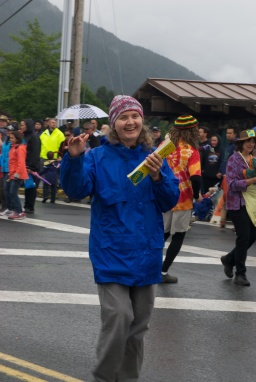
Sitka Local Foods Network Board Vice President Cathy Lieser distributes "Alaska Grown" bumper stickers during the July Fourth parade in Sitka (Photo by Heike Hüttenkofer)

Sitka Local Foods Network Board Vice President Cathy Lieser distributes “Alaska Grown” bumper stickers during the July Fourth parade in Sitka (Photo by Heike Hüttenkofer)

By CATHY LIESER
Sitka Local Foods Network Board Vice President

I am cooking on a boat throughout Southeast Alaska this summer, so on May 5, I planted seeds in my garden, covered it with bird netting and wished it well until my return. The text from my friend read, “the weeds are winning,” luckily I have an herb garden on the boat.

I have been on the hunt for local food in the towns where we provision. It was a late spring, so early on I watched plots greening up and took mental notes. There was kale and rhubarb in Tenakee, with one grower who sells on Friday — The Party Time Bakery — which uses local produce for delicious meals. We bought a rhubarb-berry pie fresh out of the oven and took it back to the boat.

In Juneau, we stocked up at Pinkies Fish Market where the mission is to create a local food economy by sourcing local seafood and other farm fresh items. I toured the Jensen-Olson Arboretum (click here for Facebook page) with Merrill Jensen while he shared about their process toward having a certified virus-free Tlingít potato. The Wild Oven sourdough bakery found me sampling chewy and flavorful loaves that I found out got better with age. At the Second Saturday Market, I bought greenhouse-fresh basil picked that morning.

I barely missed the first Sitka Farmers Market on July 6, but did raid my garden for spinach, kale, lettuce, corn salad and miner’s lettuce. I thank those who watered for me during the hot month of June. Our next boat destination was Petersburg, where I finally arrived on a day where two growers were selling.

The Garden, which participates in the Alaska Grown program, is an abundant oasis of organic produce in the middle of town. Tonna Parker has turned a family lot into a production powerhouse using French intensive methods. For the last four years she has sold direct to the community, just stop by on a Tuesday or Saturday to see what she has available. I bought cucumbers and snap peas that did not make it home, I snacked while Tonna gave me a tour. She has beautiful raised beds, chickens, ducks and compact greenhouses where she is able to grow an astounding variety. Winter squash, pumpkins, tomatoes, cucumbers, zucchini, bok choi, kale, corn salad, arugula, carrots, beans, peas, berries, eggs, the abundance went on and on.

I was incredibly inspired by her approach toward finding varieties that thrive in her micro climate, ones that are tough and aggressive growers. She trials open-pollinated varieties and saves her own seed for many of her plantings. Freely sharing her knowledge, Tonna said she would happily work herself out of a job, she just wants folks to grow local and reap the benefits.

Farragut Farm makes the trip into Petersburg by boat to sell direct twice a month. Marja Smets and Bo Varsano had beautiful, tender and sweet produce for sale. Radishes nearly the size of golf balls, collards, kale, chard, green onions, carrots, garlic scapes, edible flowers, pea shoots, peas, Napa cabbage, turnips, beets, and lettuce. Wow, to have root crops and full-sized heads of Romaine lettuce and cabbage this early on is a testament to dedicated growing. I had heard that Farragut sells to charter boats and indeed I can place an order via email to be picked up one hour on either side of the high tide in Farragut Bay. They will row and deliver to the boat.

If you love fresh flowers, Craig Olson and Deb Hurley of the Flower Farm run a flower CSA.  For a $100 subscription they deliver six bouquets a summer.  Stunning dahlia, snapdragon, campanula, linaria, veronica, delphinum, and ageratum to name a few.  They grow in three hoophouses and three heated greenhouses that were funded with a $20,000 grant from the Petersburg Development Fund. Planting starts on Jan. 9, and 60 percent of their sales are in veggie and flower bedding plants.

Inga’s Galley (click here for Facebook page) is the Petersburg reinvention of Sitka’s late-but-beloved Two Chicks on a Kabob Stick food cart. Amyee Peeler (one of the Two Chicks from Sitka) sources local produce whenever she can, and of course all of the seafood is local.

Unfortunately, the The Market In Petersburg was not happening on the Friday while I was in town, but I hope to hit it on July 19.

I’ll keep looking over the next two months wherever we dock, I am heartened to see folks committed to growing and sourcing the best food in Southeast. If you know of anyone that I’ve missed leave me a note at sitkalocalfoodsnetwork@gmail.com (put “Attention Cathy” in the subject line).

This slideshow requires JavaScript.

• Alaska chef Robert Kinneen creates webinar series about cooking with traditional foods

Local food from Sitka is featured prominently in the new Fresh49.com webisode series about using traditional foods created by Alaska chef Robert Kinneen of Anchorage and Dr. Gary Ferguson, ND, the director of the Wellness and Prevention program at the Alaska Native Tribal Health Consortium (ANTHC).

Guest chef Robert Kinneen of Anchorage demonstrates a dish using scallops during the first Sitka Seafood Festival in 2010.

Guest chef Robert Kinneen of Anchorage demonstrates a dish using scallops during the first Sitka Seafood Festival in 2010.

The first webisodes in the series are about the Store Outside Your Door, and they feature traditional foods Kinneen gathered around Sitka with Steve Johnson, a Tlingít elder-in-training from Sitka. Some of the webisodes featuring Sitka include a foraged salad, Alaskan fresh rolls, venison skewers and rockfish fumet. There is a Store Outside Your Door page on Facebook, as well as a channel on YouTubewhere people can find the webisodes.

Even though he currently lives and works in Anchorage, Kinneen is no stranger to Southeast Alaska. He is Tlingít and was born in Petersburg. Kinneen is a graduate of the Culinary School of America and has been a chef at several of Anchorage’s top restaurants over the years. He also has been a guest chef at the first two Sitka Seafood Festivals.

Dr. Ferguson, who is Aleut originally from Sand Point, is a Doctor of Naturopathy who earned his degree from the National College of Naturopathic Medicine. He has a special interest in diabetes treatment and prevention, which is one of the reasons Dr. Ferguson and Kinneen got together to do the series. Research has shown that traditional diets can play a big role in diabetes prevention.

In the first webisodes, they also worked with health educator Renae Mathson of Sitka (Tlingít), who works with the SouthEast Alaska Regional Health Consortium (SEARHC) Diabetes and Health Promotion programs, and registered dietitian Desirée Simeon (Tlingít/Haida), who works with ANTHC. They currently are filming webisodes from other parts of Alaska, featuring traditional foods from those areas.