• Sitka Community Food Assessment Indicators Report helps define Sitka’s food culture

Food Assessment Indicator Report web version_Page_01

SitkaCommunityFoodAssessmentLogoThe Sitka Community Food Assessment Indicators Report was released on Monday, and the findings will help guide future food system planning in Sitka.

A 2012 Sitka Health Summit project, the Sitka Community Food Assessment has examined where Sitka residents get their food, what types they eat, what they grow, what they hunt and fish for, where they shop, what type of access people have to healthy food, and other questions about Sitka’s food supply. The findings of the food assessment will help Sitka improve its food security.

After Sitka residents chose the Sitka Community Food Assessment as a project at the September 2012 Sitka Health Summit, the work group received a grant to hire a coordinator and contract with a data person. A revised version of a questionnaire from a similar project on the Kenai Peninsula was posted online, available at the library, and discussed in focus groups, with more than 400 residents answering the 36 questions. In November 2013, some of the initial data was presented at the Sitka Food Summit, where about 60 residents discussed the results and noted any further research that needed to be done. Since then, the work group, in partnership with The Island Institute and others, fine-tuned the data before writing and editing the indicators report.

“We hope the Sitka Community Food Assessment Indicators Report can guide future food system planning and plant seeds for innovative responses that will strengthen Sitka’s food landscape,” project coordinator Lisa Sadleir-Hart wrote in the 26-page document’s introduction. “The Sitka Community Food Assessment Indicators Report uncovers many weaknesses in our food system as well as some incredible assets that define Sitka’s food culture — a rich ecosystem filled with nutritious gems from the land and sea plus a generous spirit of sharing with our neighbors. Now that we’ve defined the current foodscape in Sitka, let’s work together to build a more resilient food system that can deeply nourish the entire community for generations to come.”

The Sitka Community Food Assessment Indicators Report opens with Sitka’s demographics and several Sitka food facts. It then features data about how many people in Sitka hunt, fish, gather, and/or grow their own food, as well as some barriers. Next is information about where people in Sitka shop for their food, followed by how many people in Sitka are on some form of food assistance. The report also includes information about food in the schools, and local food manufacturing.

The findings will be presented to the community during an upcoming meeting of the Sitka Assembly, and the report will be posted online here (see below) and on The Island Institute’s website.

• Sitka Community Food Assessment Indicator Report (April 14, 2014, opens as PDF file)

• Kayaaní Commission accepting letters of interest for commissioners.

Devils-Club__SE-Alaska1

Sitka Tribe of Alaska‘s Kayaaní Commission is accepting letters of interest to fill two open commissioner seats — a three-year term tribal citizen seat, and a one-year term general membership seat.

The Kayaaní Commission works to preserve and protect plants and the traditional ways they are used. It is a commission of knowledgeable tribal citizens, elders and knowledgeable Sitka residents who care for the preservation of traditional ways, protection of native species and their uses. The commission then shares that knowledge so it is not lost. A few years ago, the Kayaaní Commission published The Kayaaní Commission Ethnobotany Field Guide to Selective Plants in Sitka, Alaska, which details some of the food and medicinal uses of a variety of local plants.

For the open commission seats, the term “tribal citizen” shall mean any individual enrolled at the Sitka Tribe of Alaska, and the term “general membership” of the Kayaani Commission shall mean all tribal citizens and residents of Sitka who have resided here for at least six months. Deadline is close of business on Friday, March 28.

Please mail or hand deliver letters of interest to the STA’s Resource Protection Department, 456 Katlian Street, Sitka, AK 99835, Attention: Heather Riggs, or email letters to heather.riggs@sitkatribe-nsn.gov. For more information, please contact Heather @ 747-7167.

• Sitka Sound Science Center presentation will shed light on impacts of Fukushima radiation in the Pacific Ocean

cooperFukushima

People living along the Pacific Coast, including in Sitka and Southeast Alaska, have been wondering about the impacts of radiation in the food supply ever since the March 2011 earthquake in Japan and Fukushima Dai-ichi nuclear power plant meltdown.

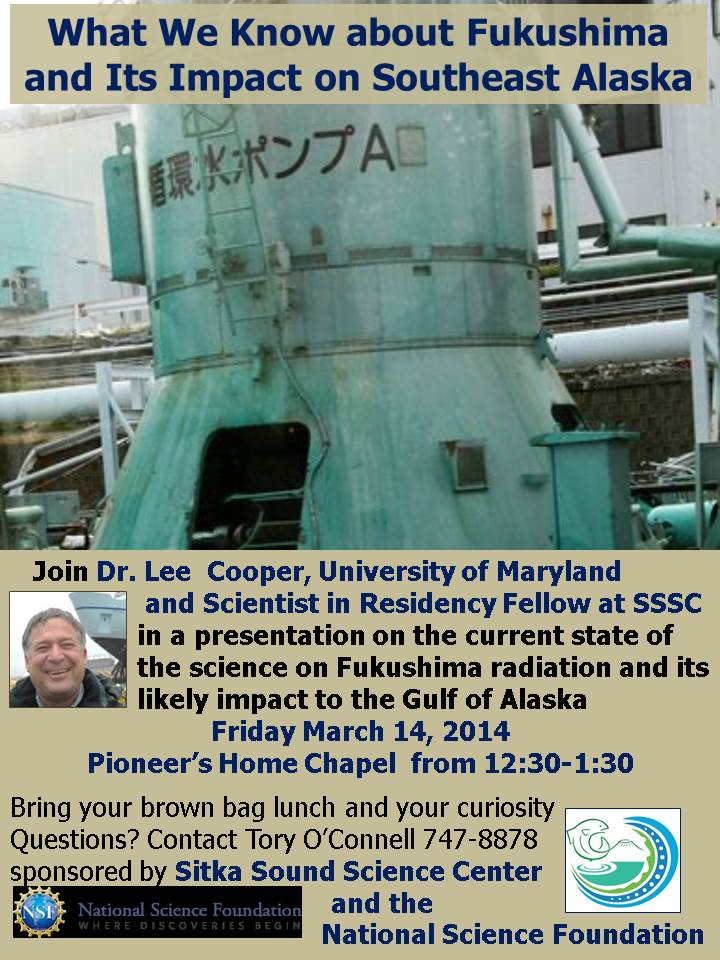
Dr. Lee Cooper of the University of Maryland, a Scientist in Residency Fellow at the Sitka Sound Science Center, will discuss the current state of the science on Fukushima radiation and its likely impact on the Gulf of Alaska during a brown-bag lunch presentation from 12:30-1:30 p.m. on Friday, March 14, at the Sitka Pioneer Home Chapel. Bring your lunch and questions to the presentation, which is sponsored by the Sitka Sound Science Center and the National Science Foundation.

According to the Sitka Sound Science Center:

It is projected that dissolved contaminants, particularly the radioactive isotopes of cesium, 137Cs and 134Cs from the Fukushima Dai-ichi Nuclear Power in Japan, will reach Southeast Alaska this year.  Because the amount of radiation released is uncertain and the accident site is still leaking to some extent, it is difficult to know exactly what the peak concentrations of radioactive cesium will be in local waters, but it is not likely to exceed levels that were observed during the bomb fallout era 40 to 50 years ago. Cesium is chemically very similar to potassium, which is a common ionic salt in seawater, so fortunately the concentration of cesium into the foodweb and into seafood harvested for food is comparatively modest.

Nevertheless, it is important to put into perspective the potential risks involved and communicate this to the public. This talk will summarize the newest scientific information that is available on the impacts of the accident, based upon a special session held in late February at the Ocean Science Meeting in Honolulu and attended by scientists studying Fukushima impacts, ranging from Japan and East Asia to the Woods Hole Oceanographic Institution.

For more information, contact Tory O’Connell at 747-8878.


• How to weed through the conflicting information about Fukushima radiation and its impacts on Alaska waters

SalmonImage

Alaskans have been worried about their seafood ever since the March 2011 Fukushima earthquake and Japanese nuclear plant problems. It’s understandable that Alaskans are concerned about the safety of the seafood, seaweed and marine mammals in the area. But Alaskans also should note that most of the information posted on social marketing sites just isn’t true.

This NOAA map has been showing up on social media posts with a note that it shows the path of 300 tons of radioactive material entering the ocean each day. This map really shows the probable tsunami paths from the 2011 Tohoku earthquake.

FALSE IMAGE: TSUNAMI WAVES, NOT RADIATION: Many people have posted on social media that this NOAA map shows the path of 300 tons of radioactive material entering the ocean each day. This map really shows the probable tsunami wave heights from the 2011 Tohoku earthquake.

One of the biggest examples of false information usually is accompanied by an official-looking map from the National Oceanic and Atmospheric Administration (NOAA) and a note that each day the map shows 300 tons of radioactive material entering the water each day. The map is an official NOAA map, but it doesn’t show radiation. It actually shows the probable tsunami paths from the 2011 Tohoku earthquake. When in doubt, or even if not, don’t be afraid to consult one of the myth-debunker sites such as Snopes.com, which has the details on the real story behind this map.

The Sitka Local Foods Network has been following the situation since it happened, and we even posted an update in March 2012 in hopes of easing people’s worries (many of the links on this page have been updated). The Alaska Department of Health and Social Services also has a site with updates.

In recent weeks, Rep. Jonathan Kreiss-Tomkins (D-Sitka) did some research, interviewing Dr. Ken Buesseler of the Woods Hole Oceanographic Institution and one of the country’s top researchers on oceanographic radiation. Rep. Kreiss-Tomkins posted his findings in his Jan. 8 constituent newsletter, and that write-up also appeared in several Alaska publications such as the Alaska Dispatch.

010714_Fukushima-Radiation-GraphAlso in January, Alaska Department of Environmental Conservation Commissioner Larry Hartig gave an update to the Alaska Senate’s Natural Resources Committee about what it’s doing to track the radiation, and he said so far the DEC hasn’t seen anything to cause concern. The Ketchikan website Stories In The News also had a follow-up story that included information from Hartic’s testimony and an update from Buesseler, who announced the launch of a new “How Radioactive Is Our Ocean?” website to help crowd-source information about what’s happening along the 5,000-mile Pacific coastline.

Taking things a step further, in January a couple of Seattle media organizations — KPLU and the Seattle Times — ran stories about Seattle fish-broker Loki Fish Co. ran its own tests on Alaska seafood. After the testing, the folks at Loki Fish Co. decided Pacific salmon is safe to eat.

• Sitka Conservation Society to host annual Wild Foods Potluck on Dec. 8 at Sweetland Hall

Wild Foods Potluck no words

WildFoodsPotluckHelp Sitka celebrate its wonderful bounty of local and wild foods by joining the Sitka Conservation Society for its annual Wild Foods Potluck from 5-7:30 p.m. on Sunday, Dec. 8, at Sweetland Hall on the Sheldon Jackson Campus.

This annual event features a variety of wild foods that can be harvested around Sitka, including many varieties of fish, deer, ducks, berries, seaweed, beach greens, and more. This event gives local residents a chance to sample a multitude of wild food dishes for a true taste of Sitka. If you don’t have any wild foods, just garnish your dish with a local plant.

“Bring a dish that features ingredients from the outdoors and meet others interested in subsistence foods and the conservation field,” said the Sitka Conservation Society’s Ray Friedlander, who is helping coordinate the event. “Your dish could win a prize if you enter it into the Best Dish, Best Side, and Best Dessert category.”

This event is non-alcoholic, and it is open to all residents of Sitka, including members and non-members of the Sitka Conservation Society. For more information, contact Ray Friedlander or Mary Wood at the Sitka Conservation Society at 747-7509, or go to http://www.sitkawild.org/.

• Sitka Community Food Assessment findings to be presented Nov. 14 at inaugural Sitka Food Summit

Sitka Food Summit Flyer

SitkaCommunityFoodAssessmentLogoThe Sitka Community Food Assessment work group will present its findings during the inaugural Sitka Food Summit, from 6-9 p.m. on Thursday, Nov. 14, at Harrigan Centennial Hall.

A 2012 Sitka Health Summit project, the Sitka Community Food Assessment has examined where Sitka residents get their food, what types they eat, what they grow, what they hunt and fish for, where they shop, what type of access people have to healthy food, and other questions about Sitka’s food supply. The findings of the food assessment will help Sitka improve its food security.

“The Sitka Community Food Assessment work group decided early on that there needed to be an opportunity for Sitka to engage with the food data and shape the writing of the food assessment indicator report,” project coordinator Lisa Sadleir-Hart said. “The inaugural Sitka Food Summit will use a format that was first tested in the late 1990s when the Island Institute was developing Sitka’s initial indicator report.  We’ll interact individually with the data, then use a conversation café model to discuss what the data brings up for us as Sitkans.  The working group wanted to create a venue that meets the needs of a wide range of citizens.”

The event sponsors include the Sitka Community Food Assessment Work Group from the Sitka Health Summit, Alaskans Own Seafood, the Sitka Food Co-op, Sitka Community Hospital, the SouthEast Alaska Regional Health Consortium (SEARHC) Community Transformation Grant and Diabetes Prevention programs, the Sitka Local Foods Network, the Southeast Soil and Water Conservation District, and Sitka Tribe of Alaska. There also will be refreshments thanks to Sitka Community Hospital’s Basement Bistro, St Peter’s Fellowship Farm and Sitka Conservation Society staff.

For more information, contact Lisa Sadleir-Hart at 747-5895 or sitkafoodassessment@gmail.com. (Editor’s note: A few photos from the Sitka Food Summit are posted below.)

This slideshow requires JavaScript.

• Deadline extended on Sitka Community Food Assessment to get more completed surveys

SitkaCommunityFoodAssessmentSign2

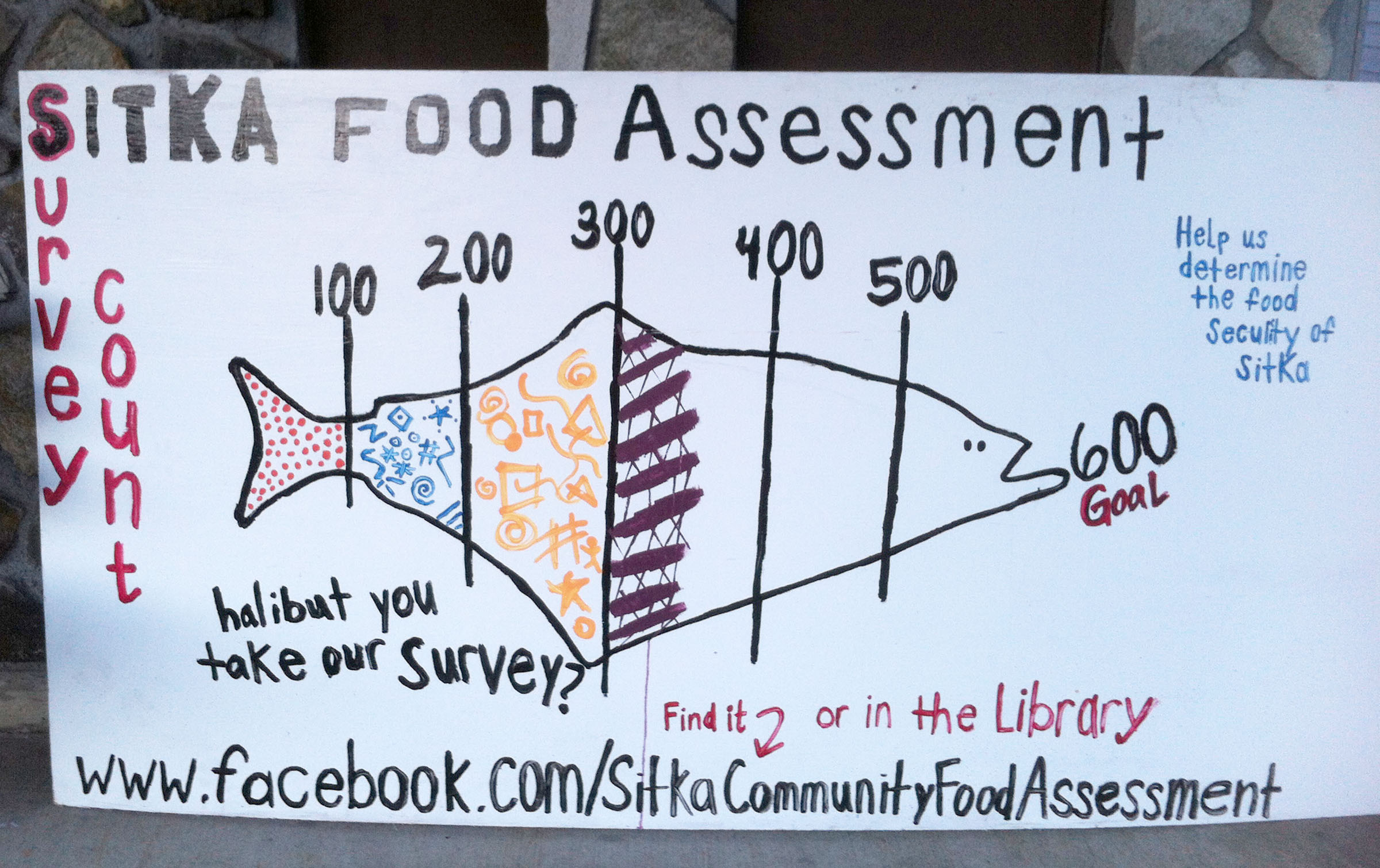
The deadline for surveys to be completed in the Sitka Community Food Assessment has been extended to the end of the month. Our goal is 600 completed surveys and as of Tuesday, May 21, we had 392 that had been recorded.

The Sitka Community Food Assessment is a 2012 Sitka Health Summit project designed to help shape food policy and improve Sitka’s food security. To learn more about the project, KCAW-Raven Radio hosted an interview with project coordinator Lisa Sadleir-Hart that aired on Monday, May 20.

Additional information can be found in this March 26 post on the Sitka Local Foods Network website, and in this April 9 article from the Daily Sitka Sentinel.

Surveys are available online at https://www.surveymonkey.com/s/MQTF22Q, or click the Sitka Community Food Assessment logo in the right column of this webpage. Printed copies are available at Kettleson Memorial Library. A sign has been posted at the corner of Lincoln and Lake streets to update people on the progress of the project.

• Sitka joins communities around the world to host a local March Against Monsanto on Saturday, May 25

March Against Monsanto Yellow 72Millions of people around the world, including several in Sitka, will take a stand by hosting a local March Against Monsanto. The Sitka march takes place at 2 p.m. on Saturday, May 25, at Castle Hill. So far, more than 370 marches around the world are planned on May 25.

The Sitka March Against Monsanto is being organized by Brett Wilcox, who has created a Facebook page with more details. Brett and his 14-year-old son, David, will take things a step (OK, many steps) further when they start a transcontinental run across the country in January to raise awareness about some of the ethically challenged practices of the agri-business Monsanto. These include creating GMO (genetically modified) foods that are unlabeled and untested, putting patents on crop seed so farmers have to pay high fees to plant food, and more.

In addition to the march, various Sitka residents will speak on a variety of topics, such as how GMO-food causes health problems, the number of former Monsanto executives who now work for our government, farmer suicides in India due to Monsanto practices, the Monsanto Protection Act slipped into the recently passed US Farm Bill, etc.

This month, Brett hosted free Monsanto Movie Nights at 7 p.m. on Fridays, May 10, 17 and 24, at Harrigan Centennial Hall.

According to a press release about the event:

Sitka’s March Against Monsanto will be held on Castle Hill, the location where Russia sold the vast territory of Alaska—land it did not own—to the U.S.A.

March organizer, Brett Wilcox, chose Castle Hill for Sitka’s March Against Monsanto for its symbolic significance. “There are many similarities between the original ‘Land Grab’ that took place with the first European expansion and Monsanto’s current global ‘Seed Grab,'” Wilcox states. “Both involve the privatization of Nature, a concept that was largely foreign to Native Americans and Alaska Natives. And both have resulted in loss of freedom and loss of life. The difference is that Monsanto’s seed grab not only further disenfranchises Native Americans; it disenfranchises all nations and all people. The citizens of the world are, as it were, sitting in our canoes in Sitka Sound, watching powerful people and corporations claim and repackage life as their own, thereby stealing our seed sovereignty and seed freedom.”

Chuck Miller, a Tlingit “Elder in Training”, will preside at the event. “My grandmother used to teach my family that we need to treat our food with respect or it will not provide for us,” Miller states. “My ancestors’ teachings are still a very big part of my life and I want to be able to pass that on to my children, grandchildren and those yet to come. GMOs are not the way to treat Mother Earth and the generations yet to come. I urge all the Native people of Alaska and our non-Native brothers and sisters to come and support this cause.”

“Sitka’s March Against Monsanto will not be a traditional march,” says Wilcox. “Sitka’s event will be a ceremony to honor nature as well as the indigenous people of Alaska and the Americas. We will stand on Castle Hill united with the people of the world in defense and protection of life and nature.”

For more information about the Sitka March Against Monsanto, contact Brett Wilcox at 747-7437 or brett@runningthecountry.com, or contact Chuck Miller at 752-9955 or cohomojo25@yahoo.com. KCAW-Raven Radio aired a story on Tuesday, May 21, about Brett’s and David’s plans to run across the country and to host this march. Brett also recorded a commentary for KCAW-Raven Radio.

• Sitka Community Food Assessment featured in the Tuesday, April 9, issue of the Daily Sitka Sentinel

Courtney Bobsin, a Jesuit Volunteer with the Sitka Conservation Society who is helping the Sitka Community Food Assessment collect data, has her computer logged in and ready to take the survey. (Daily Sitka Sentinel photo by James Poulson, used with permission)

Courtney Bobsin, a Jesuit Volunteer with the Sitka Conservation Society who is helping the Sitka Community Food Assessment collect data, has her computer logged in and ready to take the survey. (Daily Sitka Sentinel photo by James Poulson, used with permission)

(This article originally appeared in the Tuesday, April 9, 2013, edition of the Daily Sitka Sentinel. It is used here with permission.)

Sitkans Taking Stock of Local Food Security

By SHANNON HAUGLAND
Sentinel Staff Writer

SitkaCommunityFoodAssessmentLogoCan you afford to eat the foods you want in Sitka?

How long could you survive on the food you have in your house today?

How often do you eat foods that are gathered locally?

The Sitka Food Security Survey is trying to find the answers to these and other questions related to food security in Sitka.

The survey is one of the projects of the Sitka Community Food Assessment group that was started at the 2012 Health Summit last fall.

“Community food security is looking at how secure are we as a community if for some reason something happened in the Lower 48 and we couldn’t get barges up here,” said Lisa Sadleir-Hart, the community food assessment coordinator for the Sitka Community Food Assessment project. “Are there things we could do differently? … We’re pretty dependent on the food coming from outside.”

The group is looking at food security from both a household standpoint and a community standpoint. While some information has been collected, more is needed on a home-by-home basis, Sadleir-Hart said.

To that end, Sadleir-Hart is hoping residents go online to participate in the food security survey to document where the problems are, where the strengths are and how to start addressing the shortcomings. The assessment will make it easier to apply for grants to help the community strengthen its food security position, she said.

“Our goal is 600 completed surveys, which is about 10 percent of the adult population here,” she said. She has set a tentative deadline by the end of this month.

Among many of the issues considered, Sadleir-Hart wonders how the 44-percent increase in food prices from 2006 to 2011 is affecting choices residents are making.

“Given these increases, fuel prices, housing prices, housing costs, at some point you have to make a decision: if you pay for one you might not be able to pay for something else,” she said. “People are hurting when it comes to food.”

The survey asks whether residents are able to eat as much as they need, and eat the foods they want to eat, or if they make sacrifices or eat less in order to feed others, when they are financially strapped.

Some of the focus in the survey is whether residents take advantage of foods that are available locally, including fish, deer, mushrooms, seaweed and berries, among the dozens of possibilities. Some questions are aimed at traditional and customary foods.

From a community standpoint, some data already indicates a level of “insecurity,” since 95 percent of the food Sitkans consume is shipped in from the Lower 48.

“Does our community have the capacity to feed itself if a natural disaster left us isolated?” is one of the survey’s underlying questions.

The assessment project’s goals are to create a community food security profile; map Sitka’s existing food resources and production capacity; and assess household food security, food accessibility, and food availability and affordability.

The work group for the project said community food security is a relatively new concept that covers a variety of disciplines, including community nutrition, nutrition education, public health, sustainable agriculture, and anti-hunger and community development.

“As such, no universally accepted definition exists,” the group said in a handout.

Sadleir-Hart said community food security can be seen as an expansion of the concept of household food security.

“Whereas household food security is concerned with the ability to acquire food at the household level, community food security focuses on the underlying social, economic and institutional factors within a community that affect the quantity and quality of food available …” the handout said.

Affordability is another issue that can affect community food security, Sadleir-Hart said.

The Sitka Community Food Assessment group from the Sitka Health Summit started by collecting data already available locally. Sitka Conservation Society contributed the Jesuit Volunteer, Courtney Bobsin, to work part-time to collect data on local producers, senior and tribal food programs, food banks and other food assistance programs.

“She’s been collecting lots of great information,” Sadleir-Hart said.

The assessment team is using the Food Security Toolkit from the U.S. Department of Agriculture to guide the process. Sadleir-Hart said the local effort received a head-start on the assessment by looking at Kenai’s food security survey designed by the University of Alaska Fairbanks Cooperative Extension Service. The Sitka Local Foods Network, which runs the Sitka Farmers Market, is also involved in the project.

The Sitka Community Food Assessment project received a $15,000 SEARHC Community Transformation Grant to fund Sadleir-Hart’s part-time position, and data analysis.

The goals of the assessment are to improve Sitka’s understanding of the local food system, identify the system’s strengths and weaknesses, inform decisions about policies and ways to improve Sitka’s security, and position Sitka to access grant funding for food system improvement.

Years ago, Sadleir-Hart said, more people in Sitka had vegetable gardens and some kept milk cows and other farm animals. The potential for increasing the amount of locally produced food still exists, and with it the prospect for economic development.

“There are a lot of different angles we could explore, from a community perspective,” she said.

Focus groups are also being called to continue to collect information about food and the community.

The Sitka Community Food Assessment group is looking ahead to the first annual Sitka Food Summit in November, when citizens review the findings of the data collection and start talking about ways to improve the current food system.

The survey can be reached by typing Sitka Community Food Assessment on Facebook, and going to the “Survey Monkey” link. The survey is filled out anonymously. The direct link to the survey is: https://www.surveymonkey.com/s/MQTF22Q.

• Sitka Tribe of Alaska submits editorial on protecting Pacific herring as a keystone forage fish

HerringBranches

(The following editorial about protecting forage fish, such as Pacific herring, was submitted to local media on April 11 by Sitka Tribe of Alaska tribal chairman Michael Baines.)

State of Alaska Denies Herring Forage Fish Status

2006 Herring collection 007Currently Pacific herring are acknowledged as a keystone forage fish species that is responsible for maintaining the health of the marine ecosystem in the waters of California, Oregon, Washington and British Columbia (BC).  As you cross the maritime boundary between BC and Alaska herring lose their forage fish status and become just another commercially harvested finfish.  At a recent Board of Fish meeting in Anchorage, the Board heard testimony from fishery managers, the herring industry and the public on a proposal that would have acknowledged herring as a forage fish by adding them to the State’s Forage Fish Management Plan (FFMP).

The FFMP became effective in 1999 and was intended to prevent the development of new fisheries on forage fish while allowing existing commercial forage fisheries to continue.  The Plan states that forage fish perform a critical role in the marine ecosystem by transferring energy from primary (zooplankton) and secondary (phytoplankton) producers to upper trophic level shellfish, finfish, marine mammals and sea birds.  The Plan also recognizes that, “abundant populations of forage fish are necessary to sustain healthy populations of commercially important species of salmon, groundfish, halibut, and shellfish.” 

The Alaska Department of Fish and Game commented that adding herring the FFMP would not affect the way it currently manages herring fisheries in the State. When asked by the Board if herring met the definition and fulfilled the role of a forage fish as described in the Plan, the ADF&G Southeast Regional Commercial Fisheries Coordinator responded that he felt they did.

Supporters of the plan stressed that herring are an ecological keystone species that are recognized around the world as a forage fish.  The Federal government holds herring to a higher standard that other forage fish by having no directed fisheries on herring in federal waters and by listing them as a prohibited species that is not allowed to be retained as by-catch.

Herring industry representatives testified that they felt herring stocks are healthy, well managed and did not need to be acknowledged as a forage fish.  Concerns were also expressed that listing herring as a forage fish would lead to changes in the way herring are managed.  This would have required the State to look at herring in a different light.  It may have paved the way for more conservative forage fish friendly management plans to be brought forth through the Board of Fisheries process in the future.

Unfortunately for Alaskans, this proposal was voted down on a 4-3 vote.  Three of the opposing Board members are commercial fishermen or have ties to the commercial fishing industry.  These Board members reiterated comments made by the industry that herring stocks are healthy, well managed and did not need to be listed in the plan.

The arguments put forth by the industry representatives and members of the Board in opposition to the proposal were not germane to the issue of adding herring to the FFMP.  The health of a population has nothing to do with its definition as a forage fish.  If this were the case the Lynn Canal and Prince William Sound herring stocks would be considered forage fish while the apparently healthy Togiak stock would not have the same status.  Likewise, if acknowledging herring as a forage fish by adding them to the FFMP eventually changes the way stocks are managed, it should tell us something about their current management.

The acknowledgement of herring as a forage fish would have allowed managers to look at herring in a different light and might have paved the way for more conservative forage fish friendly management plans to be brought forth through the Board of Fisheries process in the future.  Refusal by the State of Alaska to acknowledge herring as a forage fish sends a message to the world about Alaska’s biased Board of Fish process and the State’s priorities when it comes to managing its marine resources.  Alaska boasts having the best managed fisheries in the world, but that reputation is now tarnished.  It’s a sad day for Alaskans when greed and political influence win out over the common good of all who live in this great State.

If you feel the Board of Fisheries erred in their decision to deny herring forage fish status, you are encouraged to contact Alaska Governor Sean Parnell and the Board of Fisheries and request that the State reconsider adding herring to the State’s FFMP.  This is an Alaskan resource that needs to be managed for the benefit of all Alaskans.

(Sent to)

Governor Sean Parnell, P.O. Box 110001, Juneau, AK 99811-0001, Phone (907) 465-3500, governor@alaska.gov

and

Alaska Department of Fish and Game, Board of Fisheries, P.O. Box 115526, 1255 W. 8th Street, Juneau, AK 99811-5526