• Sitka Tribe of Alaska to host inaugural Sitka Herring Festival on March 17 to April 12

Herring_Fest_Flyer

HerringBranchesThe inaugural Sitka Herring Festival will feature a variety of events from March 17 through April 12, when the herring return to Sitka to spawn. The event is sponsored by the Sitka Tribe of Alaska Resource Protection Department.

“The festival is a collaborative event to promote the importance of Pacific herring on the ecosystem and the culture of Sitka and the North Pacific Ocean,” event coordinator Jessica Gill said. “A few events to note are: kids’ herring derby, herring dip, fish printing, an educational unit in the schools, and a community potluck scheduled for April 4th. I am currently working on bringing in a scientist from Oxford to give a talk on herring for the potluck, but that will be dependent of funding.”

HerringFestSchedule of Events2Among the scheduled events include a blessing of herring rock on a day TBA, the Yaa Khusgé Yaaw Woogoo herring camp for middle school students from March 17-21 at Sitka National Historical Park, a herring fishing derby for kids ages 2-17 from March 23-April 4, a herring class for the Alaska Way of Life 4-H club on March 28, a herring splash swimming event on March 29, a community potluck dinner on April 4, the herring community school fun run on April 5, and a Discovery Days event on April 12 at the Sitka Sound Science Center.

To learn more, please contact Jessica Gill at 747-7168 or by email at sitkaherringfestival@gmail.com. In addition to the event’s new website, there is a Facebook page.
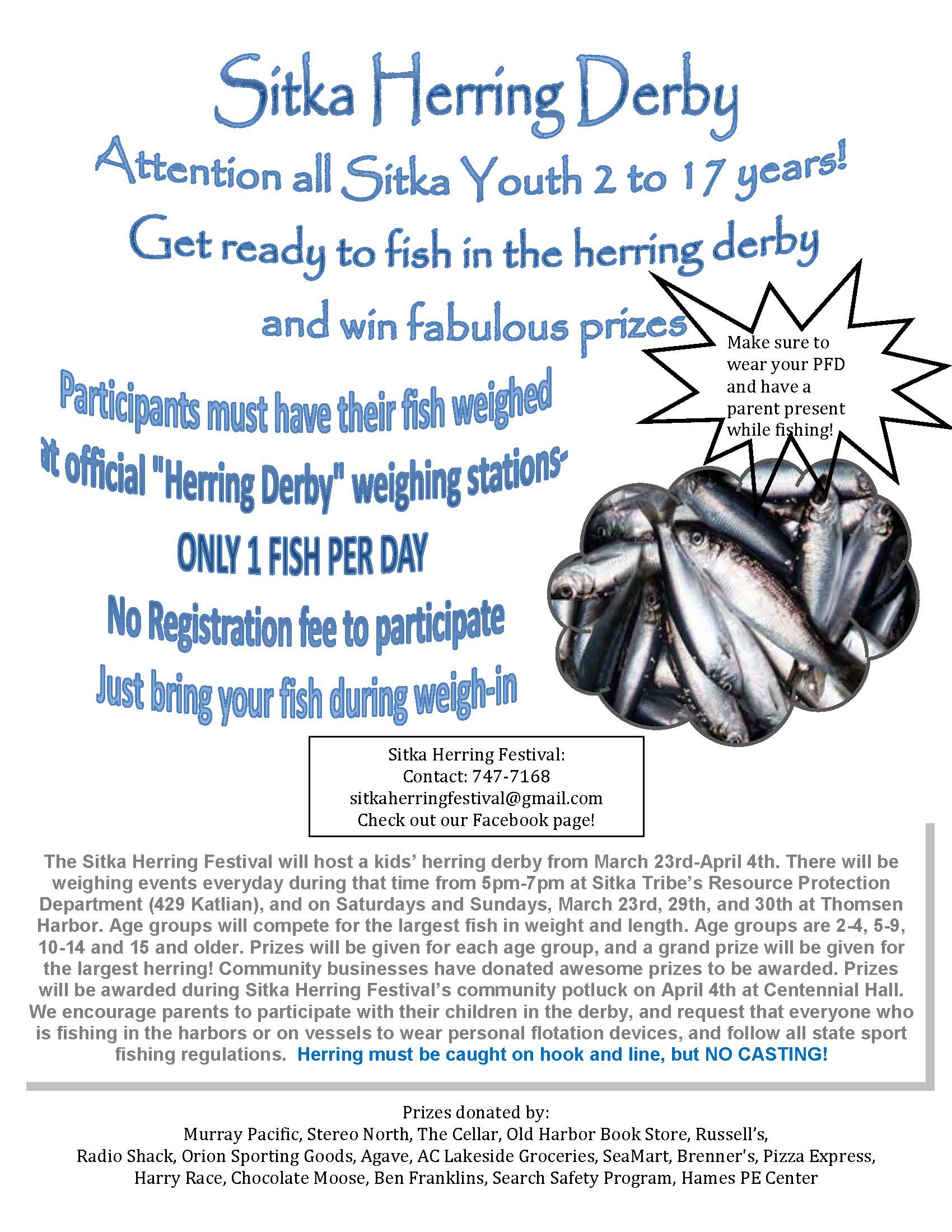
HerringFestDerby Flyer 2014

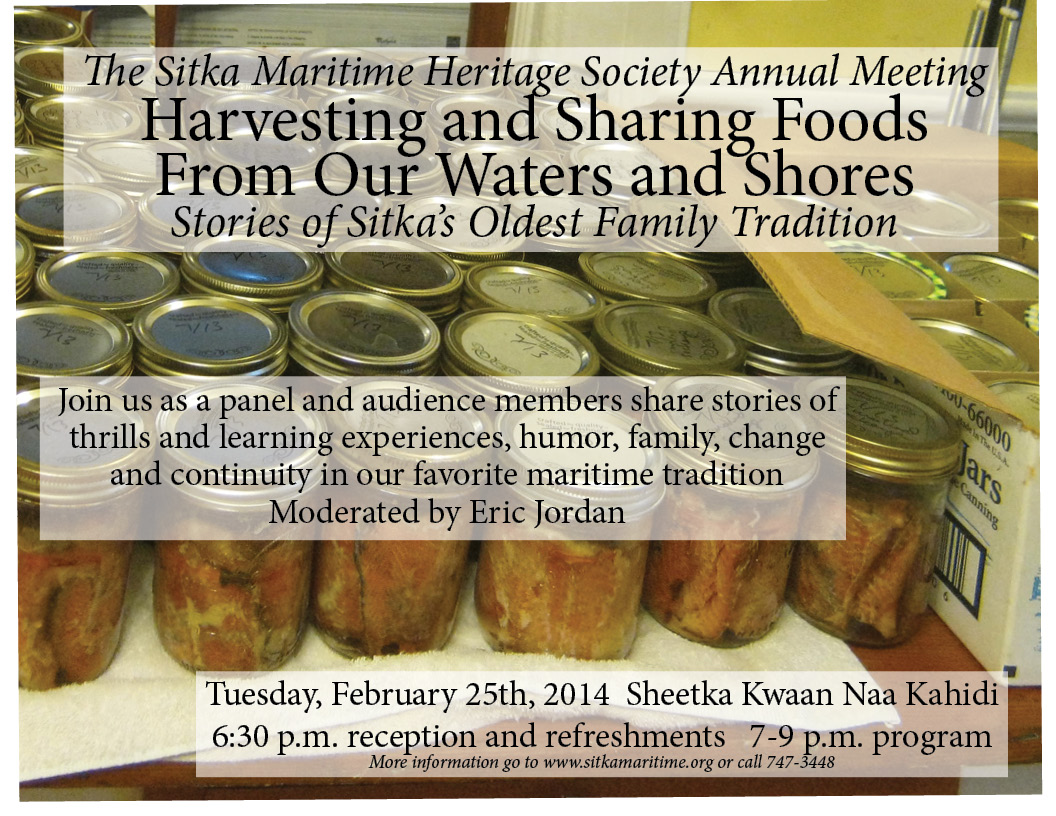
• Sitka Maritime Heritage Society annual meeting features stories of harvesting and sharing foods from our local waters and shores

annual meet 2014 web

Local food will be the focus when the Sitka Maritime Heritage Society holds its annual meeting on Tuesday, Feb. 25, at the Sheet’ká Kwáan Naa Kahídi. The meeting’s program topic is Harvesting and Sharing Foods from our Waters and Shores: Stories of Sitka’s Oldest Family Tradition. There will be mingling and refreshments starting at 6:30 p.m., with the program running from 7-9 p.m.

The meeting’s format, as in past years, is to have a panel of individuals with stories and experiences to share about the topic. In the second half of the program, the floor will be opened up to stories from the audience. The panel host and moderator will be longtime troller Eric Jordan.

According to the Sitka Maritime Heritage Society’s website:

Being able to get our food for our families from the ocean and shores is a big reason for living here. In fact, for many of us, it’s a big reason to live, period: the collective effort with friends and family, teaching and learning, the satisfaction of a productive day on the water (never dull!), the deep contentment of having food put up to feed our children and elders. As in past annual meetings, we are expecting a lot of laughter, and a lot of learning about our fellow Sitkans, this place we live in, family and history. Oh, and cookies.

For more information about the annual meeting, go to the group’s website, send email to sitkamaritime@gmail.com, or contact new executive director Carole Gibb at 747-3448.


• Sitka School District touts more state investment into local foods for school lunch programs

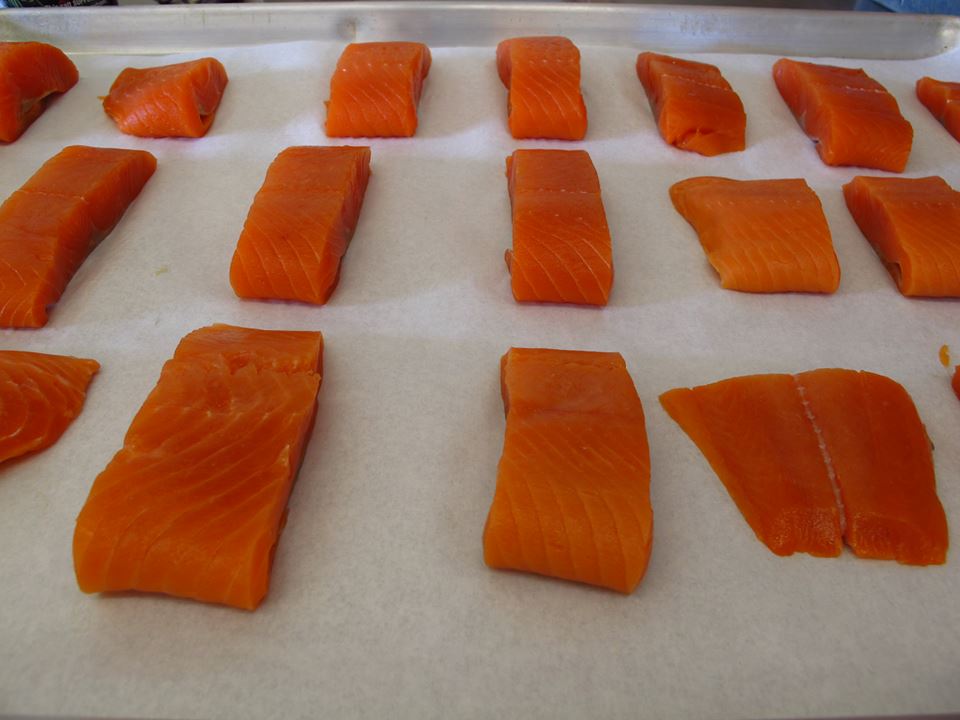
SCSCohoPortionsForCooking

During its Feb. 4 meeting, the Sitka School Board put its weight behind an effort to increase funding for locally sourced food in schools across the state.

In a resolution to the legislature, the board cited the success of Sitka’s Fish to Schools program as justification for extending a similar statewide program beyond one year. Nutritional Alaskan Food for Schools (NAFS) was introduced by Rep. Bill Stoltze (R-Anchorage) in 2012, and piloted last year. This year the governor has included funding of $3 million dollars for the program — but only for one year. All schools in Alaska will receive funding from the program, based on student population. The Sitka School District and state-run Mount Edgecumbe High School received $39,000 from the program last year, which mostly went for seafood purchases (Mount Edgecumbe did buy some potatoes from Gustavus, and Pacific High School bought some vegetables from St. Peter’s Fellowship Farm).

In late January, Tracy Gagnon, who coordinates the Fish to Schools program for the Sitka Conservation Society, submitted the following letter to the editor to the Daily Sitka Sentinel outlining the reasons to support the program.

Nutritional Alaskan Foods for Schools

Dear Editor,

Sitka is one of the first communities in Alaska to push for local foods in schools through the Fish to Schools program; now it’s time to go state-wide. The Governor has included in his FY15 budget state funding to reimburse school districts for their purchases of Alaskan grown or caught foods through the Nutritional Alaskan Foods for Schools program (NAFS). This makes it possible for schools to serve local, nutritious foods to their students, sourcing from farmers, fishermen, and processors in or around their communities. NAFS improves Alaska’s food security and helps us create a more sustainable local food system.

Representative Stoltze proposed NAFS in 2011, and more than 100 vendors and 48 school districts benefited from this legislation in the 2012-2013 school year. Nearly 90 percent of those 48 school districts purchased local seafood.

Every year food producers and school food service providers wait anxiously every spring for NAFS to pass. And usually it’s too late for farmers to meet the extra demand because they’ve already planted their crops and food service has already purchased other foods. Making this funding permanent would provide both food service and food producers the consistency necessary for advanced planning and coordination of harvest to ensure supply meets demand.

The Sitka Conservation Society thanks both the leadership of Representative Stoltze and Governor Parnell for including NAFS in his proposed budget. We urge Alaska Legislators to support the permanent funding of a program that increases Alaska’s food security, catalyzes Alaska’s food production, supports local communities, and improves the health of our students.

Tracy Gagnon
Community Sustainability Organizer
Sitka Conservation Society

• How to weed through the conflicting information about Fukushima radiation and its impacts on Alaska waters

SalmonImage

Alaskans have been worried about their seafood ever since the March 2011 Fukushima earthquake and Japanese nuclear plant problems. It’s understandable that Alaskans are concerned about the safety of the seafood, seaweed and marine mammals in the area. But Alaskans also should note that most of the information posted on social marketing sites just isn’t true.

This NOAA map has been showing up on social media posts with a note that it shows the path of 300 tons of radioactive material entering the ocean each day. This map really shows the probable tsunami paths from the 2011 Tohoku earthquake.

FALSE IMAGE: TSUNAMI WAVES, NOT RADIATION: Many people have posted on social media that this NOAA map shows the path of 300 tons of radioactive material entering the ocean each day. This map really shows the probable tsunami wave heights from the 2011 Tohoku earthquake.

One of the biggest examples of false information usually is accompanied by an official-looking map from the National Oceanic and Atmospheric Administration (NOAA) and a note that each day the map shows 300 tons of radioactive material entering the water each day. The map is an official NOAA map, but it doesn’t show radiation. It actually shows the probable tsunami paths from the 2011 Tohoku earthquake. When in doubt, or even if not, don’t be afraid to consult one of the myth-debunker sites such as Snopes.com, which has the details on the real story behind this map.

The Sitka Local Foods Network has been following the situation since it happened, and we even posted an update in March 2012 in hopes of easing people’s worries (many of the links on this page have been updated). The Alaska Department of Health and Social Services also has a site with updates.

In recent weeks, Rep. Jonathan Kreiss-Tomkins (D-Sitka) did some research, interviewing Dr. Ken Buesseler of the Woods Hole Oceanographic Institution and one of the country’s top researchers on oceanographic radiation. Rep. Kreiss-Tomkins posted his findings in his Jan. 8 constituent newsletter, and that write-up also appeared in several Alaska publications such as the Alaska Dispatch.

010714_Fukushima-Radiation-GraphAlso in January, Alaska Department of Environmental Conservation Commissioner Larry Hartig gave an update to the Alaska Senate’s Natural Resources Committee about what it’s doing to track the radiation, and he said so far the DEC hasn’t seen anything to cause concern. The Ketchikan website Stories In The News also had a follow-up story that included information from Hartic’s testimony and an update from Buesseler, who announced the launch of a new “How Radioactive Is Our Ocean?” website to help crowd-source information about what’s happening along the 5,000-mile Pacific coastline.

Taking things a step further, in January a couple of Seattle media organizations — KPLU and the Seattle Times — ran stories about Seattle fish-broker Loki Fish Co. ran its own tests on Alaska seafood. After the testing, the folks at Loki Fish Co. decided Pacific salmon is safe to eat.

• Former Sitka resident Nic Mink publishes book, ‘Salmon: A Glocal History,’ highlighting salmon in Sitka and the world

NicolaasMinkWithBookOnSalmon

Former Sitka resident Nicolaas “Nic” Mink — now the Urban Sustainable Foods Fellow at Butler University, Indianapolis — recently published the book Salmon: A Global History that highlights salmon in Sitka, Alaska, and the world.

The book is published by Reaktion Books, LTD, as part of The Edible Series, which features books about different types of food from around the world. The small hardback book is 127 pages with 49 illustrations (30 in color), recipes, bibliography, and index. It costs $18 in the United States ($9.99 on Kindle).

Nic used to lead the now-defunct Sitka Salmon Tours, which took visitors on a walking tour around Sitka to show them the different stages of salmon growth and processing, during the two-plus years he lived in Sitka and worked with the Sitka Conservation Society. He said many of the scripts he developed for the tours were incorporated into the book, which isn’t much longer than a traditional academic paper. Now that he lives in Indiana, Nic still has connections to Sitka’s salmon through a company he started called Sitka Salmon Shares, which markets sustainably caught salmon, halibut, sablefish (black cod), and other fish from Sitka and Juneau to residents of the Midwest United States.

While exploring the state of salmon throughout the world, Nic said he centered a lot of the book on Sitka’s salmon because of its place in the history of the fish. In addition to looking at the natural history of salmon eating, the book also examines cured, canned, and fresh salmon, plus the future of edible salmon. He writes about the role of salmon with Alaska Native cultures, how Alaska’s salmon industry was impacted when a British boy died from botulism after eating canned salmon from Ketchikan in the 1980s, the differences between wild Alaska salmon and farmed salmon, and more.

The book’s description, from the book jacket:

The story of salmon takes readers on a culinary journey from the coast of Alaska to the rivers of Scotland, tracing salmon’s history from the earliest known records to the present. He tells the story of how the salmon was transformed from an abundant fish found seasonally along coastal regions to a mass-produced canned food  and a highly prized culinary delight.

Rich in omega-3 fatty acids, cheap, and widely available, salmon is often listed as an essential part of any diet. A delicious and versatile fish, it can be used to make sashimi, cold smoked for lox, or shaped into a fishcake as an alternative to hamburgers. But while salmon is enjoyed all over the globe, it also swims at the center of controversy, with commercial fishing, global warming, and loss of freshwater habitats all threatening salmon populations and the ecological and health impacts of intense salmon farming under fire.

• Sitka Conservation Society to host annual Wild Foods Potluck on Dec. 8 at Sweetland Hall

Wild Foods Potluck no words

WildFoodsPotluckHelp Sitka celebrate its wonderful bounty of local and wild foods by joining the Sitka Conservation Society for its annual Wild Foods Potluck from 5-7:30 p.m. on Sunday, Dec. 8, at Sweetland Hall on the Sheldon Jackson Campus.

This annual event features a variety of wild foods that can be harvested around Sitka, including many varieties of fish, deer, ducks, berries, seaweed, beach greens, and more. This event gives local residents a chance to sample a multitude of wild food dishes for a true taste of Sitka. If you don’t have any wild foods, just garnish your dish with a local plant.

“Bring a dish that features ingredients from the outdoors and meet others interested in subsistence foods and the conservation field,” said the Sitka Conservation Society’s Ray Friedlander, who is helping coordinate the event. “Your dish could win a prize if you enter it into the Best Dish, Best Side, and Best Dessert category.”

This event is non-alcoholic, and it is open to all residents of Sitka, including members and non-members of the Sitka Conservation Society. For more information, contact Ray Friedlander or Mary Wood at the Sitka Conservation Society at 747-7509, or go to http://www.sitkawild.org/.

• Sitka Herring Festival to host benefit dinner on Sunday, Nov. 17

Herring_Fest_Flyer

The inaugural Sitka Herring Festival will host a benefit dinner at 5:30 p.m. on Sunday, Nov. 17, at the Sitka Elks Club.

The Sitka Herring Festival will take place in the spring of 2014, when the herring return to Sitka to spawn. The event is sponsored by the Sitka Tribe of Alaska Resource Protection Department.

“The festival is a collaborative event to promote the importance of Pacific herring on the ecosystem and the culture of Sitka and the North Pacific Ocean,” event coordinator Jessica Gill said. “A few events to note are: kids’ herring derby, herring dip, fish printing, an educational unit in the schools, and a community potluck scheduled for April 4th.  I am currently working on bringing in a scientist from Oxford to give a talk on herring for the potluck, but that will be dependent of funding.”

To learn more, please contact Jessica Gill at 747-7168 or by email at sitkaherringfestival@gmail.com. In addition to the event’s new website (still under construction), there is a Facebook page.
• Alaskans Own to host fish sale on Monday, Nov. 4, in Sitka

AO_LogoDo you need to stock up your freezer with locally caught fish for the winter? Alaskans Own Seafood of Sitka will host a fish sale from 3-6 p.m. on Monday, Nov. 4, at the Mill Building (next to the Sitka Sound Science Center).

The sale will feature several types of frozen fish commonly sold at the Alaskans Own Seafood booth at the Sitka Farmers Market or found in the monthly community-supported fisheries subscription boxes — king (chinook) salmon, silver (coho) salmon, halibut, and rockfish. In addition, spot prawns will be available at this sale.

To learn more, contact Erin Fulton at 747-3477 or email her at efulton@thealaskatrust.org.

• Fish to Schools serves up a coho lunch Wednesday to start off the school year

SCSCohoPortionsForCooking

Fish to Schools Flyer_2013-2014The Fish to Schools program kicked off its 2013-14 school year with a coho salmon lunch (baked with salt and pepper) on Wednesday, Sept. 11, at Sitka High School, Blatchley Middle School and Keet Gooshi Heen Elementary School.

The Fish to Schools program is a project that came out of the 2010 Sitka Health Summit, and now is coordinated by the Sitka Conservation Society. Local commercial fishermen have been donating fish to the program this summer, helping sustain the program through the school year.

The fish lunches are served at Sitka High School, Blatchley Middle School and Keet Gooshi Heen Elementary School on the second and fourth Wednesdays of the month. The students at Pacific High School (Sitka’s alternative high school where the students do the cooking) and Mount Edgecumbe High School also have Fish to Schools, but they are served on a different schedule at those schools. A schedule for upcoming Fish to Schools lunches is posted to the right.

For more information about the Fish To Schools program, contact Tracy Gagnon at the Sitka Conservation Society at 747-7509 or tracy@sitkawild.org. Also, the Stream to Plate program, a companion program of Fish to Schools, recently was featured on Delish.com in a feature about “Cool Cafeterias: The New Wave of School Lunch.”

• Sitka’s ‘Fish To Schools’ program puts out call to commercial fishermen for donations

Fishermen_Donation_Updated Aug2013

The Fish To Schools program in Sitka has put out the call looking for donations of commercially caught fish for the upcoming school year. Donations are being accepted from Aug. 18-25 at Sitka Sound Seafoods and Seafood Producers Cooperative. (NOTE, the time period for donations has been extended. Please call the numbers below to see if more fish still is needed.)

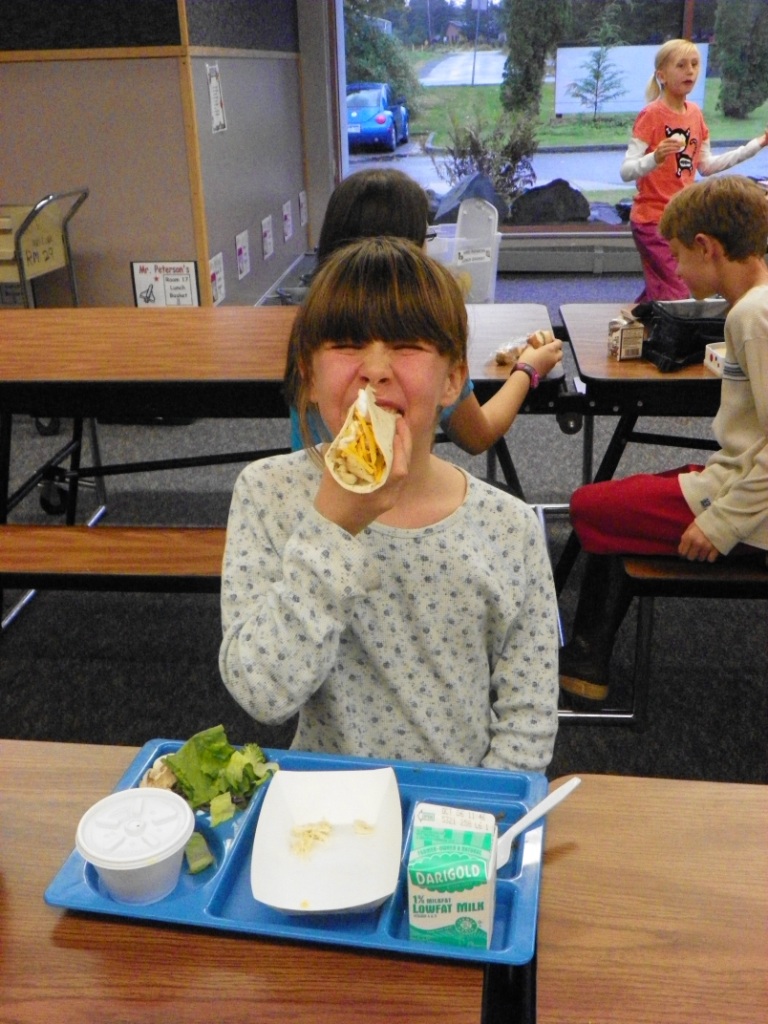
SCS-031_smFishToSchoolsTacoThe Sitka Fish To Schools project (click here to see short video) got its start as a community wellness project at the 2010 Sitka Health Summit, and now is managed by the Sitka Conservation Society. It started by providing a monthly fish dish as part of the school lunch as Blatchley Middle School, and since then has grown to feature regular fish dishes as part of the lunch programs at Keet Gooshi Heen Elementary School, Blatchley Middle School, Sitka High School, Pacific High School (where the alternative high school students cook the meals themselves) and Mount Edgecumbe High School.

In addition to serving locally caught fish meals as part of the school lunch program, the Fish To Schools program also brings local fishermen, fisheries biologists and chefs to the classroom to teach the kids about the importance of locally caught fish in Sitka. The program received an innovation award from the Alaska Farm To Schools program during a community celebration dinner in May 2012, and now serves as a model for other school districts from coastal fishing communities.

Due to state regulations, the Sitka Fish To Schools program can only accept donations of fish that have been commercially caught, and it cannot accept fish from sport or subsistence fishermen. The donation period is timed with the coho salmon season, and fishermen can get more information or pledge a donation by contacting Beth Short-Rhodes at 738-9942 or elianise@yahoo.com.

For more information about the Fish To Schools program, contact Tracy Gagnon at the Sitka Conservation Society at 747-7509 or tracy@sitkawild.org.