• UAF Cooperative Extension Service offers Certified Food Protection Manager class by videoconference in Sitka

CFPM flyer 1-15-14

Friday, Dec. 20, is the registration deadline for a certified food protection manager workshop being taught on Wednesday, Jan. 15, by University of Alaska Fairbanks Cooperative Extension Service. This is an all-day statewide class that will be offered live in Fairbanks and Palmer, and by videoconferencing to Sitka and Kotzebue.

A certified food protection manager (CFPM) is responsible for monitoring and managing all food establishment operations to ensure that the facility is operating in compliance with food establishment regulations.

A CFPM is knowledgeable about food safety practices and uses this knowledge to provide consumers with safe food, protect public health and prevent food-borne illnesses. Alaska regulations require food establishments to have at least one CFPM on staff.

This course takes place from 9 a.m. to 5 p.m. (with a half-hour lunch), and participants will take a computer-based exam at the end of the class. The reason the deadline is two weeks before the class is to guarantee course materials reach all the students in time for the class. The cost is $175, and the course will be taught by Kate Idzorek of Fairbanks and Julie Cascio of Palmer. Students can register here.

The Sitka videoconference for the class will take place in Room 110 at the University of Alaska Southeast Sitka Campus. To learn more, contact the Sitka District Office of the UAF Cooperative Extension Service at 747-9440, or contact Kate Idzorek at 907-474-5391 (toll-free, 1-877-520-5211) or kjidzorek@alaska.edu in Fairbanks.

• Wilcox family prepares to run across country to raise awareness about Monsanto

Fund Run

DavidWilcoxSpeaksAtMayMarchAgainstMonsantoRallyA Sitka family is gearing up for a cross-country run in January to raise awareness about genetically modified organisms (GMOs) in food and the dubious practices of agriculture giant Monsanto.

David Wilcox, 15, and his father, Brett, will begin their 3,000-mile from Huntington Beach, Calif., to Cape May, N.J.,  with stops in St. Louis (home of Monsanto) and Washington, D.C. David and Brett will receive support from mom, Kris, and sister, Olivia. The current Southeast Conference-Class 3A high school cross-country running champion from Sitka High School, David is hoping to become the second-youngest runner to complete a run across the United States (he recently found out there was a younger runner who did a similar run back in 1928). The family hosted March Against Monsanto events in Sitka in May and October as part of an international movement against the company’s practices.

“Running across the USA! Wow! David and I are growing more and more excited to pound pavement, run trails, meet people, and advocate with millions of like-minded Americans for a GMO free USA!” Brett Wilcox said.

Even though the run won’t start until January, the Wilcox family has several activities planned for December to help publicize and raise funds for the project. Brett recently self-published a book, We’re Monsanto: Feeding the World, Lie After Lie, Book One. Brett and the rest of the Wilcox family will be at Old Harbor Books for a book-signing from 2-4 p.m. on Saturday, Dec. 7, and he will give a reading and book-signing at 5 p.m. on Sunday, Dec. 15, at Kettleson Memorial Library.

BrettWilcoxWithBookIn addition, from 9 a.m. to 3 p.m. on Saturday, Dec. 14, David will run 100 laps of the Moller Park track as a fundraiser for the trip. People can pledge per lap, or pledge lump sums at this event. Other runners are encouraged to join in the fun by running in Sitka or wherever they are and recording their laps. Also at 7 p.m. on Saturday, Dec. 14, the Wilcox family will have a table at the Elvis Monthly Grind at the Sheet’ká Kwáan Naa Kahídi.

“The topic of genetic modification can be heavy and confusing–confusing primarily because Monsanto and other chemical giants don’t want us to know about the problems associated with modern chemical-based agriculture,” Brett Wilcox said. “We’re Monsanto: Feeding the World, Lie After Lie is a fun, fast and creative approach designed to cast light on Monsanto’s products, poisons and lies. I wrote We’re Monsanto to give mainstream Americans the power to say no to Monsanto’s GMOs, say no to agricultural imperialism, and to say no to Monsanto’s lies. Once we understand that Earth’s natural biodiversity and agroecology are the true solutions to feeding a hungry world, we free ourselves from Monsanto’s poison-saturated false promises.”

To learn more about the run, you can read this Dec. 2, 2013, article from the Daily Sitka Sentinel or go to the Wilcox family website, Running The Country. The family also has created a crowd-funding campaign on Indiegogo.com, Running for a GMO-Free USA, where it hopes to raise money to help pay for the trip. In addition, Brett moderates a Facebook group, March Against Monsanto SE Alaska, and a group page about the run called, Running The Country.

• Sitka Food Co-op to host all-day planning workshop on Saturday, Nov. 23

SitkaFoodCoopPlanningEvent

Are you interested in helping the Sitka Food Co-op develop its short- and long-term plans? Then come join us in an all-day planning workshop from 9 a.m. to 3:30 p.m. on Saturday, Nov. 23, at the Fireside Room at the First Presbyterian Church, 505 Sawmill Creek Rd.

This workshop will be facilitated by Lisa Sadleir-Hart, board president of the Sitka Local Foods Network and project coordinator of the Sitka Community Food Assessment. Workshop participants will create an action plan for the co-op’s next five years, as well as developing the co-op’s vision and priorities.

Sitka Food Co-op Board Chair Keith Nyitray said, “Topics to be covered include whether we need a paid “general manager” position, whether and/or when to conduct a feasibility study about opening a retail store-front, starting home-deliveries, submitting paperwork to accept WIC, whether to switch incorporation to a non-profit status or not, moving toward establishing a two-tiered membership system, bulk buying and/or member equity sharing, and more.”

According to the Co-op’s website, the purposes of the Sitka Food Co-op are to:

  1. Create a community-based, member-owned buying service;
  2. Make available wholesome natural and organic foods and products as inexpensively as possible;
  3. Support and encourage local growing of fresh organic foods;
  4. Purchase and purvey, whenever feasible, the goods or services of local and regional growers and producers; and
  5. Serve as a center for activities and services which otherwise enrich the life of the community.

This workshop is open to everyone, including non-members, but please RSVP by Nov. 21 at sitkafoodcoop@gmail.com. There will be a potluck lunch, so please bring a dish to share. To learn more about the Sitka Food Co-op, go to http://sitkafoodcoop.org/.

• Sitka Food Hub project to focus on a community commercial kitchen and emergency food storage

Summit_Logo

The Sitka Food Hub project working group from the 2013 Sitka Health Summit now has refined its focus based on a survey of group interests.

The project will continue to focus on community food security through food education and a commercial kitchen facility. A  second sub-group is devoted to increasing local capacity to develop a food storage system for emergency preparedness. These groups will meet individually to begin planning. The groups will also re-convene in December to report back to one another and push the project forward. Ultimately the two projects will be combined as the project grows.

The two sub-groups will meet next week — the community kitchen group at 6:30 p.m. on Tuesday,  Nov. 19, and the food storage group at noon on Wednesday, Nov. 20, both at Harrigan Centennial Hall. The two sub-groups were created to help tighten the focus of the main project and make it easier to improve Sitka’s food security

The shared-use community kitchen will be a place where families and individuals may take classes, rent space to preserve and can their own food, and small-scale local food producers can rent it to create their own value-added food products. The other group will focus on increasing food storage options, since our local hunger groups need more storage in order to expand and Sitka residents expressed community and individual food storage concerns when it came to disaster planning.

The two groups will reconvene for a meeting of the big group at 6:30 p.m. on Wednesday, Dec. 18, at Harrigan Centennial Hall. To learn more about the Sitka Food Hub and to get onto the group’s email list, contact Marjorie Hennessy at 747-7509 (days) or marjorie@sitkawild.org.

• Sitka Food Hub project working group to meet on Tuesday, Nov. 12

Summit_LogoThe working group for the Sitka Food Hub project from the 2013 Sitka Health Summit will meet from 6-7:30 p.m. on Tuesday, Nov. 12, at Harrigan Centennial Hall.

This is the third meeting of the group, which formed during the Sitka Health Summit in late September as one of the summit’s two community wellness projects for the upcoming year. While the group’s ultimate mission, vision and goals still are being refined, community members at the Sitka Health Summit said they wanted the Sitka Food Hub to serve multiple functions — to be a place to help feed Sitka’s hungry while also serving as an emergency food supply for the community and also to provide education about how people can build their own personal pantries.

For this meeting we will continue on the work we started in our last meeting, which includes refining our mission, vision and goals so we can move forward with this project.

To learn more about the Sitka Food Hub and to get onto the group’s email list, contact Marjorie Hennessy at 747-7509 (days) or marjorie@sitkawild.org.

• Sitka Community Food Assessment findings to be presented Nov. 14 at inaugural Sitka Food Summit

Sitka Food Summit Flyer

SitkaCommunityFoodAssessmentLogoThe Sitka Community Food Assessment work group will present its findings during the inaugural Sitka Food Summit, from 6-9 p.m. on Thursday, Nov. 14, at Harrigan Centennial Hall.

A 2012 Sitka Health Summit project, the Sitka Community Food Assessment has examined where Sitka residents get their food, what types they eat, what they grow, what they hunt and fish for, where they shop, what type of access people have to healthy food, and other questions about Sitka’s food supply. The findings of the food assessment will help Sitka improve its food security.

“The Sitka Community Food Assessment work group decided early on that there needed to be an opportunity for Sitka to engage with the food data and shape the writing of the food assessment indicator report,” project coordinator Lisa Sadleir-Hart said. “The inaugural Sitka Food Summit will use a format that was first tested in the late 1990s when the Island Institute was developing Sitka’s initial indicator report.  We’ll interact individually with the data, then use a conversation café model to discuss what the data brings up for us as Sitkans.  The working group wanted to create a venue that meets the needs of a wide range of citizens.”

The event sponsors include the Sitka Community Food Assessment Work Group from the Sitka Health Summit, Alaskans Own Seafood, the Sitka Food Co-op, Sitka Community Hospital, the SouthEast Alaska Regional Health Consortium (SEARHC) Community Transformation Grant and Diabetes Prevention programs, the Sitka Local Foods Network, the Southeast Soil and Water Conservation District, and Sitka Tribe of Alaska. There also will be refreshments thanks to Sitka Community Hospital’s Basement Bistro, St Peter’s Fellowship Farm and Sitka Conservation Society staff.

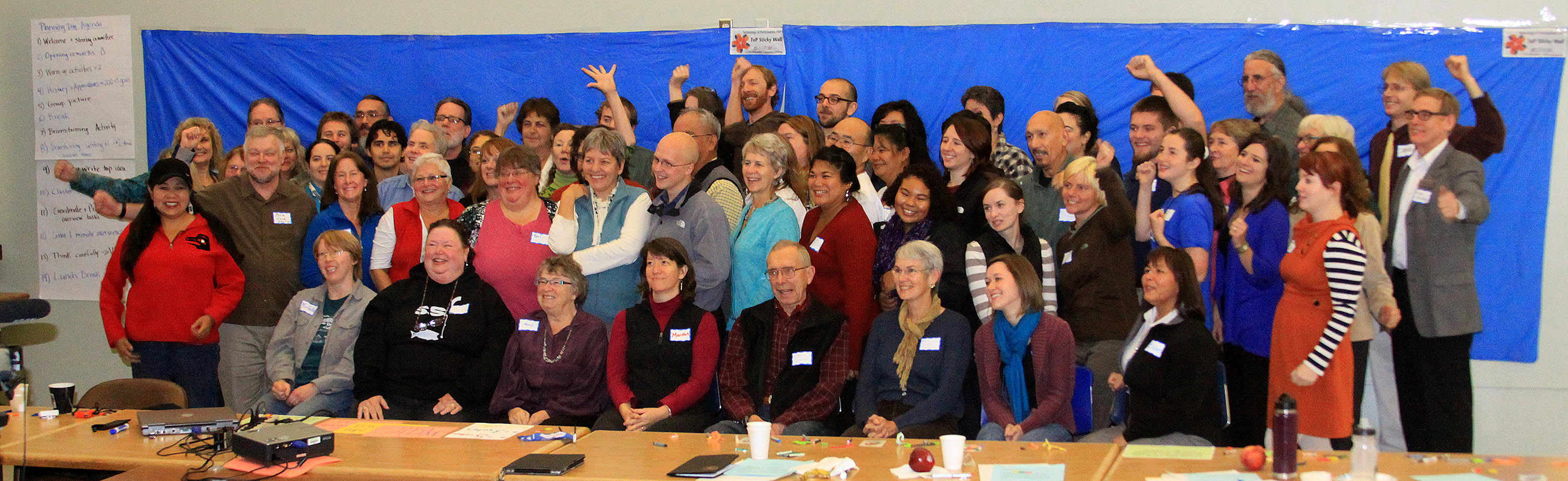
For more information, contact Lisa Sadleir-Hart at 747-5895 or sitkafoodassessment@gmail.com. (Editor’s note: A few photos from the Sitka Food Summit are posted below.)

This slideshow requires JavaScript.

• Alaska Food Resource Working Group to hold inaugural meeting Nov. 4 in Anchorage

(The following is a press release from the Alaska Food Policy Council. Sitka Local Foods Network Board President Lisa Sadleir-Hart is a member of the Alaska Food Policy Council’s governing board.)

Alaska Food Resource Working Group to hold inaugural meeting in Anchorage

Statewide call-to-action on food resource development
AlaskaFoodPolicyCouncilLogoANCHORAGE, Alaska (Oct. 31) – Alaskans spend approximately $2.5 billion dollars on food each year, but only an estimated 5 percent of the food Alaskans buy is produced locally. The Alaska Food Resource Working Group (AFRWG) is tasked with changing that statistic and building a strong, resilient statewide food economy. The AFRWG will hold its inaugural meeting from 10 a.m. until noon on Monday, Nov. 4, in Room 602 of the Robert B. Atwood Building, located at 550 West 7th Avenue in Anchorage.

On June 28, 2013, Gov. Sean Parnell signed legislation calling for the creation of the Alaska Food Resource Working Group (AFRWG) under Administrative Order 265, with the goal of building Alaska’s food economy. As a response to House Concurrent Resolution 1, sponsored by Rep. Bill Stoltze, the Governor signed the administrative order to establish a state agency work group focused on recommending policies and measures to increase the purchase and consumption of local wild seafood and farm products.

The AFRWG will be composed of eight (8) state agency commissioners or designees responsible for the development, oversight, and marketing of locally grown and harvested foods. Increasing collaboration between state and local agencies, the University of Alaska, federal agencies, regional corporations, nonprofit organizations, and the Alaska Food Policy Council (AFPC). Danny Consenstein, Alaska Food Policy Council Governing Board Member, will serve as a representative on behalf of the AFPC.

“[AO 265] recognizes the importance to all Alaskans of developing a secure food system that can provide jobs, support healthy communities, and increase food security to feed the hungry and insulate us from potential disruptions along the food supply chain,” said Lisa Sadleir-Hart (Sitka), Governing Board Member of the Alaska Food Policy Council.

The Alaska Food Policy Council (AFPC) is an independent statewide organization with the vision of a healthy, secure food system that feeds all Alaskans. Over 150 representatives from federal and state agencies, tribal entities, university programs, farmers, fisheries, food systems businesses, and health and hunger agencies serve on the AFPC to determine food policy opportunities to ensure a healthy, self-reliant, and prosperous Alaskan food system. A member of the AFPC Governing Board will serve on the AFRWG to represent the broader group of stakeholders on the Alaska Food Policy Council.

“The Alaska Food Policy Council really believes that the group created by this resolution will ultimately help to both bring Alaska’s rich food resources to market and address issues of access to healthy, nutritious, adequate supplies of food for all Alaskans,” declared Mary Sullivan of the Food Bank of Alaska and Alaska Food Policy Council Legislative Workgroup Chair.

By instituting programs and adopting regulations supporting a vibrant food economy in Alaska, the Alaska State Legislature and the Governor are facilitating momentous steps toward a food secure state. HCR1 and Administrative Order 265 demonstrate the commitment of Alaska’s government to the health, safety, welfare, and overall economic and social well-being of Alaska residents.

###

The Alaska Food Policy Council is an independent, statewide organization with a vision for a food secure, healthy Alaska. For more information about the Alaska Food Policy Council, please contact Danny Consenstein by phone at (907) 761-7738 or by email at daniel.consenstein@ak.usda.gov.


• Sitka Food Hub project working group to meet on Monday, Oct. 28

Summit_LogoThe working group for the Sitka Food Hub project from the 2013 Sitka Health Summit will meet from 6-7:30 p.m. on Monday, Oct. 28, at Harrigan Centennial Hall.

This is the second meeting of the group, which formed during the Sitka Health Summit in late September as one of the summit’s two community wellness projects for the upcoming year. While the group’s ultimate mission, vision and goals still are being refined, community members at the Sitka Health Summit said they wanted the Sitka Food Hub to serve multiple functions — to be a place to help feed Sitka’s hungry while also serving as an emergency food supply for the community and also to provide education about how people can build their own personal pantries.

For this meeting we will be joined Lauren Havens, who has graciously offered to help facilitate the meeting. Topping our agenda will be hearing reports from volunteers who have been researching other food-based or food-related groups in the area , state and around the nation. The group will be discussing a few things, including some pertinent definitions and finally a heavy focus on refining our mission, vision and goals so we can move forward with this exciting project. We also may discuss a project name change to better match definitions used by major food policy groups. We hope we will see you there.

To learn more about the Sitka Food Hub and to get onto the group’s email list, contact Marjorie Hennessy at 747-7509 (days) or marjorie@sitkawild.org.

• Sitka Food Hub chosen as one of Sitka Health Summit’s two new community wellness projects for 2013-14

SitkaHealthSummitPlanningDayGroup

Summit_LogoWhen the Sitka Health Summit met on Friday at Sweetland Hall to choose its new community wellness projects for the next year, Sitka residents chose creating a Sitka Food Hub as one of the priority projects.

The Sitka Food Hub has multiple purposes. It will serve as a local community food bank, and provide emergency food storage for Sitka. In addition, it will be a program that can help teach food storage and canning skills so residents can fill their own pantries.

Some of the reasons members gave for creating a Sitka Food Hub included eliminating hunger in Sitka, providing canning and food education, providing a community food storage on high ground, helping Sitka prepare for emergencies and have community resiliency, increasing Sitka’s food security, and more.

The goal of the Sitka Food Hub is to work together as a community to make sure everyone in Sitka has access to healthy food daily and for any emergencies. The project will receive $1,500 as seed money and facilitation help from the Sitka Health Summit. The Sitka Health Summit’s other community wellness project this year is to create a task force to prevent the use of meth in Sitka.

The first meeting of the Sitka Food Hub group will be from 6:30-8 p.m. on Thursday, Oct. 3, at Harrigan Centennial Hall. All community members are invited, especially if they are connected to local schools, emergency planning organizations, food organizations, clergy, government agencies, health programs, and others who deal in hunger and food security issues. If you can’t attend, but might be able to provide us with resources and partnership opportunities, please contact us.

To learn more about the Sitka Food Hub and to get onto the group’s email list, contact Marjorie Hennessy at 747-7509 (days) or marjorie@sitkawild.org.

The re

• A 2010 Sitka Health Summit project starts to bear fruit

RedApplesKCAW

GreenApplesKCAWOne of the 2010 Sitka Health Summit community wellness projects was to plant a bunch of apple, crabapple and cherry trees around town as a way to provide fresh fruit for people as they wander about Sitka.

When we planted the trees, we knew it would take a couple of years before we started seeing any fruit. Several of the trees were planted on public land, with several Sitka residents also buying the saplings to plant at their homes and offices.

On Tuesday, Sept. 10, a couple of the trees planted in front of the historic Cable House (home of the KCAW-Raven Radio station and the Larkspur Café) were full of apples, even though a couple of weeks earlier it didn’t appear these smaller trees had any fruit.  It’s nice to see some of the trees are producing.