
• Kayaaní Commission accepting letters of interest for commissioners.

Devils-Club__SE-Alaska1

Sitka Tribe of Alaska‘s Kayaaní Commission is accepting letters of interest to fill two open commissioner seats — a three-year term tribal citizen seat, and a one-year term general membership seat.

The Kayaaní Commission works to preserve and protect plants and the traditional ways they are used. It is a commission of knowledgeable tribal citizens, elders and knowledgeable Sitka residents who care for the preservation of traditional ways, protection of native species and their uses. The commission then shares that knowledge so it is not lost. A few years ago, the Kayaaní Commission published The Kayaaní Commission Ethnobotany Field Guide to Selective Plants in Sitka, Alaska, which details some of the food and medicinal uses of a variety of local plants.

For the open commission seats, the term “tribal citizen” shall mean any individual enrolled at the Sitka Tribe of Alaska, and the term “general membership” of the Kayaani Commission shall mean all tribal citizens and residents of Sitka who have resided here for at least six months. Deadline is close of business on Friday, March 28.

Please mail or hand deliver letters of interest to the STA’s Resource Protection Department, 456 Katlian Street, Sitka, AK 99835, Attention: Heather Riggs, or email letters to heather.riggs@sitkatribe-nsn.gov. For more information, please contact Heather @ 747-7167.

• Celebrate Fish to State takes place on March 20 to support statewide Fish to Schools program

celebrate fish to state

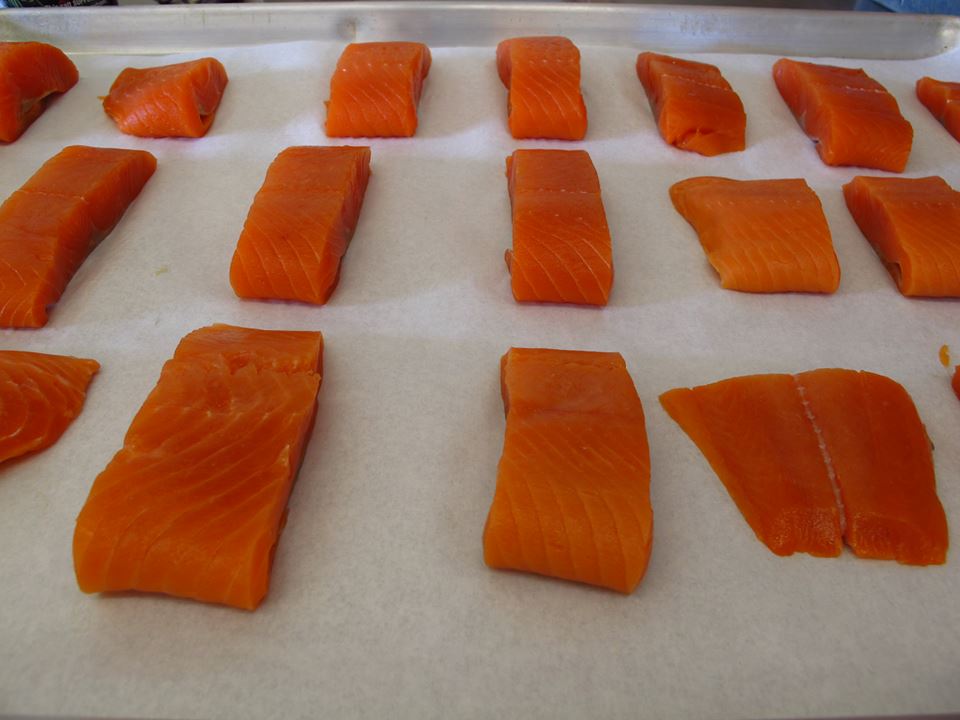
SCSCohoPortionsForCookingSitka’s Fish to Schools program has been extremely successful the past three years, and now there’s a movement to make similar programs available statewide. Join us from 6:30-7:30 p.m. on Thursday, March 20, at Blatchley Middle School as we celebrate Fish to State.

This event will celebrate the success of the Sitka Fish to Schools program, which is coordinated by the Sitka Conservation Society and other partners. The event will include short presentations from Sitka School Board President Lon Garrison, Sitka Local Foods Network President Lisa Sadleir-Hart, and Sitka Conservation Society Community Sustainability Organizer Tracy Gagnon. Light refreshments will be available.

The Sitka Fish to Schools program came out of the 2010 Sitka Health Summit, when local residents chose as one of its community wellness projects to serve more local seafood in our schools. Since then the program has grown so that all students from Grades 2-12 in Sitka have a local seafood lunch option at least twice a month. This includes the Sitka School District schools, Keet Gooshi Heen Elementary School, Blatchley Middle School, Sitka High School, and Pacific High School, plus other local schools, the state-run boarding school Mount Edgecumbe High School and the private K-8 The SEER School. The award-winning program has served as a model for a handful of other school districts in Alaska, and now there is a push to make it available statewide with a full curriculum and resource guide, plus financial support.

For more information, contact Ray Friedlander of the Sitka Conservation Society at 747-7509 or ray@sitkawild.org.


• Sitka Sound Science Center presentation will shed light on impacts of Fukushima radiation in the Pacific Ocean

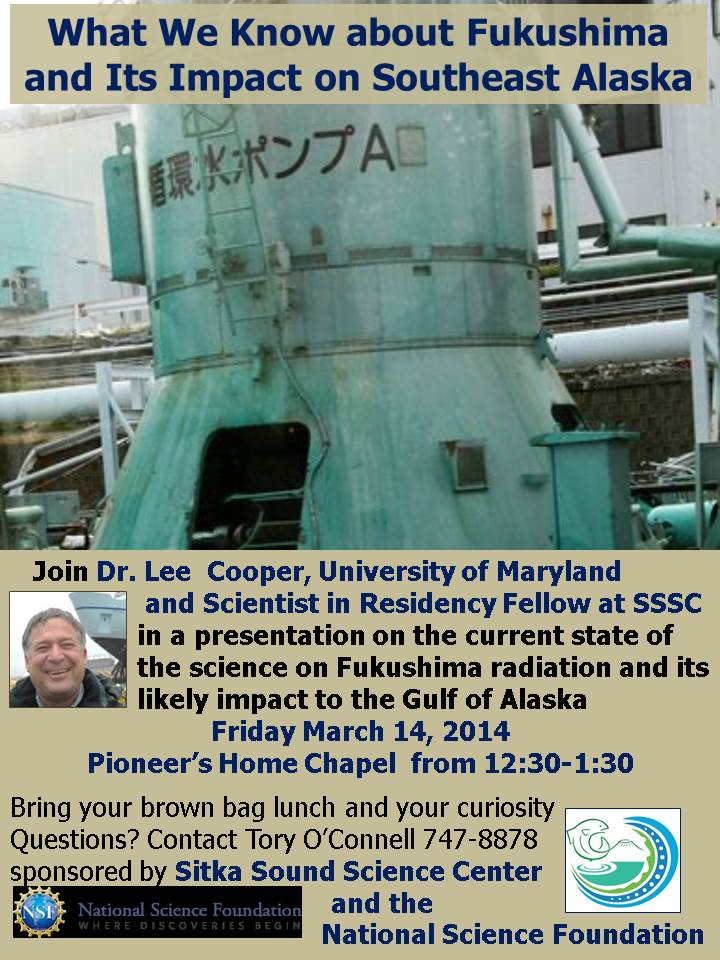
cooperFukushima

People living along the Pacific Coast, including in Sitka and Southeast Alaska, have been wondering about the impacts of radiation in the food supply ever since the March 2011 earthquake in Japan and Fukushima Dai-ichi nuclear power plant meltdown.

Dr. Lee Cooper of the University of Maryland, a Scientist in Residency Fellow at the Sitka Sound Science Center, will discuss the current state of the science on Fukushima radiation and its likely impact on the Gulf of Alaska during a brown-bag lunch presentation from 12:30-1:30 p.m. on Friday, March 14, at the Sitka Pioneer Home Chapel. Bring your lunch and questions to the presentation, which is sponsored by the Sitka Sound Science Center and the National Science Foundation.

According to the Sitka Sound Science Center:

It is projected that dissolved contaminants, particularly the radioactive isotopes of cesium, 137Cs and 134Cs from the Fukushima Dai-ichi Nuclear Power in Japan, will reach Southeast Alaska this year.  Because the amount of radiation released is uncertain and the accident site is still leaking to some extent, it is difficult to know exactly what the peak concentrations of radioactive cesium will be in local waters, but it is not likely to exceed levels that were observed during the bomb fallout era 40 to 50 years ago. Cesium is chemically very similar to potassium, which is a common ionic salt in seawater, so fortunately the concentration of cesium into the foodweb and into seafood harvested for food is comparatively modest.

Nevertheless, it is important to put into perspective the potential risks involved and communicate this to the public. This talk will summarize the newest scientific information that is available on the impacts of the accident, based upon a special session held in late February at the Ocean Science Meeting in Honolulu and attended by scientists studying Fukushima impacts, ranging from Japan and East Asia to the Woods Hole Oceanographic Institution.

For more information, contact Tory O’Connell at 747-8878.


• Support the Sitka Local Foods Network and possibly double your dividend

PickClickGiveFlier3DYDPRINT

PCG023 StickerMany Alaskans donate to their favorite nonprofit groups, including the Sitka Local Foods Network, through the Pick.Click.Give. program that’s part of the Alaska Permanent Fund Dividend application. Now 10 lucky Alaskans who donate through Pick.Click.Give. program have a chance to win through the Double Your Dividend Sweepstakes, announced on Tuesday, March 4.

Here’s how the Double Your Dividend Sweepstakes works. Those Alaskans who choose to make a Pick.Click.Give. donation to one of the more than 500 qualifying 501(c)(3) Alaska nonprofit organizations (22 from Sitka, including the Sitka Local Foods Network) when they file their PFD application will be entered into the sweepstakes. All non-anonymous donations made before the PFD application due date of March 31 will count for the sweepstakes. On Sept. 15, the names of 10 lucky Alaskans will be drawn and the winners will be announced on Oct. 1. The complete rules can be found here, http://www.pickclickgive.org/index.cfm/double-your-dividend/.

One of the reasons for the sweepstakes is a technical glitch in January that prevented a lot of Alaskans from being able to make Pick.Click.Give. donations when they filed their PFD applications. The sweepstakes is an incentive to get those Alaskans who didn’t make Pick.Click.Give. donations to go back into their PFD applications and add some. The 2014 PFDs should be much bigger than the PFDs from the last couple of years, which makes this a great time to share the wealth with nonprofit organizations in your communities.

Lovalaska FB Square PhotoGrid Tag (1)This is the first year the Sitka Local Foods Network is participating in the Pick.Click.Give. program, which allows people to donate in $25 increments to their favorite statewide and local nonprofit organizations. When you choose to donate part of your PFD to the Sitka Local Foods Network, you support the Sitka Farmers Market, St. Peter’s Fellowship Farm, Blatchley Community Gardens, education programs about growing and preserving food, the sustainable use of traditional foods, the Sitka Community Food Assessment, the Sitka Food Summit, and a variety of other projects designed to increase access to healthy local foods in Sitka.

The Pick.Click.Give. program only is available to people who file their PFD applications online, and not to those who file by mail. Even though you can’t file a new PFD application after March 31, you can go into your application and update your Pick.Click.Give. donations through Aug. 31 (but you won’t be entered into the sweepstakes unless you’d made a donation before March 31).

If you aren’t from Alaska or aren’t eligible for a 2014 PFD, you still can donate to the Sitka Local Foods Network. To donate, send your check to the Sitka Local Foods Network, 408 Marine St., Suite D, Sitka, Alaska, 99835. Our EIN is 26-4629930. Please let us know if you need a receipt for tax purposes. For more information about donating, you can send an email to sitkalocalfoodsnetwork@gmail.com.

https://www.youtube.com/watch?v=rF3av66fXE8

• Sitka Tribe of Alaska to host inaugural Sitka Herring Festival on March 17 to April 12

Herring_Fest_Flyer

HerringBranchesThe inaugural Sitka Herring Festival will feature a variety of events from March 17 through April 12, when the herring return to Sitka to spawn. The event is sponsored by the Sitka Tribe of Alaska Resource Protection Department.

“The festival is a collaborative event to promote the importance of Pacific herring on the ecosystem and the culture of Sitka and the North Pacific Ocean,” event coordinator Jessica Gill said. “A few events to note are: kids’ herring derby, herring dip, fish printing, an educational unit in the schools, and a community potluck scheduled for April 4th. I am currently working on bringing in a scientist from Oxford to give a talk on herring for the potluck, but that will be dependent of funding.”

HerringFestSchedule of Events2Among the scheduled events include a blessing of herring rock on a day TBA, the Yaa Khusgé Yaaw Woogoo herring camp for middle school students from March 17-21 at Sitka National Historical Park, a herring fishing derby for kids ages 2-17 from March 23-April 4, a herring class for the Alaska Way of Life 4-H club on March 28, a herring splash swimming event on March 29, a community potluck dinner on April 4, the herring community school fun run on April 5, and a Discovery Days event on April 12 at the Sitka Sound Science Center.

To learn more, please contact Jessica Gill at 747-7168 or by email at sitkaherringfestival@gmail.com. In addition to the event’s new website, there is a Facebook page.

HerringFestDerby Flyer 2014

• Southeast Conference and partners release regional food system assessment

FoodAssess_3.0_email (1)_Page_01

The Southeast Conference and its partners recently released the “Southeast Alaska Food System Assessment: A pilot project to identify actions to promote self-sustaining communities and a resilient food system.”

The 32-page document is the result of a four-month research project supported by the Tongass People and Place Program (coordinated by the Southeast Alaska Watershed Coalition), Southeast Conference, Sheinberg Associates, and the University of Alaska Fairbanks Cooperative Extension Service. The report examines local food systems throughout the region to see what challenges exist and how they can be solved so Southeast Alaska communities are more food secure and sustainable.

The report looks at what foods are being grown in several communities and who’s growing them. It also weighs the strengths and weaknesses of the different food systems in the region, with a special wild food focus group hosted by the Organized Village of Kake. For more information, check out the report link below.

• Southeast Alaska Food System Assessment


• Sitka Maritime Heritage Society annual meeting features stories of harvesting and sharing foods from our local waters and shores

annual meet 2014 web

Local food will be the focus when the Sitka Maritime Heritage Society holds its annual meeting on Tuesday, Feb. 25, at the Sheet’ká Kwáan Naa Kahídi. The meeting’s program topic is Harvesting and Sharing Foods from our Waters and Shores: Stories of Sitka’s Oldest Family Tradition. There will be mingling and refreshments starting at 6:30 p.m., with the program running from 7-9 p.m.

The meeting’s format, as in past years, is to have a panel of individuals with stories and experiences to share about the topic. In the second half of the program, the floor will be opened up to stories from the audience. The panel host and moderator will be longtime troller Eric Jordan.

According to the Sitka Maritime Heritage Society’s website:

Being able to get our food for our families from the ocean and shores is a big reason for living here. In fact, for many of us, it’s a big reason to live, period: the collective effort with friends and family, teaching and learning, the satisfaction of a productive day on the water (never dull!), the deep contentment of having food put up to feed our children and elders. As in past annual meetings, we are expecting a lot of laughter, and a lot of learning about our fellow Sitkans, this place we live in, family and history. Oh, and cookies.

For more information about the annual meeting, go to the group’s website, send email to sitkamaritime@gmail.com, or contact new executive director Carole Gibb at 747-3448.


• State fixes glitch to Pick.Click.Give. program with online Alaska PFD application

PickClickGiveFlier2PRINT

Lovalaska FB Square PhotoGrid Tag (1)The state has fixed a recent glitch in the online application that kept Alaskans from making their Pick.Click.Give. donation selections when they filed for their 2014 Alaska Permanent Fund Dividend checks. Applicants now can go back into their PFD applications and select or fix their Pick.Click.Give. donation picks.

In an email to participating Pick.Click.Give. nonprofit organizations (including the Sitka Local Foods Network) program manager Heather Beaty wrote:

If you continue to receive reports of problems in completing the PFD application or making Pick.Click.Give. donations, please contact me (at hbeaty@pickclickgive.org) so we can follow up with the state. The PFD Division will send an email to Alaskans who experienced difficulty with the application process to let them know they can go back and add Pick.Click.Give. donations. Alaskans who had trouble with the PFD website can return to the PFD homepage and use the green “Add or Change Your Pick.Click.Give. Donation” button to make a donation.

This is the first year the Sitka Local Foods Network will participate in the Pick.Click.Give. program, which allows people to donate in $25 increments to their favorite statewide and local 501(c)(3) nonprofit organizations when they file their PFD applications from Jan. 1 through March 31. When you choose to donate part of your PFD to the Sitka Local Foods Network, you support the Sitka Farmers Market, St. Peter’s Fellowship Farm, Blatchley Community Gardens, education programs about growing and preserving food, the sustainable use of traditional foods, the Sitka Community Food Assessment, the Sitka Food Summit, and a variety of other projects designed to increase access to healthy local foods in Sitka.

The Pick.Click.Give. program only is available to people who file their PFD applications online, and not to those who file by mail. Even though you can’t file a new PFD application after March 31, you can go into your application and update your Pick.Click.Give. donations through August.

You still can donate to the Sitka Local Foods Network if you aren’t from Alaska or aren’t eligible for a 2014 PFD. To donate, send your check to the Sitka Local Foods Network, 408 Marine St., Suite D, Sitka, Alaska, 99835. Our EIN is 26-4629930. Please let us know if you need a receipt for tax purposes. For more information about donating, you can send an email to sitkalocalfoodsnetwork@gmail.com.

• How to weed through the conflicting information about Fukushima radiation and its impacts on Alaska waters

SalmonImage

Alaskans have been worried about their seafood ever since the March 2011 Fukushima earthquake and Japanese nuclear plant problems. It’s understandable that Alaskans are concerned about the safety of the seafood, seaweed and marine mammals in the area. But Alaskans also should note that most of the information posted on social marketing sites just isn’t true.

This NOAA map has been showing up on social media posts with a note that it shows the path of 300 tons of radioactive material entering the ocean each day. This map really shows the probable tsunami paths from the 2011 Tohoku earthquake.

FALSE IMAGE: TSUNAMI WAVES, NOT RADIATION: Many people have posted on social media that this NOAA map shows the path of 300 tons of radioactive material entering the ocean each day. This map really shows the probable tsunami wave heights from the 2011 Tohoku earthquake.

One of the biggest examples of false information usually is accompanied by an official-looking map from the National Oceanic and Atmospheric Administration (NOAA) and a note that each day the map shows 300 tons of radioactive material entering the water each day. The map is an official NOAA map, but it doesn’t show radiation. It actually shows the probable tsunami paths from the 2011 Tohoku earthquake. When in doubt, or even if not, don’t be afraid to consult one of the myth-debunker sites such as Snopes.com, which has the details on the real story behind this map.

The Sitka Local Foods Network has been following the situation since it happened, and we even posted an update in March 2012 in hopes of easing people’s worries (many of the links on this page have been updated). The Alaska Department of Health and Social Services also has a site with updates.

In recent weeks, Rep. Jonathan Kreiss-Tomkins (D-Sitka) did some research, interviewing Dr. Ken Buesseler of the Woods Hole Oceanographic Institution and one of the country’s top researchers on oceanographic radiation. Rep. Kreiss-Tomkins posted his findings in his Jan. 8 constituent newsletter, and that write-up also appeared in several Alaska publications such as the Alaska Dispatch.

010714_Fukushima-Radiation-GraphAlso in January, Alaska Department of Environmental Conservation Commissioner Larry Hartig gave an update to the Alaska Senate’s Natural Resources Committee about what it’s doing to track the radiation, and he said so far the DEC hasn’t seen anything to cause concern. The Ketchikan website Stories In The News also had a follow-up story that included information from Hartic’s testimony and an update from Buesseler, who announced the launch of a new “How Radioactive Is Our Ocean?” website to help crowd-source information about what’s happening along the 5,000-mile Pacific coastline.

Taking things a step further, in January a couple of Seattle media organizations — KPLU and the Seattle Times — ran stories about Seattle fish-broker Loki Fish Co. ran its own tests on Alaska seafood. After the testing, the folks at Loki Fish Co. decided Pacific salmon is safe to eat.

• State fixes glitch to Pick.Click.Give. program with online Alaska PFD application

PickClickGiveFlier2PRINT

Lovalaska FB Square PhotoGrid Tag (1)The state has fixed a recent glitch in the online application that kept Alaskans from making their Pick.Click.Give. donation selections when they filed for their 2014 Alaska Permanent Fund Dividend checks. Applicants now can go back into their PFD applications and select or fix their Pick.Click.Give. donation picks.

In an email to participating Pick.Click.Give. nonprofit organizations (including the Sitka Local Foods Network) program manager Heather Beaty wrote:

If you continue to receive reports of problems in completing the PFD application or making Pick.Click.Give. donations, please contact me (at hbeaty@pickclickgive.org) so we can follow up with the state. The PFD Division will send an email to Alaskans who experienced difficulty with the application process to let them know they can go back and add Pick.Click.Give. donations. Alaskans who had trouble with the PFD website can return to the PFD homepage and use the green “Add or Change Your Pick.Click.Give. Donation” button to make a donation.

This is the first year the Sitka Local Foods Network will participate in the Pick.Click.Give. program, which allows people to donate in $25 increments to their favorite statewide and local 501(c)(3) nonprofit organizations when they file their PFD applications from Jan. 1 through March 31. When you choose to donate part of your PFD to the Sitka Local Foods Network, you support the Sitka Farmers Market, St. Peter’s Fellowship Farm, Blatchley Community Gardens, education programs about growing and preserving food, the sustainable use of traditional foods, the Sitka Community Food Assessment, the Sitka Food Summit, and a variety of other projects designed to increase access to healthy local foods in Sitka.

The Pick.Click.Give. program only is available to people who file their PFD applications online, and not to those who file by mail. Even though you can’t file a new PFD application after March 31, you can go into your application and update your Pick.Click.Give. donations through August.

You still can donate to the Sitka Local Foods Network if you aren’t from Alaska or aren’t eligible for a 2014 PFD. To donate, send your check to the Sitka Local Foods Network, 408 Marine St., Suite D, Sitka, Alaska, 99835. Our EIN is 26-4629930. Please let us know if you need a receipt for tax purposes. For more information about donating, you can send an email to sitkalocalfoodsnetwork@gmail.com.