• Lori Adams discusses everything she’s learned about growing cabbage in her latest Daily Sitka Sentinel garden column

(Lori Adams, who owns Down-To-Earth U-Pick Garden and is a frequent vendor at the Sitka Farmers Market, will be writing a regular garden column in the Daily Sitka Sentinel this summer. The Sentinel is allowing us to reprint the columns on this site after they first appear in the newspaper. This column appeared on Page 6 of the Wednesday, Sept. 19, 2012, edition of the Daily Sitka Sentinel.)

GARDENING IN SITKA

By Lori Adams

EVERYTHING I’VE LEARNED ABOUT GROWING CABBAGE

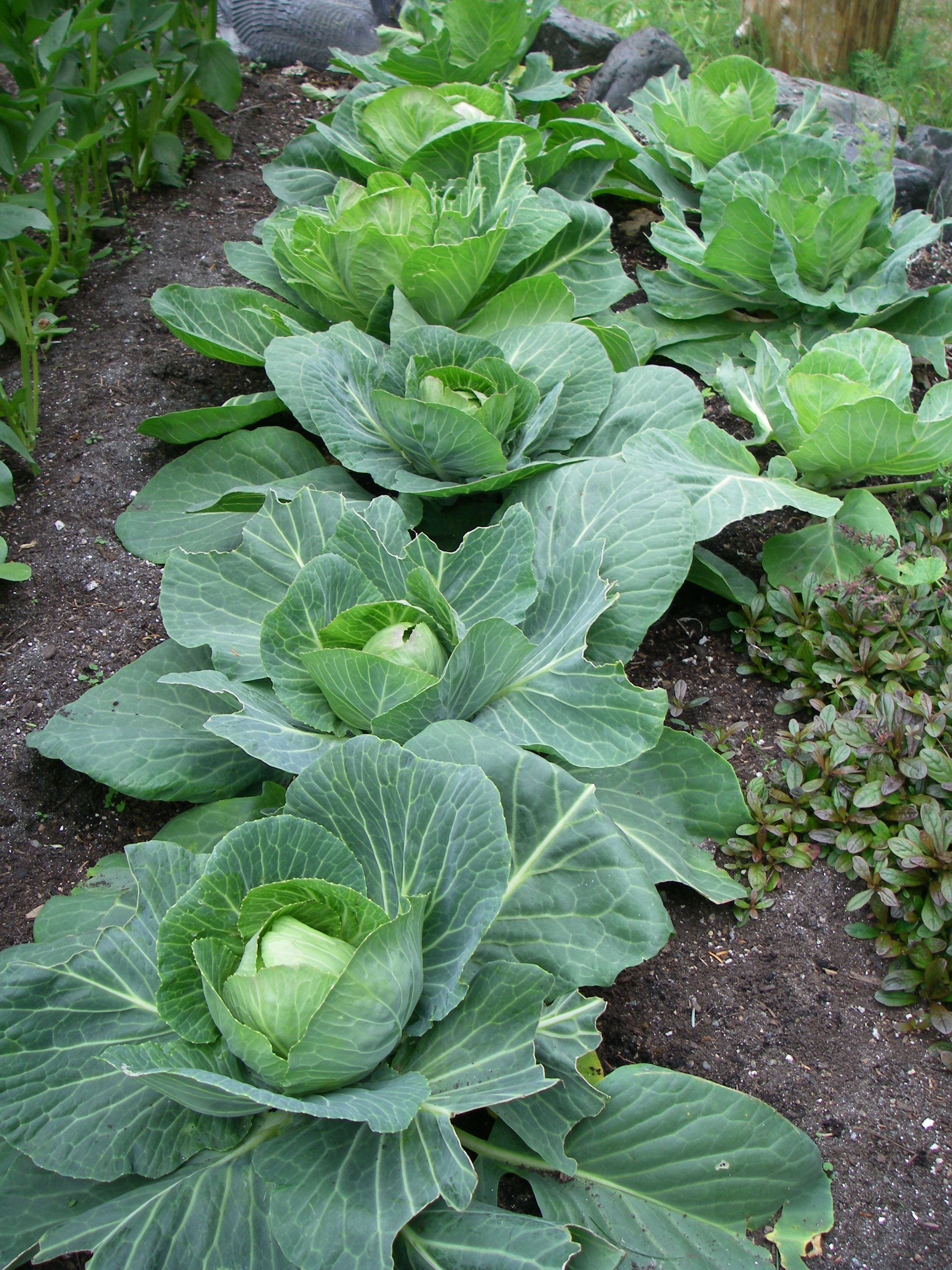
Cabbage does really well in Sitka.  It is a crop worth growing, if you have the space for it.  I find that the most important thing about growing cabbage is picking the right variety.  Loosely knit heads allow too many spaces for slugs, so choose varieties that produce tightly packed heads.  Purple varieties mature really late but the slugs don’t bother them as much as they do the green varieties. I always grow both colors.

Cabbage is a moderately heavy feeder, so prepare next year’s bed this fall by loading it up with fertilizer (or compost, seaweed and salmon carcasses) and lime (or seashell sand).  Plant seeds indoors mid-March and transplant outdoors mid-April. It’s important to transplant cabbage plants while they are still young.  If they get too old the plants will stunt and never reach their potential size.

Make a dish-shaped depression in the soil and then plant the seedling in the bottom of the depression burying it up to its first set of true leaves.  Cabbage that is planted too close together produces small heads so be sure to give them plenty of room.  I like to use about 2 foot spacing.  Mulch the entire row with seaweed (without herring eggs) to retain moisture, but be sure the seaweed touches the tender starts as little as possible to avoid rot.

Cabbage is from the brassica family and as with all brassicas it is very important to cover the entire bed with floating row cover to protect the crop from the dreaded root maggot fly.  For best results use hoops to support the row cover up off the little seedlings so they do not get flattened by the rain. Leave the cover on until at least July 15.

Slugs are the mortal enemy of cabbages.  They get in between the leaves, live in the cracks and crannies, and just riddle the heads with holes.  It is quite unpleasant to cut into a cabbage and find slugs, worms and slug poop.  GROSS!  My ducks do a good job of eliminating the slugs, but they also love to eat cabbage so during the summer I need to lock them out of the garden.  Consequently the slugs eventually move back in and take up residence in the cabbage.

The only thing that can help this situation is preventative measures:  Don’t plant cabbage next to slug habitat (brush, groundcover, piles of boards or stones), be vigilant with the slug bait/traps, try some cabbage collars or copper flashing when transplanting, when the plant is sturdy enough remove leaves that are touching the ground, and keep the bed weeded to reduce slug habitat.

Cabbage is ready to eat at any time but it is a waste to harvest a head that is the size of a softball. Try to be patient and start harvesting your first heads when they are about the size of a cantaloupe. Use a knife to cut the head at ground level leaving the root in the ground to avoid disturbing the plants nearby.  It can be removed later in the season or even next spring. The loose outer leaves are edible but not as tender and sweet as the head itself.

Do not feel that you have to harvest all the plants in the row before the weather turns cold.  Cabbage is very hearty. It can sit in the garden covered with snow and still be perfectly edible.  Of course it can’t withstand that type of weather forever, so by November if you haven’t eaten them all harvest the rest and store them in the fridge in plastic bags.  They have an amazing shelf life.

One more note, sometimes gardeners have trouble with their cabbages splitting.  General information says that this is caused by too much rain, but I have heard that too much nitrogen can also cause splitting. If you notice a head has split, harvest it right away.  Split heads start to deteriorate quickly if left in the garden.

Brought to you by Down-To-Earth U-Pick Garden

2103 Sawmill Creek Road

Open June-August / Monday to Saturday, 11 a.m. to 6 p.m.

747-6108 or 738-2241

http://downtoearthupick.blogspot.com/

• Sitka resident Keith Nyitray shares a recipe for Hungarian cabbage noodles

Hungarian cabbage noodles

Hungarian cabbage noodles

A Hungarian cabbage noodles recipe from Sitka resident Keith Nyitray

• Another recipe from Keith Nyitray — Broccoli pesto/dip

It’s September and, at least in my garden, it’s time to start harvesting cabbages. I love cabbages. Being one of the many members of the Brassica family, cabbage is easy to grow and cultivate in Southeast Alaska and does well without any real special attention. Just keep the deer and slugs away.

Whether used in soups or stews, made into sauerkraut or ’slaw, cabbages are a surprisingly good source of vitamin C, riboflavin, (vitamin B12) and glutamine (which has anti-inflammatory properties).

Below is a very simple yet hearty meal that can stand alone or be served with other meats and/or vegetables. Adding the dill or caraway seeds is a matter of personal taste. Personally, I like to use the dill seeds that I’ve already dried and stored from my previous years’ garden.

Hungarian Cabbage Noodles
(makes 6-8 servings)

1 medium sized head of cabbage – shredded
1/2 cup butter (melted)
1 tbs. sugar/honey
salt/pepper
12 oz. egg noodles, freshly cooked
1 tbs. dill or caraway seeds (optional)

Halve, then core the cabbage. Slice each half of the cabbage into half-inch strips, rotate and then cut those strips into thirds.

Melt butter in a Dutch oven or large pot over medium heat. Add cabbage, dill/caraway seeds (optional), and sauté until cabbage is almost translucent and lightly browned. Note: the volume of cabbage will have shrunk considerably.

Mix in salt, pepper, sugar/honey (to taste). Add noodles and toss to combine.

Reduce heat to low and stir until warmed through.

Serve immediately.

• St. Peter’s Fellowship Farm communal garden work party takes place on Saturday, May 1

St. Peter's Fellowship Farm sign

St. Peter's Fellowship Farm sign

The next work party to get the St. Peter’s Fellowship Farm communal garden ready for planting later this month takes place from 2-4 p.m. on Saturday, May 1. St. Peter’s Fellowship Farm is located behind the See House behind St. Peter’s By The Sea Episcopal Church on Lincoln Street. Tools and gloves will be provided.

Food grown at the St. Peter’s Fellowship Farm communal garden is sold at the Sitka Farmers Markets, which take place on alternate Saturdays starting on July 17. For more information about the May 1 work party, contact Doug Osborne at 747-3752 or doug_las@att.net, or contact Lisa Sadleir-Hart at 747-5985 or 3akharts@acsalaska.net.

Planting parties at St. Peter’s Fellowship Farm take place from 2-4 p.m. on three straight Saturdays in mid-May — May 15, 22 and 29 — safely after the last frost of the spring. For more information on the planting parties, contact Lisa Sadleir-Hart at 747-5985 or 3akharts@acsalaska.net.

• Sitka Local Foods Network selling seeds from Bountiful Gardens as fundraiser

Screenshot of Bountiful Gardens website

Screenshot of Bountiful Gardens website

Help support the Sitka Local Foods Network by purchasing organic seed varieties from Bountiful Gardens seed company that have been specially selected for our challenging climate by longtime Sitka gardener Jamie Chevalier.

There will be a serve-yourself seed rack at Old Harbor Books, with an honor-system donation jar for making change next to the seeds.

Among the seed varieties available will be cabbage, broccoli, beets, carrots, a variety of greens mixes, kale, lettuces, peas, radishes and summer squash. Seed supplies are limited for first come, first served.

Bountiful Gardens is an educational nonprofit organization that specializes in heirloom, untreated and open-pollinated varieties of seeds for sustainable agriculture. Bountiful Gardens also promotes the GROW BIOINTENSIVE sustainable mini-farming concept, which helps gardeners make small plots of land productive sources for agriculture.

For more information, contact Kerry MacLane at 752-0654.

• Sitka gardeners to meet Tuesday, April 20, at UAS-Sitka Campus

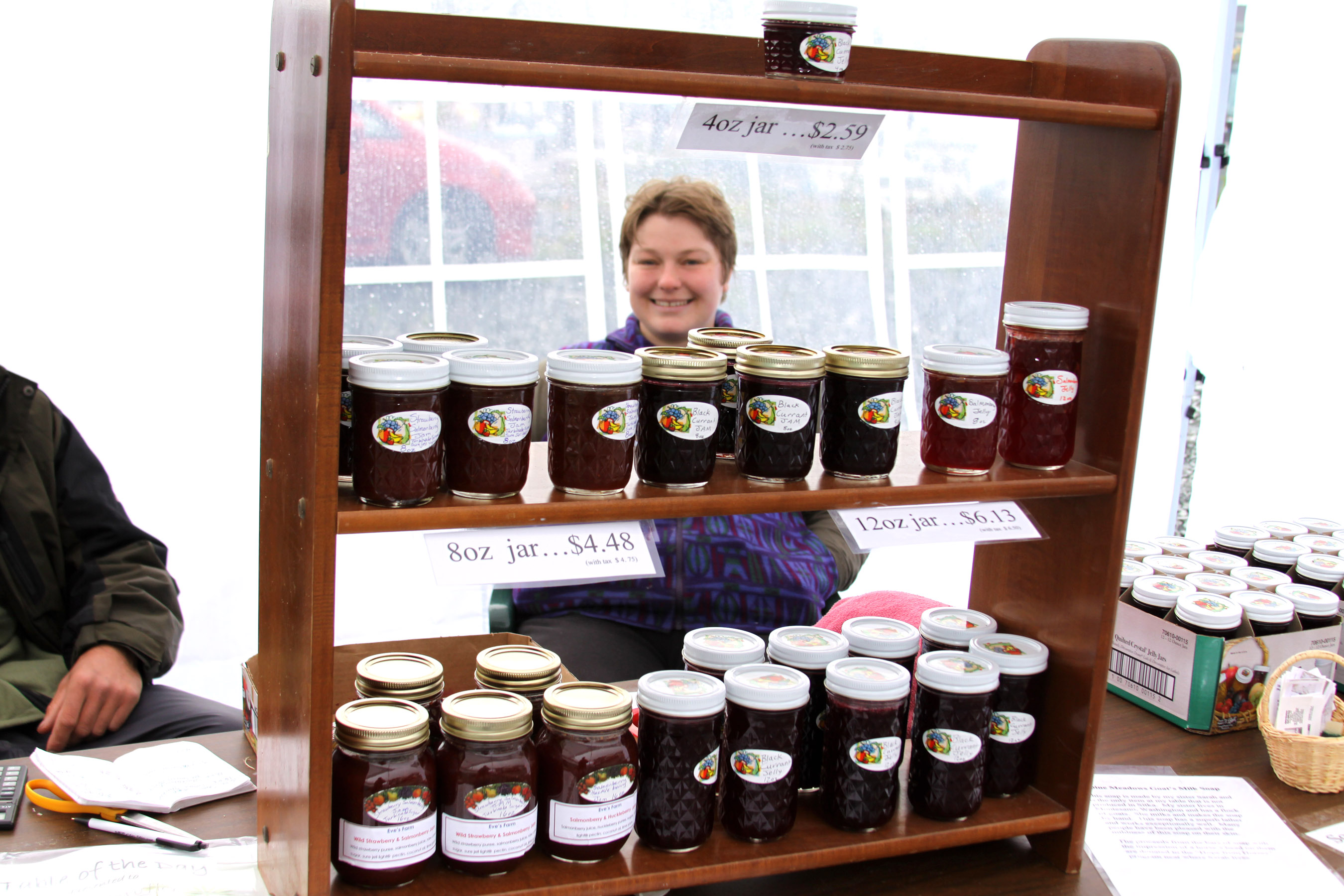
Local gardener Evening Star Grutter of Eve's Farm, shown here with some of her homemade jams during the Aug. 29, 2009, Sitka Farmers Market, will be the guest speaker at April's meeting of the Sitka Gardeners Club

Local gardener Evening Star Grutter of Eve's Farm, shown here with some of her homemade jams during the Aug. 29, 2009, Sitka Farmers Market, will be the guest speaker at April's meeting of the Sitka Gardeners Club

The Sitka Gardeners Club’s monthly get-together takes place from 7-8:30 p.m. on Tuesday, April 20, in Room 106 at the University of Alaska Southeast-Sitka Campus on Japonski Island.

The get-together provides a venue for gardeners of all types, interests and skills to informally exchange ideas, information, seeds and growing tips. Share and learn from other gardeners with no dues or commitments other than good fellowship.

Sitka gardeners plan to meet on the third Tuesday of the month at the UAS-Sitka Campus. This month’s meeting will feature gardening tips from Evening Star Grutter of Eve’s Farm, and it is sponsored by UAS-Sitka Campus and the University of Alaska Fairbanks Cooperative Extension Service. For more information, call Cheryl Stromme at 747-9473 or Bob Gorman at 747-9413.

• Sitka growers to contribute to local CSA venture

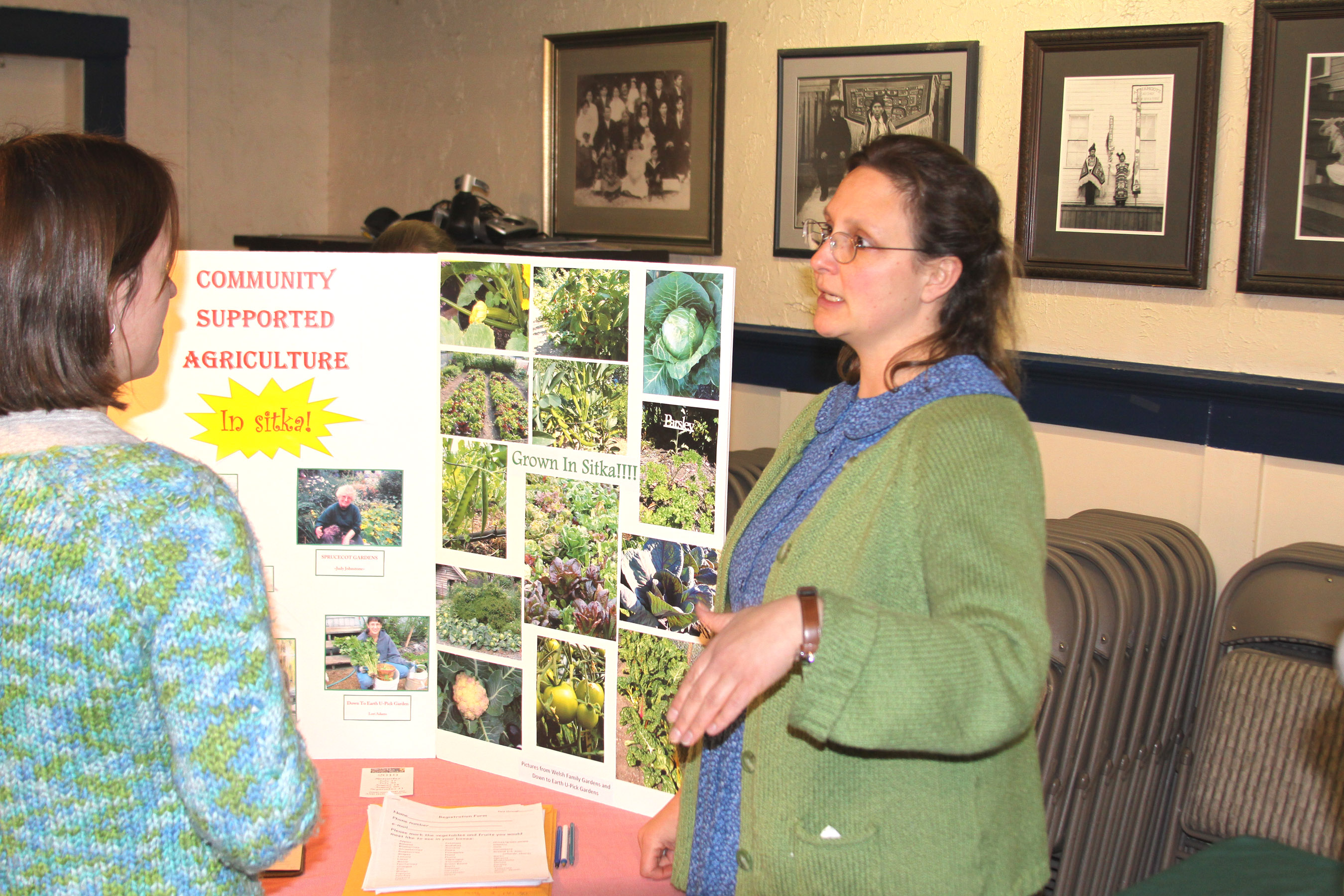
Renee Pierce, right, explains the first Sitka CSA venture to Sitka Local Foods Network board member Natalie Sattler during the Let's Grow Sitka! event on March 14

Renee Pierce, right, explains the first Sitka CSA venture to Sitka Local Foods Network board member Natalie Sattler during the Let's Grow Sitka! event on March 14

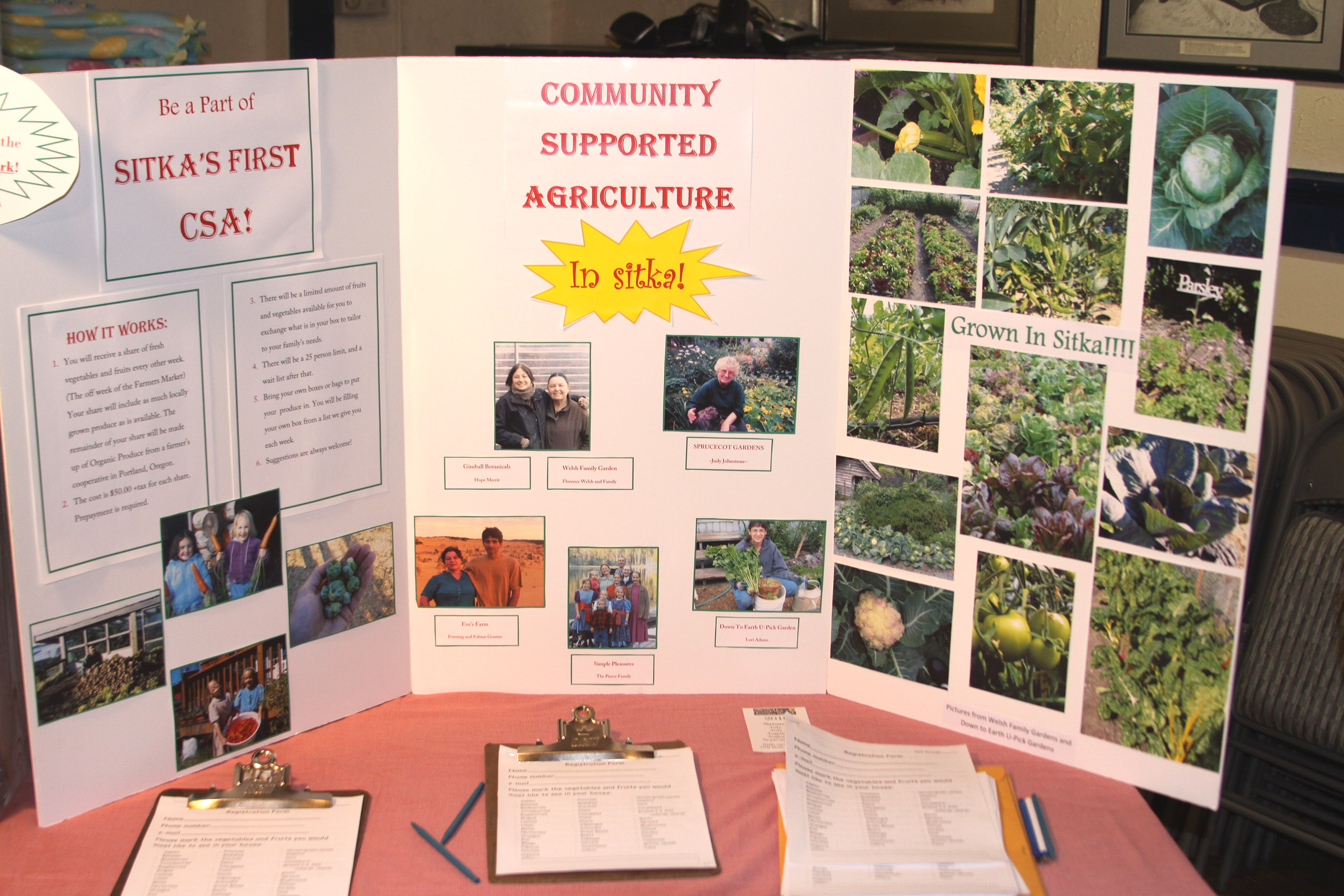
One of the latest trends in farming is Community Supported Agriculture (CSA), which enables people to buy local, seasonal food directly from the farmer. Renee and Brian Pierce, who own the locally made kelp products and wild berry jelly shop Simple Pleasures of Alaska, are working with Sitka growers to start a small CSA venture with local produce during the summer growing season.

Renee Pierce said that instead of the CSA being a true farmers’ cooperative, she will buy produce from several local growers — including Florence Welsh of the Welsh Family Forget-Me-Not Gardens, Hope Merritt of Gimbal Botanicals, Judy Johnstone of Sprucecot Gardens, Evening Star and Fabian Grutter of Eve’s Farm, and Lori Adams of Down To Earth U-Pick Gardens. The CSA also will include produce from the Pierce Family’s Simple Pleasures garden.

The Sitka CSA will start small, with membership slots for just 25 families the first year. Renee Pierce said of those 25 slots, only about 10 memberships are left. CSA members will commit to paying $50 plus tax every other week, which will give the member families a selection of produce that includes some organic produce purchased from Organically Grown Company of Portland, Ore. During the months when Sitka growers aren’t producing many vegetables, there will be more produce purchased from Organically Grown Company. There also will be an option to buy bread at $6 a loaf beyond the price of the produce box.

The produce selection includes many crops that can be grown in Sitka — such as blueberries, strawberries, raspberries, potatoes, radishes, zucchini, green beans, beets, cabbage, carrots, cauliflower, broccoli, greens, tomatoes, etc. But with the Organically Grown Company providing some of the produce, CSA members also can choose items that aren’t regular Sitka crops — such as bananas, lemons, limes, pineapples, oranges, etc.

Information about Sitka's first CSA from the Let's Grow Sitka! event on March 14

Information about Sitka's first CSA from the Let's Grow Sitka! event on March 14

Renee Pierce said she has worked with Organically Grown Company for about four years, purchasing organic produce for the Pierce family and several friends and other Sitka residents who heard about the venture (at one point she had about 60-70 families buying from her). She said she orders produce by the case, and it is available for pick-up from 3-6 p.m. every other Monday afternoon at the Simple Pleasures store next to Kettleson Memorial Library. The first pick-up day for the Sitka CSA is March 29 (which will be for the 15 or so families that already have reserved a spot in the CSA), and the next pick-up day is April 12. CSA members are encouraged to bring their own bags and/or boxes on pick-up days.

The pick-up days are slated to be during the weeks between the every-other-week Sitka Farmers Markets this summer, which will give local growers and buyers the opportunity to buy and sell local produce for both. Renee said there will be some produce extras for families that want to adjust their allotments, but everybody’s allotted produce value will be $50. If you add from the extras you will need to pay the difference, and if you give up some produce you don’t want so your value dips below $50 there are no refunds. She said the CSA is being done as a community service and it’s meant to just break even so the bills get paid.

To learn more about the Sitka CSA, contact Renee Pierce at 738-0044 (cell) or 747-3814 (home). You also can e-mail her at mpierce@ptialaska.net.

• WISEGUYS men’s health group builds a community potato patch in Klukwan

Tubs of potatoes are loaded into the back of a pick-up truck after they were picked at the WISEGUYS potato patch in Klukwan

Tubs of potatoes are loaded into the back of a pick-up truck after they were picked at the WISEGUYS potato patch in Klukwan

While this site is about the Sitka Local Foods Network and projects in Sitka promoting local foods, occasionally we have news from a nearby community that’s worth reporting.

This summer, the new WISEGUYS men’s health group in Klukwan, a Tlingít community just north of Haines, decided to build a potato patch to raise potatoes and a few other vegetables for community members of the Chilkat Indian Village.

“The idea was to provide a sustainable subsistence based crop that could supply every house in Klukwan with potatoes every year,” said Mike Adams, a Community Health Practitioner at the SEARHC Klukwan Health Center. “This would also allow us to get together with the community kids, exercise and spent time together doing something for our community.”

Adams said the group started with a donated piece of land from the Chilkat Indian Village and began clearing it of debris and cleaning it up so the ground could be tilled for planting. The WISEGUYS received funding from the SEARHC WISEWOMAN Women’s Health Program so they could purchase the potato seed and fertilizer, and the SEARHC Behavioral Health Prevention Program (a program to educate youth about drug and alcohol abuse) bought a few hand tools.

Sixty hours were spent in clearing and ground preparations, as well as 20 hours of donated heavy equipment time from Chilkat Indian village and Hank Jacquot. This got us to a 100-foot-by-100-foot piece of usable ground. The preparations for planting then began. Many of us spent several days with three Roto-Tillers tilling the area, digging furrows for planting, adding organic fertilizers and ultimately planting 1,000 potato plants. Four varieties were planted — Kennebec, Tlingít, Yukon Gold and Chippawa’s.

The summer was unseasonably hot and there was a minimal water supply from a nearby creek. To supplement the creek, watering was done using the village fire truck to spray the patch with 750 gallons of water every three to five days.

“We harvested the potatoes on Sept. 25th and had many community members participate as well as all the kids from the Klukwan school and their teachers,” Adams said. “We grossed approximately 1,500 pounds of potatoes. Every child and teacher was sent home with a large bag of potatoes and every household in Klukwan was given potatoes. Due to the prolonged unseasonable hot weather all summer the final harvest amount was a bit lower then we’d hoped, but everyone was given potatoes and we all had a great time harvesting.”

Adams said the WISEGUYS received a positive note when they applied for a small grant from RurAL CAP in August to purchase supplies and equipment, and they recently found out they were awarded the grant. He said the group plans to build a sprinkler system in the potato patch next year.

“Thanks goes to everyone for all your support,” Adams said. “We look forward to another great year in 2010!”

Potato pickers gather for the potato-picking party on Sept. 25 at the WISEGUYS potato patch in Klukwan

Potato pickers gather for the potato-picking party on Sept. 25 at the WISEGUYS potato patch in Klukwan

Barren land before it was cleared to become the WISEGUYS potato patch in Klukwan

Barren land before it was cleared to become the WISEGUYS potato patch in Klukwan

Potato plants growing in the WISEGUYS potato patch in Klukwan

Potato plants growing in the WISEGUYS potato patch in Klukwan

Community members pick potatoes during a potato-picking party Sept. 25 at the WISEGUYS potato patch in Klukwan

Community members pick potatoes during a potato-picking party Sept. 25 at the WISEGUYS potato patch in Klukwan

Lani Hotch and Bev Klanott stand behind a big cabbage growing at the WISEGUYS potato patch in Klukwan. The cabbage weighed nearly 30 pounds when it was harvested.

Lani Hotch and Bev Klanott stand behind a big cabbage growing at the WISEGUYS potato patch in Klukwan. The cabbage weighed nearly 30 pounds when it was harvested.