• Lori Adams discusses everything she’s learned about growing turnips in her latest Daily Sitka Sentinel garden column

(Lori Adams, who owns Down-To-Earth U-Pick Garden and is a frequent vendor at the Sitka Farmers Market, will be writing a regular garden column in the Daily Sitka Sentinel this summer. The Sentinel is allowing us to reprint the columns on this site after they first appear in the newspaper. This column appeared on Page 4 of the Wednesday, Aug. 15, 2012, edition of the Daily Sitka Sentinel.)

GARDENING IN SITKA

By Lori Adams

EVERYTHING I’VE LEARNED ABOUT GROWING TURNIPS

I have been growing turnips the last couple of years for the greens, but have never had any luck growing them for the bulbs.

This year I was able to actually harvest some large bulbs and they were really delicious. They taste like a cross between a kohlrabi and a radish. It turns out that they are relatively easy to grow, so from now on I am going to make more room in my garden for turnips.

To prep the bed for growing turnips be sure not over-fertilize with nitrogen. Turnips are a root crop and root crops like loose soil amended with organic material, sand, bonemeal and plenty of lime (seashell sand) to keep them from being bitter. Plant the seeds directly outside in the soil with about 4-inch spacing.

If you want a lot of tops you can plant the seeds closer, and then when they are big enough to eat you can simply thin the crop by pulling every other plant completely out of the ground. After planting the seeds be sure to cover the entire area with row cover. All of the local pests seem to like turnips and it is not uncommon to pull one and find it riddled with holes and bite marks. Row cover and crop rotation can really help minimize pest damage.

At harvest time most of the turnips bulbs will be pushing their tops up out of the soil, so you will be able to see how big they are. Pull them when they still tender — about 3 inches in diameter. If they get too large they can become quite woody and fibrous. You can eat them raw or cooked and it is not necessary to peel them. The greens are ready to eat at any time and you can pull the entire plants or clip off the leaves leaving the roots to grow more leaves for a later harvest.

One of the reasons I am enthused about growing more turnips next year is because they are ready to harvest so early in the season, when there are mostly just greens to eat and no poundage crops. I had always considered them a fall crop, so I was surprised to have them mature so early. It might even be possible to sow multiple plantings each season.

Although it sounds so easy to grow turnips it took a lot of years for me to be successful at it. I think the biggest mistakes I made in the past were planting them too close together and adding too much nitrogen. If there is one thing I’ve learned about gardening in Sitka it’s to never give up. Keep trying and eventually you will probably succeed.

Brought to you by Down-To-Earth U-Pick Garden

2103 Sawmill Creek Road

Open June-August / Monday to Saturday, 11 a.m. to 6 p.m.

747-6108 or 738-2241

http://downtoearthupick.blogspot.com/

• Pauline Duncan wins Table of the Day at third Sitka Farmers Market of 2012

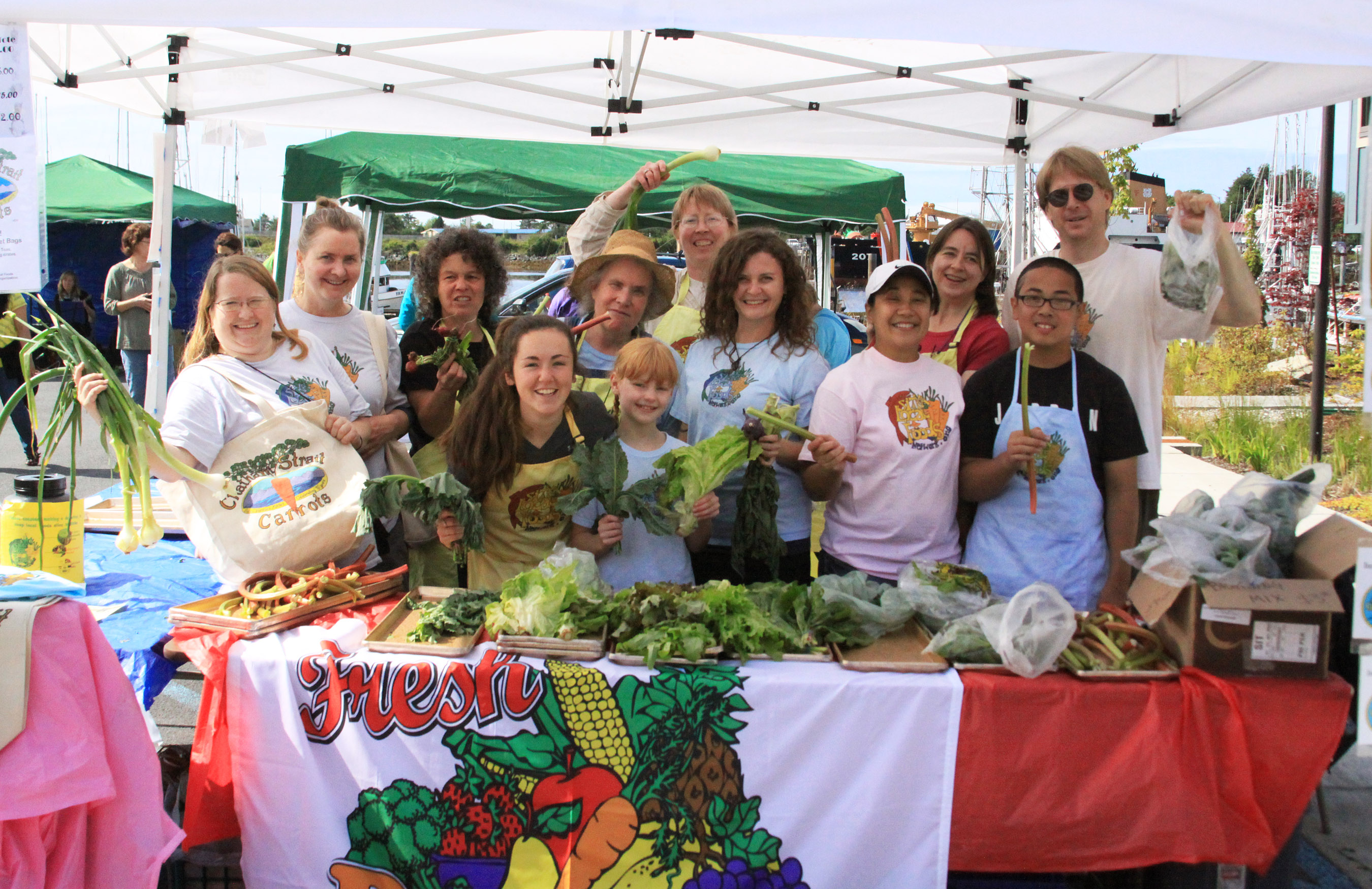
TABLE OF THE DAY: Sitka Local Foods Network volunteer Mandy Griffith, far left, volunteer Jonathan Ocampo, second from right, and Sitka Local Foods Network board member Maybelle Filler, right, present the Table of the Day Award to Pauline Duncan for the third Sitka Farmers Market of the season, on Aug. 4, 2012, at ANB Hall. Pauline sold packaged seaweed and her Tlingít recipe cookbooks at the market. The Sitka Local Foods Network board selects a Table of the Day winner from the vendors at each Sitka Farmers Market of the season, and the winners receive prizes such as a fifth-anniversary market tote bag and check.

The next Sitka Farmers Market is scheduled for 10 a.m. to 2 p.m. on Saturday, Aug. 18, at ANB Hall. The Sitka Local Foods Network is seeking volunteers to help set up tables and tents before the market starts, and to tear down and pack up the market after it ends. We need volunteers for all of the remaining markets (Aug. 18, Sept. 1 and 15). If you have a strong back and helping hands, please contact Johanna Willingham at 738-8336 for more details. For more information about the Sitka Local Foods Network and the Sitka Farmers Market, go to http://www.sitkalocalfoodsnetwork.org/

• Lori Adams discusses everything she’s learned about growing rhubarb in her latest Daily Sitka Sentinel garden column

(Lori Adams, who owns Down-To-Earth U-Pick Garden and is a frequent vendor at the Sitka Farmers Market, will be writing a regular garden column in the Daily Sitka Sentinel this summer. The Sentinel is allowing us to reprint the columns on this site after they first appear in the newspaper. This column appeared on Page 4 of the Wednesday, Aug. 1, 2012, edition of the Daily Sitka Sentinel.)

GARDENING IN SITKA

By Lori Adams

EVERYTHING I’VE LEARNED ABOUT GROWING RHUBARB

Rhubarb grows so well here that I’m surprised it’s not indigenous. I have always been amazed at how many customers come out to the Down-To-Earth U-Pick Garden just to pick it because I figured everyone had a clump growing behind their house.

Rhubarb is a vegetable but it is used most often like a fruit in pies and desserts. It grows out of a tuberous root system. The stalks are very tart, tasting a lot like lemon, and the leaves are poisonous but can be composted.

The best way to started growing it is to get a clump of roots from another Sitka gardener any time after May 15 but before Sept. 15. Penny Brown out at Garden Ventures has sold rhubarb seeds in the past and has had good reports from customers who have planted them, but I have no experience with rhubarb seeds.

The best growing conditions for a rhubarb patch in Sitka are partial shade, acidic soil, plenty of moisture, and a thick layer of mulch and nitrogen-rich food spring and fall. If at any point a flower stalk comes up out of the center of the plant it should be removed to ensure that the plant uses all of its energy to grow edible stalks. The flower is totally useless unless you are planning to save seeds. Just use a knife and cut it off close to the base of the plant.

It would be best not to harvest any stalks from your patch the first year and then in the following years harvest as much as you like as long as you don’t take more than two-thirds of the stalks from each clump each time you pick. It’s good to leave at least one or two stalks on the plant at the end of the season to die naturally to ensure that the plant is photosynthesizing up until the very end.

Rhubarb is “ripe” at any size. It does not change in flavor as it matures, but large, old stalks can get “pithy” or tough if they aren’t utilized and should be removed and thrown away. If most of your stalks are pithy you are not watering your patch enough. DO NOT cut your stalks from the plant when harvesting. It’s best to pull them loose by twisting them while pulling down and out with one hand and supporting the rest of the plant with the other. New plants could pull completely out of the ground and clumps of stalks can come out all together if you are not careful.

The entire stalk can be chopped up for use — even the very bottom tip that is white is good. Rhubarb holds up really well in the freezer. Just measure out  enough for a pie and put it in a labeled Zip-Lock bag and throw it in the freezer. No blanching is necessary. When it’s thawed out it will be kind of freezer burnt and soggy looking, but it cooks up just beautifully.

Rhubarb grows well in a pot but after a few years the root system will grow too large for the pot and the plant will become less and less productive. It’s also more susceptible during freezing weather so it’s best to grow it right in the ground.

About every five years or so it is beneficial to divide the plant. Shove a space right down through the middle of the clump and cut it into four pieces. The tubers can be very large and go very deep but you can be quite aggressive while dividing. Rhubarb is very hardy and even a portion of a tuber can survive just fine.

Replant some of the clumps for yourself but be sure to share the others with your neighbors  It’s good to spread the love!

Brought to you by Down-To-Earth U-Pick Garden

2103 Sawmill Creek Road

Open June-August / Monday to Saturday, 11 a.m. to 6 p.m.

747-6108 or 738-2241

http://downtoearthupick.blogspot.com/

• Celebrate National Farmers Market Week by going to the Sitka Farmers Market on Saturday, Aug. 18

Aug. 5-11 is National Farmers Market Week this year, as noted by the Farmers Market Coalition. The Sitka Farmers Market didn’t quite line up its dates with National Farmers Market Week this year, but if you didn’t attend our market on Saturday, Aug. 4 you still can celebrate the week by attending the Sitka Farmers Market from 10 a.m. to 2 p.m. on Saturday, Aug. 18, at the Alaska Native Brotherhood Hall (235 Katlian St.).

Farmers markets are a great way to connect with the community, while also purchasing local produce, wild fish, locally baked bread and arts and crafts. Besides providing access to fresh local produce, farmers markets create strong economic engines in communities, promote local health and bring a diverse group of people together. They also help consumers meet and get to know the people who produce their food.

“The Sitka Farmers Market serves as a family friendly place for people to meet and to visit with other members of the community,” Sitka Local Foods Network Vice-President Linda Wilson said. “Some people spend an hour or two just going around mingling with folks and chatting, catching up on the local news, telling jokes, and sharing ideas and information. There is a lot of good energy around during the market.”

Farmers markets have been growing nationally, from 2,863 in 2000 to 7,864 in 2012, a jump of more than 270 percent. While Alaska doesn’t have as many farmers markets as other states, it did have the highest percentage of new markets in the country last year, up 35 markets in 2011 or 46 percent. The national rate of new market growth was 17 percent in 2011 and 9.6 percent in 2012.

Aug. 18 will be the fourth of six full Sitka Farmers Markets this summer, with the schedule running on alternate Saturdays (July 7, 21, Aug. 4, 18, Sept. 1 and 15). The markets feature local seafood (fresh, frozen, and cooked, ready to eat), locally grown and harvested fruits and vegetables, baked bread, locally picked berries, jams and jellies, cooking demonstrations, live entertainment, locally brewed and roasted coffee, music, local arts and crafts, and a variety of other items gathered or made in Sitka. We emphasize local products and lots of fun. We are the first farmers market in Southeast Alaska to accept WIC coupons. You also can vote for the Sitka Farmers Market in the America’s Favorite Farmers Markets contest by following the links at https://sitkalocalfoodsnetwork.org/2012/06/22/%E2%80%A2-dont-forget-to-vote-for-the-sitka-farmers-market-in-this-years-americas-favorite-farmers-markets-contest/.

For more information about the market or hosting a booth, contact Sitka Farmers Market Manager Johanna Willingham at 738-8836 or johanna.willingham@gmail.com. By the way, we always need volunteers to help set up and take down the market before and after the event. Your help is greatly appreciated.

Also, there will be a couple of work parties from 4-6 p.m. on Wednesday, Aug. 8, and  from 2-4 p.m. on Saturday, Aug. 11, at St. Peter’s Fellowship Farm, which is located behind St. Peter’s By The Sea Episcopal Church (the dark brown brick-and-wood church on Lincoln Street above Crescent Harbor). Fresh veggies will be available for a donation to the Sitka Local Foods Network or a WIC Farmers Market Coupon. For more info on garden work parties, contact St. Peter’s Fellowship Farm Lead Gardener Laura Schmidt at 738-7009 or 623-7003.

• SitNiks to provide musical entertainment during the third Sitka Farmers Market of the season, Aug. 4

The SitNiks will provide musical entertainment during the third Sitka Farmers Market of the season, from 10 a.m. to 2 p.m. on Saturday, Aug. 4, at the Alaska Native Brotherhood Hall (235 Katlian St.).

The SitNiks, who will play from 10 a.m. to noon, perform music from Russian and other Eastern European countries. Members of the group include, from left, Ritch Phillips on bass, John Fulton on concertina, Pattie Skannes on balalaika, Bree Hack on fiddle, Jeanne Stolberg on balalaika, Kris Fulton on fiddle and Mike Litman on accordion (not pictured is J Bradley on various stringed instruments).

The Sitka Farmers Market is happy to provide a showcase for local musicians. Musical acts for future Sitka Farmers Markets this year will be announced later. For more information about providing musical entertainment, contact market coordinator Johanna Willingham at 738-8336.

The Sitka Local Foods Network also is seeking volunteers to help set up tables and tents before the market starts, and to tear down and pack up the market after it ends. We need volunteers for all of the remaining markets (Aug. 4, 18, Sept. 1 and 15). If you have a strong back and helping hands, please contact Johanna at the number above.

In addition, the Sitka Local Foods Network needs people to help harvest veggies from St. Peter’s Fellowship Farm to sell at the Sitka Farmers Market. Work/harvest parties will take place from 4-5 p.m. on Friday, Aug. 3, and from 8-9 a.m. on Saturday, Aug. 4, at St. Peter’s Fellowship Farm (located behind St. Peter’s By The Sea Episcopal Church on Lincoln Street). We expect to have lots of veggies to harvest for Saturday’s market, so we hope to have several people help with the picking.

• A short video to get you excited about the 2012 Sitka Seafood Festival

Elizabeth Cockrell of the Sitka Conservation Society provides this short promotional video for the 2012 Sitka Seafood Festival, which takes places Aug. 9-12 at various locations around downtown Sitka. The video was shown during a recent community salmon bake hosted by the Sitka Conservation Society. Tickets for the Friday, Aug. 10, Sitka Seafood Festival banquet at Harrigan Centennial Hall are for sale for $65 each at Old Harbor Books, and the guest chefs are sure to have exciting seafood dishes for you to try. Also, this year’s Sitka Seafood Festival will give Sitka residents a chance to watch and participate in a Scottish Highland Games. A complete schedule of events is posted on the Sitka Seafood Festival website.


• Lori Adams says it’s time to start planning for garlic in her latest Daily Sitka Sentinel garden column

(Lori Adams, who owns Down-To-Earth U-Pick Garden and is a frequent vendor at the Sitka Farmers Market, will be writing a regular garden column in the Daily Sitka Sentinel this summer. The Sentinel is allowing us to reprint the columns on this site after they first appear in the newspaper. This column appeared on Page 3 of the Wednesday, July 25, 2012, edition of the Daily Sitka Sentinel.)

GARDENING IN SITKA

By Lori Adams

IT’S TIME TO START PLANNING FOR GARLIC

Garlic is the most rewarding thing I’ve grown yet in my garden.  It is amazingly delicious, easy to plant and does so well here in Sitka.

Even though it’s too early to plant garlic right now, the stores are starting to sell it and the catalogs are arriving in the mail. It’s good to buy now because garlic is a hot seller and everyone is usually sold out by October when you need it. Do not buy garlic from the grocery store to plant even though it is cheaper. It won’t do as well as stock bought from a nursery. In fact, many farmers spray the garlic with something to keep it from sprouting during storage.

Our local garden stores sell garlic and Penny Brown at Garden Ventures has been keeping track of the local gardener’s favorite varieties so be sure to talk to her. All garlic varieties fall under two basic categories — hard neck and soft neck.

Soft neck plants have soft stalks at harvest time that can be braided together. The cloves run on the smaller, milder side but have a long shelf life. Most of the garlic you see on the grocery store shelves is soft neck.

Hard neck plants have very rigid stalks.  The cloves run on the larger, more flavorful side but do not have a long shelf life. Hard neck garlic plants send a flower stalk out of the top of the plant in July that needs to be cut off so that all of the energy goes into producing large cloves. This flower stalk is called a “scape” and it’s not only edible, it’s delicious. Just eat it raw or chop it up and throw it into your stir fry.

All of the information I’ve gathered says that hard neck garlic is the best choice for Sitka.

The best time to plant garlic is in the fall. Some stores sell it in time for a spring planting and it works, but your garlic won’t reach its full potential. Preparation for the garlic bed should take place this September.

Remove all the existing plants in the bed, and till or loosen up the soil with a trowel.  Amend with fertilizer (or seaweed and compost), lime (or seashell sand) and bonemeal (or starfish). Be sure the bed has good drainage — if the garlic sits in a puddle all winter it will rot. Planting should take place mid-October.  Separate all the cloves of your garlic, being sure NOT to remove the individual papery covering over each clove. If the covering is accidentally removed plant the clove anyways.

Plant each clove about 2 inches deep and about 9 inches apart and then mulch the entire bed with a thick layer of seaweed to protect it from the winter weather. Mark your bed clearly so you remember where they are planted next year.

Next spring, green blades will start to appear that look like saw grass. Each blade indicates one clove. Fertilize or mulch with seaweed or compost when all the garlic has emerged. Harvest the scapes in July while they are tender before the flower develops.

During July the blades will start to turn brown from the bottom up.  Although garlic is edible at any stage, usually by early August half of the blades have turned brown and it is time to harvest. If you harvest too early it won’t store well and if you harvest too late the cloves will separate from the stalk and the flavor diminishes slightly.  Use a trowel to harvest instead of pulling the stalk to ensure that the garlic stays intact.  For storage just wash off the dirt, cut off the stalk to about an inch and let the garlic dry completely using a fan.

Save your largest cloves to plant for next season, eat the rest of the large cloves and save any tiny or misshapen cloves to plant an inch or two apart in a separate bed to use in the spring as “garlic greens.”  Garlic greens look like green onions but taste like garlic.  If you save and replant your own stock each year the garlic plants will get more adapted to our climate and will get better and better.

Garlic is so delicious, you just HAVE to try it.

Brought to you by Down-To-Earth U-Pick Garden

2103 Sawmill Creek Road

Open June-August / Monday to Saturday, 11 a.m. to 6 p.m.

747-6108 or 738-2241
http://downtoearthupick.blogspot.com/

• Suzan Brawnlyn, the Chef at the Market, provides her recipes from the second Sitka Farmers Market

Suzan Brawnlyn, the Chef at the Market, holds a sample cup of honey miso-glazed black cod with broccoli and bok choy stir fry during a cooking demonstration on July 21, 2012, at the second Sitka Farmers Market of the season.

Suzan Brawnlyn, the Chef at the Market, holds a sample cup of honey miso-glazed black cod with broccoli and bok choy stir fry during a cooking demonstration on July 21, 2012, at the second Sitka Farmers Market of the season.

This year, the Sitka Local Foods Network is happy to feature local chef Suzan Brawnlyn as its “Chef at the Market.” Suzan received a grant to provide cooking demonstrations at at least four of our six markets this year. Suzan also has been making her recipes available so people can try them at home. Her recipes from the second market on July 21 are posted below. To get her first batch of recipes, click this link.

The next Sitka Farmers Market is from 10 a.m. to 2 p.m. on Saturday, Aug. 4, at Alaska Native Brotherhood Hall (235 Katlian St.).The Sitka Local Foods Network is seeking volunteers to help set up tables and tents before the market starts, and to tear down and pack up the market after it ends. We need volunteers for all of the remaining markets (Aug. 4, 18, Sept. 1 and 15). If you have a strong back and helping hands, please contact Johanna Willingham at 738-8336 for more details.

• Chef at the Market recipes from the second Sitka Farmers Market of the season, July 21, 2012

• Lori Adams discusses everything she’s learned about growing fennel in her latest Daily Sitka Sentinel garden column

(Lori Adams, who owns Down-To-Earth U-Pick Garden and is a frequent vendor at the Sitka Farmers Market, will be writing a regular garden column in the Daily Sitka Sentinel this summer. The Sentinel is allowing us to reprint the columns on this site after they first appear in the newspaper. This column appeared on Page 4 of the Wednesday, July 18, 2012, edition of the Daily Sitka Sentinel.)

GARDENING IN SITKA

By Lori Adams

EVERYTHING I’VE LEARNED ABOUT GROWING FENNEL

I have to admit that up until about two years ago I didn’t even know what fennel was.  Florence Welsh recommended that I grow it because it does so well here in Sitka and is truly delicious. I am so glad I gave it a try.

Fennel has a round, slightly oval-shaped bulb that grows above the ground and looks sort of like a fat, short celery, while the tops look a lot like dill. If you eat fennel raw it tastes strongly of anise (licorice), but when cooked the flavor changes to this amazing mellow flavor I can’t even describe.

In preparation for growing fennel I like to amend the bed with seaweed in the fall and again in the spring. If the spring seaweed has a sprinkling of herring roe on it, it’s fine because fennel is a fairly heavy feeder. I start my seeds indoors mid-March and transplant them outside mid-April.

When transplanting the floppy, fragile starts, be sure to make a dish-shaped depression in the soil and then dig a hole in the center of the depression. Bury the starts deep enough in the hole to ensure that they are firmly supported with dirt and plant them with about 10-12 inch spacing. After they recover from transplant shock and begin to grow they will straighten out and become more stout.

It is a really good idea to mulch around each start with seaweed to keep the weeds down, feed the starts and retain moisture.  Cover the starts with row cover and for best results use hoop supports that will hold the cover up 2-3 feet off the ground.  Fennel has beautiful bushy foliage that can get quite tall and if the cover is too low it will break the foliage and make the plants very unattractive.

Fennel is ready to eat anytime you want to, but it is best to wait until it has reached maturity for maximum size. You’ve probably noticed the fennel in the grocery store produce aisle … the large, round, plump bulbs are white and the stems of the foliage are stout. My fennel never looks like that. The bulbs are smaller, more flat — almost disc-shaped — and greener in color.  The foliage and stems are more dainty and tender.

Sometimes a few plants will “bolt” and just send up a series of branches getting really tall. They are edible, but don’t amount to much. Adequate spacing usually minimizes bolting.

Because fennel matures so early you can successfully raise two plantings. You probably can plan to be able to start your first harvest mid to late July. If you take a sharp knife and cut the bulb loose leaving the root in the ground it is possible that the root will sprout up baby fennel for a second harvest.

But it is a more sure thing to start some more fennel seeds indoors around June 1, pull mature plants out of the ground root and all, amend the empty spot with compost and transplant new starts in the same spot. If you don’t have room indoors for starting more seeds just pop a new seed into the empty spots as you harvest mature plants.

Brought to you by Down-To-Earth U-Pick Garden

2103 Sawmill Creek Road

Open June-August / Monday to Saturday, 11 a.m. to 6 p.m.

747-6108 or 738-2241

http://downtoearthupick.blogspot.com/

• Lori Adams discusses weeding and feeding in her latest Daily Sitka Sentinel garden column

(Lori Adams, who owns Down-To-Earth U-Pick Garden and is a frequent vendor at the Sitka Farmers Market, will be writing a regular garden column in the Daily Sitka Sentinel this summer. The Sentinel is allowing us to reprint the columns on this site after they first appear in the newspaper. This column appeared on Page 4 of the Wednesday, July 11, 2012, edition of the Daily Sitka Sentinel.)

GARDENING IN SITKA

By Lori Adams

WEED AND FEED

I consider July 15 to be the middle of the gardening season. By this time a large portion of the nutrients you added to your beds in the spring have either been used up or washed away by the rain, and the weeds are threatening to take over the garden. Weeds rob what little nutrients are left in your soil, block sunlight and harbor mold and mildew. It can really make a difference in the health and harvest of your garden if you invest some time in weeding and amending the soil at this time.

If you tilled your garden this spring like I did, and did not mulch with seaweed, you were probably amazed at the carpet of weeds that sprouted up. It is very important to take the time to sit down and pull every single one of them before they produce seeds. If you did till and mulch with seaweed, you probably saw a pronounced decrease in the amount of weeds in your garden.

Most weeds really aren’t a problem if you are diligent to pull them before they produce seed and are sure to get all the roots because once they are pulled they are gone forever. The only two weeds I have had real trouble with are horsetail and Japanese knotweed. These two weeds have invasive root systems that are just about impossible to eradicate. If you break them off, the broken end just grows multiple sprouts. A small piece laying on the ground can even take root.

Someone once told me that the best defense is a good offense … that these weeds like acidic, poor soil, so the first step is to add lime to the soil and make it as nutritious as possible. It helped, but was not a complete solution. I noticed that where I till they are drastically reduced. I think it is because the roots get chopped up into bits, the bits sprout, I pull on the sprouts and the entire bits come up.

The places were I can’t till or really work it over with a trowel (like the asparagus bed) have become infested with horsetail. This year I mulched the asparagus bed heavily with beach seaweed/leaf mulch and I noticed that the horsetail roots are starting to spread through the loose mulch. When I pulled on them I was able to pull up long root sections. In fact, the other weeds that were growing in the beach mulch pulled up easily. I plan on gathering lots of beach mulch this fall.

If you have a traditional bottomless box bed that has a lot of horsetail in it, it is probably coming up from the ground below.  You can’t till in the box so the only way to get rid of it is to completely empty the bed, lay two layers of landscaping cloth in the bottom and up around the OUTSIDE of the box a few inches and staple it to the sides of the box. Then sift the dirt to remove every scrap of root, and start over. If anyone reading this has a magic bullet for these weeds please let me know.

To add nutrients to your beds either fertilize with commercial fertilizer, spread cured compost an inch thick over every bed or mulch with seaweed. Even with this awful weather we’ve been having I think you will see a definite difference in the health of your garden if you weed and feed.

Brought to you by Down-To-Earth U-Pick Garden

2103 Sawmill Creek Road

Open June-August / Monday to Saturday, 11 a.m. to 6 p.m.

747-6108 or 738-2241

http://downtoearthupick.blogspot.com/