• Reminder to submit nominations for Sitka’s best gardens

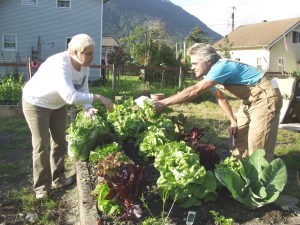
Cindy Westergaard, left, and Kerry MacLane pick lettuce from the St. Peter's Fellowship Farm community garden in August 2008

Cindy Westergaard, left, and Kerry MacLane pick lettuce from the St. Peter's Fellowship Farm community garden in August 2008

Last week we posted an item (click here to read it) seeking nominations for an informal survey about Sitka’s best gardens. We’ve had a few nominations come in, but it doesn’t hurt to remind everybody that the deadline to submit nominations is Wednesday, Aug. 12.

Check the original post linked above to see all the categories. You can nominate your own garden, or you can submit a neighbor’s garden (please double-check with them first). Hopefully we’ll be able to set up an informal garden tour, so other Sitka residents are inspired to grow their own gardens next year.

There are two ways to submit nominations. You can click the “Leave a Comment” link below and post it to this site (please keep them family rated and realize that all comments go to a moderator before they show up on the site). The other option is to e-mail the information to charles@sitkalocalfoodsnetwork.org. When you submit your nomination, please write a note about why you enjoy this garden and include the address since we might want to go take pictures and feature the garden on our site.

• Local foods articles in Capital City Weekly and Fairbanks Daily News-Miner

This week’s issue of Capital City Weekly, a free weekly newspaper distributed throughout Southeast Alaska, included four local food-related stories. The Fairbanks Daily News-Miner, a daily paper in Fairbanks, also has had a couple of local food-oriented stories the past couple of days. Here are some links to the articles.

Click here to read a Capital City Weekly article on a new community garden being built behind the Glory Hole homeless shelter in downtown Juneau.

Click here to read a Capital City Weekly article on the Montessori Borealis Adolescent Program’s vegetable garden project in Juneau’s Mendenhall Valley.

Click here to read a story about a couple of upcoming University of Alaska Fairbanks Cooperative Extension Service classes this weekend in Juneau about how to market specialty food products (geared toward people selling at farmers markets).

Click here to read a Capital City Weekly article on home canning of crab and geoducks by Sonja Koukel of the Juneau office of the UAF Cooperative Extension Service.

Click here to read a Fairbanks Daily News-Miner story from Wednesday’s paper from Roxie Rodgers Dinstel of the Fairbanks office of the UAF Cooperative Extension Service about how fireweed (which grows wild in Sitka) can add a subtle flavor to different meals.

Click here to read a Fairbanks Daily News-Miner story from Tuesday’s paper about how Fairbanks students are turning their schoolyards into blooming gardens as part of the EATING (Engaging Alaska Teens IN Gardening) program run by the Calypso Farm and Ecology Center. Click here to read more about the EATING program on the Calypso Farm site.

• Pete Karras, Mimi Goodwin win second Table of the Day Award

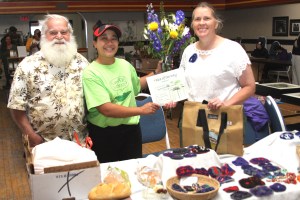
Pete Karras, left, of Pete's Sourdough Bread, and Mimi Goodwin, right, of Just Arts, receive the Table of the Day Award from Maybelle Filler for the second Sitka Farmers Market of the season

Pete Karras, left, of Pete's Sourdough Bread, and Mimi Goodwin, right, of Just Arts, receive the Table of the Day Award from Maybelle Filler for the second Sitka Farmers Market of the season

Pete Karras of Pete’s Sourdough Bread and Mimi Goodwin of Just Arts won the “Table of the Day Award” for the second Sitka Farmers Market of the season on Aug. 1.

The Sitka Local Foods Network selected the shared table — which featured Pete’s freshly baked sourdough bread and Mimi’s beaded artwork — to receive the $25 cash prize, an Alaska Farmers Market Association tote bag, a bouquet of flowers and a certificate of appreciation. An identical prize package will be awarded to a deserving vendor at each of the four remaining Sitka Farmers Markets.

The third market of the season takes place from 10 a.m. to 2 p.m. on Saturday, Aug. 15, at Alaska Native Brotherhood Hall. Keep your eye on this site for more information.

Also, a new photo gallery from the second Sitka Farmers Market has been posted on Shutterfly (an online photo-sharing site). Click this link to check out the photos.

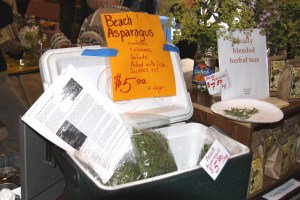
Gimbal Botanicals sold beach asparagus

Gimbal Botanicals sold beach asparagus

Kerry MacLane grills black cod for the Alaska Longline Fisherman's Association

Kerry MacLane grills black cod for the Alaska Longline Fisherman's Association

• This week’s e-newsletter (Aug. 2)

Here is this week’s Sitka Local Foods Newsletter courtesy of Linda Wilson. Don’t forget, you can sign up for the e-newsletter by typing your e-mail address in the box on the left side of the page.

Click here to read this week’s Sitka Local Foods Network e-newsletter.

• Vote for Sitka Farmers Market in the America’s Favorite Farmers Market contest

SitkaFarmersMarketSign

America's Favorite Farmers Markets

Do you enjoy the Sitka Farmers Market? If so, vote for us in the America’s Favorite Farmers Market contest sponsored by the American Farmland Trust, a non-profit organization dedicated to preserving America’s agricultural resources.

To vote, click here and then search for the Sitka Farmers Market by using the zip code or state directories. The deadline to vote is midnight EST on Saturday, Aug. 8 (8 p.m. Alaska time on Friday, Aug. 7). The online voting form asks what you like about the market, so be prepared to type something in the box. The top small, medium and large markets win a large quantity of “No Farms, No Food” totebags to distribute at a market in September.

By the way, the next Sitka Farmers Market is from 10 a.m. to 2 p.m. this Saturday, Aug. 1, at Alaska Native Brotherhood Hall (235 Katlian St.). We’re looking forward to seeing you at the market.

This weekend’s market will feature nearly 30 vendors with local fish, produce and arts and crafts. There also will be music on the stage by Ted Howard and friends, and the jam tent outside. As usual, there will be children’s activities.

If you have extra produce from your garden, the Sitka Local Foods Network table (outside by the Sitka Farmers Market sign) accepts donations and does buy some produce to sell at its booth. All money raised by the Sitka Local Foods Network booth goes into various projects sponsored by the 501(c)(3) non-profit group, including the Sitka Farmers Market, community gardens, the proposed Sitka Community greenhouse and other projects.

Click here to vote for the Sitka Farmers Market in the America’s Favorite Farmers Market contest

Click here to learn more about the America’s Favorite Farmers Market contest hosted by the American Farmland Trust

fm-flyer

• Gardening column reminds us time to harvest food is now

Anchorage Daily News garden columnist Jeff Lowenfels, a member of the Garden Writers Association Hall of Fame, in his column on Wednesday reminded us that the time to begin harvesting our vegetable gardens starts now. We don’t want to let any food go to waste on the ground. If we don’t want the food, there are others who do.

In his column, Lowenfels tells us which plants to harvest and how to do it, with special tips for broccoli, Kohlrabi, cauliflower, carrots and others. While geared toward the Anchorage audience, the column is worth a read for Sitka gardeners.

On a side note, Lowenfels is the garden columnist who first suggested the “Plant a Row for the Hungry” campaign, which encourages gardeners to plant an extra row or two of food that will be donated to local homeless shelters or food banks. He raised the idea in his column as a way to help out Bean’s Cafe, an Anchorage soup kitchen, and the Garden Writers Association liked the idea so well that they made it a national effort.

Click here to read the Anchorage Daily News gardening column by Jeff Lowenfels about the time to harvest is now

Click here to learn about the Garden Writers Association’s “Plant a Row for the Hungry” campaign

• UAF Cooperative Extension Service offers online resources for home canners

Salmon ready for canning in jars (Photo courtesy of University of Alaska Fairbanks Cooperative Extension Service)

Salmon ready for canning in jars (Photo courtesy of University of Alaska Fairbanks Cooperative Extension Service)

Did you catch a lot of fish this summer and now you want to can some of them to eat this winter? Do you want to make salmonberry preserves with all those lush, ripe salmonberries you picked this week?

The University of Alaska Fairbanks Cooperative Extension Service recently launched a series of interactive online demonstrations called “Preserving Alaska’s Bounty.” Want to learn how to can salmon using jars? Click on the link and you are taken to a page with photos and short descriptions mixed in with video clips to show you how to can your fish. There is an introduction and sections on equipment, preparation, packing, canning, cooling and storage. There also are links to additional resources.

If you want to learn about making jams and jellies, there’s an online demonstration on that topic. There also are demonstrations about canner basics, acidity, canning fish using cans, canning wild meats in jars and in cans, and more. Jeff Fay from the UAF Cooperative Extension Service said there also are DVDs that cover some of the same topics, and more titles are expected to be added to the site in the next year or two.

If you do a little bit of surfing around the UAF Cooperative Extension Service’s Web site, you’ll find all kinds of how-to materials. There are materials on gardening, recipes, home construction, food safety, winterizing your house and other topics.

If you can’t find what you need on the UAF Cooperative Extension Service site, other state land grant universities have their own version of the Cooperative Extension Service and most of their materials are available for download off the Internet. One of the attachments below is to a handout from the Iowa State University Cooperative Extension Service about how to freeze a variety of fruits and vegetables to maintain freshness and nutritional value.

Click here to go to the “Preserving Alaska’s Bounty” page on the University of Alaska Fairbanks Cooperative Extension Service Web site

Click here to go to a catalog of available DVDs from the University of Alaska Fairbanks Cooperative Extension Service

Click here to go to the main page for the University of Alaska Fairbanks Cooperative Extension Service

Click here to open an Adobe Acrobat PDF file of a handout on freezing fruits and vegetables from the Iowa State University Cooperative Extension Service

A batch of fruit is ready to be canned in jars (Photo courtesy of the University of Alaska Fairbanks Cooperative Extension Service)

A batch of fruit is ready to be canned in jars (Photo courtesy of the University of Alaska Fairbanks Cooperative Extension Service)

• How does your garden grow?

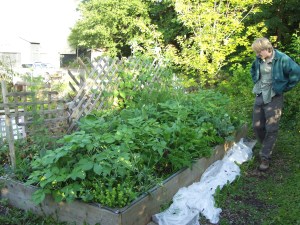
Doug Osborne checks out the WISEGUYS men's health group's plot at the Blatchley Community Gardens in August 2008

Doug Osborne checks out the WISEGUYS men's health group's plot at the Blatchley Community Gardens in August 2008

Now that we’re well into the garden season, it’s time to take an informal survey to find out who is growing the best gardens in Sitka.

Does your neighbor have an incredible garden? Do you think your own garden looks pretty impressive? Then look for the “Leave A Comment” link below this story and post a nomination. Tell us why you think the nominated garden is one of Sitka’s best, and don’t forget to tell us the address (NOTE: if you’re nominating a neighbor, please double-check with them to make sure they want their garden nominated). The Sitka Local Foods Network is focussed on food production, but there is a category for flower gardens.

Hopefully we’ll get enough nominations so we can create an informal garden tour of Sitka to show how people are growing their own food. At some point, a few of the better gardens might be featured here with photos.

Here are some categories to consider:
• Best of show (top overall gardens in Sitka)
• Widest variety of food (most different kinds of food)
• Most productive garden (which garden produces the most food)
• Best looking food garden (for productive gardens that really look nice)
• Most unique plants (who grows stuff in Sitka nobody else grows)
• Best use of limited space (for apartment dwellers and container gardens)
• Best greenhouse
• Best flower garden

Again, click on the “Leave a Comment” link below to nominate your favorite Sitka gardens (all comments are moderated so there may be a delay before comments appear on the page). Those of you who don’t want to deal with the comment function on this site can e-mail nominations to charles@sitkalocalfoodsnetwork.org, then I’ll post them on the site. Please help us recognize the best gardens in Sitka.

(NOTE: Please be respectful of others when leaving comments. Any comments that are excessively negative or those that are worse than a PG rating will be deleted. This is site a place to encourage others, and we want to keep things family friendly. Thanks)

• Saturday’s Sitka Farmers Market leads into National Farmers Market Week

SitkaFarmersMarketSign

This Saturday’s second Sitka Farmers Market of the season will serve as the perfect lead-in for National Farmers Market Week next week.

The Sitka Farmers Market takes place from 10 a.m. to 2 p.m. on Saturday, Aug. 1, at the Alaska Native Brotherhood Hall (235 Katlian St.) and in the adjoining parking lot owned by the Baranof Island Housing Authority. Recently U.S. Secretary of Agriculture Tom Vilsack proclaimed Aug. 2-8 of this year as the 10th annual National Farmers Market Week.

“Farmers markets are good for everyone,” says Stacy Miller, Executive Director of the Farmers Market Coalition, a non-profit organization supporting farmers markets across the country. “They are good for your health, good for your community and good for the economy. Not to mention, farmers markets offer the freshest foods from America’s most entrepreneurial farmers and they preserve our country’s agricultural traditions.”

“The Sitka Farmers Market offers unique varieties of fresh, nutritious food at the peak of flavor, creates a vibrant community gathering place, and provides the opportunity for learning about healthy life choices and local products,” says Linda Wilson, Sitka Farmers Market Co-Coordinator.

The Sitka Farmers Market started last year as a project from the 2008 Sitka Health Summit. We hosted three successful markets last year, and this year we have five on the schedule with Saturday’s being the second of the summer. Even though the Sitka Farmers Markets are new, they’ve quickly become community gathering points whenever they’re held, and ANB Hall is packed with people.

The Sitka Farmers Market features about 20-25 vendors each market who sell locally grown produce, locally harvested fish and locally made arts and crafts. Local musicians perform on the stage inside ANB Hall and in the jam tent outside, local cooks make ready-to-eat dishes and there are activities for the children. The Sitka Farmers Market is the only farmers market in Southeast Alaska authorized to accept WIC vouchers, which can be used by WIC-eligible families to purchase produce.

Booths are available for Saturday’s market for a nominal $5 each, but the emphasis is on locally produced food and arts and crafts. For more information about this week’s market, contact Linda Wilson at 747-3096 (nights) or lawilson87@hotmail.com, or contact Kerry MacLane at maclanekerry@yahoo.com.

Click this link to learn more about the Farmers Market Coalition and why farmers markets are becoming more important in America.

The Gimbal Botanicals booth at the July 18 first Sitka Farmers Market of the season.
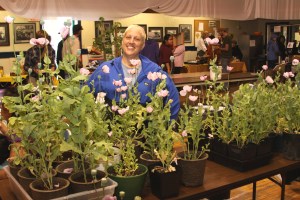
The Gimbal Botanicals booth at the July 18 first Sitka Farmers Market of the season.

Cindy Westergaard sells plants at the July 18 Sitka Farmers Market

Cindy Westergaard sells plants at the July 18 Sitka Farmers Market
• Healthy Wrangell Coalition hopes to build a community garden

Some of our neighbor communities also are looking for ways to get more local foods into their diets. Last week, KSTK-FM in Wrangell ran a story about the Healthy Wrangell Coalition’s goal of building a community garden in Wrangell. A couple of days later, there was a follow-up story about the project receiving a $5,000 start-up grant from the SEARHC Steps to a Healthier SE Alaska program.

Here’s wishing Wrangell well with the project. We can use more locally grown food in all Southeast Alaska communities.

By the way, Wrangell and Kake both recently launched new WISEFAMILIES Through Customary and Traditional Living health and wellness programs, which are modeled after a similar WISEFAMILIES program in Klukwan that’s been around for a couple of years. These programs feature culture camps where residents learn how to harvest and preserve traditional subsistence foods, learn Tlingít language, tell stories and learn other traditional activities such as carving and weaving. The more established program in Klukwan includes a community garden and a potato patch as part of its offerings, and Kake also is working on building a community garden. The three WISEFAMILIES programs are partnerships between the SEARHC WISEWOMAN Women’s Health Program and the local tribes in each community (Wrangell Cooperative Association, Organized Village of Kake and Chilkat Indian Village).

Click here to listen to the first KSTK-FM radio story about building a Wrangell community garden (note that link has streaming audio, so adjust your volume accordingly)

Click here to listen to the follow-up KSTK-FM radio story about the $5,000 start-up grant for the project (link also has streaming audio)

Click here to learn more about the Healthy Wrangell Coalition