
• The Garden Show returns to KCAW-Raven Radio spring programming lineup

KittyLaBountyAndMollieKablerKCAWGardenShow

,


For more than 20 years, Mollie Kabler and Kitty LaBounty have taken to the airwaves during the spring months for The Garden Show on KCAW-Raven Radio.

The show returned to the programming lineup earlier this month and airs from 5:30-6 p.m. on Saturdays from April through June, or longer into the summer if work schedules permit. Topics include timely tasks for gardening in Southeast Alaska, taking on-air questions, and themes around basic and more advanced gardening of vegetables, flowers, fruit, etc.

Mollie and Kitty both have been gardening in Sitka for more than 25 years, and they also have gardening experience from their childhoods in Wisconsin (Mollie) and Oregon (Kitty). They both have passed the Master Gardener classes offered by the University of Alaska Fairbanks Cooperative Extension Service.

To call the show with gardening questions, call 747-5877 between 5:30-6 p.m. on Saturday.

• Sitka Tribe of Alaska starts testing for paralytic shellfish poisoning (PSP) and other marine biotoxins

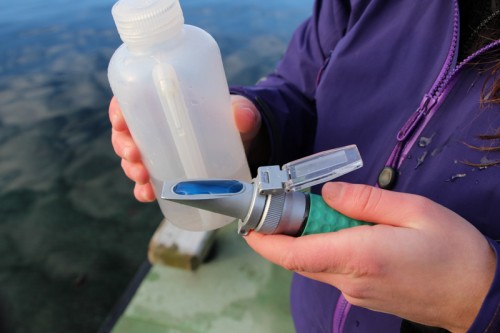
Esther Kennedy of the Sitka Tribe of Alaska Resource Protection Department samples water near the Starrigavan Recreation Area dock for marine biotoxins such as paralytic shellfish poisoning. (Photos by Emily Kwong, KCAW-Raven Radio)

Esther Kennedy of the Sitka Tribe of Alaska Resource Protection Department samples water near the Starrigavan Recreation Area dock for marine biotoxins such as paralytic shellfish poisoning. (Photos by Emily Kwong, KCAW-Raven Radio)

PSPTestingEquipmentThe Sitka Tribe of Alaska and its other tribal partners in Southeast Alaska have begun testing for paralytic shellfish poisoning (PSP) and other marine biotoxins.

The first-year testing program was detailed in a March 24 story on KCAW-Raven Radio, with each of the tribal partners concentrating on one particular spot in their communities (at Starrigavan Recreation Area in Sitka, where two people were sickened in October 2013) as the tribal testers become more comfortable with the testing procedures. Once the technicians become more proficient, and the regional testing lab is built, the program will be expanded to other beaches in Southeast Alaska. The second part of the two-part series aired on April 9 and discussed the benefits to commercial shellfish operations of having a lab in Southeast Alaska.

The Southeast Alaska Tribal Toxins (SEATT) program to study harmful algal blooms was announced in October, and Sitka Tribe of Alaska hosted a regional training in November. SEATT partners include Sitka Tribe of Alaska, the Klawock Cooperative Association, Craig Tribal Association, Yakutat Tlingít Tribe, Petersburg Indian Association, Organized Village of Kasaan, and the Central Council of Tlingít and Haida Indian Tribes of Alaska (CCTHITA). In addition to the grant to create the partnership, Sitka Tribe of Alaska also received a second grant to create a regional lab in Sitka to help monitor HABs in Southeast Alaska.

Harmful algal blooms, such as paralytic shellfish poisoning (PSP), typically have not been monitored in Southeast Alaska for subsistence and recreational harvesters of clams, mussels, oysters, cockles, and other bivalves (commercial harvests are tested). Even though many people in Southeast Alaska love to harvest shellfish, eating it comes with some risks. There have been several PSP outbreaks in recent years that sent people to the hospital, and in 2010 two deaths were attributed to PSP and other HABs, such as Alexandrium, Pseudonitzchia and Dinophysis.

Being able to put trained monitors in several Southeast Alaska communities, the hope is the health risk can be reduced. Each technician will make weekly reports to the lab, which will help harvesters have better information as to the safety of their shellfish.

• Wilcox family of Sitka completes cross-country run from California to New Jersey to raise awareness about GMOs in our food

WilcoxFamily25thAnniversary

WilcoxFamilyRunMapAfter nearly 3,000 miles and six months of running, the Wilcox family from Sitka reached its finish line Saturday, July 19, in Ocean City, N.J., to complete its cross-country run across the country to raise awareness about genetically modified organisms (GMOs) in our food system and the roles of large agribusiness companies, such as Monsanto, in making it difficult for consumers to know which food contains GMOs.

Fifteen-year-old David Wilcox decided he wanted to run across country back in 2010, when he read about another teenage runner to complete the USA crossing, so he and his father, Brett, 53, started training. In January, Brett quit his job as a behavioral health clinician and David’s mom, Kris, put her cleaning business on hold, and the family rented out its home in Sitka. Brett and David started the run on Jan. 18 in Huntington Beach, Calif., and started running about 20 miles a day, six days a week. While Brett and David ran, Kris and David’s younger sister, Olivia, 13, drove ahead on the course in the used pick-up truck and trailer the family purchased for the trip. Along the way, Brett and David took turns pushing a runner’s stroller loaded with their supplies for the day, water bottles, lunch, some GMO-free lettuce seeds, GMO literature, a few copies of Brett’s book, We’re Monsanto: Feeding the World, Lie After Lie, Book One, and the 15-year-old family dog, Angel. (Note, after awhile, Angel decided she didn’t like riding in the stroller and preferred riding in the truck, so the Wilcox family adopted a new dog, Jenna, while in Texas.)

DavidAndBrett“Being able to run 20 miles with David is a good thing,” Brett said. “Running with him for 20 miles a day, day after day for six months across 13 states is a great thing. I got to know David far better than I would have in our routines back in Sitka. I have a lot of respect for David for sticking with it even when it was tough going. Of course our run would not have been possible if Kris and Olivia had not been there to support us. Our last day’s run included a big radio interview and a police escort to the beach. Kris and several other runners joined in and ran with us. We passed through a cheering crowd as we entered the boardwalk. It was a special moment. Of course, the fact that Kris and I celebrated our 25th wedding anniversary on the same day we finished our run gave the whole occasion a fairy tale sort of ending.”

The Wilcox family decided to use the run to raise awareness about our food supply because the family is vegetarian, and they don’t like seeing more GMOs enter the food supply, and consumers not being able to find out which foods have GMOs. “Running For a GMO Free USA was the perfect cause for us. We learned that virtually all people — regardless of location — oppose chemically-saturated genetically modified organisms,” Brett said.

Trying to find GMO-free food on the run did become an issue for the family, and for part of the trip they stopped eating corn tortillas because of how much of our nation’s corn now has GMOs (they did find some Navajo corn tortillas they decided to try). GMOs also are in soy, sugar beets, and several other plants, and they may soon be coming to potatoes used by large fast food corporations. Along the way, the Wilcox family passed through St. Louis just in time to participate in the annual March Against Monsanto (an international event on May 24 this year) right outside Monsanto headquarters. Last year, the Wilcox family hosted a March Against Monsanto event in Sitka.

BrettWilcoxAtMonsantoHeadquartersWhen they planned the run, the Wilcox family hooked up with several anti-GMO groups across the country, and those groups helped connect the family to local media outlets and runners where they could spread their message. The anti-GMO groups helped the Wilcox family raise some funds and find places to stay for the trip, and there were two Indiegogo crowd-funding campaigns coordinated by Owen Kindig of Sitka (the first campaign raised $7,500 when it closed in January, and the current campaign still has 40-plus days left to run and has raised roughly $1,400). Along the way, Brett and Kris regularly updated the family’s Running the Country blog and Facebook page. Different media groups covered the run (here’s a link to our story before the run), and the media coverage increased as Brett and David neared the finish line. In recent weeks there has been coverage from small media outlets and large ones, such the Philadelphia Inquirer and Runner’s World magazine. Here is a link to the KCAW-Raven Radio story that aired July 21 about the Wilcox family run.

DavidWHIZNewsInterviewBrett and David trained for the run, but soon realized their training was a little lacking in LSD (long, slow, distance) runs. David won the Southeast Conference (Region V) cross-country running title in October, but most of his runs during the season were about five miles. Brett, a regular bike commuter, also ran shorter distances, and he and David had one or two longer runs a week. Running 20 miles a day, six days a week resulted in a lot of blisters, several worn-out pairs of shoes, and a couple of injuries along the way. Brett was hobbled early in the run by a bad foot, David had a bad leg, and Brett said he plans to have minor surgery in the near future for another injury.

“I had a couple of months where I couldn’t run, so instead I just walked,” David said. “Probably the best day for me was the day the fourth chiropractor fixed me. He was really nice to us, he let us take a shower. I told him where it hurt, and he told me what was wrong and he told me he was going to fix it and I was sort of wondering if he could really fix it. A muscle that’s supposed to be on the inside of my hip was on the outside. He pulled it over and told me I was fixed. Then he adjusted something else that I didn’t even know was wrong. He also worked on my mom and dad.”

As the miles piled up, the Wilcox family enjoyed the scenery. But sometimes the weather was a bit too hot for folks used to a temperate rain forest and then there were the ticks.

“Pennsylvania was probably the most beautiful state, but I could never live there because it’s too hot and humid,” David said. “I can’t wait to get back to Sitka so I can run the trails and not have to worry about ticks.”

WilcoxFamiyFinishesCrossCountryRunNow that the Wilcox family is done with the run, the next plan is to go to Washington, D.C., to talk with members of Congress and various agencies about GMOs. They already have meetings scheduled with Rep. Don Young and Sen. Lisa Murkowski, and hope to add a meeting with Sen. Mark Begich. “It will be fun to pass on to them what we learned from our cross-country run,” Brett said.

The family also will be doing more fundraising to help pay for the trip. “Our run is now over but we’ve spent far more than we’ve received from donations,” Brett said. “If you’d like to help us out with our expenses, please donate online at RunningTheCountry.com or at Indiegogo.com. The name of our Indiegogo fundraising campaign is ‘Help the Wilcox Family Finish Strong.’ Thanks to all the people who have helped us help David achieve his big dream to run across the USA.”

• Alaska State Parks now requires special permit to harvest seaweed at Halibut Point Recreation Area

BeachSeaweed

Because of a major increase in the collection of seaweed from Halibut Point Recreation Area for gardens and compost, the Alaska Division of Parks and Outdoor Recreation (aka, Alaska State Parks) is limiting the amount residents can remove in order to continue to provide reasonable qualities for all users.

Alaska State Parks has permitted collection of seaweed washed ashore at Halibut Point Recreation Area for many years. However, effective immediately a special-use permit is required to collect seaweed at Halibut Point Recreation Area. Commercial use will not be permitted.

Special-use permits are required for any vehicle access to Halibut Point Recreation Area due to increased damage to park terrain. Seaweed collection will be allowed for anybody willing to walk in and not use a vehicle. KCAW-Raven Radio recently ran this story, which provides more information about the new policies.

The Sitka Park office, which is located at the recreation area, is open 8 a.m. to 4 p.m. weekdays, but staff is often away from the office. Residents should make an appointment to obtain a seaweed special-use permit in advance of using it, at least a day prior to collecting, by calling state parks at 747-6249. Please note that those people needing a permit on a weekend should call during the week so staff can be available to open the gate. There is no charge for the permit. The access gate will be locked starting April 12. Gatherers are asked to limit the amount of seaweed they take.

Alaska State Parks said it appreciates the public’s cooperation in the implementation of the seaweed collection special-use permit. Access to Halibut Point Recreation Area for the disabled to get to the picnic and day use area will continue to be accommodated as quickly as possible, the park said. Contact park staff for more information.

• Alaska State Parks special-use permit for seaweed gathering at Halibut Point Recreation Area

• The Garden Show returns to KCAW-Raven Radio spring programming lineup

KittyLaBountyAndMollieKablerKCAWGardenShow

Kitty LaBounty, left, and Mollie Kabler have been hosts of The Garden Show on KCAW-Raven Radio for more than 20 years. (Photo courtesy of KCAW-Raven Radio)

For more than 20 years, Mollie Kabler and Kitty LaBounty have taken to the airwaves during the spring months for The Garden Show on KCAW-Raven Radio.

The show returned to the programming lineup earlier this month and airs from 5:30-6 p.m. on Saturdays from April through June, or longer into the summer if work schedules permit. Topics include timely tasks for gardening in Southeast Alaska, taking on-air questions, and themes around basic and more advanced gardening of vegetables, flowers, fruit etc.

Mollie and Kitty both have been gardening in Sitka for more than 25 years, and they also have gardening experience from their childhoods in Wisconsin (Mollie) and Oregon (Kitty). They both have passed the Master Gardener classes offered by the University of Alaska Fairbanks Cooperative Extension Service.

To call the show with gardening questions, call 747-5877 between 5:30-6 p.m. on Saturday.

• Pacific High School receives national recognition for locally sourced school lunches

Pacific High freshman Oleana Valley makes lunch for her classmates as AmeriCorps volunteer Abby Long plans future recipes. (KCAW photo/Emily Forman)

Pacific High freshman Oleana Valley makes lunch for her classmates as AmeriCorps volunteer Abby Long plans future recipes. (KCAW photo/Emily Forman)

The Pacific High School lunch program, which recently received statewide recognition in the 2013 Alaska Farm To School Challenge, now is receiving national attention for its locally sourced school lunches.

The student lunches from the Sitka alternative high school recently were featured in an article in USA Today about what America’s school lunches look like.

They also were featured in a KCAW-Raven Radio story about the recent recognition. The KCAW article touched on how much the students gained by picking locally sourced ingredients from Sitka over box-packaged items to make their food.

• A 2010 Sitka Health Summit project starts to bear fruit

RedApplesKCAW

GreenApplesKCAWOne of the 2010 Sitka Health Summit community wellness projects was to plant a bunch of apple, crabapple and cherry trees around town as a way to provide fresh fruit for people as they wander about Sitka.

When we planted the trees, we knew it would take a couple of years before we started seeing any fruit. Several of the trees were planted on public land, with several Sitka residents also buying the saplings to plant at their homes and offices.

On Tuesday, Sept. 10, a couple of the trees planted in front of the historic Cable House (home of the KCAW-Raven Radio station and the Larkspur Café) were full of apples, even though a couple of weeks earlier it didn’t appear these smaller trees had any fruit.  It’s nice to see some of the trees are producing.


• KCAW-Raven Radio reports on how Sitka residents can double down on EBT benefits at the Sitka Farmers Market

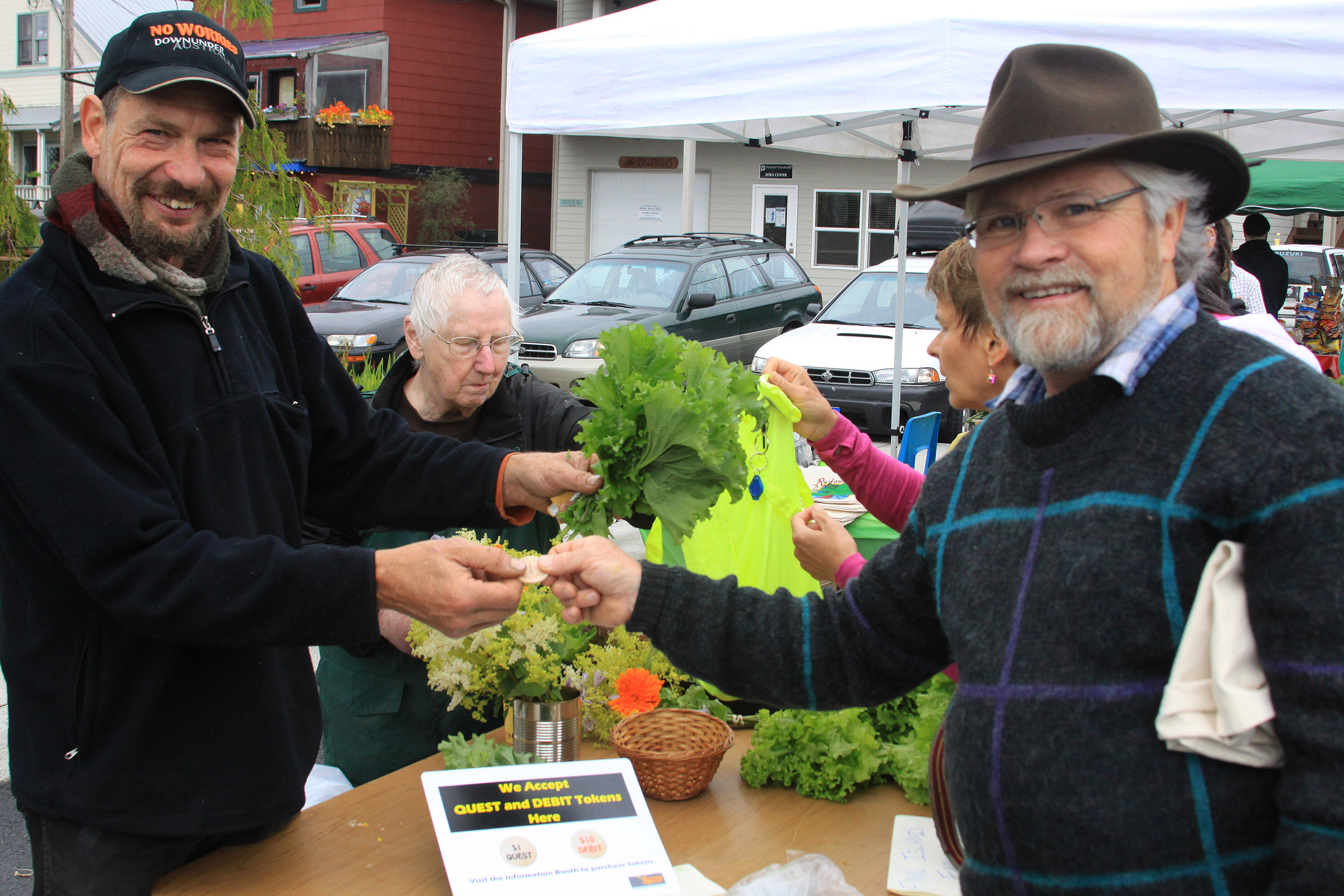
Mira Vale staffs the EBT Quest Card table at the Aug. 3, 2013, Sitka Farmers Market

Mira Vale staffs the Alaska Quest Card/EBT benefits table at the Aug. 3, 2013, Sitka Farmers Market

The Friday, Aug. 9, 2013, newscast on KCAW-Raven Radio featured a story about how Sitka residents on food stamps can double their Alaska Quest Card/EBT benefits at the Sitka Farmers Market.

The Alaska Quest Card is an EBT, or Electronic Benefits Transfer, program that helps people on food stamps pay for food at local grocery stores. Their monthly EBT benefits are loaded onto their Alaska Quest Card, and an amount is deducted from the card each time they buy food.

Starting last year, the Sitka Farmers Market joined several Alaska farmers markets in accepting Alaska Quest Cards/EBT benefits, and this year the number of markets accepting EBT has grown to 11 markets in Alaska. Since many farmers market vendors aren’t set up to accept charge cards, people on EBT benefits can use their cards to buy tokens (wooden nickels) at a booth at the Sitka Farmers Market, and they then can use the tokens to purchase fresh food from participating vendors.

The Alaska Quest Card/EBT booth also sells a second type of token that people not on EBT benefits can use to purchase food and other items (including arts and crafts) from participating vendors. This second token allows vendors who aren’t set up for credit/debit cards to still make sales.

Kerry MacLane uses a token to purchase produce from Sitka Farmers Market vendor Keith Nyitray during the Aug. 3, 2013, Sitka Farmers Market.

Kerry MacLane uses a token to purchase produce from Sitka Farmers Market vendor Keith Nyitray during the Aug. 3, 2013, Sitka Farmers Market.

The KCAW story focused on Sitka resident Stacie Joseph, who uses EBT benefits to help pay for her food for her four kids while she attends school. Because of a grant from the state, various Alaska farmers markets are able to provide double the benefits for people using EBT benefits. For example, if someone wants to use $20 of their EBT benefits, they’ll receive $40 worth of tokens. Joseph said the doubled benefits mean that in addition to providing healthy fresh produce for her family, she can have more money available to use on her health management classes at the University of Alaska Southeast-Sitka Campus, helping her improve her earning potential.

“This program improves access to fresh, local foods to community members who are struggling financially.  Additionally, the program helps increase understanding of food insecurity issues in our community and how produce and other food vendors can be part of the solution,” said Lisa Sadlier-Hart, president of the Sitka Local Foods Network board of directors, which hosts the Sitka Farmers Markets.

• Invasive and damaging insect, the green alder sawfly, found in Sitka

GreenAlderSawflyAdult

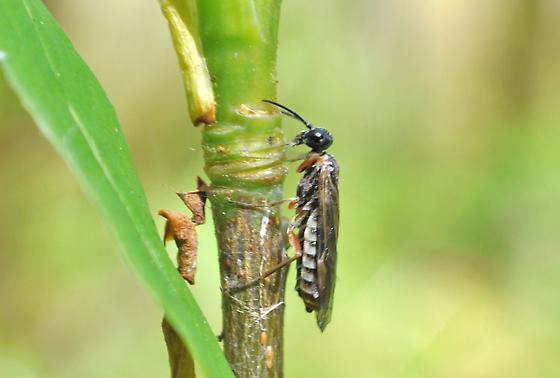
GreenAlderSawflyLarvaFor the first time, an invasive insect called the green alder sawfly (Monsoma pulveratum) has been found in Sitka. This insect is considered a danger to alder trees in Sitka and other Southeast wetlands.

“Several days ago a positive identification has been made on the green alder sawfly in Sitka,” Bob Gorman, resource development faculty with the Sitka office of the University of Alaska Fairbanks Cooperative Extension Service, wrote in an e-mail sent to Sitka and Southeast gardeners, “This invasive, exotic insect has defoliated alder trees in Anchorage and surrounding areas. It is a potentially serious threat to alder in southeast Alaska. The attached fact sheet (linked at the bottom of this post) provides details on the green alder sawfly. Distribute this information as you see fit. Thanks.”

The green alder sawfly is native to Europe and North Africa, and its preferred diet is European gray alder. It was first reported in North America in 1995 in Newfoundland, Canada. In 2004 it was first collected in Alaska near Palmer. Since 2007, the green alder sawfly has been documented defoliating thin-leaf alder (Alnus glutinosa) in numerous locations in Southcentral Alaska, eliminating alder in some watersheds. The green alder sawfly has been found in red alder (Alnus rubra) trees along Sawmill Creek Road, Halibut Point Road and Jarvis Street.

On Friday, KCAW-Raven Radio aired a story about the green alder sawfly with more details from Gorman and USDA Forest Service entomologist Liz Graham, who flew to Sitka from Juneau after Gorman sent her photos of the insect’s caterpillars.

Please report any known or suspected infestations of green alder sawfly to the Sitka office of the UAF Cooperative Extension Service by calling 747-9440 or stopping by the office located in Room 122 at University of Alaska Southeast Sitka Campus. GPS (global positioning system) coordinates of known locations of the green alder sawfly will help in determining the extent of this insect, which probably overwintered in Sitka.

• Green Alder Sawfly: A Threat to Sitka and Southeast Watersheds flier from the UAF Cooperative Extension Service


• Deadline extended on Sitka Community Food Assessment to get more completed surveys

SitkaCommunityFoodAssessmentSign2

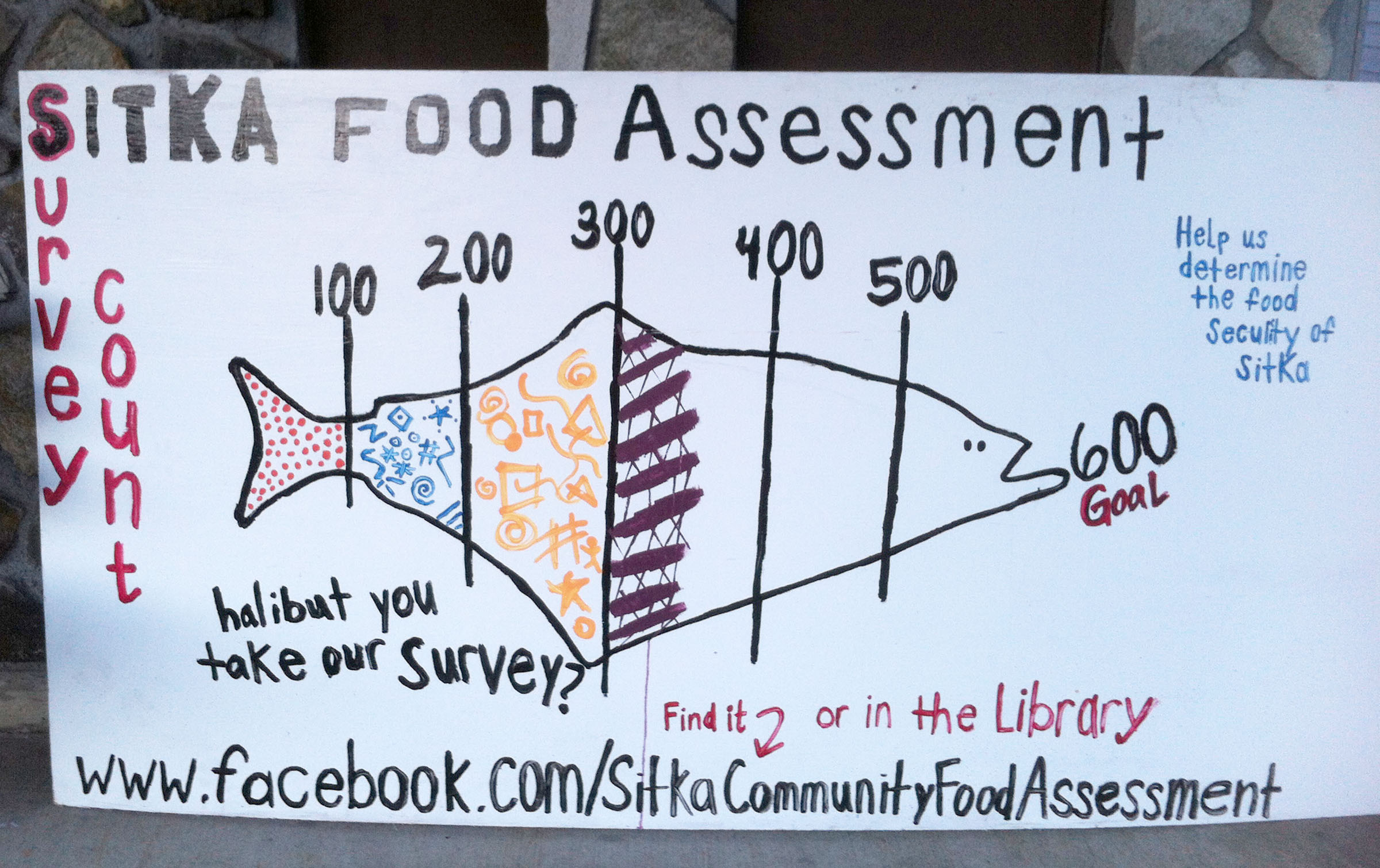
The deadline for surveys to be completed in the Sitka Community Food Assessment has been extended to the end of the month. Our goal is 600 completed surveys and as of Tuesday, May 21, we had 392 that had been recorded.

The Sitka Community Food Assessment is a 2012 Sitka Health Summit project designed to help shape food policy and improve Sitka’s food security. To learn more about the project, KCAW-Raven Radio hosted an interview with project coordinator Lisa Sadleir-Hart that aired on Monday, May 20.

Additional information can be found in this March 26 post on the Sitka Local Foods Network website, and in this April 9 article from the Daily Sitka Sentinel.

Surveys are available online at https://www.surveymonkey.com/s/MQTF22Q, or click the Sitka Community Food Assessment logo in the right column of this webpage. Printed copies are available at Kettleson Memorial Library. A sign has been posted at the corner of Lincoln and Lake streets to update people on the progress of the project.