• Sitka Conservation Society publishes resource guide for statewide Fish to Schools programs

Serving Local Fish in School Cafeteria_Page_01

The Sitka Conservation Society, which coordinates Sitka’s Fish to Schools program, has published a new resource guide, A Guide to Serving Local Fish in School Cafeterias, to help other school districts around the state implement similar programs in their communities.

F2S_Elementary2The Sitka Fish to Schools program came out of the 2010 Sitka Health Summit, when local residents chose as one of its community wellness projects to serve more local seafood in our schools. Since then the program has grown so that all students from Grades 2-12 in Sitka have a local seafood lunch option at least twice a month. This includes the Sitka School District schools, Keet Gooshi Heen Elementary School, Blatchley Middle School, Sitka High School, and Pacific High School, plus other local schools, the state-run boarding school Mount Edgecumbe High School and the private K-8 The SEER School.

Sitka is one of the first districts in the state to serve local seafood through the National School Lunch Program and has become a leader in the State of Alaska in getting local foods into schools. In the last three years, the number of schools interested in serving local seafood has increased ten-fold. Haines, Dillingham, Kodiak, Galena, and Juneau are a few of the districts that are now serving seafood in their meal programs.

In an effort to support regional and statewide efforts to serve local foods in schools, the Sitka Conservation Society developed a “how-to” guide to serving fish in schools. Using Sitka as a case study, it outlines procurement and processing strategies, legalities, tips, and recipes. Also included are case studies from around the state that offer tips and suggestions based on the success of their programs.

F2S_Elementary3The Sitka Fish to Schools program has seen an increase in meal participation on fish lunch days, likely attributed to the participation of students who typically bring a sack lunch. One student who reported never liking fish started to eat fish after a local chef came to her classroom. Others students circle fish lunch dates on their school lunch calendar, refusing home lunch that day. And why are they so excited? A middle school student put it this way, “It’s healthy and good for you and you feel good after you eat it.” Others give reasons of wanting to become a fisherman or cite the economic value to their community.

In addition to this guide is the “Stream to Plate” curriculum, a unit of seven lessons that connect salmon to the classroom. The lessons address the ecological significance and human relationship to salmon. These lessons have been tried and refined the last three years with third graders at Keet Gooshi Heen Elementary School.

Chris Bryner, teacher and collaborator on the salmon unit said, “The Fish to Schools curriculum connects my classroom to the community. Students not only learn about a resource relevant to their daily lives, but come away with an understanding that learning happens inside and outside of school.”

As the ninth largest seafood port in the country, Sitka is paving the way for locally-sourced meals. Their efforts are part of a larger national movement, Farm to School, to get local foods in schools. The Alaska Farm to School program honored Sitka’s Fish to Schools program for its innovation a couple of years ago.

celebrate fish to state“The beauty of Fish to Schools is that it provides a practical, local solution to a multitude of current global issues,” Fish to Schools Co-Founder Lexi Fish said. Local sourcing reduces the environmental impact of foods grown and raised thousands of miles away and ultimately supports a more resilient food system.

Local fish in school lunches not only tastes “delicus” (stet), as one third grader put it, but also addresses food justice, nutrition, community sustainability, and conservation. To get a free copy of the guide and curriculum, visit http://sitkawild.org/2014/03/a-guide-to-serving-local-fish-in-school-cafeterias/ or contact Sitka Conservation Society Community Sustainability Organizer Tracy Gagnon at 747.7509 or tracy@sitkawild.org.

Also, don’t forget to stop by the Celebrate Fish to State event from 6:30-7:30 p.m. on Thursday, March 20, at Blatchley Middle School to learn more about the efforts to expand the Fish to Schools program statewide.

• Kayaaní Commission accepting letters of interest for commissioners.

Devils-Club__SE-Alaska1

Sitka Tribe of Alaska‘s Kayaaní Commission is accepting letters of interest to fill two open commissioner seats — a three-year term tribal citizen seat, and a one-year term general membership seat.

The Kayaaní Commission works to preserve and protect plants and the traditional ways they are used. It is a commission of knowledgeable tribal citizens, elders and knowledgeable Sitka residents who care for the preservation of traditional ways, protection of native species and their uses. The commission then shares that knowledge so it is not lost. A few years ago, the Kayaaní Commission published The Kayaaní Commission Ethnobotany Field Guide to Selective Plants in Sitka, Alaska, which details some of the food and medicinal uses of a variety of local plants.

For the open commission seats, the term “tribal citizen” shall mean any individual enrolled at the Sitka Tribe of Alaska, and the term “general membership” of the Kayaani Commission shall mean all tribal citizens and residents of Sitka who have resided here for at least six months. Deadline is close of business on Friday, March 28.

Please mail or hand deliver letters of interest to the STA’s Resource Protection Department, 456 Katlian Street, Sitka, AK 99835, Attention: Heather Riggs, or email letters to heather.riggs@sitkatribe-nsn.gov. For more information, please contact Heather @ 747-7167.

• Celebrate Fish to State takes place on March 20 to support statewide Fish to Schools program

celebrate fish to state

SCSCohoPortionsForCookingSitka’s Fish to Schools program has been extremely successful the past three years, and now there’s a movement to make similar programs available statewide. Join us from 6:30-7:30 p.m. on Thursday, March 20, at Blatchley Middle School as we celebrate Fish to State.

This event will celebrate the success of the Sitka Fish to Schools program, which is coordinated by the Sitka Conservation Society and other partners. The event will include short presentations from Sitka School Board President Lon Garrison, Sitka Local Foods Network President Lisa Sadleir-Hart, and Sitka Conservation Society Community Sustainability Organizer Tracy Gagnon. Light refreshments will be available.

The Sitka Fish to Schools program came out of the 2010 Sitka Health Summit, when local residents chose as one of its community wellness projects to serve more local seafood in our schools. Since then the program has grown so that all students from Grades 2-12 in Sitka have a local seafood lunch option at least twice a month. This includes the Sitka School District schools, Keet Gooshi Heen Elementary School, Blatchley Middle School, Sitka High School, and Pacific High School, plus other local schools, the state-run boarding school Mount Edgecumbe High School and the private K-8 The SEER School. The award-winning program has served as a model for a handful of other school districts in Alaska, and now there is a push to make it available statewide with a full curriculum and resource guide, plus financial support.

For more information, contact Ray Friedlander of the Sitka Conservation Society at 747-7509 or ray@sitkawild.org.


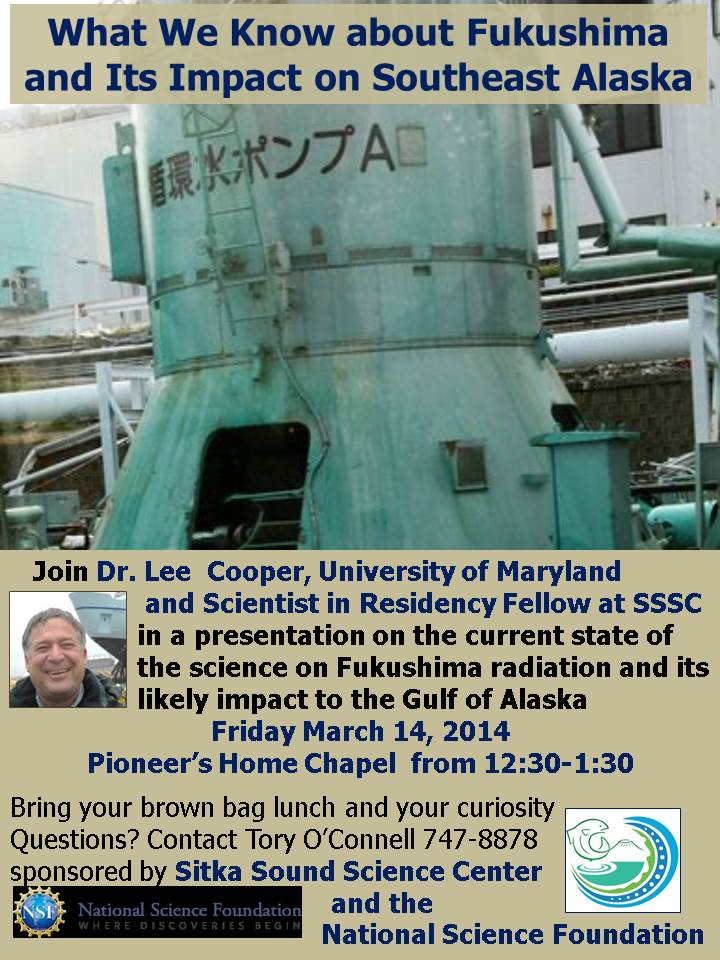
• Sitka Sound Science Center presentation will shed light on impacts of Fukushima radiation in the Pacific Ocean

cooperFukushima

People living along the Pacific Coast, including in Sitka and Southeast Alaska, have been wondering about the impacts of radiation in the food supply ever since the March 2011 earthquake in Japan and Fukushima Dai-ichi nuclear power plant meltdown.

Dr. Lee Cooper of the University of Maryland, a Scientist in Residency Fellow at the Sitka Sound Science Center, will discuss the current state of the science on Fukushima radiation and its likely impact on the Gulf of Alaska during a brown-bag lunch presentation from 12:30-1:30 p.m. on Friday, March 14, at the Sitka Pioneer Home Chapel. Bring your lunch and questions to the presentation, which is sponsored by the Sitka Sound Science Center and the National Science Foundation.

According to the Sitka Sound Science Center:

It is projected that dissolved contaminants, particularly the radioactive isotopes of cesium, 137Cs and 134Cs from the Fukushima Dai-ichi Nuclear Power in Japan, will reach Southeast Alaska this year.  Because the amount of radiation released is uncertain and the accident site is still leaking to some extent, it is difficult to know exactly what the peak concentrations of radioactive cesium will be in local waters, but it is not likely to exceed levels that were observed during the bomb fallout era 40 to 50 years ago. Cesium is chemically very similar to potassium, which is a common ionic salt in seawater, so fortunately the concentration of cesium into the foodweb and into seafood harvested for food is comparatively modest.

Nevertheless, it is important to put into perspective the potential risks involved and communicate this to the public. This talk will summarize the newest scientific information that is available on the impacts of the accident, based upon a special session held in late February at the Ocean Science Meeting in Honolulu and attended by scientists studying Fukushima impacts, ranging from Japan and East Asia to the Woods Hole Oceanographic Institution.

For more information, contact Tory O’Connell at 747-8878.


• Sitka Maritime Heritage Society annual meeting features stories of harvesting and sharing foods from our local waters and shores

annual meet 2014 web

Local food will be the focus when the Sitka Maritime Heritage Society holds its annual meeting on Tuesday, Feb. 25, at the Sheet’ká Kwáan Naa Kahídi. The meeting’s program topic is Harvesting and Sharing Foods from our Waters and Shores: Stories of Sitka’s Oldest Family Tradition. There will be mingling and refreshments starting at 6:30 p.m., with the program running from 7-9 p.m.

The meeting’s format, as in past years, is to have a panel of individuals with stories and experiences to share about the topic. In the second half of the program, the floor will be opened up to stories from the audience. The panel host and moderator will be longtime troller Eric Jordan.

According to the Sitka Maritime Heritage Society’s website:

Being able to get our food for our families from the ocean and shores is a big reason for living here. In fact, for many of us, it’s a big reason to live, period: the collective effort with friends and family, teaching and learning, the satisfaction of a productive day on the water (never dull!), the deep contentment of having food put up to feed our children and elders. As in past annual meetings, we are expecting a lot of laughter, and a lot of learning about our fellow Sitkans, this place we live in, family and history. Oh, and cookies.

For more information about the annual meeting, go to the group’s website, send email to sitkamaritime@gmail.com, or contact new executive director Carole Gibb at 747-3448.


• Sitka School District touts more state investment into local foods for school lunch programs

SCSCohoPortionsForCooking

During its Feb. 4 meeting, the Sitka School Board put its weight behind an effort to increase funding for locally sourced food in schools across the state.

In a resolution to the legislature, the board cited the success of Sitka’s Fish to Schools program as justification for extending a similar statewide program beyond one year. Nutritional Alaskan Food for Schools (NAFS) was introduced by Rep. Bill Stoltze (R-Anchorage) in 2012, and piloted last year. This year the governor has included funding of $3 million dollars for the program — but only for one year. All schools in Alaska will receive funding from the program, based on student population. The Sitka School District and state-run Mount Edgecumbe High School received $39,000 from the program last year, which mostly went for seafood purchases (Mount Edgecumbe did buy some potatoes from Gustavus, and Pacific High School bought some vegetables from St. Peter’s Fellowship Farm).

In late January, Tracy Gagnon, who coordinates the Fish to Schools program for the Sitka Conservation Society, submitted the following letter to the editor to the Daily Sitka Sentinel outlining the reasons to support the program.

Nutritional Alaskan Foods for Schools

Dear Editor,

Sitka is one of the first communities in Alaska to push for local foods in schools through the Fish to Schools program; now it’s time to go state-wide. The Governor has included in his FY15 budget state funding to reimburse school districts for their purchases of Alaskan grown or caught foods through the Nutritional Alaskan Foods for Schools program (NAFS). This makes it possible for schools to serve local, nutritious foods to their students, sourcing from farmers, fishermen, and processors in or around their communities. NAFS improves Alaska’s food security and helps us create a more sustainable local food system.

Representative Stoltze proposed NAFS in 2011, and more than 100 vendors and 48 school districts benefited from this legislation in the 2012-2013 school year. Nearly 90 percent of those 48 school districts purchased local seafood.

Every year food producers and school food service providers wait anxiously every spring for NAFS to pass. And usually it’s too late for farmers to meet the extra demand because they’ve already planted their crops and food service has already purchased other foods. Making this funding permanent would provide both food service and food producers the consistency necessary for advanced planning and coordination of harvest to ensure supply meets demand.

The Sitka Conservation Society thanks both the leadership of Representative Stoltze and Governor Parnell for including NAFS in his proposed budget. We urge Alaska Legislators to support the permanent funding of a program that increases Alaska’s food security, catalyzes Alaska’s food production, supports local communities, and improves the health of our students.

Tracy Gagnon
Community Sustainability Organizer
Sitka Conservation Society

• How to weed through the conflicting information about Fukushima radiation and its impacts on Alaska waters

SalmonImage

Alaskans have been worried about their seafood ever since the March 2011 Fukushima earthquake and Japanese nuclear plant problems. It’s understandable that Alaskans are concerned about the safety of the seafood, seaweed and marine mammals in the area. But Alaskans also should note that most of the information posted on social marketing sites just isn’t true.

This NOAA map has been showing up on social media posts with a note that it shows the path of 300 tons of radioactive material entering the ocean each day. This map really shows the probable tsunami paths from the 2011 Tohoku earthquake.

FALSE IMAGE: TSUNAMI WAVES, NOT RADIATION: Many people have posted on social media that this NOAA map shows the path of 300 tons of radioactive material entering the ocean each day. This map really shows the probable tsunami wave heights from the 2011 Tohoku earthquake.

One of the biggest examples of false information usually is accompanied by an official-looking map from the National Oceanic and Atmospheric Administration (NOAA) and a note that each day the map shows 300 tons of radioactive material entering the water each day. The map is an official NOAA map, but it doesn’t show radiation. It actually shows the probable tsunami paths from the 2011 Tohoku earthquake. When in doubt, or even if not, don’t be afraid to consult one of the myth-debunker sites such as Snopes.com, which has the details on the real story behind this map.

The Sitka Local Foods Network has been following the situation since it happened, and we even posted an update in March 2012 in hopes of easing people’s worries (many of the links on this page have been updated). The Alaska Department of Health and Social Services also has a site with updates.

In recent weeks, Rep. Jonathan Kreiss-Tomkins (D-Sitka) did some research, interviewing Dr. Ken Buesseler of the Woods Hole Oceanographic Institution and one of the country’s top researchers on oceanographic radiation. Rep. Kreiss-Tomkins posted his findings in his Jan. 8 constituent newsletter, and that write-up also appeared in several Alaska publications such as the Alaska Dispatch.

010714_Fukushima-Radiation-GraphAlso in January, Alaska Department of Environmental Conservation Commissioner Larry Hartig gave an update to the Alaska Senate’s Natural Resources Committee about what it’s doing to track the radiation, and he said so far the DEC hasn’t seen anything to cause concern. The Ketchikan website Stories In The News also had a follow-up story that included information from Hartic’s testimony and an update from Buesseler, who announced the launch of a new “How Radioactive Is Our Ocean?” website to help crowd-source information about what’s happening along the 5,000-mile Pacific coastline.

Taking things a step further, in January a couple of Seattle media organizations — KPLU and the Seattle Times — ran stories about Seattle fish-broker Loki Fish Co. ran its own tests on Alaska seafood. After the testing, the folks at Loki Fish Co. decided Pacific salmon is safe to eat.

• Sitka Conservation Society to host annual Wild Foods Potluck on Dec. 8 at Sweetland Hall

Wild Foods Potluck no words

WildFoodsPotluckHelp Sitka celebrate its wonderful bounty of local and wild foods by joining the Sitka Conservation Society for its annual Wild Foods Potluck from 5-7:30 p.m. on Sunday, Dec. 8, at Sweetland Hall on the Sheldon Jackson Campus.

This annual event features a variety of wild foods that can be harvested around Sitka, including many varieties of fish, deer, ducks, berries, seaweed, beach greens, and more. This event gives local residents a chance to sample a multitude of wild food dishes for a true taste of Sitka. If you don’t have any wild foods, just garnish your dish with a local plant.

“Bring a dish that features ingredients from the outdoors and meet others interested in subsistence foods and the conservation field,” said the Sitka Conservation Society’s Ray Friedlander, who is helping coordinate the event. “Your dish could win a prize if you enter it into the Best Dish, Best Side, and Best Dessert category.”

This event is non-alcoholic, and it is open to all residents of Sitka, including members and non-members of the Sitka Conservation Society. For more information, contact Ray Friedlander or Mary Wood at the Sitka Conservation Society at 747-7509, or go to http://www.sitkawild.org/.

• Sitka Community Food Assessment findings to be presented Nov. 14 at inaugural Sitka Food Summit

Sitka Food Summit Flyer

SitkaCommunityFoodAssessmentLogoThe Sitka Community Food Assessment work group will present its findings during the inaugural Sitka Food Summit, from 6-9 p.m. on Thursday, Nov. 14, at Harrigan Centennial Hall.

A 2012 Sitka Health Summit project, the Sitka Community Food Assessment has examined where Sitka residents get their food, what types they eat, what they grow, what they hunt and fish for, where they shop, what type of access people have to healthy food, and other questions about Sitka’s food supply. The findings of the food assessment will help Sitka improve its food security.

“The Sitka Community Food Assessment work group decided early on that there needed to be an opportunity for Sitka to engage with the food data and shape the writing of the food assessment indicator report,” project coordinator Lisa Sadleir-Hart said. “The inaugural Sitka Food Summit will use a format that was first tested in the late 1990s when the Island Institute was developing Sitka’s initial indicator report.  We’ll interact individually with the data, then use a conversation café model to discuss what the data brings up for us as Sitkans.  The working group wanted to create a venue that meets the needs of a wide range of citizens.”

The event sponsors include the Sitka Community Food Assessment Work Group from the Sitka Health Summit, Alaskans Own Seafood, the Sitka Food Co-op, Sitka Community Hospital, the SouthEast Alaska Regional Health Consortium (SEARHC) Community Transformation Grant and Diabetes Prevention programs, the Sitka Local Foods Network, the Southeast Soil and Water Conservation District, and Sitka Tribe of Alaska. There also will be refreshments thanks to Sitka Community Hospital’s Basement Bistro, St Peter’s Fellowship Farm and Sitka Conservation Society staff.

For more information, contact Lisa Sadleir-Hart at 747-5895 or sitkafoodassessment@gmail.com. (Editor’s note: A few photos from the Sitka Food Summit are posted below.)

This slideshow requires JavaScript.

• Alaskans Own to host fish sale on Monday, Nov. 4, in Sitka

AO_LogoDo you need to stock up your freezer with locally caught fish for the winter? Alaskans Own Seafood of Sitka will host a fish sale from 3-6 p.m. on Monday, Nov. 4, at the Mill Building (next to the Sitka Sound Science Center).

The sale will feature several types of frozen fish commonly sold at the Alaskans Own Seafood booth at the Sitka Farmers Market or found in the monthly community-supported fisheries subscription boxes — king (chinook) salmon, silver (coho) salmon, halibut, and rockfish. In addition, spot prawns will be available at this sale.

To learn more, contact Erin Fulton at 747-3477 or email her at efulton@thealaskatrust.org.