• Sitka Local Foods Network seeks lead gardener for St. Peter’s Fellowship Farm

St. Peter's Fellowship Farm sign

St. Peter's Fellowship Farm sign

The Sitka Local Foods Network is looking to contract with a lead gardener for the St. Peter’s Fellowship Farm communal garden this spring and summer.

The person who’s selected will help manage the network’s activities at the community garden, lead the planting parties this spring and coordinate routine maintenance (watering, harvesting, weeding, etc.) at the garden this summer. Vegetables grown at St. Peter’s Fellowship Farm are sold at the Sitka Farmers Markets, with some crops also being donated to charitable groups in need of fresh fruits and vegetables. St. Peter’s Fellowship Farm is a communal garden located behind the See House behind St. Peter’s By The Sea Episcopal Church, 611 Lincoln Street.

Details about the job duties and pay can be found on the Sitka Local Foods Network website (see PDF file below), http://www.sitkalocalfoodsnetwork.org/. If you are interested in the lead gardener contract, please submit a resume with two local gardening references and a letter of interest by Saturday, Feb. 5th, to 3akharts@acsalaska.net. For more information about the position, contact Lisa Sadleir-Hart at 747-5985 or Doug Osborne at 747-3752.

• St. Peter’s Fellowship Farm lead gardener job details (opens as PDF document)

• Sitka Community Schools opens registration for Blatchley Community Garden

Blatchley Community Garden

Blatchley Community Garden

Sitka Community Schools has opened registration for the 2010 Blatchley Community Garden located behind Blatchley Middle School.

Potential gardeners can register for a plot from 8 a.m. to 5 p.m. on Monday through Friday through May 28 at the Sitka Community Schools office at Hames Athletic and Wellness Center. Availability of garden plots is limited, and former gardeners will be assigned their plots from previous years if they register before May 28. Fees for the program are 50 cents per square foot for plots.

Blatchley Community Garden features small plots for families or groups who want to raise vegetables for their personal consumption. This is different than the St. Peter’s Fellowship Farm communal garden, which raises vegetables for the Sitka Local Foods Network to sell at the Sitka Farmers Market.

For more information, please contact Scott McAdams at 966-1405 or lead gardener Dave Neutzel at 738-8732.

• Endless Summer Ecological Garden and Landscape is a new service for Sitka gardeners

Tracy Sylvester (left) and Jesse Remund staff the Endless Summer Ecological Garden and Landscape information booth at Let's Grow Sitka on March 14, 2010

Tracy Sylvester (left) and Jesse Remund staff the Endless Summer Ecological Garden and Landscape information booth at Let's Grow Sitka on March 14, 2010

Jesse Remund and Tracy Sylvester are offering a new service to Sitka with their Endless Summer Ecological Garden and Landscape company.

Jesse and Tracy say they can help Sitka gardeners take local food to a new level. They will help local gardeners grow vegetables, herbs and medicinal plants by providing expertise and grunt labor. They introduced their new service at the “Let’s Grow Sitka!” garden show event on March 14 at Alaska Native Brotherhood Hall.

The pair will help Sitka residents with garden and landscape planning, planting, growing and maintenance, and harvesting. They believe, “A smart landscape is not only beautiful, it conserves water and energy, creates habitat for birds and other living organisms, filters pollution, combats global warming and can even provide tasty food for your plate!”

To learn more about their service, call 738-5377 or e-mail EndlessSummerEcological@gmail.com. Rates will depend on the job. Their main focus is on vegetable gardens.

• Florence Welsh updates her popular garden guide for Sitka

Florence Welsh with copies of her Sitka gardening book

Florence Welsh with copies of her Sitka gardening book

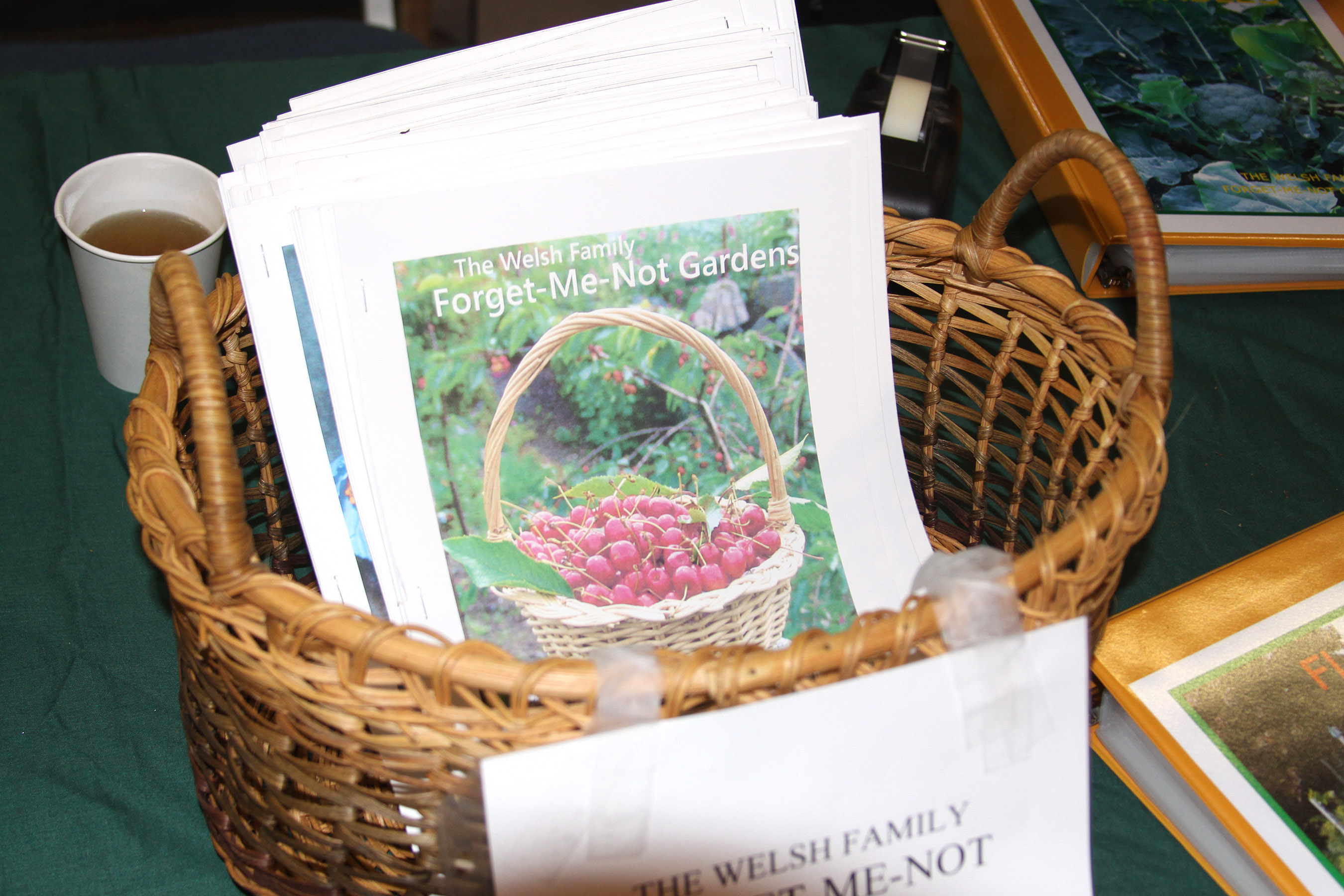
One of Sitka’s best known gardeners is Florence Welsh, who heads up The Welsh Family Forget-Me-Not Gardens. The Welsh family has been gardening in Sitka since 1984, and the garden on Davidoff Street has been used to teach other gardeners what works in Sitka. Several years ago Florence wrote a guide to help other gardeners take advantage of her family’s experiences trying to grow edible and ornamental plants in Sitka using organic methods.

This past winter, Florence updated her book and during the “Let’s Grow Sitka!” garden show event on Sunday she released the new version of the guide.

The book includes information about how to prepare your garden for Sitka’s short growing season, including how to set up your home for plants you may need to start inside. She talks about using sand and seaweed in the garden to help with drainage and fertilizer. The guide also lists many of the plants, bushes and trees the Welsh family has grown in its garden, including the specific varieties that did best in Sitka. There also are several photos from the garden.

The Welsh Family Forget-Me-Not Gardens is one of Sitka’s most productive gardens when it comes to producing food, and Florence frequently has a booth at the Sitka Farmers Market to sell her produce. The garden grows berries, fruit trees, herbs/mints, and a wide variety of vegetables. She includes some instructions with the vegetables, and the guide also includes a timeline for seed starting so you know when to plant. The guide ends with information about invasive plants, insects and slugs, and a list of useful seed catalogs and Web sites.

The homemade booklet is available for $5 a copy, and people can order copies by contacting Florence at (907) 747-8705 or florence.welsh@acsalaska.net. There are several different cover photos, but the content is the same on all the guides.

A basket of Florence Welsh's books for sale at Let's Grow Sitka!

A basket of Florence Welsh's books for sale at Let's Grow Sitka!

• Sitka Global Warming Group, Sitka Local Foods Network offer Sitka garden-matching program

Do you have a planting bed that you don’t have the time or energy to cultivate? Do you wish you could grow some vegetables, but have no place to put them?

Sitka Global Warming Group (SGWG), in conjunction with the Sitka Local Foods Network, is offering a garden-matching program to help people who have garden space get matched up with people who want to plant and tend a garden. This is an effort to increase the amount of food grown and eaten locally. SGWG asks Sitka residents who have garden space to share or residents who need a garden space to contact the group at info@sitkaglobalwarming.org. Provide your name, email address, phone number, size of the spot available or wanted, and the location of either the spot that is available or the address of the person who wants the spot.

SGWG will collect this data over the next month and then work to match garden spots with a nearby person who would like to plant and tend a garden. SGWG also will be collecting names and garden locations at the “Let’s Grow Sitka” garden show event taking place from noon until 3 p.m. on Sunday, March 14, at the Alaska Native Brotherhood Hall on Katlian Street.

Michelle Putz of SGWG said the group is not setting any expectations of either the people who offer garden space or who want a garden space. Sharing of produce will be encouraged, but won’t be an expectation. SGWG also does not know how many participants to expect.

“This is the first year that we will do this,” Michelle said. “We’ve seen plenty of people who want to grow their own food but don’t have space to do it, and we have seen a lot of planting beds and garden spots that go unused during the summer because people are too busy or lack knowledge or experience in growing a garden. This is a great way to match those unused gardens with someone who will make them productive and increase the amount of vegetables being grown in Sitka.”

“Growing food locally has many benefits,” Michelle added. “For our group, the benefit is reducing the miles that food is shipped [thus reducing fuel use and carbon dioxide emissions]. But growing food locally also makes the food cheaper and improves the quality and healthfulness of the vegetables, since they are fresher. Growing food locally also improves our ‘food security,’ making a food shortage less likely in times of high fuel prices or bad weather. And local food tastes really good.”

• Sitka Local Foods Network contracting for 2010 St. Peter’s Fellowship Farm lead gardener

Darby Osborne, Doug Osborne, Kerry MacLane and Maybelle Filler pick radishes at St. Peter's Fellowship Farm before the first Sitka Farmers Market in 2008

Darby Osborne, Doug Osborne, Kerry MacLane and Maybelle Filler pick radishes at St. Peter's Fellowship Farm before the first Sitka Farmers Market in 2008

The Sitka Local Foods Network is contracting for a lead gardener to help manage our activities at the St. Peter’s Fellowship Farm community garden this summer. St. Peter’s Fellowship Farm (SPFF) is growing, and we’re adding new garden beds so we can grow more crops. The vegetables grown at SPFF are sold at the Sitka Farmers Market to help support the efforts of the Sitka Local Foods Network, with some crops also going to local church and charity groups. Here is the lead gardener contract description.

St. Peter’s Fellowship Farm 2010 Lead Gardener Contract Description

Work Experience: 2-3 years of varied vegetable gardening experience, preferably with at least one year in Southeast Alaska. This includes planning, cultivating, harvesting, composting and preparing vegetables for sale or preservation, as well as putting the garden to rest for the season.

Contract Requirements:

  • Develop a garden plan that includes succession planting in conjunction with the SPFF tri-coordinators (board members Lisa Sadleir-Hart, Doug Osborne and Maybelle Filler)
  • Conduct soil testing and amend the soil to improve soil quality using available resources (i.e., seaweed, bone meal, etc) in conjunction with the SPFF tri-coordinators and volunteer work parties
  • Cultivate plant starts using seeds provided by the SLFN and make recommendations for SPFF seed start kits to be distributed at the Let’s Grow Sitka event on March 14, 2010
  • Use organic gardening practices
  • Host 3 initial planting parties (from 2-4:30 p.m. on three Saturdays, May 15, May 22 and May 29) i.e., coordinate with the SPFF tri-coordinators to plan and direct work
  • Direct 75 percent of the garden work parties, i.e., these are tentatively scheduled for Wednesdays 4:30-6 p.m. and Saturdays 2-3:30 p.m. (on non-Sitka Farmers Market Saturdays) during the months of June, July and August, plus the first half of September, but can be negotiated.
  • Plan and oversee the harvest of the garden for the first five 2010 Sitka Farmers Markets (harvest usually takes place early on market-day mornings, July 17, July 31, August 14, August 28 and September 4)
  • Develop a method for quantifying the amount of vegetables harvested from SPFF and implement it
  • Maintain the composting and watering systems
  • Direct any questions or concerns to the SPFF tri-coordinators

Compensation: A total of $1,500 paid in three installments (May 15, July 15 and September 15) plus 5 percent of the SPFF harvest – this compensation schedule is open for negotiation.

If interested in the SPFF lead gardener contract, e-mail a resume that includes two local references that can speak to your gardening ability and a letter of interest by February 20th to 3akharts@acsalaska.net. Direct questions to Lisa Sadleir-Hart at 747-5985 or Doug Osborne at 747-3752.

• Sonja Koukel of the UAF Cooperative Extension Service writes about discovering treasures from the CES catalog

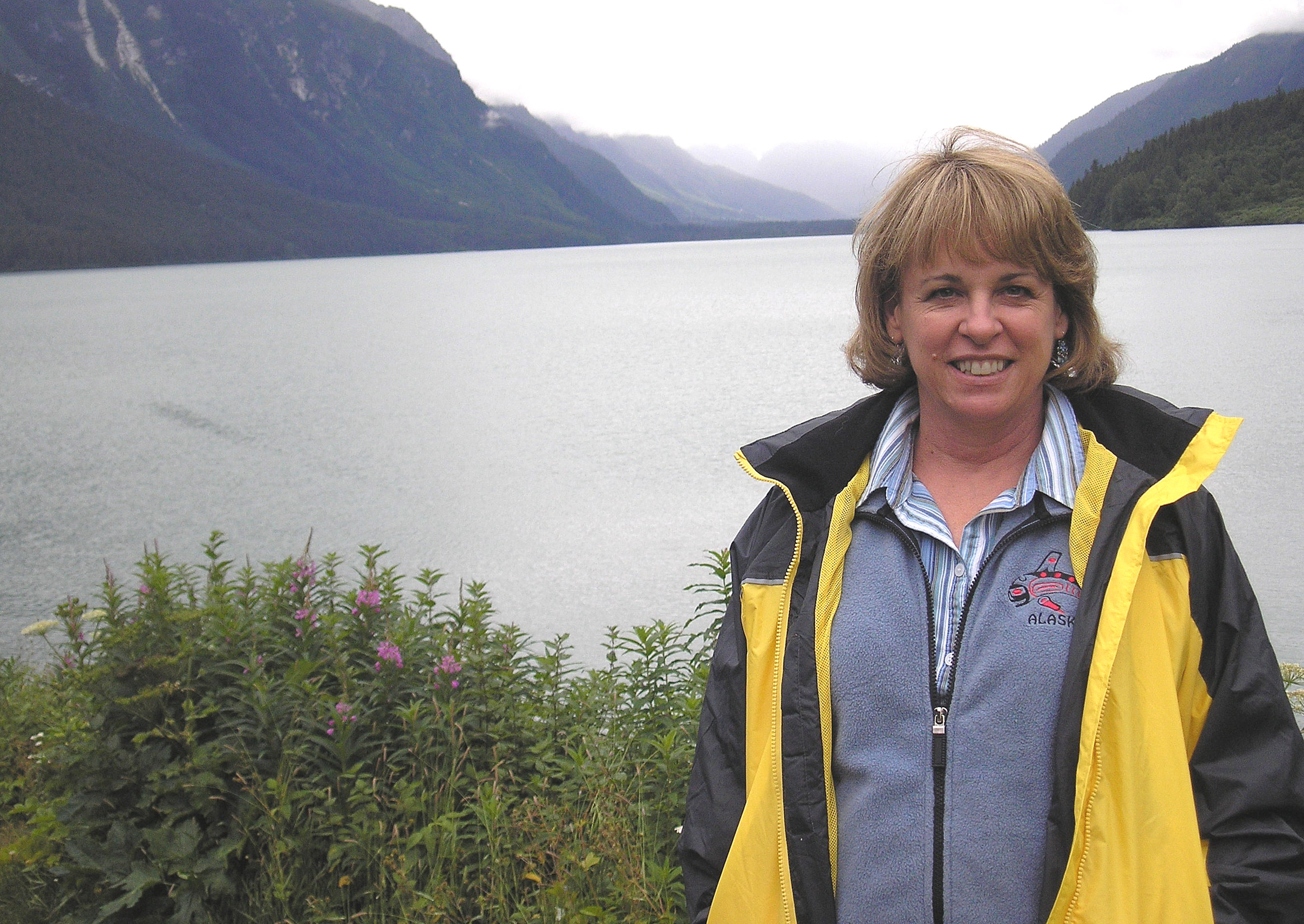
Dr. Sonja Koukel, PhD, of the UAF Cooperative Extension Service

Dr. Sonja Koukel, PhD, of the UAF Cooperative Extension Service

Discover Treasures from the UAF Cooperative Extension Service

By Dr. Sonja Koukel, PhD
Health, Home & Family Development Program
UAF Cooperative Extension Service, Juneau Office

_____

When was the last time you visited the University of Alaska Fairbanks Cooperative Extension Service (UAF CES) website? Perhaps it’s been awhile, or perhaps you’ve never taken the time to surf the site and take stock of all the treasures available in hard copy, electronic media, and on the Internet.

Every year the CES Communications Department provides a “Publications & Media” catalog listing research-based publications in the major program areas: Agriculture & Horticulture; Community Resource & Economic Development; Energy Education & Housing; and Health, Home & Family Development. Some publications are free and may be downloaded from the website. Those with a small fee can be ordered using the online form (http://www.uaf.edu/ces/pubs/), calling the toll-free number (1-877-520-5211), or contacting the local district office.

Let’s take a look at the treasure trove of information available through the Health, Home & Family Development (HHFD) program. For instance, there are a number of publications listed in the “Food, Nutrition and Health” category. Here, you will find information on storing vegetables and fruits, freezing vegetables, making fruit leather, making jerky, facts on botulism, and a variety of recipes including sourdough, rhubarb, zucchini, and wild berries. Several vegetable fact sheets provide nutrition and health guidelines (such as vitamin, mineral, and fiber content), harvesting, storage, and preparation with sample recipes included. Selected vegetables include beets, broccoli, cabbage, carrots, potatoes, squash, herbs, and chard. Bonus — all these fact sheets are free!

In my view, the most exciting new developments are the educational modules made possible through a USDA grant. Titled, “Preserving Alaska’s Bounty,” the web-based modules and DVDs were created and developed as a team effort involving HHFD faculty, program assistants, and the communications staff. The series focuses on home preservation of Alaska Native foods. Client feedback on the media, gathered from an online satisfaction survey, has been very positive.

The primary purpose for developing the modules was to provide research-based information for rural communities and areas that do not have extension faculty members on-site. The web modules are developed in a sequential manner so that each step is clearly defined and explained. There are hyperlinks within the modules that link the user to additional information. Topics are grouped into three main categories: Canning Basics, Canning Products & Methods (i.e., canning fish, meat, jams/jellies), and Meat Products & Methods (i.e., sausage, jerky). These modules are free. Locate them at (http://www.uaf.edu/ces/preservingalaskasbounty/index.html)

For those who learn best by watching demonstrations, the DVDs bring the extension experts into your home. Health, Home & Family Development program area faculty from all seven Alaska districts serve as the educators. To date, seven DVDs have been released on the following topics: Canning Basics, Canning Meat and Fish in Jars, Canning Meat and Fish in Cans, Pickling, Drying Foods, Sausage and Jerky, and the just-released, Jams and Jellies. More titles will be available in the very near future, these include: Root Cellars, Fireweed, Processing Reindeer (game meats), and Harvesting Alaska Seaweeds. The DVDs are available at a nominal fee of $5.

The Alaska Native foods preservation series is the culmination of a five-year process. It is a topic that figures into all the HHFD program areas: nutrition, food budgeting, eating locally, and energy conservation. Recently, the CES HHFD team received recognition for their work, “A Multimedia Approach to Preserving Alaska’s Bounty,” from the National Extension Honorary Society of Epsilon Sigma Phi.

In the new year, take a moment to visit the UAF Cooperative Extension Service website and discover all the treasures that await you. Contact: sdkoukel@alaska.edu or 907-796-6221.
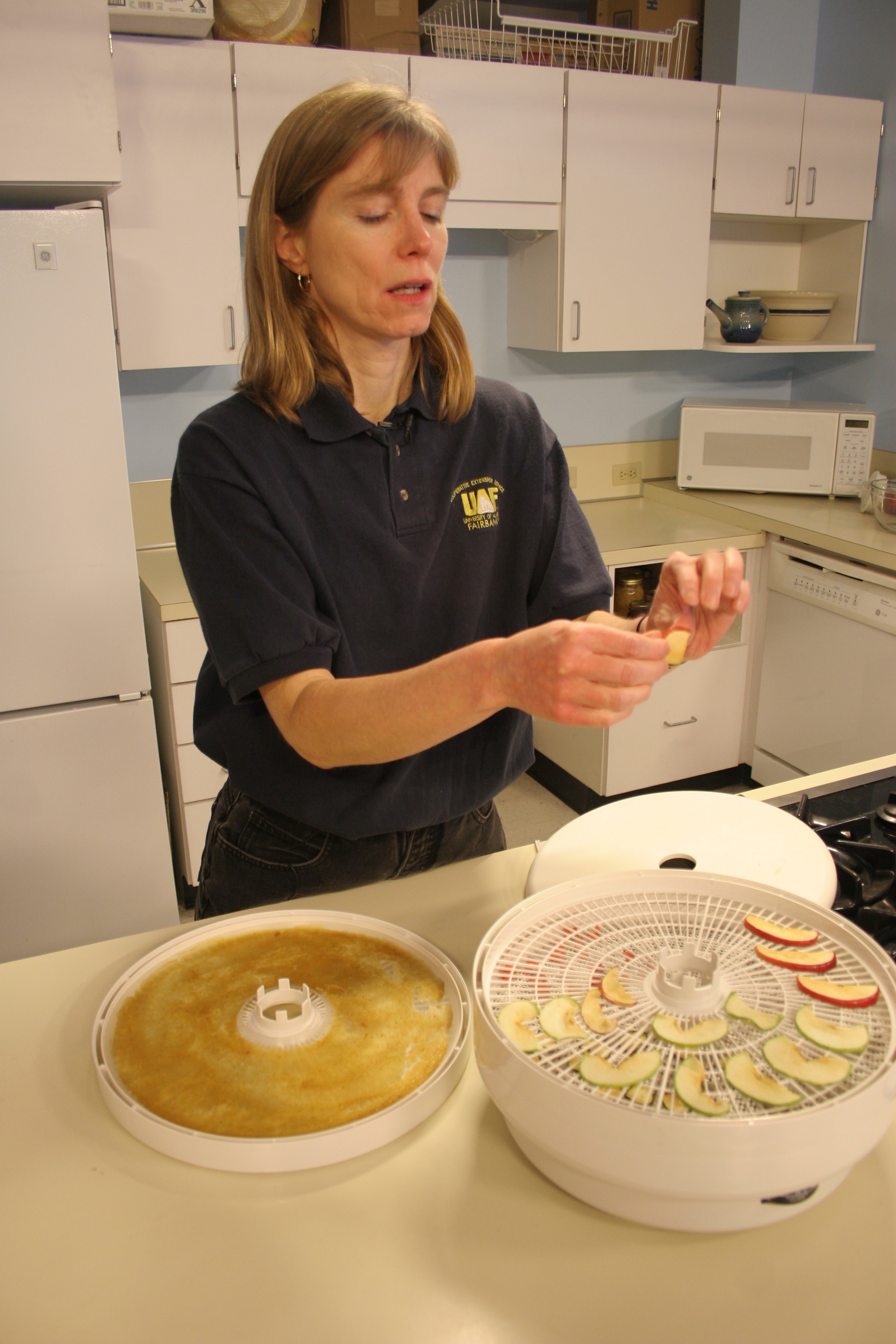
Julie Cascio of UAF Cooperative Extension Service's Health, Home and Family Development program in the Palmer/Mat-Su district demonstrates how to dry apples

Julie Cascio of UAF Cooperative Extension Service's Health, Home and Family Development program in the Palmer/Mat-Su district demonstrates how to dry apples

• Baranof Elementary students dig up potatoes and other local food stories in the news

Daily Sitka Sentinel screenshot of Baranof Elementary School student picking potatoes

Daily Sitka Sentinel screenshot of Baranof Elementary School student picking potatoes

Monday’s edition of the Daily Sitka Sentinel features a photo of Baranof Elementary School first-grader Keaton Kelling, 7, holding up a couple of potatoes he dug up from the Russian Bishop’s House garden on Thursday. First-grade students from Baranof Elementary harvested crops of peas, potatoes, carrots and other vegetables they planted last spring when they were kindergarten students. Most crops did well this year. (Sentinel Photo by James Poulson)

Monday's picking potatoes photo from the Daily Sitka Sentinel

Monday's picking potatoes photo from the Daily Sitka Sentinel

There were several other local food stories in Alaska newspapers over the weekend. Here’s a quick rundown.

Click here to read a story from Sunday’s Juneau Empire that features an Alaskanized version of a recipe for “salmon maritako,” a stew made by Spanish fishermen. The article is by Ginny Mahar, a chef at Rainbow Foods who also writes the Food-G blog. Many of the recipes Ginny posts on her blog include local, Southeast Alaska ingredients.

Click here to read an article from Sunday’s Fairbanks Daily News-Miner about a University of Alaska Fairbanks Cooperative Extension Service project at the Fairbanks Experimental Farm where they are using high-tunnel greenhouses to grow more apples and berries in northern climates. Click here to go directly to the UAF Cooperative Extension Service project page.

Click here to read Wednesday’s Anchorage Daily News gardening column by Jeff Lowenfels about now being the time to prepare plants for winter. Most of the column deals with flowers, but he does have some info about preparing tomato plants for the winter at the end of the column.

Click here to read an Associated Press story posted on the Anchorage Daily News Web site on Monday about how hoop houses (a low-cost type of greenhouse that uses plastic on a frame) are extending the growing season for urban farmers in northern climates. The version of the story on the ADN site didn’t have any photos of the hoop houses, so click here to see a version with photos.

Click here to read a transcript from National Public Radio of a story about two Walmart truckers who drive 2,600 miles one way from an Oregon warehouse to Alaska each week to deliver produce to Alaska stores. That’s a long way to transport a piece of lettuce or a carrot we can grow in Alaska, and that distance doesn’t include how far the produce had to travel to get to the Oregon warehouse before being trucked to Alaska. The story originated from the Alaska Public Radio Network, which has the story in streaming audio on its site.

Finally, click here for a humorous column from the July 2009 Field and Stream by Scott Bestul comparing the taste of Grade A Choice Holstein beef vs. wild venison when both are prepared the same way. This isn’t really a local story, but deer hunting season is coming soon in Southeast Alaska.