• Sitka Local Foods Network, other groups make free dirt available for Sitka gardens

IMG_9095

IMG_6075Free dirt is now available to the people of Sitka for their gardening needs. On a trial basis, your Sitka Local Foods Network (SLFN) worked with and formalized an agreement with the City and Borough of Sitka, Sitka School District, and the Blatchley Community Gardens to provide free dirt to individuals, families, and non-commercial entities for developing fruit, vegetable, and flower gardens and beds.

The free community dirt pile is located at Blatchley Community Gardens, behind Blatchley Middle School. The pile is to the right (north) of the community garden and only dirt between the signs should be removed. People can remove dirt at any time, though avoiding school hours when school is in session is preferred.

“This is raw dirt, mostly from land development in forest and muskeg lots around Sitka. It is NOT top soil, but it is a good starting point for gardens when mixed with locally purchased lime and sand, and locally purchased or produced compost, manure, and other organic materials,” said Michelle Putz, SLFN vice-president. The Sitka Local Foods Network asks that gardeners not remove sand, rocks, live kelp or live creatures from local beaches to build their soil.

People taking dirt should bring their own shovels and containers for dirt. To make sure there is enough for everyone, SLFN asks Sitkans to take as much as you need but please do not use it for commercial use or developing a lot. People who are coming for dirt need to respect the gardens, gardeners, compost, equipment and other materials at the site by only taking dirt from the pile and not removing or using anything else at the site.

“One of the most asked questions SLFN gets is ‘where can I get dirt to start a garden?’ We recognize that dirt is scarce in Sitka, and we wanted to try to do something about it,” Putz said. “Making soil, the starting point of all gardens, more available to people really helps us to meet our mission of increasing the amount of locally produced and harvested food in the diets of Southeast Alaskans. We hope that people will take all the dirt they need to build new and larger vegetable, fruit, and flower beds, planters and gardens.”

Local contractors, like Troy’s Excavating are providing the dirt. If this trial goes well, the Sitka Local Foods Network hopes to continue to provide free dirt. Compost will not be given away or created at this time.

Those with questions or wishing to help volunteer on this or other SLFN projects should call Michelle Putz at 747-2708. (Editor’s note, click this link to listen to an Aug. 5 story about the community dirt pile from KCAW-Raven Radio.)

• It’s time to … learn how to amend your soil and increase your production — free workshops

LoriAdamsWithBook

Your Sitka Local Foods Network reminds Sitkans that now is a great time to think about scaling up vegetable garden production with local soil amendments. Large scale production in your garden takes some forethought and requires good, productive, healthy soil. Local amendments such as seaweed, fish parts, chicken and duck manure, and other materials can help boost the production in your garden.

Lori Adams, owner and manager of Down-to-Earth U-Pick Garden, will host two discussions and hands-on workshops on large-scale garden production using local amendments at her u-pick garden at 2103 Sawmill Creek Road (across from the Mormon church). Classes will be held from 3-4 p.m. on Sunday, July 27, or at 10 a.m. on Monday, July 28.  All are welcome to come and attend these free classes.

Other topics that may be discussed include using ducks in the garden, organizing and simplifying techniques to keep costs down, and proven seed varieties for success.

Lori grew up on a farm in Oregon, and has gardened in Sitka for 20 years. Her u-pick garden has been in production for about six years. In 2012, Lori wrote a series of garden columns for the Daily Sitka Sentinel (and reprinted on the Sitka Local Foods Network website), and in 2013 she produced a book of those columns, “How to Grow Vegetables in Sitka, Alaska,” which she sells for $20 a copy at her Sitka Farmers Market booth. For information or directions to the garden, call Lori at 747-6108 or 738-2241.

The Sitka Local Foods Network education committee has been hosting a series of “It’s time to …” workshops this spring and summer designed to help local residents learn about various aspects of vegetable gardening and fruit growing. Many of these classes will be informal get-togethers at various gardens around town. Please watch our website, Facebook pageFacebook group, and local news media for information about upcoming classes. If you have an “It’s time to …” workshop you’d like to teach, contact Michelle Putz at 747-2708.

The SLFN education committee is still looking to expand our network of local volunteers who can teach classes (formal and informal) this year about growing food, please email Charles Bingham at charleswbingham3@gmail.com with info about what topics you can teach, your gardening experience, and contact information so we can add you to our database of instructors.

• Tickets available for fifth annual Sitka Seafood Festival; volunteers needed all week

salmon boat header

ssflogo2The fifth annual Sitka Seafood Festival is finalizing its schedule for July 31-Aug. 2 at various locations around Sitka, but tickets have gone on sale for its three main events — the VIP cocktail hour on Friday night, the five-course banquet on Friday night, and the headline entertainment concert by the Yup’ik soul group Pamyua on Saturday night (link to Pamyua’s Facebook page).

The major events for the Sitka Seafood Festival will take place on Friday and Saturday, Aug. 1-2, but there are some additional events set for July 31 (a wine bottle-signing and a garden tour). A full festival schedule is available here.

On Friday, Aug. 1, the VIP cocktail hour takes place from 5:30-6:30 p.m. at the Harrigan Centennial Hall Exhibit Room, and the cost is $35 per person. The five-course seafood banquet prepared by guest chefs starts at 7 p.m. at Harrigan Centennial Hall (doors open at 6:30 p.m.). The banquet costs $65 per person, or you can buy a whole table for $600 (10 seats per table). There are Friend of the Festival tables available for $800 that feature special bartender service, are close to the stage, and feature gift bags).

The tentative menu for Friday’s banquet features (according to an email from event founder Alicia Haseltine):

  • Amuse Bouche — herring roe, finger lime, baby fennel, cucumber, bulls blood
  • First Course — ricotta gnocchi, sea asparagus (pesto), foraged mushroom xo, tat soi oil, brown butter
  • Second Course — scallops, pistachio crumble, fromage blanc, yellow squash puree, snap pea coulis, pancetta
  • Third Course — rockfish, spruce tip nage, lemon ash marshmallow, arugula, whole barley, carrot
  • Fourth Course — salmon, tomato jam, scallion potato puree, black garlic aioli, leeks charred
  • Fifth Course — cocoa praline rocks, chocolate soil, sudachi curd, huckleberry, merlot caramel, bergamot cloud mascarpone and cream base

On Saturday, Aug. 2, the day opens with tote races at 11 a.m. at Crescent Harbor, followed by the parade at 11:30 a.m. from Crescent Harbor Shelter to the Sitka Fine Arts Camp/Sheldon Jackson Campus, and the marketplace from noon until 7 p.m. There will be a variety of entertainment from noon until 4 p.m., and the Scottish Highland Games are from noon to 6 p.m., both at the Sitka Fine Arts Camp/Sheldon Jackson Campus. The headline entertainment concert by Pamyua starts at 7 p.m. at Allen Hall at the Sitka Fine Arts Camp/Sheldon Jackson Campus, and tickets are $20 per person.

Volunteers are needed all week for the festival, which includes event set up and tear down. To learn more, contact Sitka Seafood Festival Director Carolyn Kinneen at (907) 222-8422 or email sitkaseafoodfestival@gmail.com. Parade participants should contact Linda Olson at 747-6985. Scottish Highland Games participants are welcome to practice at 5:30 p.m. on Wednesdays and Sundays at the Moller Field Track


• It’s time to … make homemade wine from your extra rhubarb; learn how on July 18

WINERY

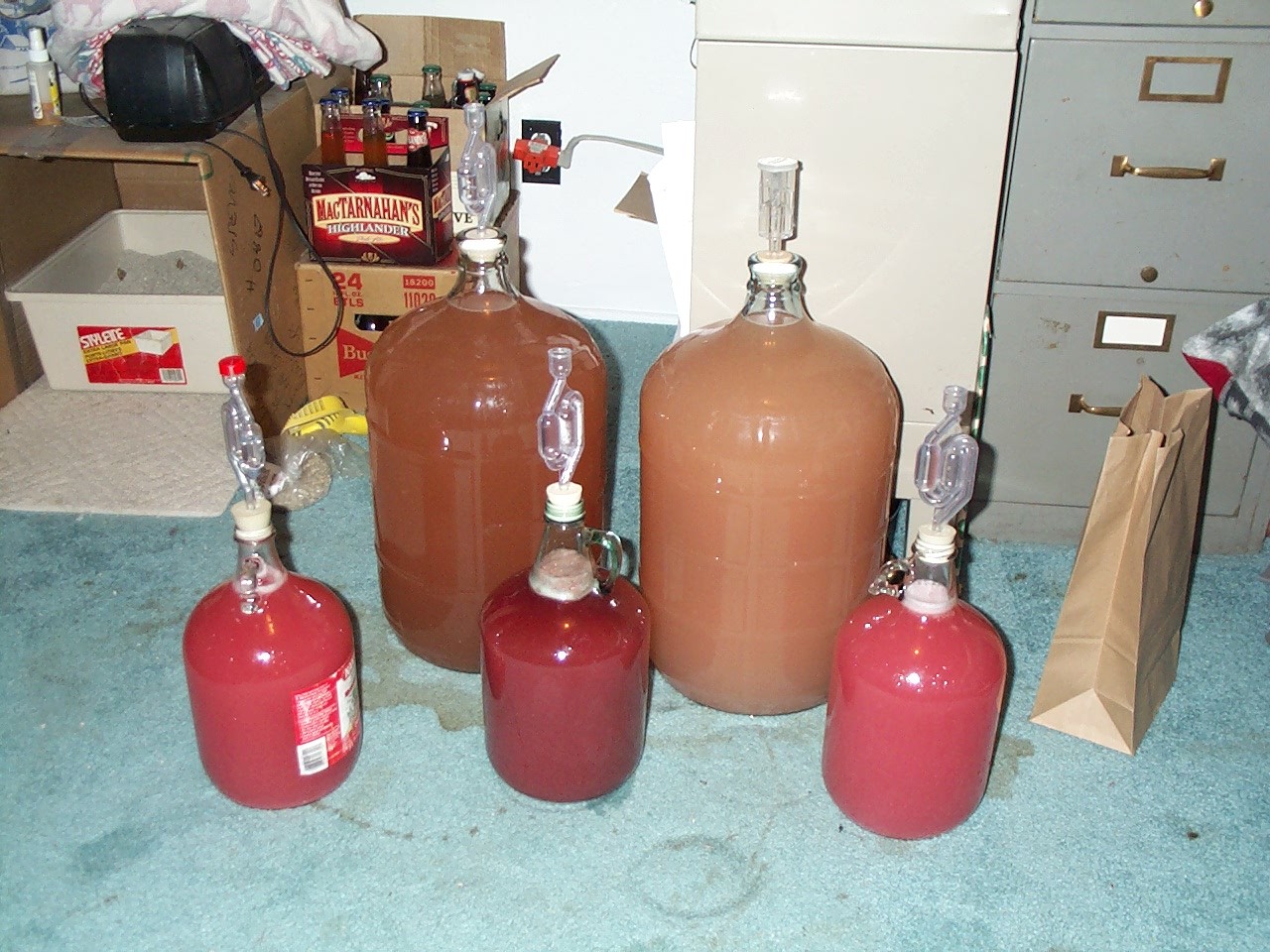
RhubarbWine1Rhubarb is one of the easiest plants to grow in Sitka. So what do you do with all the extra rhubarb, after you’ve already made as many pies and jams and other rhubarb recipes as you can handle? You can make rhubarb wine.

Perry Edwards and Michelle Putz, who are members of the Sitka Global Warming Group, will teach their annual homemade wine-making class at 7 p.m. on Friday, July 18, at their home (address and directions will be given to people who register for the class). This fun and informative beginner’s class will teach people how to use locally grown fruit, such as rhubarb, apples or berries, to make wine. This class will offer simple wine-making tips, techniques, tools, and will feature Perry and Michelle’s award-winning rhubarb wine recipe.

This class is free and open to all adults age 21 or older. Space is very limited and this class fills up fast. Please pre-register to assure your spot in the class. For more information, or to register for the class, please call Michelle at 747-2708. This wine-making class is sponsored by the Sitka Global Warming Group.

• Samia Savell of USDA Natural Resources Conservation Service to give presentation in Sitka on high tunnels

picture8

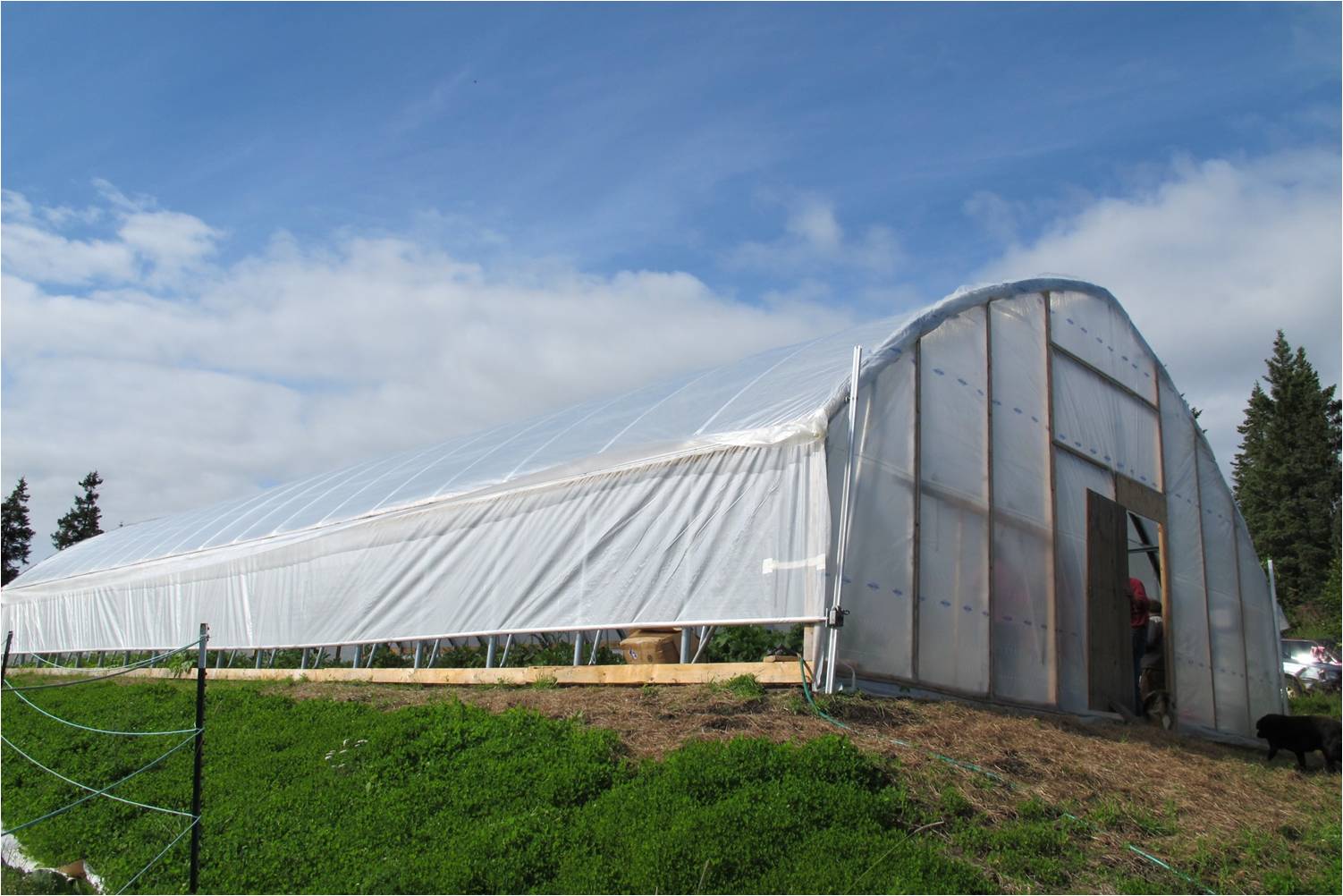
Picture10Want to learn how to extend your growing season with high tunnels and find out how Sitka growers can receive help from the USDA to purchase a high tunnel? Samia Savell of the Juneau office of the U.S. Department of Agriculture’s Natural Resources Conservation Service will give a presentation from 5-6 p.m. on Thursday, July 10, at Harrigan Centennial Hall.

In recent years, the USDA Natural Resources Conservation Service (NRCS) has offered a cost-sharing program that enables qualifying landowners who produce food to build high tunnels. Samia has overseen that program for Southeast Alaska, and several gardeners in Sitka have taken advantage of the program.

High tunnels, also known as hoop houses or temporary greenhouses, extend the growing season so more food is produced before and after the traditional dates for growing stuff outdoors. High tunnels are different than greenhouses in that they are passively heated by the sun, so they have lower energy costs than greenhouses. High tunnels are at least six-feet tall, and low tunnels aren’t eligible in this program. Food in high tunnels is planted either directly into the ground or in raised beds.

For more information about the presentation, contact Sitka Local Foods Network Board President Lisa Sadleir-Hart at 747-5985. To learn more about the USDA NRCS high tunnel program, contact Samia Savella at the Juneau field office at (907) 586-7220 or samia.savell@ak.usda.gov.


• Sitka Kitch hosts Sarah Lewis for cottage foods industry and home canning classes

kitch_flyer_july25_26

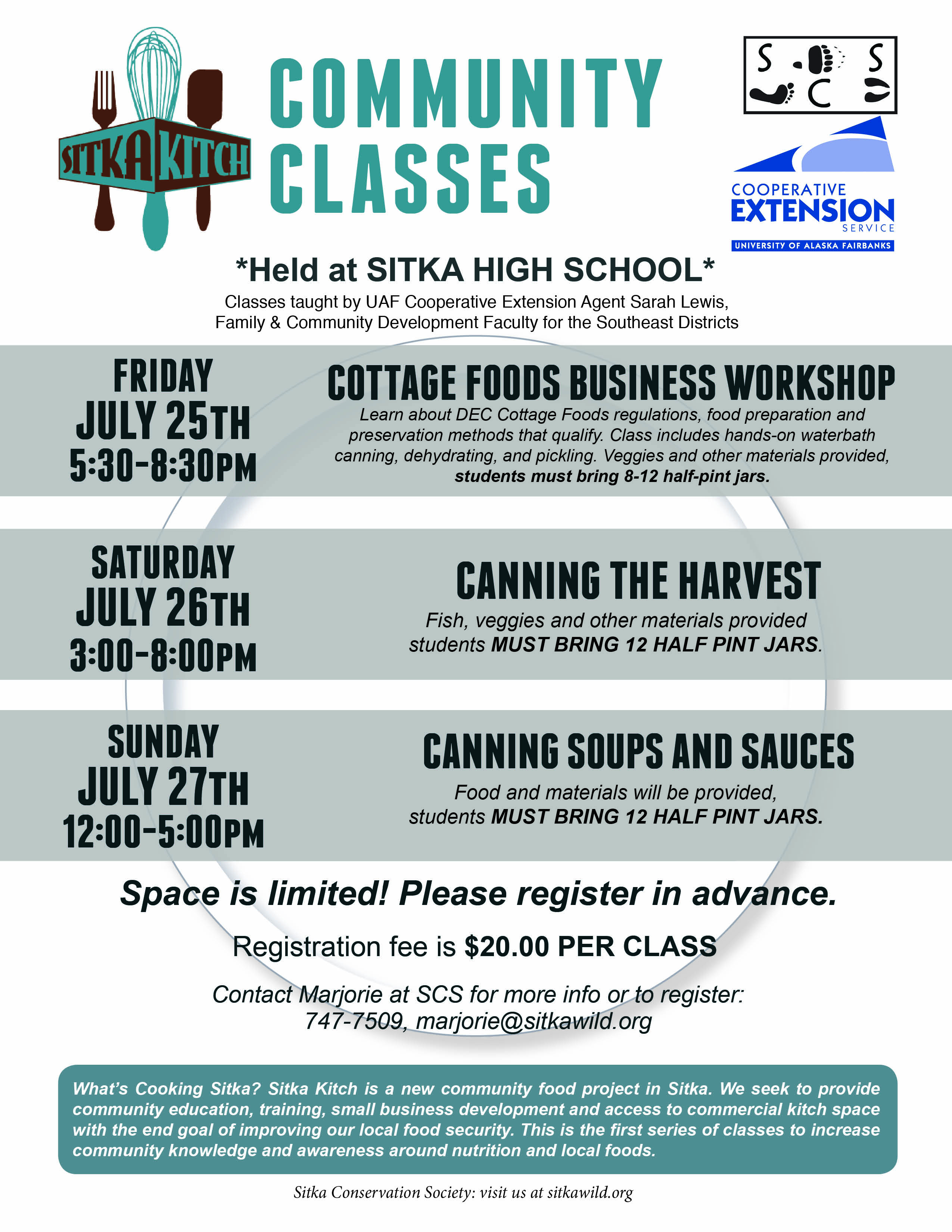
SarahLewisSitka Kitch will host Sarah Lewis, Family and Community Development Faculty from the Juneau District Office of the University of Alaska Fairbanks Cooperative Extension Service, for three classes about the cottage food industry and home canning on July 25-27 at Sitka High School. (Editor’s note: The location of the first two classes has been moved to the Sitka Presbyterian Church on Sawmill Creek Road. Sunday’s class still will take place at Sitka High School, but the topic has been changed to Canning Jams and Jellies and the time will be from noon to 3 p.m.)

The three classes cost $20 each. Space is limited, so please register in advance by calling Marjorie Hennessy of the Sitka Conservation Society at 747-7509. Students will take home the products they make. The classes are:

  • Friday, June 25, 5:30-8:30 p.m., Cottage Foods Business Workshop — Students learn about Alaska Department of Environmental Conservation cottage foods industry regulations, as well as the food preparation and food preservation techniques that qualify. Class includes hands-on water-bath canning, dehydrating and pickling instruction. Veggies and other materials will be provided. Students must bring 8-12 half-pint canning jars with lids.
  • Saturday, June 26, 3-8 p.m., Canning the Harvest — Fish, veggies and other materials provided. Students must bring 12 half-pint canning jars with lids.
  • Sunday, June 27, noon to 5 p.m., Canning Soups and Sauces — Food and materials will be provided. Students must bring 12 half-pint canning jars with lids.

In addition, Sarah will be at the Sitka Farmers Market from 10 a.m. to 1 p.m. on Saturday, July 26, at the Alaska Native Brotherhood Founders Hall, where she will be available to test canner pressure gauges and provide other resources about home canning and food preservation.

Also, Sitka Kitch will partner with Sitka Tribe of Alaska to offer a pickled salmon course in August. This class is offered free of charge, but space is extremely limited. More details on date and location will be available soon.

Sitka Kitch is a community wellness project from the 2013 Sitka Health Summit designed to improve food security in Sitka. The different parts of the project include creating a community kitchen Sitka residents can rent to prepare food for their small businesses or to preserve their family harvest of fish, game, or garden veggies; expanding Sitka’s emergency food storage capacity; and providing education about preserving food and building family emergency food pantries.

For more information about the Sitka Kitch project, contact Marjorie Hennessy at marjorie@sitkawild.org or 747-7509.


• It’s time to … thin your apples for better production (free workshop)

RedApplesKCAW

Your Sitka Local Foods Network reminds Sitkans that now is the time to get out in your garden and thin the apples on your tree. Thinning fruit increases the size and quality of your fruit and reduces the chances that limbs will break. Thinning also reduces the chances of spreading diseases.

Jud Kirkness will host a free discussion and hands-on workshop on fruit thinning and fruit tree care from 6-7 p.m. on Thursday, June 26, at 131 Shelikof Way. Jud also will look for and discuss fruit tree pests. All are welcome; call Michelle Putz at 747-2708 for more information or directions to the garden.

The Sitka Local Foods Network education committee has been hosting a series of “It’s time to …” workshops this spring and summer designed to help local residents learn about various aspects of vegetable gardening and fruit growing. Many of these classes will be informal get-togethers at various gardens around town. Please watch our website, Facebook pageFacebook group, and local news media for information about upcoming classes. If you have an “It’s time to …” workshop you’d like to teach, contact Michelle Putz at 747-2708.

The SLFN education committee is still looking to expand our network of local volunteers who can teach classes (formal and informal) this year about growing food, please email Charles Bingham at charleswbingham3@gmail.com with info about what topics you can teach, your gardening experience, and contact information so we can add you to our database of instructors.

• It’s time to … get the veggies at St. Peter’s Fellowship Farm ready for the first Sitka Farmers Market

StPetersSignWithToDoListSignYour Sitka Local Foods Network will host a garden party from 2-4 p.m. on Saturday, June 21, at the St. Peter’s Fellowship Farm communal garden (located behind St. Peter’s By The Sea Episcopal Church on Lincoln Street) to get the veggies ready in preparation for the first Sitka Farmers Market of the season.

Produce grown at St. Peter’s Fellowship Farm is sold during the Sitka Farmers Markets to help fund Sitka Local Foods Network projects throughout the year. Some of the produce also is sold to people using SNAP benefits (food stamps) and to local schools for their lunch programs. The first Sitka Farmers Market of the season is from 10 a.m. to 1 p.m. on Saturday, June 28, at Alaska Native Brotherhood Founders Hall (235 Katlian St.). The remaining Sitka Farmers Markets are on July 12, July 26, Aug. 9, Aug. 23, and Sept. 6.

In addition to planting and weeding, there may be other garden chores to do. During these garden parties we usually need people to shovel dirt and sift soil, weed, mulch and spread fertilizer (seaweed) on the existing garden beds. Most garden tools will be provided, but we may need people to bring shovels and pick-axes if they have them. These garden parties are a great place for Sitka residents new to gardening to get some hands-on instruction on how to plant their own veggie garden. The garden parties are kid-friendly, and we encourage volunteers to bring their children so they can learn where their food comes from. Volunteers can receive a share of the veggies for their work at the garden.

For more information, contact St. Peter’s Fellowship Farm lead gardener Laura Schmidt at 623-7003 or 738-7009, or contact Lisa Sadleir-Hart at 747-5985.

• It’s time to … learn about gardening in a high tunnel

photo 1 (1)

Have you ever wanted to learn more about growing vegetables in a high tunnel or hoop house? Your Sitka Local Foods Network is teaming up with local landscape architect and 20-year Sitka gardener Barth Hamberg, who will host a free discussion about high-tunnel gardening at 7 p.m. on Wednesday, June 25, at Hamberg’s garden.

High tunnels, also known as hoop houses or temporary greenhouses, extend the growing season so more food is produced before and after the traditional dates for growing stuff outdoors. High tunnels are different than greenhouses in that they are passively heated by the sun, so they have lower energy costs than greenhouses. This link has frequently asked questions and answers about seasonal high tunnel systems for crops.

“Last summer I constructed a high tunnel with a grant from the NRCS (Natural Resources Conservation Service),” Hamberg said. “This is my first season in production and I’m experimenting with may different plants and learning a lot about the advantages of the high tunnel. It’s working great.”

Some of the topics Hamberg will discuss include:

  • siting and constructing a high tunnel
  • selecting a high tunnel manufacturer and style of tunnel
  • planting for winter harvest
  • planting for early spring harvest
  • high tunnel maintenance requirements
  • irrigation systems
  • making the high tunnel an enjoyable place to work and to be
  • compost-based soil fertility in the high tunnel

“My interest is growing food in the most efficient and beautiful way possible,” Hamberg said.

People interested in attending this discussion should call Hamberg at 738-9145 to reserve a space and to receive the address and directions to his garden.

The Sitka Local Foods Network education committee has been hosting a series of “It’s time to …” workshops this spring and summer designed to help local residents learn about various aspects of vegetable gardening and fruit growing. Many of these classes will be informal get-togethers at various gardens around town. Please watch our website, Facebook pageFacebook group, and local news media for information about upcoming classes. If you have an “It’s time to …” workshop you’d like to teach, contact Michelle Putz at 747-2708.

The SLFN education committee is still looking to expand our network of local volunteers who can teach classes (formal and informal) this year about growing food, please email Charles Bingham at charleswbingham3@gmail.com with info about what topics you can teach, your gardening experience, and contact information so we can add you to our database of instructors.

• UAF Cooperative Extension Service offers Certified Food Protection Manager class by videoconference in Sitka

CFPM flyer 7-9-14

Friday, June 27, is the registration deadline for a certified food protection manager workshop being taught on Wednesday, July 9, by University of Alaska Fairbanks Cooperative Extension Service. This is an all-day statewide class that will be offered live in Fairbanks and Palmer, and by videoconferencing to Sitka and Ketchikan.

A certified food protection manager (CFPM) is responsible for monitoring and managing all food establishment operations to ensure that the facility is operating in compliance with food establishment regulations.

A CFPM is knowledgeable about food safety practices and uses this knowledge to provide consumers with safe food, protect public health and prevent food-borne illnesses. Alaska regulations require food establishments to have at least one CFPM on staff.

This course takes place from 9 a.m. to 5 p.m. (with a half-hour lunch), and participants will take a computer-based exam at the end of the class. The reason the deadline is two weeks before the class is to guarantee course materials reach all the students in time for the class. The cost is $200, and the course will be taught by Marsha Munsell of Fairbanks and Julie Cascio of Palmer. Students can register here (scroll down and select the July 9 item)

The Sitka videoconference for the class will take place in Room 110 at the University of Alaska Southeast Sitka Campus. To learn more, contact the Sitka District Office of the UAF Cooperative Extension Service at 747-9440, or contact Kathy McDougall at (907) 474-2420 (Fairbanks number) or kmmcdougall@alaska.edu.