• Sitka represented at first meeting of new Alaska Food Policy Council

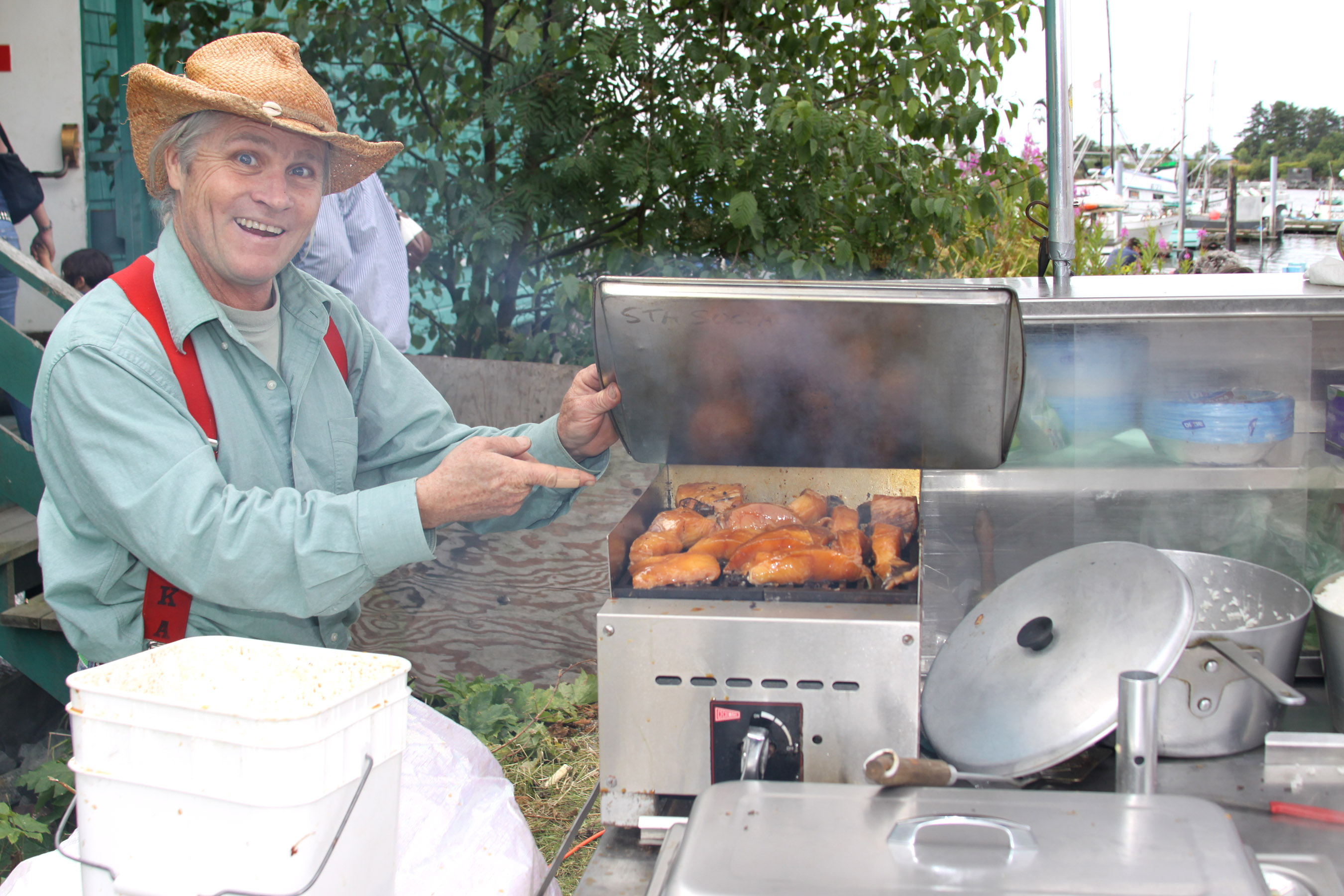
Kerry MacLane grills black cod for the Alaska Longline Fisherman's Association booth at an August 2009 Sitka Farmers Market

Kerry MacLane grills black cod for the Alaska Longline Fisherman's Association booth at an August 2009 Sitka Farmers Market

When the new Alaska Food Policy Council held its first meeting in Anchorage last month, Sitka Local Foods Network president Kerry MacLane was among the 80 or so people in attendance.

“There were nutritionists, politicians, state and federal government folks galore, Native groups, Alaska ranchers (of reindeer, musk ox, elk, goats and even cows), our one creamery, schools, WIC (Women, Infants, Children supplemental nutrition program), restaurants, truckers, a food wholesaler and even some people growing fruits and vegetables,” said Kerry, whose meeting notes are linked as a PDF file at the bottom of this story. “I was honored to represent Sitka at the first meeting of the Alaska Food Policy Council.”

The Alaska Food Policy Council is a new venture in Alaska, but food policy councils are becoming more common around the country at the state and regional level, especially as more people are becoming concerned about where their food comes from and what’s in it. The first meeting of the Alaska Food Policy Council featured guest speaker Mark Winne of the Community Food Security Coalition, who discussed what food policy councils do, and there was a panel of experts from around the state who gave brief presentations about different parts of Alaska’s food system. Many of the participants also took an online survey about Alaska’s food system, which helped provide guidance for the two-day meeting.

“This group will take a critical look at our current food system and start thinking about ideas for building a stronger regional system,” Daniel Consenstein, executive director of the U.S. Department of Agriculture’s Alaska Farm Service Agency, wrote about the meeting. “Most of these stakeholders know that keeping more of our food dollars in Alaska will help create jobs and spur economic development. They know that if Alaska can produce more of its own food, we can build healthier communities and be less vulnerable to food disruptions in times of emergencies. The long-term goals of the Food Policy Council will be to identify barriers to building a viable Alaskan food system, create a strategic plan to address these barriers, and make the necessary recommendations to decision makers to implement this plan. Over the next year, this group will develop an action plan to make Alaska more food secure.”
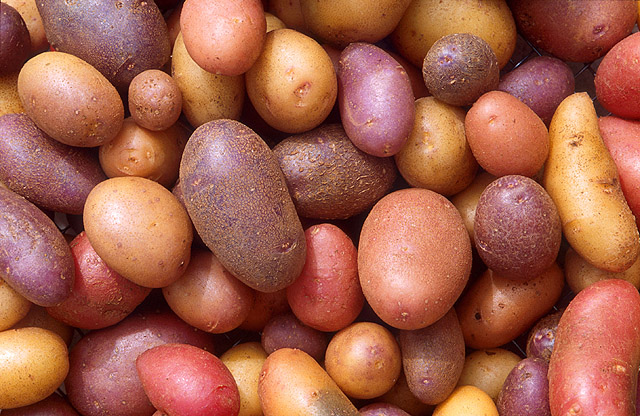
Photo courtesy of USDA Agricultural Research Service Image Gallery / Photo by Scott Bauer -- The average American eats 142 pounds of potatoes a year, making the tubers the vegetable of choice in this country

Photo courtesy of USDA Agricultural Research Service Image Gallery / Photo by Scott Bauer -- The average American eats 142 pounds of potatoes a year, making the tubers the vegetable of choice in this country

Diane Peck of the Alaska Division of Public Health is coordinating the Alaska Food Policy Council, which is having its creation funded by a grant from the U.S. Department of Agriculture and from a two-year grant from the Alaska Department of Health and Social Services Obesity Prevention and Control Program (grant originally provided through the U.S. Centers of Disease Control and Prevention). Detailed meeting minutes and a purpose and next steps document are linked below as PDF files.

The University of Alaska Fairbanks School of Natural Resources and Agricultural Sciences posted a good, detailed wrap-up of the first meeting on its blog, and the University of Alaska’s “Statewide Voice” also had an article about the meeting.

The creation of the Alaska Food Policy Council has sparked regional interest in Southeast Alaska. The Health, Education and Social Services committee of the Southeast Conference will meet by teleconference at 10 a.m. on Tuesday, June 22, to discuss the Alaska Food Policy Council (click Calendar and Events on the link to get call-in numbers and codes). “We have opportunity to advance our local food production and utilize the bounty of our region to sustain our people and improve our health,” Southeast Conference executive director Shelly Wright wrote about the Alaska Food Policy Council.

“There are numerous benefits that food policy changes could mean for residents of Southeast Alaska,” Kerry MacLane said. “The bycatch regulations could be modified to encourage great recovery, processing and distribution. This would result in affordable fish in local markets, schools, health institutions and statewide. Federal, state and local government institutions would have more incentives and few restrictions to include local food in their purchases. More economic development funds could be made available to food system-related entrepreneurs. State and federal storage of (Alaska) emergency food supplies could be in our communities instead of in Portland, Ore. The Alaska Food Policy Council can help Alaskans increase our self-reliance and be more prepared for the coming rise in fuel costs.”

To learn more about the Alaska Food Policy Council, contact Diane Peck with the Alaska Division of Public Health at 1-907-269-8447 (Anchorage) or by e-mail at diane.peck@alaska.gov. Most of the council’s communication and meetings will be by e-mail and teleconference.

Minutes from the May 18-19, 2010, first meeting of the Alaska Food Policy Council

Purpose and next steps for Alaska Food Policy Council

Kerry MacLane’s notes on the first meeting of the Alaska Food Policy Council

• Fast Food Nation author encourages Alaskans to grow their own local food

Fast Food Nation author Eric Schlosser, second from left, visits with University of Alaska Fairbanks School of Natural Resources and Agricultural Sciences associate professor Joshua Greenberg, left, student Charles Caster, third from left, and professor Milan Shipka, right, during a May 27 visit to speak at UAF. (Photo courtesy of the UAF School of Natural Resources and Agricultural Sciences blog)

Fast Food Nation author Eric Schlosser, second from left, visits with University of Alaska Fairbanks School of Natural Resources and Agricultural Sciences associate professor Joshua Greenberg, left, student Charles Caster, third from left, and professor Milan Shipka, right, during a May 27 visit to speak at UAF. (Photo courtesy of the UAF School of Natural Resources and Agricultural Sciences blog)

Eric Schlosser, the author of “Fast Food Nation” and “Chew On This,” encouraged Alaskans to grow their own local foods during a May 27 lunch of Alaska-grown food with University of Alaska Fairbanks (UAF) School of Natural Resources and Agricultural Sciences (SNRAS) students, faculty and staff involved with food security and food production.

Schlosser, who also co-produced the films “Food, Inc.” and “There Will Be Blood,” was in Fairbanks to give a lecture that night as part of UAF’s Summer Sessions. Stories about his lecture can be found on the SNRAS blog and in the UAF Sun Star student newspaper, and a preview story was in the Fairbanks Daily News-Miner.

During his free lecture, Schlosser discussed the recent changes to how our food is grown and prepared, and about how we are losing contact with how our food gets to our plates. He focused on many of the industrial agriculture themes highlighted in his more popular book, “Fast Food Nation,” and some of the resulting problems, such as the low wages and vulnerable workforce in fast food production and the use of hormones in feedlot cattle and issues with antibiotics given feedlot animals.

He also delved into some of the resulting health issues from eating too much fast food, a topic he discussed in his book “Chew On This,” which was written for older children. (Editor’s note: “Chew On This” has a section about the Stop The Pop movement by schools in rural Alaska to eliminate soda pop from their school vending machines.) According to the SNRAS blog, Schlosser discussed the connections between our highly processed, industrial food and diseases such as diabetes.

The people most at risk are children and the elderly. Fast food, which is high in fat, sugar, starch, and salt, compromises the health of these vulnerable citizens. “These are ideal foods to make you unhealthy,” Schlosser said. “And they sell tons of soda because it is the most profitable thing they sell.”

While people in the US used to be some of the most fit people now they are terribly unfit. The obesity rate has nearly doubled for toddlers and tripled for children ages 6 to 11. “Alaska has one of the highest obesity rates in the US,” Schlosser said. “Alaska has more in common with Alabama and Mississippi than western states when it comes to obesity.”

Diabetes is another concern, with one in three children born in 2000 destined to develop diabetes. Among poor people the number is one in two.

“What is to be done?” Schlosser asked. “That all sounds really grim but an entirely different system is possible and necessary.” He stressed organic foods, buying local food, and reconnecting people with where food comes from. He said he is encouraged by the interest in sustainability found on college campuses.

“The fast food system exploits the weak and the poor and threatens our entire democratic system,” he said. “We need an agricultural system based on social policies and access to healthy, nutritional food for every member of society.”

Schlosser also noted how dependent Alaska has become on imported food, and how that impacts food security.

“Hey, you guys in Alaska gotta grow your own. You need to remember where food comes from. Alaska is the most food insecure state; that is not good.” He said Alaska has 15 million acres suitable for agriculture, yet only 30,000 acres are cultivated. (See addendum below.) “Rhode Island has twice as many farms as you and their value of agricultural products is twice as big. Now come on, you guys need to grow food in your back yards, have school gardens, and buy food grown in this state.”

(Addendum — From SNRAS Dean and AFES Director Carol Lewis, June 1, 2010: The 15 million acres is a wonderful quote, but if you look at Roeger (1958), you’ll see the rest of the story. Only 500,000 are accessible by road or rail. There are opportunities to use non-agricultural lands if we use controlled environments and composting, however. There are more than 30,000 acres actually cleared and in Delta alone there are about 100,000 acres.)

• Kerry MacLane provides update on Sitka Community Greenhouse and Education Center project

An artist's concept of one version of a proposed Sitka Community Greenhouse and Education Center

An artist's concept of one version of a proposed Sitka Community Greenhouse and Education Center

About a dozen people joined Sitka Local Foods Network president Kerry MacLane for a PowerPoint presentation about the proposed Sitka Community Greenhouse and Education Center on Wednesday, May 12, at the SEARHC At Kaník Hít Community Health Services Building first-floor conference room. Kerry showed his presentation (attached) and provided a status update for the project. He also took feedback from the participants, seeking ideas for the next steps needed to complete the project.

The Sitka Community Greenhouse and Education Center is a project of the Sitka Local Foods Network to address one of the top local health priorities identified at the 2008 Sitka Health Summit. Sitka residents said they wanted a community greenhouse in order to make more locally grown fruits and vegetables available in town, and a community greenhouse is seen as a way to grow fruits and veggies all year. In addition to local food being healthier for you, local food also provides food security in case of a disaster or other event that keeps the barges or airplanes from delivering (it’s estimated that 95 percent of the food eaten in Alaska is shipped in from the Lower 48 or overseas).

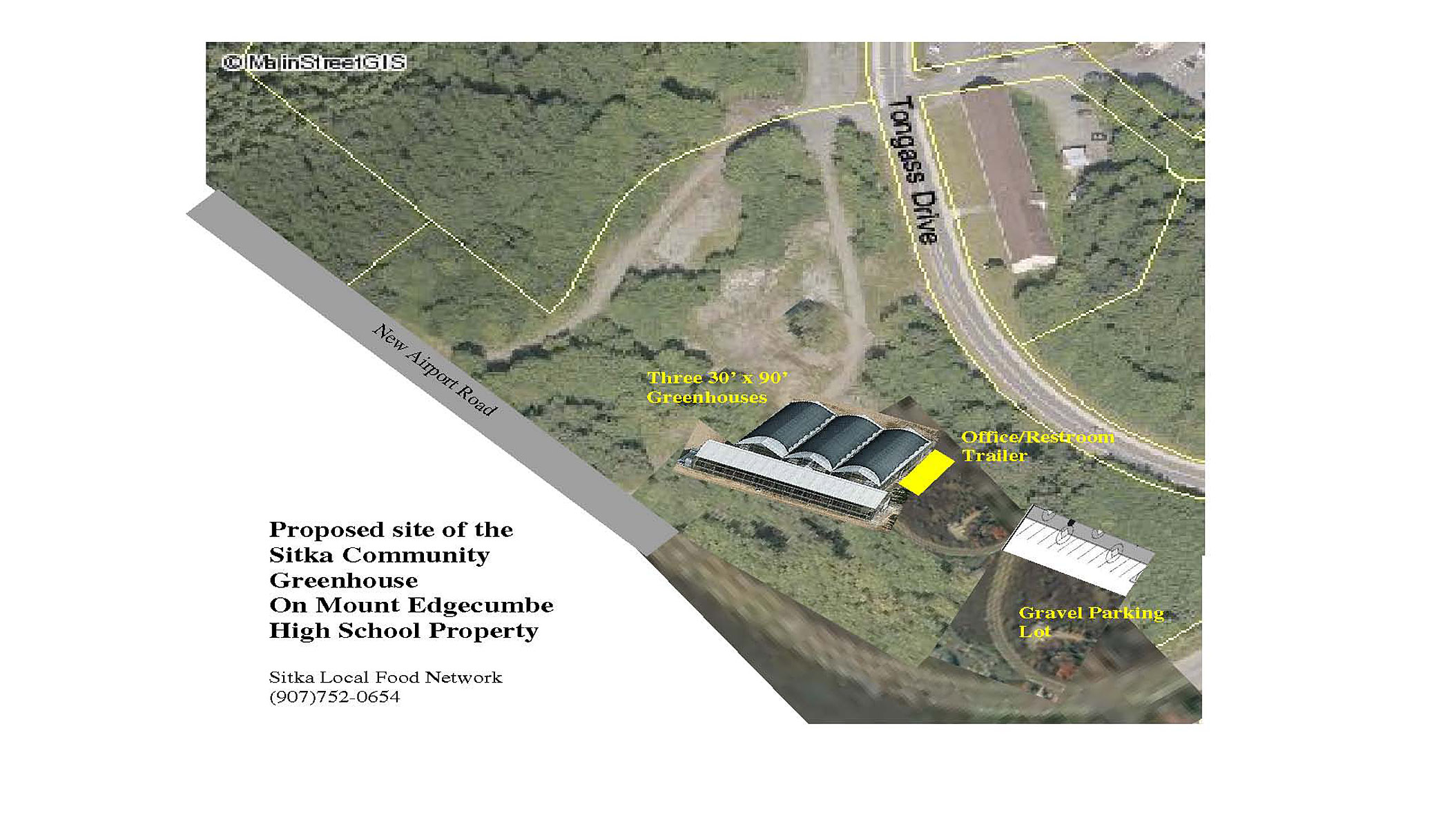
Currently, the Sitka Local Foods Network is in negotiations with the State of Alaska to lease an unused piece of Mt. Edgecumbe High School-owned land on Japonski Island near Mt. Edgecumbe Hospital. If the lease goes through, the community greenhouse will help Sitka grow more fruits and vegetables locally while extending our short growing season. The greenhouse can provide educational opportunities for Mt. Edgecumbe High School and University of Alaska Southeast-Sitka Campus students, as well as for other school, church and community groups who want to learn more about growing their own food. The community greenhouse also can provide horticultural therapy for medical and behavioral health patients.

Kerry said the model for the Sitka Community Garden and Education Center is the Cheyenne Botanic Gardens in Cheyenne, Wyo. Kerry used to work at the Cheyenne Botanic Gardens several years ago, and he has been given pointers by Cheyenne Botanic Gardens director/founder Shane Smith. The Cheyenne Botanic Gardens started out as a small-scale community greenhouse in 1977 that now features more than nine acres of extensive gardens, a solarium, arboretum and other features. It combines educational opportunities with production gardening and horticultural therapy (see fact sheet linked below).

Kerry said he is seeking letters of support from individuals and groups in Sitka who support the Sitka Community Greenhouse and Education Center, and a sample letter is attached below. For more information, contact Kerry at 966-8839 or 752-0654.

Sitka Community Greenhouse and Education Center PowerPoint presentation

Sitka Community Greenhouse and Education Center proposal 2010

Sample Letter of Support for the Sitka Community Greenhouse and Education Center

Cheyenne Botanic Gardens factsheet

• Sitka Community Schools opens registration for Blatchley Community Garden

Blatchley Community Garden

Blatchley Community Garden

Sitka Community Schools has opened registration for the 2010 Blatchley Community Garden located behind Blatchley Middle School.

Potential gardeners can register for a plot from 8 a.m. to 5 p.m. on Monday through Friday through May 28 at the Sitka Community Schools office at Hames Athletic and Wellness Center. Availability of garden plots is limited, and former gardeners will be assigned their plots from previous years if they register before May 28. Fees for the program are 50 cents per square foot for plots.

Blatchley Community Garden features small plots for families or groups who want to raise vegetables for their personal consumption. This is different than the St. Peter’s Fellowship Farm communal garden, which raises vegetables for the Sitka Local Foods Network to sell at the Sitka Farmers Market.

For more information, please contact Scott McAdams at 966-1405 or lead gardener Dave Neutzel at 738-8732.

• As you build your garden, don’t forget to plant a row for the hungry

As you start to plan your garden for this spring and summer, don’t forget to Plant A Row For The Hungry. The Plant A Row For The Hungry program (also known as Plant A Row or PAR) is a national campaign by the Garden Writers Association of America that got its start in Alaska.

In the cold winter of 1994, Anchorage Daily News garden columnist and former Garden Writers Association of America President Jeff Lowenfels was returning to his hotel after a Washington, D.C., event when he was approached by a homeless person who asked for some money to buy food. Lowenfels said Washington, D.C., had signs saying, “Don’t give money to panhandlers,” so he shook his head and kept on walking. But the man’s reply, “I really am homeless and I really am hungry. You can come with me and watch me eat,” stayed with Lowenfels for the rest of his trip.

Jeff Lowenfels

Jeff Lowenfels

The encounter continued to bother Lowenfels, even as he was flying back to Anchorage. During the flight, Lowenfels came up with an idea when he started writing his weekly garden column (the longest continuously running garden column in the country, with no missed weeks since it started on Nov. 13, 1976). He asked his readers to plant one extra row in their gardens to grow food to donate to Bean’s Café, an Anchorage soup kitchen. The idea took off.

When Anchorage hosted the Garden Writers Association of America convention in 1995, Lowenfels took the GWAA members to Bean’s Café to learn about the Plant A Row For Bean’s Café program. The Garden Writers Association of America liked the idea, and it became the national Plant A Row For The Hungry campaign. In 2002, the Garden Writers Association Foundation was created as a national 501(c)(3) nonprofit to manage the Plant A Row For The Hungry program.

“I am not surprised by the growth of PAR,” Lowenfels wrote in an e-mail to the Sitka Local Foods Network. “It is now in all 50 states and across Canada and there are thousands of variations of the original program — from prison gardens for the hungry to botanical gardens donating their produce from public display gardens. This is because gardeners always share information and extra food, so the idea was a natural.”

It took five years for the program to reach its first million pounds of donated food, but the second million only took two years and the next eight years saw a million pounds of donated food (or more) each year. Since 1995, more than 14 million pounds of food have been donated. Not only that, the program is getting ready to expand overseas to Australia, England and other countries with avid gardeners.

“We have supplied something in the vicinity of enough food for 50 million meals,” Lowenfels wrote in his e-mail. “Gardeners can solve this hunger problem without the government. And we don’t need a tea party to do it! Or chemicals, I might add, as author of a book on organic gardening (Teaming With Microbes, written with Wayne Lewis)!”

According to the U.S. Department of Agriculture, one out of every eight U.S. households experiences hunger or the risk of hunger. Many people skip meals or eat too little, sometimes going an entire day or more without food. About 33 million Americans, including 13 million children, have substandard diets or must resort to seeking emergency food because they can’t always afford to buy the food they need. In recent years the demand for hunger assistance has increased 70 percent, and research shows that hundreds of children and adults are turned away from food banks each year because of lack of resources.

While many people credit Lowenfels for creating the Plant A Row For The Hungry program, Lowenfels says the real heroes are the gardeners growing the extra food and donating it to local soup kitchens, senior programs, schools, homeless shelters and neighbors. You can hear him pass along the credit to all gardeners at the end of this interview last year with an Oklahoma television station (video also embedded below).

“One row. That’s all it takes. No rules other than the food goes to the hungry. You pick the drop-off spot or just give it to a needy friend or neighbor. Nothing slips between the lip and the cup, I say,” Lowenfels wrote in his e-mail.

For people wanting to Plant A Row For The Hungry in Sitka, there are several places that would love to help distribute some fresh locally grown veggies or berries to those who are less fortunate, such as the Salvation Army (note, the current officers are Capts. Kevin and Tina Bottjen), Sitkans Against Family Violence (SAFV), local churches, Sitka Tribe of Alaska and other organizations. The food the Sitka Local Foods Network grows at St. Peter’s Fellowship Farm communal garden goes to the Sitka Farmers Market, where people who are in the WIC (Women, Infants, Children) supplemental food program can use special farmers market vouchers to buy fresh vegetables.

The Sitka Local Foods Network also takes donations of local produce to sell at the Sitka Farmers Markets, and all proceeds from the Sitka Farmers Markets are used to help pay for Sitka Local Foods Network projects geared toward helping more people in Sitka grow and harvest local food. For more information, contact Sitka Farmers Market coordinators Linda Wilson (lawilson87@hotmail.com) or Kerry MacLane (maclanekerry@yahoo.com).

2010 Plant A Row For The Hungry marketing brochure

2009 Start a local Plant A Row For The Hungry campaign brochure

• Sitka Local Foods Network featured on APRN’s “Talk of Alaska” statewide call-in show about local food production

Sitka Local Foods Network President Kerry MacLane was one of the featured guests for the Alaska Public Radio Network’s “Talk of Alaska” statewide call-in show hosted by Steve Heimel on Tuesday, March 30.

The topic of Tuesday’s hour-long show was “Local Food Production.” If you weren’t able to hear the show, you can listen to it by clicking this link and then looking for the arrow above the comments box. In addition to Kerry, the other featured guest was Tim Meyers of Meyers Farm in Bethel. Some of the topics on this show included community supported agriculture (CSA) farms, spring planting, the Sitka Farmers Market, the Sitka Seafood Festival, the new Alaska Food Policy Council, sac roe herring, composting, soil conditions and other issues.

Some of the clips from Tuesday’s Talk of Alaska show were reorganized into a news feature story that ran on Wednesday’s “Alaska News Nightly” half-hour newscast on APRN. The news feature used some of Kerry MacLane’s comments about the Sitka Local Foods Network, but there were several minor errors in the story about what’s going on in Sitka.

By the way, this isn’t the first time local food has been featured on Talk of Alaska this year. In October 2009, Talk of Alaska did a show “Our Food Supply” as a preview for the Bioneers of Alaska annual conference.

• Alaska Food Policy Council created to examine how our food system relates to our economy, security and health

In response to concerns by Alaskans about food security, health and job creation, the Alaska Food Policy Council is being formed and it will host a meeting on May 18-19 at a location TBA in Anchorage.

“This will be a chance for Alaskans to come together and develop a plan to produce more food for our communities,” said Danny Consenstein, the Executive Director of the USDA Alaska Farm Service Agency in Palmer.

The Alaska Food Policy Council wants your help in examining how our food system relates to our economy, our security and our health. The meeting will provide an opportunity for the wide variety of food system stakeholders to connect, so they can begin to develop comprehensive solutions toward building a stronger Alaska food system.

The first face-to-face meeting takes place from noon to 5 p.m. on Tuesday, May 18, and from 8 a.m. to noon on Wednesday, May 19, at a location TBA in Anchorage. Mark Winne of the Community Food Security Coalition will facilitate the meeting. The goal will be to learn about food policy councils (which exist in many states and local communities), consult with experts to establish the lay of the land in Alaska, and to begin to set the direction for the Alaska Food Policy Council to take. Sitka Local Foods Network President Kerry MacLane has been asked to represent our group on this council, and he said he plans to attend the May meeting.
Seating is limited for this meeting, so please contact Public Health Specialist Diane Peck, MPH, RD, with the Alaska Department of Health and Social Services by May 1 to RSVP or request more information. Diane can be reached at 269-8447 (Anchorage) or diane.peck@alaska.gov. The Alaska Center for the Environment’s local food project page has more information about the creation of the Alaska Food Policy Council.

Alaska Food Policy Council meeting flier for May 18-19 in Anchorage

• Sitka Local Foods Network featured in magazine article

The Sitka Local Foods Network is mentioned in the article, “The Search for Food Sustainability in Alaska,” in the March/April 2010 issue of Countryside & Small Stock Journal, a magazine of modern homesteading.

The article is written by Cathy Lieser, who recently moved to Baranof Island after several years living on a homestead in the Alaska Range. She mentions the work being done by the Sitka Local Foods Network to promote local food security and local gardens. She also mentions the movie, “Eating Alaska,” by Sitka filmmaker Ellen Frankenstein.

This article is not one of the articles posted on the Countryside site, but the editors did give us permission to post the article as a PDF document. It is posted below.

The Search for Food Sustainability in Alaska

• Sitka gardeners extend growing seasons with government pilot study on high tunnels

Several Sitka gardeners will be extending their growing seasons this year thanks to a government soil conservation program designed to study the effectiveness of “high tunnels” or “hoop houses” when it comes to growing more local food in a conservation-minded way. To qualify you need to have grown $1,000 worth of produce for two of the past five years, even if just for your family and friends.

The Sitka participants will be constructing the greenhouse-like structures this year, which will enable them to grow more local food. For participating in the study, the government will reimburse them for the cost of the materials. This project is part of a nationwide effort to improve our community food security called “Know Your Farmer, Know Your Food.” As part of the project, the U.S. Department of Agriculture will conduct a three-year, 38-state study on high tunnels to see if they help reduce pesticide use, extend the growing season, keep vital nutrients in the soil, etc. This YouTube video has more information about the pilot study and shows several smaller family garden-sized high tunnels being placed in the White House garden.

“There is great potential for high tunnels to expand the availability of healthy, locally-grown crops — a win for producers and consumers,” U.S. Department of Agriculture Deputy Secretary Kathleen Merrigan said. “This pilot project is going to give us real-world information that farmers all over the country can use to decide if they want to add high tunnels to their operations. We know that these fixtures can help producers extend their growing season and hopefully add to their bottom line.”

If you meet the requirement, feel free to participate by contacting our local USDA Natural Resources Conservation Service (NRCS) agent for Southeast Alaska, Samia Savell in Juneau at 586-7220, or go to http://www.nrcs.usda.gov/. NRCS will fund one high tunnel per qualifying farm, and a high tunnel can cover as much as 5 percent of one acre.

High tunnels have been used successfully in Alaska, including up in Fairbanks where temperatures drop to minus-50. Last September, the University of Alaska Fairbanks School of Natural Resources and Agricultural Sciences reported on a two-year project where 39 varieties of apples had been grown in high tunnels at the Fairbanks Experiment Farm. The UAF Cooperative Extension Service also reported on the project (with short videos), and the Fairbanks Daily News-Miner also reported on the story.

• Wanton waste of deer meat, a record high herring quota and other local foods stories in the news

Over the past couple of weeks, at least 10 Sitka black tail deer corpses have been found in Sitka with lots of edible meat still on the bone but the prime cuts missing. According to the Anchorage Daily News, state wildlife officials are searching for the hunters, and wanton waste charges may be coming for those involved. There were six deer found off Green Lake Road, then four deer were found near Harbor Mountain Road five days later.

The Sitka Local Foods Network encourages the responsible and sustainable harvesting of traditional subsistence foods, such as deer, but we must respect the resource and use the entire animal. Not only is leaving edible meat in the field wasteful, but the last couple of years have been down years for deer survival and the actions of these wasteful hunters may mean fewer hunting opportunities next year for hunters who need the deer to feed their families. Anyone with information about the cases is asked to call Alaska Wildlife Troopers at 747-3254 or, to remain anonymous, Wildlife Safeguard at 1-800-478-3377.

In other local foods news, the Alaska Department of Fish and Game established a record sac roe herring quota for the 2010 season, a quota of more than 18,000 tons (more than 4,000 tons higher than last year’s then-record quota). The commercial herring fleet is very happy with the higher quota, but KCAW-Raven Radio reports local subsistence gatherers worry that the record quota will harm their ability to gather herring eggs on hemlock branches, a popular subsistence and barter food for local Tlingít and Haida residents. They also worry two straight years of record quotas will hurt the resource, since herring also serves as a key forage food for salmon, halibut, whales, sea lions and other species in the region.

The Juneau Empire reported that the State of Alaska asked for an extension to reply to an inquiry on subsistence management from the federal government. The federal government took over some management of subsistence in Alaska more than a decade ago because state laws weren’t in compliance with the Alaska National Interest Lands Conservation Act (ANILCA), which calls for a rural preference on subsistence in times of shortage, and the federal government may be expanding its role in subsistence management.

The Anchorage Daily News reported on Alaska pork being ready for the freezer at A.D. Farms, and that pork will be sold at the indoor farmers market at Anchorage’s Northway Mall. The story included a wrap-up of other local foods available at the market, and it had a recipe for crock-pot cod.

Laine Welch’s Alaska fishing column was about how more local fish is appearing in school lunch menus.

The Anchorage Daily News Alaska Newsreader feature reported on several Arctic travelers getting trichinosis from eating undercooked bear meat. The National Post of Canada also had a story on travelers eating undercooked bear meat, while the New York Times had an article about how trichinosis is common in bear meat that isn’t cooked properly.

The Anchorage Daily News had an article about how Alaska’s rhubarb probably first came from Russia.

Miller-McCune magazine had an article about how Alaska’s complex salmon politics can serve as a model for sustainable fisheries elsewhere in the world.

The Alaska Public Radio Network reported on a woman from Aniak, Dee Matter, who has taken freezing her food to a new level. The story also was on APRN’s Alaska News Nightly show.

The Fairbanks Daily News-Miner had a feature article about Kotzebue hunter and trapper Ross Schafer and the “Eskimo” way of life.

The Fairbanks Daily News-Miner had an article about a conflict between farmers and hunters over the future of the Delta bison herd.

The Juneau Empire ran a story about glaciers providing an important food source.

Anchorage Daily News garden columnist Jeff Lowenfels wrote about magazine gifts for gardeners.

The Seattle Post-Intelligencer ran an Associated Press article about Monsanto’s role in the business of agriculture, especially the way it squeezes out competitors in the seed industry.

Finally, the University of Alaska Fairbanks School of Natural Resources and Agricultural Sciences blog featured an article about a new study about food security challenges in Alaska.