• As you build your garden this spring, don’t forget to Plant A Row For The Hungry

(EDITOR’S NOTE: The following article first appeared on this site in April 2010. It is repeated because much of the information remains current and newsworthy.)

As you start to plan your garden for this spring and summer, don’t forget to Plant A Row For The Hungry. The Plant A Row For The Hungry program (also known as Plant A Row or PAR) is a national campaign by the Garden Writers Association of America that got its start in Alaska.

In the cold winter of 1994, Anchorage Daily News garden columnist and former Garden Writers Association of America President Jeff Lowenfels was returning to his hotel after a Washington, D.C., event when he was approached by a homeless person who asked for some money to buy food. Lowenfels said Washington, D.C., had signs saying, “Don’t give money to panhandlers,” so he shook his head and kept on walking. But the man’s reply, “I really am homeless and I really am hungry. You can come with me and watch me eat,” stayed with Lowenfels for the rest of his trip.

Jeff Lowenfels

Jeff Lowenfels

The encounter continued to bother Lowenfels, even as he was flying back to Anchorage. During the flight, Lowenfels came up with an idea when he started writing his weekly garden column (the longest continuously running garden column in the country, with no missed weeks since it started on Nov. 13, 1976). He asked his readers to plant one extra row in their gardens to grow food to donate to Bean’s Café, an Anchorage soup kitchen. The idea took off.

When Anchorage hosted the Garden Writers Association of America convention in 1995, Lowenfels took the GWAA members to Bean’s Café to learn about the Plant A Row For Bean’s Café program. The Garden Writers Association of America liked the idea, and it became the national Plant A Row For The Hungry campaign (also known as Plant A Row or PAR). In 2002, the Garden Writers Association Foundation was created as a national 501(c)(3) nonprofit to manage the Plant A Row For The Hungry program.

“I am not surprised by the growth of PAR,” Lowenfels wrote in an e-mail to the Sitka Local Foods Network. “It is now in all 50 states and across Canada and there are thousands of variations of the original program — from prison gardens for the hungry to botanical gardens donating their produce from public display gardens. This is because gardeners always share information and extra food, so the idea was a natural.”

It took five years for the program to reach its first million pounds of donated food, but the second million only took two years and the next eight years saw a million pounds of donated food (or more) each year. Since 1995, more than 14 million pounds of food have been donated. Not only that, the program is getting ready to expand overseas to Australia, England and other countries with avid gardeners.

“We have supplied something in the vicinity of enough food for 50 million meals,” Lowenfels wrote in his e-mail. “Gardeners can solve this hunger problem without the government. And we don’t need a tea party to do it! Or chemicals, I might add, as author of a book on organic gardening (Teaming With Microbes, written with Wayne Lewis)!”

According to the U.S. Department of Agriculture, one out of every eight U.S. households experiences hunger or the risk of hunger. Many people skip meals or eat too little, sometimes going an entire day or more without food. About 33 million Americans, including 13 million children, have substandard diets or must resort to seeking emergency food because they can’t always afford to buy the food they need. In recent years the demand for hunger assistance has increased 70 percent, and research shows that hundreds of children and adults are turned away from food banks each year because of lack of resources.

While many people credit Lowenfels for creating the Plant A Row For The Hungry program, Lowenfels says the real heroes are the gardeners growing the extra food and donating it to local soup kitchens, senior programs, schools, homeless shelters and neighbors. You can hear him pass along the credit to all gardeners at the end of this interview last year with an Oklahoma television station (video also embedded below).

“One row. That’s all it takes. No rules other than the food goes to the hungry. You pick the drop-off spot or just give it to a needy friend or neighbor. Nothing slips between the lip and the cup, I say,” Lowenfels wrote in his e-mail.

For people wanting to Plant A Row For The Hungry in Sitka, there are several places that would love to help distribute some fresh locally grown veggies or berries to those who are less fortunate, such as the Salvation Army, Sitkans Against Family Violence (SAFV), local churches, Sitka Tribe of Alaska and other organizations. The food the Sitka Local Foods Network grows at St. Peter’s Fellowship Farm communal garden goes to the Sitka Farmers Market, where people who are in the WIC (Women, Infants, Children) supplemental food program (operated in Southeast Alaska by the SouthEast Alaska Regional Health Consortium or SEARHC) can use special farmers market vouchers to buy fresh vegetables.

The Sitka Local Foods Network also takes donations of local produce to sell at the Sitka Farmers Markets, and all proceeds from the Sitka Farmers Markets are used to help pay for Sitka Local Foods Network projects geared toward helping more people in Sitka grow and harvest local food. For more information, contact Sitka Local Foods Network President Kerry MacLane (maclanekerry@yahoo.com), Sitka Local Foods Network Vice President Linda Wilson (lawilson87@hotmail.com) or Sitka Farmers Market Coordinator Johanna Willingham-Guevin (johanna.willingham@gmail.com).

• 2010 Plant A Row For The Hungry marketing brochure

• 2009 Start a local Plant A Row For The Hungry campaign brochure
• Sitka Local Foods Network board of directors to meet on Monday, Feb. 6

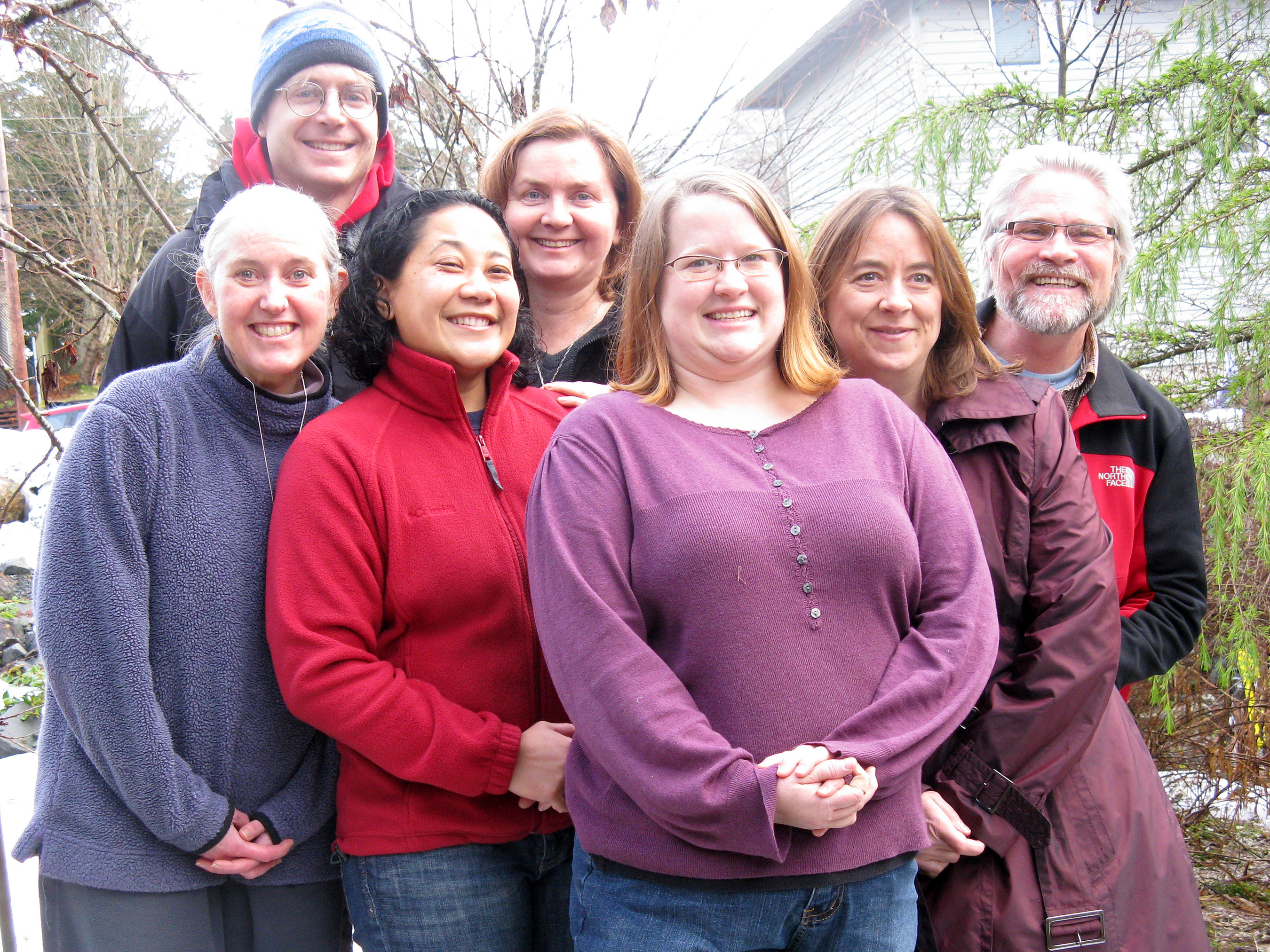
The 2011-12 Sitka Local Foods Network Board of Directors at its winter board retreat on Dec. 3, 2011. From left are Lisa Sadleir-Hart, Doug Osborne, Maybelle Filler, Cathy Lieser, Robin Grewe, Linda Wilson and Kerry MacLane. Not pictured are Johanna Willingham-Guevin and Tom Crane.

The 2011-12 Sitka Local Foods Network Board of Directors at its winter board retreat on Dec. 3, 2011. From left are Lisa Sadleir-Hart, Doug Osborne, Maybelle Filler, Cathy Lieser, Robin Grewe, Linda Wilson and Kerry MacLane. Not pictured are Johanna Willingham-Guevin and Tom Crane.

The Sitka Local Foods Network board of directors will hold its monthly meeting from 6:30-8 p.m. on Monday, Feb. 6, at the Sitka Unitarian Universalist Fellowship Building, 408 Marine St. (parking lot is off Spruce Street).

Key topics for the meeting include planning for the Let’s Grow Sitka on March 11, a recap of the Jan. 21 Sitka Local Foods Network annual meeting and potluck, an update on the Sitka Community Greenhouse and Education Center, an update on the Sitka Food Co-op, an update on recent work by the Alaska Food Policy Council, an update on the Sitka Composting Project (Sick-a-Waste), our new logo and t-shirts, planning for spring planting at St. Peter’s Fellowship Farm and other community gardens, planning for upcoming events such as the Sitka Farmers Markets on alternating Saturdays from July 7-Sept. 15, and more.

Board meetings are free and open to the general public, usually once a month (except summer). We always welcome new volunteers interested in helping out with our various projects. For more information, contact Kerry MacLane at 752-0654 or 747-7888.

• Sitka Local Foods Network hosts annual meeting and potluck dinner on Saturday, Jan. 21

Please join the Sitka Local Foods Network for its annual meeting and potluck dinner at 6 p.m. on Saturday, Jan. 21, at the Sitka Unitarian Universalist Fellowship Hall (408 Marine St., parking lot is off Spruce Street).

Join us as we honor our four years of existence and prepare for our fifth year. During this time, the Sitka Local Foods Network has worked on several initiatives — creating the Sitka Farmers Market, building St. Peter’s Fellowship Farm, hosting the Let’s Grow Sitka! garden education event, and more. We supported projects to plant more fruit trees around Sitka, get more local fish served in school lunches and increase Sitka’s ability to compost, and we are working toward starting the Sitka Community Greenhouse and Education Center. We also received a 501(c)(3) non-profit status from the IRS, so people can make tax-deductible gifts to help fund our work.

Our annual meeting and potluck is open to the public, and all Sitka residents are welcome to attend. We will feature local and slow foods, but we really value your attendance. This is our opportunity to say thank you to those who have helped us grow, and it is your chance to learn more about what we’re doing and how you can help.

As we enter 2012, Sitka and the rest of Alaska face some serious food security issues. According to a recent survey by the University of Alaska Fairbanks Cooperative Extension Service, the weekly cost for food for a family of four in Sitka has gone up 44 percent over the past five years. With rising fuel prices, this trend does not figure to change in the near future. Sitka still imports about 90-95 percent of its food from the Lower 48 or other countries, which means transportation is a big part of our food cost. The Sitka Local Foods Network is looking for input from Sitka residents about how we can work to improve Sitka’s food security. We also are working with the Alaska Food Policy Council, which is a statewide organization working on food security issues.

So mark your calendar to attend our annual meeting and potluck dinner at 6 p.m. on Saturday, Jan. 21, at the Unitarian Universalist Fellowship Hall, 408 Marine St. For more information, contact Kerry MacLane at 752-0654.

• Sitka Local Foods Network board of directors to meet on Thursday, May 12

The Sitka Local Foods Network board of directors will hold its monthly meeting from 6-7:30 p.m. on Thursday, May 12, at the Sitka Local Foods Network’s new office in the Sitka Unitarian Universalist Fellowship Building, 408 Marine St.

Key topics for the meeting include the start of work parties at St. Peter’s Fellowship Farm, preparations for the upcoming Sitka Farmers Market season, an update on fruit tree planting efforts from the Sitka Fruit Tree Initiative, an update on the Sitka Seafood Festival, an update on the Sitka Community Greenhouse and Education Center project, a recap of the Let’s Grow Sitka event on March 20, an update on Blatchley Community Garden plans for the spring and summer, an update on the Alaska Food Policy Council, an update on the Fish In Schools Hooray (FISH) project to get more locally caught fish into school menus.

Board meetings are free and open to the general public. We always welcome new volunteers interested in helping out with our various projects. For more information, contact Kerry MacLane at 752-0654.

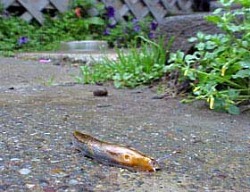
• Start now in your fight against slugs and snails

Ah, springtime in Southeast Alaska, when the weather is moist and chilly. If it’s springtime in Southeast, it means it’s time for garden slugs, the bane of every Southeast gardener.

Now is the time to fight slugs, even if you haven’t planted yet as you wait for final frost in May. Slugs get into gardens in the spring, and this is when they are laying their eggs (and both male and female slugs can lay eggs). If you don’t fight the slugs now, the problem will be worse in the summer when your garden starts growing. Slugs eat the plants in your garden, and if uncontrolled they can do considerable damage to your crops.

Charlie Nardozzi, who writes the Edible Landscaping page on the National Gardening Association’s site, recently posted a good article on how to control slugs and snails. Most of his hints work in Alaska, though some people say the Southeast rain makes beer traps less effective here than in dryer climates.

The University of Alaska Fairbanks Cooperative Extension Service has several publications with information on controlling pests such as slugs. One good reference is the Gardening in Southeast Alaska booklet (click link for free download as a PDF file). Another good reference, written by Sitka-based Resource Development Agent Robert Gorman, is the publication “Slugs” (click link for free download as a PDF file).

Fran Durner, who used to write the Talk Dirt To Me blog for the Anchorage Daily News, wrote a post about slug control a couple of years ago that included a picture of slug eggs so people could get them out of their gardens before they hatch. Fran also wrote a post about using dryer lint to deter slugs. Julie Riley of the Anchorage office of the UAF Cooperative Extension Service also wrote an article for the Anchorage Daily News with tips on how to control slugs that gardeners in Southeast might find helpful.

• Sitka National Historical Park hosts ‘Gardening in Sitka’ presentation

The Sitka National Historical Park‘s “An Evening in the Park” series will feature a presentation at 7 p.m. on Thursday, April 21, called “Gardening in Sitka: A Unique Challenge.”

This presentation will be led by Park Ranger Thomas Cook, who also is certified as a Master Gardener. The presentation takes place at the Sitka National Historical Park Visitors Center Theatre.

Gardening in Sitka can be a challenge, with lots of rain and tricky soil conditions. This can discourage many aspiring green thumbs. But with a little knowledge, you can plant and grow a beautiful garden in Sitka.

This interactive presentation invites people to share their own perspectives and experiences, and to discuss their successes and challenges with the group as a whole. Ranger Thomas Cook will discuss planting schedules for Sitka, how to overcome acidic soil conditions, seeds vs. seedlings, slugs and pests, and how to construct an inexpensive greenhouse.

To learn more, contact Becky Latanich at 747-0132 or becky_latanich@nps.gov.


• Sitka Local Foods Network board of directors to meet on Thursday, April 7

The Sitka Local Foods Network board of directors will hold its monthly meeting from 7-8:30 p.m. on Thursday, April 7, at the Sitka Local Foods Network’s new office in the Sitka Unitarian Universalist Fellowship Building, 408 Marine St. This is a change from the board’s regular meeting schedule.

Key topics for the meeting include an update on the Sitka Community Greenhouse and Education Center project, a recap of the Let’s Grow Sitka event on March 20, an update on St. Peter’s Fellowship Farm and Blatchley Community Garden plans for the spring and summer, an update on the Sitka Farmers Markets that start in July, an update on the Alaska Food Policy Council, an update on the two new food projects from the Sitka Health Summit (planting 200 apple or other fruit trees in Sitka and getting more locally caught fish served at Sitka schools), and more.

Board meetings are free and open to the general public. We always welcome new volunteers interested in helping out with our various projects. For more information, contact Kerry MacLane at 752-0654.

• Sitka Local Foods Network board of directors to meet on Monday, Feb. 14

The Sitka Local Foods Network board of directors will hold its monthly meeting from 5:30-7 p.m. on Monday, Feb. 14, at the Sitka Local Foods Network’s new office in the Sitka Unitarian Universalist Fellowship Building, 408 Marine St. Starting this month, meetings will move to the second Monday instead of the first.

Key topics for the meeting include an update on the Sitka Community Greenhouse and Education Center project, plans for the Let’s Grow Sitka event on March 20, an update on St. Peter’s Fellowship Farm and Blatchley Community Garden, a recap of the Sitka Farmers Markets, an update on the Alaska Food Policy Council, an update on the two new food projects from the Sitka Health Summit (planting 200 apple or other fruit trees in Sitka and getting more locally caught fish served at Sitka schools), and more.

Board meetings are free and open to the general public. We always welcome new volunteers interested in helping out with our various projects. For more information, contact Kerry MacLane at 752-0654 .

• UAF Cooperative Extension Service publishes new sustainable gardening manual for Alaska

(The following is a press release from the University of Alaska Fairbanks news service)

The University of Alaska Fairbanks Cooperative Extension Service has published a new comprehensive gardening manual.

“Sustainable Gardening: The Alaska Master Gardener Manual” was adapted for Alaska from an Oregon State University publication, “Sustainable Gardening: The Oregon-Washington Master Gardener Handbook.”

The 490-page manual, which sells for $40, is a basic gardening text. It also offers information on soils and fertilizers, propagation, berry crops, pruning, composting, flowers, greenhouses and season extenders, lawns, plant diseases, pesticides and integrated pest management. The manual is a good resource for home gardeners and also will be used as one component in Extension’s master gardener training programs.

Michele Hebert, Extension’s Tanana District agriculture and horticulture agent, was one of several people who contributed to the manual. She said gardeners need additional information to overcome the challenges and capitalize on the benefits of growing vegetables and flowers in the Far North.

The manual focuses on sustainable gardening practices, a holistic method for growing plants that is good for the environment, good for families and good for the community, said Hebert. “It takes a minimal input of labor, water, fertilizer and pesticides while building the soil into a healthy living system. A thoughtful balance is made between the resources used and the results gained.”

Other contributors to the manual include current and former Alaska Extension faculty Stephen Brown, Jeff Smeenk, Tom Jahns, Robert Gorman (of Sitka), Fred Sorensen, Julie Riley, Heidi Rader, Bob Wheeler, Peter Bierman and Jay Moore. Copies may be ordered through Extension’s toll-free line at 1-877-520-5211 or by clicking this link.

(The Alaska Public Radio Network ran this story about the book on the Tuesday, Sept. 7, Alaska News Nightly show.)

• Sitka Local Foods Network to host board meeting on Monday, Sept. 6

The 2009-10 Sitka Local Foods Network board of directors. Back row, from left, Doug Osborne, Linda Wilson, Lisa Sadleir-Hart, Natalie Sattler, Peggy Reeve (no longer on board) and Maybelle Filler. Front row, from left, Lynnda Strong, Kerry MacLane and Suzan Brawnlyn. Not pictured, Tom Crane, Johanna Willingham (added to board in May 2010).

The 2009-10 Sitka Local Foods Network board of directors. Back row, from left, Doug Osborne, Linda Wilson, Lisa Sadleir-Hart, Natalie Sattler, Peggy Reeve (no longer on board) and Maybelle Filler. Front row, from left, Lynnda Strong, Kerry MacLane and Suzan Brawnlyn. Not pictured, Tom Crane, Johanna Willingham (added to board in May 2010).

The Sitka Local Foods Network board of directors will meet at 4:30 p.m. on Monday, Sept. 6 (Labor Day) at the See House behind St. Peter’s By The Sea Episcopal Church.

This is the board’s first monthly meeting since June, and the meeting is expected to last until 6 p.m. An agenda is posted below, and board president Kerry MacLane expects to stick to the assigned times on each topic. Key topics include the Sitka Farmers Market, St. Peter’s Fellowship Farm, Blatchley Community Gardens, the Sitka Community Greenhouse and Education Center, the Alaska Food Policy Council, the Running of the Boots fundraiser on Sept. 25 and more.

Board meetings are free and open to the general public. We always welcome new volunteers interested in helping out with our various projects.

• Sitka Local Foods Network board meeting agenda for Sept. 6, 2010