• State of Alaska updates safe seafood consumption guidelines

FishConsumptionCalc

Eat all the salmon you want, but limit your amount of salmon shark, the Alaska Section of Epidemiology (part of the Division of Public Health) said when it recently updated its safe seafood consumption guidelines.

The Section of Epidemiology, in partnership with the Alaska Department of Environmental Conservation, started testing Alaska seafood for toxic heavy metals, such as mercury, and other pollutants, such as pesticides, back in 2001. The main reason for the research was to determine safe levels of seafood consumption for pregnant women, nursing mothers, infants, and others. According to the Alaska Dispatch News, the research involved testing fish, and using human hair samples to see how the heavy metals moved from species to species.

The Division of Public Health Division recommends eating fish at least twice a week. Medical research shows salmon are high in omega 3 fatty acids, which are believed to improve cholesterol and fight heart disease. Many types of Alaska seafood also are part of the traditional Alaska Native diet.

The good news is Alaska’s five salmon varieties (chinook/king, sockeye/red, coho/silver, chum/keta/dog, and humpy/pink) all tested as safe for everybody, with no limitations for pregnant women or others, as did halibut smaller than 40 pounds and Alaska pollock (commonly found in fish sticks and fast food fishburgers). This year’s expanded testing increased the number of safe-for-all species to 23 from 11 in 2007 (see chart above for complete list).

However, there were some seafood species where the Office of Epidemiology suggests consumption limits. Alaskans should use a point system, where people can eat up to 12 points a week (the safe species get zero points), with points based on six-ounce portions. Halibut (40-80 pounds), lingcod (35-40 inches) and lake trout are worth three points. Halibut (80-140 pounds), lingcod (40-45 inches) and longnose skate are worth four points. Halibut (140-220 pounds) and yelloweye rockfish are worth six points. Halibut (220 pounds or larger), lingcod (45 inches or longer), salmon shark and spiny dogfish are worth 12 points and should only be eaten once per week.

• Sitka Farmers Market vendor forms, information sheets and regulations for 2014 now available

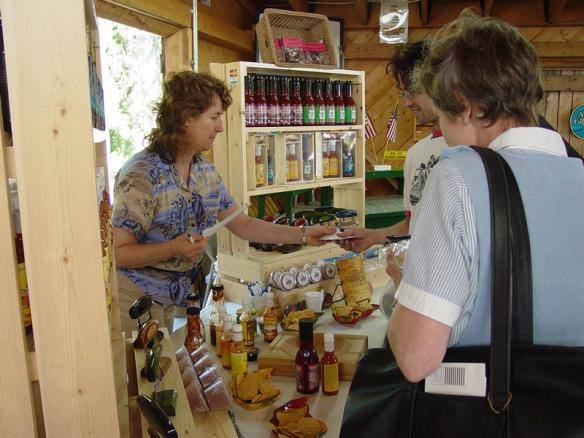
SitkaFarmersMarketSignVendors looking to sell local food, arts and crafts, and other items at the 2014 Sitka Farmers Markets can find all the vendor forms, information sheets and regulations for this year by going to the Documents page on this site, or look at the bottom of this post for the documents. The forms are in downloadable Acrobat PDF files.

The 2014 Sitka Farmers Markets will be managed by Ellexis Howey and Debe Brincefield, and they can be reached at sitkafarmersmarket@gmail.com or 738-8683 during the market season. Our 2014 Sitka Farmers Markets will be from 10 a.m. to 1 p.m. on six alternating Saturdays starting in late June (June 28, July 12, 26, Aug. 9, 23, and Sept. 6) at the Alaska Native Brotherhood Founders Hall on Katlian Street.

Ellexis and Debe already have hosted one pre-market meeting for potential market vendors, and the next pre-market meeting for market vendors is at 6:30 p.m. on Tuesday, June 17, at the See House behind St. Peter’s By The Sea Episcopal Church on Lincoln Street. All potential market vendors are encouraged to attend. Ellexis and Debe are available to answer questions and to make suggestions that will help new and returning vendors adjust to any food regulation changes from the Alaska Department of Environmental Conservation, changes to the Alaska Quest electronic benefits program, and any other changes.

For more information, contact Ellexis or Debe at the numbers above.

Sitka Farmers Market vendor forms

• Guide to Operating a Successful Home-Based Food Business (March 2014 document from UAF Cooperative Extension Service and Alaska Department of Environmental Conservation includes Alaska food safety information and regulations for farmers markets and other food sales)

• 2014 City and Borough of Sitka Sales Tax Form for Sitka Farmers Market Vendors

• 2014 Sitka Farmers Market Vendor Rules And Responsibilities Packet

• 2014 Sitka Farmers Market Vendor Registration Packet

• 2014 Sitka Farmers Market Vendor Guidelines Signature Page (this must be on file for all vendors)

• 2014 Sitka Farmers Market EBT Alaska Quest Vendor Agreement

• Sitka Farmers Market vendor forms, information sheets and regulations for 2014 now available

SitkaFarmersMarketSignVendors looking to sell local food, arts and crafts, and other items at the 2014 Sitka Farmers Markets can find all the vendor forms, information sheets and regulations for this year by going to the Documents page on this site, or look at the bottom of this post for the documents. The forms are in downloadable Acrobat PDF files.

The 2014 Sitka Farmers Markets will be managed by Ellexis Howey and Debe Brincefield, and they can be reached at sitkafarmersmarket@gmail.com or 738-8683 during the market season. Our 2014 Sitka Farmers Markets will be from 10 a.m. to 1 p.m. on six alternating Saturdays starting in late June (June 28, July 12, 26, Aug. 9, 23, and Sept. 6) at the Alaska Native Brotherhood Founders Hall on Katlian Street.

Ellexis and Debe will host at least one pre-market meeting for potential market vendors, tentatively scheduled for 6:30 p.m. on Wednesday, May 21, at the See House behind St. Peter’s By The Sea Episcopal Church. They will be available to answer questions and to make suggestions that will help new and returning vendors adjust to any food regulation changes from the Alaska Department of Environmental Conservation, changes to the Alaska Quest electronic benefits program, and any other changes.

For more information, contact Ellexis or Debe at the numbers above.

Sitka Farmers Market vendor forms

• Guide to Operating a Successful Home-Based Food Business (March 2014 document from UAF Cooperative Extension Service and Alaska Department of Environmental Conservation includes Alaska food safety information and regulations for farmers markets and other food sales)

• 2014 City and Borough of Sitka Sales Tax Form for Sitka Farmers Market Vendors

• 2014 Sitka Farmers Market Vendor Rules And Responsibilities Packet

• 2014 Sitka Farmers Market Vendor Registration Packet

• 2014 Sitka Farmers Market Vendor Guidelines Signature Page (this must be on file for all vendors)

• UAF Cooperative Extension Service releases new guide for home-based food businesses

Home-BasedFoodBusinessPhoto

Photo courtesy of UAF Cooperative Extension Service

The Sitka District office and other regional offices of the University of Alaska Fairbanks Cooperative Extension Service now have on hand a new publication, “Guide to Operating a Successful Home-Based Food Business.”

Have questions about Alaska Food Code exemption requirements? Want to know more about recipe formulation, product testing, labeling, safe preparation packaging, or starting your own business? Are you curious which homemade foods can be sold at farmers markets and festivals, and which ones require a commercial kitchen?

The 12-page handout features the answers to these questions and many other topics discussed during the training sessions about food regulations for farmers markets, hosted in February by Kate Idzorek with the UAF Cooperative Extension Service, and by Lorinda Lhotka and Morgan Poloni with the Alaska DEC Food Safety and Sanitation office.

View and download a copy of the publication onlineor contact the UAF Cooperative Extension Service’s Sitka office at 747-9440 for a hard copy.

• Sitka Sound Science Center presentation will shed light on impacts of Fukushima radiation in the Pacific Ocean

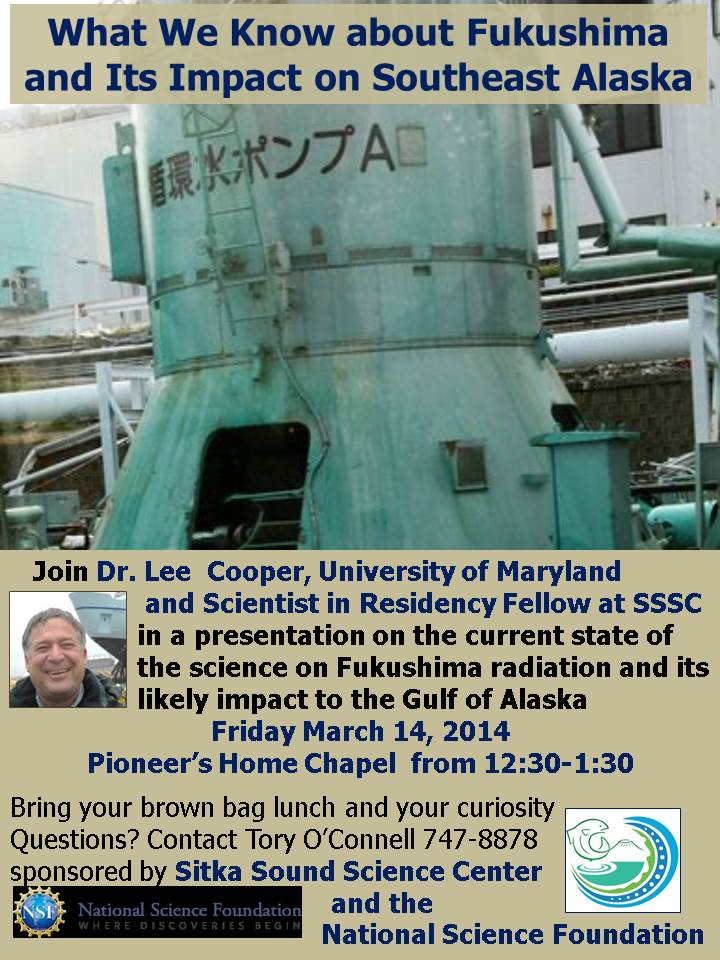
cooperFukushima

People living along the Pacific Coast, including in Sitka and Southeast Alaska, have been wondering about the impacts of radiation in the food supply ever since the March 2011 earthquake in Japan and Fukushima Dai-ichi nuclear power plant meltdown.

Dr. Lee Cooper of the University of Maryland, a Scientist in Residency Fellow at the Sitka Sound Science Center, will discuss the current state of the science on Fukushima radiation and its likely impact on the Gulf of Alaska during a brown-bag lunch presentation from 12:30-1:30 p.m. on Friday, March 14, at the Sitka Pioneer Home Chapel. Bring your lunch and questions to the presentation, which is sponsored by the Sitka Sound Science Center and the National Science Foundation.

According to the Sitka Sound Science Center:

It is projected that dissolved contaminants, particularly the radioactive isotopes of cesium, 137Cs and 134Cs from the Fukushima Dai-ichi Nuclear Power in Japan, will reach Southeast Alaska this year.  Because the amount of radiation released is uncertain and the accident site is still leaking to some extent, it is difficult to know exactly what the peak concentrations of radioactive cesium will be in local waters, but it is not likely to exceed levels that were observed during the bomb fallout era 40 to 50 years ago. Cesium is chemically very similar to potassium, which is a common ionic salt in seawater, so fortunately the concentration of cesium into the foodweb and into seafood harvested for food is comparatively modest.

Nevertheless, it is important to put into perspective the potential risks involved and communicate this to the public. This talk will summarize the newest scientific information that is available on the impacts of the accident, based upon a special session held in late February at the Ocean Science Meeting in Honolulu and attended by scientists studying Fukushima impacts, ranging from Japan and East Asia to the Woods Hole Oceanographic Institution.

For more information, contact Tory O’Connell at 747-8878.


• Alaska DEC, UAF Cooperative Extension to host food regulations training for farmers markets

Farmers Market Regs

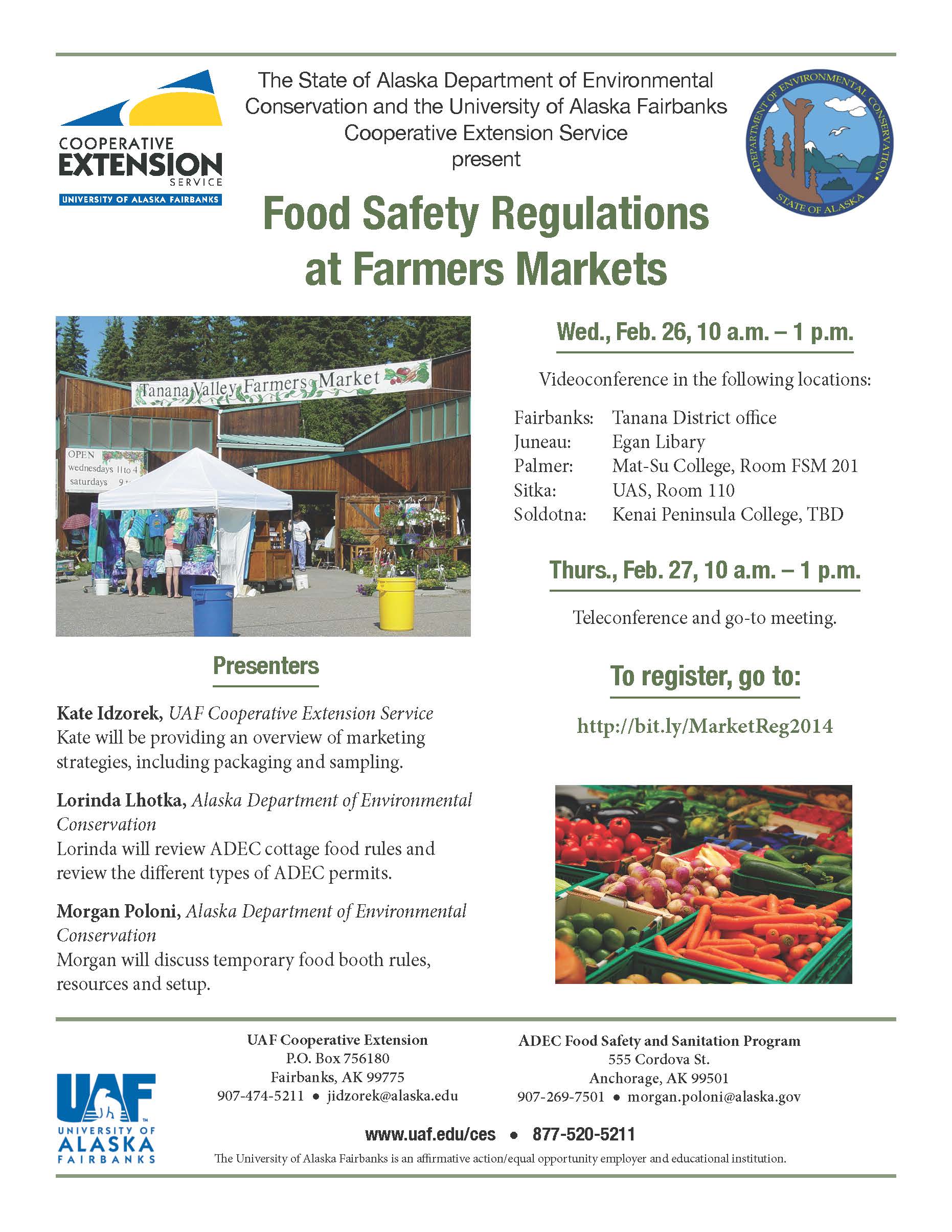
The Alaska Department of Environmental Conservation and the University of Alaska Fairbanks Cooperative Extension Service will team up to offer two training sessions about food regulations for farmers markets from 10 a.m. to 1 p.m. on both Wednesday, Feb. 26 (videoconference available in five locations, including Sitka) and on Thursday, Feb. 27 (by teleconference available statewide).

During these trainings you will learn how to market your products, how to set up your temporary food booth, and what foods do and do not require Alaska DEC permits. The course will be taught by Kate Idzorek with the UAF Cooperative Extension Service, and by Lorinda Lhotka and Morgan Poloni with the Alaska DEC Food Safety and Sanitation office. Kate will discuss marketing strategies including packaging and sampling, Lorinda will talk about Alaska DEC cottage food rules and the different types of permits, and Morgan review temporary food booth rules, resources and setup.

The first training will be offered by videoconference in five locations on Wednesday — Juneau, the Matanuska Valley, Soldotna, Fairbanks and Sitka. The Sitka videoconference site is University of Alaska Southeast Sitka Campus, Room 110 (see the flier for the other videoconference locations). The second training will be offered by teleconference or webinar (Go-To Meeting).

To register, go to http://bit.ly/MarketReg2014. For more information, contact Kate at 1-907-474-5211 or jizdorak@alaska.edu, or contact Morgan at 1-907-269-7501 or morgan.poloni@alaska.gov. The UAF Cooperative Extension Service can be reached (toll-free) at 1-877-520-5211. (Editor’s note: the three PowerPoint presentations from the Feb. 26 workshop are linked below as PDF files.)

• Cottage Foods at the market handout

• Food safety at farmers markets PowerPoint (opens as PDF file)

• Update on Alaska Farmers Markets Quest Card program PowerPoint (opens as PDF file)

• How to weed through the conflicting information about Fukushima radiation and its impacts on Alaska waters

SalmonImage

Alaskans have been worried about their seafood ever since the March 2011 Fukushima earthquake and Japanese nuclear plant problems. It’s understandable that Alaskans are concerned about the safety of the seafood, seaweed and marine mammals in the area. But Alaskans also should note that most of the information posted on social marketing sites just isn’t true.

This NOAA map has been showing up on social media posts with a note that it shows the path of 300 tons of radioactive material entering the ocean each day. This map really shows the probable tsunami paths from the 2011 Tohoku earthquake.

FALSE IMAGE: TSUNAMI WAVES, NOT RADIATION: Many people have posted on social media that this NOAA map shows the path of 300 tons of radioactive material entering the ocean each day. This map really shows the probable tsunami wave heights from the 2011 Tohoku earthquake.

One of the biggest examples of false information usually is accompanied by an official-looking map from the National Oceanic and Atmospheric Administration (NOAA) and a note that each day the map shows 300 tons of radioactive material entering the water each day. The map is an official NOAA map, but it doesn’t show radiation. It actually shows the probable tsunami paths from the 2011 Tohoku earthquake. When in doubt, or even if not, don’t be afraid to consult one of the myth-debunker sites such as Snopes.com, which has the details on the real story behind this map.

The Sitka Local Foods Network has been following the situation since it happened, and we even posted an update in March 2012 in hopes of easing people’s worries (many of the links on this page have been updated). The Alaska Department of Health and Social Services also has a site with updates.

In recent weeks, Rep. Jonathan Kreiss-Tomkins (D-Sitka) did some research, interviewing Dr. Ken Buesseler of the Woods Hole Oceanographic Institution and one of the country’s top researchers on oceanographic radiation. Rep. Kreiss-Tomkins posted his findings in his Jan. 8 constituent newsletter, and that write-up also appeared in several Alaska publications such as the Alaska Dispatch.

010714_Fukushima-Radiation-GraphAlso in January, Alaska Department of Environmental Conservation Commissioner Larry Hartig gave an update to the Alaska Senate’s Natural Resources Committee about what it’s doing to track the radiation, and he said so far the DEC hasn’t seen anything to cause concern. The Ketchikan website Stories In The News also had a follow-up story that included information from Hartic’s testimony and an update from Buesseler, who announced the launch of a new “How Radioactive Is Our Ocean?” website to help crowd-source information about what’s happening along the 5,000-mile Pacific coastline.

Taking things a step further, in January a couple of Seattle media organizations — KPLU and the Seattle Times — ran stories about Seattle fish-broker Loki Fish Co. ran its own tests on Alaska seafood. After the testing, the folks at Loki Fish Co. decided Pacific salmon is safe to eat.

• Sitka Farmers Market vendor forms, information sheets and regulations for 2013 now available

SitkaFarmersMarketSignVendors looking to sell local food, arts and crafts, and other items at the 2013 Sitka Farmers Markets can find all the vendor forms, information sheets and regulations for this year by going to the Documents page on this site. The forms are in downloadable Acrobat PDF files.

The 2013 Sitka Farmers Markets will be managed by Bridget Kauffman, and she can be reached at sitkafarmersmarket@gmail.com or 738-8683 during the market season. Bridget’s co-managers will be Sabrina Cimerol for the first three markets and Garrett Bauer for the last three. Bridget is a former vendor (she used to sell home baked goods), so she should be a good fit for the manager position.

Our 2013 Sitka Farmers Markets will be from 10 a.m. to 1 p.m. on alternating Saturdays in July, August and September (July 6, 20, Aug. 3, 17, 31, and Sept. 14) at the Alaska Native Brotherhood Founders Hall on Katlian Street.

Bridget plans to host two pre-market meetings with potential vendors at 7 p.m. on Monday, June 10, and at 7 p.m. on Monday, June 24, at the See House behind St. Peter’s By The Sea Episcopal Church. This will be when she’s available to answer questions and make suggestions to help new and old vendors adjust to any food regulation changes from the Alaska Department of Environmental Conservation, changes in the Alaska Quest electronic benefits program, etc. For more information, contact Bridget.

• Sitka Farmers Market vendor forms ready for 2012

The vendor forms for the 2012 Sitka Farmers Markets are finally ready so prospective vendors can review them and familiarize themselves with the food safety, market and sales tax rules.

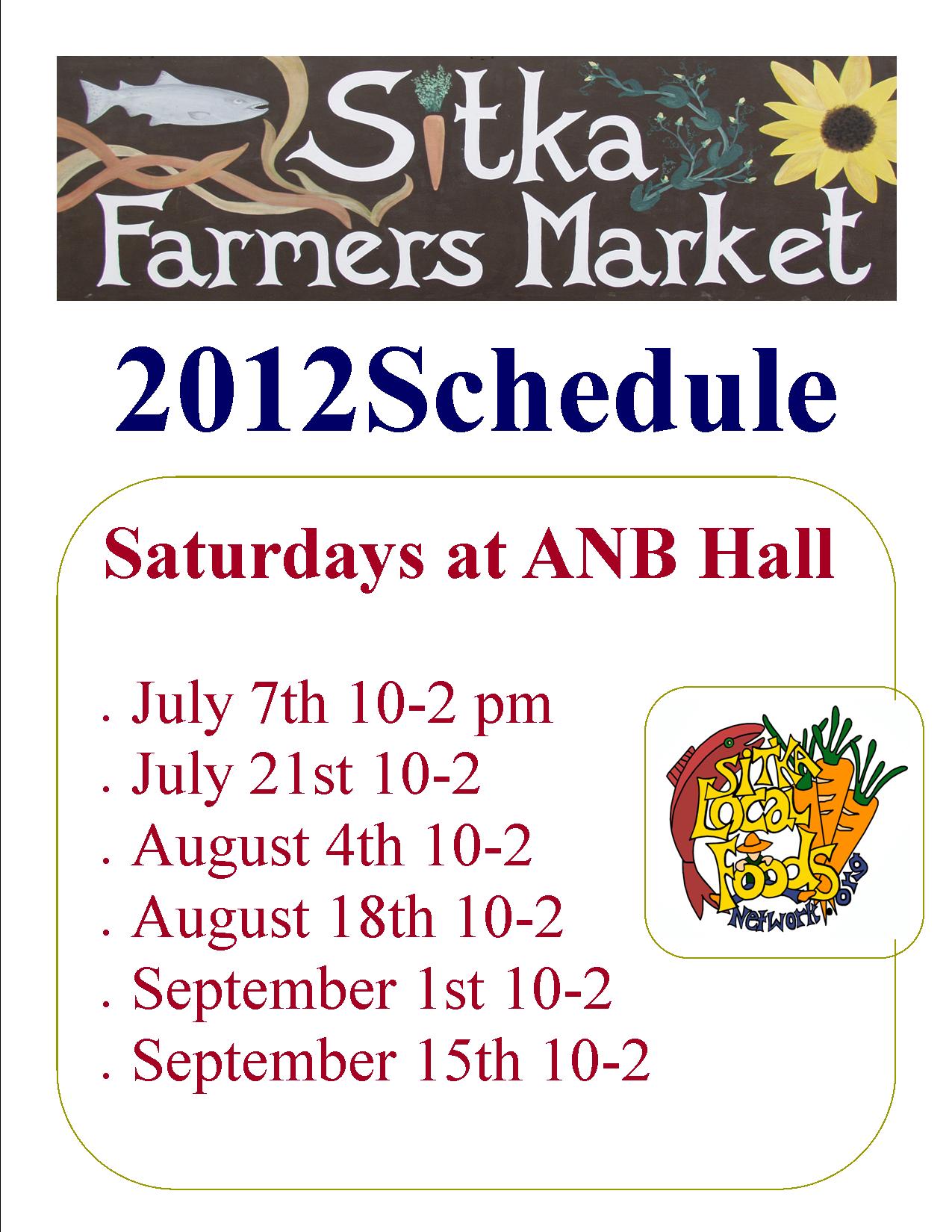
This year the Sitka Farmers Markets take place from 10 a.m. to 2 p.m. on alternate Saturdays starting on July 7 and running through Sept. 15 (July 7, 21, Aug. 4, 18, Sept. 1 and 15) at the historic Alaska Native Brotherhood Hall located at 235 Katlian St. This year we have a new market manager, Johanna Willingham-Guevin, and she will be assisted by Jasmine Shaw. Please remember that our focus is on locally grown or produced items at the market (no goods produced outside Alaska allowed, except for certain food items that are to be consumed at the market).

Prospective vendors can send their completed forms to Johanna Willingham, P.O. Box 6235, Sitka, Alaska 99835. Johanna’s e-mail address is johanna.willingham@gmail.com, and her cell number is 738-8336. All forms can be downloaded as Adobe Acrobat (PDF) files. These forms also are posted on our Forms page.

• 2012 Sitka Farmers Market Vendor Registration Packet

• 2012 Sitka Farmers Market Food Rules Vendor Packet

• 2012 Sitka Farmers Market Home Baker Guidelines Packet

• 2012 Sitka Farmers Market Home Baker Vendor Application Packet (Required By Alaska Department Of Environmental Conservation)

• 2012 Sitka Farmers Market Home Baker Ingredient Inventory Forms (Required By Alaska Department Of Environmental Conservation).

• 2012 “Do I Need A Permit?” List For Food Vendors

• 2012 “Safe, Small, Local” Brochure About Preparing Food For Farmers Markets, Bazaars And Other Events From Alaska Department of Environmental Conservation

• 2012 Sitka Farmers Market Sales Tax Form For City And Borough Of Sitka

• 2012 Sitka Farmers Market Vendor Rules And Responsibilities Packet (Has Table/Tent Fee Information)

• Paralytic shellfish poisoning (PSP) warning issued for Southeast Alaska

The enclosed copy is courtesy of the SouthEast Alaska Regional Health Consortium (SEARHC) website.
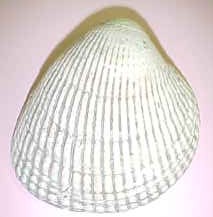
A cockle has deep ridges similar to a Ruffles potato chip (Photo courtesy of Alaska Department of Environmental Conservation)

A cockle has deep ridges similar to a Ruffles potato chip (Photo courtesy of Alaska Department of Environmental Conservation)

This past week has seen five cases of paralytic shellfish poisoning (PSP) in Alaska, including two cases in Southeast Alaska that resulted in the June 17 death of a Juneau woman who ate a cockle and the June 22 death of a Haines man who ate a Dungeness crab. The other three cases were in Kodiak and they resulted in illness from eating butter clams.

The two Southeast deaths, if confirmed by autopsy, will be the first paralytic shellfish poisoning deaths in Alaska since 1997. In 2009 there was just one reported case of PSP in Alaska, and there were no cases of PSP in 2008 and one in 2007. There have been periodic outbreaks of PSP over the years, with the most deadly instance coming when clams and mussels gathered from Peril Straits near Sitka killed more than 100 Russians and Aleuts in 1799.

According to the Alaska Department of Health and Social Services, the 57-year-old Juneau woman reportedly ate cockles she gathered on June 14 from the Point Louisa end of Auke Bay. She died June 17 after being hospitalized at Bartlett Regional Hospital in Juneau. The Alaska Department of Environmental Conservation tested cockles from Auke Bay after the woman was hospitalized and DEC found the Auke Bay cockles had much higher levels of PSP than acceptable (they should not have more than 80 parts per million, and the cockles had 2,044 parts per million).

The 57-year-old Haines man reportedly ate Dungeness crab on June 18 that he caught off Jenkins Rock near the Chilkat Inlet of Lynn Canal. He was hospitalized at Bartlett Regional Hospital on June 18 and released from the hospital on June 21. He died in his Haines home early on June 22. Dungeness crab meat does not contain PSP, but the viscera (guts) can have the toxin, health officials said. People should not eat crab viscera. The Department of Environmental Conservation plans to test crabs from Southeast for PSP.

What is paralytic shellfish poisoning (PSP)?

Paralytic shellfish poisoning, or PSP, is a potentially lethal toxin that can lead to fatal respiratory paralysis, according to the Alaska Department of Environmental Conservation. The toxin comes from algae, which is a food source for clams, mussels, crabs and other shellfish found across Alaska. This toxin can be found in shellfish every month of the year, and butter clams have been known to store the toxin for up to two years. The toxin cannot be seen with the naked eye, and there is no simple test a person can do before they harvest. One of the highest concentrations of PSP in the world was reported in shellfish from Southeast Alaska.
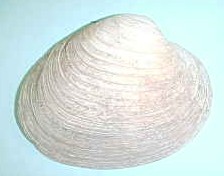
The butter clam has one set of rings that go one direction only, around the same center point (Photo courtesy of Alaska Department of Environmental Conservation)

The butter clam has one set of rings that go one direction only, around the same center point (Photo courtesy of Alaska Department of Environmental Conservation)

Symptoms of PSP can begin almost immediately, or they can take several hours after eating the affected shellfish before they appear. Symptoms include shortness of breath, tingling, dizziness and numbness. If you suspect someone has symptoms of PSP, get that person to a medical facility fast (an Alaska Sea Grant link below has first aid for PSP). Death is rare from PSP, but some people have died after eating just one clam or mussel with the PSP toxin, while in other cases it took eating many clams or mussels to get enough of the poison to cause death.

Are Southeast beaches safe for subsistence or recreational shellfish harvesting?

The Department of Environmental Conservation recommends harvesting of shellfish only from DEC-certified beaches, and the only certified beaches in the state are located in the Cook Inlet and Kachemak Bay areas of Southcentral Alaska. According to DEC, there are no certified beaches in populated areas of Southeast Alaska, Kodiak or the Aleutian Islands. The only beaches DEC can certify as safe for shellfish collecting are those where state-certified testing of clams and mussels is done regularly.

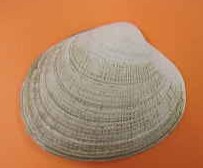
The littleneck clam has two sets of rings that cross each other at 90 degree angles (Photo courtesy of Alaska Department of Environmental Conservation)

The littleneck clam has two sets of rings that cross each other at 90 degree angles (Photo courtesy of Alaska Department of Environmental Conservation)

“Do not eat shellfish from uncertified beaches,” DEC Program Specialist George Scanlan said. “Anyone who eats PSP-contaminated shellfish is at risk for illness or death.”

The DEC warning does not apply to commercially grown and harvested shellfish available in grocery stores and restaurants. Commercially grown and harvested shellfish goes through a regular testing program before it goes to market.

Paralytic shellfish poisoning (PSP) resources

DEC page about paralytic shellfish poisoning (PSP) and how it works, http://www.dec.state.ak.us/eh/fss/seafood/psp/psp.htm

DEC links page with more info about PSP,
http://www.dec.state.ak.us/eh/fss/seafood/psphome.htm

DEC page about identifying butter clams, littleneck clams and cockles (has photos),
http://www.dec.state.ak.us/eh/fss/seafood/psp/shellfish.htm

Current DEC warning about PSP in Alaska (dated June 16, 2010),
http://dec.alaska.gov/press_releases/2010/2010_06_16_psp%20final.pdf

Joint DH&SS/DEC press release about Haines case of PSP (dated June 21, 2010),
http://www.hss.state.ak.us/press/2010/Additional_case_of_PSP_reported_062110.pdf

DH&SS  fact sheet about paralytic shellfish poisoning, http://www.hss.state.ak.us/pdf/201006_shellfish.pdf

Twitter feed for the Alaska Department of Health and Social Services,
http://twitter.com/alaska_DHSS

Alaska Sea Grant page with links about paralytic shellfish poisoning,
http://seagrant.uaf.edu/features/PSP/psp_page.html

Alaska Sea Grant page with first aid for PSP victims (get victim to medical facility fast),
http://seagrant.uaf.edu/features/PSP/PSP_aid.html

Centers of Disease Control and Prevention page on marine toxins (including PSP),
http://www.cdc.gov/nczved/divisions/dfbmd/diseases/marine_toxins/