• UAF Cooperative Extension Service offers Certified Food Protection Manager class by videoconference in Sitka

CFPM-flyer-10-1-14

Wednesday, Sept. 17, is the registration deadline for a certified food protection manager workshop being taught on Wednesday, Oct. 1, by University of Alaska Fairbanks Cooperative Extension Service. This is an all-day statewide class that will be offered by videoconferencing to Fairbanks, Nome, Palmer, Sitka and Petersburg.

A certified food protection manager (CFPM) is responsible for monitoring and managing all food establishment operations to ensure that the facility is operating in compliance with food establishment regulations.

A CFPM is knowledgeable about food safety practices and uses this knowledge to provide consumers with safe food, protect public health and prevent food-borne illnesses. Alaska regulations require food establishments to have at least one CFPM on staff.

This course takes place from 9 a.m. to 5 p.m. (with a half-hour lunch), and participants will take a computer-based exam at the end of the class. The reason the deadline is two weeks before the class is to guarantee course materials reach all the students in time for the class. The cost is $200, and the course will be taught by Marsha Munsell of Fairbanks and Julie Cascio of Palmer. Students can register here (scroll down and select the Oct. 1 item).

The Sitka videoconference for the class will take place in Room 110 at the University of Alaska Southeast Sitka Campus. To learn more, contact Jasmine Shaw at the Sitka District Office of the UAF Cooperative Extension Service at 747-9440, or contact Kathy McDougall at (907) 474-2420 (Fairbanks number) or kmmcdougall@alaska.edu.

• UAF Cooperative Extension Service offers Certified Food Protection Manager class by videoconference in Sitka

CFPM flyer 7-9-14

Friday, June 27, is the registration deadline for a certified food protection manager workshop being taught on Wednesday, July 9, by University of Alaska Fairbanks Cooperative Extension Service. This is an all-day statewide class that will be offered live in Fairbanks and Palmer, and by videoconferencing to Sitka and Ketchikan.

A certified food protection manager (CFPM) is responsible for monitoring and managing all food establishment operations to ensure that the facility is operating in compliance with food establishment regulations.

A CFPM is knowledgeable about food safety practices and uses this knowledge to provide consumers with safe food, protect public health and prevent food-borne illnesses. Alaska regulations require food establishments to have at least one CFPM on staff.

This course takes place from 9 a.m. to 5 p.m. (with a half-hour lunch), and participants will take a computer-based exam at the end of the class. The reason the deadline is two weeks before the class is to guarantee course materials reach all the students in time for the class. The cost is $200, and the course will be taught by Marsha Munsell of Fairbanks and Julie Cascio of Palmer. Students can register here (scroll down and select the July 9 item)

The Sitka videoconference for the class will take place in Room 110 at the University of Alaska Southeast Sitka Campus. To learn more, contact the Sitka District Office of the UAF Cooperative Extension Service at 747-9440, or contact Kathy McDougall at (907) 474-2420 (Fairbanks number) or kmmcdougall@alaska.edu.

• UAF Cooperative Extension Service offers Certified Food Protection Manager class by videoconference in Sitka

April 2 Food Safety class

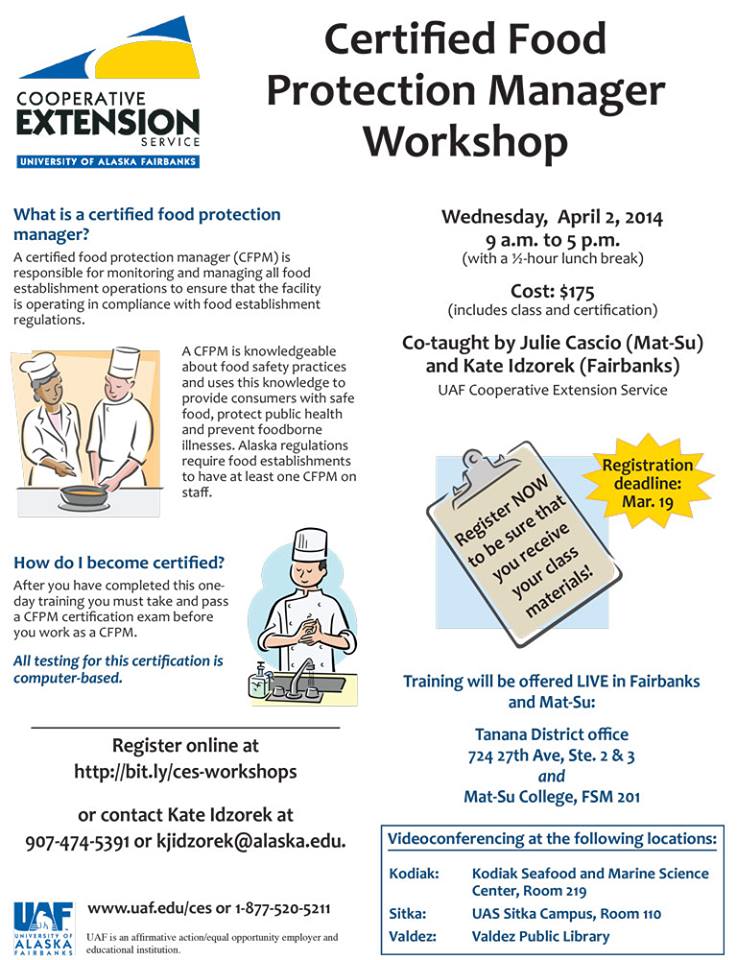
Wednesday, March 19, is the registration deadline for a certified food protection manager workshop being taught on Wednesday, April 2, by University of Alaska Fairbanks Cooperative Extension Service. This is an all-day statewide class that will be offered live in Fairbanks and Palmer, and by videoconferencing to Sitka, Kodiak and Valdez.

A certified food protection manager (CFPM) is responsible for monitoring and managing all food establishment operations to ensure that the facility is operating in compliance with food establishment regulations.

A CFPM is knowledgeable about food safety practices and uses this knowledge to provide consumers with safe food, protect public health and prevent food-borne illnesses. Alaska regulations require food establishments to have at least one CFPM on staff.

This course takes place from 9 a.m. to 5 p.m. (with a half-hour lunch), and participants will take a computer-based exam at the end of the class. The reason the deadline is two weeks before the class is to guarantee course materials reach all the students in time for the class. The cost is $175, and the course will be taught by Kate Idzorek of Fairbanks and Julie Cascio of Palmer. Students can register here (scroll down and select the April 2 item)

The Sitka videoconference for the class will take place in Room 110 at the University of Alaska Southeast Sitka Campus. To learn more, contact the Sitka District Office of the UAF Cooperative Extension Service at 747-9440, or contact Kate Idzorek at 907-474-5391 (toll-free, 1-877-520-5211) or kjidzorek@alaska.edu in Fairbanks.

• UAF Cooperative Extension Service offers Certified Food Protection Manager class by videoconference in Sitka

CFPM flyer 1-15-14

Friday, Dec. 20, is the registration deadline for a certified food protection manager workshop being taught on Wednesday, Jan. 15, by University of Alaska Fairbanks Cooperative Extension Service. This is an all-day statewide class that will be offered live in Fairbanks and Palmer, and by videoconferencing to Sitka and Kotzebue.

A certified food protection manager (CFPM) is responsible for monitoring and managing all food establishment operations to ensure that the facility is operating in compliance with food establishment regulations.

A CFPM is knowledgeable about food safety practices and uses this knowledge to provide consumers with safe food, protect public health and prevent food-borne illnesses. Alaska regulations require food establishments to have at least one CFPM on staff.

This course takes place from 9 a.m. to 5 p.m. (with a half-hour lunch), and participants will take a computer-based exam at the end of the class. The reason the deadline is two weeks before the class is to guarantee course materials reach all the students in time for the class. The cost is $175, and the course will be taught by Kate Idzorek of Fairbanks and Julie Cascio of Palmer. Students can register here.

The Sitka videoconference for the class will take place in Room 110 at the University of Alaska Southeast Sitka Campus. To learn more, contact the Sitka District Office of the UAF Cooperative Extension Service at 747-9440, or contact Kate Idzorek at 907-474-5391 (toll-free, 1-877-520-5211) or kjidzorek@alaska.edu in Fairbanks.

• Registration deadline Wednesday, Sept. 18, for upcoming certified food protection manager workshop on Oct. 18

CFPM flyer 10-2-13

Wednesday, Sept. 18, is the registration deadline for a certified food protection manager workshop being taught on Wednesday, Oct. 2, by University of Alaska Fairbanks Cooperative Extension Service. This is an all-day statewide class that will be offered live in Fairbanks and Palmer, and by videoconferencing to Sitka, Nome, Kodiak and Dillingham.

A certified food protection manager (CFPM) is responsible for monitoring and managing all food establishment operations to ensure that the facility is operating in compliance with food establishment regulations.

A CFPM is knowledgeable about food safety practices and uses this knowledge to provide consumers with safe food, protect public health and prevent food-borne illnesses. Alaska regulations require food establishments to have at least one CFPM on staff.

This course takes place from 9 a.m. to 5 p.m. (with a half-hour lunch), and participants will take a computer-based exam at the end of the class. The reason the deadline is two weeks before the class is to guarantee course materials reach all the students in time for the class. The cost is $175, and the course will be taught by Kate Idzorek of Fairbanks and Julie Cascio of Palmer. Students can register here.

The Sitka videoconference for the class will take place in Room 110 at the University of Alaska Southeast Sitka Campus. To learn more, contact the Sitka District Office of the UAF Cooperative Extension Service at 747-9440, or contact Kate Idzorek at 907-474-5391 (toll-free, 1-877-520-5211) or kjidzorek@alaska.edu in Fairbanks.

• Alaska Division of Agriculture to host four On-Farm Food Safety Workshops in Southeast communities

Southeast Workshops flyer2

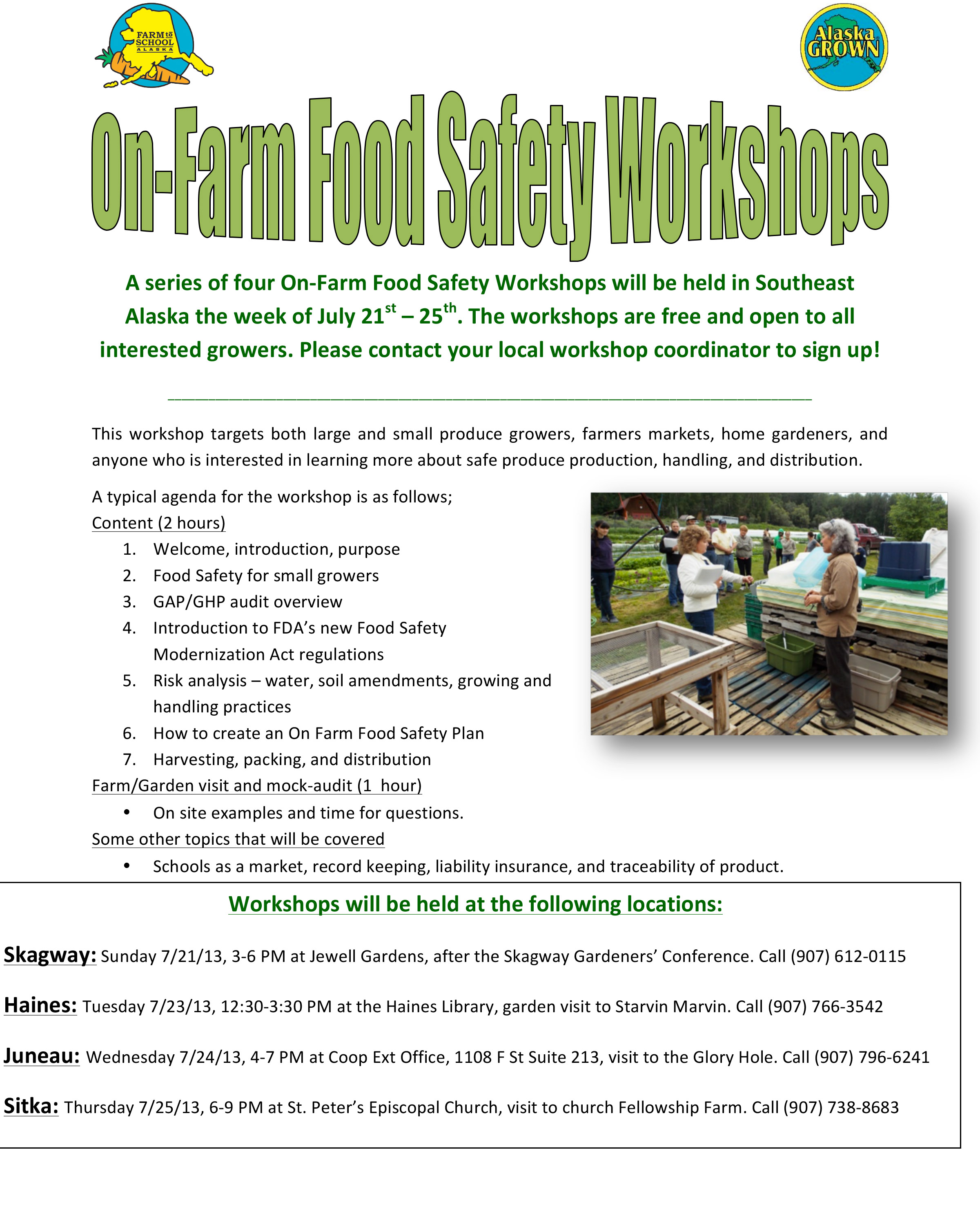
The Alaska Division of Agriculture is planning a series of four On-Farm Food Safety Workshops in Southeast Alaska communities the week of July 21-25. The workshops will be in Skagway, Haines, Juneau and Sitka.

These workshops are geared toward farmers both large and small, farmers market vendors, gardeners, and anyone who is interested in learning more about food safety in the production of fruits and vegetables.

The Sitka workshop will be from 6-9 p.m. on Thursday, July 25, in the upstairs classroom of the See House at the St. Peter’s By The Sea Episcopal Church (on Lincoln Street, the brown church with the steeple above Crescent Harbor). This is a voluntary educational event for farmers and gardeners who want to learn more about agricultural practices that help reduce the risk of food-borne illness, especially if they plan to sell or donate produce to the Sitka Farmers Market or other programs. For more information about the Sitka workshop, contact Lisa Sadleir-Hart at 747-5985.

The workshops are free, informal, and run for about three hours. The workshops consist of two powerpoint presentations – one on food safety, and introduction to both USDA GAP/GHP food safety audits and the FDA’s new Food Safety Modernization Act, and a second presentation that assists growers who are interested in marketing their produce to schools and local institutions.

The workshops include a site visit to a local farm or garden where we will conduct a mock food-safety audit and answer growers’ questions. We will also provide a wealth of food safety reference materials, and an introduction to online tools that can assist growers in creating a food safety plan, which is the first step in providing food safety assurance to their buyers.  All attendees will receive a copy of FamilyFarmed.org’s “Wholesale Success” reference manual, and a certificate for 3 hours of continuing education in farm food safety.

To learn about the Skagway, Haines and Juneau workshops, check out the flier posted above.

• Sitka residents say ‘No’ to genetically modified salmon during Feb. 9 rally

ProtestersOutside

Size comparison of an AquAdvantage® Salmon (background) vs. a non-transgenic Atlantic salmon sibling (foreground) of the same age. (CREDIT AquaBounty)

Size comparison of an AquAdvantage® Salmon (background) vs. a non-transgenic Atlantic salmon sibling (foreground) of the same age. (CREDIT AquaBounty)

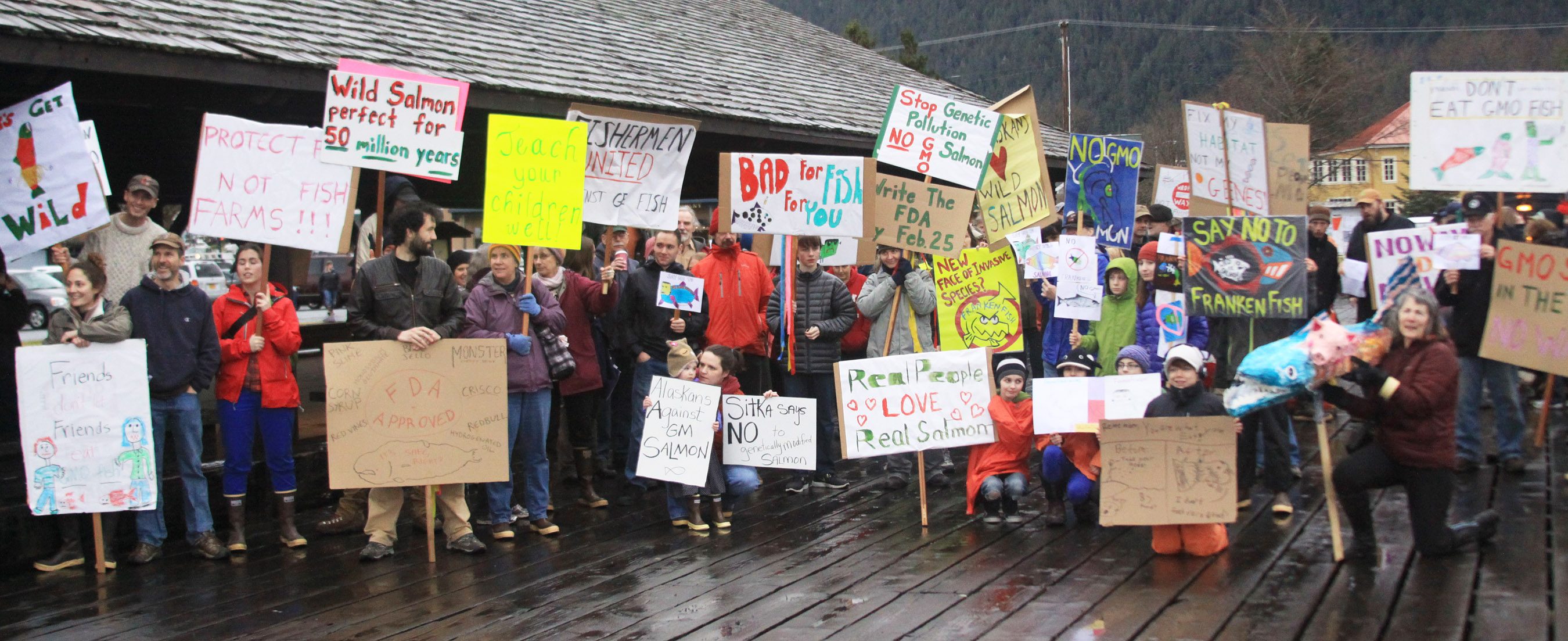
Between 100 and 150 Sitka residents braved the wind and rain on Saturday, Feb. 9, at the Crescent Harbor Shelter to protest the possible U.S. Food and Drug Administration (FDA) approval of genetically modified salmon (aka, GMO or GE salmon, or Frankenfish).

The rally (click here to listen to rally coverage from KCAW-Raven Radio) was in protest of a genetically engineered salmon from the Massachusetts company AquaBounty Technologies, called the AquAdvantage® Salmon. The GMO salmon starts with an Atlantic salmon commonly used in fish farms, but adds genes from a Pacific king (chinook) salmon to promote growth and genes from an eel-like fish called an ocean pout that grows all year round instead of seasonally. According to AquaBounty, all of the commercialized fish will be female and sterile, and the fish are designed to be raised in fresh-water pens or tanks on land instead of the usual salt-water pens where most farmed Atlantic salmon are raised. AquaBounty promotes the fish as a faster-growing farmed salmon that takes half the time to reach maturity and be sent to market. To learn more about GMO salmon, read our post from 2010.

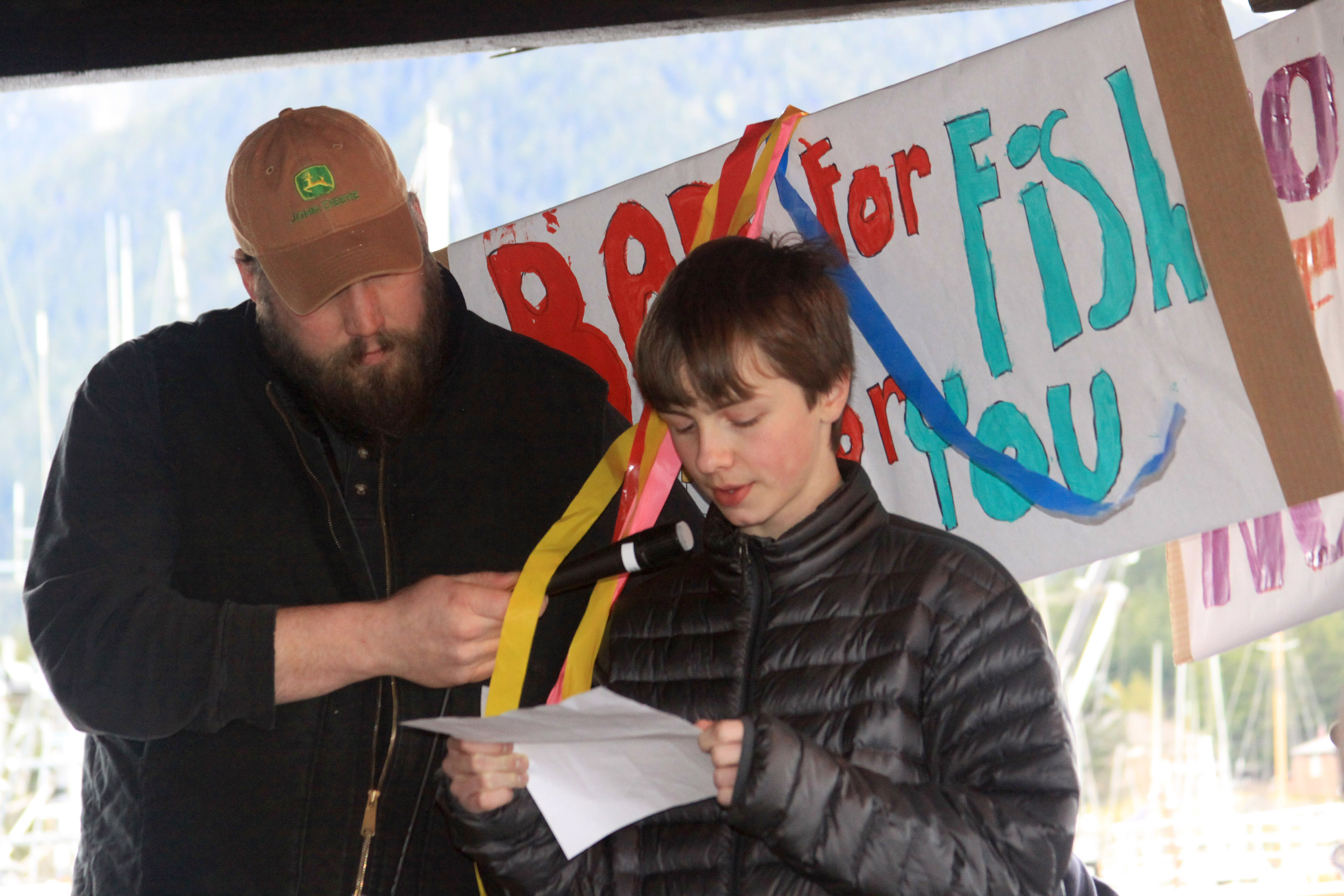
PaulRiouxSignsPaul Rioux — the Sitka resident who organized the rally with the help of local fishing groups, the Sitka Conservation Society, and others — said fishermen are concerned about what happens if these GMO salmon escape from pens. He noted that while AquaBounty said the fish will be sterile, other scientists said as many as 5 percent could be fertile, and that’s enough so that the GMO salmon as an invasive species could replace wild Pacific salmon within 40 salmon generations. DavidWilcoxSpeaksSignsDavid Wilcox, a 14-year-old Sitka resident who plans to run across the country to protest GMO foods, spoke for the other residents who said they were concerned with genetically engineered fish in general, and they worried this fish might go to market without being labeled as GMO salmon. (Click here to listen to Rioux, Wilcox and Ray Friedlander of the Sitka Conservation Society discuss why they held the rally during a Feb. 8 Morning Edition interview on KCAW-Raven Radio.)

SayNoToFrankenfishThe FDA, which has been looking at GMO salmon for more than a decade (AquaBounty started work on the fish in 1989), announced in December it planned to approve the genetically engineered fish, just in time for the holidays. At the same time, the FDA finally released environmental impact research papers it was supposed to have released in May. The FDA announcement also started a 60-day public comment period that was supposed to end on Feb. 25. On Feb. 13, the FDA extended the comment period until April 26. Sitka residents are encouraged to go to Regulations.gov and search for “GE salmon” (not “GMO”) to comment on the regulations before the April 26 deadline.

PatKehoeFrankenfishAlaska’s Congressional delegation agrees on few items, but Sen. Mark Begich, Sen. Lisa Murkowski and Rep. Don Young have been united for a couple of years in their efforts to stop Frankenfish. Sen. Begich this week introduced two bills banning GMO salmon. Last May, Sen. Murkowski introduced an amendment (that failed 50-46) requiring more study of GMO salmon by the National Oceanic and Atmospheric Agency (NOAA). In the House, Rep. Young has been one of the most vocal opponents of Frankenfish and in February he introduced a bill requiring GMO salmon be labeled. In the Alaska House of Representatives, Rep. Geran Tarr (D-Anchorage) and Rep. Scott Kawasaki (D-Fairbanks) introduced an anti-Frankenfish bill that passed out of the House Fisheries Committee this week.

This slideshow requires JavaScript.

• Two FDA committees hear testimony about genetically modified salmon

Size comparison of an AquAdvantage® Salmon (background) vs. a non-transgenic Atlantic salmon sibling (foreground) of the same age. (CREDIT AquaBounty)

Size comparison of an AquAdvantage® Salmon (background) vs. a non-transgenic Atlantic salmon sibling (foreground) of the same age. (CREDIT AquaBounty)

This week, two different U.S. Food and Drug Administration committees have been taking testimony about the future of genetically modified salmon. On Monday, one committee — the FDA’s Center for Veterinary Medicine — heard testimony about whether genetically modified salmon is safe to eat and if it should be approved. Tuesday, the other committee — the FDA’s Center for Food Safety and Applied Nutrition — heard testimony about whether or not genetically modified salmon should have special labeling.

The issue is over a genetically modified Atlantic salmon produced by the Massachusetts firm AquaBounty Technologies, known as AquAdvantage®. The AquAdvantage® fish not only includes a growth gene from a chinook salmon, which makes it reach market size in 16-18 months instead of the usual three years, plus there is a gene from an eel-like fish known as an ocean pout. According to AquaBounty, all of the commercialized fish will be female and sterile, and the fish are designed to be raised in fresh-water pens or tanks on land instead of the usual salt-water pens where most farmed Atlantic salmon are raised.

Many in the biotech, food and other industries are pushing for the FDA to quickly approve the commercial production of this fish. But some consumer groups, food safety experts and others want the FDA to slow or end the approval process until more is known about the fish.

On Tuesday’s Alaska News Nightly show, the Alaska Public Radio Network reported that it may be some time before genetically modified salmon reach the market. However, the Los Angeles Times reported that the FDA seemed to give preliminary approval to the fish’s safety and the main issue was who is responsible for telling the consumer the fish has been genetically altered.
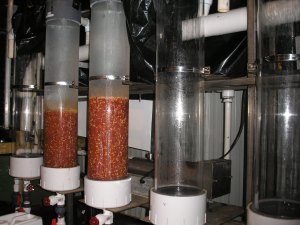
AquAdvantage salmon eggs are grown in incubator jars in a laboratory. (CREDIT AquaBounty)

AquAdvantage salmon eggs are grown in incubator jars in a laboratory. (CREDIT AquaBounty)

The idea of a genetically modified Atlantic salmon is of special concern to Alaska’s fishermen. Many fish farms in British Columbia raise Atlantic salmon, and there have been times when Atlantic salmon have escaped from the fish farm pens and mixed with wild Pacific salmon, including in Alaska. The Alaska Department of Fish and Game considers Atlantic salmon an invasive species, and already requests fishermen turn any Atlantic salmon caught in Alaska in to the nearest ADF&G office without being cleaned. According to ADF&G, there are concerns that Atlantic salmon might bring diseases to the five species of Pacific salmon and compete for food.

In addition to more recent cases of diseases among farmed fish and a high use of antibiotics, farmed Atlantic salmon also harmed the markets for Alaska fishermen trying to sell wild salmon (fish farming is banned in Alaska), and prices for Alaska fish dropped substantially when fish farms became more popular in the late 1980s and early 1990s. It’s only been in recent years that Alaska fishermen have started to regain some of their lost market share.

Sitka Conservation Society intern Molly Andrews has been keeping a blog this summer on the genetically modified salmon issue and what the fish could mean to Sitka. Molly’s blog has links to several stories about genetically modified salmon (recently called “Frankenfish” by U.S. Sen. Mark Begich, D-Alaska). The blog also has contact information if people want to contact the FDA or other officials to make comments about genetically modified salmon.


• Food booths need permits for Sitka Farmers Markets

SitkaFarmersMarketSign

Those vendors who plan to prepare and serve food at this year’s Sitka Farmers Markets must obtain a temporary food service permit from the Alaska Department of Environmental Conservation’s Food Safety and Sanitation program office at 901-C Halibut Point Road in Sitka.

By regulation, if the application is submitted after Monday, July 13, the fees are doubled. Applications are available in an envelope attached to the door at the ADEC office. Call Greg Johnstone at 747-8614 if you have any questions or need to get a permit.

Due to the danger of botulism, and other health considerations, only a certified commercial processor can sell canned foods. NO home canned goods are allowed, except for jams and jellies. All vendors selling prepared foods at the market MUST have a food handling permit.

The ANB Hall kitchen is a certified commercial kitchen and will be available for vendor use. The kitchen will be open at 7:30 a.m. the morning of each market. If you know that you will need it, please reserve the oven by calling Linda Wilson at 747-3096 or sending an e-mail to lawilson87@hotmail.com. Please be aware there will be a number of people using the kitchen at the same time, so you will need to be prepared to share space.

Click here for a detailed guide to safe food handling.

WaitingForCrepes