• Sitka Local Foods Network recruiting two new board members and other volunteers

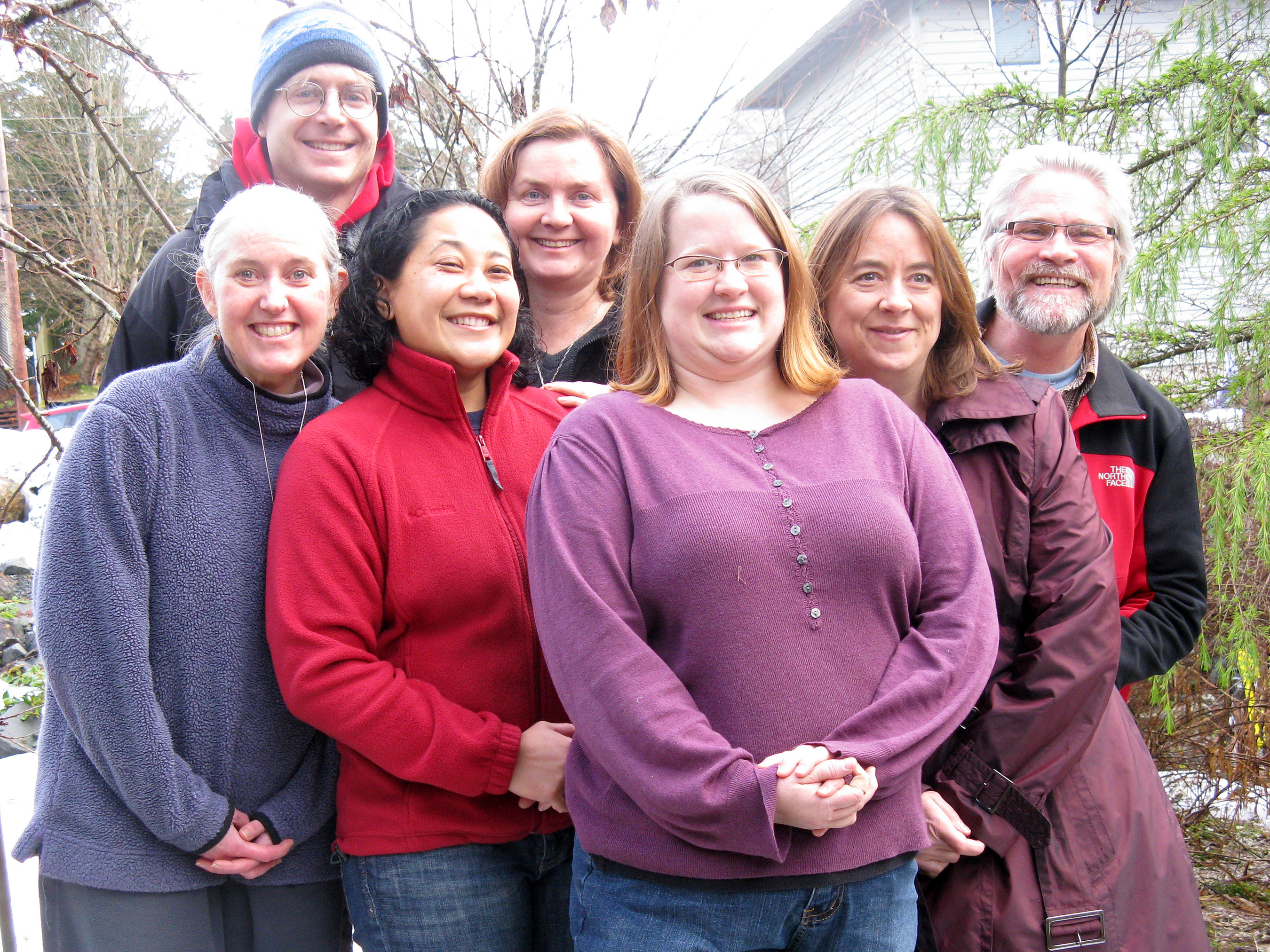
The 2011-12 Sitka Local Foods Network Board of Directors at its winter board retreat on Dec. 3, 2011. From left are Lisa Sadleir-Hart, Doug Osborne, Maybelle Filler, Cathy Lieser, Robin Grewe, Linda Wilson and Kerry MacLane. Not pictured is Tom Crane.

The 2011-12 Sitka Local Foods Network Board of Directors at its winter board retreat on Dec. 3, 2011. From left are Lisa Sadleir-Hart, Doug Osborne, Maybelle Filler, Cathy Lieser, Robin Grewe, Linda Wilson and Kerry MacLane. Not pictured is Tom Crane.

Are you concerned about increasing access to local food for all Sitka residents? Are you concerned about rising food prices in Sitka, or do you want to advocate for more community gardens in Sitka?

Then consider joining the board of directors for the Sitka Local Foods Network for the 2012-13 fiscal year. Two board members are needed — one to start immediately and the other to start in March when one of the current board members moves out of town.

Board members help direct the Sitka Local Foods Network, a non-profit that promotes the harvest and use of local food in Sitka. In addition to setting the focus of the group, board members also help on a wide variety of projects such as the Sitka Farmers Market, St. Peter’s Fellowship Farm, Blatchley Community Garden, Let’s Grow Sitka, the Sick-A-Waste compost project, the Sitka Community Food Assessment project, Sitka Fish-To-Schools, other school education projects and more.

To apply for a spot on the board, please fill out the attached application and submit it to sitkalocalfoodsnetwork@gmail.org. For more information, contact Lisa Sadleir-Hart at 747-5985.

We also are looking to increase our pool of volunteers who will help out during the various projects hosted by the network each year (no formal application needed, just send us your name/contact info and what types of projects you enjoy).

The next Sitka Local Foods Network board meeting is at 6:30 p.m. on Tuesday, Feb. 5, at the Sitka Unitarian Universalists Fellowship Hall (408 Marine St.). The board meets from 6:30-8 p.m. on the first Tuesday of each month, except during the summer when board members are busy working with the Sitka Farmers Market and St. Peter’s Fellowship Farm communal garden.

• Sitka Local Foods Network board of directors application

• Sitka Local Foods Network recruiting new board members and other volunteers

The 2011-12 Sitka Local Foods Network Board of Directors at its winter board retreat on Dec. 3, 2011. From left are Lisa Sadleir-Hart, Doug Osborne, Maybelle Filler, Cathy Lieser, Robin Grewe, Linda Wilson and Kerry MacLane. Not pictured is Tom Crane.

The 2011-12 Sitka Local Foods Network Board of Directors at its winter board retreat on Dec. 3, 2011. From left are Lisa Sadleir-Hart, Doug Osborne, Maybelle Filler, Cathy Lieser, Robin Grewe, Linda Wilson and Kerry MacLane. Not pictured is Tom Crane.

Are you concerned about increasing access to local food for all Sitka residents? Are you concerned about rising food prices in Sitka, or do you want to advocate for more community gardens in Sitka?

Then consider joining the board of directors for the Sitka Local Foods Network for the 2012-13 fiscal year. Board members help direct the Sitka Local Foods Network, a non-profit that promotes the harvest and use of local food in Sitka. In addition to setting the focus of the group, board members also help on a wide variety of projects such as the Sitka Farmers Market, St. Peter’s Fellowship Farm, Blatchley Community Garden, Let’s Grow Sitka, the Sick-A-Waste compost project, the Sitka Community Food Assessment project, Sitka Fish-To-Schools, other school education projects and more.

To apply for a spot on the board, please fill out the attached application and submit it to sitkalocalfoodsnetwork@gmail.org. We also are looking to increase our pool of volunteers who will help out during the various projects hosted by the network each year (no formal application needed, just send us your name/contact info and what types of projects you enjoy).

The next Sitka Local Foods Network board meeting is at 6:30 p.m. on Tuesday, Dec. 4, at the Sitka Unitarian Universalists Fellowship Hall (408 Marine St.). The board meets from 6:30-8 p.m. on the first Tuesday of each month, except during the summer when board members are busy working with the Sitka Farmers Market and St. Peter’s Fellowship Farm communal garden. For more information, contact Lisa Sadleir-Hart at 747-5985.

• Sitka Local Foods Network board of directors application

• Quest cards and debit cards will be accepted starting with the Aug. 18 Sitka Farmers Market

The Sitka Local Foods Network will begin accepting Quest and debit cards for the purchase of locally grown and made products during its fourth Sitka Farmers Market of the summer, from 10 a.m. to 2 p.m. on Saturday, Aug. 18, at Alaska Native Brotherhood Hall (235 Katlian St.).

The Sitka Farmers Market received funding from the Alaska Farmers Market-Quest Card Program to purchase a wireless card reader, also known as an EBT (electronic benefit transfer) machine. The EBT machine allows Quest customers to use their food stamps and TANF (Temporary Assistance for Needy Families) benefits to purchase fresh, local food at the market. The EBT machine allows customers to use their regular debit and credit cards to purchase food and other items, such as locally made crafts.

Many farmers markets have accepted food stamps, TANF benefits and WIC coupons for produce for several years, but in recent years all 50 states stopped using paper coupons and started using electronic transfers for their benefits (putting them on plastic cards that work like debit/credit cards). Since most farmers markets do not have access to electricity and phone lines during the market, they now required a wireless machine to handle these benefits. This system is expensive and difficult for most farmers markets to offer, so the use of food stamps and other benefits dropped dramatically. The goal of the Alaska Farmers Market-Quest Card Program is to help the markets be able to purchase a machine so they can continue to offer fresh, local food to low-income Alaskans and offering another payment option for other residents. The Sitka Local Foods Network will match dollar-for-dollar up to $20 of Quest card benefits so people using Quest cards have access to double the produce at the market.

“Providing appropriate EBT technology at farmers markets can improve the diets and subsequently the health of Sitkans who rely on food stamps by increasing access to fresh, local and affordable vegetables and fruits,” said Sitka Local Foods Network Board Treasurer Lisa Sadleir-Hart, a registered dietitian. “Shopping at farmers markets has been shown in several studies to increase fruit and vegetable purchases and consumption among nutrition assistance participants, and fruits and vegetables sold at farmers markets often are equal in price to or less expensive than seasonal produce at grocery stores.”

To use the Quest cards or your debit card at the Sitka Farmers Market, look for the Information Booth inside ANB Hall and let the staff person know you’d like to use your card at the market and how much you plan to spend. The staff person will swipe your card through the EBT machine, have you enter your PIN, then provide you with Quest and Debit tokens in the amount you requested (there is a $2 service charge for debit card transactions). Look for vendors with signs saying “Quest and Debit Tokens Accepted Here” (some vendors only accept Debit tokens). Quest customers can purchase foods allowed on food stamps, such as fruits and vegetables, bread, meat, seafood, honey and jam. Food and beverages meant to be eaten right away, such as sandwiches and hot coffee, cannot be purchased with Quest tokens. Debit card tokens can be used to purchase anything offered at the market. If you do not spend all of your tokens, you can save the remaining tokens for the next market or take them back to the Information Booth to be credited back to your card (credit can only be given for tokens purchased that day, and for no more than the amount purchased that day). Debit card users can return their unused tokens, but another $2 service fee will apply for the transaction.

This project is a collaboration of the Alaska Department of Health and Social Services Divisions of Public Health and Public Assistance, the Department of Natural Resources Division of Agriculture, the SouthEast Alaska Regional Health Consortium (SEARHC) Health Promotion Division, and the Sitka Local Foods Network. For more info about the Alaska Farmers Market-Quest Card Program, go to http://www.hss.state.ak.us/dph/chronic/nutrition/farmersmarket-quest/default.htm. For information about the Alaska Quest Program, visit http://www.akquest.alaska.gov/. For info about the Sitka Farmers Market, go to http://www.sitkalocalfoodsnetwork.org/. Vendors wanting to sign up to accept Quest card and debit card tokens can contact Sitka Farmers Market Manager Johanna Willingham at johanna.willingham@gmail.com or 738-8336.

• Sitka Farmers Market vendor agreement to accept EBT/Quest tokens (2012)

• Alaska Food Policy Council seeks people to join its five priority strategies action plan work groups

The Alaska Food Policy Council  is seeking Alaska residents to participate in five workgroups to help develop action plans for certain key food issues in the state.

A group of 30 council members met on April 4-5 to develop basic action plans geared toward five priority strategies to improve food security in the state. Now they need people to begin implementing the individual action plans. The five priority strategies are part of the Alaska Food Policy Council’s three-year strategic plan developed at its Jan. 12 meeting.

The five priority strategies include:

  • Improving school-based programs such as Farm to Schools and Fish to Schools;
  • Strengthening enforcement of the state’s 7-percent bidding preference for Alaska Grown food;
  • Improving emergency food preparedness plans throughout the state;
  • Serving as a research aggregator/resource to help people get a better handle on Alaska’s food situation and supply chain; and
  • Supporting local food efforts throughout the state.

The Alaska Food Policy Council got its start during a May 18-19, 2010, meeting in Anchorage. Sitka Local Foods Network treasurer Lisa Sadleir-Hart, a registered dietitian and SEARHC Health Educator, is one of the 30 members of the council.

These five work groups are open to anybody who has a special interest in the various topics. To learn more about the work groups, contact Lisa Sadleir-Hart at 966-8735 or lisa.sadleir-hart@searhc.org, or contact Alaska Food Policy Council Coordinator Diane Peck with the Alaska Department of Health and Social Services Obesity Prevention and Control Program at 269-8447 or diane.peck@alaska.gov.

• Alaska Food Policy Council School Programs Action Plan (Strategy 1)

• Alaska Food Policy Council Local Grown Action Plan (Strategy 2)

• Alaska Food Policy Council Disaster Preparedness Action Plan (Strategy 3)

• Alaska Food Policy Council Research and Information Action Plan (Strategy 4)

• Alaska Food Policy Council Public Engagement Action Plan (Strategy 5)

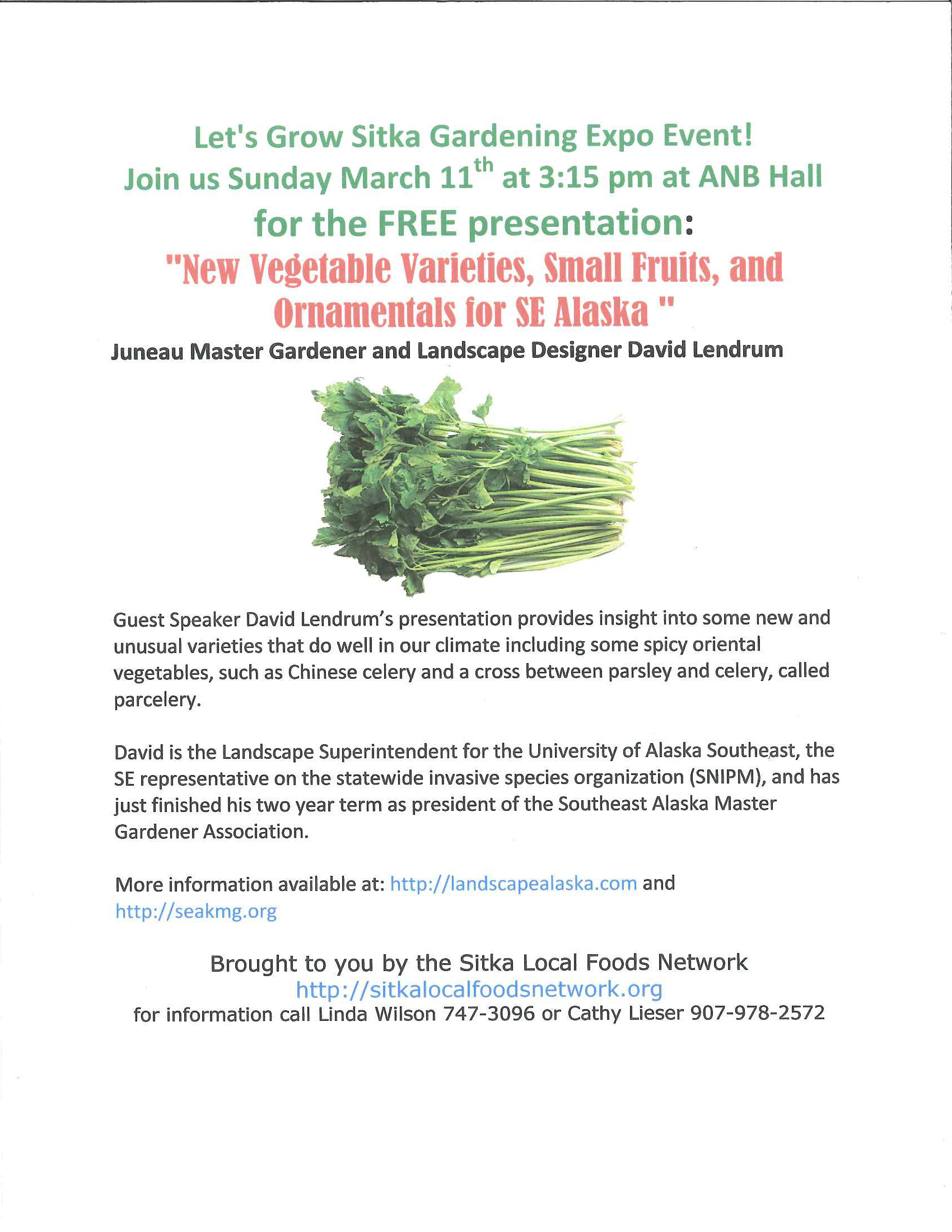
• Let’s Grow Sitka garden education event is Sunday, March 11, at ANB Hall

Mark your calendars, because the 2012 “Let’s Grow Sitka” gardening education event opens at noon and runs until 3 p.m. on Sunday, March 11, at the Alaska Native Brotherhood Hall on Katlian Street. Don’t forget to set your clocks to spring forward so you can get ready to grow.

This annual event brings together local garden supply stores, local gardeners, landscapers and anybody who is interested in learning how to grow food and/or flowers. Sitka Local Foods Network Vice President Linda Wilson, who is coordinating the event with SLFN Board Member Cathy Lieser, was interviewed during the Morning Edition show Thursday on KCAW-Raven Radio and she provided more details about this event (click the link to listen to the interview), which helps Sitka residents get excited about the upcoming garden season.

There will be a wide variety of individuals and businesses with booths for the event, with some booths providing gardening information geared toward and others selling gardening supplies. Lunch will be available for purchase. Here is a tentative list of some of those planning to host booths:

  • Linda Wilson, Sitka Farmers Market, Grow a Row for the Market
  • Cathy Lieser, Let’s Grow Sitka, Sitka Local Foods Network
  • Doug Osborne. Sitka Local Foods Network?
  • Johanna Willingham, Pacific H.S./Sitka Farmers Market backup.
  • Jud Kirkness, Sicka Waste compost project, Fruit tree map
  • Tom Hart, compost, NZ composter ?
  • Kerry MacLane. Pest management
  • Lisa Sadleir-Hart. St. Peter’s Fellowship Farm
  • Laura Schmidt, St. Peter’s Fellowship Farm/Seed swap & share
  • Maybelle Filler, ???
  • Stanley Schoening, Chickens, fig trees, UAF Cooperative Extension Service
  • Judy Johnstone, High Tunnel program
  • David Lendrum, Guest speaker 3:15, info on new/unusual varieties for Southeast Alaska
  • Jeren Schmidt, Sitka Spruce Catering, lunch for purchase
  • Robert Gorman, UAF Cooperative Extension Service, history of Experimental Station
  • Andrianna Natsoulas, Food Sovereignty
  • Tracy Gagnon, Sitka 4H Club
  • Eve Grutter, Chickens, produce
  • Adam Chinalski, Model greenhouse
  • Penny Brown, Garden Ventures – products for sale
  • Amanda Grearson, True Value – products for sale
  • Lowell Frank, Spenard Building Supply Garden Center ??
  • Michelle Putz, Locally grown environmental benefits?
  • Rick Peterson, Gardening 101 – easiest to grow, need to amend soil, etc…
  • Lori Adams, Down-to-Earth U-Pick Garden – garden promotion and information
  • Mike Tackaberry/Robin Grewe, White’s Inc. – products for sale
  • Mandy Summers, Pacific High School
  • Kelly Smitherman, National Park Service – garden at Bishops House, etc…
  • Lisa Teas, Sitka Farmers Market art debut
  • Florence Welsh, Forget-Me-Not Gardens, local garden booklet, possible plant starts
  • Hope Merritt, Gimbal Botanicals herbal teas – info on wild herbs and herbs to grow

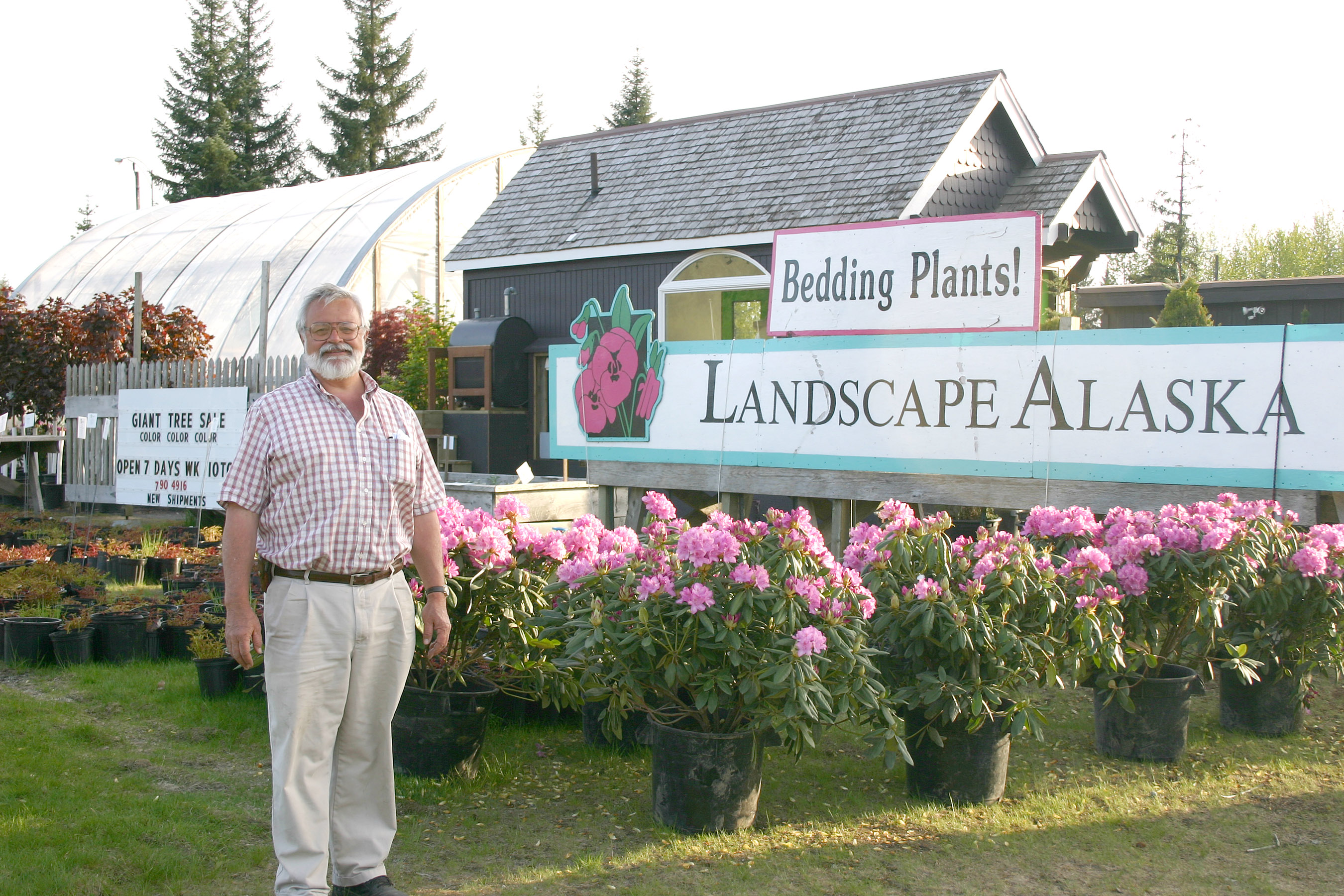
Right after the three-hour Let’s Grow Sitka event ends, guest speaker Dave Lendrum of Juneau will speak at 3:15 p.m. on “New Vegetable Varieties, Small Fruits, and Ornamentals for Southeast Alaska.” Lendrum is a landscape designer who just finished a two-year term as president of the Southeast Alaska Master Gardener Association and with his landscape architect wife, Margaret Tharp, owns Landscape Alaska.

Dave’s life has evolved in partnership with the natural world. He grew up in California on an organic u-pick vegetable farm, learning horticulture from his parents and the 4H club. He did nursery work and continued his post-college adventure in Ecuador by starting a fresh market produce business. After being a city horticulturist at the Eugene (Ore.) Parks Department, Dave started his first nursery, Western Oregon Perennials. A few years later, he found himself in a high-temperature photosynthesis lab at Stanford. In the Pacific Northwest, Dave restored old estate gardens. When he heard Alaska’s call, he moved north to Elfin Cove. Dave and his wife started Landscape Alaska in Juneau 28 years ago. They design and build landscapes on every scale and have won numerous awards both locally and nationally. In addition, Dave is the landscape superintendent for the University of Alaska Southeast and the Southeast representative on the statewide invasive species organization (SNIPM).

For more information about Let’s Grow Sitka, contact Linda Wilson at 747-3096 (evenings, weekends) or lawilson87@hotmail.com, or Cathy Lieser at 978-2572. The two event fliers for this event are posted below as Adobe Acrobat files (PDF files).

• Main flier for 2012 Let’s Grow Sitka event

• Flier for Dave Lendrum presentation after Let’s Grow Sitka event ends

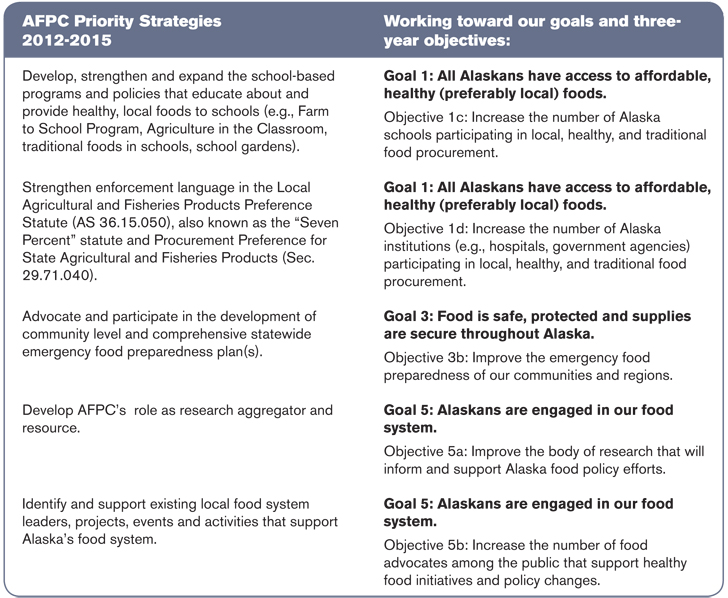
• Alaska Food Policy Council releases its 2012-15 strategic plan

The Alaska Food Policy Council recently released its 2012-15 Alaska Food Policy Strategic Plan, which was about a year in development.

This spring, the council will work on action-planning on its top five priority strategies:

  1. Develop, strengthen and expand the school-based programs and policies that educate about and provide healthy, local foods to schools (e.g., Farm to School Program, Agriculture in the Classroom, traditional foods in schools, school gardens).
  2. Strengthen enforcement language in the Local Agricultural and Fisheries Products Preference Statute (AS 36.15.050), also known as the “Seven Percent” statute and Procurement Preference for State Agricultural and Fisheries Products (Sec. 29.71.040).
  3. Advocate and participate in the development of community level and comprehensive statewide emergency food preparedness plan(s).
  4. Develop AFPC’s role as research aggregator and resource.
  5. Identify and support existing local food system leaders, projects, events, and activities that support Alaska’s food system.

“The Alaska Food Policy Council has been working toward this strategic plan since May 2010,” said Diane Peck, MPH, RD, a community and evaluation specialist with the Alaska Obesity Prevention and Control Program who leads the council. “Initial committees worked to identify Alaska’s food system issues and concerns and then the strategic planning group worked to turn those into our goals and strategies. It’s exciting to see such a broad spectrum of food system stakeholders come together to develop a clear and concise plan that will help guide local, regional and statewide food systems planning in Alaska.”

“The Alaska Food Policy Council works to strengthen Alaska’s food systems to spur local economic development, increase food security, and improve nutrition and health,” according to the council’s website. “The council serves as a resource for information on local and state food systems, and works to identify and propose policy and environmental changes that can improve the production, processing, distribution, health, security and safety of our food.”

According to the council’s website, “the long-term goals of the Alaska Food Policy Council are to identify barriers to building a viable Alaska food system, create a strategic plan to address these barriers, and make the necessary recommendations to decision makers to implement this plan. Diverse stakeholders from around the state have been invited to participate, including representatives for commercial farmers, farmers’ markets and CSAs; fisheries and fish processors; distributors; institutional purchasers; private-sector businesses; legislators; consumers; Alaska Native tribal organizations; food security organizations; environmental organizations; and local, state, and federal government agencies.

”

The Sitka Local Foods Network is represented on the Alaska Food Policy Council by Lisa Sadleir-Hart, MPH, RD, CHES, ACE, community nutrition department manager for SEARHC Health Promotion and the treasurer of the Sitka Local Foods Network.

“Being involved in the Alaska Food Policy Council has deepened my commitment to making local food a reality in Sitka,” Lisa said. “It’s also made me realize that we are already a community ‘on the map’ when it comes to food issues and creative responses. Sitka is considered to be one of the leading communities in the state, on par with Fairbanks/Ester/Delta Junction and Homer.”

The Alaska Food Policy Council will meet April 4-5 in Anchorage for a face-to-face meeting to action-plan the five priority strategies. People interested in providing feedback on the plan should contact Diane Peck at diane.peck@alaska.gov.

• 2012-15 Alaska Food Policy Council Strategic Plan

• Rising grocery prices raise food insecurity concerns in Sitka

(NOTE: The following letter to the editor appeared in the Friday, Dec. 9, 2011, edition of the Daily Sitka Sentinel.)

Dear Editor,

Many in Sitka are feeling squeezed not only by rising fuel costs, but also by escalating food costs. The September 2011 Alaska Food Cost Survey, conducted by University of Alaska Fairbanks Cooperative Extension Service, calculated Sitka’s weekly food cost for a family of four as $198.41. This is a 44-percent increase since 2006, when the same market basket cost was $138.14. Sitka’s food costs are 57 percent higher than in Portland, Ore., 37 percent more than in Anchorage and 30 percent more than in Juneau.

Feeding America 2011 statistics report that 11.7 percent of Sitka’s borough is “food insecure.”  This translates to 1,030 Sitkans and other Baranof Islanders who sometimes are completely without a source of food on a regular basis.

Kids Count Alaska 2009-2010 reports that 46 percent of Sitka’s school age children and youth live in families receiving some form of public assistance i.e., Denali KidCare, food stamps, or Alaska Temporary Assistance. This is a 10-percent increase since 2007.

Alaska behavioral risk factor data from 2009 show that only 23 percent of Alaskans consume the recommended five fruits and vegetables each day and only 17 percent of adolescents eat five daily servings of fruits and vegetables. One of the primary reasons for this low intake is inadequate access to affordable, quality produce.

These combined statistics paint a picture of increasing vulnerability when it comes to securing nutritious food on a regular basis. In the nutrition and public health world, this tenuous access to healthy food is known as food insecurity. So, how can Sitka, collectively and creatively, respond to food insecurity? Sitka can respond by INCREASING ACCESS TO AFFORDABLE LOCAL FOOD.

The Sitka Local Foods Network is working towards improving access to nutritious, local foods through five interconnected strategies. Together, these five strategies can move Sitka toward a more food-secure future. They are:

  1. Promoting traditional and customary food gathering and preservation.
  2. Developing the Let’s Grow Sitka gardening campaign to assist Sitkans in learning to grow some of their own food.
  3. Growing the number of community gardens to augment the garden behind Blatchley Middle School. The 4-year-old St. Peter’s Fellowship Farm is a recent example.
  4. Coordinating regular Sitka Farmers Markets during the summer growing and gathering seasons.
  5. Creating a community greenhouse and promoting commercial greenhouses to increase year-round access to local fruits and vegetables.

If you are interested in supporting this effort, please commit to one of the following actions:

  • Attend the Let’s Grow Sitka extravaganza as part of Artigras from noon-3pm on March 11, 2012, at the ANB Hall to learn how to grow your own food
  • Volunteer to work at St. Peter’s Fellowship Farm this spring or the Sitka Farmers Market this summer
  • Support the Sitka Farmers Market which begins July 7, 2012, and runs every other Saturday morning through Sept. 15, 2012.
  • Mail a tax-deductible, year-end contribution to the Sitka Local Food Network at 408-D Marine Street, Sitka, AK 99835.

Together, we can make food security a reality in Sitka.

Sincerely,

Sitka Local Foods Network Board and Friends
(Lisa Sadleir-Hart, Charles Bingham, Kerry MacLane, Doug Osborne, Ellen Frankenstein, Maybelle Filler, Robin Grewe)

• Work party and veggies available Saturday at St. Peter’s Fellowship Farm

St. Peter's Fellowship Farm sign

St. Peter's Fellowship Farm sign

Carrots, kale, lettuce, potatoes and other vegetables will be available for a donation from 2-4 p.m. on Saturday, Sept. 3, at St. Peter’s Fellowship Farm (behind St. Peter’s By The Sea Episcopal Church on Lincoln Street).

People are encouraged to stick around and help out at the regular Saturday work party at the same time. Volunteers are needed to help weed and pick slugs from the gardens. Feel free to stick around, tend the garden and enjoy the fellowship of people making local food happen in Sitka.

Call Lisa Sadleir-Hart for more information at 747-5985.

• Rhubarb, greens ready at St. Peter’s Fellowship Farm

St. Peter's Fellowship Farm sign

St. Peter's Fellowship Farm sign

Rhubarb and several types of greens will be available during the work party scheduled for 2-4 p.m. on Saturday, July 9, at St. Peter’s Fellowship Farm (located behind St. Peter’s By The Sea Episcopal Church on Lincoln Street).

Besides rhubarb, the available veggies include spinach, kale, lettuce, basil, Swiss chard and bok choy. Many of these items were grown at Seaview Gardens.

These items are available for a $3 donation for greens or a bundle of rhubarb, or $2 for a small bundle of basil. Donations will help support St. Peter’s Fellowship Farm, a communal garden that produces veggies for the Sitka Farmers Market, local food charities and other programs. WIC farmers market vouchers and fruit and vegetable vouchers are welcome.

In addition, help is needed to help harvest produce that’s ready for picking on Sitka Farmers Market days (on alternate Saturdays, July 16, 30, Aug. 13, 27 and Sept. 10). Early risers can show up at St. Peter’s Fellowship Farm between 6:30-9 a.m. to help harvest for the markets that run from 10 a.m. to 2 p.m. On weeks when there is no market, there will be regular work parties from 2-4 p.m. at St. Peter’s Fellowship Farm.

To learn more about the garden work parties, please contact Laura Schmidt at 623-7003 or 738-7009. To learn more about the available produce, contact Lisa Sadleir-Hart at 747-5985.

• July work parties set for St. Peter’s Fellowship Farm

St. Peter's Fellowship Farm sign

St. Peter's Fellowship Farm sign

The Sitka Local Foods Network will host work parties from 2-4 p.m. each Saturday in July at St. Peter’s Fellowship Farm (if there isn’t a Sitka Farmers Market scheduled that Saturday).

St. Peter’s Fellowship Farm provides vegetables, herbs and fruit for the Sitka Farmers Markets, which start in July (from 10 a.m. to 2 p.m. on July 16, 30, Aug. 13, 27 and Sept. 10 at ANB Hall). The communal garden is located behind St. Peter’s By The Sea Episcopal Church on Lincoln Street.

In addition to helping get the communal garden ready to grow veggies this summer, volunteers can meet Laura Schmidt, who is the lead gardener for St. Peter’s Fellowship Farm this year and will coordinate most of the summer’s work parties. Laura said the work parties will be kid-friendly and there will be several activities to keep the kids busy.

To learn more about the garden work parties, please contact Laura Schmidt at 623-7003 or 738-7009. To learn more about the Sitka Farmers Markets, contact Linda Wilson at 747-3096 (nights or weekends) or by e-mail at lawilson87@hotmail.com.