• Sitka Local Foods Network seeks manager and assistant manager for 2014 Sitka Farmers Markets

SitkaFarmersMarketSignThe Sitka Local Foods Network is looking for a manager and assistant manager to coordinate the 2014 Sitka Farmers Markets this summer. These are contract positions, and the manager and assistant manager (who reports to the manager) receive small compensation depending on experience for their work organizing the six scheduled farmers markets this summer.

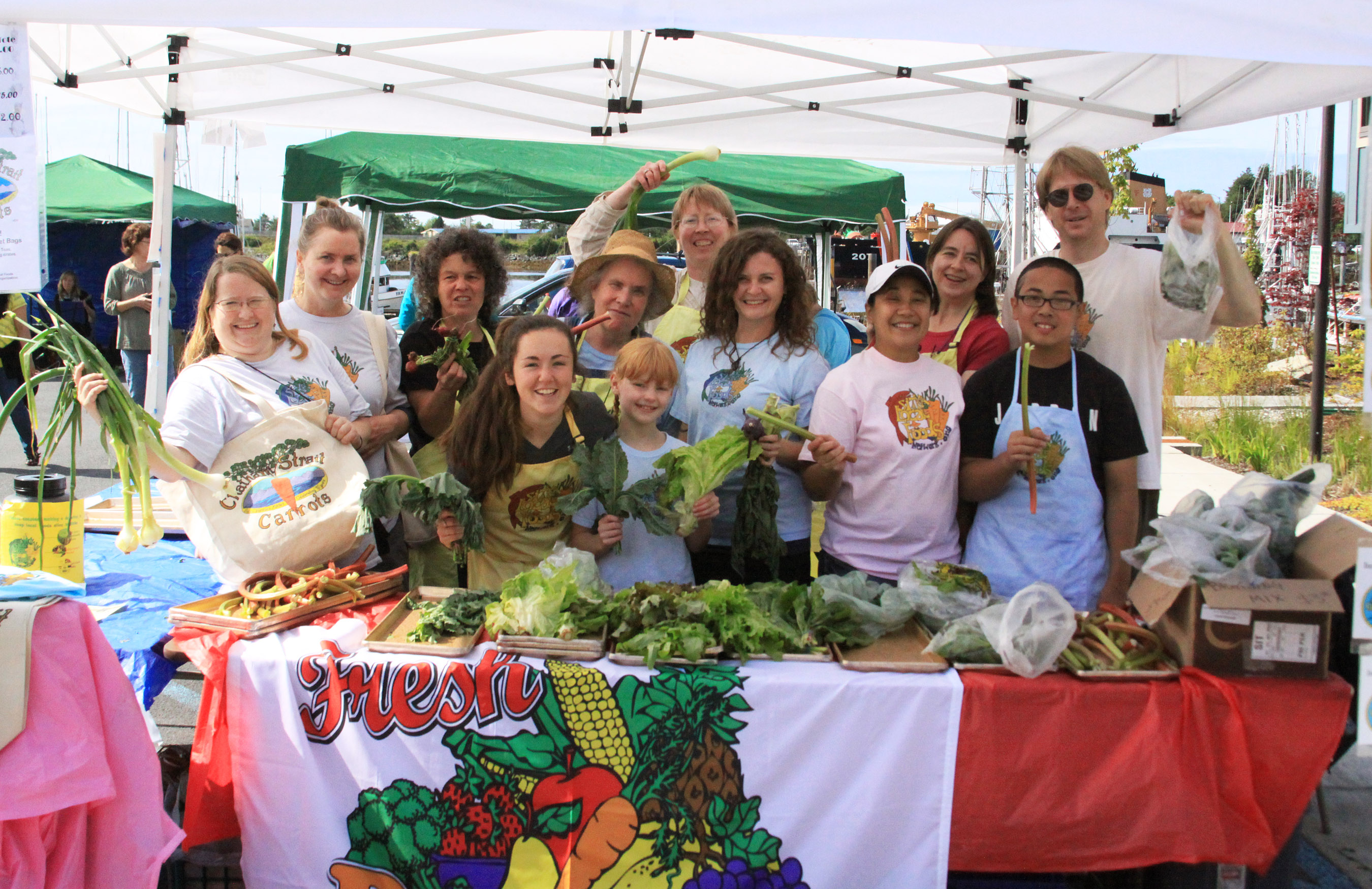
This is the seventh year of operation for the Sitka Farmers Market, which features six markets from 10 a.m. to 1 p.m. every other Saturday from June through September at the Alaska Native Brotherhood Founders Hall (this year’s tentative dates are June 28, July 12, 26, Aug. 9, 23, and Sept. 6). SLFNGroupwLindaThe farmers markets feature booths from local farmers/gardeners, local fishermen, and artisans and craftspeople. These events are great Sitka gathering places, and we promote local foods and other local goods at them.
A detailed description of the market manager duties can be found at the link below. For more information or to submit applications, contact Maybelle Filler at 738-1982 or mocampo25@hotmail.com, or you can email the Sitka Local Foods Network Board of Directors at sitkalocalfoodsnetwork@gmail.com. Applications (cover letter, resume, three recommendations) are due by 5 p.m. on Friday, Feb. 28. The market manager of the Sitka Farmers Market reports to the Sitka Local Foods Network Board of Directors.

• Description of duties for market manager of the Sitka Farmers Market Manager (2014)
• State fixes glitch to Pick.Click.Give. program with online Alaska PFD application

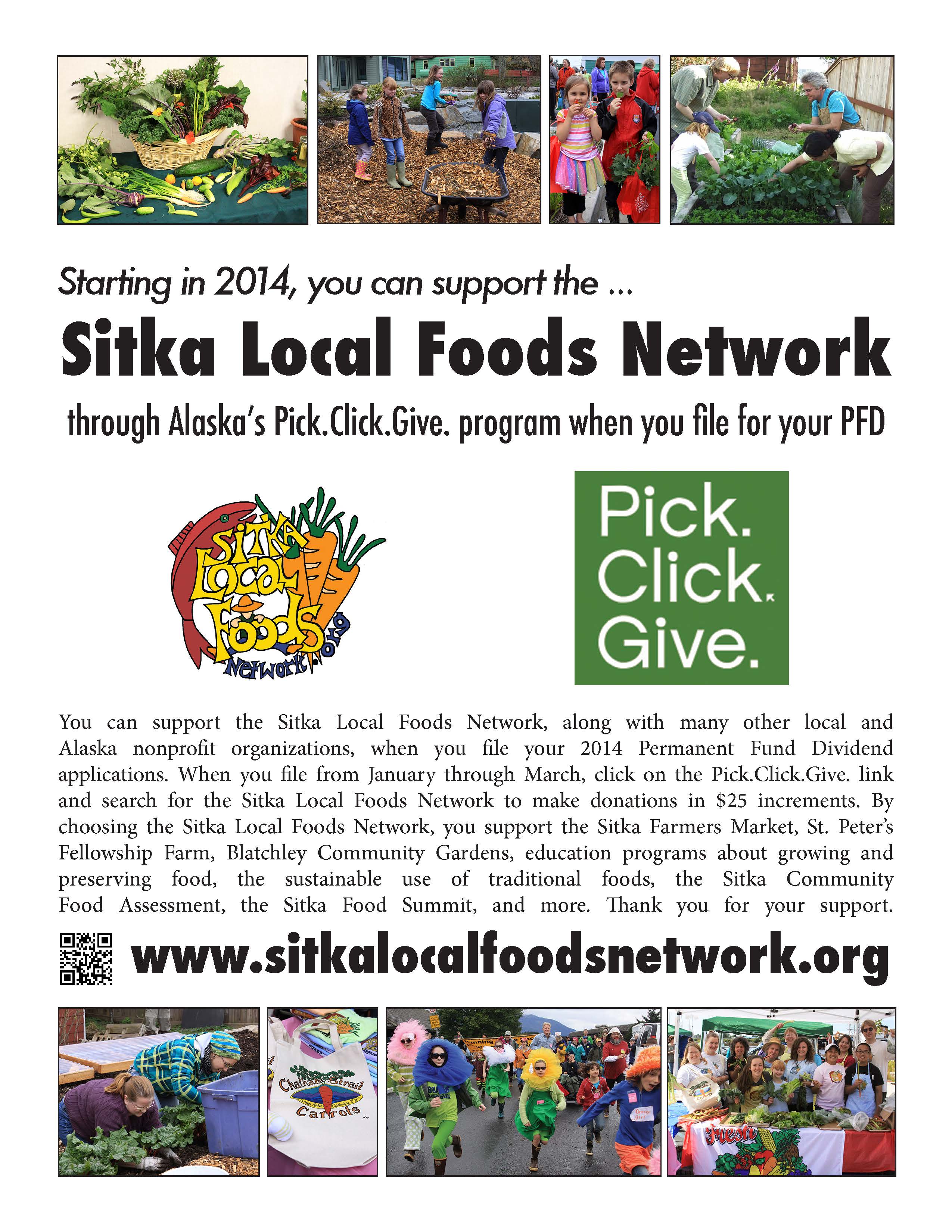
PickClickGiveFlier2PRINT

Lovalaska FB Square PhotoGrid Tag (1)The state has fixed a recent glitch in the online application that kept Alaskans from making their Pick.Click.Give. donation selections when they filed for their 2014 Alaska Permanent Fund Dividend checks. Applicants now can go back into their PFD applications and select or fix their Pick.Click.Give. donation picks.

In an email to participating Pick.Click.Give. nonprofit organizations (including the Sitka Local Foods Network) program manager Heather Beaty wrote:

If you continue to receive reports of problems in completing the PFD application or making Pick.Click.Give. donations, please contact me (at hbeaty@pickclickgive.org) so we can follow up with the state. The PFD Division will send an email to Alaskans who experienced difficulty with the application process to let them know they can go back and add Pick.Click.Give. donations. Alaskans who had trouble with the PFD website can return to the PFD homepage and use the green “Add or Change Your Pick.Click.Give. Donation” button to make a donation.

This is the first year the Sitka Local Foods Network will participate in the Pick.Click.Give. program, which allows people to donate in $25 increments to their favorite statewide and local 501(c)(3) nonprofit organizations when they file their PFD applications from Jan. 1 through March 31. When you choose to donate part of your PFD to the Sitka Local Foods Network, you support the Sitka Farmers Market, St. Peter’s Fellowship Farm, Blatchley Community Gardens, education programs about growing and preserving food, the sustainable use of traditional foods, the Sitka Community Food Assessment, the Sitka Food Summit, and a variety of other projects designed to increase access to healthy local foods in Sitka.

The Pick.Click.Give. program only is available to people who file their PFD applications online, and not to those who file by mail. Even though you can’t file a new PFD application after March 31, you can go into your application and update your Pick.Click.Give. donations through August.

You still can donate to the Sitka Local Foods Network if you aren’t from Alaska or aren’t eligible for a 2014 PFD. To donate, send your check to the Sitka Local Foods Network, 408 Marine St., Suite D, Sitka, Alaska, 99835. Our EIN is 26-4629930. Please let us know if you need a receipt for tax purposes. For more information about donating, you can send an email to sitkalocalfoodsnetwork@gmail.com.

• Sitka School District touts more state investment into local foods for school lunch programs

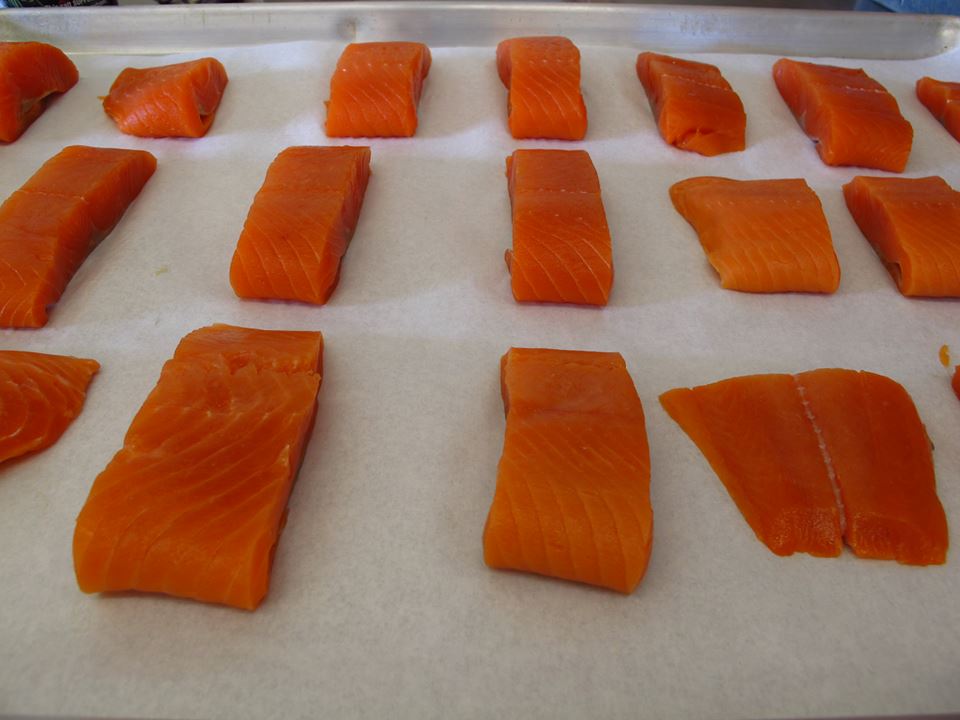
SCSCohoPortionsForCooking

During its Feb. 4 meeting, the Sitka School Board put its weight behind an effort to increase funding for locally sourced food in schools across the state.

In a resolution to the legislature, the board cited the success of Sitka’s Fish to Schools program as justification for extending a similar statewide program beyond one year. Nutritional Alaskan Food for Schools (NAFS) was introduced by Rep. Bill Stoltze (R-Anchorage) in 2012, and piloted last year. This year the governor has included funding of $3 million dollars for the program — but only for one year. All schools in Alaska will receive funding from the program, based on student population. The Sitka School District and state-run Mount Edgecumbe High School received $39,000 from the program last year, which mostly went for seafood purchases (Mount Edgecumbe did buy some potatoes from Gustavus, and Pacific High School bought some vegetables from St. Peter’s Fellowship Farm).

In late January, Tracy Gagnon, who coordinates the Fish to Schools program for the Sitka Conservation Society, submitted the following letter to the editor to the Daily Sitka Sentinel outlining the reasons to support the program.

Nutritional Alaskan Foods for Schools

Dear Editor,

Sitka is one of the first communities in Alaska to push for local foods in schools through the Fish to Schools program; now it’s time to go state-wide. The Governor has included in his FY15 budget state funding to reimburse school districts for their purchases of Alaskan grown or caught foods through the Nutritional Alaskan Foods for Schools program (NAFS). This makes it possible for schools to serve local, nutritious foods to their students, sourcing from farmers, fishermen, and processors in or around their communities. NAFS improves Alaska’s food security and helps us create a more sustainable local food system.

Representative Stoltze proposed NAFS in 2011, and more than 100 vendors and 48 school districts benefited from this legislation in the 2012-2013 school year. Nearly 90 percent of those 48 school districts purchased local seafood.

Every year food producers and school food service providers wait anxiously every spring for NAFS to pass. And usually it’s too late for farmers to meet the extra demand because they’ve already planted their crops and food service has already purchased other foods. Making this funding permanent would provide both food service and food producers the consistency necessary for advanced planning and coordination of harvest to ensure supply meets demand.

The Sitka Conservation Society thanks both the leadership of Representative Stoltze and Governor Parnell for including NAFS in his proposed budget. We urge Alaska Legislators to support the permanent funding of a program that increases Alaska’s food security, catalyzes Alaska’s food production, supports local communities, and improves the health of our students.

Tracy Gagnon
Community Sustainability Organizer
Sitka Conservation Society

• Sitka Community Greenhouse and Education Center project to hold meeting on Friday, Feb. 7

Sitka Local Foods Network President Kerry MacLane, left, and Sprucecot Garden Owner Judy Johnstone pose in front of one of the high tunnels recently erected on Judy's land on Peterson Street. (Photo Courtesy of KCAW-Raven Radio)

Sitka Local Foods Network President Kerry MacLane, left, and Sprucecot Garden Owner Judy Johnstone pose in front of one of the high tunnels recently erected on Judy’s land on Peterson Street. (Photo Courtesy of KCAW-Raven Radio)

The Sitka Community Greenhouse and Education Center project will hold its next meeting at 5 p.m. on Friday, Feb. 7, at the Sprucecot B&B and Gardens at 308 Peterson St. This meeting is open to the public.

Judy Johnstone, who owns Sprucecot B&B and Gardens, is hosting the meeting, where participants will discuss the possibility of her donating her high-tunnel greenhouse to the project and the possible use of her garden site for community gardeners. She will provide refreshments.

In addition, committee members will report on the meeting we had with some of the gardeners from the Blatchley Community Gardens and research done on other sites. The new “mystery” sites are the former tank farm overlooking Indian Village and the two lots owned by Tess Hayburn (from the former Lane 7 eatery to the Back Street site, where her house was destroyed by a small plane that crashed into it a few years ago).

Please bring your creativity to the table, but try to keep your comments concise and on topic, as the meeting will end at 6:30 p.m. (i.e., no swapping of gardening stories … sorry!). Folks are welcome to stay and socialize after the meeting and swap all the stories they want. The Sitka Local Foods Network is supporting this project, but is not coordinating it.

For more information, call Kerry MacLane at 752-0654.

• How to weed through the conflicting information about Fukushima radiation and its impacts on Alaska waters

SalmonImage

Alaskans have been worried about their seafood ever since the March 2011 Fukushima earthquake and Japanese nuclear plant problems. It’s understandable that Alaskans are concerned about the safety of the seafood, seaweed and marine mammals in the area. But Alaskans also should note that most of the information posted on social marketing sites just isn’t true.

This NOAA map has been showing up on social media posts with a note that it shows the path of 300 tons of radioactive material entering the ocean each day. This map really shows the probable tsunami paths from the 2011 Tohoku earthquake.

FALSE IMAGE: TSUNAMI WAVES, NOT RADIATION: Many people have posted on social media that this NOAA map shows the path of 300 tons of radioactive material entering the ocean each day. This map really shows the probable tsunami wave heights from the 2011 Tohoku earthquake.

One of the biggest examples of false information usually is accompanied by an official-looking map from the National Oceanic and Atmospheric Administration (NOAA) and a note that each day the map shows 300 tons of radioactive material entering the water each day. The map is an official NOAA map, but it doesn’t show radiation. It actually shows the probable tsunami paths from the 2011 Tohoku earthquake. When in doubt, or even if not, don’t be afraid to consult one of the myth-debunker sites such as Snopes.com, which has the details on the real story behind this map.

The Sitka Local Foods Network has been following the situation since it happened, and we even posted an update in March 2012 in hopes of easing people’s worries (many of the links on this page have been updated). The Alaska Department of Health and Social Services also has a site with updates.

In recent weeks, Rep. Jonathan Kreiss-Tomkins (D-Sitka) did some research, interviewing Dr. Ken Buesseler of the Woods Hole Oceanographic Institution and one of the country’s top researchers on oceanographic radiation. Rep. Kreiss-Tomkins posted his findings in his Jan. 8 constituent newsletter, and that write-up also appeared in several Alaska publications such as the Alaska Dispatch.

010714_Fukushima-Radiation-GraphAlso in January, Alaska Department of Environmental Conservation Commissioner Larry Hartig gave an update to the Alaska Senate’s Natural Resources Committee about what it’s doing to track the radiation, and he said so far the DEC hasn’t seen anything to cause concern. The Ketchikan website Stories In The News also had a follow-up story that included information from Hartic’s testimony and an update from Buesseler, who announced the launch of a new “How Radioactive Is Our Ocean?” website to help crowd-source information about what’s happening along the 5,000-mile Pacific coastline.

Taking things a step further, in January a couple of Seattle media organizations — KPLU and the Seattle Times — ran stories about Seattle fish-broker Loki Fish Co. ran its own tests on Alaska seafood. After the testing, the folks at Loki Fish Co. decided Pacific salmon is safe to eat.

• Scenes from the Sitka Local Foods Network’s 2014 annual meeting and potluck dinner

On Saturday, Jan. 11, the Sitka Local Foods Network hosted its 2014 annual meeting and potluck dinner at the Sitka Unitarian Universalist Fellowship Hall.

The two dozen or so participants shared a meal of local food dishes, as well as heard reports on some of the various projects the Sitka Local Foods Network is coordinating and/or supporting. We also were introduced to new board member candidates who were added to the board a week later.

Here are some scenes from the event.

This slideshow requires JavaScript.

• State fixes glitch to Pick.Click.Give. program with online Alaska PFD application

PickClickGiveFlier2PRINT

Lovalaska FB Square PhotoGrid Tag (1)The state has fixed a recent glitch in the online application that kept Alaskans from making their Pick.Click.Give. donation selections when they filed for their 2014 Alaska Permanent Fund Dividend checks. Applicants now can go back into their PFD applications and select or fix their Pick.Click.Give. donation picks.

In an email to participating Pick.Click.Give. nonprofit organizations (including the Sitka Local Foods Network) program manager Heather Beaty wrote:

If you continue to receive reports of problems in completing the PFD application or making Pick.Click.Give. donations, please contact me (at hbeaty@pickclickgive.org) so we can follow up with the state. The PFD Division will send an email to Alaskans who experienced difficulty with the application process to let them know they can go back and add Pick.Click.Give. donations. Alaskans who had trouble with the PFD website can return to the PFD homepage and use the green “Add or Change Your Pick.Click.Give. Donation” button to make a donation.

This is the first year the Sitka Local Foods Network will participate in the Pick.Click.Give. program, which allows people to donate in $25 increments to their favorite statewide and local 501(c)(3) nonprofit organizations when they file their PFD applications from Jan. 1 through March 31. When you choose to donate part of your PFD to the Sitka Local Foods Network, you support the Sitka Farmers Market, St. Peter’s Fellowship Farm, Blatchley Community Gardens, education programs about growing and preserving food, the sustainable use of traditional foods, the Sitka Community Food Assessment, the Sitka Food Summit, and a variety of other projects designed to increase access to healthy local foods in Sitka.

The Pick.Click.Give. program only is available to people who file their PFD applications online, and not to those who file by mail. Even though you can’t file a new PFD application after March 31, you can go into your application and update your Pick.Click.Give. donations through August.

You still can donate to the Sitka Local Foods Network if you aren’t from Alaska or aren’t eligible for a 2014 PFD. To donate, send your check to the Sitka Local Foods Network, 408 Marine St., Suite D, Sitka, Alaska, 99835. Our EIN is 26-4629930. Please let us know if you need a receipt for tax purposes. For more information about donating, you can send an email to sitkalocalfoodsnetwork@gmail.com.

• Former Sitka resident Nic Mink publishes book, ‘Salmon: A Glocal History,’ highlighting salmon in Sitka and the world

NicolaasMinkWithBookOnSalmon

Former Sitka resident Nicolaas “Nic” Mink — now the Urban Sustainable Foods Fellow at Butler University, Indianapolis — recently published the book Salmon: A Global History that highlights salmon in Sitka, Alaska, and the world.

The book is published by Reaktion Books, LTD, as part of The Edible Series, which features books about different types of food from around the world. The small hardback book is 127 pages with 49 illustrations (30 in color), recipes, bibliography, and index. It costs $18 in the United States ($9.99 on Kindle).

Nic used to lead the now-defunct Sitka Salmon Tours, which took visitors on a walking tour around Sitka to show them the different stages of salmon growth and processing, during the two-plus years he lived in Sitka and worked with the Sitka Conservation Society. He said many of the scripts he developed for the tours were incorporated into the book, which isn’t much longer than a traditional academic paper. Now that he lives in Indiana, Nic still has connections to Sitka’s salmon through a company he started called Sitka Salmon Shares, which markets sustainably caught salmon, halibut, sablefish (black cod), and other fish from Sitka and Juneau to residents of the Midwest United States.

While exploring the state of salmon throughout the world, Nic said he centered a lot of the book on Sitka’s salmon because of its place in the history of the fish. In addition to looking at the natural history of salmon eating, the book also examines cured, canned, and fresh salmon, plus the future of edible salmon. He writes about the role of salmon with Alaska Native cultures, how Alaska’s salmon industry was impacted when a British boy died from botulism after eating canned salmon from Ketchikan in the 1980s, the differences between wild Alaska salmon and farmed salmon, and more.

The book’s description, from the book jacket:

The story of salmon takes readers on a culinary journey from the coast of Alaska to the rivers of Scotland, tracing salmon’s history from the earliest known records to the present. He tells the story of how the salmon was transformed from an abundant fish found seasonally along coastal regions to a mass-produced canned food  and a highly prized culinary delight.

Rich in omega-3 fatty acids, cheap, and widely available, salmon is often listed as an essential part of any diet. A delicious and versatile fish, it can be used to make sashimi, cold smoked for lox, or shaped into a fishcake as an alternative to hamburgers. But while salmon is enjoyed all over the globe, it also swims at the center of controversy, with commercial fishing, global warming, and loss of freshwater habitats all threatening salmon populations and the ecological and health impacts of intense salmon farming under fire.

• Sitka community greenhouse project to host two meetings this week

This is the inside of a community greenhouse built above the Arctic Circle in Inuvik, Northwest Territories, Canada, that has been one of the models for the Sitka Community Greenhouse and Education Center (Photo from http://www.cityfarmer.org/inuvik.html).

This is the inside of a community greenhouse built above the Arctic Circle in Inuvik, Northwest Territories, Canada, that has been one of the models for the Sitka Community Greenhouse and Education Center (Photo from http://www.cityfarmer.org/inuvik.html).

The Sitka community greenhouse project will host two meetings this week about its project and how it might impact Blatchley Community Gardens.

The first meeting is an informal tea for people leasing garden plots at Blatchley Community Gardens, and it takes place  at 5:30 p.m. on Wednesday, Jan. 15, at the Sitka Westmark Hotel dining room. The meeting topic will be people to share ideas about improvements and expansion of the community gardening in Sitka.

The second meeting is the regular monthly meeting of the Sitka Community Greenhouse and Education Center project, and it takes place at 5 p.m. on Friday, Jan. 17, at the Sitka Unitarian Universalist Fellowship Hall (408 Marine Street, parking is off Spruce Street). This meeting will feature reports from committee members on possible building sites (one possible site is at Blatchley Community Gardens).

For more information, contact Kerry MacLane at 752-0654.

• In 2014, you can support the Sitka Local Foods Network through the Alaska’s Permanent Fund Dividend’s Pick.Click.Give. program

PickClickGiveFlier2PRINT

Each year Alaskans get to share in the state’s oil wealth through the Alaska Permanent Fund Dividend program. Starting in 2014, Alaskans can share their wealth with the Sitka Local Foods Network through the PFD’s Pick.Click.Give. program.

This is the first year the Sitka Local Foods Network will participate in the Pick.Click.Give. program, which allows people to donate in $25 increments to their favorite statewide and local 501(c)(3) nonprofit organizations when they file their PFD applications from Jan. 1 through March 31. When you choose to donate part of your PFD to the Sitka Local Foods Network, you support the Sitka Farmers Market, St. Peter’s Fellowship Farm, Blatchley Community Gardens, education programs about growing and preserving food, the sustainable use of traditional foods, the Sitka Community Food Assessment, the Sitka Food Summit, and a variety of other projects designed to increase access to healthy local foods in Sitka.

Lovalaska FB Square PhotoGrid Tag (1)In 2013 there were 26,063 Alaskans who gave nearly $2.45 million to their favorite nonprofit organizations, up from $545,000 donated by 5,175 people in the program’s first year of 2009. Some Alaskans choose to donate to just one group, while others may spread several donations around to many groups. There now are more than 500 total 501(c)(3) nonprofit organizations participating in Pick.Click.Give. for 2014, including 22 from Sitka.

So how do you make a donation to the Sitka Local Foods Network through the Pick.Click.Give. program? First, go to http://pfd.alaska.gov/ and fill out your PFD application. When you get to the section of the application asking if you want to participate in Pick.Click.Give., click on the PCG link and search for the Sitka Local Foods Network. You also can look for us by using the town search for Sitka.

The Pick.Click.Give. program only is available to people who file their PFD applications online, and not to those who file by mail. Even though you can’t file a new PFD application after March 31, you can go into your application and update your Pick.Click.Give. donations through August.

You still can donate to the Sitka Local Foods Network if you aren’t from Alaska or aren’t eligible for a 2014 PFD. To donate, send your check to the Sitka Local Foods Network, 408D Marine St., Sitka, Alaska, 99835. You also can send in a check if you are trying to make nonprofit donations before the end  of the 2013 tax year. Please let us know if you need a receipt for tax purposes. For more information about donating, you can send an email to sitkalocalfoodsnetwork@gmail.com.