• Southeast Conference and partners release regional food system assessment

FoodAssess_3.0_email (1)_Page_01

The Southeast Conference and its partners recently released the “Southeast Alaska Food System Assessment: A pilot project to identify actions to promote self-sustaining communities and a resilient food system.”

The 32-page document is the result of a four-month research project supported by the Tongass People and Place Program (coordinated by the Southeast Alaska Watershed Coalition), Southeast Conference, Sheinberg Associates, and the University of Alaska Fairbanks Cooperative Extension Service. The report examines local food systems throughout the region to see what challenges exist and how they can be solved so Southeast Alaska communities are more food secure and sustainable.

The report looks at what foods are being grown in several communities and who’s growing them. It also weighs the strengths and weaknesses of the different food systems in the region, with a special wild food focus group hosted by the Organized Village of Kake. For more information, check out the report link below.

• Southeast Alaska Food System Assessment


• Sitka Local Foods Network building a pool of volunteers who can teach gardening

GreensInHoopHouseStPeters

Are you an experienced Sitka gardener willing to share some of your knowledge? The Sitka Local Foods Network needs you. The Sitka Local Foods Network is building a pool of volunteers who can teach gardening to local residents who might be new to growing local food.

We’re looking for people who can teach all aspects of gardening, such as how to build a raised garden bed, how to amend soil, how to choose seeds and plant starts for our climate, how to manage your garden once it’s planted, and more. To learn more about our education plans and our efforts to build a pool of teaching volunteers, please join us for a Sitka Local Foods Network education committee meeting from 5:30-7 p.m. on Monday, March 3, at Harrigan Centennial Hall.

While we encourage people who have completed the Master Gardener program to apply, you don’t have to be a Master Gardener for our list of teaching volunteers. Just send us a a note expressing your interest in teaching or helping with a class, what types of classes you’re comfortable teaching, and the best dates and times for teaching that class. Please list your prior experience with these skills (such as I’ve been growing my own garden in Sitka for 12 years).

In addition to skilled gardeners willing to teach basic gardening, we’re also looking for people who can teach Sitka residents how to gather seaweed and other beach greens, how to go berry picking, how to preserve and can food, how to field dress a deer, how to cook with some of the lesser-known veggies that grow in Sitka, and other local food skills. Also, please let us know if you can teach specialized classes, such as permaculture, hydroponics, square-foot gardening, container gardening, how to raise chickens, etc.

This spring our local University of Alaska Fairbanks Cooperative Extension Service agent is retiring, so we’re trying to build a pool of volunteers who can provide gardening education until the UAF Cooperative Extension Service can hire a replacement. We might be without a Sitka agent for a period of time, and when they hire a new agent they may rewrite the job description.

To join our pool of teaching volunteers, send your information to charleswbingham3@gmail.com. Please put SLFN Education in the subject line of your email. Please send us a note if you’re willing to teach at a later date and not just this spring or summer. We thank you for your support.

• Alaska DEC, UAF Cooperative Extension to host food regulations training for farmers markets

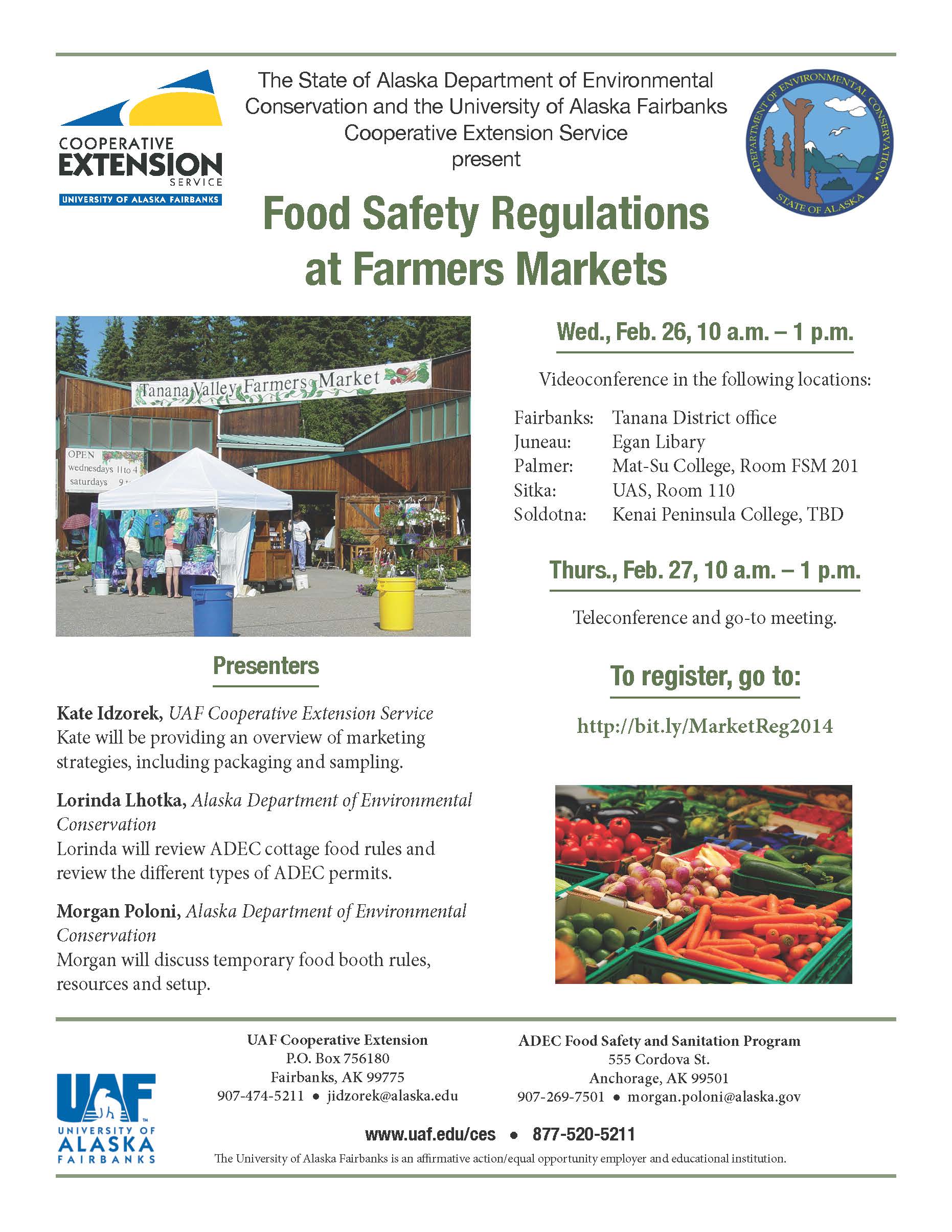
Farmers Market Regs

The Alaska Department of Environmental Conservation and the University of Alaska Fairbanks Cooperative Extension Service will team up to offer two training sessions about food regulations for farmers markets from 10 a.m. to 1 p.m. on both Wednesday, Feb. 26 (videoconference available in five locations, including Sitka) and on Thursday, Feb. 27 (by teleconference available statewide).

During these trainings you will learn how to market your products, how to set up your temporary food booth, and what foods do and do not require Alaska DEC permits. The course will be taught by Kate Idzorek with the UAF Cooperative Extension Service, and by Lorinda Lhotka and Morgan Poloni with the Alaska DEC Food Safety and Sanitation office. Kate will discuss marketing strategies including packaging and sampling, Lorinda will talk about Alaska DEC cottage food rules and the different types of permits, and Morgan review temporary food booth rules, resources and setup.

The first training will be offered by videoconference in five locations on Wednesday — Juneau, the Matanuska Valley, Soldotna, Fairbanks and Sitka. The Sitka videoconference site is University of Alaska Southeast Sitka Campus, Room 110 (see the flier for the other videoconference locations). The second training will be offered by teleconference or webinar (Go-To Meeting).

To register, go to http://bit.ly/MarketReg2014. For more information, contact Kate at 1-907-474-5211 or jizdorak@alaska.edu, or contact Morgan at 1-907-269-7501 or morgan.poloni@alaska.gov. The UAF Cooperative Extension Service can be reached (toll-free) at 1-877-520-5211. (Editor’s note: the three PowerPoint presentations from the Feb. 26 workshop are linked below as PDF files.)

• Cottage Foods at the market handout

• Food safety at farmers markets PowerPoint (opens as PDF file)

• Update on Alaska Farmers Markets Quest Card program PowerPoint (opens as PDF file)

• UAF Cooperative Extension Service offers Certified Food Protection Manager class by videoconference in Sitka

CFPM flyer 1-15-14

Friday, Dec. 20, is the registration deadline for a certified food protection manager workshop being taught on Wednesday, Jan. 15, by University of Alaska Fairbanks Cooperative Extension Service. This is an all-day statewide class that will be offered live in Fairbanks and Palmer, and by videoconferencing to Sitka and Kotzebue.

A certified food protection manager (CFPM) is responsible for monitoring and managing all food establishment operations to ensure that the facility is operating in compliance with food establishment regulations.

A CFPM is knowledgeable about food safety practices and uses this knowledge to provide consumers with safe food, protect public health and prevent food-borne illnesses. Alaska regulations require food establishments to have at least one CFPM on staff.

This course takes place from 9 a.m. to 5 p.m. (with a half-hour lunch), and participants will take a computer-based exam at the end of the class. The reason the deadline is two weeks before the class is to guarantee course materials reach all the students in time for the class. The cost is $175, and the course will be taught by Kate Idzorek of Fairbanks and Julie Cascio of Palmer. Students can register here.

The Sitka videoconference for the class will take place in Room 110 at the University of Alaska Southeast Sitka Campus. To learn more, contact the Sitka District Office of the UAF Cooperative Extension Service at 747-9440, or contact Kate Idzorek at 907-474-5391 (toll-free, 1-877-520-5211) or kjidzorek@alaska.edu in Fairbanks.

• Registration deadline Wednesday, Sept. 18, for upcoming certified food protection manager workshop on Oct. 18

CFPM flyer 10-2-13

Wednesday, Sept. 18, is the registration deadline for a certified food protection manager workshop being taught on Wednesday, Oct. 2, by University of Alaska Fairbanks Cooperative Extension Service. This is an all-day statewide class that will be offered live in Fairbanks and Palmer, and by videoconferencing to Sitka, Nome, Kodiak and Dillingham.

A certified food protection manager (CFPM) is responsible for monitoring and managing all food establishment operations to ensure that the facility is operating in compliance with food establishment regulations.

A CFPM is knowledgeable about food safety practices and uses this knowledge to provide consumers with safe food, protect public health and prevent food-borne illnesses. Alaska regulations require food establishments to have at least one CFPM on staff.

This course takes place from 9 a.m. to 5 p.m. (with a half-hour lunch), and participants will take a computer-based exam at the end of the class. The reason the deadline is two weeks before the class is to guarantee course materials reach all the students in time for the class. The cost is $175, and the course will be taught by Kate Idzorek of Fairbanks and Julie Cascio of Palmer. Students can register here.

The Sitka videoconference for the class will take place in Room 110 at the University of Alaska Southeast Sitka Campus. To learn more, contact the Sitka District Office of the UAF Cooperative Extension Service at 747-9440, or contact Kate Idzorek at 907-474-5391 (toll-free, 1-877-520-5211) or kjidzorek@alaska.edu in Fairbanks.

• Sitka shows off its gardens to International Master Garden Conference cruise

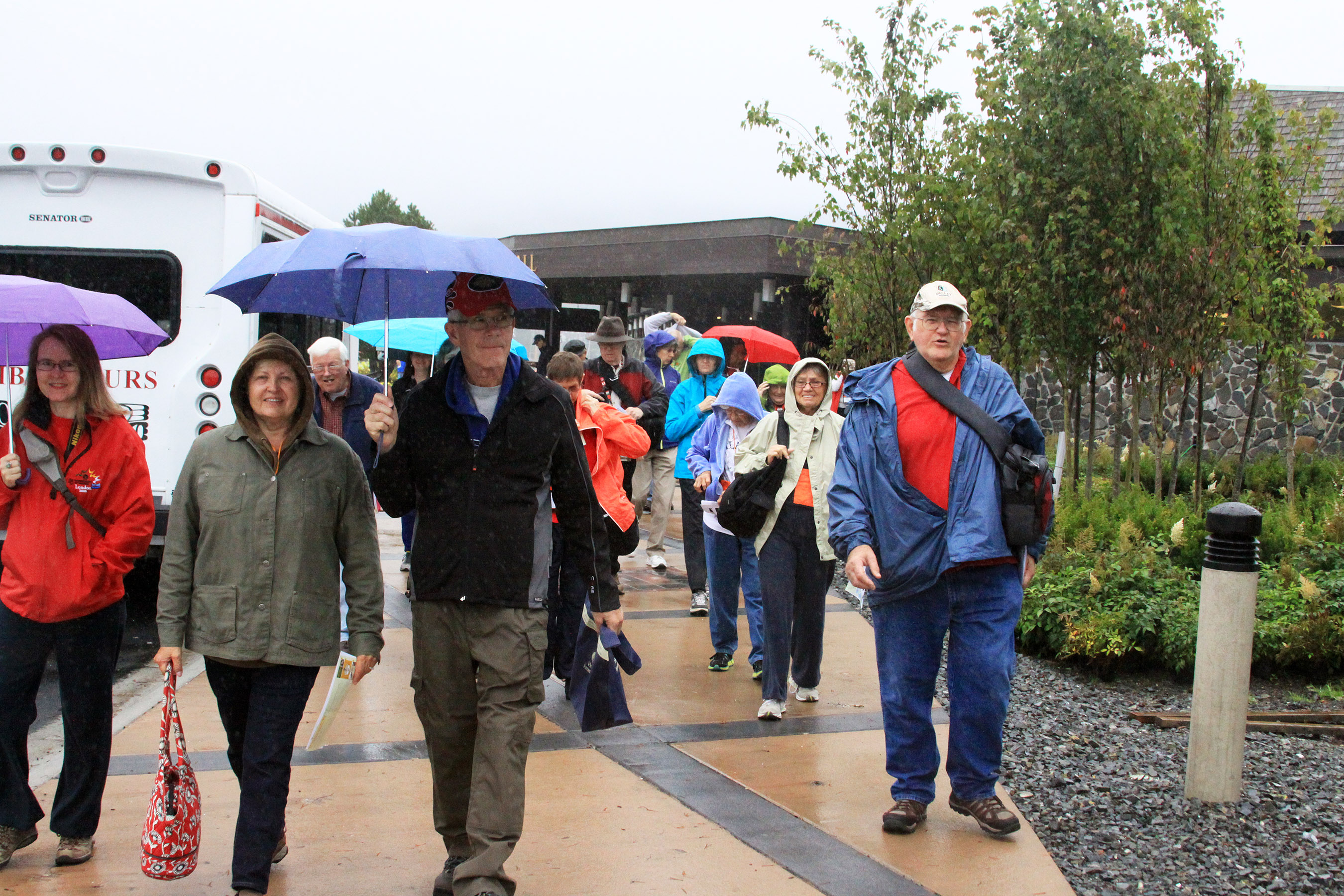
StartingGroupHike

InternationalMasterGardenersConferenceLogoSome 1,100 participants in the 2013 International Master Gardeners Conference were in Sitka on Wednesday, Sept. 11, when the Holland America Lines cruise ship Westerdam docked in town.

As part of the visit, the Sitka District office of the University of Alaska Fairbanks Cooperative Extension Service prepared a walking tour for the conference participants to show off local gardens and other highlights. The walking tour was a unique opportunity to showcase the challenges and methods used to garden in Sitka as well as interact with Master Gardeners from various locales. In addition to visiting Sitka, the Sept. 7-14 cruise took the conference from Seattle to Juneau, Glacier Bay, Sitka, Ketchikan, Victoria (British Columbia) and back to Seattle.

The Sitka walking tour started at Harrigan Centennial Hall and included a stop to look at apple trees by KCAW-Raven Radio, a stop at the Sitka Pioneer Home to look at the roses and other gardens, a stop at the Russian Bishop’s House (where kindergarten students from nearby Baranof Elementary School plant vegetables in the spring and harvest them in the fall when they return as first-graders). From there the walking tour went to St. Peter’s Fellowship Farm (where the Sitka Local Foods Network grows veggies to sell at the Sitka Farmers Markets), then it was on to the Sheldon Jackson Museum and on to Sitka National Historical Park. The final two stops were at a garden on the Sheldon Jackson Campus (between the Yaw Art Center and Hames Athletic and Wellness Center), and on to the US Geological Survey Geomagnetic Station and UAF Cooperative Extension Service demonstration plots (at the site of the original USDA Sitka Experimental Farm (Page 7), which was the first in Alaska and had more than 100 acres of crops from 1898-1931).

Also at Harrigan Centennial Hall, Sitka filmmaker Ellen Frankenstein hosted a couple of showings of her movie “Eating Alaska,” which examines the food choices one makes, especially when they live in Alaska where produce can be marginal but fish and game are widely available.

UAFMasterGardenerProgramLogoThe Master Gardener (MG) program started in Seattle in the 1970s as a way to extend the horticulture resources of Washington State’s land grant university  to the urban horticulture public in Seattle. The Master Gardeners receive 40 hours of training, similar to a basic three-credit-semester-hour, college-level horticulture class.

In return for this low-cost education the MG participants provide 40 hours of service to their community using Cooperative Extension information resources from their home states. The MG service may be in food gardening, pest management, youth gardening, tree and landscape care, public gardens, etc. Since the initial Seattle project, Master Gardener programs now exist in every state in the U.S., as well as Canada, Australia, New Zealand, and other countries. A Master Gardener course was taught in Sitka in April at the University of Alaska Southeast Sitka Campus.

• Sitka garden walking tour map for 2013 International Master Gardeners Conference

This slideshow requires JavaScript.

• Sitka gears up for cruise visit from International Master Gardeners Conference on Wednesday, Sept. 11

InternationalMasterGardenersConferenceLogoSitka will be host to 1,100 participants in the International Master Gardeners Conference when the Holland cruise ship Westerdam arrives in port on Wednesday, Sept. 11. The ship is due in port from 7 a.m. to 3 p.m.

Volunteers are needed to assist with local, non-commercial activities related to the conference‘s Sitka stop. Those who have completed a Master Gardener course are especially encouraged to participate. This is a unique opportunity to showcase the challenges and methods used to garden in Sitka as well as interact with Master Gardeners from various locales.

The Master Gardener (MG) program started in Seattle in the 1970s as a way to extend the horticulture resources of Washington State’s land grant university  to the urban horticulture public in Seattle. The Master Gardeners receive 40 hours of training, similar to a basic three-credit-semester-hour, college-level horticulture class.

In return for this low-cost education the MG participants provide 40 hours of service to their community using Cooperative Extension information resources. The MG service may be in food gardening, pest management, youth gardening, tree and landscape care, public gardens, etc. Since the initial Seattle project, Master Gardener programs now exist in every state in the U.S., as well as Canada, Australia, New Zealand, and other countries. A Master Gardener course was taught in Sitka in April

For more information or to sign up for a volunteer time slot, please contact the University of Alaska Fairbanks Cooperative Extension Service Sitka District office at 747-9440 .

• Invasive and damaging insect, the green alder sawfly, found in Sitka

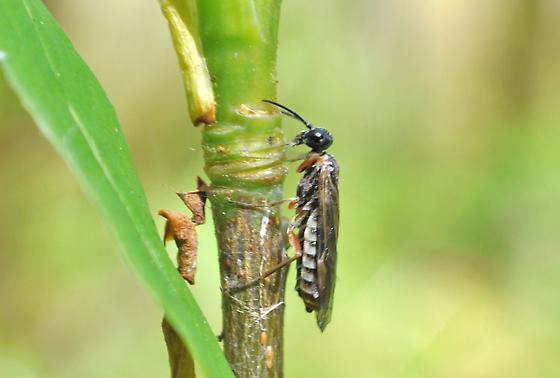
GreenAlderSawflyAdult

GreenAlderSawflyLarvaFor the first time, an invasive insect called the green alder sawfly (Monsoma pulveratum) has been found in Sitka. This insect is considered a danger to alder trees in Sitka and other Southeast wetlands.

“Several days ago a positive identification has been made on the green alder sawfly in Sitka,” Bob Gorman, resource development faculty with the Sitka office of the University of Alaska Fairbanks Cooperative Extension Service, wrote in an e-mail sent to Sitka and Southeast gardeners, “This invasive, exotic insect has defoliated alder trees in Anchorage and surrounding areas. It is a potentially serious threat to alder in southeast Alaska. The attached fact sheet (linked at the bottom of this post) provides details on the green alder sawfly. Distribute this information as you see fit. Thanks.”

The green alder sawfly is native to Europe and North Africa, and its preferred diet is European gray alder. It was first reported in North America in 1995 in Newfoundland, Canada. In 2004 it was first collected in Alaska near Palmer. Since 2007, the green alder sawfly has been documented defoliating thin-leaf alder (Alnus glutinosa) in numerous locations in Southcentral Alaska, eliminating alder in some watersheds. The green alder sawfly has been found in red alder (Alnus rubra) trees along Sawmill Creek Road, Halibut Point Road and Jarvis Street.

On Friday, KCAW-Raven Radio aired a story about the green alder sawfly with more details from Gorman and USDA Forest Service entomologist Liz Graham, who flew to Sitka from Juneau after Gorman sent her photos of the insect’s caterpillars.

Please report any known or suspected infestations of green alder sawfly to the Sitka office of the UAF Cooperative Extension Service by calling 747-9440 or stopping by the office located in Room 122 at University of Alaska Southeast Sitka Campus. GPS (global positioning system) coordinates of known locations of the green alder sawfly will help in determining the extent of this insect, which probably overwintered in Sitka.

• Green Alder Sawfly: A Threat to Sitka and Southeast Watersheds flier from the UAF Cooperative Extension Service


• Alaska Division of Forestry Community Forestry Program to host tree care and planting classes in Sitka

A cluster of Parkland apples (photo from the Alaska Pioneer Fruit Growers Association gallery, http://www.apfga.org/)

A cluster of Parkland apples (photo from the Alaska Pioneer Fruit Growers Association gallery, http://www.apfga.org/)

The Alaska Division of Forestry Community Forestry Program, in partnership with Sitka Tree and Landscape Committee, is coordinating three classes on tree health care and planting in Sitka. The classes are open to the public at no charge. Sign-up beforehand is not required. The schedule is as follows:

  • Diagnosing Tree Health Problems
    Monday, June 3, 6:00 – 8:30 pm
    Bob Gorman, UAF Cooperative Extension Service Sitka Office
    Natural Resources & Community Development Faculty
    Learn to observe signs and symptoms and to gather information about the biological, environmental, and cultural factors that affect a tree’s health.
  • Tree Selection, Planting, & Care
    Tuesday, June 4, 6:00 – 8:30 pm
    Patricia Joyner, Alaska Division of Forestry
    Community Forestry Program Manager and certified arborist
    Learn to select the right site, choose a high quality tree, and plant and maintain it.
  • Plant a Tree
    Wednesday, June 5, 6:00 – 8:00 pm
    Patricia Joyner
    Help plant trees in a city park. Apply what you learned in Wednesday’s class in the real world.

The classes will be held at Harrigan Centennial Hall on Monday and Tuesday and will meet at Centennial Hall on Wednesday before going to Sealing Cove for a tree planting. For information, contact the Division of Forestry at patricia.joyner@alaska.gov, 907-269-8465, or Lynne Brandon, Sitka Parks and Recreation, at 747-1852.

• Optimistic Gardeners: What to do with a bumper crop? The UAF Cooperative Extension Service can help

SarahLewisGreetings, Sitka. My name is Sarah Lewis and I’m the new Home, Health and Family Development Agent for the University of Alaska Fairbanks Cooperative Extension Service. My home is in Juneau, but my district is all of Southeast.

On Sunday, March 10, I’ll be in Sitka to participate in the Let’s Grow Sitka garden education event. But I won’t be there to give you tips on how to grow abundant food — fine Master Gardeners and other local and national experts will be on hand do that. I’m coming to motivate you! I have so much confidence in the gardeners of Sitka that my job is to prepare you for your bumper crops. Imagine winter meals with food stored and preserved from your garden.

I will have information about preparing and safely preserving your harvest, and I’ll have a pressure canning gauge tester on hand to test your gauges. I’ll have information about a wide range of vegetables and how you can enjoy them over the summer and even after your garden has been put to rest for the winter.

I look forward to coming to Sitka regularly in the coming years, and welcome calls and emails from Sitkans with questions about food (preparation, preservation, safety, and entrepreneurship), home resource use and conservation (energy, food, finances, and consumer goods), and family emergency preparedness. I’m here to assist individuals and support agencies and groups in their own work, with Cooperative Extension classes, information, and publications.

Please stop by the Let’s Grow Sitka event from noon to 3 p.m. on Sunday, March 10, at the ANB Founders Hall at 235 Katlian. Come chat with me, bring your questions and ideas, and take advantage of all the resources Let’s Grow Sitka will have to offer.

And always feel free to contact me at 907-796-6241 or sarah.lewis@alaska.edu at the UAF Cooperative Extension Service office in Juneau.