• Sitka Local Foods Network gets mentions in Juneau Empire, Daily Sitka Sentinel, Capital City Weekly and on APRN’s Talk of Alaska show

The Sunday edition of the Juneau Empire and Monday edition of the Daily Sitka Sentinel (Page 4) both featured a press release about a Sitka Local Foods Network-hosted presentation about “Growing in Sitka and Southeast Alaska: The Food of Today, Tomorrow and 200 Years Ago” that takes place at 5 p.m. this Friday, Oct. 16, at the Kettleson Memorial Library. The presentation is by UAS anthropology student Elizabeth Kunibe of Juneau, who has spent the last six years researching traditional gardens in Southeast Alaska. The presentation also received a write-up in this week’s issue of Capital City Weekly that came out on Wednesday.

Monday’s issue of the Daily Sitka Sentinel also featured a press release about a put-the-garden-to-bed work party the Sitka Local Foods network is hosting from 10 a.m. to 1 p.m. on Saturday, Oct. 17, at the St. Peter’s Fellowship Farm.

On Tuesday, the Alaska Public Radio Network’s statewide call-in show “Talk of Alaska” was about food security and during the show the work of the Sitka Local Foods Network was mentioned. The Talk of Alaska topic on food security was a preview of the Bioneers In Alaska conference this weekend (Oct. 16-18) in Anchorage where food security will be one of the topics. Kerry MacLane, president of the Sitka Local Foods Network, is supposed to travel to Anchorage to participate in the conference.

In addition to the Sitka Local Foods Network mentions, there has been a lot of other local foods news around Alaska this week.

In Sunday’s Juneau Empire, Ginny Mahar (a chef at Rainbow Foods) wrote a column featuring a mac and cheese recipe with king crab. Ginny also writes the Food-G blog, which features a lot of local foods recipes for Southeast Alaska.

Also in Sunday’s Juneau Empire was an article about the Alaska Native Brotherhood/Alaska Native Sisterhood Grand Camp meeting in Juneau and discussion about subsistence fishing rights following the recent arrest of Sen. Albert Kookesh.

In this week’s Capital City Weekly, there is an article from Carla Peterson about the chocolate lily and how to prepare this edible plant for food.

In the Alaska Newsreader blog Wednesday on the Anchorage Daily News Web site was a link to a feature from TheDailyGreen.com, which listed Anchorage ninth among U.S. cities in per capita space given to community gardens. The list (opens as PDF document) was compiled by the Trust for Public Land, and it had a distinct Northwest feel with Seattle ranked No. 1 and Portland, Ore., was No. 2. Click here to learn more about Anchorage’s community gardens program.

In his Anchorage Daily News garden column last week, Jeff Lowenfels wrote about planting garlic now for spring flowers and an August crop.

The Mat-Su Frontiersman recently ran an article about a sustainability project at the University of Alaska Fairbanks Mat-Su College where students were gathering organic spuds.

Finally, while this isn’t about Alaska, you might want to read an article about efforts to preserve our biodiversity so we don’t lose more food plant varieties and why these efforts are important.
• Recent articles highlight food security issue in rural Alaska

The New York Times on Saturday ran a lengthy article by former Fairbanks Daily News-Miner reporter Stefan Milkowski about how weak runs of king salmon are hurting Yukon River communities. The article is datelined from the village of Marshall, near the mouth of the Yukon River, where villagers already are feeling the pinch of no salmon to fill their freezers for the winter.

This is a region where heating oil costs $7 a gallon and a can of condensed milk goes for nearly $4. It also is a region that last year faced critical food shortages last year, with many faith groups from around the country sending food to help tide the residents through the winter. Click here to read accounts from “Anonymous Bloggers” about last year’s airlift and what villagers are doing to prepare for this winter.

The food shortages resulted in some July protest fisheries, which resulted in the arrest of the only police officer in Marshall, Jason Isaac, who joined other villagers in claiming state and federal fish and wildlife officials were more concerned with a Canadian fish treaty than they were about rural Alaskans. The Tundra Drums reports that 67,000 Yukon kings reached Canada, about 10,000 to 13,000 more than the treaty called for.

In relatively close-by Bethel, Tim Meyers and his wife Lisa have helped their communities food security with Meyer’s Farm, which is growing enough fruits and vegetables that Bethel residents can buy weekly boxes of locally grown produce for $30. This shows that local produce can be grown in rural Alaska to reduce our dependency on store-bought food.

Food security also hits closer to home, where state Sen. Albert Kookesh of Angoon faces a trial over subsistence fishing practices near his home village.

Not all of the local foods news in Alaska is gloom and doom this week. The Fairbanks Daily News-Miner featured a story on Monday about the growth of the Delta Meat and Sausage plant in Delta Junction, which processes locally raised Galloway cattle and game meat shot by local hunters.

Also, this week’s Chilkat Valley News (Haines weekly) included a brief item about a Haines moose hunter who was the beneficiary of a snow goose dropped by a hawk that didn’t have the strength to carry its prey.

Finally, the Alaska Dispatch site includes an update on the inaugural Alaska Local Food Film Festival, which runs from Oct. 2-8 at the Beartooth Theatrepub and Grill in Anchorage. Sitka filmmaker Ellen Frankenstein presented her movie “Eating Alaska” on Sunday, Oct. 4.

• Sonja Koukel of the UAF Cooperative Extension Service writes about home canning crab and shrimp

Dr. Sonja Koukel of the UAF Cooperative Extension Service

Dr. Sonja Koukel of the UAF Cooperative Extension Service

2814027500088610947sTovNd_ph

The following column originally appeared in the Sept. 30-Oct. 6, 2009, issue of Capital City Weekly and was made available to the Sitka Local Foods Network site. This column runs monthly.

More on Home Canning Seafood: Crab and Shrimp

By Dr. Sonja Koukel, PhD
Health, Home & Family Development Program
UAF Cooperative Extension Service

For the Aug. 5 Capital City Weekly issue, I submitted an article focusing on home canning seafood, specifically crab and geoducks. I was pleased to receive an e-mail from a reader asking for more information. As many of you may have had the same questions I’m sharing my responses here.

To refresh: In the article, I provided the guideline for freezing crab as that is the best preservation method for this food. Experts recommend boiling the live crab for five minutes -– at which time the crab is considered “cooked.”

Our reader asked two questions.

The first:

“Please let me know if this [recommended time] is a misprint. All the people I know who cook crab heat water in a crab cooking vessel until the water boils, then they boil the crab a minimum of 15 minutes before cooling it. I have often wondered if the 15-minute boiling period is too long, but have always deferred to the locals with crab experience. What is the critical issue in crab cooking?”

The second question:

“When cooking shrimp, on the other hand, the accepted practice seems to be: put the critters in a pot, bring the water to boil, then remove the shrimp when they float to the surface, which does not take very long.”

My responses to these two questions follow.

Dear Capital City Weekly Reader,

In regards to your questions, I did some further research over the weekend on the topics of cooking crab and shrimp. Here is what I found.

Crab:

The University of Alaska Fairbanks Cooperative Extension Service uses the University of Georgia Extension publication, “So Easy to Preserve,” as the main resource for home canning and food preservation information. Much of the information in this publication is based on the USDA, “Complete Guide to Home Canning,” as well as research from Extension Services across the US. In fact, Alaska Cooperative Extension is represented in the publication for the processing times for canning fish in quart jars (Kristy Long, Foods Specialist UAF CES).

For more information, I resourced other Extension websites and found a variety of cooking times for preparing crab for freezing. Oregon State University Extension publication, “home freezing of seafood” (PNW0586), recommends the following for whole crab: [after preparing crab] Cook in boiling salt water (2-4 Tbsp. per gallon, according to your taste preference) for 12-15 minutes. If the back is left intact, add 10 minutes to the cooking time. Add 2-3 minutes to the cooking time if the water doesn’t boil within a few minutes after adding the crab.

This from the Sea Grant Extension Program, UC Davis, “Freezing Seafood at Home”: You can either freeze crabmeat in the shell or as picked crabmeat. Cook crab before freezing to prevent discoloration of the crabmeat. Drop live crabs into enough boiling water to cover the crabs. Cover and return water to a boil. Boil for about 25 minutes. Remove crabs from boiling water and cool them immediately in cold water. Let crabs cool for several minutes and then drain.

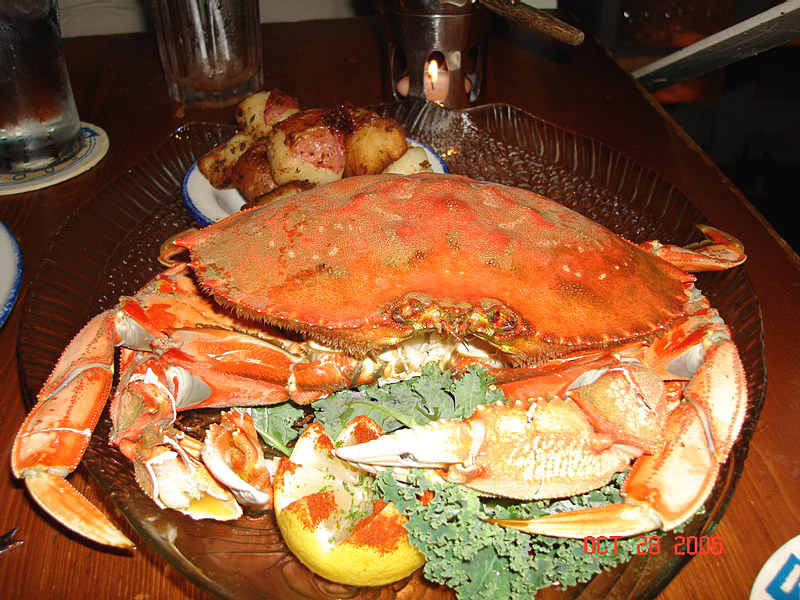
One purpose served by boiling the crab prior to freezing is that the process makes the meat easier to remove from the shell. As far as food safety, boiling will kill any parasites and/or bacteria that contribute to the decay of the shellfish. My sources claim that this is done after one minute in the boiling water. A celebrity chef wrote on his website that the cooking time for crab is not based on food safety but on the product being undercooked, cooked, and overcooked. A good guideline for cooking crab is to check the color of the shell. When the crab is done, the shell turns an orange/red color.

Something to take into consideration when looking at information on the Internet, many sources group all types of crab into one category. On the East Coast, most crab will be Maryland blue crab which are smaller than the Dungeness crab normally consumed in the Northwest. Just keep in mind that you have a safe and easy to handle product when the crab is boiled at least five minutes prior to freezing.

Now, the reply to the shrimp question.

The Sea Grant Extension Program, University of Delaware, instructs cooking the live shrimp just to the point of being done (the flesh turns from translucent to opaque). The cooking method you describe — putting live shrimp in a pot of boiling water and removing when they float to the top — is right on. If you were to time this procedure you probably will find that it takes approximately 3-5 minutes to boil one pound of medium sized shrimp.

I appreciate input from readers and welcome all suggestions, inquiries, and ideas. Please contact me via email: sdkoukel@alaska.edu or phone: 907-796-6221.

Sonja Koukel, PhD, is an assistant professor in the Health, Home & Family Development Program for the Juneau District office of the UAF Cooperative Extension Service. Reach her at sdkoukel@alaska.edu or 907-796-6221.

• ADF&G hunter education safety courses offered in Sitka

The Alaska Department of Fish and Game is offering an Online Basic Hunter Education Field Day and a Basic Hunter Education class this month in Sitka.

The Online Basic Hunter Education Field Day will be held from 9 a.m. to 2 p.m. on Saturday, Sept. 19. This field day course is only for students who already have successfully completed the electronic portion of the Online Basic Hunter Education class. Upon passing the online exam, students will receive a field day qualifier certificate, which grants admission to the field day. Students must have their field day qualifier number before registering for the field day. Register online at http://www.hunt.alaska.gov (click the “Hunter Education/Shooting” link at the bottom-right corner of the grid listing services). Detailed information about each course can be found on the Hunter Education/Shooting link.

The three-day Basic Hunter Education class will run from 6-8 p.m. on Friday and Saturday, Sept. 24-25, and from 9 a.m. to 5 p.m. on Sunday, Sept. 26. To register, students must purchase a $10 study packet available at the Alaska Department of Fish and Game office in Sitka. The packet workbook must be completed prior to the start of class.

Classes will be held at the Sitka Sportsman’s Association building located at 5211 Halibut Point Road. For additional information, please contact the Sitka office for the Alaska Department of Fish and Game at 747-5449.

• Movie ‘Eating Alaska’ to be shown July 16

The publicity poster for the movie Eating Alaska

The publicity poster for the movie Eating Alaska

The movie, “Eating Alaska,” will be shown at 7 p.m. on Thursday, July 16, at the Kettleson Memorial Library in Sitka. The movie is free. “Eating Alaska” is a documentary movie by Sitka filmmaker Ellen Frankenstein about how Alaskans make their food choices. In addition to the movie, other Sitka residents will be on hand to discuss the harvesting and drying of seaweed, local medicinal plants, wild edibles and cultivating wild plants.

Click here to go to the “Eating Alaska” movie Web site.