
• Bob Gorman to lead garden tour on July 31 as part of Sitka Seafood Festival

Bob Gorman, Extension Agent of the Sitka office of the University of Alaska Fairbanks Cooperative Extension Service, shows some germinating seed starts during a free garden workshop on March 11, 2009.

Bob Gorman, Extension Agent of the Sitka office of the University of Alaska Fairbanks Cooperative Extension Service, shows some germinating seed starts during a free garden workshop on March 11, 2009.

University of Alaska Fairbanks Cooperative Extension Service Professor Emeritus Bob Gorman will lead a walking garden tour at 6 p.m. on Thursday, July 31, as part of the Sitka Seafood Festival.

The tour should last about 90 minutes, and participants should dress for the weather and be prepared for a walking tour with several stops. The garden tour will feature visits to a mixture of ornamental landscapes and food gardens in the downtown area.

Many of these gardens on this tour are private, home gardens, so no public map will be released for privacy reasons. However, last September when a cruise was in town with participants in the 2013 International Master Gardeners Conference, there was a similar tour of public gardens in town and there was a map (PDF document) provided to participants (note, the USDA Experimental Farm site in Sitka usually is closed to the public).

The event is free, but pre-registration is required and can be done by calling UAF Cooperative Extension Service Sitka District office at 747-9440 or emailing Jasmine Shaw at jdshaw2@alaska.edu by noon on July 31.

• State of Alaska updates safe seafood consumption guidelines

FishConsumptionCalc

Eat all the salmon you want, but limit your amount of salmon shark, the Alaska Section of Epidemiology (part of the Division of Public Health) said when it recently updated its safe seafood consumption guidelines.

The Section of Epidemiology, in partnership with the Alaska Department of Environmental Conservation, started testing Alaska seafood for toxic heavy metals, such as mercury, and other pollutants, such as pesticides, back in 2001. The main reason for the research was to determine safe levels of seafood consumption for pregnant women, nursing mothers, infants, and others. According to the Alaska Dispatch News, the research involved testing fish, and using human hair samples to see how the heavy metals moved from species to species.

The Division of Public Health Division recommends eating fish at least twice a week. Medical research shows salmon are high in omega 3 fatty acids, which are believed to improve cholesterol and fight heart disease. Many types of Alaska seafood also are part of the traditional Alaska Native diet.

The good news is Alaska’s five salmon varieties (chinook/king, sockeye/red, coho/silver, chum/keta/dog, and humpy/pink) all tested as safe for everybody, with no limitations for pregnant women or others, as did halibut smaller than 40 pounds and Alaska pollock (commonly found in fish sticks and fast food fishburgers). This year’s expanded testing increased the number of safe-for-all species to 23 from 11 in 2007 (see chart above for complete list).

However, there were some seafood species where the Office of Epidemiology suggests consumption limits. Alaskans should use a point system, where people can eat up to 12 points a week (the safe species get zero points), with points based on six-ounce portions. Halibut (40-80 pounds), lingcod (35-40 inches) and lake trout are worth three points. Halibut (80-140 pounds), lingcod (40-45 inches) and longnose skate are worth four points. Halibut (140-220 pounds) and yelloweye rockfish are worth six points. Halibut (220 pounds or larger), lingcod (45 inches or longer), salmon shark and spiny dogfish are worth 12 points and should only be eaten once per week.

• Sarah Lewis to provide free pressure canner gauge testing at Saturday’s Sitka Farmers Market

Canner

SarahLewisThis is a great time of the year to be in Sitka. The fish are running, gardens are starting to produce, and berries are ripe for the picking.

Many Sitka residents have pressure canners to preserve their harvest, and this weekend Sarah Lewis of the Juneau District Office of the University of Alaska Fairbanks Cooperative Extension Service will be in town to teach three classes about canning on Friday, Saturday and Sunday. She also provide free pressure canner gauge testing at the Sitka Farmers Market from 10 a.m. to 1 p.m. on Saturday, July 26, at the Alaska Native Brotherhood Founders Hall.

“People can bring the gauge or the lid with the gauge still attached,” Sarah said. “If they have any questions about the full canner (gaskets, damage, how to use, etc.) they can bring the whole thing.”

In addition to testing pressure canner gauges, Sarah plans to work with Jasmine Shaw of the Sitka District Office of the UAF Cooperative Extension Service to have a wide variety of publications available about home canning. In addition, the UAF Cooperative Extension Service has a series of online tutorials on its website called “Preserving Alaska’s Bounty.” Pressure canner gauges should be tested at least once a year to make sure they are hitting the right pressures for safe food preservation.

We posted earlier about Sarah’s canner classes this weekend, hosted by the Sitka Kitch project, and info can be found here. However, the location for the first two classes has been moved to the Sitka Presbyterian Church (from Sitka High School) and the topic and time have been changed for Sunday’s class (new topic is Canning Jams and Jellies, new time is noon to 3 p.m., location remains Sitka High School). The canning classes are $20 each, and preregistration is required (call Marjorie at the number below).

For more information about the Sitka Kitch project and to register for Sarah’s canning classes, contact Marjorie Hennessy of the Sitka Conservation Society at marjorie@sitkawild.org or 747-7509.

• Wilcox family of Sitka completes cross-country run from California to New Jersey to raise awareness about GMOs in our food

WilcoxFamily25thAnniversary

WilcoxFamilyRunMapAfter nearly 3,000 miles and six months of running, the Wilcox family from Sitka reached its finish line Saturday, July 19, in Ocean City, N.J., to complete its cross-country run across the country to raise awareness about genetically modified organisms (GMOs) in our food system and the roles of large agribusiness companies, such as Monsanto, in making it difficult for consumers to know which food contains GMOs.

Fifteen-year-old David Wilcox decided he wanted to run across country back in 2010, when he read about another teenage runner to complete the USA crossing, so he and his father, Brett, 53, started training. In January, Brett quit his job as a behavioral health clinician and David’s mom, Kris, put her cleaning business on hold, and the family rented out its home in Sitka. Brett and David started the run on Jan. 18 in Huntington Beach, Calif., and started running about 20 miles a day, six days a week. While Brett and David ran, Kris and David’s younger sister, Olivia, 13, drove ahead on the course in the used pick-up truck and trailer the family purchased for the trip. Along the way, Brett and David took turns pushing a runner’s stroller loaded with their supplies for the day, water bottles, lunch, some GMO-free lettuce seeds, GMO literature, a few copies of Brett’s book, We’re Monsanto: Feeding the World, Lie After Lie, Book One, and the 15-year-old family dog, Angel. (Note, after awhile, Angel decided she didn’t like riding in the stroller and preferred riding in the truck, so the Wilcox family adopted a new dog, Jenna, while in Texas.)

DavidAndBrett“Being able to run 20 miles with David is a good thing,” Brett said. “Running with him for 20 miles a day, day after day for six months across 13 states is a great thing. I got to know David far better than I would have in our routines back in Sitka. I have a lot of respect for David for sticking with it even when it was tough going. Of course our run would not have been possible if Kris and Olivia had not been there to support us. Our last day’s run included a big radio interview and a police escort to the beach. Kris and several other runners joined in and ran with us. We passed through a cheering crowd as we entered the boardwalk. It was a special moment. Of course, the fact that Kris and I celebrated our 25th wedding anniversary on the same day we finished our run gave the whole occasion a fairy tale sort of ending.”

The Wilcox family decided to use the run to raise awareness about our food supply because the family is vegetarian, and they don’t like seeing more GMOs enter the food supply, and consumers not being able to find out which foods have GMOs. “Running For a GMO Free USA was the perfect cause for us. We learned that virtually all people — regardless of location — oppose chemically-saturated genetically modified organisms,” Brett said.

Trying to find GMO-free food on the run did become an issue for the family, and for part of the trip they stopped eating corn tortillas because of how much of our nation’s corn now has GMOs (they did find some Navajo corn tortillas they decided to try). GMOs also are in soy, sugar beets, and several other plants, and they may soon be coming to potatoes used by large fast food corporations. Along the way, the Wilcox family passed through St. Louis just in time to participate in the annual March Against Monsanto (an international event on May 24 this year) right outside Monsanto headquarters. Last year, the Wilcox family hosted a March Against Monsanto event in Sitka.

BrettWilcoxAtMonsantoHeadquartersWhen they planned the run, the Wilcox family hooked up with several anti-GMO groups across the country, and those groups helped connect the family to local media outlets and runners where they could spread their message. The anti-GMO groups helped the Wilcox family raise some funds and find places to stay for the trip, and there were two Indiegogo crowd-funding campaigns coordinated by Owen Kindig of Sitka (the first campaign raised $7,500 when it closed in January, and the current campaign still has 40-plus days left to run and has raised roughly $1,400). Along the way, Brett and Kris regularly updated the family’s Running the Country blog and Facebook page. Different media groups covered the run (here’s a link to our story before the run), and the media coverage increased as Brett and David neared the finish line. In recent weeks there has been coverage from small media outlets and large ones, such the Philadelphia Inquirer and Runner’s World magazine. Here is a link to the KCAW-Raven Radio story that aired July 21 about the Wilcox family run.

DavidWHIZNewsInterviewBrett and David trained for the run, but soon realized their training was a little lacking in LSD (long, slow, distance) runs. David won the Southeast Conference (Region V) cross-country running title in October, but most of his runs during the season were about five miles. Brett, a regular bike commuter, also ran shorter distances, and he and David had one or two longer runs a week. Running 20 miles a day, six days a week resulted in a lot of blisters, several worn-out pairs of shoes, and a couple of injuries along the way. Brett was hobbled early in the run by a bad foot, David had a bad leg, and Brett said he plans to have minor surgery in the near future for another injury.

“I had a couple of months where I couldn’t run, so instead I just walked,” David said. “Probably the best day for me was the day the fourth chiropractor fixed me. He was really nice to us, he let us take a shower. I told him where it hurt, and he told me what was wrong and he told me he was going to fix it and I was sort of wondering if he could really fix it. A muscle that’s supposed to be on the inside of my hip was on the outside. He pulled it over and told me I was fixed. Then he adjusted something else that I didn’t even know was wrong. He also worked on my mom and dad.”

As the miles piled up, the Wilcox family enjoyed the scenery. But sometimes the weather was a bit too hot for folks used to a temperate rain forest and then there were the ticks.

“Pennsylvania was probably the most beautiful state, but I could never live there because it’s too hot and humid,” David said. “I can’t wait to get back to Sitka so I can run the trails and not have to worry about ticks.”

WilcoxFamiyFinishesCrossCountryRunNow that the Wilcox family is done with the run, the next plan is to go to Washington, D.C., to talk with members of Congress and various agencies about GMOs. They already have meetings scheduled with Rep. Don Young and Sen. Lisa Murkowski, and hope to add a meeting with Sen. Mark Begich. “It will be fun to pass on to them what we learned from our cross-country run,” Brett said.

The family also will be doing more fundraising to help pay for the trip. “Our run is now over but we’ve spent far more than we’ve received from donations,” Brett said. “If you’d like to help us out with our expenses, please donate online at RunningTheCountry.com or at Indiegogo.com. The name of our Indiegogo fundraising campaign is ‘Help the Wilcox Family Finish Strong.’ Thanks to all the people who have helped us help David achieve his big dream to run across the USA.”

• Sitka Kitch hosts Sarah Lewis for cottage foods industry and home canning classes

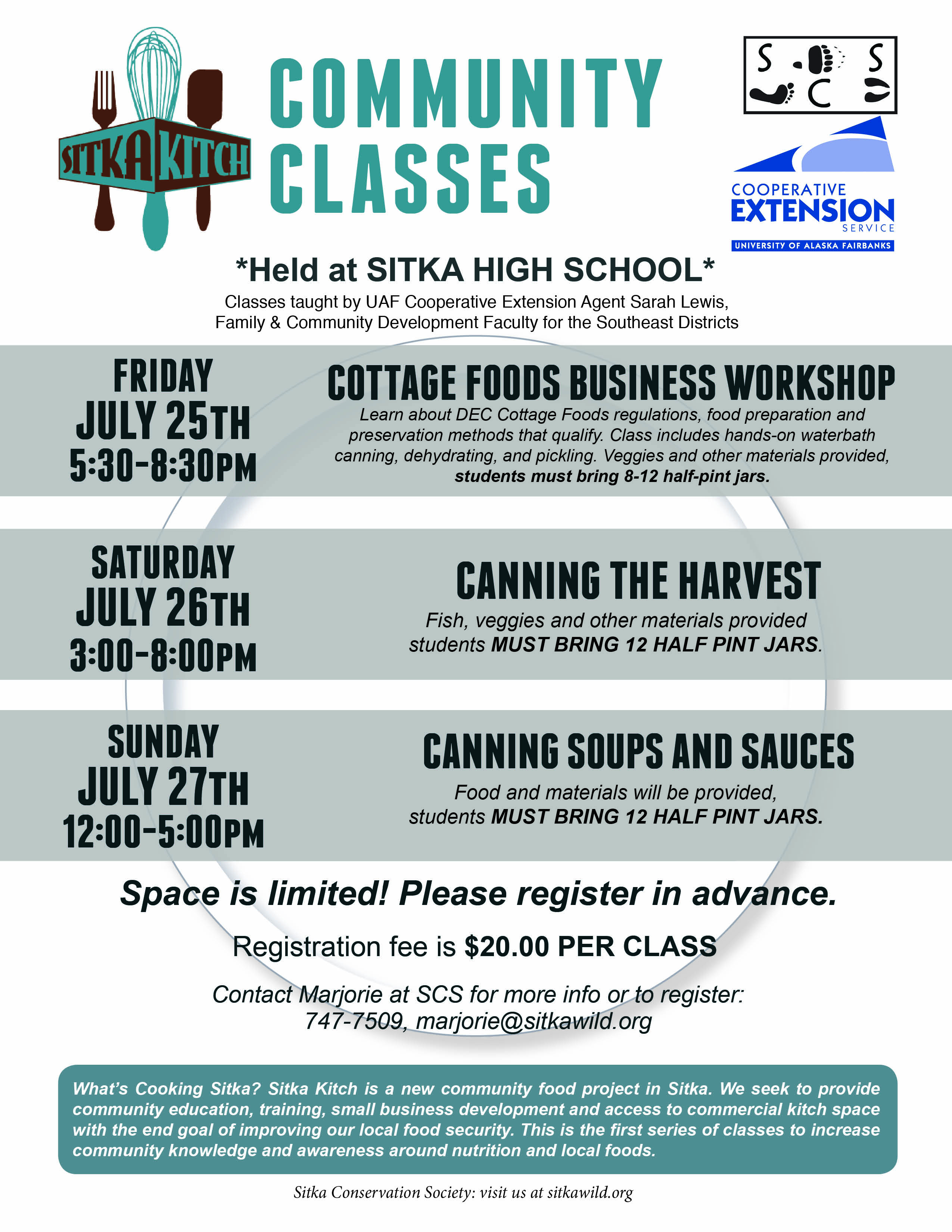
kitch_flyer_july25_26

SarahLewisSitka Kitch will host Sarah Lewis, Family and Community Development Faculty from the Juneau District Office of the University of Alaska Fairbanks Cooperative Extension Service, for three classes about the cottage food industry and home canning on July 25-27 at Sitka High School. (Editor’s note: The location of the first two classes has been moved to the Sitka Presbyterian Church on Sawmill Creek Road. Sunday’s class still will take place at Sitka High School, but the topic has been changed to Canning Jams and Jellies and the time will be from noon to 3 p.m.)

The three classes cost $20 each. Space is limited, so please register in advance by calling Marjorie Hennessy of the Sitka Conservation Society at 747-7509. Students will take home the products they make. The classes are:

  • Friday, June 25, 5:30-8:30 p.m., Cottage Foods Business Workshop — Students learn about Alaska Department of Environmental Conservation cottage foods industry regulations, as well as the food preparation and food preservation techniques that qualify. Class includes hands-on water-bath canning, dehydrating and pickling instruction. Veggies and other materials will be provided. Students must bring 8-12 half-pint canning jars with lids.
  • Saturday, June 26, 3-8 p.m., Canning the Harvest — Fish, veggies and other materials provided. Students must bring 12 half-pint canning jars with lids.
  • Sunday, June 27, noon to 5 p.m., Canning Soups and Sauces — Food and materials will be provided. Students must bring 12 half-pint canning jars with lids.

In addition, Sarah will be at the Sitka Farmers Market from 10 a.m. to 1 p.m. on Saturday, July 26, at the Alaska Native Brotherhood Founders Hall, where she will be available to test canner pressure gauges and provide other resources about home canning and food preservation.

Also, Sitka Kitch will partner with Sitka Tribe of Alaska to offer a pickled salmon course in August. This class is offered free of charge, but space is extremely limited. More details on date and location will be available soon.

Sitka Kitch is a community wellness project from the 2013 Sitka Health Summit designed to improve food security in Sitka. The different parts of the project include creating a community kitchen Sitka residents can rent to prepare food for their small businesses or to preserve their family harvest of fish, game, or garden veggies; expanding Sitka’s emergency food storage capacity; and providing education about preserving food and building family emergency food pantries.

For more information about the Sitka Kitch project, contact Marjorie Hennessy at marjorie@sitkawild.org or 747-7509.


• UAF Cooperative Extension Service offers Certified Food Protection Manager class by videoconference in Sitka

CFPM flyer 7-9-14

Friday, June 27, is the registration deadline for a certified food protection manager workshop being taught on Wednesday, July 9, by University of Alaska Fairbanks Cooperative Extension Service. This is an all-day statewide class that will be offered live in Fairbanks and Palmer, and by videoconferencing to Sitka and Ketchikan.

A certified food protection manager (CFPM) is responsible for monitoring and managing all food establishment operations to ensure that the facility is operating in compliance with food establishment regulations.

A CFPM is knowledgeable about food safety practices and uses this knowledge to provide consumers with safe food, protect public health and prevent food-borne illnesses. Alaska regulations require food establishments to have at least one CFPM on staff.

This course takes place from 9 a.m. to 5 p.m. (with a half-hour lunch), and participants will take a computer-based exam at the end of the class. The reason the deadline is two weeks before the class is to guarantee course materials reach all the students in time for the class. The cost is $200, and the course will be taught by Marsha Munsell of Fairbanks and Julie Cascio of Palmer. Students can register here (scroll down and select the July 9 item)

The Sitka videoconference for the class will take place in Room 110 at the University of Alaska Southeast Sitka Campus. To learn more, contact the Sitka District Office of the UAF Cooperative Extension Service at 747-9440, or contact Kathy McDougall at (907) 474-2420 (Fairbanks number) or kmmcdougall@alaska.edu.

• Sitka Local Foods Network education committee to host fourth classes in new garden mentor program

???????????????????????????????

Harvesting vegetables will be the theme of the fourth round of classes in the Sitka Local Foods Network’s new garden mentoring program.

This year, the SLFN education committee chose two families from a list of first-time gardeners to mentor for the summer. The two families agreed to allow other first-time gardeners to attend the six proposed classes at their homes, in exchange for help building their gardens from more experienced Sitka gardeners.

IMG_0005These free classes are open to all first-time gardeners in Sitka. The classes will be similar at each location, so people wanting to participate only need to sign up for one class. New classes will be added as the spring/summer progress, so keep watching for more. New participants are welcome, and a review of previous classes will be available.

The first class was on garden preparation, the second class was on planting, and the third class was on garden maintenance. The fourth round of classes will focus on early season harvest. Gardeners will learn about harvesting plants in a way that ensures the continued health of the plants and a long-term harvest throughout the summer. Uses and recipes for harvested plants will also be discussed.

The two vegetable harvest classes will be:

  • Friday, June 20, 4:30 p.m. at Anna Bradley’s house, 4764 Halibut Point Road.
  • Monday, July 7, 7 p.m. at Tami O’Neill’s house, 2309 Merganser Drive.

For more information, contact Michelle Putz at 747-2708 or michelleputzfood@yahoo.com.

• Sitka to host three-day Gathering in conjunction with two-week Introduction to Ethnobotany course

Salmonberries await picking near the entrance to Sitka National Historical Park

Salmonberries await picking near the entrance to Sitka National Historical Park

This month Sitka will host a two-week Introduction to Ethnobotany course on May 19-30, and as part of that course there will be a three-day UAF Kuskokwim Campus Ethnobotany Program All-Hands Gathering for stakeholders on May 29-31 held in conjunction with the class. As part of the Gathering, there will be a couple of events open to Sitka residents interested in ethnobotany and the uses of local plants.

The Gathering is sponsored by the Ethnobotany Certification Program of the University of Alaska Fairbanks Kuskokwim Campus (Bethel), and the Gathering will serve as a chance for stakeholders (students, instructors, elders, colleagues) to to get together to celebrate the program’s first five years, plan the next five years, and network with each other.

The schedule is still being finalized, but the first public event will be on Thursday, May 29, when the 10 ethnobotany class students will make their presentations from 3-5 and 6-8 p.m. (with a break for a bring-your-own dinner) in Room 229 of the University of Alaska Southeast Sitka Campus.

At 9:30-10:30 a.m. on Saturday morning, May 31, keynote speaker Anore Jones (author of Plants That We Eat) will  share her passion for traditional foods of the subarctic. This event will be at the Yaw Classroom at the Sitka Fine Arts Campus.

The Gathering will conclude at 5:30-9 p.m. on Saturday, May 31, with a community potluck dinner/local foods feast and Native dancing at the Sheet’ká Kwáan Naa Kahídi. This event will feature a Native chant from our Hawaiian friends, vending tables, as well as music from the Sitka rock band Slack Tide. The Gathering will provide a main course, some desserts and beverages for this event, and people are encouraged to bring side dishes featuring local food.

For more information, contact Kuskokwim Campus Ethnobotany Program Coordinator Rose Meier, PhD, at 1-907-474-6935 (voice), 1-907-474-5952 (fax) or by email at rameier@alaska.edu.

EBOT Public Flyer final

• Sitka Kitch, First Presbyterian Church announce grant to renovate kitchen for classes, rentals

The Sitka Health Summit congratulates the folks at Sitka Kitch and First Presbyterian Church on their $13,000 grant. The funds will go a long way towards renovation of their community kitchen. "Sitka Kitch is a community collaboration to augment and strengthen Sitka's workforce through the development of food-based curriculum and training." It is an initiative of the Sitka Health Summit. From left are Patrick Williams, Marjorie Hennessy, Clara Gray, Cheri Hample, Martina Kurzer, Suzan Brawnlyn, Cyndy Gibson, and Betsy Decker. (Photo Courtesy of the Sitka Health Summit)

The Sitka Health Summit congratulates the folks at Sitka Kitch and First Presbyterian Church on their $13,000 grant. The funds will go a long way towards renovation of their community kitchen. “Sitka Kitch is a community collaboration to augment and strengthen Sitka’s workforce through the development of food-based curriculum and training.” It is an initiative of the Sitka Health Summit. From left are Patrick Williams, Marjorie Hennessy, Clara Gray, Cheri Hample, Martina Kurzer, Suzan Brawnlyn, Cyndy Gibson, and Betsy Decker. (Photo Courtesy of the Sitka Health Summit)

kitch_logo_mainSitka Kitch is the community food project that arose from the 2013 Sitka Health Summit. The overall goal of Sitka Kitch is to improve community capacity and community development through the lens of food security.

The Sitka Kitch will start with food-based education and emergency preparedness at the household level. As it grows, the Sitka Kitch seeks to provide career and technical training, and entrepreneurial development opportunities. This will be achieved through a shared-use community kitchen and will work to educate, incubate and cultivate community sustainability.

Sitka Kitch also has a sub-group that is currently working to improve storage of emergency food with the Salvation Army. Eventually the kitchen would also like to generate a food ‘income’ stream to augment immediate relief efforts by local food banks and soup kitchens.

Sitka Kitch is pleased to announce a new partnering with the Sitka First Presbyterian Church to kick off its first year through the use of kitchen space. The groups collaborated in April to prepare an application to the Northwest Coast Presbytery Community Blessings Grant. The proposal outlined a budget to renovate the church’s existing kitchen to meet the requirements of becoming an Alaska Department of Environmental Conservation (DEC)-certified kitchen and thus meet the needs of Sitka Kitch users.

The church and Sitka Kitch were awarded the grant, in the amount of $13,000, and the funds will go towards renovating and improving functionality of the kitchen. These renovations will begin in June and Sitka Kitch plans to start offering classes in July.

For more information, contact Marjorie Hennessy at the Sitka Conservation Society (marjorie@sitkawild.org or 747-7509). Click here to listen to a KCAW-Raven Radio morning interview with Marjorie and Suzan Brawnlyn to learn more about Sitka Kitch.

• Sitka Community Greenhouse and Education Center committee to present project update to Sitka Parks and Rec Committee

Community Greenhouse Turn Around_Page_1

Community Greenhouse Turn Around_Page_2Are you interested in seeing year-round produce and flower production in Sitka? The Sitka Community Greenhouse and Education Center ad-hoc committee will give a project update to the City and Borough of Sitka Parks and Recreation Committee at noon on Thursday, May 1, at the Harrigan Centennial Hall Exhibit Room.

The Sitka Community Greenhouse and Education Center idea started off as a project from the 2008 Sitka Health Summit, but problems acquiring land kept the center from advancing much beyond the concept stage. In recent months, the project gained some new momentum when city officials suggested using land at the city’s Turnaround Park (the old amphibious plane turnaround near the corner of Halibut Point Road and Katlian Street, where the Sitka Skatepark and Sitka Trail Works office are located).

The current proposal is to build a 25-foot-diameter geodesic dome in the middle of the site’s current parking lot. As the project grows, the plan is to build a 90-foot-diameter geodesic dome in the center (the smaller geodesic dome will be moved to another location), with two conventional greenhouses along the ridge by Katlian Street and by the guardrail by the Sitka Trail Works building. There also are plans for some garden landscaping around the site to help clean it up and make it a more attractive place to visit. The greenhouse project will not impede the use of the Sitka Skatepark.

The slideshow below includes several concept drawings by James Patterson. These plans are subject to change, but they help give people an idea of where the project stands right now. Another option is to start off with a high tunnel greenhouse and build around it.

Sitka residents are encouraged to attend the meeting Thursday to show their support for the project. “If we don’t make it through this committee meeting it be ‘back to the drawing board,'” project coordinator Kerry MacLane said. “Your appearance for even a few minutes from 12:10 12:30 p.m. would mean a lot.”

The project was presented to the Sitka Historic Preservation Commission in mid April (the Sitka Turnaround Park is a historic site). If the greenhouse concept is approved by the Parks and Rec Committee on Thursday, it then will be presented to the Sitka Planning Commission on May 6. After that, the proposal will go to the Sitka Assembly to approve a lease to use the property.

Linked below are some concept points and a response to some questions by Parks and Rec’s partner, the Alaska Department of Natural Resources. For more information, contact Kerry MacLane at 747-7888.

• Sitka Community Greenhouse and Education Center proposal bullet points

• Sitka Community Greenhouse and Education Center response to DNR questions

This slideshow requires JavaScript.