The Sitka Local Foods Network will host several work parties on Saturdays and Wednesdays throughout the summer at St. Peter’s Fellowship Farm communal garden (located behind St. Peter’s By The Sea Episcopal Church on Lincoln Street).
Work parties are scheduled for 2-4 p.m. on several Saturdays this summer — on June 1, 8, 22, July 13, 27, Aug. 10, 24, and Sept. 7 and 21. Wednesday afternoon work parties take place from 4:30-6 p.m. on July 10, 24, Aug. 7, 21, and Sept. 4.
Produce grown at St. Peter’s Fellowship Farm is sold during the Sitka Farmers Markets to help fund Sitka Local Foods Network projects throughout the year. The work parties also are great for newer gardeners to learn about growing food in Sitka’s rainy climate.
During these work parties we usually need people to shovel dirt and sift soil, weed, mulch and spread fertilizer (seaweed) on the existing garden beds. Most garden tools will be provided, but we will need people to bring shovels and pick-axes if they have them. The work parties are kid-friendly, in case you want to teach your children about growing food.
For more information, contact St. Peter’s Fellowship Farm lead gardener Laura Schmidt at 623-7003 or 738-7009, or contact Lisa Sadleir-Hart at 747-5985. Fresh vegetables usually can be purchased during the work parties once crops start to ripen, and people who volunteer may be able to take some veggies with them when they go home.
The Blatchley Community Gardens and Blatchley Middle School will host a memorial for Kathy Swanberg in the community garden behind the school at 1:30 p.m. on Friday, May 24.
A bench built by Blatchley teachers will be dedicated in her honor. Family and friends are invited to attend, and a short reception will follow in the library.
Kathy Swanberg passed away in November 2012. She was the longtime secretary at the middle school and a gardener in the community gardens.
To learn more about the memorial and Blatchley Community Gardens, contact Dave Nuetzel at 738-8732 or community.garden@hotmail.com, or go to the Blatchley Community Gardens’ Facebook page.
(EDITOR’S NOTE: The following article first appeared on this site in April 2010. It is repeated because much of the information remains current and newsworthy.)
As you start to plan your garden for this spring and summer, don’t forget to Plant A Row For The Hungry. The Plant A Row For The Hungry program (also known as Plant A Row or PAR) is a national campaign by the Garden Writers Association of America that got its start in Alaska.
In the cold winter of 1994, Anchorage Daily News garden columnist and former Garden Writers Association of America President Jeff Lowenfels was returning to his hotel after a Washington, D.C., event when he was approached by a homeless person who asked for some money to buy food. Lowenfels said Washington, D.C., had signs saying, “Don’t give money to panhandlers,” so he shook his head and kept on walking. But the man’s reply, “I really am homeless and I really am hungry. You can come with me and watch me eat,” stayed with Lowenfels for the rest of his trip.
Jeff Lowenfels
The encounter continued to bother Lowenfels, even as he was flying back to Anchorage. During the flight, Lowenfels came up with an idea when he started writing his weekly garden column (the longest continuously running garden column in the country, with no missed weeks since it started on Nov. 13, 1976). He asked his readers to plant one extra row in their gardens to grow food to donate to Bean’s Café, an Anchorage soup kitchen. The idea took off.
When Anchorage hosted the Garden Writers Association of America convention in 1995, Lowenfels took the GWAA members to Bean’s Café to learn about the Plant A Row For Bean’s Café program. The Garden Writers Association of America liked the idea, and it became the national Plant A Row For The Hungry campaign (also known as Plant A Row or PAR). In 2002, the Garden Writers Association Foundation was created as a national 501(c)(3) nonprofit to manage the Plant A Row For The Hungry program.
“I am not surprised by the growth of PAR,” Lowenfels wrote in an e-mail to the Sitka Local Foods Network. “It is now in all 50 states and across Canada and there are thousands of variations of the original program — from prison gardens for the hungry to botanical gardens donating their produce from public display gardens. This is because gardeners always share information and extra food, so the idea was a natural.”
It took five years for the program to reach its first million pounds of donated food, but the second million only took two years and the next eight years saw a million pounds of donated food (or more) each year. Since 1995, more than 14 million pounds of food have been donated. Not only that, the program is getting ready to expand overseas to Australia, England and other countries with avid gardeners.
“We have supplied something in the vicinity of enough food for 50 million meals,” Lowenfels wrote in his e-mail. “Gardeners can solve this hunger problem without the government. And we don’t need a tea party to do it! Or chemicals, I might add, as author of a book on organic gardening (Teaming With Microbes, written with Wayne Lewis)!” (Lowenfels recently released a second book, Teaming With Nutrients, which is a follow-up to his first book).
According to the U.S. Department of Agriculture, one out of every eight U.S. households experiences hunger or the risk of hunger. Many people skip meals or eat too little, sometimes going an entire day or more without food. About 33 million Americans, including 13 million children, have substandard diets or must resort to seeking emergency food because they can’t always afford to buy the food they need. In recent years the demand for hunger assistance has increased 70 percent, and research shows that hundreds of children and adults are turned away from food banks each year because of lack of resources.
While many people credit Lowenfels for creating the Plant A Row For The Hungry program, Lowenfels says the real heroes are the gardeners growing the extra food and donating it to local soup kitchens, senior programs, schools, homeless shelters and neighbors. You can hear him pass along the credit to all gardeners at the end of this interview last year with an Oklahoma television station (video also embedded below).
“One row. That’s all it takes. No rules other than the food goes to the hungry. You pick the drop-off spot or just give it to a needy friend or neighbor. Nothing slips between the lip and the cup, I say,” Lowenfels wrote in his e-mail.
For people wanting to Plant A Row For The Hungry in Sitka, there are several places that would love to help distribute some fresh locally grown veggies or berries to those who are less fortunate, such as the Salvation Army, Sitkans Against Family Violence (SAFV), local churches, Sitka Tribe of Alaska and other organizations. The food the Sitka Local Foods Network grows at St. Peter’s Fellowship Farm communal garden goes to the Sitka Farmers Market.
The Sitka Local Foods Network also takes donations of local produce to sell at the Sitka Farmers Markets, and all proceeds are used to help pay for SLFN projects geared toward helping more people in Sitka grow and harvest local food. For more information, contact SLFN President Lisa Sadleir-Hart or one of the other board members at sitkalocalfoodsnetwork@gmail.com.
(The following is a letter to the editor sent to the Daily Sitka Sentinel from Blatchley Middle School earth science teacher Karen Lucas. The letter ran in the Thursday, May 16, 2013, edition, and Karen provided the Sitka Local Foods Network with a copy to post on our site.)
Dear Editor,
For our soil conservation studies, the seventh grade earth science students at Blatchley Middle School had a local soils expert come to class.
On a very sunny Monday, a couple weeks ago, Kerry MacLane, clad in bib overalls and broad brimmed hat, with his loaded-up wheelbarrow with five types of local soil, mini-greenhouse, plant starts, a very informative visual presentation, a tubular water wall, and a scavenger hunt up his sleeve that included a solar electric panel, solar powered fan, kale plants, newest compost pile, garlic and raspberry canes, wheeled his way down the halls of Blatchley.
After a concise basic powerpoint on local soils, greenhouse productivity, where our food comes from, and how Sitka disposes of waste; and learning that optimum soil for Sitka is one-third native soils, one-third compost and one-third sand; that starfish and herring eggs are good for the garden, too, and the lively discussion therewith; two teams were supplied each with a different scavenger hunt, and the class departed for the Blatchley Community Garden behind the school to identify items on their list.
Students nibbled on chives, kale and rhubarb, and generally exulted in being outdoors on that fine day in spring. Returning to the classroom, discussion ensued about the Farmer’s Markets, community greenhouse project, and the Sitka Local Foods Network, and how students could get involved in local gardening at home or in the community.
Kerry has certainly helped raise the consciousness of Blatchley students, and Sitkans alike, has been, and continues to be, instrumental in helping Sitka to progress toward sustainability in growing our own food, promoting community gardens, spearheading the Sitka Farmers Markets, and local greenhouse project that is underfoot, for all this, and for spending that Monday with us in the indoor and outdoor classroom, the Blatchley Middle School seventh grade earth science students are grateful; so, on their behalf and mine, thank you, Mr. MacLane, for sharing your knowledge with us about local soils, making relevant and useful, the ‘dirt on dirt.’
Karen Lucas Earth Science Teacher Blatchley Middle School
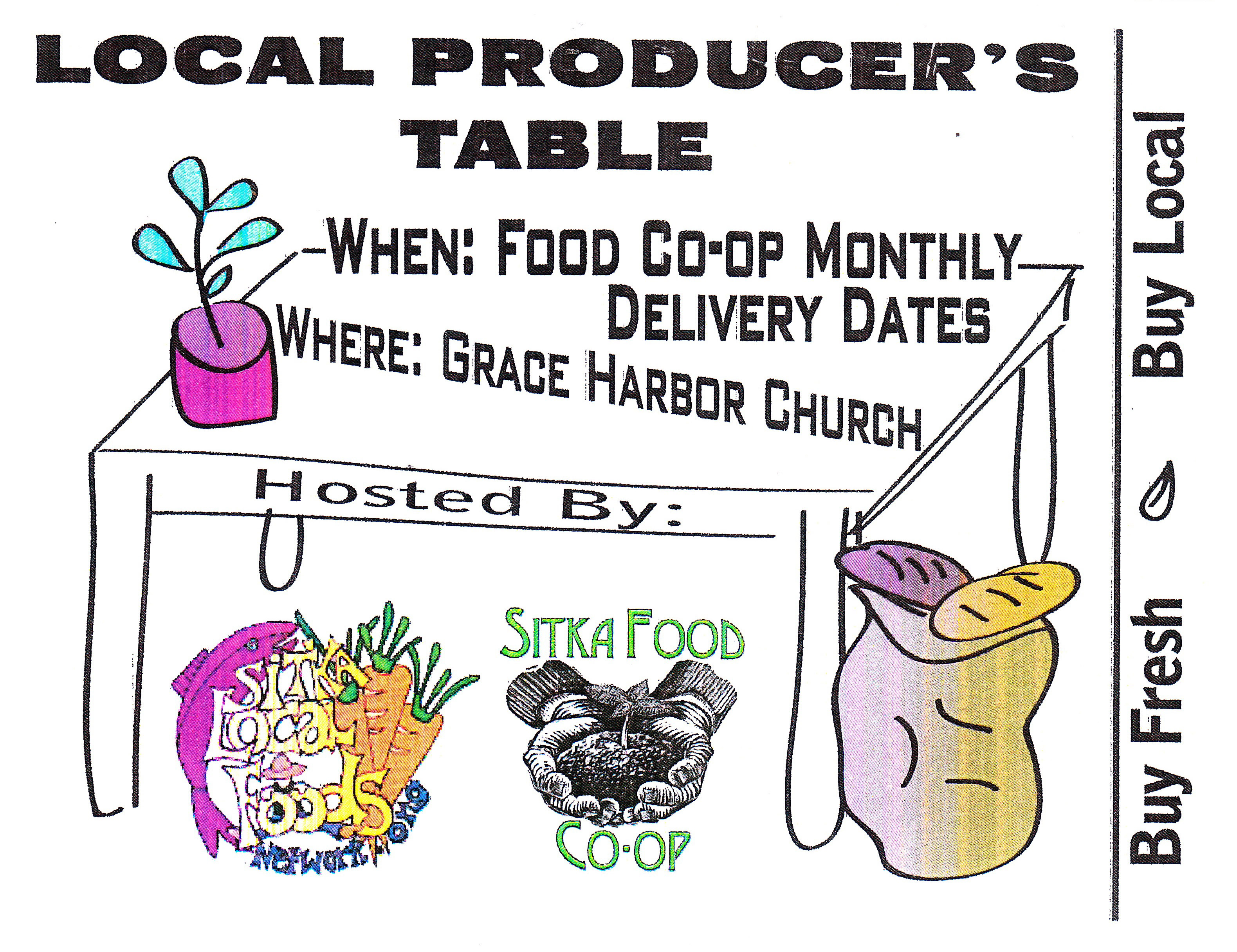
Looking for locally grown garden starts at reasonable prices? The Sitka Food Co-op just loaded up 12 boxes (about 15 trays of 4-inch pots) of garden and herb starts to bring to the “Local Producers Table” at the Sitka Food Co-op monthly box pick-up from 4-6 p.m. on Monday, May 20, at Grace Harbor Church (1904 Halibut Point Road).
The garden and herb starts are provided by the Sitka Local Foods Network and are available to help local gardeners get something growing in their own gardens. This is the second month the Sitka Local Foods Network has made garden starts available. Local produce will be available once the growing season hits its stride. This will be in addition to the regular Sitka Farmers Markets (alternate Saturdays from July through September) and Saturday work party sales at St. Peter’s Fellowship Farm (alternate Saturdays from the markets).
Also, Stuart Reid, the executive director of the Food Co-op Initiative, will be in Sitka this week. The Sitka Food Co-op will host Stuart at its board meeting at 5:30 p.m. on Thursday, May 23, at the Dock Shack, with dinner to follow at 6:30 p.m.
The Sitka Local Foods Network will host work parties from 2-4 p.m. on Saturday, May 11, and from 2-4 p.m. on Saturday, May 18, to start planting this summer’s crops at the St. Peter’s Fellowship Farm communal garden (located behind St. Peter’s By The Sea Episcopal Church on Lincoln Street).
Produce grown at St. Peter’s Fellowship Farm is sold during the Sitka Farmers Markets to help fund Sitka Local Foods Network projects throughout the year.
In addition to planting, there may be other garden chores to do. During these work parties we usually need people to shovel dirt and sift soil, weed, mulch and spread fertilizer (seaweed) on the existing garden beds. Most garden tools will be provided, but we will need people to bring shovels and pick-axes if they have them.
For more information, contact St. Peter’s Fellowship Farm lead gardener Laura Schmidt at 623-7003 or 738-7009, or contact Lisa Sadleir-Hart at 747-5985.
The Sitka Local Foods Network will host a work party from 2-4 p.m. on Saturday, April 20 (Earth Day), to help get the garden beds ready at the St. Peter’s Fellowship Farm communal garden (located behind St. Peter’s By The Sea Episcopal Church on Lincoln Street). Produce grown at St. Peter’s Fellowship Farm is sold during the Sitka Farmers Markets to help fund Sitka Local Foods Network projects throughout the year.
During these work parties we will need people to shovel dirt and sift soil, among other jobs. For those wanting to do lighter work, we need people to weed, mulch and spread fertilizer (seaweed) on the existing garden beds. Most garden tools will be provided, but we will need people to bring shovels and pick-axes if they have them.
For more information, contact St. Peter’s Fellowship Farm lead gardener Laura Schmidt at 623-7003 or 738-7009, or contact Lisa Sadleir-Hart at 747-5985. We will start planting the gardens in May, once we’re past the final freeze. Additional work parties are scheduled for 2-4 p.m. on Saturday, May 11, and 2-4 p.m. on Saturday, May 18.
It’s still a little cold to be planting outdoors, but it’s warm enough to start getting the garden ready.
The Sitka Local Foods Network will host two work parties, from 2-4 p.m. on Saturday, March 23, and from 2-4 p.m. on Saturday, April 20, to help get the garden beds ready at the St. Peter’s Fellowship Farm communal garden (located behind St. Peter’s By The Sea Episcopal Church on Lincoln Street). Produce grown at St. Peter’s Fellowship Farm is sold during the Sitka Farmers Markets to help fund Sitka Local Foods Network projects throughout the year.
During these work parties we will need people to shovel dirt and sift soil, among other jobs. For those wanting to do lighter work, we need people to weed, mulch and spread fertilizer (seaweed) on the existing garden beds. Most garden tools will be provided, but we will need people to bring shovels and pick-axes if they have them.
For more information, contact St. Peter’s Fellowship Farm lead gardener Laura Schmidt at 623-7003 or 738-7009, or contact Lisa Sadleir-Hart at 747-5985. We will start planting the gardens in May, once we’re past the final freeze.
On Sunday, March 10, I’ll be in Sitka to participate in the Let’s Grow Sitka garden education event. But I won’t be there to give you tips on how to grow abundant food — fine Master Gardeners and other local and national experts will be on hand do that. I’m coming to motivate you! I have so much confidence in the gardeners of Sitka that my job is to prepare you for your bumper crops. Imagine winter meals with food stored and preserved from your garden.
I will have information about preparing and safely preserving your harvest, and I’ll have a pressure canning gauge tester on hand to test your gauges. I’ll have information about a wide range of vegetables and how you can enjoy them over the summer and even after your garden has been put to rest for the winter.
I look forward to coming to Sitka regularly in the coming years, and welcome calls and emails from Sitkans with questions about food (preparation, preservation, safety, and entrepreneurship), home resource use and conservation (energy, food, finances, and consumer goods), and family emergency preparedness. I’m here to assist individuals and support agencies and groups in their own work, with Cooperative Extension classes, information, and publications.
Please stop by the Let’s Grow Sitka event from noon to 3 p.m. on Sunday, March 10, at the ANB Founders Hall at 235 Katlian. Come chat with me, bring your questions and ideas, and take advantage of all the resources Let’s Grow Sitka will have to offer.
And always feel free to contact me at 907-796-6241 or sarah.lewis@alaska.edu at the UAF Cooperative Extension Service office in Juneau.
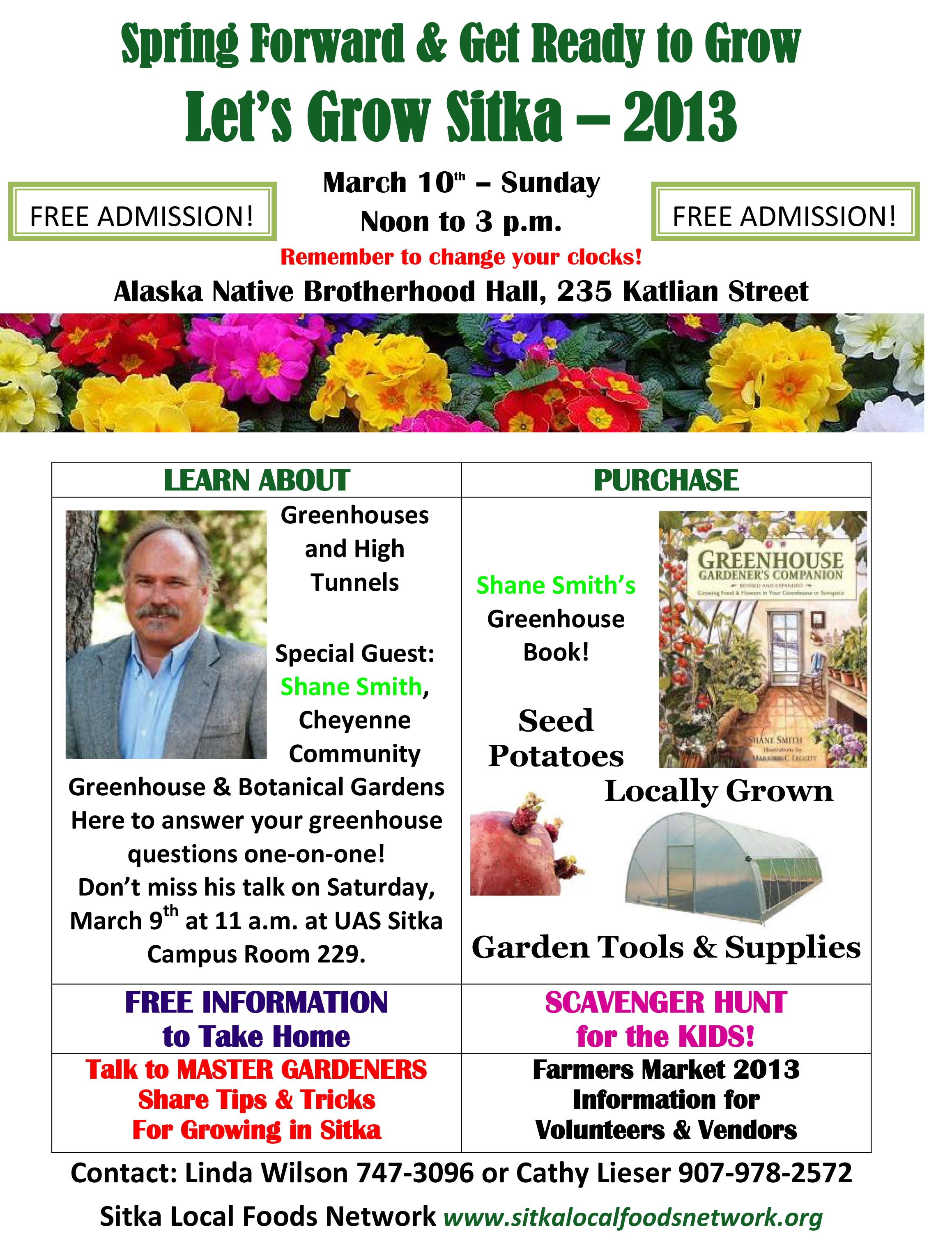
Mark your calendars as the Sitka Local Foods Network will host two big garden events Saturday and Sunday, March 9-10, in Sitka.
The first event is a presentation by Shane Smith of the Cheyenne (Wyo.) Botanic Gardens from 11 a.m. until 12:30 p.m. on Saturday, March 9, in Room 229 of the University of Alaska Southeast Sitka Campus. The second event is the fifth annual Let’s Grow Sitka garden education event from noon until 3 p.m. on Sunday, March 10, at the Alaska Native Brotherhood Founders Hall, 235 Katlian (don’t forget to set your clocks ahead an hour Saturday night).
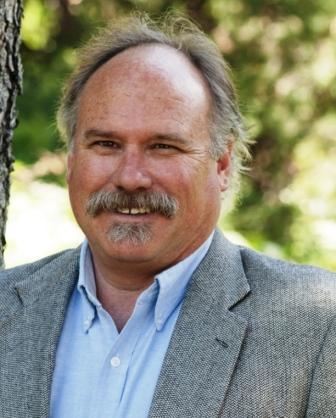
The Sitka Local Foods Network is excited to bring Shane Smith to town to discuss gardens and greenhouses. Shane is the founder of the Cheyenne (Wyo.) Botanic Gardens and has been its director since 1977. Shane is the author of the Greenhouse Gardener’s Companion, and he will be signing copies of his book. Shane received the American Horticulture Society’s 2012 Great American Gardener Award.
Shane also will have a booth at Sunday’s Let’s Grow Sitka event, which is an annual event designed to get Sitka residents excited about the upcoming garden season. This annual event brings together local garden supply stores, local gardeners, landscapers and anybody who is interested in learning how to grow food and/or flowers.
There will be a wide variety of individuals and businesses with booths for the event, with some booths providing gardening information geared toward and others selling gardening supplies. Lunch will be available for purchase. There also will be a chance to learn from certified Master Gardeners, a chance to learn about greenhouses and high tunnels, an opportunity to buy seeds and seed potatoes, and there’s a scavenger hunt for the kids.
For more information, contact Linda Wilson at 747-3096 (evenings and weekends) or Cathy Lieser at 1-907-978-2572. Table space still may be available for people wanting to provide information about different types of gardening or gardening products/services available in Sitka.
The Sitka Local Foods Network thanks the City and Borough of Sitka, Shee Atika Corp., and the SouthEast Alaska Regional Health Consortium (SEARHC) Diabetes Programs for their help in making these events possible.

 The Sitka Local Foods Network will host several work parties on Saturdays and Wednesdays throughout the summer at St. Peter’s Fellowship Farm communal garden (located behind St. Peter’s By The Sea Episcopal Church on Lincoln Street).




 Sitka Local Foods Network
You must be logged in to post a comment.