• Alaska Division of Forestry Community Forestry Program to host tree care and planting classes in Sitka

A cluster of Parkland apples (photo from the Alaska Pioneer Fruit Growers Association gallery, http://www.apfga.org/)

A cluster of Parkland apples (photo from the Alaska Pioneer Fruit Growers Association gallery, http://www.apfga.org/)

The Alaska Division of Forestry Community Forestry Program, in partnership with Sitka Tree and Landscape Committee, is coordinating three classes on tree health care and planting in Sitka. The classes are open to the public at no charge. Sign-up beforehand is not required. The schedule is as follows:

  • Diagnosing Tree Health Problems
    Monday, June 3, 6:00 – 8:30 pm
    Bob Gorman, UAF Cooperative Extension Service Sitka Office
    Natural Resources & Community Development Faculty
    Learn to observe signs and symptoms and to gather information about the biological, environmental, and cultural factors that affect a tree’s health.
  • Tree Selection, Planting, & Care
    Tuesday, June 4, 6:00 – 8:30 pm
    Patricia Joyner, Alaska Division of Forestry
    Community Forestry Program Manager and certified arborist
    Learn to select the right site, choose a high quality tree, and plant and maintain it.
  • Plant a Tree
    Wednesday, June 5, 6:00 – 8:00 pm
    Patricia Joyner
    Help plant trees in a city park. Apply what you learned in Wednesday’s class in the real world.

The classes will be held at Harrigan Centennial Hall on Monday and Tuesday and will meet at Centennial Hall on Wednesday before going to Sealing Cove for a tree planting. For information, contact the Division of Forestry at patricia.joyner@alaska.gov, 907-269-8465, or Lynne Brandon, Sitka Parks and Recreation, at 747-1852.

• Sitka joins communities around the world to host a local March Against Monsanto on Saturday, May 25

March Against Monsanto Yellow 72Millions of people around the world, including several in Sitka, will take a stand by hosting a local March Against Monsanto. The Sitka march takes place at 2 p.m. on Saturday, May 25, at Castle Hill. So far, more than 370 marches around the world are planned on May 25.

The Sitka March Against Monsanto is being organized by Brett Wilcox, who has created a Facebook page with more details. Brett and his 14-year-old son, David, will take things a step (OK, many steps) further when they start a transcontinental run across the country in January to raise awareness about some of the ethically challenged practices of the agri-business Monsanto. These include creating GMO (genetically modified) foods that are unlabeled and untested, putting patents on crop seed so farmers have to pay high fees to plant food, and more.

In addition to the march, various Sitka residents will speak on a variety of topics, such as how GMO-food causes health problems, the number of former Monsanto executives who now work for our government, farmer suicides in India due to Monsanto practices, the Monsanto Protection Act slipped into the recently passed US Farm Bill, etc.

This month, Brett hosted free Monsanto Movie Nights at 7 p.m. on Fridays, May 10, 17 and 24, at Harrigan Centennial Hall.

According to a press release about the event:

Sitka’s March Against Monsanto will be held on Castle Hill, the location where Russia sold the vast territory of Alaska—land it did not own—to the U.S.A.

March organizer, Brett Wilcox, chose Castle Hill for Sitka’s March Against Monsanto for its symbolic significance. “There are many similarities between the original ‘Land Grab’ that took place with the first European expansion and Monsanto’s current global ‘Seed Grab,'” Wilcox states. “Both involve the privatization of Nature, a concept that was largely foreign to Native Americans and Alaska Natives. And both have resulted in loss of freedom and loss of life. The difference is that Monsanto’s seed grab not only further disenfranchises Native Americans; it disenfranchises all nations and all people. The citizens of the world are, as it were, sitting in our canoes in Sitka Sound, watching powerful people and corporations claim and repackage life as their own, thereby stealing our seed sovereignty and seed freedom.”

Chuck Miller, a Tlingit “Elder in Training”, will preside at the event. “My grandmother used to teach my family that we need to treat our food with respect or it will not provide for us,” Miller states. “My ancestors’ teachings are still a very big part of my life and I want to be able to pass that on to my children, grandchildren and those yet to come. GMOs are not the way to treat Mother Earth and the generations yet to come. I urge all the Native people of Alaska and our non-Native brothers and sisters to come and support this cause.”

“Sitka’s March Against Monsanto will not be a traditional march,” says Wilcox. “Sitka’s event will be a ceremony to honor nature as well as the indigenous people of Alaska and the Americas. We will stand on Castle Hill united with the people of the world in defense and protection of life and nature.”

For more information about the Sitka March Against Monsanto, contact Brett Wilcox at 747-7437 or brett@runningthecountry.com, or contact Chuck Miller at 752-9955 or cohomojo25@yahoo.com. KCAW-Raven Radio aired a story on Tuesday, May 21, about Brett’s and David’s plans to run across the country and to host this march. Brett also recorded a commentary for KCAW-Raven Radio.

• Sitka Community Food Assessment featured in the Tuesday, April 9, issue of the Daily Sitka Sentinel

Courtney Bobsin, a Jesuit Volunteer with the Sitka Conservation Society who is helping the Sitka Community Food Assessment collect data, has her computer logged in and ready to take the survey. (Daily Sitka Sentinel photo by James Poulson, used with permission)

Courtney Bobsin, a Jesuit Volunteer with the Sitka Conservation Society who is helping the Sitka Community Food Assessment collect data, has her computer logged in and ready to take the survey. (Daily Sitka Sentinel photo by James Poulson, used with permission)

(This article originally appeared in the Tuesday, April 9, 2013, edition of the Daily Sitka Sentinel. It is used here with permission.)

Sitkans Taking Stock of Local Food Security

By SHANNON HAUGLAND
Sentinel Staff Writer

SitkaCommunityFoodAssessmentLogoCan you afford to eat the foods you want in Sitka?

How long could you survive on the food you have in your house today?

How often do you eat foods that are gathered locally?

The Sitka Food Security Survey is trying to find the answers to these and other questions related to food security in Sitka.

The survey is one of the projects of the Sitka Community Food Assessment group that was started at the 2012 Health Summit last fall.

“Community food security is looking at how secure are we as a community if for some reason something happened in the Lower 48 and we couldn’t get barges up here,” said Lisa Sadleir-Hart, the community food assessment coordinator for the Sitka Community Food Assessment project. “Are there things we could do differently? … We’re pretty dependent on the food coming from outside.”

The group is looking at food security from both a household standpoint and a community standpoint. While some information has been collected, more is needed on a home-by-home basis, Sadleir-Hart said.

To that end, Sadleir-Hart is hoping residents go online to participate in the food security survey to document where the problems are, where the strengths are and how to start addressing the shortcomings. The assessment will make it easier to apply for grants to help the community strengthen its food security position, she said.

“Our goal is 600 completed surveys, which is about 10 percent of the adult population here,” she said. She has set a tentative deadline by the end of this month.

Among many of the issues considered, Sadleir-Hart wonders how the 44-percent increase in food prices from 2006 to 2011 is affecting choices residents are making.

“Given these increases, fuel prices, housing prices, housing costs, at some point you have to make a decision: if you pay for one you might not be able to pay for something else,” she said. “People are hurting when it comes to food.”

The survey asks whether residents are able to eat as much as they need, and eat the foods they want to eat, or if they make sacrifices or eat less in order to feed others, when they are financially strapped.

Some of the focus in the survey is whether residents take advantage of foods that are available locally, including fish, deer, mushrooms, seaweed and berries, among the dozens of possibilities. Some questions are aimed at traditional and customary foods.

From a community standpoint, some data already indicates a level of “insecurity,” since 95 percent of the food Sitkans consume is shipped in from the Lower 48.

“Does our community have the capacity to feed itself if a natural disaster left us isolated?” is one of the survey’s underlying questions.

The assessment project’s goals are to create a community food security profile; map Sitka’s existing food resources and production capacity; and assess household food security, food accessibility, and food availability and affordability.

The work group for the project said community food security is a relatively new concept that covers a variety of disciplines, including community nutrition, nutrition education, public health, sustainable agriculture, and anti-hunger and community development.

“As such, no universally accepted definition exists,” the group said in a handout.

Sadleir-Hart said community food security can be seen as an expansion of the concept of household food security.

“Whereas household food security is concerned with the ability to acquire food at the household level, community food security focuses on the underlying social, economic and institutional factors within a community that affect the quantity and quality of food available …” the handout said.

Affordability is another issue that can affect community food security, Sadleir-Hart said.

The Sitka Community Food Assessment group from the Sitka Health Summit started by collecting data already available locally. Sitka Conservation Society contributed the Jesuit Volunteer, Courtney Bobsin, to work part-time to collect data on local producers, senior and tribal food programs, food banks and other food assistance programs.

“She’s been collecting lots of great information,” Sadleir-Hart said.

The assessment team is using the Food Security Toolkit from the U.S. Department of Agriculture to guide the process. Sadleir-Hart said the local effort received a head-start on the assessment by looking at Kenai’s food security survey designed by the University of Alaska Fairbanks Cooperative Extension Service. The Sitka Local Foods Network, which runs the Sitka Farmers Market, is also involved in the project.

The Sitka Community Food Assessment project received a $15,000 SEARHC Community Transformation Grant to fund Sadleir-Hart’s part-time position, and data analysis.

The goals of the assessment are to improve Sitka’s understanding of the local food system, identify the system’s strengths and weaknesses, inform decisions about policies and ways to improve Sitka’s security, and position Sitka to access grant funding for food system improvement.

Years ago, Sadleir-Hart said, more people in Sitka had vegetable gardens and some kept milk cows and other farm animals. The potential for increasing the amount of locally produced food still exists, and with it the prospect for economic development.

“There are a lot of different angles we could explore, from a community perspective,” she said.

Focus groups are also being called to continue to collect information about food and the community.

The Sitka Community Food Assessment group is looking ahead to the first annual Sitka Food Summit in November, when citizens review the findings of the data collection and start talking about ways to improve the current food system.

The survey can be reached by typing Sitka Community Food Assessment on Facebook, and going to the “Survey Monkey” link. The survey is filled out anonymously. The direct link to the survey is: https://www.surveymonkey.com/s/MQTF22Q.

• Sitka Tribe of Alaska submits editorial on protecting Pacific herring as a keystone forage fish

HerringBranches

(The following editorial about protecting forage fish, such as Pacific herring, was submitted to local media on April 11 by Sitka Tribe of Alaska tribal chairman Michael Baines.)

State of Alaska Denies Herring Forage Fish Status

2006 Herring collection 007Currently Pacific herring are acknowledged as a keystone forage fish species that is responsible for maintaining the health of the marine ecosystem in the waters of California, Oregon, Washington and British Columbia (BC).  As you cross the maritime boundary between BC and Alaska herring lose their forage fish status and become just another commercially harvested finfish.  At a recent Board of Fish meeting in Anchorage, the Board heard testimony from fishery managers, the herring industry and the public on a proposal that would have acknowledged herring as a forage fish by adding them to the State’s Forage Fish Management Plan (FFMP).

The FFMP became effective in 1999 and was intended to prevent the development of new fisheries on forage fish while allowing existing commercial forage fisheries to continue.  The Plan states that forage fish perform a critical role in the marine ecosystem by transferring energy from primary (zooplankton) and secondary (phytoplankton) producers to upper trophic level shellfish, finfish, marine mammals and sea birds.  The Plan also recognizes that, “abundant populations of forage fish are necessary to sustain healthy populations of commercially important species of salmon, groundfish, halibut, and shellfish.” 

The Alaska Department of Fish and Game commented that adding herring the FFMP would not affect the way it currently manages herring fisheries in the State. When asked by the Board if herring met the definition and fulfilled the role of a forage fish as described in the Plan, the ADF&G Southeast Regional Commercial Fisheries Coordinator responded that he felt they did.

Supporters of the plan stressed that herring are an ecological keystone species that are recognized around the world as a forage fish.  The Federal government holds herring to a higher standard that other forage fish by having no directed fisheries on herring in federal waters and by listing them as a prohibited species that is not allowed to be retained as by-catch.

Herring industry representatives testified that they felt herring stocks are healthy, well managed and did not need to be acknowledged as a forage fish.  Concerns were also expressed that listing herring as a forage fish would lead to changes in the way herring are managed.  This would have required the State to look at herring in a different light.  It may have paved the way for more conservative forage fish friendly management plans to be brought forth through the Board of Fisheries process in the future.

Unfortunately for Alaskans, this proposal was voted down on a 4-3 vote.  Three of the opposing Board members are commercial fishermen or have ties to the commercial fishing industry.  These Board members reiterated comments made by the industry that herring stocks are healthy, well managed and did not need to be listed in the plan.

The arguments put forth by the industry representatives and members of the Board in opposition to the proposal were not germane to the issue of adding herring to the FFMP.  The health of a population has nothing to do with its definition as a forage fish.  If this were the case the Lynn Canal and Prince William Sound herring stocks would be considered forage fish while the apparently healthy Togiak stock would not have the same status.  Likewise, if acknowledging herring as a forage fish by adding them to the FFMP eventually changes the way stocks are managed, it should tell us something about their current management.

The acknowledgement of herring as a forage fish would have allowed managers to look at herring in a different light and might have paved the way for more conservative forage fish friendly management plans to be brought forth through the Board of Fisheries process in the future.  Refusal by the State of Alaska to acknowledge herring as a forage fish sends a message to the world about Alaska’s biased Board of Fish process and the State’s priorities when it comes to managing its marine resources.  Alaska boasts having the best managed fisheries in the world, but that reputation is now tarnished.  It’s a sad day for Alaskans when greed and political influence win out over the common good of all who live in this great State.

If you feel the Board of Fisheries erred in their decision to deny herring forage fish status, you are encouraged to contact Alaska Governor Sean Parnell and the Board of Fisheries and request that the State reconsider adding herring to the State’s FFMP.  This is an Alaskan resource that needs to be managed for the benefit of all Alaskans.

(Sent to)

Governor Sean Parnell, P.O. Box 110001, Juneau, AK 99811-0001, Phone (907) 465-3500, governor@alaska.gov

and

Alaska Department of Fish and Game, Board of Fisheries, P.O. Box 115526, 1255 W. 8th Street, Juneau, AK 99811-5526


• Sitka office of UAF Cooperative Extension Service to host Master Gardener class

Bob Gorman, Extension Agent of the Sitka office of the University of Alaska Fairbanks Cooperative Extension Service, shows some germinating seed starts during a free garden workshop on March 11, 2009.

Bob Gorman, Extension Agent of the Sitka office of the University of Alaska Fairbanks Cooperative Extension Service, shows some germinating seed starts during a free garden workshop on March 11, 2009.

The Sitka office of the University of Alaska Fairbanks Cooperative Extension Service will host a Master Gardener class in Sitka starting on Thursday, March 7. This will be the last Master Gardener certification course offered in Sitka until at least 2015.

The course is a basic horticulture class covering such topics as soil and pest management, food gardening, greenhouses and season extenders, and plant propagation.

The purpose of the service learning class is to train community people who will provide 40 hours of Master Gardener-related community service in Sitka.

MG March 2013 SitkaThe class costs $150 including the manual, handouts, supplies, and instruction. The class consists of lectures, demonstrations, reading, laboratory exercises, videos and DVD’s. The instructor is Sitka-based UAF Cooperative Extension Service Agent Bob Gorman.

Preregistration is necessary. To register for the class go to http://bit.ly/ces-workshops or call 907-747-9440.

The class begins at 6:30 p.m. on Thursday, March 7,  and finishes April 18 with a final exam. Instruction is on six Saturdays and four Thursdays. Part of the Alaska Master Gardener and Southeast Alaska Master Gardener programs include public service, where Master Gardener students help with community gardening projects.

Students should be high school graduates, GED or similar education level. Home school and high school students are welcome.

For questions about the class or course content, contact the instructor at 907-747-9440.

• Sitka Master Gardener Class Syllabus, Spring 2013

• Sitka Master Gardener class press release

• UAF Cooperative Extension Service flier for Master Gardener class in Sitka

• Sitka Conservation Society, other groups to host Sitka Food Film Festival on Feb. 22-24

Food Film FestThe Sitka Conservation Society and several other partners will host the Sitka Food Film Festival on Friday through Sunday, Feb. 22-24, at Harrigan Centennial Hall and the Larkspur Cafe. The films are free, but donations will be accepted to help cover costs.

In addition to the dozen films, the festival will feature an appearance by Tlingít chef Robert Kinneen about the Store Outside Your Door (a project with the Alaska Native Tribal Health Consortium (ANTHC) promoting healthy traditional foods). There also will be a roundtable discussion about Sitka’s food resiliency (food security).

The festival opens with a feature film TBA at 8:30 p.m. on Friday night at the Larkspur Cafe.

On Saturday at Harrigan Centennial Hall, the schedule includes Ratatouille (a family friendly movie) at 10 a.m., Ingredients at 12:30 p.m., End of the Line at 2:30 p.m., Two Angry Moms at 3:45 p.m., followed by a roundtable discussion about Sitka’s food resiliency from 5:30-6:30 p.m. Saturday’s schedule concludes with another feature film TBA at 8:30 p.m. at the Larkspur Cafe.

Sunday’s schedule at Harrigan Centennial Hall opens with A Feast At Midnight (a family friendly movie) at 10 a.m., Food Fight at 12:30 p.m., Bitter Seeds at 2:30 p.m., and Food Stamped at 4 p.m. Robert Kinneen is the keynote speaker at 6 p.m., discussing the Store Outside Your Door and showing film shorts from the project. The festival concludes at 7 p.m. with The Economics of Happiness.

Besides the Sitka Conservation Society, the film festival is sponsored by the Alaska Sustainable Fisheries Trust, SEARHC, Sitka Food Co-op, ArtChange Inc., Sitka Film Society, Alaska Pure Sea Salt Co., and the Larkspur Cafe. On Tuesday, Feb. 19, Tracy Gagnon with the Sitka Conservation Society and Andrianna Natsoulas with the Alaska Sustainable Fisheries Trust were interviewed on KCAW-Raven Radio’s Morning Edition program about the film festival, and you can click here to listen to the interview.

• Sitka residents say ‘No’ to genetically modified salmon during Feb. 9 rally

ProtestersOutside

Size comparison of an AquAdvantage® Salmon (background) vs. a non-transgenic Atlantic salmon sibling (foreground) of the same age. (CREDIT AquaBounty)

Size comparison of an AquAdvantage® Salmon (background) vs. a non-transgenic Atlantic salmon sibling (foreground) of the same age. (CREDIT AquaBounty)

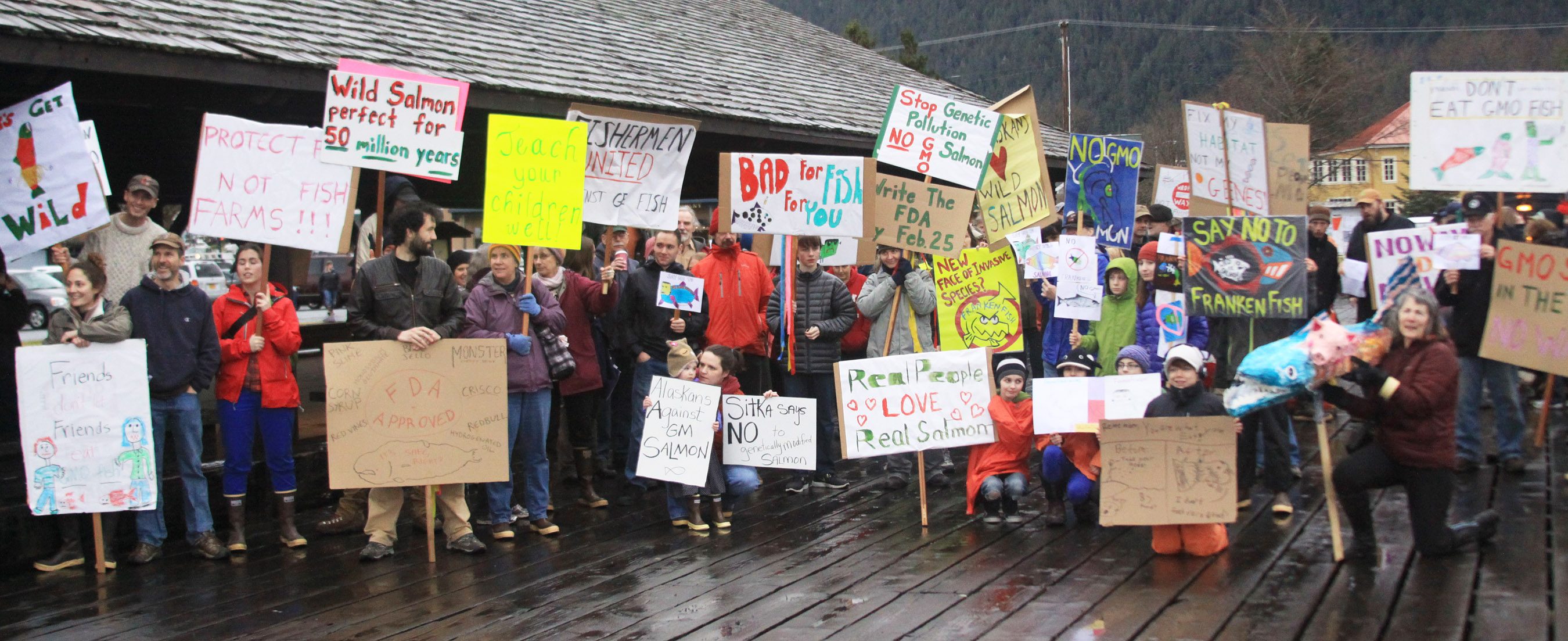
Between 100 and 150 Sitka residents braved the wind and rain on Saturday, Feb. 9, at the Crescent Harbor Shelter to protest the possible U.S. Food and Drug Administration (FDA) approval of genetically modified salmon (aka, GMO or GE salmon, or Frankenfish).

The rally (click here to listen to rally coverage from KCAW-Raven Radio) was in protest of a genetically engineered salmon from the Massachusetts company AquaBounty Technologies, called the AquAdvantage® Salmon. The GMO salmon starts with an Atlantic salmon commonly used in fish farms, but adds genes from a Pacific king (chinook) salmon to promote growth and genes from an eel-like fish called an ocean pout that grows all year round instead of seasonally. According to AquaBounty, all of the commercialized fish will be female and sterile, and the fish are designed to be raised in fresh-water pens or tanks on land instead of the usual salt-water pens where most farmed Atlantic salmon are raised. AquaBounty promotes the fish as a faster-growing farmed salmon that takes half the time to reach maturity and be sent to market. To learn more about GMO salmon, read our post from 2010.

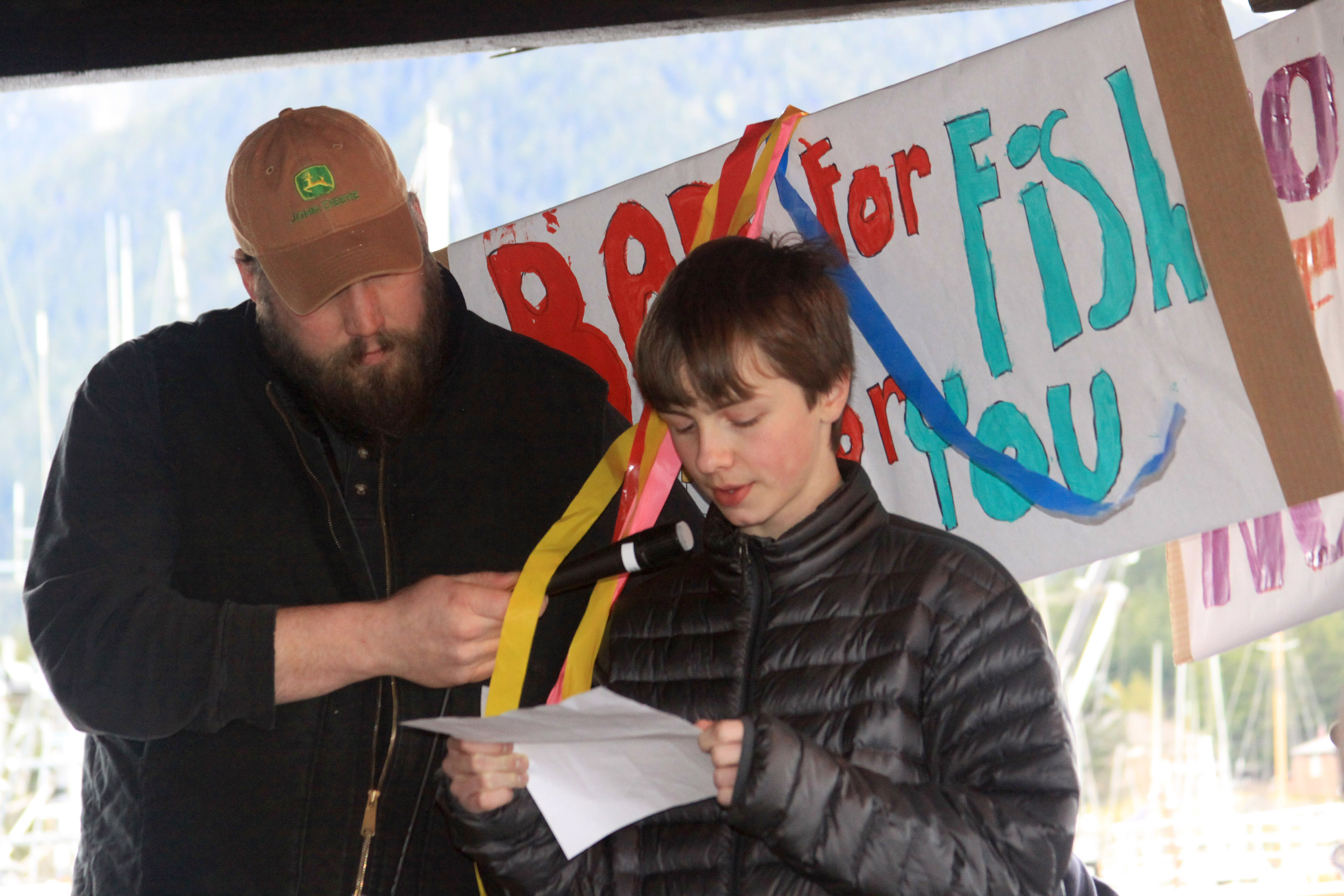
PaulRiouxSignsPaul Rioux — the Sitka resident who organized the rally with the help of local fishing groups, the Sitka Conservation Society, and others — said fishermen are concerned about what happens if these GMO salmon escape from pens. He noted that while AquaBounty said the fish will be sterile, other scientists said as many as 5 percent could be fertile, and that’s enough so that the GMO salmon as an invasive species could replace wild Pacific salmon within 40 salmon generations. DavidWilcoxSpeaksSignsDavid Wilcox, a 14-year-old Sitka resident who plans to run across the country to protest GMO foods, spoke for the other residents who said they were concerned with genetically engineered fish in general, and they worried this fish might go to market without being labeled as GMO salmon. (Click here to listen to Rioux, Wilcox and Ray Friedlander of the Sitka Conservation Society discuss why they held the rally during a Feb. 8 Morning Edition interview on KCAW-Raven Radio.)

SayNoToFrankenfishThe FDA, which has been looking at GMO salmon for more than a decade (AquaBounty started work on the fish in 1989), announced in December it planned to approve the genetically engineered fish, just in time for the holidays. At the same time, the FDA finally released environmental impact research papers it was supposed to have released in May. The FDA announcement also started a 60-day public comment period that was supposed to end on Feb. 25. On Feb. 13, the FDA extended the comment period until April 26. Sitka residents are encouraged to go to Regulations.gov and search for “GE salmon” (not “GMO”) to comment on the regulations before the April 26 deadline.

PatKehoeFrankenfishAlaska’s Congressional delegation agrees on few items, but Sen. Mark Begich, Sen. Lisa Murkowski and Rep. Don Young have been united for a couple of years in their efforts to stop Frankenfish. Sen. Begich this week introduced two bills banning GMO salmon. Last May, Sen. Murkowski introduced an amendment (that failed 50-46) requiring more study of GMO salmon by the National Oceanic and Atmospheric Agency (NOAA). In the House, Rep. Young has been one of the most vocal opponents of Frankenfish and in February he introduced a bill requiring GMO salmon be labeled. In the Alaska House of Representatives, Rep. Geran Tarr (D-Anchorage) and Rep. Scott Kawasaki (D-Fairbanks) introduced an anti-Frankenfish bill that passed out of the House Fisheries Committee this week.

This slideshow requires JavaScript.

• Lori Adams discusses ‘The End’ in her last Daily Sitka Sentinel garden column

LoriAdamsDownToEarthUPickGarden(Lori Adams, who owns Down-To-Earth U-Pick Garden and is a frequent vendor at the Sitka Farmers Market, will be wrote a regular garden column in the Daily Sitka Sentinel this summer and fall. The Sentinel is allowing us to reprint the columns on this site after they first appear in the newspaper. This column appeared on Page 4 of the Wednesday, Dec. 5, 2012, edition of the Daily Sitka Sentinel.)

GARDENING IN SITKA

By Lori Adams

THE END

The ground is frozen now, but at times throughout the winter and spring things will thaw out. So there is still time to tinker in the garden before planting time.  Once it thaws you can gather and apply seaweed, pull weeds, remove rocks and salmonberry bushes, sterilize your greenhouse or sun room, etc. It can be hard to make yourself get out there, but once you do it’s not so bad.

Those delightful seed catalogs should start showing up in the mail pretty soon, so now is a good time to plan for next year. Try to connect with a gardening friend some time before spring arrives and have them help you come up with a realistic plan and suggestions for reliable seed varieties to invest in. I try to get together with my gardening friends at least once a year and it is SO helpful.  Networking is important.

I think I pretty much covered the basics with the “Gardening In Sitka” column, so the time has come to put away my pen.  You now have enough information to get started growing a successful vegetable garden.

Quite a few people have suggested that I compile all of the printed columns into a book and I think it is a good idea, so I’m in the planning stages of that project right now.  My goal is to have the books ready to purchase by March 2013 in time for the annual “Let’s Grow Sitka” event. They will be edited and revised, with room for your own notes, and a yearly planner calendar will be included.

The “Let’s Grow Sitka” event, usually held on a Sunday in mid-March, is a fantastic resource for new and old gardeners.  There are informational booths, presentations and demonstrations, things to purchase and experienced gardeners are available to give you answers to any questions you might have.  It’s a MUST-ATTEND event for anyone interested in gardening in Sitka.

Another great resource you should check out is the Sitka Local Foods Network’s website at http://www.sitkalocalfoodsnetwork.org.  It has notices for upcoming gardening events and many, many links to other informative websites.

Thank you for all of the positive feedback you’ve given me on the column.  You made it so rewarding.  And to be truthful, I learned so much by doing it.  I had to research the “why” and “how” to get my tips into readable form and ended up learning more myself.

Feel free to give me a call if you have questions and be sure to come out to the Down-To-Earth U-Pick Garden next summer to get a tour.  Happy gardening and be sure to BUY LOCAL!

Brought to you by Down-To-Earth U-Pick Garden

2103 Sawmill Creek Road

Open June-August / Monday to Saturday, 11 a.m. to 6 p.m.

747-6108 or 738-2241

http://downtoearthupick.blogspot.com/

• Lori Adams says a word about growing beans in her latest Daily Sitka Sentinel garden column

LoriAdamsDownToEarthUPickGarden(Lori Adams, who owns Down-To-Earth U-Pick Garden and is a frequent vendor at the Sitka Farmers Market, will be writing a regular garden column in the Daily Sitka Sentinel this summer. The Sentinel is allowing us to reprint the columns on this site after they first appear in the newspaper. This column appeared on Page 4 of the Wednesday, Nov. 28, 2012, edition of the Daily Sitka Sentinel.)

GARDENING IN SITKA

By Lori Adams

A WORD ABOUT GROWING BEANS

In general, Sitka is just not bean-growing country, but there is one bean that actually does really well here — the fava bean (also called the broad bean).  Up until a few years ago I had never even heard of fava beans, but had read that they’re grown in England so I figured they would grow here too and gave them a try.  The results were excellent.

Fava beans are from the legume family. As a rule the members of this family grow pods with seeds in them; peas, beans, alfalfa, clover and peanuts are the most commonly known legumes.  Legumes can do something that other plants can do — by working in a cooperative partnership with the Rhizobia bacteria found in the soil they can pull nitrogen right out of the air.

Nodules form on the roots in this nitrogen-fixing process and the plants store nitrogen for pod formation. When you plant beans in a garden bed for the first time there is a good chance that the proper strain of this bacteria will not be present in the soil, so it is important to “inoculate” the seeds.  Inoculant bacteria can be purchased in powder form and sprinkled onto the seeds at planting time.

Before planting fava beans prep the soil with plenty of organic material that is not too rich with nitrogen (cured compost or beach mulch) and lime (seashell sand) and prepare some type of support to put in place to keep mature plants off of the ground.  I used wire tomato cages. Fava bean plants get about five feet tall and although they are fairly sturdy they can eventually get knocked down by the wind and rain.

You can start seeds indoors mid-March and transplant them outdoors mid-April or just sow them directly outdoors mid-April. Either way it’s best to dampen the seeds and sprinkle them with inoculant before planting.  The seeds are quite large and should be planted an inch deep. Final spacing in the garden should be at least 12 inches apart.  Floating row cover is not necessary but can speed up maturity.

Fava beans bloom just like peas do with beautiful blooms similar to lupine flowers.  These flowers are self pollinating. Pods soon appear and can be picked while very small and cooked and eaten whole like snap peas. Once the pods get a little size to them they are wooly and fibrous and unpleasant to eat whole, so let them get to be full sized before harvesting them for the beans. Full-sized pods contain anywhere from 1-5 beans in them.

Cooking fava beans is rather labor intensive but worth it.  Shuck the beans and discard the pods, blanch the beans and then “pop” each inner bean out of its waxy covering.  The inner bean will fall out in two halves and can be eaten cold or hot. As with other vegetables, it is good to harvest the mature pods regularly so the plant will continue to produce more pods. Besides, the longer pods are left on the vine the tougher the beans will be.

I think any attempt to leave beans on the vine in hopes of harvesting them as shelling beans is futile as they will probably just mold.  I have read that the tips of the plants themselves are also edible as a leafy green but I have never tried them. A word of warning: some people of Mediterranean descent are allergic to fava beans.

I used to grow Fava Beans in the u-pick garden but very few of my customers were familiar with them so I had trouble selling them.  Rather than taking up valuable garden space growing something my customers don’t want I decided to concentrate on growing vegetables that they do want.

It is possible to grow green beans here but very, very difficult.  The plants simply do not like to get wet and slugs just love, love, love them. If grown outside they MUST be protected from the rain, but if enclosed with a covering they are very likely to rot, so any cover needs to have the sides open for ventilation.  I have had very little success growing green beans, but they are so delicious fresh from the vine that I just keep beating my head against the wall trying.

Brought to you by Down-To-Earth U-Pick Garden

2103 Sawmill Creek Road

Open June-August / Monday to Saturday, 11 a.m. to 6 p.m.

747-6108 or 738-2241

http://downtoearthupick.blogspot.com/

• Lori Adams discusses everything she’s learned about growing strawberries in her latest Daily Sitka Sentinel garden column

LoriAdamsDownToEarthUPickGarden(Lori Adams, who owns Down-To-Earth U-Pick Garden and is a frequent vendor at the Sitka Farmers Market, will be writing a regular garden column in the Daily Sitka Sentinel this summer. The Sentinel is allowing us to reprint the columns on this site after they first appear in the newspaper. This column appeared on Page 9 of the Friday, Nov. 23, 2012, edition of the Daily Sitka Sentinel.)

GARDENING IN SITKA

By Lori Adams

EVERYTHING I’VE LEARNED ABOUT GROWING STRAWBERRIES

Strawberries do well here in Sitka, but they come with some challenges.  I think one of the key secrets to success is location, location, location.

Strawberries are a perennial crop that come in two basic types:

  • JUNE BEARING/SHORT-DAY cultivars that produce a heavy crop over a short period in the summer, or
  • EVER BEARING/DAY NEUTRAL cultivars that produce a smaller crop that is stretched over a longer season.

Within these two types there are many different varieties.  Most strawberries that are grown here in Sitka have been passed down generation after generation and originated from early breeding work at the USDA Sitka Experimental Station during the 1920s.  The berries from these plants are small, pale in color and not very sweet, but they make up for it by being very hearty and producing large crops. In Sitka it is very difficult to grow large, beautiful red berries with the “true strawberry” flavor.  Besides the two basic types there are also alpine and specialty varieties.

Strawberries can be grown in containers, rows or patches.  Most Sitkans have patches because of the way the plants grow and multiply, but your production will go up if you have rows and take the effort to control plant growth.  Containers can be helpful in keeping the fruit off the ground where it will rot or be eaten by slugs.

The best strawberries I have tasted here in Sitka were grown in rock walls. I believe this is because of the heat retention of the stones, the lack of slugs and soil, and the excellent drainage a rock wall provides.  The worst place to grow strawberries is in the shade, next to brushy slug-infested areas or areas with poor drainage.

Strawberry plants can be grown from seeds or “runners.”  Runners look like a stem/root that grows from the mother plant.  This runner grows about a foot long and then produces a baby strawberry plant that will take root and start to grow on its own.  To harvest runners simply cut rooting baby plants free from the mother plant and plant on their own.

The life expectancy of any one plant is about six years with only the first third years being highly productive, so the best plan is to grow a row of plants and consistently remove every single runner for two years.  On the third year allow no more than five runners to grow on each plan,t then harvest the runners mid-summer and plant them in a different bed being sure to diligently remove any runners that they themselves might produce.  At the end of the season just tear out the old bed.  Repeat.

Strawberries like soil that is full of organic material that is low in nitrogen.  If the nitrogen level is too high then you will end up with fabulous greens that will make your neighbors jealous but very few berries, and the berries you do get will not be able to ripen because of the shade of the foliage.

Berries require lots of potassium (seaweed) and only a trace of lime (seashell sand) to thrive.  The best way to apply seaweed is to mulch monthly with a thin layer around plants being sure not to cover up the growing center, or the “crown” of the plant.  To prepare a new bed just load it up with seaweed in the Spring, let it break down and then till it into the soil before planting time.

A strawberry plant has tough gnarly roots that grow from the crown.  When planting, it is critical that the crown is right at ground level — if it is buried it will definitely rot and die and if it is planted too high it will dry out and die.  Dig a shallow hole with a cone of soil in the middle, set the crown on top of the cone, spread the roots out like a spider in the hole and then cover with dirt.  Firm the soil around the plant being sure to position the crown properly.

Floating row cover can be helpful but it is critical that you remove it when the plants start to flower.  In order for pollination to occur the blooms must be accessible to bees and other natural pollinators.

Once strawberries start to ripen it is important to pick them almost every day because they are very perishable and easily susceptible to rot and slugs.  Try to leave their “caps” on, lay them in a shallow container rather than stacking them in a deep bowl, and do not wash them until right before it’s time to eat them.

In the fall you can mulch the bed heavily with seaweed being sure not to bury the plants themselves and then spread straw over the entire bed, plants and all, to protect them from frost heaves.

On a final note, there doesn’t seem to be anyone growing a large enough volume of strawberries to sell them.  If you have some extra garden space or an empty greenhouse, please consider growing strawberries and selling them at the Sitka Farmers Market. We’d all love you for it.

Brought to you by Down-To-Earth U-Pick Garden

2103 Sawmill Creek Road

Open June-August / Monday to Saturday, 11 a.m. to 6 p.m.

747-6108 or 738-2241

http://downtoearthupick.blogspot.com/