• Greater Sitka Arts Council seeks entries for Sitka “state” Fair on Aug. 11

2013 Sitka State Fair flierHave you always wanted to participate in one of the official Alaska State Fairs, but didn’t have the money or time to get to Haines, Palmer or Fairbanks? The Greater Sitka Arts Council is seeking entries, including food entries, for the second annual Sitka “state” Fair, which takes place on Sunday, Aug. 11, at Harrigan Centennial Hall.

“The thinking was there are a lot of people in Sitka with a wide variety of interests and talents and a state fair would give them an opportunity to share them, show them off, and have some good old-fashioned, state-fair-type competition,” said Jeff Budd of the Greater Sitka Arts Council. “We also did it because it seemed like a lot of fun and meets our  stated Vision: Art is vital to a healthy vibrant community, and Mission: To increase awareness of the value of arts in Sitka through education, advocacy and programming. Also, as we were the first capital of Alaska that we deserved a state fair as much as Palmer or Haines.”

Entries will be taken for three age divisions — age 0-10, age 10-17, and age 18-older. Entry fees are $3 per item, with a maximum of nine total entries. Ribbons will be awarded for first, second and third place in each age division and category. Food contest entries should include two samples (one for the judges, one for display). Items are for display only, and no sales will be permitted.

Entries should be dropped off from 8-9 a.m. on Sunday, Aug. 11, at Harrigan Centennial Hall. They will be judged from 9 a.m. to noon, and the fair will be open to the public from noon to 5 p.m. All entries must remain on display until 5 p.m.

Categories to be judged include:

  • Cupcakes
  • Savory Pies
  • Sweet Pies
  • Savory Bread
  • Sweet Bread
  • Artisinal Bread
  • Scones
  • Muffins
  • Jams
  • Jellies
  • Canned Fruit
  • Canned Vegetables
  • Home-Grown Vegetables
  • Hobbies (Crsfts, Collections)
  • Flower Arranging
  • Spam Hors d’Oeuvres
  • Pickling
  • Chickens (Caged)
  • Bunnies (Caged)
  • Vegetable/Fruit Art
  • Canned Fish
  • Smoked Fish

In addition, there also is a “Sitka Tuf” photography contest hosted by the Harry Race Photo Department. To learn more about it, go to the Harry Race website or the Harry Race page on Facebook.

To learn more about the Sitka “state” Fair, go to the Greater Sitka Arts Council website (scroll down for details) or the group’s Facebook page. Entry forms can be downloaded below, or you can get copies at the GSAC office, Room 108 of the Yaw Building on the Sheldon Jackson Campus, or at the Harry Race Photo Department.

• 2013 Sitka State Fair entry form

• Deadline extended on Sitka Community Food Assessment to get more completed surveys

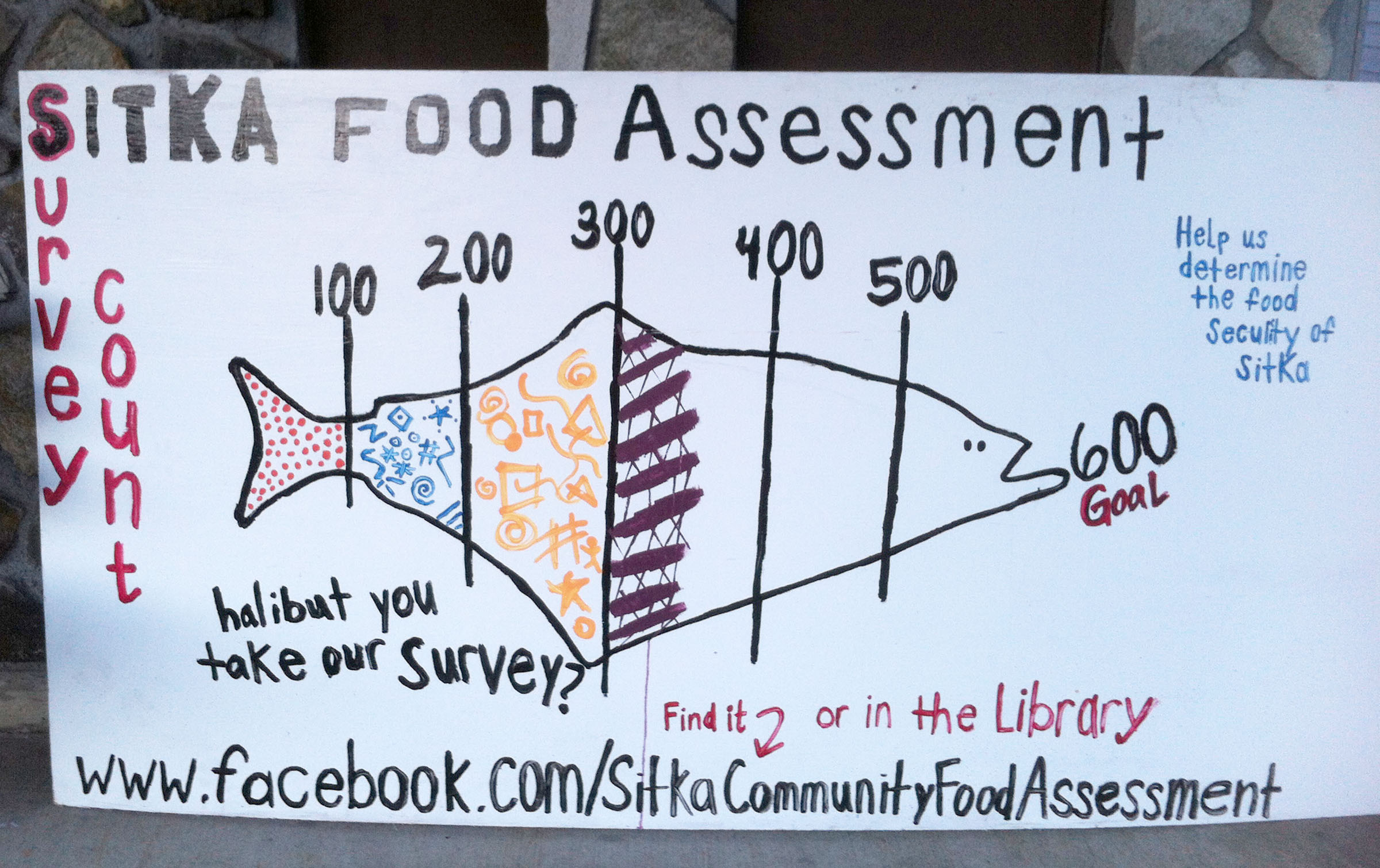
SitkaCommunityFoodAssessmentSign2

The deadline for surveys to be completed in the Sitka Community Food Assessment has been extended to the end of the month. Our goal is 600 completed surveys and as of Tuesday, May 21, we had 392 that had been recorded.

The Sitka Community Food Assessment is a 2012 Sitka Health Summit project designed to help shape food policy and improve Sitka’s food security. To learn more about the project, KCAW-Raven Radio hosted an interview with project coordinator Lisa Sadleir-Hart that aired on Monday, May 20.

Additional information can be found in this March 26 post on the Sitka Local Foods Network website, and in this April 9 article from the Daily Sitka Sentinel.

Surveys are available online at https://www.surveymonkey.com/s/MQTF22Q, or click the Sitka Community Food Assessment logo in the right column of this webpage. Printed copies are available at Kettleson Memorial Library. A sign has been posted at the corner of Lincoln and Lake streets to update people on the progress of the project.

• Sitka Community Food Assessment featured in the Tuesday, April 9, issue of the Daily Sitka Sentinel

Courtney Bobsin, a Jesuit Volunteer with the Sitka Conservation Society who is helping the Sitka Community Food Assessment collect data, has her computer logged in and ready to take the survey. (Daily Sitka Sentinel photo by James Poulson, used with permission)

Courtney Bobsin, a Jesuit Volunteer with the Sitka Conservation Society who is helping the Sitka Community Food Assessment collect data, has her computer logged in and ready to take the survey. (Daily Sitka Sentinel photo by James Poulson, used with permission)

(This article originally appeared in the Tuesday, April 9, 2013, edition of the Daily Sitka Sentinel. It is used here with permission.)

Sitkans Taking Stock of Local Food Security

By SHANNON HAUGLAND
Sentinel Staff Writer

SitkaCommunityFoodAssessmentLogoCan you afford to eat the foods you want in Sitka?

How long could you survive on the food you have in your house today?

How often do you eat foods that are gathered locally?

The Sitka Food Security Survey is trying to find the answers to these and other questions related to food security in Sitka.

The survey is one of the projects of the Sitka Community Food Assessment group that was started at the 2012 Health Summit last fall.

“Community food security is looking at how secure are we as a community if for some reason something happened in the Lower 48 and we couldn’t get barges up here,” said Lisa Sadleir-Hart, the community food assessment coordinator for the Sitka Community Food Assessment project. “Are there things we could do differently? … We’re pretty dependent on the food coming from outside.”

The group is looking at food security from both a household standpoint and a community standpoint. While some information has been collected, more is needed on a home-by-home basis, Sadleir-Hart said.

To that end, Sadleir-Hart is hoping residents go online to participate in the food security survey to document where the problems are, where the strengths are and how to start addressing the shortcomings. The assessment will make it easier to apply for grants to help the community strengthen its food security position, she said.

“Our goal is 600 completed surveys, which is about 10 percent of the adult population here,” she said. She has set a tentative deadline by the end of this month.

Among many of the issues considered, Sadleir-Hart wonders how the 44-percent increase in food prices from 2006 to 2011 is affecting choices residents are making.

“Given these increases, fuel prices, housing prices, housing costs, at some point you have to make a decision: if you pay for one you might not be able to pay for something else,” she said. “People are hurting when it comes to food.”

The survey asks whether residents are able to eat as much as they need, and eat the foods they want to eat, or if they make sacrifices or eat less in order to feed others, when they are financially strapped.

Some of the focus in the survey is whether residents take advantage of foods that are available locally, including fish, deer, mushrooms, seaweed and berries, among the dozens of possibilities. Some questions are aimed at traditional and customary foods.

From a community standpoint, some data already indicates a level of “insecurity,” since 95 percent of the food Sitkans consume is shipped in from the Lower 48.

“Does our community have the capacity to feed itself if a natural disaster left us isolated?” is one of the survey’s underlying questions.

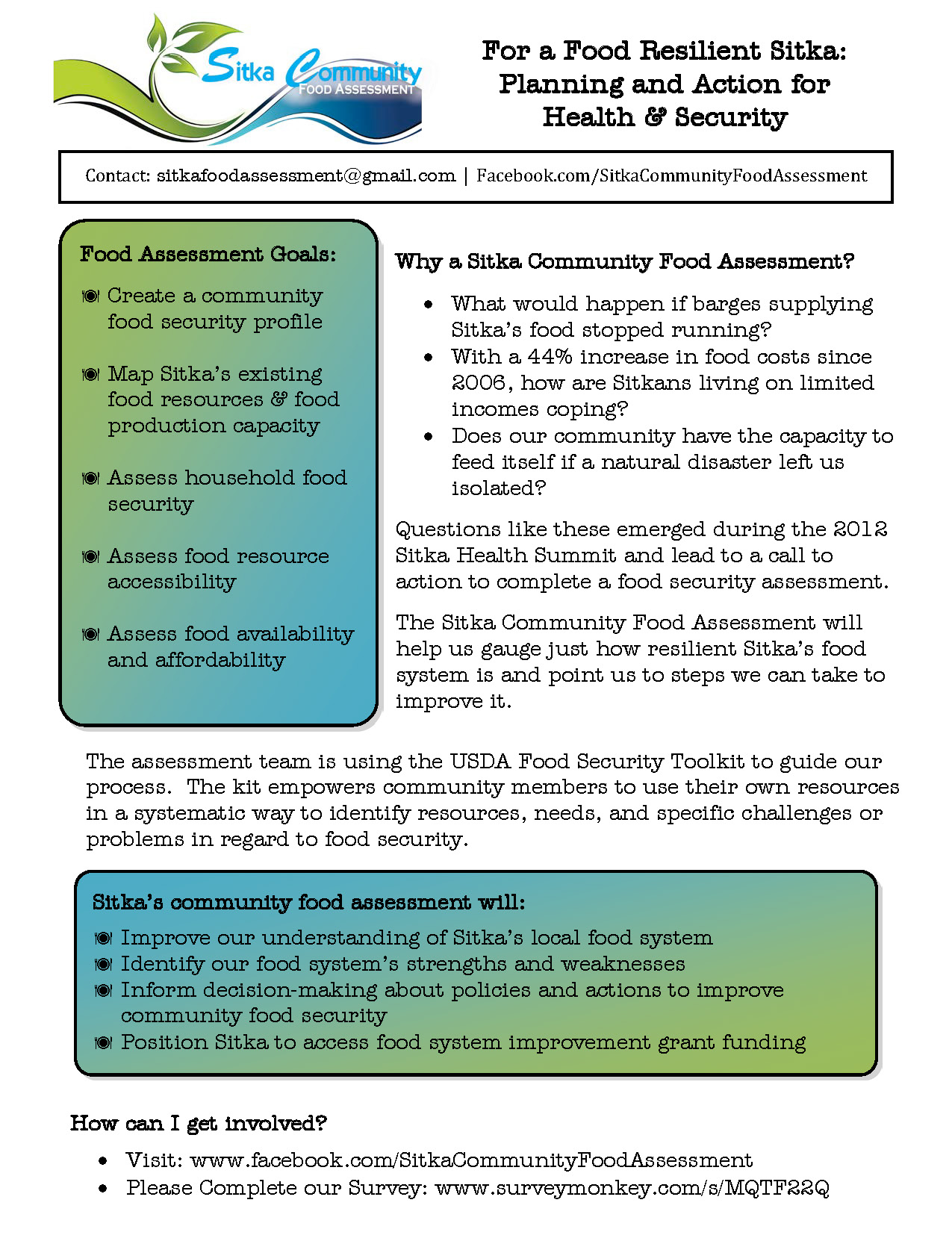
The assessment project’s goals are to create a community food security profile; map Sitka’s existing food resources and production capacity; and assess household food security, food accessibility, and food availability and affordability.

The work group for the project said community food security is a relatively new concept that covers a variety of disciplines, including community nutrition, nutrition education, public health, sustainable agriculture, and anti-hunger and community development.

“As such, no universally accepted definition exists,” the group said in a handout.

Sadleir-Hart said community food security can be seen as an expansion of the concept of household food security.

“Whereas household food security is concerned with the ability to acquire food at the household level, community food security focuses on the underlying social, economic and institutional factors within a community that affect the quantity and quality of food available …” the handout said.

Affordability is another issue that can affect community food security, Sadleir-Hart said.

The Sitka Community Food Assessment group from the Sitka Health Summit started by collecting data already available locally. Sitka Conservation Society contributed the Jesuit Volunteer, Courtney Bobsin, to work part-time to collect data on local producers, senior and tribal food programs, food banks and other food assistance programs.

“She’s been collecting lots of great information,” Sadleir-Hart said.

The assessment team is using the Food Security Toolkit from the U.S. Department of Agriculture to guide the process. Sadleir-Hart said the local effort received a head-start on the assessment by looking at Kenai’s food security survey designed by the University of Alaska Fairbanks Cooperative Extension Service. The Sitka Local Foods Network, which runs the Sitka Farmers Market, is also involved in the project.

The Sitka Community Food Assessment project received a $15,000 SEARHC Community Transformation Grant to fund Sadleir-Hart’s part-time position, and data analysis.

The goals of the assessment are to improve Sitka’s understanding of the local food system, identify the system’s strengths and weaknesses, inform decisions about policies and ways to improve Sitka’s security, and position Sitka to access grant funding for food system improvement.

Years ago, Sadleir-Hart said, more people in Sitka had vegetable gardens and some kept milk cows and other farm animals. The potential for increasing the amount of locally produced food still exists, and with it the prospect for economic development.

“There are a lot of different angles we could explore, from a community perspective,” she said.

Focus groups are also being called to continue to collect information about food and the community.

The Sitka Community Food Assessment group is looking ahead to the first annual Sitka Food Summit in November, when citizens review the findings of the data collection and start talking about ways to improve the current food system.

The survey can be reached by typing Sitka Community Food Assessment on Facebook, and going to the “Survey Monkey” link. The survey is filled out anonymously. The direct link to the survey is: https://www.surveymonkey.com/s/MQTF22Q.

• Sitka Tribe of Alaska submits editorial on protecting Pacific herring as a keystone forage fish

HerringBranches

(The following editorial about protecting forage fish, such as Pacific herring, was submitted to local media on April 11 by Sitka Tribe of Alaska tribal chairman Michael Baines.)

State of Alaska Denies Herring Forage Fish Status

2006 Herring collection 007Currently Pacific herring are acknowledged as a keystone forage fish species that is responsible for maintaining the health of the marine ecosystem in the waters of California, Oregon, Washington and British Columbia (BC).  As you cross the maritime boundary between BC and Alaska herring lose their forage fish status and become just another commercially harvested finfish.  At a recent Board of Fish meeting in Anchorage, the Board heard testimony from fishery managers, the herring industry and the public on a proposal that would have acknowledged herring as a forage fish by adding them to the State’s Forage Fish Management Plan (FFMP).

The FFMP became effective in 1999 and was intended to prevent the development of new fisheries on forage fish while allowing existing commercial forage fisheries to continue.  The Plan states that forage fish perform a critical role in the marine ecosystem by transferring energy from primary (zooplankton) and secondary (phytoplankton) producers to upper trophic level shellfish, finfish, marine mammals and sea birds.  The Plan also recognizes that, “abundant populations of forage fish are necessary to sustain healthy populations of commercially important species of salmon, groundfish, halibut, and shellfish.” 

The Alaska Department of Fish and Game commented that adding herring the FFMP would not affect the way it currently manages herring fisheries in the State. When asked by the Board if herring met the definition and fulfilled the role of a forage fish as described in the Plan, the ADF&G Southeast Regional Commercial Fisheries Coordinator responded that he felt they did.

Supporters of the plan stressed that herring are an ecological keystone species that are recognized around the world as a forage fish.  The Federal government holds herring to a higher standard that other forage fish by having no directed fisheries on herring in federal waters and by listing them as a prohibited species that is not allowed to be retained as by-catch.

Herring industry representatives testified that they felt herring stocks are healthy, well managed and did not need to be acknowledged as a forage fish.  Concerns were also expressed that listing herring as a forage fish would lead to changes in the way herring are managed.  This would have required the State to look at herring in a different light.  It may have paved the way for more conservative forage fish friendly management plans to be brought forth through the Board of Fisheries process in the future.

Unfortunately for Alaskans, this proposal was voted down on a 4-3 vote.  Three of the opposing Board members are commercial fishermen or have ties to the commercial fishing industry.  These Board members reiterated comments made by the industry that herring stocks are healthy, well managed and did not need to be listed in the plan.

The arguments put forth by the industry representatives and members of the Board in opposition to the proposal were not germane to the issue of adding herring to the FFMP.  The health of a population has nothing to do with its definition as a forage fish.  If this were the case the Lynn Canal and Prince William Sound herring stocks would be considered forage fish while the apparently healthy Togiak stock would not have the same status.  Likewise, if acknowledging herring as a forage fish by adding them to the FFMP eventually changes the way stocks are managed, it should tell us something about their current management.

The acknowledgement of herring as a forage fish would have allowed managers to look at herring in a different light and might have paved the way for more conservative forage fish friendly management plans to be brought forth through the Board of Fisheries process in the future.  Refusal by the State of Alaska to acknowledge herring as a forage fish sends a message to the world about Alaska’s biased Board of Fish process and the State’s priorities when it comes to managing its marine resources.  Alaska boasts having the best managed fisheries in the world, but that reputation is now tarnished.  It’s a sad day for Alaskans when greed and political influence win out over the common good of all who live in this great State.

If you feel the Board of Fisheries erred in their decision to deny herring forage fish status, you are encouraged to contact Alaska Governor Sean Parnell and the Board of Fisheries and request that the State reconsider adding herring to the State’s FFMP.  This is an Alaskan resource that needs to be managed for the benefit of all Alaskans.

(Sent to)

Governor Sean Parnell, P.O. Box 110001, Juneau, AK 99811-0001, Phone (907) 465-3500, governor@alaska.gov

and

Alaska Department of Fish and Game, Board of Fisheries, P.O. Box 115526, 1255 W. 8th Street, Juneau, AK 99811-5526


• Sitka Community Food Assessment project launches community survey to look at food security and resiliency in Sitka

SitkaCommunityFoodAssessmentLogo

OnepagerFinalThe Sitka Community Food Assessment work group is encouraging Sitkans to complete a 36-question survey that explores questions about local, wild food, seafood, game and plants (i.e., how do you fish, hunt, gather and/or grow). It also explores issues of food security, as well as where folks shop and how much food they store.

The data collected will augment data coming from our secondary data collection efforts, which focuses on sport and subsistence harvest data for fish and game,  as well as data on food assistance programs, food producers and food costs. It also will include focus group data that we will be gathering over the next 4-6 weeks.

FoodAssessmentDefsCollectively, the work group hopes to present the findings at a Sitka Food Summit that will take place in November 2013. Then the group will begin strategic planning to address our issues and improve food access for all Sitkans.

A link to the survey can be found on the Sitka Community Food Assessment page on Facebook (https://www.facebook.com/SitkaCommunityFoodAssessment), or by going directly to the survey at https://www.surveymonkey.com/s/MQTF22Q.

Paper copies of the survey are available at the Kettleson Memorial Library.  The survey is open through the end of April.  For more information, email sitkafoodassessment@gmail.com. This is one of three community wellness projects voted on for this year by Sitka residents attending the 2012 Sitka Health Summit.

• Sitka Community Food Assessment one-page fact sheet

• Sitka Community Food Assessment food security definitions

• Sitka Conservation Society to host annual wild foods potluck on Nov. 29

The Sitka Conservation Society will host its annual wild foods potluck from 5-7:30 p.m. on Thursday, Nov. 29, at Harrigan Centennial Hall. Doors open at 5 p.m. so people can bring in their dishes, and food will be served at 5:30 p.m.
This free, family friendly, alcohol-free event allows Sitka residents to share their favorite locally foraged or harvested dishes with their neighbors. Residents bring in dishes featuring fish, wild game, seaweed, berries and other tasty treats highlighting wild food from around Sitka. Everybody is encouraed to bring in your favorite dishes featuring wild food, and if you can’t bring in a dish with wild food you can use wild plants to garnish dishes made from store-bought food.

The theme of this year’s wild foods potluck is “Restoration in the Sitka Community Use Area.” There will be live music, prizes awarded to the best wild food dishes (with categories such as “most wild”), and all kinds of other fun, stories and community.

For more information, go to http://www.sitkawild.org/events/ for a full schedule and list of contest categories. You also can call Ray Friedlander with the Sitka Conservation Society at 747-7509.

• Help wanted: Sitka Community Food Assessment seeks project coordinator

The Sitka Community Food Assessment project is looking to hire a quarter-time project coordinator to oversee the collection of and analysis of data about Sitka’s food supply and demand.

The Sitka Community Food Assessment project is one of this year’s three Sitka Health Summit community wellness projects, which were decided by local residents back in October. The project already has applied for and received a sub-award grant from the SEARHC Community Transformation Grant program to help facilitate the gathering of data about where Sitkans get their food and how much they need.

The project coordinator will work about 10 hours a week at $23 an hour for one year. Depending on other funding and job requirements, there is a possibility the job may expand from quarter-time to half-time.

This new and exciting position will create and support the Community Food Assessment for a Food Resilient Sitka. In order to understand Sitka’s food security, we need to first conduct an assessment. The assessment will be used to develop a Strategic Action Plan to ensure the resiliency of Sitka’s food future. The successful candidate will report to the Sitka Community Food Assessment committee co-chairs.

A copy of the job description is linked below. To apply, please submit a resumé and cover letter. Applications are due by Friday, Nov. 30, and the job starts on Jan. 7. To learn more or to submit your application, please contact Kerry MacLane at maclanekerry@yahoo.com or Andrianna Natsoulas at anatsoulas@thealaskatrust.org.

• Sitka Community Food Assessment project coodinator job description

• UAS-Sitka Campus to host annual class on how to identify Southeast Alaska mushrooms

The University of Alaska Southeast-Sitka Campus Office of Continuing Education will host Kitty LaBounty as she teaches the class “Southeast Mushrooms: How to Identify Them.”

This three-day class takes place from 7-8:30 p.m. on Thursday, Sept. 13, and from 10 a.m. to 2 p.m. on two Saturdays, Sept. 15 and Sept. 22, at the UAS-Sitka Campus (with field trips). The course fee is $49 and students should dress for the outdoors, bring waxed paper and a bucket for gathering.

This course is designed to introduce students to the mushroom flora of Southeast Alaska. The focus will be on the use of taxonomic keys for identification of fungi and recognition of both edible and poisonous mushrooms. Cooking and preservation of mushrooms will be discussed. Field trips are followed by in-class identification of collected mushrooms.

There is a maximum of 18 students allowed in this class. For more information, contact the UAS-Sitka Campus Office of Continuing Education at 747-7762. To register, call 1-800-478-6653, Ext. 7762, or go to https://aceweb.uas.alaska.edu/wconnect/ace/home.htm. Click the link below to download the course brochure as a PDF file.

• Southeast Mushrooms: How to Identify Them class brochure for 2012

• Celebrity food adventurer Andrew Zimmern stops by the Sitka Farmers Market

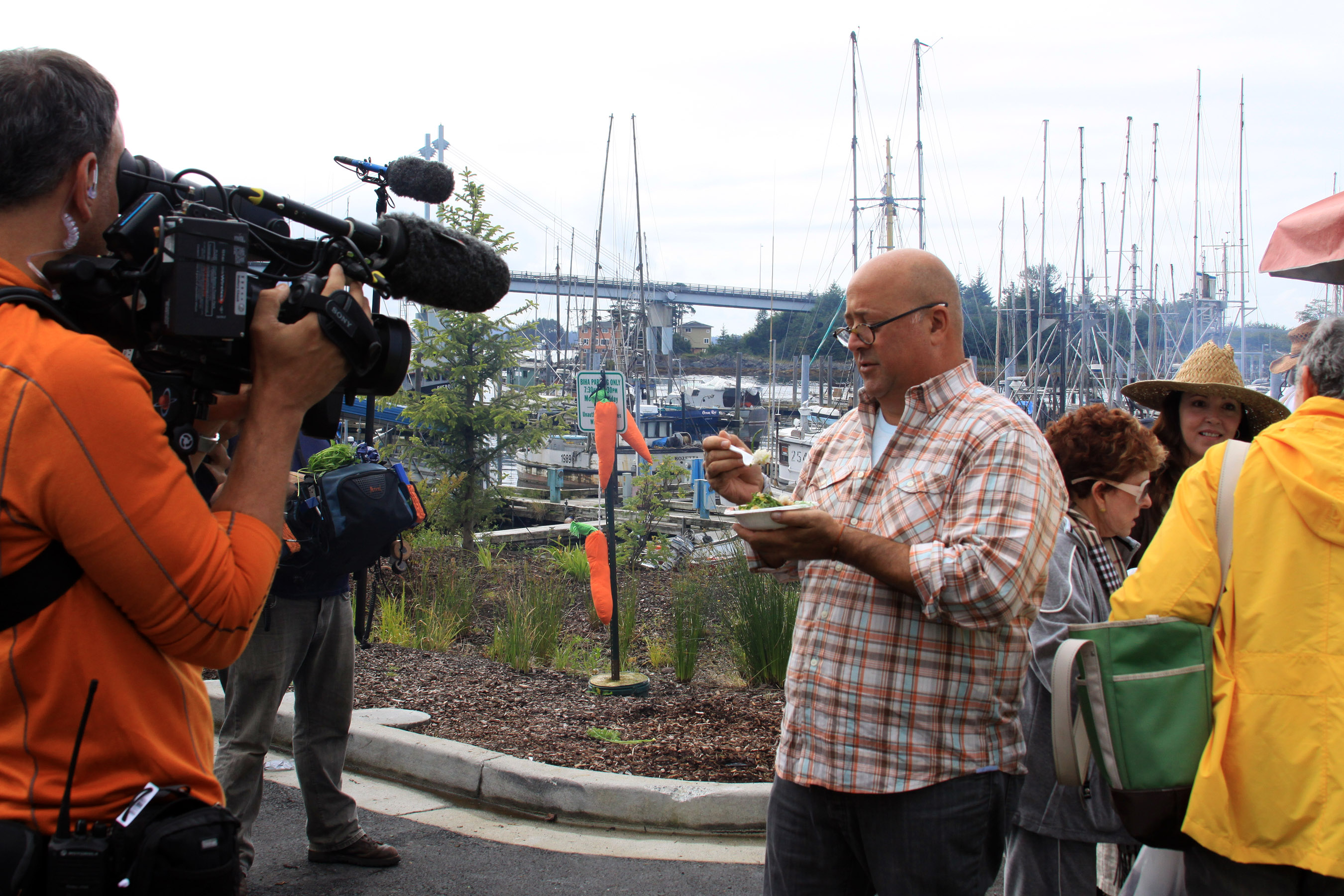
TV personality Andrew Zimmern is filmed as he samples some blackcod tips during the Aug. 18, 2012, Sitka Farmers Market.

TV personality Andrew Zimmern is filmed as he samples some blackcod tips during the Aug. 18, 2012, Sitka Farmers Market.

Celebrity food adventurer Andrew Zimmern was in Sitka this weekend, and he stopped by the Aug. 18 Sitka Farmers Market to film interviews for his three Travel Channel television showsBizarre Foods With Andrew Zimmern, Andrew Zimmern’s Bizarre World and his new show, Bizarre Foods America.

Andrew Zimmern tries a salmon crepe from Keri Fish.

Andrew Zimmern tries a salmon crepe from Keri Fish.

Zimmern is a noted TV personality, chef, food writer and teacher, but he’s most known for traveling the world sampling bizarre foods that most Americans have either neither heard of or had the guts to try (or both). None of the food he sampled at the Sitka Farmers Market on Saturday falls under the category of bizarre (unless you’re not used to eating a little beach asparagus on your blackcod tips or kelp pickles on your salmon crepes). But he’ll sample stinkfish and other Tlingít delicacies this week when he heads to Kake. Andrew’s website is subtitled “Experiencing Food, Sharing Culture.”

While he was at the Sitka Farmers Market, he interviewed Sitka Local Foods Network president Kerry MacLane and sampled some of Kerry’s blackcod tips. He also sampled a salmon crepe with kelp pickles from Keri Fish’s booth, he checked out some of the jams and jellies from Renée Pierce’s Simple Pleasures booth and bought fry bread from Grace Larson. On Monday, he Tweeted about and posted an Instragram photo of his bagel from the Highliner Coffee shop.

It’s unknown when Zimmern’s Alaska show(s) will air, but his Bizarre Foods With Andrew Zimmern show airs on Monday nights on the Travel Channel.

• Pauline Duncan wins Table of the Day at third Sitka Farmers Market of 2012

TABLE OF THE DAY: Sitka Local Foods Network volunteer Mandy Griffith, far left, volunteer Jonathan Ocampo, second from right, and Sitka Local Foods Network board member Maybelle Filler, right, present the Table of the Day Award to Pauline Duncan for the third Sitka Farmers Market of the season, on Aug. 4, 2012, at ANB Hall. Pauline sold packaged seaweed and her Tlingít recipe cookbooks at the market. The Sitka Local Foods Network board selects a Table of the Day winner from the vendors at each Sitka Farmers Market of the season, and the winners receive prizes such as a fifth-anniversary market tote bag and check.

The next Sitka Farmers Market is scheduled for 10 a.m. to 2 p.m. on Saturday, Aug. 18, at ANB Hall. The Sitka Local Foods Network is seeking volunteers to help set up tables and tents before the market starts, and to tear down and pack up the market after it ends. We need volunteers for all of the remaining markets (Aug. 18, Sept. 1 and 15). If you have a strong back and helping hands, please contact Johanna Willingham at 738-8336 for more details. For more information about the Sitka Local Foods Network and the Sitka Farmers Market, go to http://www.sitkalocalfoodsnetwork.org/