The Sitka Local Foods Network reminds you that it’s time to get out in the garden and plant your potatoes.
Potatoes are some of the most productive and easy-to-grow vegetables in Sitka. Michelle Putz will present a free, hands-on potato-planting workshop at 10 a.m. on Sunday, April 12, at 131 Shelikof Way. Parking space is limited, so please consider walking, riding your bike or carpooling. More information is available by calling Michelle at 747-2708.
Also, the next meeting of the Sitka Local Foods Network education committee is from 6:30-8 p.m. on Wednesday, April 1, at the Sitka Unitarian Universalist Fellowship Hall, 408 Marine Street (parking off Spruce Street). We will be brainstorming ideas for upcoming classes, and we welcome local gardeners who want to teach classes to join our list of educators. Just give us a topic, best date and time, and we can help you find a venue.
For more information about Sitka Local Foods Network education classes, contact Jennifer Carter at 747-0520 or 1-850-491-2666 (cell), or Michelle Putz at 747-2708. This is one of the many free classes being offered this year by the Sitka Local Foods Network education committee. Click here to get a full list of our upcoming spring classes.
The Sitka Local Foods Network just sent out the April 2015 edition of its newly launched monthly newsletter. Feel free to click this link to get a copy.
This edition of the newsletter has brief stories about how to build a simple raised garden bed, the Plant a Row for the Hungry program, our open manager and assistant manager positions for the Sitka Farmers Market, some upcoming garden mentor program and other free garden classes, and the 2015 Pick.Click.Give. fundraising campaign. Each story has links to our website for more information.
You can sign up for future editions of our newsletter by clicking on the registration form image in the right column of our website and filling in the information. If you received a copy but didn’t want one, there is a link at the bottom of the newsletter so you can unsubscribe. Our intention is to get the word out about upcoming events and not to spam people. We will not share our email list with others to protect your privacy.
The first two classes for the 2015 Sitka Local Foods Network garden mentor program have been set for each of our four participating first-year families, and the classes will be open to the public. The classes will be similar at each location, except one where we will be planting a container garden instead of our usual raised garden beds.
For three of the four families, the first class will focus on site selection, garden preparation, building planter beds, simple vegetables and soil preparation. The second class will be about simple vegetables and planting. For our first-year gardener families, we teach them how to grow four hardy crops for Sitka — kale, lettuce, potatoes and rhubarb. These classes are essentially the same, so feel free to attend the Class 1 and Class 2 that best fits your schedule.
The class schedule and location for these three families is:
A.J. Bastian, 207 Brady St. — CLASS 1: 5:30 p.m. on Tuesday, April 7; CLASS 2: 5:30 p.m. on Thursday, April 30.
Rebecca Kubacki, 1202 Halibut Point Rd. — CLASS 1: 9 a.m. on Saturday, April 11; CLASS 2: 7 p.m. on Wednesday, May 6.
Breezy, 616 Sawmill Creek Rd. — CLASS 1: 3 p.m. on Saturday, April 11; CLASS 2: 6 p.m. on Tuesday, May 5.
Our fourth family — Josephine Dasalla, 1709 Halibut Point Rd., No. 31 (green trailer) — will feature a combined Class 1 and Class 2 at 5:30 p.m. on Wednesday, April 15. In this combined class, we will teach the family about containers, soil for containers, plant needs, and we will plant lettuce, kale, potatoes and raspberries (rhubarb is our usual fourth crop, but it is not an option at this location).
This is the second year of the garden mentor program, and our two families from last year — Anna Bradley and Tami O’Neill — are back for a second year where they will learn how to grow a few more difficult crops for Sitka, such as carrots and onions. We will announce those classes when they become available.
Michelle Putz has been contracted to coordinate the program and design lesson plans, after the Sitka Local Foods Network received a community development grant from First Bank. We also have about a half-dozen experienced Sitka gardeners who serve as mentors for the program. For more information, please contact Michelle at 747-2708.
(EDITOR’S NOTE: The following article first appeared on this site in April 2010. It is repeated because much of the information remains current and newsworthy.)
In the cold winter of 1994, Anchorage Daily News (now called the Alaska Dispatch News) garden columnist and former Garden Writers Association of America President Jeff Lowenfels was returning to his hotel after a Washington, D.C., event when he was approached by a homeless person who asked for some money to buy food. Lowenfels said Washington, D.C., had signs saying, “Don’t give money to panhandlers,” so he shook his head and kept on walking. But the man’s reply, “I really am homeless and I really am hungry. You can come with me and watch me eat,” stayed with Lowenfels for the rest of his trip.
Jeff Lowenfels
The encounter continued to bother Lowenfels, even as he was flying back to Anchorage. During the flight, Lowenfels came up with an idea when he started writing his weekly garden column (the longest continuously running garden column in the country, with no missed weeks since it started on Nov. 13, 1976). He asked his readers to plant one extra row in their gardens to grow food to donate to Bean’s Café, an Anchorage soup kitchen. The idea took off.
When Anchorage hosted the Garden Writers Association of America convention in 1995, Lowenfels took the GWAA members to Bean’s Café to learn about the Plant A Row For Bean’s Café program. The Garden Writers Association of America liked the idea, and it became the national Plant A Row For The Hungry campaign (also known as Plant A Row or PAR). In 2002, the Garden Writers Association Foundation was created as a national 501(c)(3) nonprofit to manage the Plant A Row For The Hungry program.
“I am not surprised by the growth of PAR,” Lowenfels wrote in an e-mail to the Sitka Local Foods Network. “It is now in all 50 states and across Canada and there are thousands of variations of the original program — from prison gardens for the hungry to botanical gardens donating their produce from public display gardens. This is because gardeners always share information and extra food, so the idea was a natural.”
It took five years for the program to reach its first million pounds of donated food, but the second million only took two years and the next eight years saw a million pounds of donated food (or more) each year. Since 1995, more than 14 million pounds of food have been donated. Not only that, the program is getting ready to expand overseas to Australia, England and other countries with avid gardeners.
“We have supplied something in the vicinity of enough food for 50 million meals,” Lowenfels wrote in his e-mail. “Gardeners can solve this hunger problem without the government. And we don’t need a tea party to do it! Or chemicals, I might add, as author of a book on organic gardening (Teaming With Microbes, written with Wayne Lewis)!” (Lowenfels recently released a second book, Teaming With Nutrients, which is a follow-up to his first book).
According to the U.S. Department of Agriculture, one out of every eight U.S. households experiences hunger or the risk of hunger. Many people skip meals or eat too little, sometimes going an entire day or more without food. About 33 million Americans, including 13 million children, have substandard diets or must resort to seeking emergency food because they can’t always afford to buy the food they need. In recent years the demand for hunger assistance has increased 70 percent, and research shows that hundreds of children and adults are turned away from food banks each year because of lack of resources.
While many people credit Lowenfels for creating the Plant A Row For The Hungry program, Lowenfels says the real heroes are the gardeners growing the extra food and donating it to local soup kitchens, senior programs, schools, homeless shelters and neighbors. You can hear him pass along the credit to all gardeners at the end of this 2009 interview with an Oklahoma television station (video also embedded below).
“One row. That’s all it takes. No rules other than the food goes to the hungry. You pick the drop-off spot or just give it to a needy friend or neighbor. Nothing slips between the lip and the cup, I say,” Lowenfels wrote in his e-mail.
For people wanting to Plant A Row For The Hungry in Sitka, there are several places that would love to help distribute some fresh locally grown veggies or berries to those who are less fortunate, such as the Salvation Army, Sitkans Against Family Violence (SAFV), local churches, Sitka Tribe of Alaska and other organizations. The food the Sitka Local Foods Network grows at St. Peter’s Fellowship Farm communal garden goes to the Sitka Farmers Market, school lunches and other programs.
The Sitka Local Foods Network also takes donations of local produce to sell at the Sitka Farmers Markets, and all proceeds are used to help pay for SLFN projects geared toward helping more people in Sitka grow and harvest local food. For more information, contact SLFN President Lisa Sadleir-Hart or one of the other board members at sitkalocalfoodsnetwork@gmail.com.
Palmer Extension agent Steve Brown will teach the free workshop from 1 to 5 p.m. in Palmer and by videoconference in Kenai, Homer, Nome and Fairbanks. At the request of Sitka residents, on Wednesday, March 25, Sitka was added as an additional site for the videoconference.
The 2014 farm bill authorized $30 million annually for grants to be awarded nationally through the U.S. Department of Agriculture’s Farmers Market and Local Food Promotion Program. The program awards competitive grants to develop new market opportunities for farm and ranch operations serving local and regional markets. According to USDA, farmers market grants will support farmers markets and other producer-to-consumer activities, while the local food promotion grants will support enterprises that aggregate, store, distribute and process local and regional food.
The workshop will be offered at the Matanuska Experiment Farm in Palmer, the Kenai Community Library, Kenai Peninsula College in Homer, the district Extension office in Fairbanks at 724 27th Ave. and the Northwest Campus, B West, in Nome. The Sitka location for the workshop is Room 106 of the University of Alaska Southeast Sitka Campus.
The preferred registration deadline is Friday, March 27, but since Sitka was added as a site so close to the presentation walk-in participants will be allowed at this location. For more information or to register, call the Palmer Extension office at 907-745-3360. Sitka residents should pre-register by contacting Jasmine Shaw at 747-9440 or jdshaw2@alaska.gov.
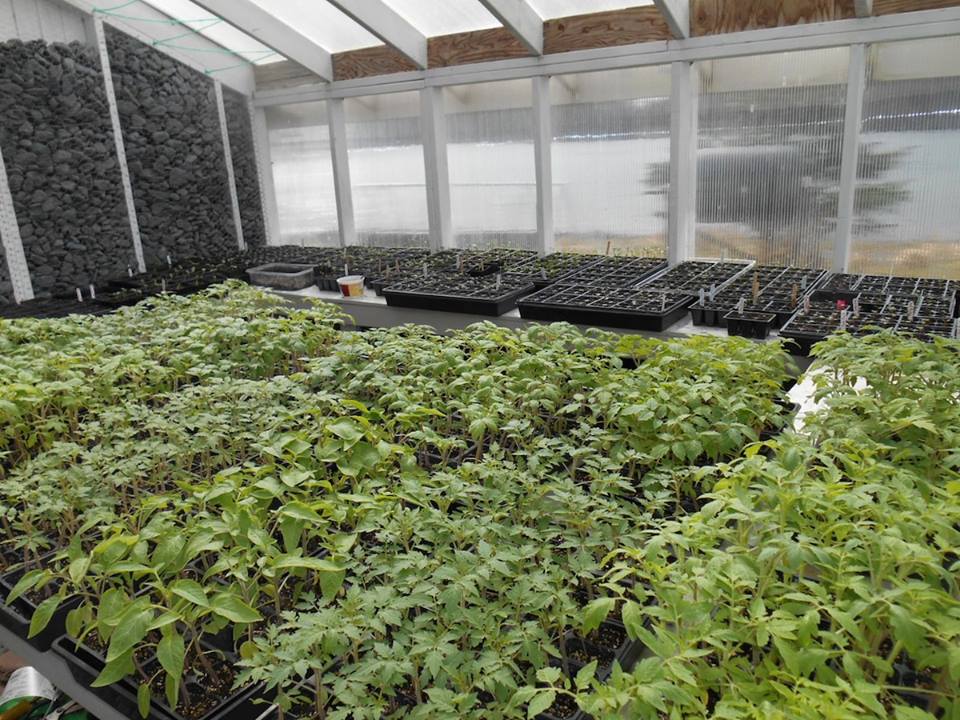
Spring 2014 plant starts in Sitka gardener Keith Nyitray’s Finn Island Farm greenhouse.
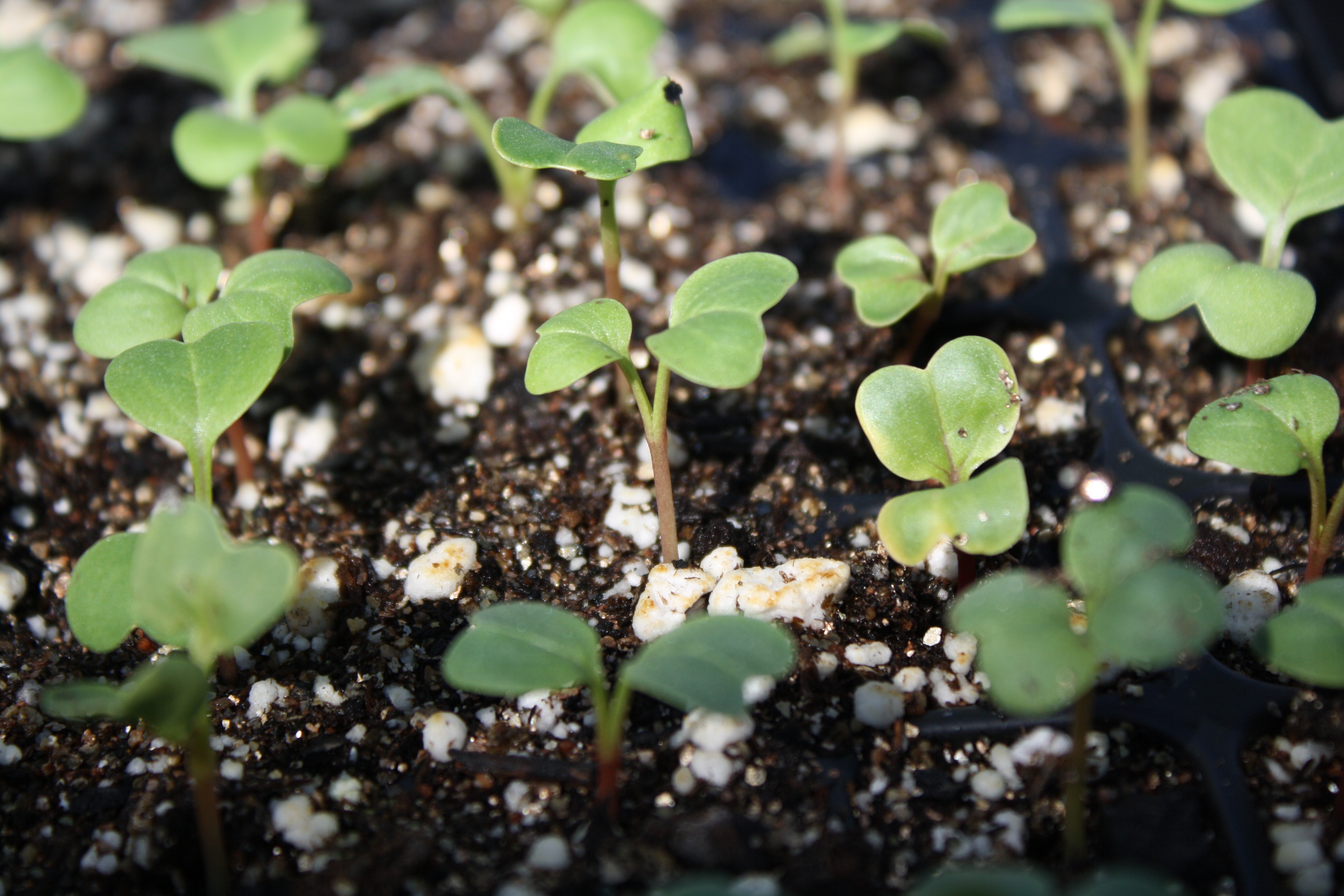
It’s the end of March, which means many people in Sitka are already planning their spring vegetable gardens. While it’s still too early to plant most crops outdoors, this is the perfect time to start some seeds indoors to you can transplant them into your garden in May.
The Sitka Local Foods Network is offering two free classes this spring about starting seeds. Both classes will be limited in size, so preregistration is required. Click here to check out the radio PSA.
The first one will be taught by Jennifer Carter, and it takes place from 6:30-8 p.m. on Tuesday, March 31, at Harrigan Centennial Hall. In this class, which is limited to 15 people, participants will learn how to mix seed-starting soil (potting soil usually is too rich for seedlings), and they will plant a few seeds to take home and grow.
The second class will be taught by longtime Sitka gardener Linda Wilson at 2 p.m. at her home. This class will be limited to 8-10 people, and you will receive the address when you call Michelle Putz or Jennifer Carter (see numbers below) to preregister.
Also, the next meeting of the Sitka Local Foods Network education committee is from 6:30-8 p.m. on Wednesday, April 1, at the Sitka Unitarian Universalist Fellowship Hall, 408 Marine Street (parking off Spruce Street). We will be brainstorming ideas for upcoming classes, and we welcome local gardeners who want to teach classes to join our list of educators. Just give us a topic, best date and time, and we can help you find a venue.
For more information about Sitka Local Foods Network education classes, contact Jennifer Carter at 747-0520 or 1-850-491-2666 (cell), or Michelle Putz at 747-2708. These are two of the many free classes being offered this year by the Sitka Local Foods Network education committee. Click here to get a full list of our upcoming spring classes.
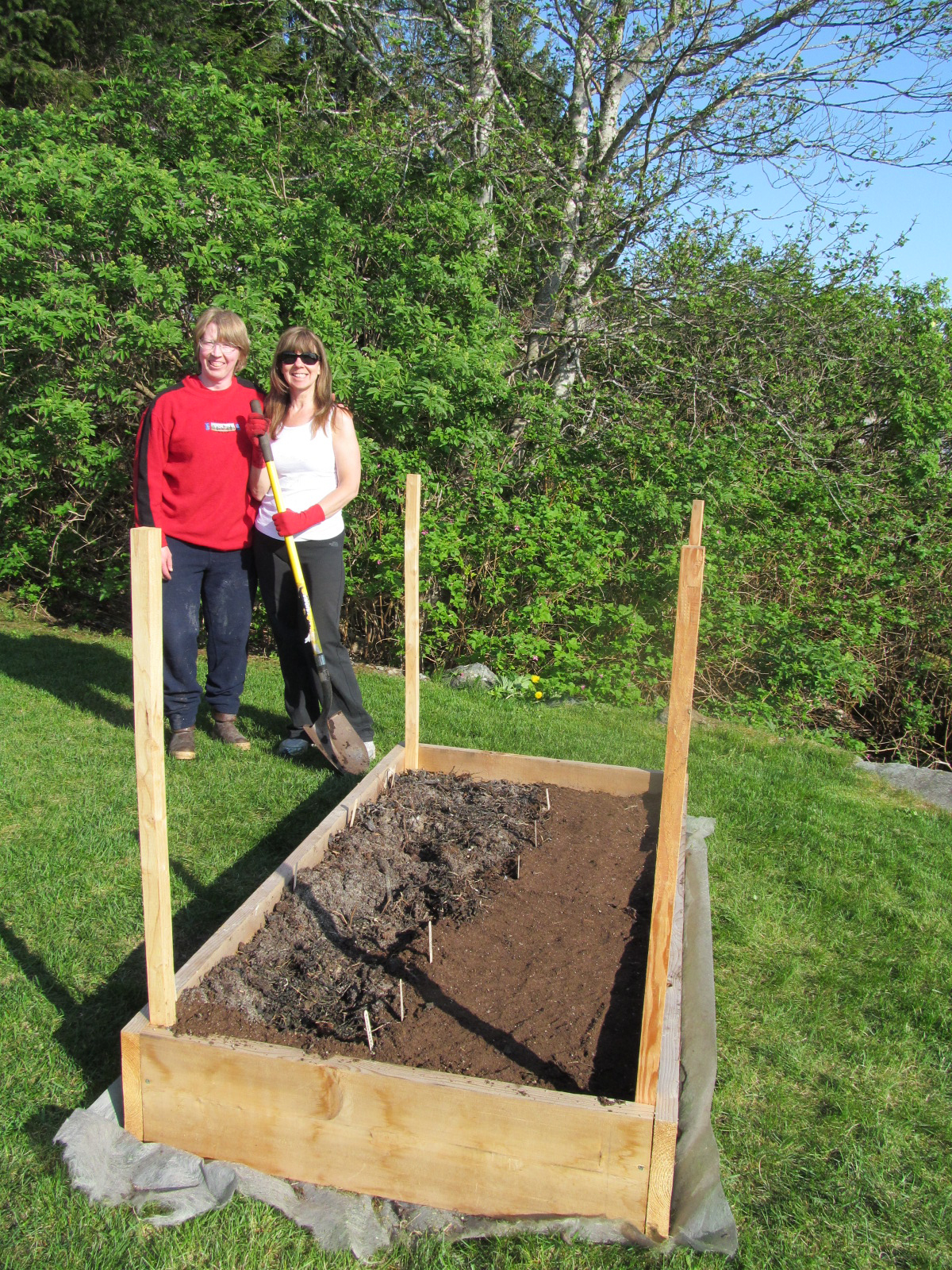
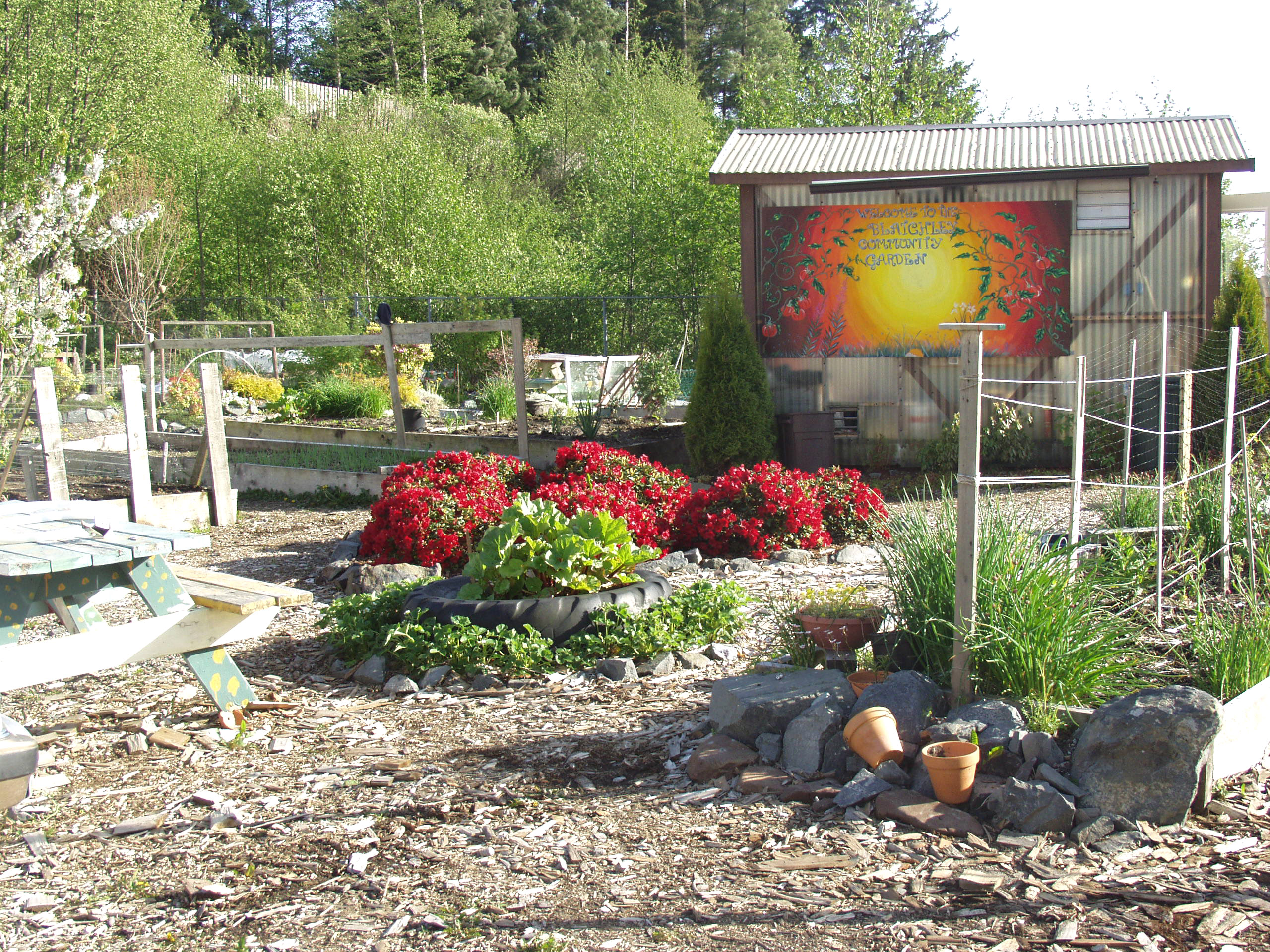
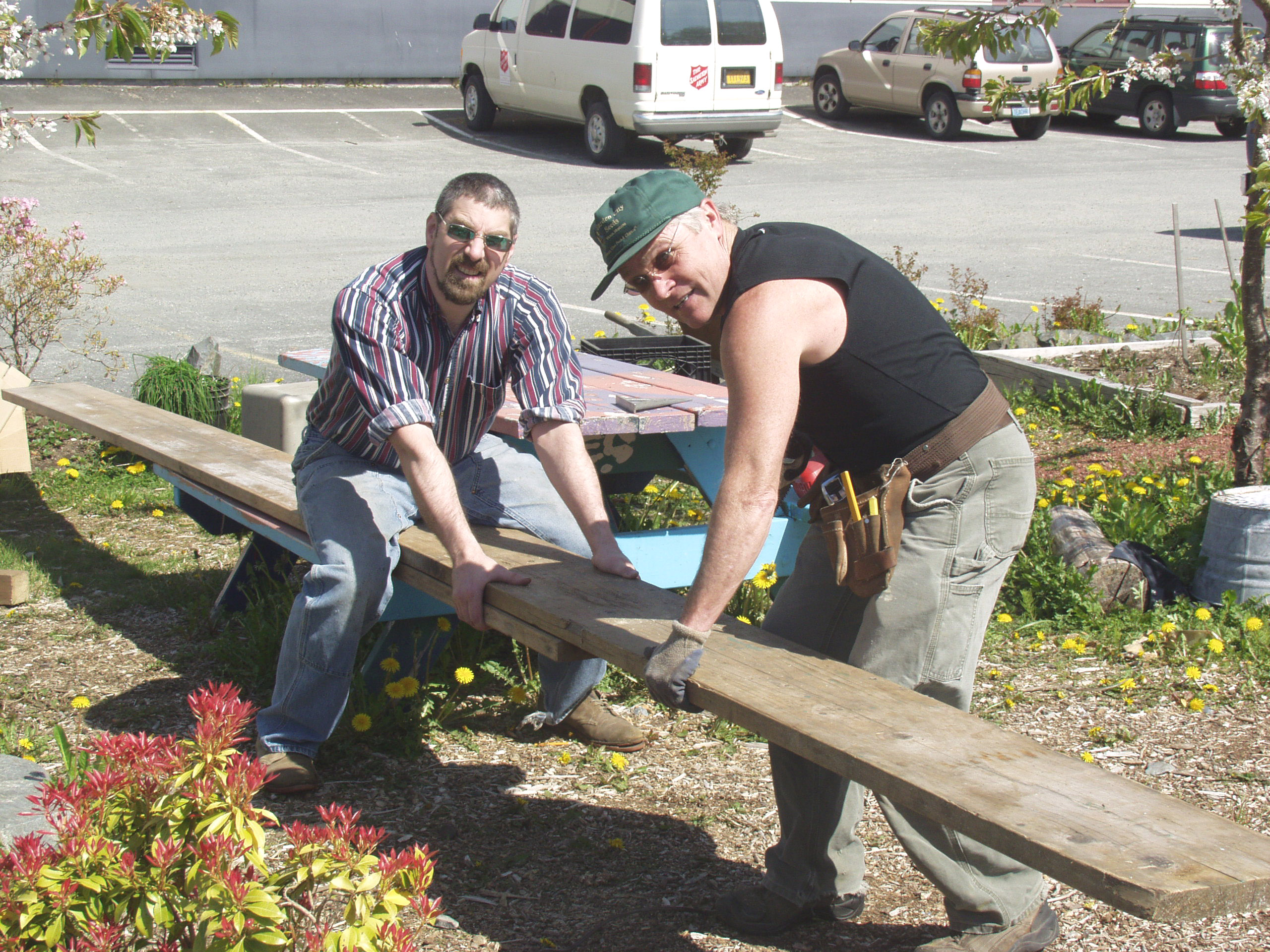
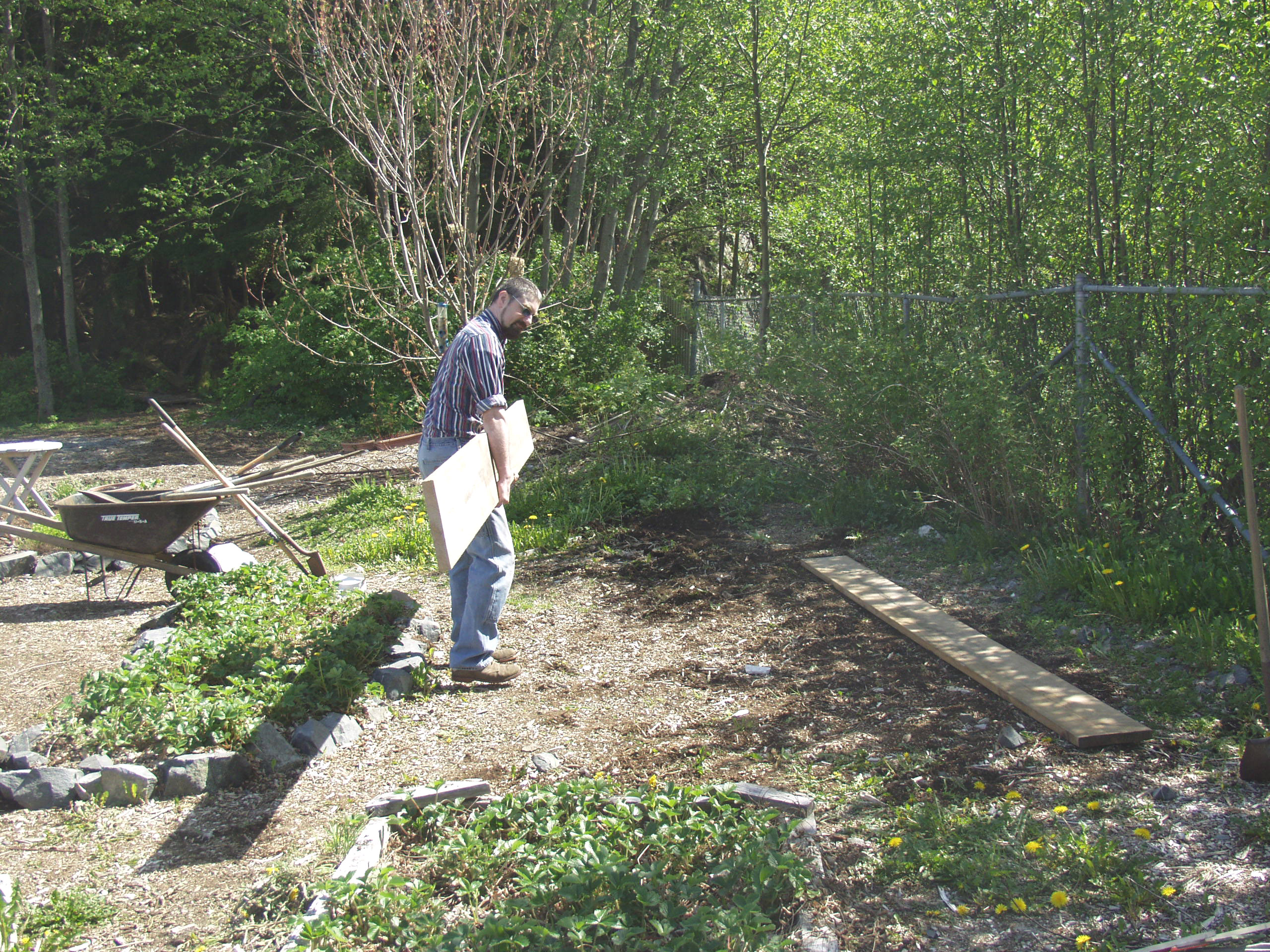
While we’re waiting for spring to finally show up in Sitka, one thing gardeners can do to prepare for planting is build a simple raised garden bed. The pictures with this post feature members of the WISEGUYS men’s health group (Rick DeGroot, Kerry MacLane, Doug Osborne and his daughter, Darby, then 4) building a garden bed in May 2008 at Blatchley Community Garden in Sitka.
First, you will need some untreated lumber (treated lumber has chemicals that can get into your food), with 2x12s being good for the frame. Your garden bed will probably be between 3-4 feet wide and 6-8 feet long, depending on your garden space and your lumber. Don’t go much wider than four feet, because you will want to be able to easily reach across the garden so you can plant and weed without falling into the bed. You can go longer than eight feet, but you might need to use more than one board to get that length. So cut your boards to your desired length and width.
Next, lay out your lumber and nail or screw your boards together to form a box. Some people prefer screws over nails, because they don’t pull loose as easily as nails. But use what you have. Some people will add corner posts that can be punched into the ground.
After you’ve built the frame, cover the ground with a bunch of old cardboard or newspapers. This will act as a barrier to help keep weeds from getting into your veggies.
Now you can start filling your frame with soil. About halfway through filling the frame, you can add a layer of seaweed, compost or other soil amendments to add nutrients to your soil. Finish by adding top soil that you mix with some of your soil amendments.
Once you have your raised garden bed built and full of soil, you can start planting (if you’re past your last-frost date, which tends to be mid-May in Sitka). Once you have your seeds planted or starts transplanted, you can water your garden bed.
In Sitka it’s always a good idea to use row-cover over your garden, especially early in the season. This not only helps keep birds and other pests out of your garden, but the white fabric creates a mini-greenhouse effect that helps warm your soil so your seeds sprout sooner.
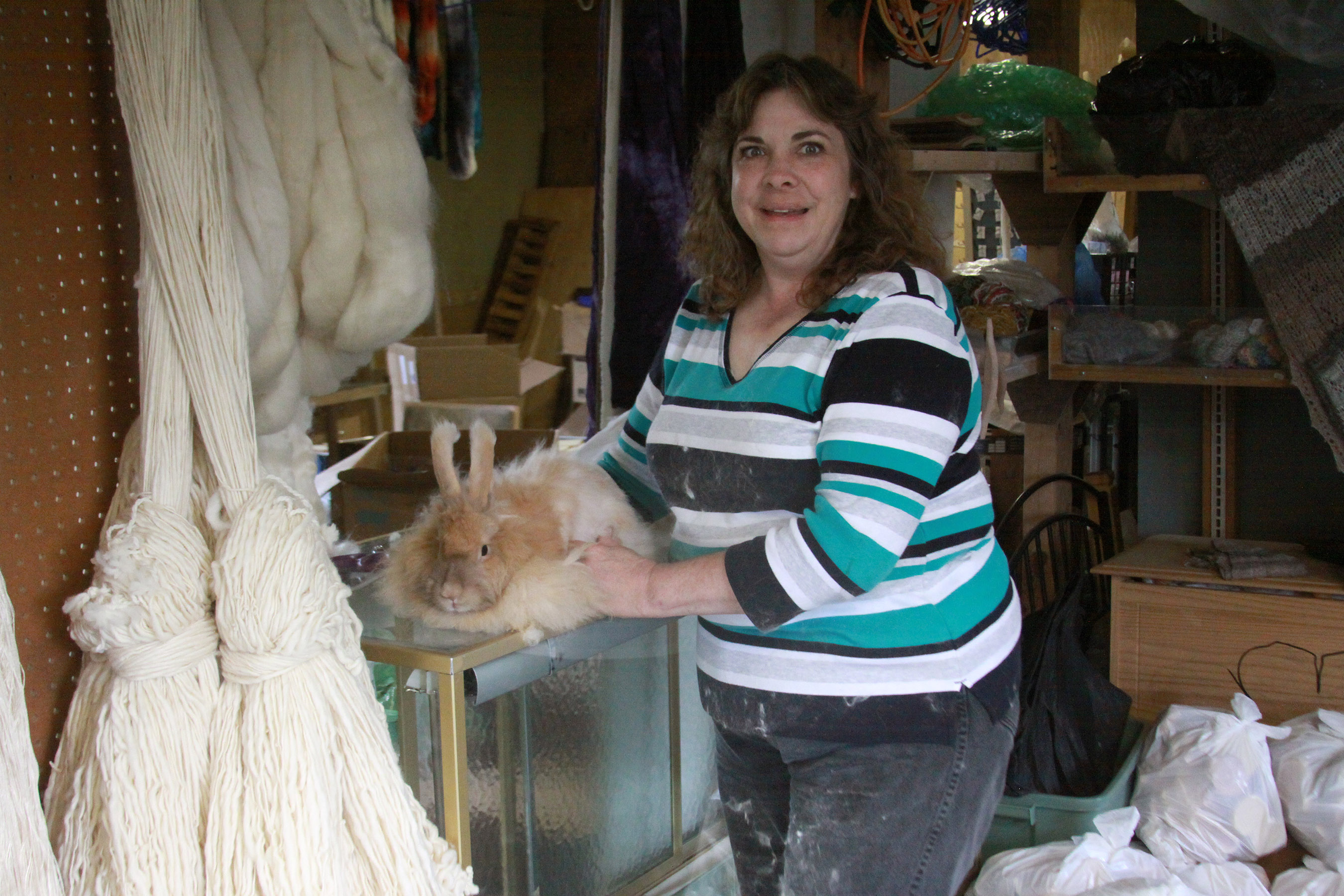
Bobbi Daniels of The Sawmill Farm grooms one of the rabbits she raises for yarn.
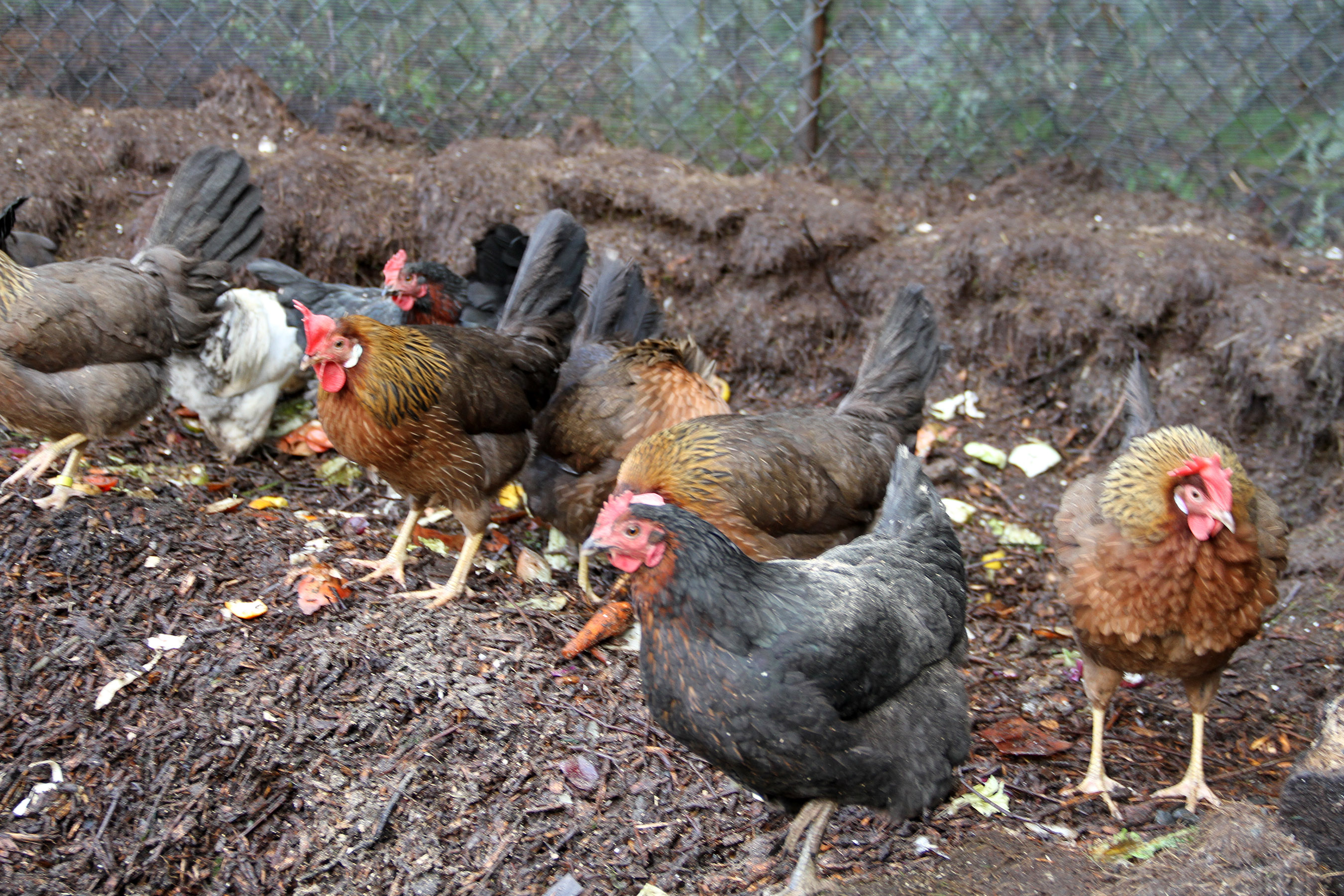
For more than a year, the Sitka Local Foods Network has offered a variety of free garden education classes. Now we’re adding livestock classes as Bobbi Daniels of The Sawmill Farm has offered to teach Raising Chickens 101 and Raising Rabbits 101.
The Raising Chickens 101 class is from 6:30-8 p.m. on Wednesday, March 25, at the Sitka Unitarian Universalist Fellowship Hall (408 Marine Street, parking on Spruce Street). The Raising Rabbits 101 class is 6:30-8 p.m. on Wednesday, April 8, at the Sitka Unitarian Universalist Fellowship Hall. Click here to check out the radio PSA.
“I am planning on tailoring the classes to who shows up (new chicken owners vs. those considering chickens) so it will go according to who is there and what they need to know, taking questions and sharing resources,” Bobbi said. “If people have something specific they want me to cover, they can message me on Facebook or call me 738-4481.”
The chicken class will cover a range of topics, including what breeds are best for eggs or meat, basic chicken coop info, how to prevent predators from getting into your flock, what types of feed you need, the advantages of chicken coop co-ops, the best time to get your chicks, etc. The rabbit class will cover topics such as what breeds are best for meat or yarn, rabbit feed types, how long it takes rabbits to reach maturity, how much cage space you need, etc.
These classes are free and open to all Sitka residents wanting to learn about chickens and rabbits. For more information about Sitka Local Foods Network education classes, contact Jennifer Carter at 747-0520 or 1-850-491-2666 (cell), or Michelle Putz at 747-2708. These are two of the many free classes being offered this year by the Sitka Local Foods Network education committee. Click here to get a full list of our upcoming spring classes.
Suzan Brawnlyn, the Chef at the Market, holds a sample cup of honey miso-glazed black cod with broccoli and bok choy stir fry during a cooking demonstration on July 21, 2012, at the second Sitka Farmers Market of the season.
The state’s Chef at the Market program is accepting grant applications from Alaska chefs interested in providing demonstrations at local farmers markets between May and September this year.
The Chef at the Market program began in 2011 to promote fresh Alaska Grown specialty crops and teach Alaskans new ways to prepare them. The program has also provided a new opportunity for chefs to develop relationships with the local food vendors who supply restaurants and with Alaskans interested in cooking Alaska Grown at home.
In the summer of 2013, six Alaska chefs performed a total of 27 demonstrations at nine local farmers markets and special events. In 2014 there were 39 demonstrations at nine local farmers markets around the state. In addition to hosting demonstrations at the local farmers markets, chefs prepare recipes and other information about how to use the local produce they highlighted each week.
The Sitka Farmers Market hasn’t had a Chef at the Market since 2012, when Suzan Brawnlyn hosted four Chef at the Market presentations. We weren’t able to host a chef in 2013 because the kitchen was closed due to construction at the Alaska Native Brotherhood Founders Hall, and no Sitka chefs applied in 2014. The ANB Hall construction is finished and the kitchen is open again, so Sitka chefs are encouraged to apply for 2015.
The Chef at the Market program is part of the federal Specialty Crop Block Grant administered by the Alaska Division of Agriculture, so it will have 2015 funding (despite budget cuts to other state-run programs). To apply for a 2015 summer program grant, go to http://dnr.alaska.gov/ag/ag_grants.htm or download the application at http://dnr.alaska.gov/ag/Grants/2015CATMRFP.pdf. Grant applications are due on Tuesday, March 31.
To find out more information about the Chef at the Market grants and demonstrations, contact Jacquelyn Schade at jacquelyn.schade@alaska.gov or 907-761-3858.
The Sitka Local Foods Network has selected the 2015 participants for its garden mentoring program, and plans are being made for six classes each this summer at the homes of our four new participants and two returning families.
This is the second year of the program, which launched last year with two participants — the families of Tami O’Neill and Anna Bradley. This year our program expands with four new families (Josephine Dasalla, A.J. Bastian, Rebecca Kubacki, and Breezy), and our two 2014 families are back for a second year. Michelle Putz has been contracted to coordinate the program and design lesson plans, after the Sitka Local Foods Network received a community development grant from First Bank.
The Sitka Local Foods Network garden mentoring program is designed for first-time gardeners, and the first year of the program involves participants learning how to grow four simple crops that grow well in Sitka (lettuce, kale, rhubarb and potatoes). The participating families learn how to find the best spot on their land (for sun and drainage), how to build raised garden beds, how to amend the soil, how to plant, how to maintain their garden, and how to harvest their crops.
The two returning families will learn how to grow more difficult crops, such as carrots and onions, plus they’ll have refreshers on their first-year crops. The goal of the program is to teach people low-cost ways to grow healthy food in Sitka. When selecting our families, we wanted to make sure there were multiple generations involved, especially kids. The classes, when announced starting in mid-April, will be open to the public. Several experienced gardeners volunteer as mentors for the selected families.








 Sitka Local Foods Network
You must be logged in to post a comment.