• Sitka Seafood Festival steering committee to meet on Thursday, May 6

The next meeting of the Sitka Seafood Festival steering committee takes place at 7:30 p.m. on Thursday, May 6, at Harrigan Centennial Hall (Editor’s note: The meeting has been changed to 7 p.m. on Thursday, May 6, at the Sitka Fire Station). Six smaller committees are supposed to hold meetings before the steering committee meets again.

During the April 17 steering committee meeting, the discussion included an update on the group’s fundraising raffle that takes place at noon on Sunday, May 9, at the Bayview Restaurant. Raffle tickets were distributed to committee members, who will sell them for $5 each. The tickets also will be available at several locations that will be announced later this week. The prizes include a Specialized Hardrock Sport Disc mountain bike worth $550 from Yellow Jersey Cycle Shop, $125 worth of king salmon from F/V Cloud Nine (Betsy and Moe Johnson) and 11 “Taste of Sitka” prizes of restaurant gift certificates with a variety of price values that will be awarded individually. For more raffle info or to purchase tickets, contact Linda Olson at 747-6985.

The steering committee also discussed the need to visit more businesses for donations or sponsorships. Committee members are trying to get the donations/sponsorships confirmed by May 9 so the businesses can be acknowledged in Sitka Seafood Festival promotions leading up to the festival. Donations will be accepted after the May 9 deadline, but they may not receive as much recognition. There are several tiers based on the level of the donation/sponsorship. Donation/sponsorship checks need to be written to the “Sitka Conservation Society” with a memo of “Sitka Seafood Festival” or “SCS/SSF” (the Sitka Conservation Society is letting the festival share the society’s 501(c)(3) non-profit permit until the festival can get its own permit).

Committee members also discussed the tentative schedule, which includes on Friday, Aug. 6, a formal opening banquet dinner with a guest chef and live music following the dinner. On Saturday, Aug. 7, the tentative schedule includes a parade, vendors (including food and a beer garden), educational booths, entertainment booths, a stage with live acts (bands, cooking demonstrations, NANDA, etc.), a variety of contests for the kids, a “Taste of Sitka” with local chefs, and the headliner band and dance at night.

So far, the committee has booked “NANDA: Acrobaticalist Ninja Action Heroes,” a four-man juggling, acrobatic, martial arts and comedy troupe (see clip below). The committee hopes to confirm a headline music act and guest chef in the near future.

To learn more about the Sitka Seafood Festival or to volunteer to help on one of the committees, e-mail sitkaseafoodfestival@gmail.com. You also can contact Alicia Peavey at alaska_al33@hotmail.com or 1-928-607-4845. The Sitka Seafood Festival also has a new website under development, and eventually updates will be posted on the site.

Tentative schedule for the 2010 Sitka Seafood Festival (Aug. 6-7)

Sitka Seafood Festival business donation assignments (who asks) (updated)

Advertising Committee and tasks
Beverage Committee and tasks

Culinary Committee and tasks

Education Committee and tasks

Entertainment Committee and tasks

Fundraising Committee and tasks

• Sitka subsistence herring egg harvest in progress

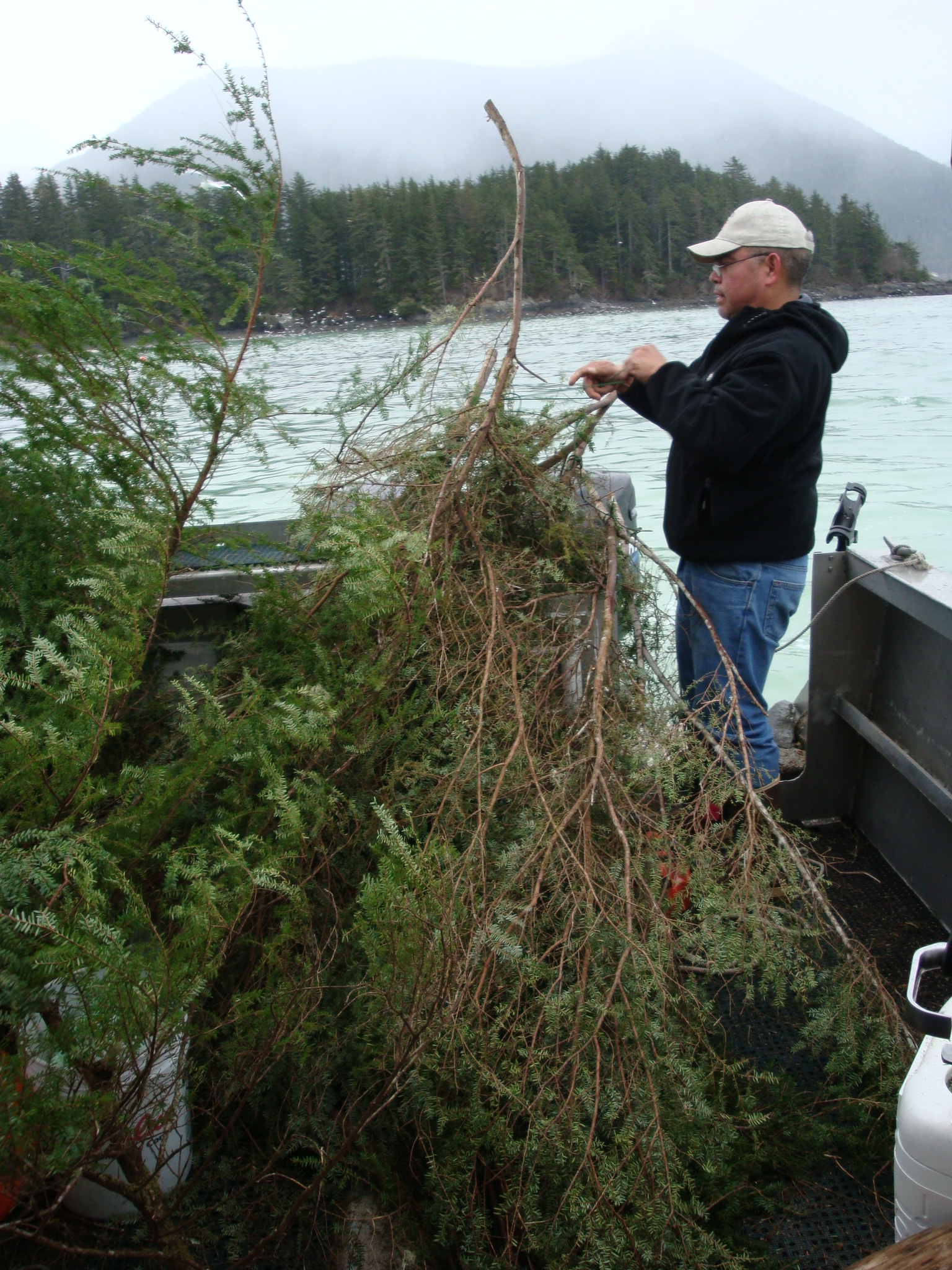
Michael Baines prepares hemlock trees and branches before they are placed in the water to catch herring spawn (Photo taken by Ed Ronco of KCAW-Raven Radio)

Michael Baines prepares hemlock trees and branches before they are placed in the water to catch herring spawn (Photo taken by Ed Ronco of KCAW-Raven Radio)

If it’s snowing in April, it probably means it’s time for the subsistence herring egg harvest in Sitka. This is one of the most important signs of spring in Sitka, especially for the Tlingít, Haida and Tsimshian people who lived in Southeast Alaska long before the first Europeans showed up.

On the KCAW-Raven Radio news Tuesday, KCAW reporter Ed Ronco reported on a trip he took with Sitka Tribe of Alaska Vice Chairman Michael Baines and his sister, Betty Baines, to place hemlock trees and branches into Sitka Sound, near Kasiana Island, to collect the herring spawn. The story link includes an audio postcard, where Michael Baines discusses the herring roe’s importance to the Native culture, and a few photos of the hemlock branches and trees being prepared. The herring eggs will collect on the branches, which will be pulled from the water a few days later, hopefully with a thick mass of roe. (Editor’s note: On Friday there was a follow-up story featuring the fishing vessel Julia Kae, skippered by Steve Demmert, which has been distributing herring eggs to local residents of Sitka and surrounding communities.)

The herring harvest is an amazing time in Sitka, because it seems like every species comes to town for the herring. There are more whales, eagles, sea gulls, sea lions, etc., around town, and even halibut and salmon are looking for meals of herring eggs. Pauline Duncan produced this Tlingít curriculum about herring geared toward younger students for the Alaska Native Knowledge Network. The blog Kiksadi News by Heen Kweix’ (Bob Gamble) tells how subsistence herring eggs are harvested and prepared (scroll down to the second item).

There also is a large commercial harvest of herring just before the subsistence herring roe harvest. The commercial harvest this year had a record guideline harvest of 18,293 tons, and finished just 550 tons short of that goal. The growing commercial harvest has put a lot of pressure on the relatively small subsistence harvest, in 2005 only 72,000 pounds (not tons) were taken out of a target range of 105,000 to 158,000 pounds. Sitka Tribe of Alaska regularly submits proposals to the Alaska Department of Fish and Game (which manages both the commercial and subsistence fisheries) to increase the subsistence harvest, but the proposals have not been passed. The subsistence herring eggs are used not just in Sitka, but all over the state and they are a popular trading subsistence food (for example, a Tlingít in Sitka might swap herring eggs with an Iñupiat for caribou meat from the Kotzebue area, since caribou is an item not found in Southeast Alaska).

• Sitka Seafood Festival steering committee to meet on Saturday, April 10

Sockeye salmon hang in a smoker in preparation for the 2009 ANSWER Camp program

Sockeye salmon hang in a smoker in preparation for the 2009 ANSWER Camp program

The next meeting of the Sitka Seafood Festival steering committee is 11 a.m. on Saturday, April 10, at the Bayview Wine Bar (on the second floor of the Bayview Building on Lincoln Street).

During the April 5 meeting, the steering committee decided to hold the inaugural Sitka Seafood Festival on Friday and Saturday, Aug. 6-7. The tentative plan is to have an opening dinner on Friday night with a guest chef and the possibility of live music. The main events will be on Saturday, with vendors set up all day, contests, a parade, cooking demos, music and educational activities. The headliner music guest will play a concert/dance on Saturday night.

To learn more about the Sitka Seafood Festival or to volunteer to help on one of the committees, e-mail sitkaseafoodfestival@gmail.com. You also can contact Alicia Peavey at alaska_al33@hotmail.com or 1-928-607-4845.

Sitka Seafood Festival committee breakdown and job tasks

Final draft of Sitka Seafood Festival donation letter

Sitka Seafood Festival business donation assignments (who asks)

• Sitka Seafood Festival steering committee meets tonight (April 5)

Grillmaster Rick DeGroot checks salmon fillets barbecuing for a 2007 prostate cancer awareness event in Sitka

Grillmaster Rick DeGroot checks salmon fillets barbecuing for a 2007 prostate cancer awareness event in Sitka

The Sitka Seafood Festival steering committee will meet at 7:30 p.m. tonight (Monday, April 5) at Harrigan Centennial Hall. The meeting times have been moving around in recent weeks as they try to find a time that can get local restaurant people involved.

Tonight’s meeting will finalize a sponsorship letter for fundraising, discuss a raffle fundraiser, discuss work committees and duties, discuss budget for music and possible guest chefs, etc.

At the last meeting on April 1, the group finalized the mission statement, “The Sitka Seafood Festival’s mission is to celebrate wild Alaska seafood.” The steering committee also decided that this year’s inaugural event will focus on culinary experience, entertainment (music) and education.

To learn more about the Sitka Seafood Festival or to volunteer to help on one of the committees, e-mail sitkaseafoodfestival@gmail.com. You also can contact Alicia Peavey at alaska_al33@hotmail.com or 1-928-607-4845.

Sitka Seafood Festival committee breakdown

Sitka Seafood Festival tasks

Rough draft of Sitka Seafood Festival donation letter

Sitka Seafood Festival business donation assignments (who asks)

• As you build your garden, don’t forget to plant a row for the hungry

As you start to plan your garden for this spring and summer, don’t forget to Plant A Row For The Hungry. The Plant A Row For The Hungry program (also known as Plant A Row or PAR) is a national campaign by the Garden Writers Association of America that got its start in Alaska.

In the cold winter of 1994, Anchorage Daily News garden columnist and former Garden Writers Association of America President Jeff Lowenfels was returning to his hotel after a Washington, D.C., event when he was approached by a homeless person who asked for some money to buy food. Lowenfels said Washington, D.C., had signs saying, “Don’t give money to panhandlers,” so he shook his head and kept on walking. But the man’s reply, “I really am homeless and I really am hungry. You can come with me and watch me eat,” stayed with Lowenfels for the rest of his trip.

Jeff Lowenfels

Jeff Lowenfels

The encounter continued to bother Lowenfels, even as he was flying back to Anchorage. During the flight, Lowenfels came up with an idea when he started writing his weekly garden column (the longest continuously running garden column in the country, with no missed weeks since it started on Nov. 13, 1976). He asked his readers to plant one extra row in their gardens to grow food to donate to Bean’s Café, an Anchorage soup kitchen. The idea took off.

When Anchorage hosted the Garden Writers Association of America convention in 1995, Lowenfels took the GWAA members to Bean’s Café to learn about the Plant A Row For Bean’s Café program. The Garden Writers Association of America liked the idea, and it became the national Plant A Row For The Hungry campaign. In 2002, the Garden Writers Association Foundation was created as a national 501(c)(3) nonprofit to manage the Plant A Row For The Hungry program.

“I am not surprised by the growth of PAR,” Lowenfels wrote in an e-mail to the Sitka Local Foods Network. “It is now in all 50 states and across Canada and there are thousands of variations of the original program — from prison gardens for the hungry to botanical gardens donating their produce from public display gardens. This is because gardeners always share information and extra food, so the idea was a natural.”

It took five years for the program to reach its first million pounds of donated food, but the second million only took two years and the next eight years saw a million pounds of donated food (or more) each year. Since 1995, more than 14 million pounds of food have been donated. Not only that, the program is getting ready to expand overseas to Australia, England and other countries with avid gardeners.

“We have supplied something in the vicinity of enough food for 50 million meals,” Lowenfels wrote in his e-mail. “Gardeners can solve this hunger problem without the government. And we don’t need a tea party to do it! Or chemicals, I might add, as author of a book on organic gardening (Teaming With Microbes, written with Wayne Lewis)!”

According to the U.S. Department of Agriculture, one out of every eight U.S. households experiences hunger or the risk of hunger. Many people skip meals or eat too little, sometimes going an entire day or more without food. About 33 million Americans, including 13 million children, have substandard diets or must resort to seeking emergency food because they can’t always afford to buy the food they need. In recent years the demand for hunger assistance has increased 70 percent, and research shows that hundreds of children and adults are turned away from food banks each year because of lack of resources.

While many people credit Lowenfels for creating the Plant A Row For The Hungry program, Lowenfels says the real heroes are the gardeners growing the extra food and donating it to local soup kitchens, senior programs, schools, homeless shelters and neighbors. You can hear him pass along the credit to all gardeners at the end of this interview last year with an Oklahoma television station (video also embedded below).

“One row. That’s all it takes. No rules other than the food goes to the hungry. You pick the drop-off spot or just give it to a needy friend or neighbor. Nothing slips between the lip and the cup, I say,” Lowenfels wrote in his e-mail.

For people wanting to Plant A Row For The Hungry in Sitka, there are several places that would love to help distribute some fresh locally grown veggies or berries to those who are less fortunate, such as the Salvation Army (note, the current officers are Capts. Kevin and Tina Bottjen), Sitkans Against Family Violence (SAFV), local churches, Sitka Tribe of Alaska and other organizations. The food the Sitka Local Foods Network grows at St. Peter’s Fellowship Farm communal garden goes to the Sitka Farmers Market, where people who are in the WIC (Women, Infants, Children) supplemental food program can use special farmers market vouchers to buy fresh vegetables.

The Sitka Local Foods Network also takes donations of local produce to sell at the Sitka Farmers Markets, and all proceeds from the Sitka Farmers Markets are used to help pay for Sitka Local Foods Network projects geared toward helping more people in Sitka grow and harvest local food. For more information, contact Sitka Farmers Market coordinators Linda Wilson (lawilson87@hotmail.com) or Kerry MacLane (maclanekerry@yahoo.com).

2010 Plant A Row For The Hungry marketing brochure

2009 Start a local Plant A Row For The Hungry campaign brochure

• Sitka Local Foods Network featured on APRN’s “Talk of Alaska” statewide call-in show about local food production

Sitka Local Foods Network President Kerry MacLane was one of the featured guests for the Alaska Public Radio Network’s “Talk of Alaska” statewide call-in show hosted by Steve Heimel on Tuesday, March 30.

The topic of Tuesday’s hour-long show was “Local Food Production.” If you weren’t able to hear the show, you can listen to it by clicking this link and then looking for the arrow above the comments box. In addition to Kerry, the other featured guest was Tim Meyers of Meyers Farm in Bethel. Some of the topics on this show included community supported agriculture (CSA) farms, spring planting, the Sitka Farmers Market, the Sitka Seafood Festival, the new Alaska Food Policy Council, sac roe herring, composting, soil conditions and other issues.

Some of the clips from Tuesday’s Talk of Alaska show were reorganized into a news feature story that ran on Wednesday’s “Alaska News Nightly” half-hour newscast on APRN. The news feature used some of Kerry MacLane’s comments about the Sitka Local Foods Network, but there were several minor errors in the story about what’s going on in Sitka.

By the way, this isn’t the first time local food has been featured on Talk of Alaska this year. In October 2009, Talk of Alaska did a show “Our Food Supply” as a preview for the Bioneers of Alaska annual conference.

• Alaska Food Policy Council created to examine how our food system relates to our economy, security and health

In response to concerns by Alaskans about food security, health and job creation, the Alaska Food Policy Council is being formed and it will host a meeting on May 18-19 at a location TBA in Anchorage.

“This will be a chance for Alaskans to come together and develop a plan to produce more food for our communities,” said Danny Consenstein, the Executive Director of the USDA Alaska Farm Service Agency in Palmer.

The Alaska Food Policy Council wants your help in examining how our food system relates to our economy, our security and our health. The meeting will provide an opportunity for the wide variety of food system stakeholders to connect, so they can begin to develop comprehensive solutions toward building a stronger Alaska food system.

The first face-to-face meeting takes place from noon to 5 p.m. on Tuesday, May 18, and from 8 a.m. to noon on Wednesday, May 19, at a location TBA in Anchorage. Mark Winne of the Community Food Security Coalition will facilitate the meeting. The goal will be to learn about food policy councils (which exist in many states and local communities), consult with experts to establish the lay of the land in Alaska, and to begin to set the direction for the Alaska Food Policy Council to take. Sitka Local Foods Network President Kerry MacLane has been asked to represent our group on this council, and he said he plans to attend the May meeting.

Seating is limited for this meeting, so please contact Public Health Specialist Diane Peck, MPH, RD, with the Alaska Department of Health and Social Services by May 1 to RSVP or request more information. Diane can be reached at 269-8447 (Anchorage) or diane.peck@alaska.gov. The Alaska Center for the Environment’s local food project page has more information about the creation of the Alaska Food Policy Council.

Alaska Food Policy Council meeting flier for May 18-19 in Anchorage

• Sitka Local Foods Network featured in magazine article

The Sitka Local Foods Network is mentioned in the article, “The Search for Food Sustainability in Alaska,” in the March/April 2010 issue of Countryside & Small Stock Journal, a magazine of modern homesteading.

The article is written by Cathy Lieser, who recently moved to Baranof Island after several years living on a homestead in the Alaska Range. She mentions the work being done by the Sitka Local Foods Network to promote local food security and local gardens. She also mentions the movie, “Eating Alaska,” by Sitka filmmaker Ellen Frankenstein.

This article is not one of the articles posted on the Countryside site, but the editors did give us permission to post the article as a PDF document. It is posted below.

The Search for Food Sustainability in Alaska

• Sitka Global Warming Group, Sitka Local Foods Network offer Sitka garden-matching program

Do you have a planting bed that you don’t have the time or energy to cultivate? Do you wish you could grow some vegetables, but have no place to put them?

Sitka Global Warming Group (SGWG), in conjunction with the Sitka Local Foods Network, is offering a garden-matching program to help people who have garden space get matched up with people who want to plant and tend a garden. This is an effort to increase the amount of food grown and eaten locally. SGWG asks Sitka residents who have garden space to share or residents who need a garden space to contact the group at info@sitkaglobalwarming.org. Provide your name, email address, phone number, size of the spot available or wanted, and the location of either the spot that is available or the address of the person who wants the spot.

SGWG will collect this data over the next month and then work to match garden spots with a nearby person who would like to plant and tend a garden. SGWG also will be collecting names and garden locations at the “Let’s Grow Sitka” garden show event taking place from noon until 3 p.m. on Sunday, March 14, at the Alaska Native Brotherhood Hall on Katlian Street.

Michelle Putz of SGWG said the group is not setting any expectations of either the people who offer garden space or who want a garden space. Sharing of produce will be encouraged, but won’t be an expectation. SGWG also does not know how many participants to expect.

“This is the first year that we will do this,” Michelle said. “We’ve seen plenty of people who want to grow their own food but don’t have space to do it, and we have seen a lot of planting beds and garden spots that go unused during the summer because people are too busy or lack knowledge or experience in growing a garden. This is a great way to match those unused gardens with someone who will make them productive and increase the amount of vegetables being grown in Sitka.”

“Growing food locally has many benefits,” Michelle added. “For our group, the benefit is reducing the miles that food is shipped [thus reducing fuel use and carbon dioxide emissions]. But growing food locally also makes the food cheaper and improves the quality and healthfulness of the vegetables, since they are fresher. Growing food locally also improves our ‘food security,’ making a food shortage less likely in times of high fuel prices or bad weather. And local food tastes really good.”

• Food security in Alaska a big issue in recent local foods news stories

Last week, the Anchorage Daily News’ Alaska Newsreader blog reported on a story from the Huffington Post’s The Daily Beast blog that ranked Alaska second in failing to properly feed its people. The story used data from a new USDA survey on household food security in 2008, where Alaska was ranked in the middle of the pack, but it re-ranked the states based on the household food security rankings combined with statewide income and access to programs (including bureaucratic issues) that feed the hungry. By the way, Colorado had the dubious No. 1 ranking. The Juneau Empire ran an editorial from the Washington Post about the USDA survey that compared food insecurity vs. hunger.

The University of Alaska Fairbanks School of Natural Resources and Agricultural Science blog reported on a food security meeting in Fairbanks earlier this month hosted by the Sustainable Community Action Network for Fairbanks (SCANFairbanks, site hasn’t been updated in more than a year). The UAF SNRAS blog article mentioned food security projects from around the state, including work being done by the Sitka Local Foods Network. The Fairbanks Community Cooperative Market blog also had an article about the meeting.

The food security issue has been around for awhile. Earlier this year, the Alaska Food Coalition reported on Alaska’s Hungriest Communities. More than a year ago, back when Sarah Palin still was governor, Kim Sollien of the Alaska Trust Food Network (and Chickaloon Tribe) wrote an open letter to then-Gov. Palin detailing Alaska’s food security problems. While the letter is more than a year old, many of the issues still exist. Last year, the Christian Science Monitor ran an article about Alaska’s food challenges and how new farmers are coming online.

In other local foods news this week, the Tundra Drums reported that a teacher from the Kuskokwim River village of Quinhagak is receiving a $10,000 grant from former talk show host Jenny Jones’ foundation to build a community greenhouse.

Laine Welch’s Alaska Fisheries column this week discussed how more halibut this year was consumed in homes instead of restaurants.

The Fairbanks Daily News-Miner reported on a problem moose hunters in the Interior have been having with Tanana Valley Meats being overloaded so it’s taking too long to process the meat, processed meat returns have been light and some meat has been rancid.

Finally, the Alaska Dispatch reported on a KTVA-TV story about Permafrost Alaska Vodka, which is made by Glacier Creek Distillery and uses potatoes grown in the Mat-Su valleys, earning a top ranking from the Beverage Tasting Institute of Chicago.