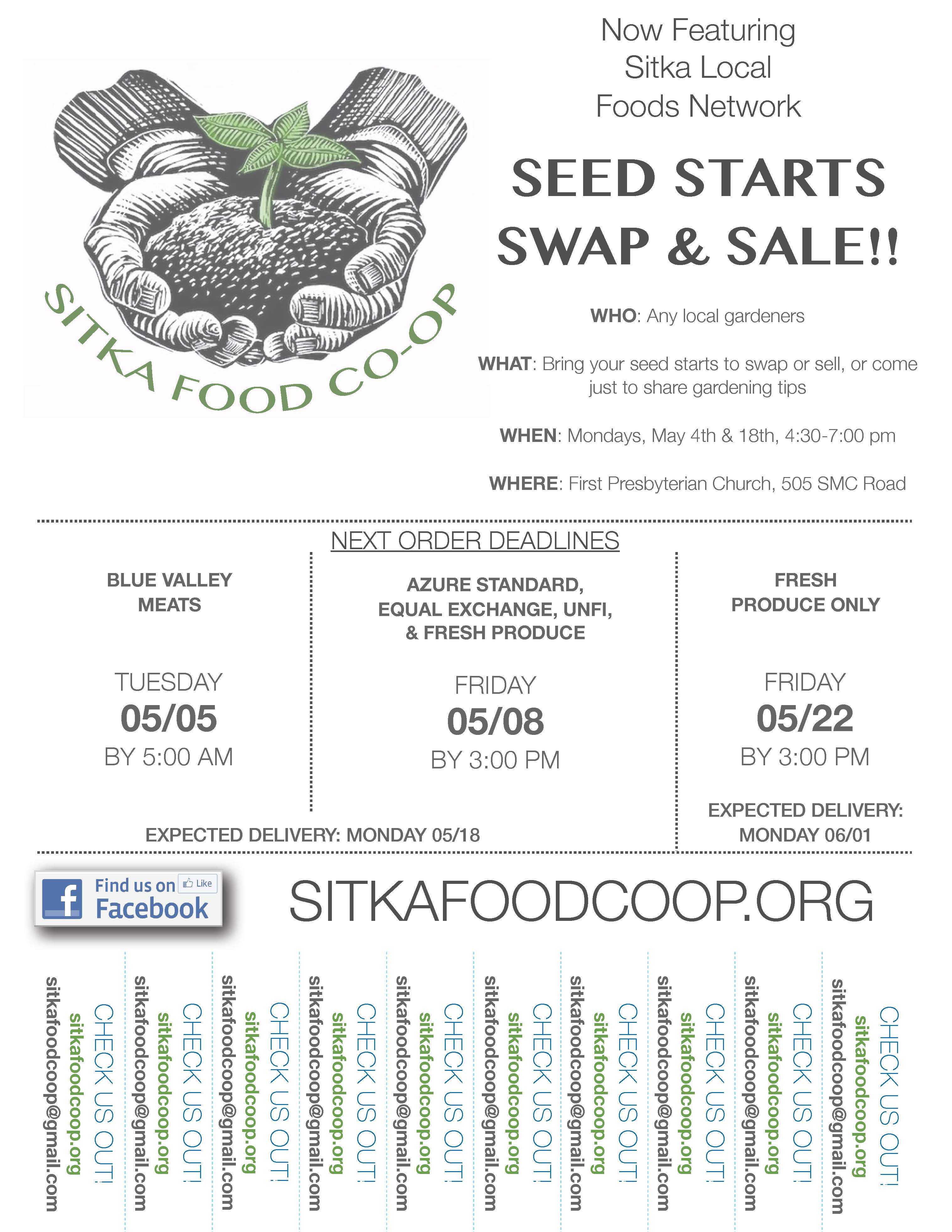
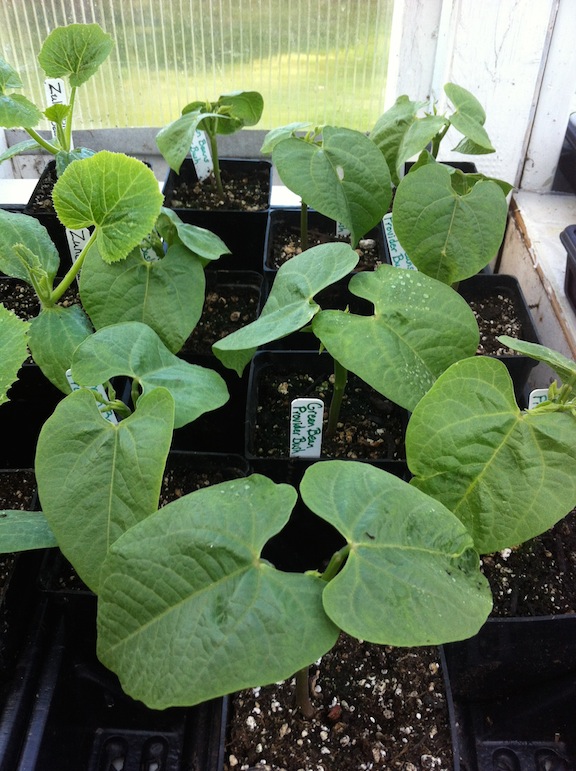
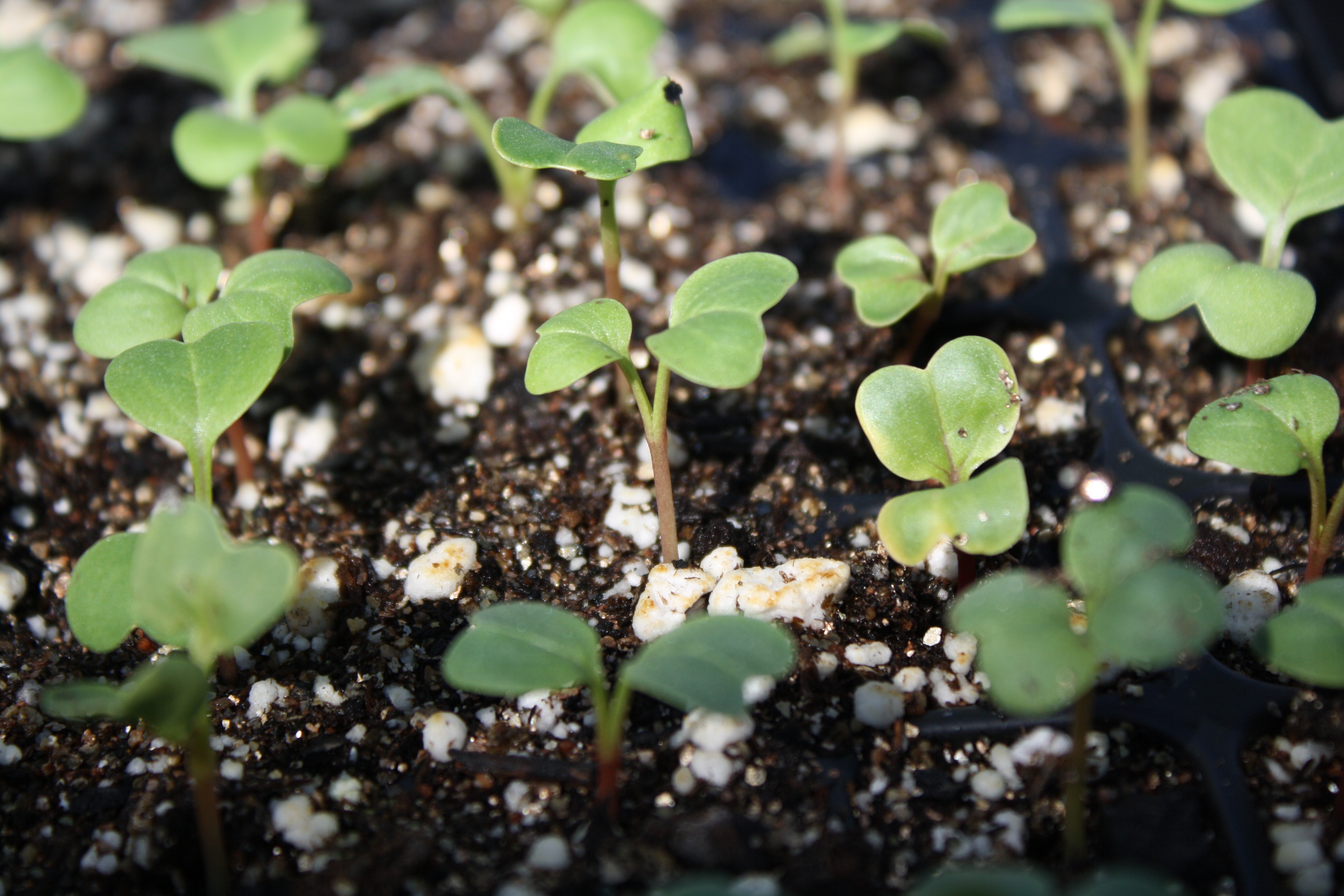
The Sitka Local Foods Network and Sitka Food Co-op are teaming up to make garden starts available for Sitka food gardeners.
Plant starts from Finn Island Farm and other Sitka gardeners will be available for sale or swap on the next two Sitka Food Co-op delivery days, from 4:30-7 p.m. on Monday, May 4 and May 18, at the Sitka First Presbyterian Church, 505 Sawmill Creek Road. (NOTE: Due to a late-arriving barge, the May 4 pick-up day has been postponed until May 5.)
Finn Island Farm will be bringing the following starts — red Romaine lettuce, Tuscan kale, snap peas, sweet bell pepper, basil, Waltham broccoli, dark green zucchini, English cucumbers, pickling cucumbers, dark red and bulls blood beets, tomatoes (a large variety), and more.
The sale of these plant starts helps benefit the Sitka Local Foods Network, and we thank the Sitka Food Co-op for the opportunity to sell them on their delivery pick-up days. The plant starts are from Sitka gardeners and are of plants that do well in Sitka’s climate.
For more information, contact Keith Nyitray of the Sitka Food Co-op at sitkafoodcoop@gmail.com or go to http://sitkafoodcoop.org/
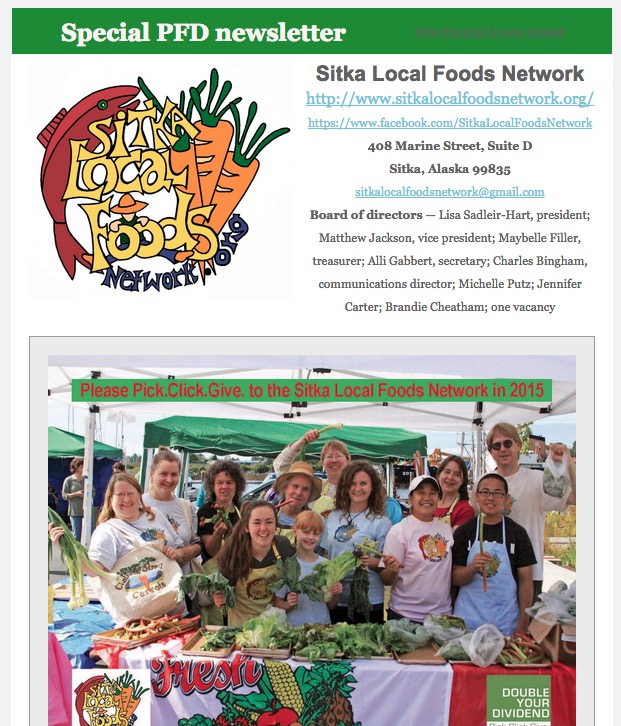
The Sitka Local Foods Network just sent out the May 2015 edition of its newly launched monthly newsletter. Feel free to click this link to get a copy.
This edition of the newsletter has brief stories about how Sitka was Alaska’s original garden city back in the 19th and early 20th Centuries, an update on upcoming Sitka Local Foods Network education programs, an update on the Sitka Farmers Market’s new manager, and a reminder about the Plant a Row for the Hungry program. Each story has links to our website for more information.
You can sign up for future editions of our newsletter by clicking on the registration form image in the right column of our website and filling in the information. If you received a copy but didn’t want one, there is a link at the bottom of the newsletter so you can unsubscribe. Our intention is to get the word out about upcoming events and not to spam people. We will not share our email list with others to protect your privacy.
Alaskans will celebrate Alaska Agriculture Day on Tuesday, May 5. On this day, Alaskans are encouraged to support local agriculture by seeking out and purchasing products produced in Alaska and educating youth about the vital role that agriculture plays in our economy.
Here are a few ideas from the Division of Agriculture on how to celebrate Alaska Agriculture Day:
Join the 34,278 people who “like” the Alaska Grown Facebook page at https://www.facebook.com/dnr.alaskagrown and learn about the exciting things Alaskans are producing around the state.
Contact your local agriculture groups/chapters (such as FFA, Farm Bureau, Agriculture in the Classroom etc.) to see if they are hosting an event in your area.
Sign up for a Community Supported Agriculture (CSA) program at a local farm.
Buy and incorporate Alaska Grown products into your meals.
If you are a farmer, consider asking a local school if you can visit a classroom to educate children about your operation and Alaska agriculture.
In Sitka, you can celebrate Alaska Agriculture Day by starting a food garden (even a couple of containers on your deck can provide you with potatoes, carrots or greens). Teachers are encouraged to offer a lesson plan or two about the importance of agriculture in Alaska and in Sitka (also, click here to listen to a Sitka History Minute feature about the potato in Sitka from KCAW-Raven Radio).
A group of kids harvests garlic during an Aug. 12, 2011, work party at St. Peter’s Fellowship Farm.
Are you interested in meeting other Sitka gardeners and learning about how to grow food in Sitka’s rainy climate? Then join us for an Earth Week garden party from 2-4 p.m. on Saturday, April 25, at St. Peter’s Fellowship Farm.
St. Peter’s Fellowship Farm is located behind St. Peter’s By The Sea Episcopal Church on Katlian Street (the brown church with the steeple above Crescent Harbor). It is a communal garden that grows food to be sold at the Sitka Farmers Markets, at a table when Chelan Produce is in town, and used for various school lunch and hunger programs around town. This year’s Sitka Farmers Markets are from 10 a.m. to 1 p.m. on Saturdays, July 4, July 18, Aug. 1, Aug. 15, Aug. 29, and Sept. 12, at the Alaska Native Brotherhood Founders Hall (235 Katlian St.).
“We will be putting starts in the ground, weeding and prepping beds for planting,” St. Peter’s Fellowship Farm lead gardener Laura Schmidt said.
The garden work parties are kid-friendly, so feel free to bring the munchkins to help.
To learn more, call St. Peter’s Fellowship Farm lead gardener Laura Schmidt at 738-7009 or 623-7003, or contact Sitka Local Foods Network board president Lisa Sadleir-Hart at 747-5985 or sitkalocalfoodsnetwork@gmail.com.
The Sitka Local Foods Network will host a meeting for prospective and past vendors of the Sitka Farmers Market from 5:45-7:45 p.m. on Tuesday, April 7, at Harrigan Centennial Hall.
This is the eighth year of operation for the Sitka Farmers Market, which features six markets from 10 a.m. to 1 p.m. every other Saturday from July through September at the Alaska Native Brotherhood Founders Hall (this year’s dates are July 4, 18, August 1, 15, 29, and September 12). The Sitka Farmers Market was a community health initiative from the 2008 Sitka Health Summit.
The farmers markets feature booths from local farmers/gardeners, local fishermen, local bakers, and local artisans and craftspeople. Our emphasis is on local products from Sitka and Southeast Alaska. The farmers markets also are great Sitka gathering places.
The Sitka Local Foods Network just sent out the April 2015 edition of its newly launched monthly newsletter. Feel free to click this link to get a copy.
This edition of the newsletter has brief stories about how to build a simple raised garden bed, the Plant a Row for the Hungry program, our open manager and assistant manager positions for the Sitka Farmers Market, some upcoming garden mentor program and other free garden classes, and the 2015 Pick.Click.Give. fundraising campaign. Each story has links to our website for more information.
You can sign up for future editions of our newsletter by clicking on the registration form image in the right column of our website and filling in the information. If you received a copy but didn’t want one, there is a link at the bottom of the newsletter so you can unsubscribe. Our intention is to get the word out about upcoming events and not to spam people. We will not share our email list with others to protect your privacy.
(EDITOR’S NOTE: The following article first appeared on this site in April 2010. It is repeated because much of the information remains current and newsworthy.)
In the cold winter of 1994, Anchorage Daily News (now called the Alaska Dispatch News) garden columnist and former Garden Writers Association of America President Jeff Lowenfels was returning to his hotel after a Washington, D.C., event when he was approached by a homeless person who asked for some money to buy food. Lowenfels said Washington, D.C., had signs saying, “Don’t give money to panhandlers,” so he shook his head and kept on walking. But the man’s reply, “I really am homeless and I really am hungry. You can come with me and watch me eat,” stayed with Lowenfels for the rest of his trip.
Jeff Lowenfels
The encounter continued to bother Lowenfels, even as he was flying back to Anchorage. During the flight, Lowenfels came up with an idea when he started writing his weekly garden column (the longest continuously running garden column in the country, with no missed weeks since it started on Nov. 13, 1976). He asked his readers to plant one extra row in their gardens to grow food to donate to Bean’s Café, an Anchorage soup kitchen. The idea took off.
When Anchorage hosted the Garden Writers Association of America convention in 1995, Lowenfels took the GWAA members to Bean’s Café to learn about the Plant A Row For Bean’s Café program. The Garden Writers Association of America liked the idea, and it became the national Plant A Row For The Hungry campaign (also known as Plant A Row or PAR). In 2002, the Garden Writers Association Foundation was created as a national 501(c)(3) nonprofit to manage the Plant A Row For The Hungry program.
“I am not surprised by the growth of PAR,” Lowenfels wrote in an e-mail to the Sitka Local Foods Network. “It is now in all 50 states and across Canada and there are thousands of variations of the original program — from prison gardens for the hungry to botanical gardens donating their produce from public display gardens. This is because gardeners always share information and extra food, so the idea was a natural.”
It took five years for the program to reach its first million pounds of donated food, but the second million only took two years and the next eight years saw a million pounds of donated food (or more) each year. Since 1995, more than 14 million pounds of food have been donated. Not only that, the program is getting ready to expand overseas to Australia, England and other countries with avid gardeners.
“We have supplied something in the vicinity of enough food for 50 million meals,” Lowenfels wrote in his e-mail. “Gardeners can solve this hunger problem without the government. And we don’t need a tea party to do it! Or chemicals, I might add, as author of a book on organic gardening (Teaming With Microbes, written with Wayne Lewis)!” (Lowenfels recently released a second book, Teaming With Nutrients, which is a follow-up to his first book).
According to the U.S. Department of Agriculture, one out of every eight U.S. households experiences hunger or the risk of hunger. Many people skip meals or eat too little, sometimes going an entire day or more without food. About 33 million Americans, including 13 million children, have substandard diets or must resort to seeking emergency food because they can’t always afford to buy the food they need. In recent years the demand for hunger assistance has increased 70 percent, and research shows that hundreds of children and adults are turned away from food banks each year because of lack of resources.
While many people credit Lowenfels for creating the Plant A Row For The Hungry program, Lowenfels says the real heroes are the gardeners growing the extra food and donating it to local soup kitchens, senior programs, schools, homeless shelters and neighbors. You can hear him pass along the credit to all gardeners at the end of this 2009 interview with an Oklahoma television station (video also embedded below).
“One row. That’s all it takes. No rules other than the food goes to the hungry. You pick the drop-off spot or just give it to a needy friend or neighbor. Nothing slips between the lip and the cup, I say,” Lowenfels wrote in his e-mail.
For people wanting to Plant A Row For The Hungry in Sitka, there are several places that would love to help distribute some fresh locally grown veggies or berries to those who are less fortunate, such as the Salvation Army, Sitkans Against Family Violence (SAFV), local churches, Sitka Tribe of Alaska and other organizations. The food the Sitka Local Foods Network grows at St. Peter’s Fellowship Farm communal garden goes to the Sitka Farmers Market, school lunches and other programs.
The Sitka Local Foods Network also takes donations of local produce to sell at the Sitka Farmers Markets, and all proceeds are used to help pay for SLFN projects geared toward helping more people in Sitka grow and harvest local food. For more information, contact SLFN President Lisa Sadleir-Hart or one of the other board members at sitkalocalfoodsnetwork@gmail.com.
Palmer Extension agent Steve Brown will teach the free workshop from 1 to 5 p.m. in Palmer and by videoconference in Kenai, Homer, Nome and Fairbanks. At the request of Sitka residents, on Wednesday, March 25, Sitka was added as an additional site for the videoconference.
The 2014 farm bill authorized $30 million annually for grants to be awarded nationally through the U.S. Department of Agriculture’s Farmers Market and Local Food Promotion Program. The program awards competitive grants to develop new market opportunities for farm and ranch operations serving local and regional markets. According to USDA, farmers market grants will support farmers markets and other producer-to-consumer activities, while the local food promotion grants will support enterprises that aggregate, store, distribute and process local and regional food.
The workshop will be offered at the Matanuska Experiment Farm in Palmer, the Kenai Community Library, Kenai Peninsula College in Homer, the district Extension office in Fairbanks at 724 27th Ave. and the Northwest Campus, B West, in Nome. The Sitka location for the workshop is Room 106 of the University of Alaska Southeast Sitka Campus.
The preferred registration deadline is Friday, March 27, but since Sitka was added as a site so close to the presentation walk-in participants will be allowed at this location. For more information or to register, call the Palmer Extension office at 907-745-3360. Sitka residents should pre-register by contacting Jasmine Shaw at 747-9440 or jdshaw2@alaska.gov.
The Sitka Local Foods Network just sent out a special PFD application edition of its newly launched newsletter. Feel free to click this link to get a copy.
This special edition of the newsletter has just one story in it, a reminder that the Alaska Permanent Fund Dividend application deadline is one week away (March 31). We encourage Alaskans to participate in the 2015 Pick.Click.Give. charitable giving program that’s part of the PFD application, and we appreciate your support of the Sitka Local Foods Network through the program. A regular monthly newsletter will come out on or near April 1.
You can sign up for future editions of our newsletter by clicking on the registration form image in the right column of our website and filling in the information. If you received a copy but didn’t want one, there is a link at the bottom of the newsletter so you can unsubscribe. Our intention is to get the word out about upcoming events and not to spam people. We will not share our email list with others to protect your privacy.
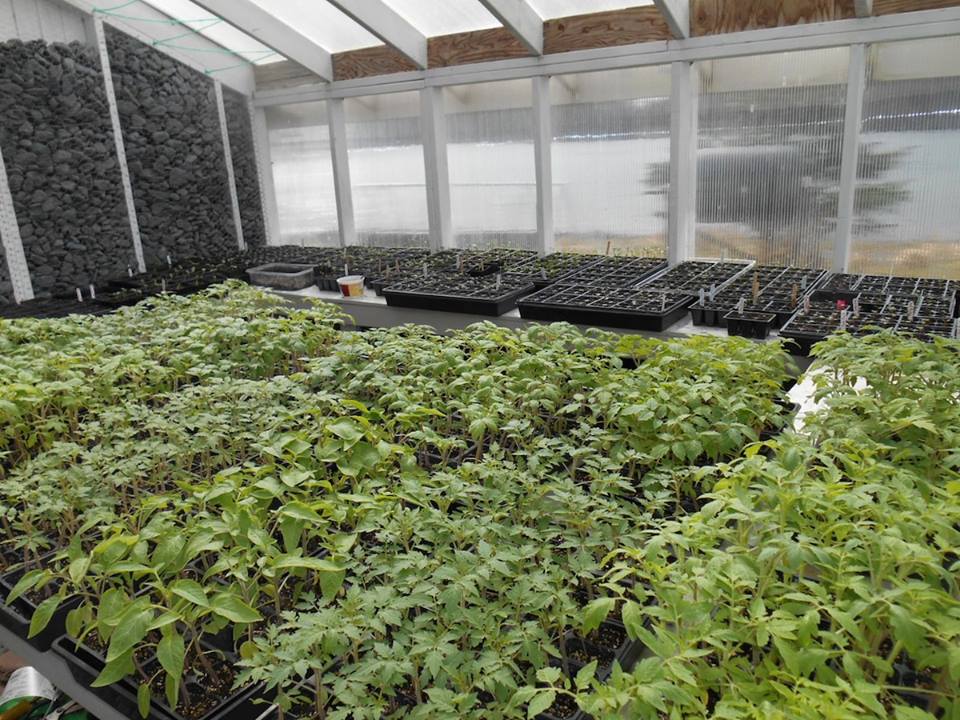
Spring 2014 plant starts in Sitka gardener Keith Nyitray’s Finn Island Farm greenhouse.
It’s the end of March, which means many people in Sitka are already planning their spring vegetable gardens. While it’s still too early to plant most crops outdoors, this is the perfect time to start some seeds indoors to you can transplant them into your garden in May.
The Sitka Local Foods Network is offering two free classes this spring about starting seeds. Both classes will be limited in size, so preregistration is required. Click here to check out the radio PSA.
The first one will be taught by Jennifer Carter, and it takes place from 6:30-8 p.m. on Tuesday, March 31, at Harrigan Centennial Hall. In this class, which is limited to 15 people, participants will learn how to mix seed-starting soil (potting soil usually is too rich for seedlings), and they will plant a few seeds to take home and grow.
The second class will be taught by longtime Sitka gardener Linda Wilson at 2 p.m. at her home. This class will be limited to 8-10 people, and you will receive the address when you call Michelle Putz or Jennifer Carter (see numbers below) to preregister.
Also, the next meeting of the Sitka Local Foods Network education committee is from 6:30-8 p.m. on Wednesday, April 1, at the Sitka Unitarian Universalist Fellowship Hall, 408 Marine Street (parking off Spruce Street). We will be brainstorming ideas for upcoming classes, and we welcome local gardeners who want to teach classes to join our list of educators. Just give us a topic, best date and time, and we can help you find a venue.
For more information about Sitka Local Foods Network education classes, contact Jennifer Carter at 747-0520 or 1-850-491-2666 (cell), or Michelle Putz at 747-2708. These are two of the many free classes being offered this year by the Sitka Local Foods Network education committee. Click here to get a full list of our upcoming spring classes.

 The Sitka Local Foods Network and Sitka Food Co-op are teaming up to make garden starts available for Sitka food gardeners.





 Sitka Local Foods Network
You must be logged in to post a comment.